
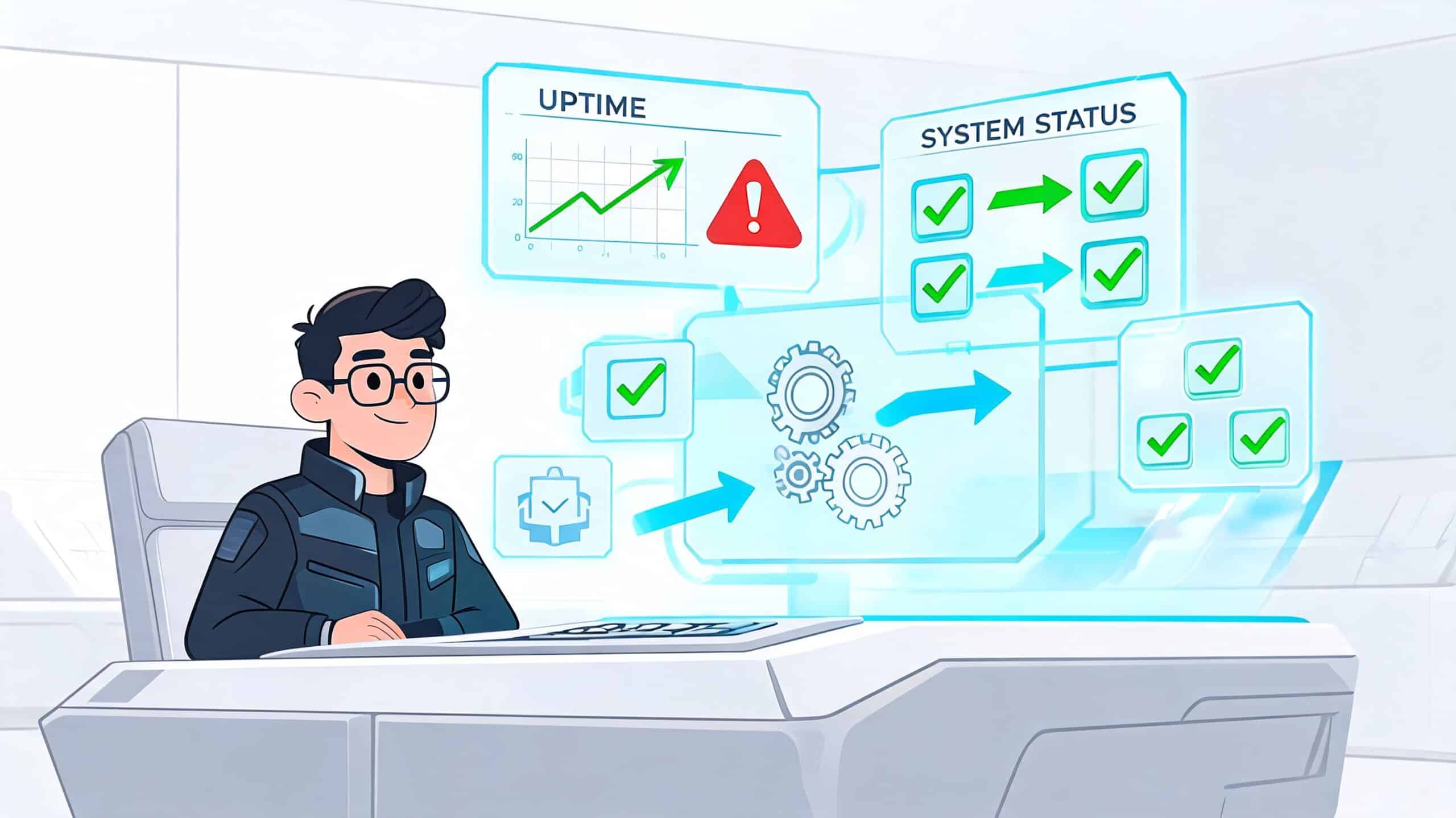

Most incident management pain doesn't start with the outage itself. It starts with the stack around it.
A deploy goes out late on Thursday. A health check starts flapping in one region. Logs are in one tool, traces in another, alerts route through a third, and the person who understands the original Terraform module is on holiday. By the time someone works out whether the problem sits in Kubernetes, the cloud load balancer, the app release, or a secret that rotated badly, the team has already burned hours on coordination instead of recovery.
That’s the point where a lot of engineering leaders realise they haven’t built an incident management system. They’ve built a collection of parts that only sort of behaves like one.
Teams rarely choose this on purpose. It happens gradually. One tool for paging. Another for dashboards. A home-grown deployment script because the CI runner was awkward. A wiki page for runbooks. A chatbot for status updates. Then a few glue services to connect the lot. It feels pragmatic at first. Later, it becomes another product your team has to maintain.
The 3 AM Alert You Don't Have to Dread
The worst alerts aren't always the loudest. They're the ones that make your team hesitate.
If an on-call engineer sees a critical alert at 3 AM and their first thought is, “Where do I even start?”, the problem isn't just operational. It's architectural. The incident management system is failing before the investigation begins.
Multi-cloud environments make this worse. A service might run in AWS, rely on managed data services in GCP, and push analytics workloads into Azure. On paper, that gives flexibility. During an incident, it often gives you three consoles, different alert semantics, and several places where ownership becomes fuzzy.
The result is familiar. Engineers bounce between Slack, dashboards, deployment logs, and cloud consoles trying to answer basic questions. What changed? Who owns this service? Is this customer-facing? Is the alert noisy, or is production broken?
For teams in London and the Thames Valley, the strain is especially visible. One public health IMS review cites expert feedback that “late stand-up can put the response ‘behind the curve’ at the outset”, and the same source includes a claim that 78% of London businesses use multi-cloud setups while 62% report deployment incidents causing more than four hours of downtime weekly due to manual IMS processes in a TechUK 2025 report referenced by the paper at the published review on PubMed Central. Even if you treat those figures as directional, the pattern rings true for software teams: manual coordination breaks down fastest in complex estates.
DIY feels cheaper until the incident arrives
A bespoke stack usually looks efficient in a planning meeting. Each tool solves a narrow problem well. The hidden cost appears when an incident crosses tool boundaries.
Three trade-offs show up repeatedly:
- Local optimisation, global confusion: Your monitoring tool might be excellent at metrics, but it doesn't know what was deployed, who approved it, or whether a rollback is safe.
- Glue code becomes production code: Webhooks, parsers, custom severity mappings, and bot automations all need testing, ownership, and updates.
- Operational knowledge concentrates in a few people: The team ends up depending on the engineer who built the alert router or the staff engineer who remembers why one cluster reports health differently from the others.
A reliable incident process should reduce the need for heroics. If it depends on heroics, it isn't reliable.
That’s why leaders who are tired of losing product time to infrastructure fire-fighting start questioning the entire setup, not just the latest outage. The issue isn't effort. Teams are often trying hard already. The issue is that a hand-assembled stack asks engineers to act as systems integrators during the most stressful moments of the week.
If that sounds familiar, the incident that used to wake you up at 3 am is usually less about bad engineers and more about bad operating conditions.
What Is a Modern Incident Management System
A modern incident management system isn't a ticket queue with an escalation policy bolted on. It's the operating layer that helps a team detect issues, decide what matters, coordinate the right people, restore service safely, and learn something useful afterwards.
That sounds broad because it is broad. In practice, the best systems aren't standalone products. They're capabilities woven into delivery, observability, communication, and change management.
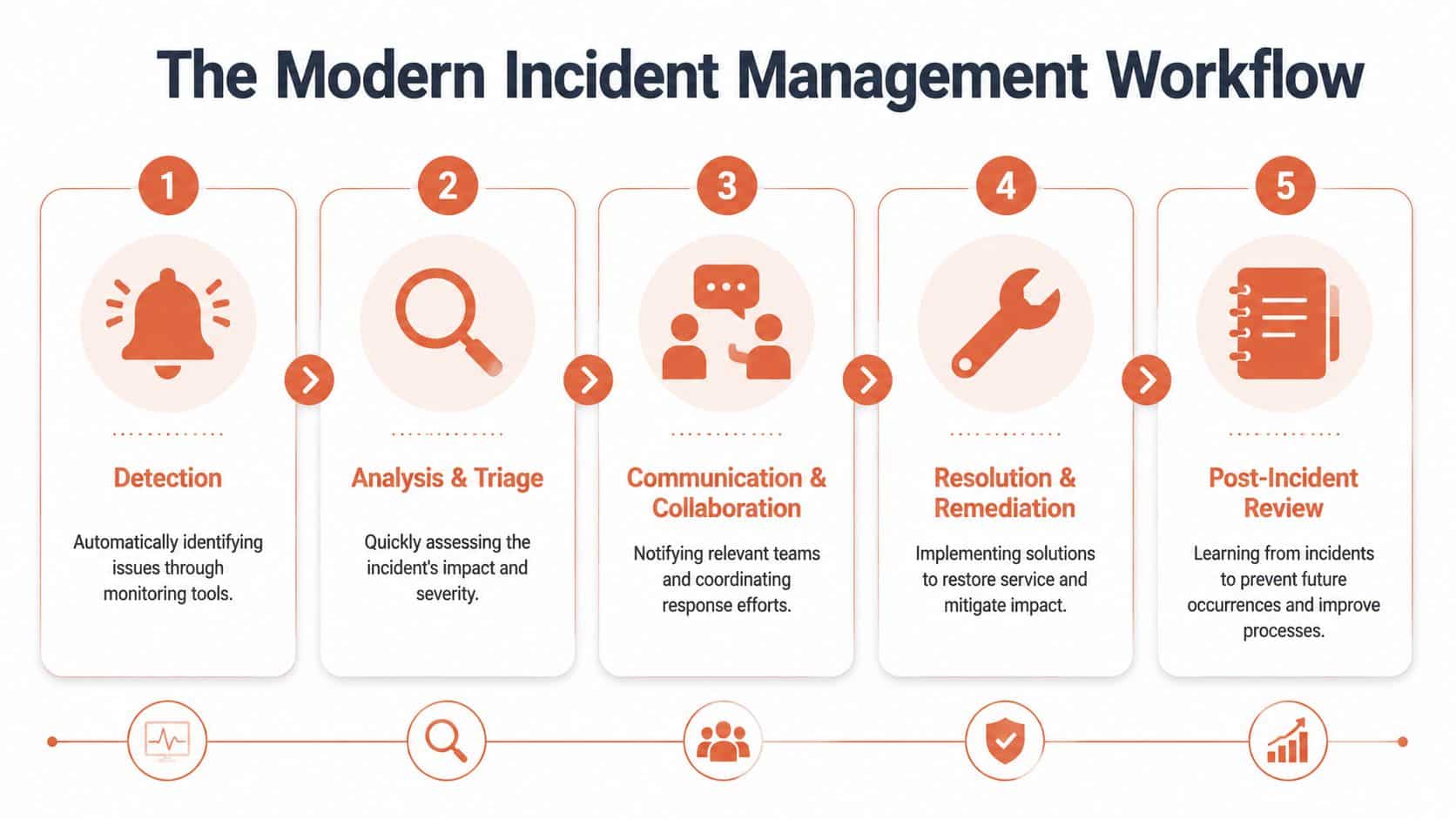
The six phases that matter
Most healthy teams run incidents through a simple lifecycle, even if they use different labels.
Detect
A system notices something is wrong before a customer has to explain it. That could be API latency crossing a threshold, a drop in successful background jobs, or an unusual spike in error logs after a release.Triage
Someone decides whether the issue is real, how severe it is, and what needs attention now. Triage is where weak systems lose time. If engineers have to manually compare dashboards, deployment histories, and cloud events just to classify an incident, they're already behind.Notify
The right people get pulled in quickly. Not everyone. Just the people who can move the incident forward. Old ticket-led processes often fail during this step, as they prioritise formal ownership over speed.Escalate
If the first responders can't solve it, the system should make escalation obvious. That includes technical escalation, but also product, support, security, or leadership communication when the incident has wider impact.Resolve
Service gets restored. Sometimes that means fixing the root problem immediately. Often it means rolling back, disabling a feature flag, draining traffic, or failing over to a healthy path.Postmortem
The incident becomes an input to better engineering. Not a blame session. A source of cleaner runbooks, safer deploys, sharper alerting, and fewer repeated mistakes.
What modern looks like in practice
Traditional ITIL-heavy setups often treat incident management as a control function. Modern software teams need it to act as an execution function.
That changes the design:
| Legacy pattern | Modern pattern |
|---|---|
| Ticket first | Signal first |
| Manual handoffs | Automated routing |
| Tool-by-tool context gathering | Shared operational context |
| Static priority labels | Business-aware triage |
| Separate deploy and incident views | Deployment-aware response |
A SaaS team doesn't benefit from opening a beautifully categorised ticket if nobody can see that the problem started two minutes after a canary release. They need immediate context.
Practical rule: If detection and notification depend on a human noticing three unrelated signals, the system is too brittle.
This is also why integrated observability matters so much. When metrics, logs, recent deploys, and service health sit together, “Detect” and “Notify” stop being slow manual exercises. They become routine.
For leaders looking to compare traditional service desk approaches with more operationally mature setups, DataLunix has a useful piece on how to enhance enterprise IT incident management. It’s worth reading alongside your own process docs, especially if your current workflow still revolves around ticket state more than service recovery.
The real definition that matters
A modern incident management system answers five questions fast:
- What broke
- Who needs to act
- What changed
- How to restore service safely
- What should change so this happens less often
If your team can't answer those without opening six tabs and pinging three senior engineers, you don't have a modern system yet. You have tooling.
Key Metrics That Actually Measure Reliability
Leaders often ask for more incident reporting when what they really need is better incident measurement. Those aren't the same thing.
A weekly spreadsheet of outages might satisfy governance. It won't tell you whether the platform is becoming easier to operate. For that, you need a small set of metrics that connect engineering work to service reliability.
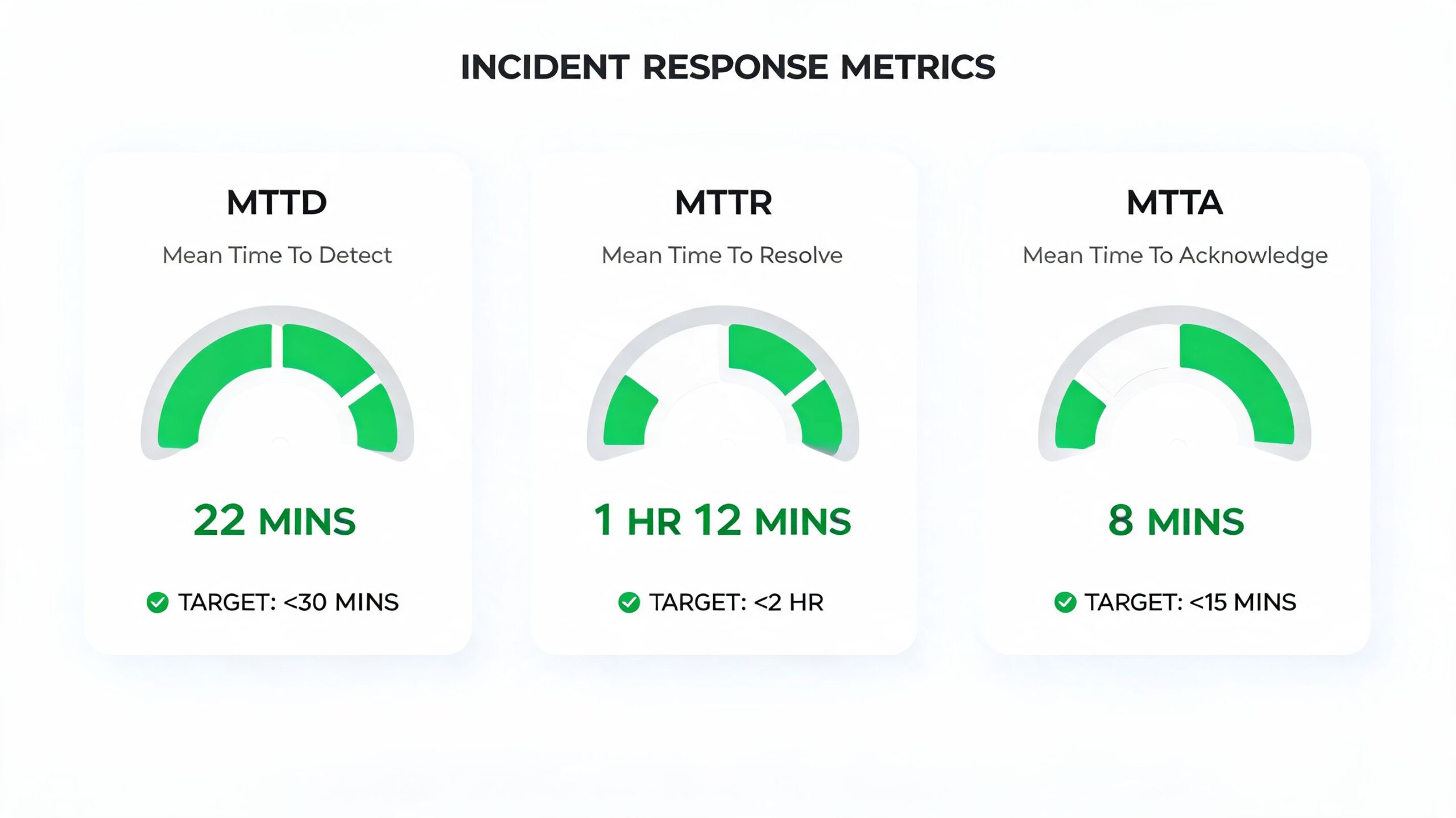
The three metrics that reveal operational maturity
The basics still matter because they expose different failure modes.
| Metric | What it tells you | What usually breaks it |
|---|---|---|
| MTTD | How quickly the team notices a real issue | Weak alerting, noisy thresholds, poor service ownership |
| MTTR | How quickly service is restored | Slow triage, fragmented tooling, risky remediation paths |
| MTTF | How long systems run before failing again | Repeated defects, weak prevention, poor learning loops |
Of these, MTTR gets the most attention for good reason. It maps cleanly to customer pain and leadership concern. According to InvGate’s incident management statistics summary, 86% of respondents use MTTR as their primary performance indicator, and the same source says AI-driven automation has the potential to reduce incident resolution times by up to 50%.
The number matters less than the direction. Teams don't need more reporting vanity. They need shorter paths from signal to action.
Why DIY stacks distort the numbers
Custom stacks usually make these metrics harder to trust.
One tool timestamps the alert. Another records when the issue was acknowledged. A third tracks the deploy rollback. Meanwhile, customer support may know the exact start time because users reported the problem before monitoring did. When timestamps live in different systems, your MTTR becomes part metric, part guesswork.
That creates two practical problems:
- You can't improve what you can't define consistently.
- Leaders end up debating incident timelines instead of fixing the system.
This is especially painful in multi-cloud estates. AWS events, GCP service metrics, Azure diagnostics, Kubernetes telemetry, application logs, and CI/CD events all tell partial stories. Unless those stories line up automatically, MTTD and MTTR become meeting topics instead of management tools.
For a concise explanation of the mechanics behind the metric itself, DocuWriter.ai's MTTR insights are a solid reference. The useful part isn't the formula. It's the reminder that calculation quality depends on event quality.
What teams should track beyond the label
A metric only helps if the team can act on it. In practice, that means pairing the headline number with enough context to answer why it moved.
Look for patterns like these:
- MTTD is drifting up: alerting is noisy, or service ownership is unclear.
- MTTR is high while MTTD is fine: detection works, but resolution is operationally clumsy.
- MTTF is low after releases: change management and deployment safety need attention.
- Metrics improve only for one team: the platform is uneven, not healthy.
Better metrics don't make incidents less stressful. They make the stress more productive.
If release quality is part of the problem, it’s worth reviewing how to reduce deployment failures before you spend another quarter tuning alert thresholds. A lot of incident noise starts upstream in the delivery process.
Best Practices for Processes and Runbooks
Tooling doesn't carry an incident on its own. People do.
That’s why the best incident management system still fails if the process is vague, the runbooks are stale, and the on-call model burns out your best engineers. Teams often blame the paging tool or dashboard layout when the larger issue is cognitive load. Under pressure, people need fewer decisions, not more.
Runbooks should be live operational documents
A runbook isn't a wiki page that someone wrote during a postmortem and never opened again. It’s a working document tied to the way the service runs today.
Good runbooks have a few traits in common:
- They start with diagnosis, not background: responders need first checks, likely failure points, and safe immediate actions.
- They include stop conditions: when to escalate, when not to retry, when rollback is safer than patching live.
- They reference current systems: current dashboards, current repos, current service names, current owners.
- They are tested in real operations: if a runbook hasn't been used or reviewed recently, treat it as suspect.
Many teams document process badly because documentation itself is treated as a side task. If you need a practical framework for making operational docs easier to maintain, HypeScribe's guide on process documentation is useful. The key lesson applies directly to incident work: documented processes only help when people can follow them quickly.
On-call should be sustainable
A brittle incident culture usually hides behind a few dependable engineers. They know the stack, they respond fast, and they absorb the mess. That's not resilience. That's deferred attrition.
A sane on-call model should include:
- Clear service ownership: every alert should point towards a team that can act.
- Escalation paths that are explicit: second-line support, platform help, security review, and stakeholder comms should never rely on memory.
- Handovers that include context: not just “watch this”, but what changed, what risk remains, and what to ignore.
- A rotation that recognises fatigue: if the same people handle every ugly incident, the process is broken.
Long incidents don't just degrade systems. They degrade judgement.
Integrated platforms help more than teams expect. Not because they remove the need for process, but because they reduce operational ambiguity. Role-based access, audit logs, deployment history, and environment state in one place remove many of the side quests that make incidents exhausting.
Postmortems should change the system
A postmortem isn't complete because a meeting happened. It's complete when the team leaves with operational changes that are likely to matter.
The most useful reviews ask questions like these:
| Weak postmortem question | Better postmortem question |
|---|---|
| Who made the mistake? | What conditions made the mistake easy to make? |
| Why didn't the engineer catch it? | Why didn't the system surface it sooner? |
| Why was the fix slow? | What context was missing during response? |
| How do we avoid this exact issue? | What class of issue does this expose? |
Blameless doesn't mean soft. It means honest about systems. If a rollback required tribal knowledge, write that down. If alerts fired without enough context, fix them. If responders lost time because permissions were inconsistent across environments, that's not a human failure. That's a platform design problem.
Integrating Your System for Proactive Resolution
A standalone incident tool can page people. It can't explain your production system.
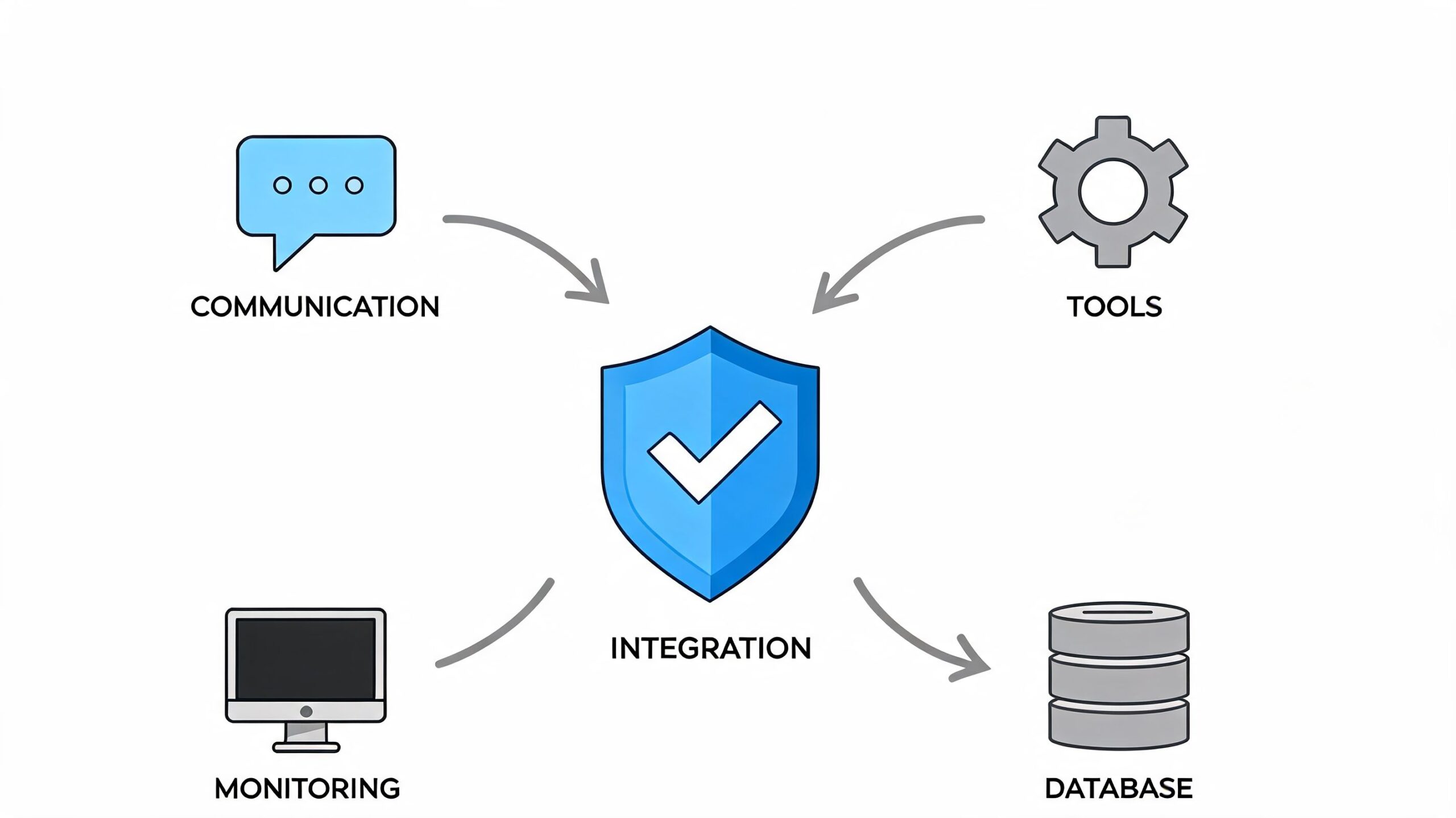
That distinction matters more every year because incidents rarely come from one layer now. A customer-visible outage may involve a feature rollout, a queue backlog, a cloud networking issue, a mis-sized workload, and a noisy alert policy at the same time. If your incident management system doesn't integrate with observability and delivery, responders spend the first part of every incident rebuilding context by hand.
Observability first, not last
Integrated observability changes the speed and quality of triage.
When an alert can immediately show related logs, traces, infrastructure events, and recent deploy activity, the responder doesn't have to ask basic correlation questions. They can move straight into diagnosis. That’s the difference between “CPU is high somewhere” and “latency spiked on the checkout API immediately after version X rolled out to one region”.
In this context, composite SLOs become more than an SRE buzzword. As Nobl9’s incident management overview notes, modern systems can use hierarchical composite SLOs that aggregate metrics across multiple data sources, letting teams monitor reliability from a single entry point down to granular components. The same source explains that, for multi-cloud platform teams, this approach removes visibility blind spots.
That matters because service health is rarely a single metric. A platform team may need to combine application latency, queue depth, dependency error rates, and user-facing success signals into one operational view. If those stay disconnected, responders optimise the wrong thing.
CI/CD integration closes the loop faster
The other integration teams underestimate is the one between incidents and delivery.
A practical incident workflow should answer these questions immediately after an alert fires:
- Was there a deploy near the start of the issue?
- Which service changed?
- Who approved it?
- Can we roll back safely?
- Is a feature flag or traffic split involved?
Without that link, every incident includes a manual archaeology phase. Engineers search commit history, check pipeline runs, inspect release notes, and message developers to reconstruct what happened.
That’s why safe delivery practices aren't separate from incident management. They're part of it. Feature flags, staged rollouts, and controlled releases reduce the blast radius of change and make remediation faster when something goes wrong. If your team is still treating release safety as a separate concern, it’s worth reviewing feature flags and safe releases as an operational discipline, not just a product delivery trick.
DIY integration is a product in disguise
Many teams say they'll just connect the tools themselves. Technically, they can. Organisationally, that decision creates another internal platform to own.
The hidden work includes:
- Schema mapping: making alerts, services, repos, teams, and environments mean the same thing across tools.
- Authentication and permissions: keeping access consistent across clouds and systems.
- Change maintenance: updating integrations every time a vendor API, pipeline, or service boundary shifts.
- Failure handling: deciding what happens when the alert reaches Slack but the deploy metadata never arrives.
The more your incident workflow depends on custom glue, the more likely that glue becomes part of the incident.
Integration is where many bespoke setups stop being clever and start being expensive. Not because integration is bad, but because operating it well is a long-term engineering commitment.
A Practical Checklist for Evaluating Your Incident System
Teams don't need another maturity model. They need a blunt review of whether their current setup helps or slows them down.
If you're a CTO, VP Engineering, or platform lead, use this checklist against your current incident management system. Answering “sometimes” usually means “no”.
Incident response clarity
Ask these first:
- Can an on-call engineer tell what changed without opening multiple systems?
- Can they see whether a recent deployment is related to the incident?
- Can they identify the owning team quickly, without Slack archaeology?
- Can they tell whether the issue is customer-facing or internal-only?
If the answer depends on who is on call, you have a people dependency disguised as a process.
Operational control
DIY stacks often look fine until a serious outage occurs.
| Question | Healthy answer | Warning sign |
|---|---|---|
| Are permissions consistent during incidents? | Access is role-based and predictable | Engineers request ad hoc access mid-incident |
| Is there one reliable event timeline? | Alerts, deploys, actions, and updates align | Teams argue over timestamps |
| Are runbooks easy to find and current? | Linked from the service context | Buried in docs or obviously stale |
| Is audit history complete enough for review? | Decisions and changes are visible | Critical actions happen in side channels |
Learning and prevention
A functioning system should improve after stress, not just survive it.
Use these prompts:
- Do postmortems produce changes in tooling, alerting, or release practice?
- Do repeated incidents point to a visible backlog of reliability work?
- Can the team distinguish between noisy alerts and meaningful early signals?
- Are incident reviews changing future deployments, not just documenting past pain?
If postmortems mostly generate notes, the loop is open.
Platform reality check
The hardest question is the strategic one.
Are you building incident capability because it creates competitive advantage, or because your existing platform leaves you no choice?
For most startups and scale-ups, incident tooling is not the product. Kubernetes upgrades, CI runner maintenance, cloud policy drift, fragmented monitoring, and custom incident glue all steal time from shipping features. Hiring more DevOps engineers can mask that for a while, but it often expands the internal platform surface area instead of simplifying it.
A better standard is simple: your platform should make the safe path the easy path.
If your current setup still requires manual stitching across AWS, GCP, Azure, CI/CD, observability, and access control during a live incident, then the incident management system isn't the only thing due for review. The broader delivery platform is.
If your team is spending too much time maintaining deployment pipelines, cloud infrastructure, observability wiring, and incident tooling instead of shipping product, it’s worth looking at PushOps. It gives software teams a production-ready platform across AWS, GCP, and Azure with integrated deployments, observability, security controls, and operational guardrails, so incident response gets simpler because the underlying system is simpler.

