

So, what exactly is a DevOps / cloud infrastructure platform? Think of it as the central nervous system for managing all your cloud environments—whether you’re on AWS, GCP, Azure, or all three. It brings together all the essential tools for automation, infrastructure, and monitoring into one place, giving your development team a single, consistent way to work.
The whole point is to let engineers get back to building great applications instead of getting bogged down in the complex, provider-specific details of each cloud.
The Architect for Your Cloud Blueprint
Imagine trying to build a modern skyscraper with separate, uncoordinated teams for the foundation, steelwork, and electrical systems. Each crew has its own blueprints, uses different tools, and doesn’t talk to the others. The result? Chaos, delays, and a building that’s probably not safe to enter.
That’s what managing AWS, GCP, and Azure individually often feels like.
A proper DevOps / cloud infrastructure platform acts as the master architect and general contractor, all rolled into one. It provides a single, unified blueprint and a shared set of advanced tools for everyone involved. This integrated approach pulls all the critical functions into a cohesive system, stopping the fragmentation that plagues so many multi-cloud operations before it can even start.
From DIY Kitchens to Professional Workspaces
Without a platform, development teams are essentially forced to build their operational “kitchen” from scratch. They have to individually pick, configure, and maintain a messy collection of tools for each cloud provider they use. This DIY approach is a massive time sink and demands deep, specialised expertise for every single environment.
This usually involves a lot of painful, manual work:
- Cobbling Tools Together: Trying to stitch together separate services for code deployment, server provisioning, and performance monitoring.
- Inconsistent Workflows: Developers end up having to learn different processes and command-line tools for each cloud, which absolutely kills productivity.
- Zero Visibility: Getting a clear, complete picture of your security posture, performance, or costs across all clouds becomes a nightmare.
A unified platform completely changes the game. It’s like stepping into a professional, state-of-the-art kitchen where everything just works. It frees up your team to focus on their real job: “cooking” up amazing applications.
A unified platform shifts the focus from managing complex cloud plumbing to delivering actual business value. It automates the tedious, error-prone tasks of infrastructure management so developers can innovate faster and more reliably.
This isn’t just a small improvement; it’s a fundamental shift. Instead of burning up to 40% of their time on manual configuration and upkeep, engineers can pour that energy back into building features and making users happy.
Platforms like PushOps were designed to solve this exact problem. They offer a straightforward path to achieving speed, security, and reliability across any cloud environment. By hiding the underlying complexity behind a powerful yet simple interface, they make building, deploying, and managing modern applications at scale much, much easier—turning a chaotic multi-cloud setup into a genuine strategic asset.
The Five Pillars of a Modern Cloud Platform
To really get what a modern DevOps / cloud infrastructure platform brings to the table, we need to look under the bonnet. It’s not just a single tool; it’s a complete system built on five critical pillars that have to work together. When these pieces are integrated, they create a powerful engine for speed, security, and control.
Think of it like building a high-performance car. You can’t just throw an engine, wheels, and a steering wheel in a pile and call it a day. Each part needs to be engineered to function as part of a whole. In the same way, these five pillars form the chassis of any effective platform.
Automating the Journey with CI/CD Pipelines
The first and most fundamental pillar is Continuous Integration and Continuous Deployment (CI/CD). This is the automated assembly line for your software. Instead of developers manually building, testing, and deploying code—a process riddled with potential for human error—CI/CD pipelines automate every single step.
When a developer commits new code, the pipeline kicks in automatically. It compiles the code, runs a whole suite of tests to catch bugs early, and then, if everything checks out, deploys it to production. This creates a fast, reliable, and repeatable path from a developer’s laptop to your customers.
A well-implemented CI/CD pipeline transforms deployment from a high-stakes, stressful event into a routine, low-risk activity. It’s the difference between a chaotic manual release and a smooth, automated workflow.
This approach dramatically shortens development cycles, letting teams ship features and fixes much faster. More importantly, it builds a culture of quality by making sure every change is rigorously tested before it ever goes live.
Building Repeatable Environments with Infrastructure as Code
The second pillar is Infrastructure as Code (IaC). Imagine having to manually click through a web console to set up servers, databases, and networks every time you need a new environment. It’s slow, wildly inconsistent, and a recipe for costly mistakes. IaC solves this by treating your infrastructure configuration just like application code.
Using tools like Terraform or AWS CloudFormation, developers define their entire infrastructure—servers, load balancers, security rules—in simple, readable script files. These scripts act as the blueprint. Need a new testing environment? Just run the script. It guarantees every environment is an exact, error-free replica of the others.
This diagram shows how a single platform unifies management across the big cloud providers like AWS, GCP, and Azure.
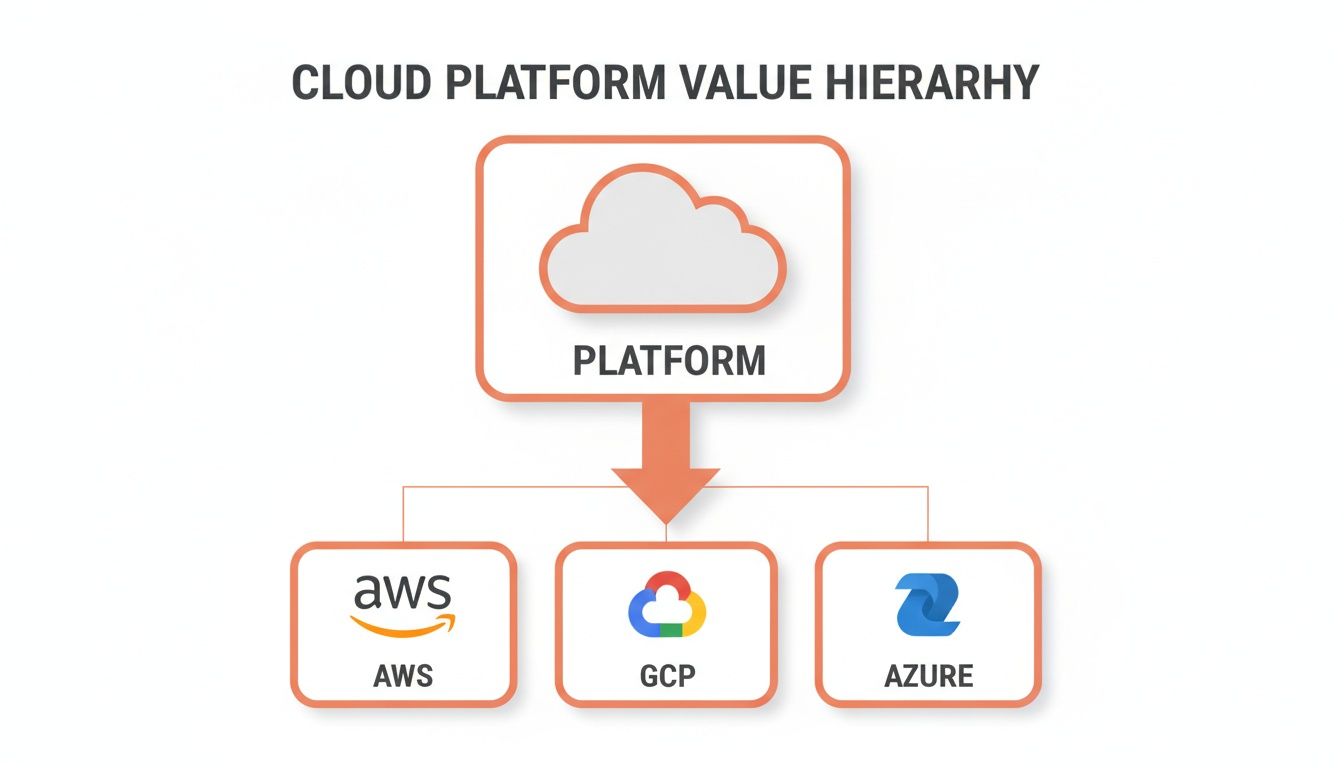
The key idea here is that the platform becomes a control layer, giving you consistency no matter which cloud vendor you’re running on underneath.
A DevOps infrastructure platform is more than just a collection of tools; it’s an integrated system where each pillar supports the others to drive business value. The table below breaks down these five essential components, explaining what they do and why they matter to different roles in your organisation.
Core Components of a DevOps Infrastructure Platform
| Pillar | Primary Function | Value for Developers | Value for CTOs/PMs |
|---|---|---|---|
| CI/CD Pipelines | Automates the software build, test, and deployment process. | Speeds up release cycles, reduces manual work, and catches bugs earlier. | Increases delivery velocity, improves product quality, and reduces deployment risk. |
| Infrastructure as Code (IaC) | Defines and manages infrastructure using code-based blueprints. | Creates consistent, reproducible environments for dev, staging, and prod. | Eliminates configuration drift, lowers operational costs, and enables scalability. |
| Unified Observability | Centralises logs, metrics, and traces for a holistic system view. | Simplifies debugging and troubleshooting by providing a single source of truth. | Reduces mean time to resolution (MTTR) and improves overall system reliability. |
| DevSecOps | Integrates automated security checks throughout the development lifecycle. | Catches vulnerabilities early in the workflow, making them easier to fix. | Reduces security risks, ensures compliance, and embeds a security-first culture. |
| Intelligent Cost Management | Monitors, analyses, and optimises cloud spending in real-time. | Provides visibility into the cost impact of their code and infrastructure. | Prevents budget overruns, improves ROI, and enables accurate financial forecasting. |
By bringing these five pillars together into a cohesive whole, a platform creates a flywheel effect. Faster, safer deployments (CI/CD and DevSecOps) running on consistent infrastructure (IaC) become easier to manage (Observability) and more cost-effective (Cost Management), ultimately accelerating innovation.
Achieving Unified Observability
The third pillar is unified observability. In a complex cloud environment, things will inevitably go wrong. Without a clear view into your systems, finding the root cause of a problem is like searching for a needle in a haystack. Observability gives you that clarity by collecting three key types of data:
- Logs: Detailed, timestamped records of every event that happens within your applications and infrastructure.
- Metrics: Numerical data points collected over time, like CPU usage or application response times.
- Traces: A complete picture of a request's journey as it travels through all the different services in your system.
A true DevOps platform pulls all this data into a single, unified dashboard. This gives your teams a "single source of truth" to quickly diagnose and fix issues long before they impact your users.
Integrating Security with DevSecOps
Fourth up is embedded security, often called DevSecOps. Traditionally, security was an afterthought—a final checkbox to tick right before deployment. That old model is slow, inefficient, and simply doesn't work anymore. DevSecOps "shifts security left," which means integrating automated security checks throughout the entire development lifecycle.
This makes security everyone’s job, not just one team’s problem. Automated tools scan code for vulnerabilities as it’s written, check for insecure configurations in IaC scripts, and monitor for threats in real-time. By catching issues early, you slash your risk profile and avoid painful, expensive fixes down the line. To see how this works in the real world, you can learn more about launching secure infrastructure at startup speed.
Enabling Intelligent Cost Management
Finally, the fifth pillar is intelligent cost management. The cloud offers incredible power, but its pay-as-you-go pricing can quickly lead to budget blowouts if you’re not careful. A unified platform gives you the tools to monitor, control, and optimise your cloud spend.
This usually includes features like:
- Centralised Dashboards: See exactly what you're spending across all projects and cloud providers, all in one place.
- Budget Alerts: Get notified before you exceed your budget, not a month later when the bill arrives.
- Optimisation Recommendations: Receive automated suggestions for right-sizing resources or shutting down wasteful instances.
By integrating cost management directly into the developer workflow, a platform helps build a culture of financial accountability. It ensures you’re getting the most value from every pound you spend on the cloud.
Taming Multi-Cloud Complexity with a Unified Platform
Running operations across multiple clouds like AWS, GCP, and Azure can quickly get out of hand. It’s like trying to conduct an orchestra where every musician has a different score, written in a different language. The result is chaos, inefficiency, and a lot of wasted effort.
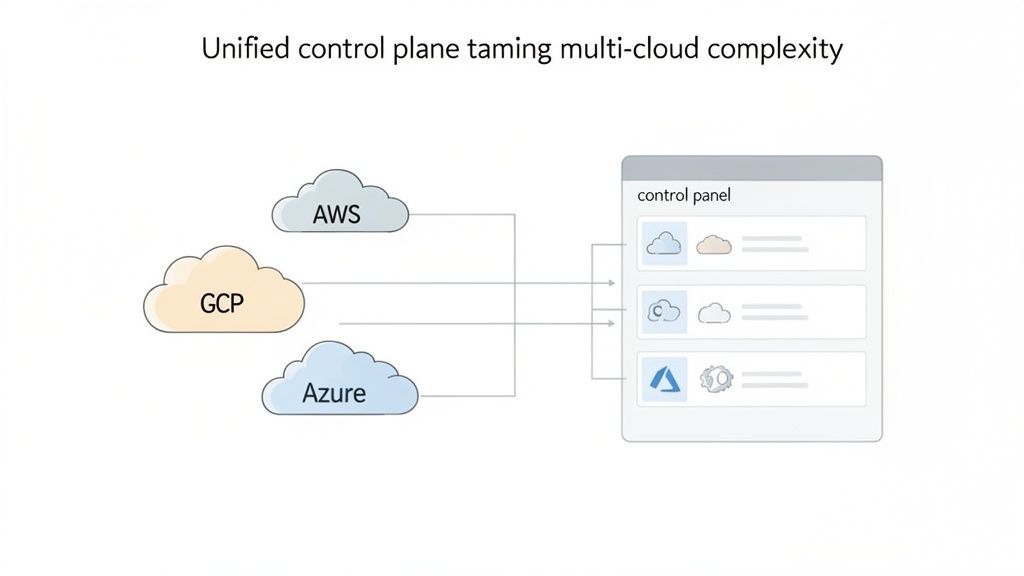
Teams find themselves juggling different toolsets, inconsistent security policies, and a completely fragmented view of their spending. This friction creates operational silos that slow down innovation and pump up risk.
Creating a Single Pane of Glass
This is where a unified devops / cloud infrastructure platform comes in. It acts as a smart abstraction layer, sitting on top of the mess to bring order. You get a "single pane of glass"—one central dashboard to provision, deploy, secure, and monitor everything consistently, no matter which cloud provider it lives on.
This single control point turns a messy multi-cloud reality into a real strategic advantage. Instead of wrestling with provider-specific quirks, your teams work through a standardised, predictable interface.
And this isn't some niche problem; it's the new normal. Globally, 80% of DevOps teams see hybrid cloud as essential, while a staggering 92% of enterprises are already running multi-cloud strategies. These numbers make it clear: we need tools that can manage this complexity.
The Value for Every Stakeholder
A unified platform delivers clear, powerful benefits to everyone in the business, from the C-suite to the developer writing code. It finally aligns technical work with business goals by creating a common ground for everybody.
For a CTO, the main win is control and governance. A single platform makes it possible to enforce universal security and compliance policies across all cloud environments. Dangerous inconsistencies disappear, and every piece of infrastructure is held to the same high standard, dramatically lowering the organisation’s risk profile.
For developers, the platform offers pure simplicity and speed. They get a standardised, predictable workflow without needing to become a certified expert in every cloud's labyrinth of services. That means less time fighting with configuration and troubleshooting, and more time building features.
A unified platform liberates developers from the burden of multi-cloud minutiae. It provides a paved road for deployment, allowing them to focus on application logic rather than underlying infrastructure.
Finally, for project managers, it brings unmatched visibility. They get a clear, consolidated view of performance metrics and costs across all clouds. This makes it far easier to track project budgets, forecast spending, and make sure resources are being used efficiently.
From Operational Nightmare to Strategic Asset
By abstracting away the underlying complexity, a platform fundamentally changes the game for multi-cloud management. It turns what was once an operational headache into a powerful strategic asset.
This approach brings several key advantages:
- Consistent Workflows: It establishes a single, repeatable process for deploying and managing applications, everywhere.
- Centralised Governance: Security and compliance policies are defined once and enforced automatically across all clouds.
- Unified Cost Visibility: It rolls up spending data from every provider into one dashboard for easy analysis and optimisation.
- Reduced Training Overhead: Engineers only need to learn one platform, not the specific nuances of three different cloud consoles.
By putting a unified devops / cloud infrastructure platform in place, organisations can finally tap into the full potential of multi-cloud without getting bogged down by its inherent chaos. To see how companies are making this happen in the real world, check out these customer success stories.
How to Choose the Right Infrastructure Platform
Picking a devops / cloud infrastructure platform is one of those foundational decisions that echoes for years. It will define how efficient, fast, and frankly, how happy your engineering team is. This isn’t just about buying another tool; it’s about choosing a partner that will grow with you. Get it wrong, and you’re signing up for years of friction and workarounds. Get it right, and you’ve just installed an engine for innovation.
The choice demands a real evaluation, not just a quick scan of a feature list. You need to think about how a platform fits into your team’s culture and current workflows. Does it actually empower developers, or does it just add another layer of complexity they have to fight with? The goal is simple: find something that makes life easier, not harder.
Start with Developer Experience
Your developers are on the front lines every day, so their experience is everything. A platform that feels intuitive and just gets out of their way will pay you back tenfold in productivity and morale. A clunky, confusing interface, on the other hand, is a guaranteed-to-slow-things-down.
When you’re looking at a platform, ask yourself these questions:
- Does it actually simplify workflows? A great platform should handle the messy, low-level details of AWS, GCP, and Azure, giving your team a clean, unified way to get work done.
- How fast can someone new get up to speed? Can a new engineer start being productive right away, or do they need a PhD in cloud architecture first? The learning curve matters.
- Does it play nice with our existing tools? The platform absolutely must integrate smoothly with the tools your team already knows and loves, like your version control and project management software.
A platform that nails the developer experience feels less like a restrictive tool and more like a powerful assistant.
Assess Core Technical and Business Criteria
Beyond a slick UI, the platform has to meet some hard technical and business needs. This is where CTOs and project managers need to roll up their sleeves and make sure the solution aligns with the company’s bigger picture. Your evaluation should cover several non-negotiable areas.
Choosing a platform is like hiring a key employee. You need to check their skills, their ability to work with the team, and how they’ll contribute to your long-term vision. It's a strategic decision, not just a technical one.
Thinking this way ensures you pick a partner that can scale alongside you. A platform might seem perfect for a small team today, but if it can’t handle the security and governance you’ll need as a larger organisation tomorrow, it’s the wrong choice.
Your Essential Evaluation Checklist
To make a decision you can stand behind, use a structured checklist to compare different options, like the one we use at PushOps. This forces you to look at every critical angle and weigh the pros and cons without guesswork.
- Multi-Cloud Support: Does it offer first-class, consistent support across AWS, GCP, and Azure? Be wary of solutions that are obviously built for one cloud with others tacked on as an afterthought. That will box you in later.
- Security and Compliance: How does the platform handle governance, role-based access control (RBAC), and policy enforcement? You want built-in security that works automatically to keep your compliance posture strong, not something you have to constantly babysit.
- Scalability and Performance: Can the platform actually handle your growth? Dig into how it manages auto-scaling, load balancing, and performance monitoring to make sure it won’t fall over when you need it most.
- Cost Management and Transparency: Does it give you a single, clear view of your spending across all clouds? Look for essentials like real-time cost dashboards, budget alerts, and recommendations you can actually act on. No one likes budget surprises.
- Support and Partnership: What kind of technical support do they offer? A good provider acts like a true partner, offering expert advice and being there with responsive help when you hit a wall.
By methodically working through these points, you shift from making a gut-feeling decision to an evidence-based one. This ensures the devops / cloud infrastructure platform you choose isn’t just a good fit for today, but a solid foundation for whatever comes next.
A Practical Roadmap for Platform Adoption
Successfully adopting a devops / cloud infrastructure platform isn’t about flipping a switch. It’s a journey that requires a clear strategy, bringing technology, people, and processes together. A phased approach is the best way to make the transition smooth, build momentum, and avoid disrupting your day-to-day operations.
This roadmap breaks the process down into four straightforward stages. Following these steps will help your organisation not just implement the new tech, but truly embrace the operational improvements that come with it.
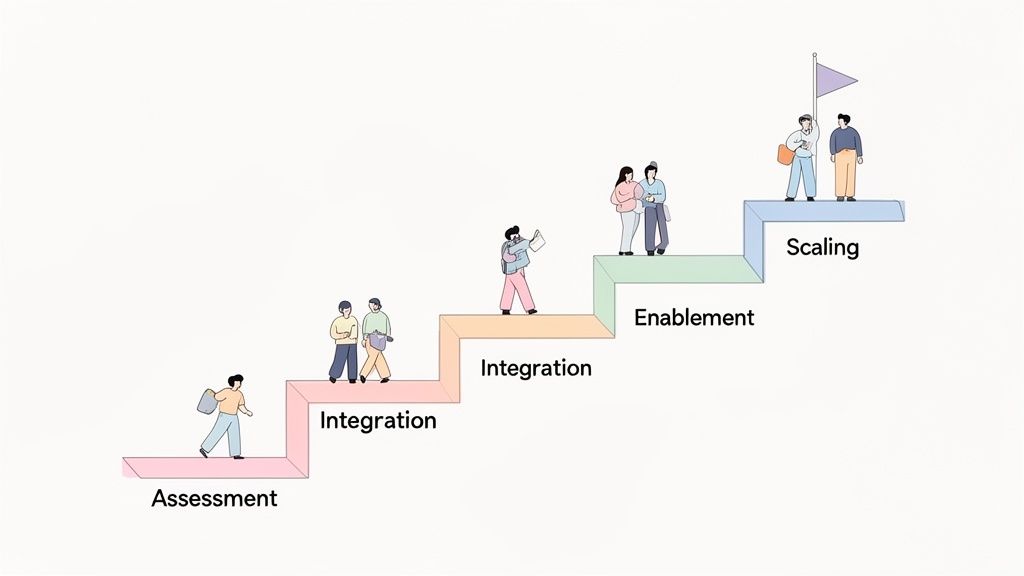
Phase 1: Assessment and Planning
Before you touch any code, you need to define what a "win" looks like. Get key people from engineering, product, and finance in a room to set clear, measurable goals. Are you trying to cut deployment times by 50%? Rein in cloud spending? Or maybe just make the whole system more reliable?
Once you have your goals, pick a pilot project. You're looking for something with high impact but low risk—a new feature or an internal service is usually a great candidate. This gives your team a safe space to learn the ropes of the new platform without putting a mission-critical application on the line.
Phase 2: Integration and Onboarding
With a solid plan, it’s time to get technical. This phase is all about connecting your cloud accounts—AWS, GCP, Azure—to the platform and setting up the first CI/CD pipelines for your pilot project. The trick is to start simple. Just focus on automating the build and deployment for that one service first.
The goal of this first integration isn't perfection; it's about making progress. A successful onboarding just means getting one simple application deployed through the new platform. It proves the value and starts building confidence.
Getting that early win is absolutely vital for getting everyone on board and showing real results fast.
Phase 3: Team Enablement and Training
A platform is only as effective as the people using it. This stage is all about getting your developers and operations folks trained up. Good enablement is more than just handing over documentation; it means running hands-on workshops, doing pair programming sessions, and identifying internal champions who can help their colleagues.
The focus here should be on practical skills, teaching the team how to use the new system for the projects they’re actually working on. This investment in training pays off big time with faster adoption and a team that really knows how to get the most out of the platform's features. We cover more on this in our detailed guide on navigating migration and scaling challenges.
Phase 4: Scaling and Optimisation
Once the pilot project is running smoothly and the team is comfortable, it’s time to scale up. Start onboarding more teams and applications onto the platform, applying the lessons you learned from the pilot to make the process even smoother. This is also when you should be gathering feedback and constantly tweaking your workflows for better performance.
This kind of expansion is a sign of a healthy tech environment. For example, Lithuania's ICT sector is a powerhouse in its digital economy, growing at an impressive 10% each year. The country’s modern infrastructure and skilled talent create a fantastic setting for companies to scale their cloud operations—a model worth noting as you grow. You can find more insights on Lithuanian business growth and trends.
Frequently Asked Questions
Here are a few common questions we hear from teams thinking about moving to a unified devops / cloud infrastructure platform.
What’s the Main Difference Between a DevOps Platform and Native Cloud Tools?
Native tools like AWS CodePipeline are fantastic, but they're built to work best inside their own walled garden. This creates vendor lock-in and means your team has to juggle different workflows and security rules if you ever use another cloud provider.
A platform like PushOps sits on top of all of them, acting as a single control panel. It gives your team one consistent way to build, deploy, and manage applications, whether you're on AWS, GCP, or Azure. The result? Way less complexity and a much shorter learning curve, since your engineers only need to learn one system, not three.
How Does an Infrastructure Platform Help with Cloud Cost Management?
The biggest win here is getting all your cost data in one place. Instead of trying to make sense of separate billing consoles from AWS, GCP, and Azure, a unified platform pulls everything into a single, easy-to-read dashboard. You can instantly see what you’re spending by project, team, or environment, which makes spotting waste incredibly simple.
A key function of a modern infrastructure platform is transforming reactive financial reporting into proactive cost optimisation. It moves you from analysing last month's bill to controlling this month's spend.
But it goes beyond just visibility. The best platforms also give you automated recommendations to save money, set up budget alerts so there are no surprises, and help you right-size your resources. It’s all about getting ahead of your cloud spend before it becomes a problem.
Is Our Team Too Small to Benefit from a DevOps Platform?
Absolutely not. In our experience, small teams often get the biggest bang for their buck. When you have limited developer time, the last thing you want is for them to be stuck wrestling with cloud configurations. A platform automates all that complex infrastructure work, freeing them up to focus on what really matters: building your product.
It essentially gives a small team the power of a large, specialised infrastructure crew. You can achieve enterprise-grade security, automation, and reliability without the headcount. This really levels the playing field, letting startups build and scale with the same confidence as much larger companies.
Ready to stop juggling cloud complexity and start building faster? With PushOps, you can streamline your setup, scaling, monitoring, and security across AWS, GCP, and Azure. Get started for free today and see how a unified platform can empower your team.

