
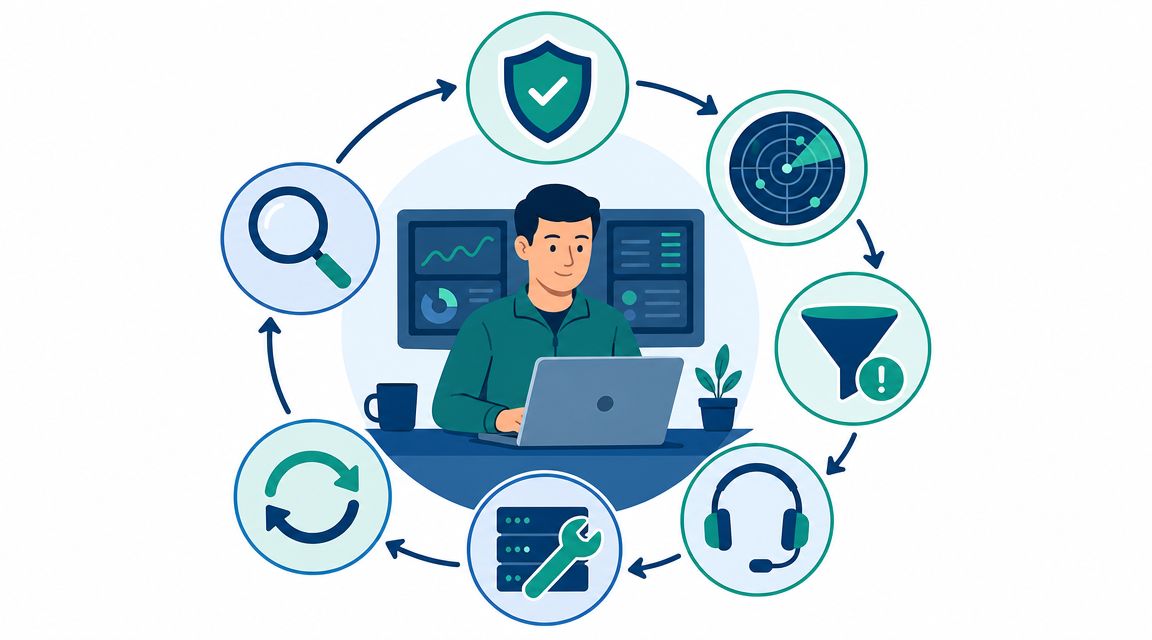

At 2 a.m., the alert itself is rarely the actual problem. The actual problem is what happens next.
One engineer opens Grafana. Another starts scrolling through Kubernetes events. Someone else asks whether the last deploy touched the failing service. A product manager joins the Slack channel because customers are already complaining. Ten minutes later, the team still hasn't agreed on whether this is a database issue, a bad rollout, a network fault, or just a noisy alert.
Most startups and scale-ups tell themselves they have an incident management process. What they usually have is a collection of habits, dashboards, chat channels, and tribal knowledge held together by whichever senior engineer happens to be awake.
I've built that version before. It works, until it doesn't. Then you realise the incident management process isn't a side task. It's an internal product. You have to define workflows, maintain runbooks, tune alerts, assign ownership, train responders, document decisions, and keep the whole thing current while your architecture keeps changing.
That hidden tax gets worse when you've also built a DIY DevOps stack. Separate tooling for CI/CD, Kubernetes, cloud accounts, logs, metrics, traces, security controls, and cost management creates one predictable outcome during an incident. Everyone spends too much time assembling context instead of restoring service.
A good incident management process is how you get that time back.
Why Your Team Is Always Fighting Fires
A release goes out late in the afternoon. Ten minutes later, latency climbs, error rates flicker, and support starts hearing from customers before engineering has agreed whether anything is broken. By the time someone with enough context joins the channel, half an hour has gone into tool-hopping, screenshot-sharing, and guesswork.
I have seen this pattern in teams that were full of capable engineers. The problem was not effort. The problem was that the incident process depended on a stack of home-assembled tooling and habits that only worked when the right people were online.
DIY operations create response drag
DIY DevOps stacks tend to look reasonable in isolation. CI/CD lives in one system. Kubernetes events sit somewhere else. Logs, metrics, traces, feature flags, cloud alerts, and runbooks all have their own homes. During an incident, that architecture turns basic questions into expensive coordination work.
Engineers are not just fixing the fault. They are rebuilding context from fragments.
One screen shows saturation. Another shows a deployment. A third has the runbook, last edited before the service was split in two. If you want to know whether a rollback is safe, you may also need release metadata and flag state. Teams that rely on feature flags and safe release practices still need that information tied into the response path, or the flag system becomes one more place to check under pressure.
Practical rule: If responders need multiple people to piece together what changed, the process is carrying too much platform complexity.
A common reaction is to add ceremony. More updates. More handoffs. More alert routes. That rarely improves anything. Speed comes from clear ownership, shared context, and a short path to action.
The process is operational work
A usable incident management process answers a small set of questions quickly:
- What happened: Is this an actual incident or alert noise?
- How bad is it: What is the customer and business impact?
- Who owns it: Which person is driving coordination and decisions?
- What happens next: Contain, communicate, recover, then review.
Incident handling has evolved beyond heroics. It is now measurable operational work. Teams that treat it that way stop relying on memory and individual stamina, and start building a repeatable response system.
That is the part many growing companies miss. They think they are adopting a process. In practice, they are building and maintaining another internal product. Someone has to keep alerts useful, ownership current, runbooks accurate, escalation paths tested, and service metadata aligned with reality. If your engineers are already stretched shipping product, that maintenance work competes directly with roadmap delivery.
What firefighting usually looks like in practice
When leaders say the team is always firefighting, the underlying failure mode is usually easy to spot:
- Ownership is blurry: The person who sees the issue cannot approve the rollback or pull in the right team.
- Detection is noisy: Alerts arrive faster than responders can judge them, so people start ignoring the channel.
- Response is improvised: Slack fills up with decisions, but nobody has a reliable incident record.
- Recovery is narrow: The service comes back, but the operational weakness stays in place.
None of this is unusual. It is also not free.
Every incident drains engineering time twice. First during the outage, then again in the background maintenance work required to keep a DIY process alive. At a certain point, a managed platform stops looking like convenience and starts looking like the sensible choice. It removes a class of internal tooling work that does not differentiate your product, but still consumes some of your best operators.
Preparing for Incidents Before They Happen
Preparation is the least glamorous part of the incident management process. It's also the part that prevents a bad hour from becoming a lost day.
Incident.io's incident response guidance states that proper preparation can reduce incident resolution time by 65%, and describes prepared organisations as using severity-specific playbooks, predefined escalation paths, monitoring thresholds, and communication protocols.
That tracks with experience. Teams that prepare well don't look smarter during incidents. They just waste less motion.
Define severity in plain language
Teams generally don't need a complex taxonomy. They need a severity model people can apply without debate. A simple SEV1 to SEV4 scheme works well if each level maps to real operational behaviour.
- SEV1: Critical production failure, broad customer impact, immediate coordinated response.
- SEV2: Significant degradation, limited workaround, urgent response from the owning team.
- SEV3: Localised fault or degraded non-core service, planned response within working hours if appropriate.
- SEV4: Minor issue, low urgency, track and fix through normal engineering workflow.
The mistake isn't choosing the wrong labels. The mistake is writing severity definitions that sound precise but don't help in the moment. If responders can't classify an incident in under a minute, the model is too abstract.
Build runbooks for predictable failure modes
Runbooks are where preparation becomes practical. Good runbooks don't try to explain the whole system. They help a responder do the next correct thing.
A useful runbook usually covers:
- Trigger conditions: What symptoms mean this runbook applies.
- Immediate checks: Logs, dashboards, recent releases, dependencies, queue depth, error rate.
- Safe first actions: Restart, failover, scale, disable a pathway, or roll back.
- Escalation rules: When to pull in another team or declare a higher severity.
- Recovery checks: How to confirm the service is healthy again.
If your delivery process already uses controlled rollouts, feature flags, and release safety checks, incident response gets easier because mitigation options are clearer. This is why feature flags and safe releases are so valuable operationally, not just for product experimentation.
A runbook that nobody trusts is worse than no runbook. It creates false confidence, then burns time while engineers verify whether the instructions still match reality.
Assign roles before the pressure arrives
Incidents slow down when everyone can act, but nobody is clearly accountable. The fix is simple. Assign roles ahead of time.
The most useful lightweight model includes:
- Incident Commander: Runs the response, makes coordination decisions, keeps the team focused.
- Communications Lead: Updates internal stakeholders and customer-facing teams.
- Subject Matter Expert: Investigates and executes technical actions.
- Stakeholders: Stay informed and remove blockers, but don't drive live diagnosis.
Here is a practical RACI-style view.
| Activity | Incident Commander | Communications Lead | Subject Matter Expert (SME) | Stakeholders |
|---|---|---|---|---|
| Declare incident | Accountable | Informed | Consulted | Informed |
| Open incident channel | Responsible | Consulted | Informed | Informed |
| Assess severity | Accountable | Informed | Consulted | Informed |
| Investigate technical cause | Informed | Informed | Responsible | Informed |
| Approve rollback or containment action | Accountable | Informed | Consulted | Informed |
| Send status updates | Informed | Responsible | Consulted | Informed |
| Confirm recovery | Accountable | Informed | Responsible | Informed |
| Lead post-incident review | Accountable | Consulted | Consulted | Informed |
The maintenance burden nobody budgets for
Severity definitions, runbooks, and role matrices look simple when you create them. Keeping them current is the actual work.
Every new service, cloud dependency, deployment pattern, and on-call rotation creates drift. In DIY environments, that drift becomes another form of technical debt. The docs say one thing, the infrastructure does another, and the responders discover the mismatch in production.
That's why standardised environments matter so much. The more variation you allow between teams and services, the harder it is to keep your incident management process usable under pressure.
From Alert Storm to Actionable Signal
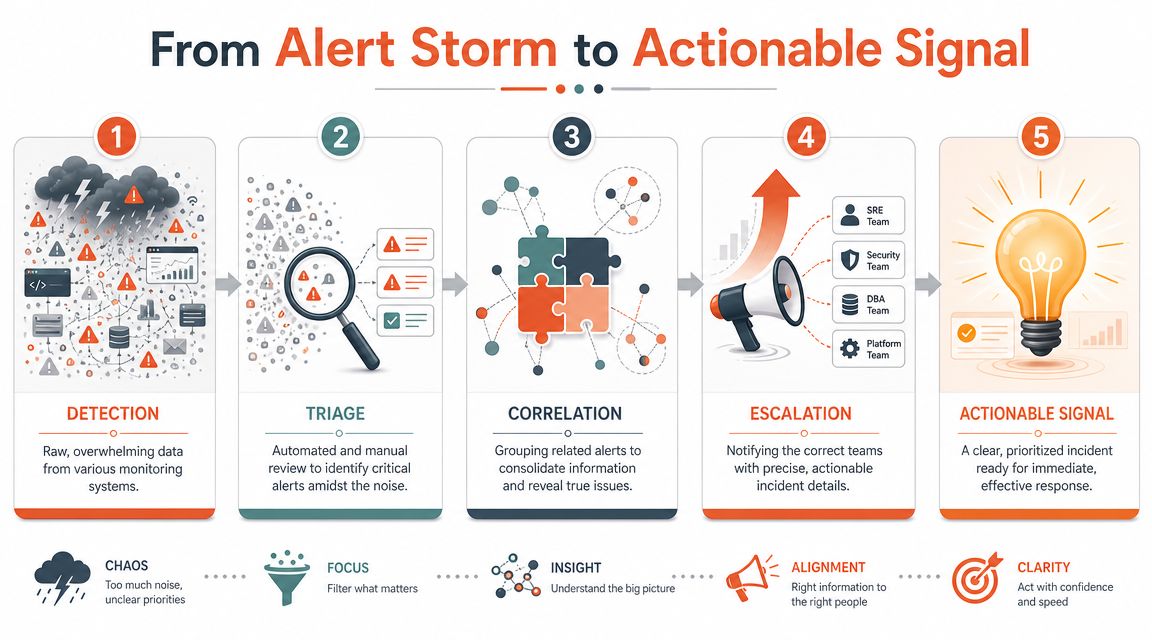
Most incident workflows don't fail at response. They fail earlier, when noisy detection makes triage unreliable.
A homegrown stack often accumulates alerts faster than it accumulates judgement. Engineers inherit thresholds they didn't design, duplicate signals from overlapping tools, and escalation rules that fire for symptoms instead of business impact. After enough false positives, people mute channels or mentally downgrade alerts before they investigate them.
That is how a real production issue gets treated like background noise.
Use sequence, not panic
A reliable incident management process follows order. Infraon describes the formal workflow as detect or identify, log, categorise, prioritise, diagnose, escalate, and respond, and notes that automating the initial steps with policy-driven categorisation and urgency matrices is key to reducing manual triage.
That sequence matters because it stops teams from jumping straight from alert to action without establishing whether the signal is real and who should own it.
Three questions make triage sharper:
- Is it real: Is this a customer-impacting fault, a transient spike, or a broken alert?
- What is the business impact: Which service is affected, and how serious is the disruption?
- Who owns the fix: Which team has both the context and the authority to act?
Those questions sound basic. In fragmented environments, they are surprisingly hard to answer quickly.
Correlation is the missing layer
The biggest gap in many DIY setups isn't monitoring coverage. It's correlation.
An alert tells you something is wrong. It rarely tells you whether the problem started after a deploy, after a configuration change, after cloud resource contention, or after a dependency failed upstream. Engineers then do manual detective work across logs, traces, build pipelines, cloud consoles, and chat history.
That isn't triage. That's archaeology.
A stronger approach groups related signals and puts change data beside service health. If latency rises minutes after a rollout and error rates spike in the same service boundary, your responders should see that immediately. They shouldn't need to ask three separate teams for screenshots.
For teams trying to improve release stability, ways to reduce deployment failures also improve incident detection because they reduce uncertainty around what changed and when.
If every alert needs a custom investigation path, your monitoring stack is producing data, not operational clarity.
Escalate with intent
Bad escalation looks like this: invite everyone, duplicate effort, debate theories in public, and wait for the most senior engineer to impose order.
Good escalation is narrower:
| Situation | Better escalation choice |
|---|---|
| Single service degraded after deploy | Page owning service team and release owner |
| Shared platform issue across services | Hand coordination to platform or incident commander immediately |
| Security suspicion during operational fault | Split technical investigation and security handling early |
| Customer-facing impact with no clear cause | Start incident channel, assign commander, send stakeholder holding update |
The point isn't to minimise collaboration. It's to minimise random collaboration. The right people should join early. Everyone else should get structured updates instead of live-channel chaos.
Managing the Response Without Managing Chaos
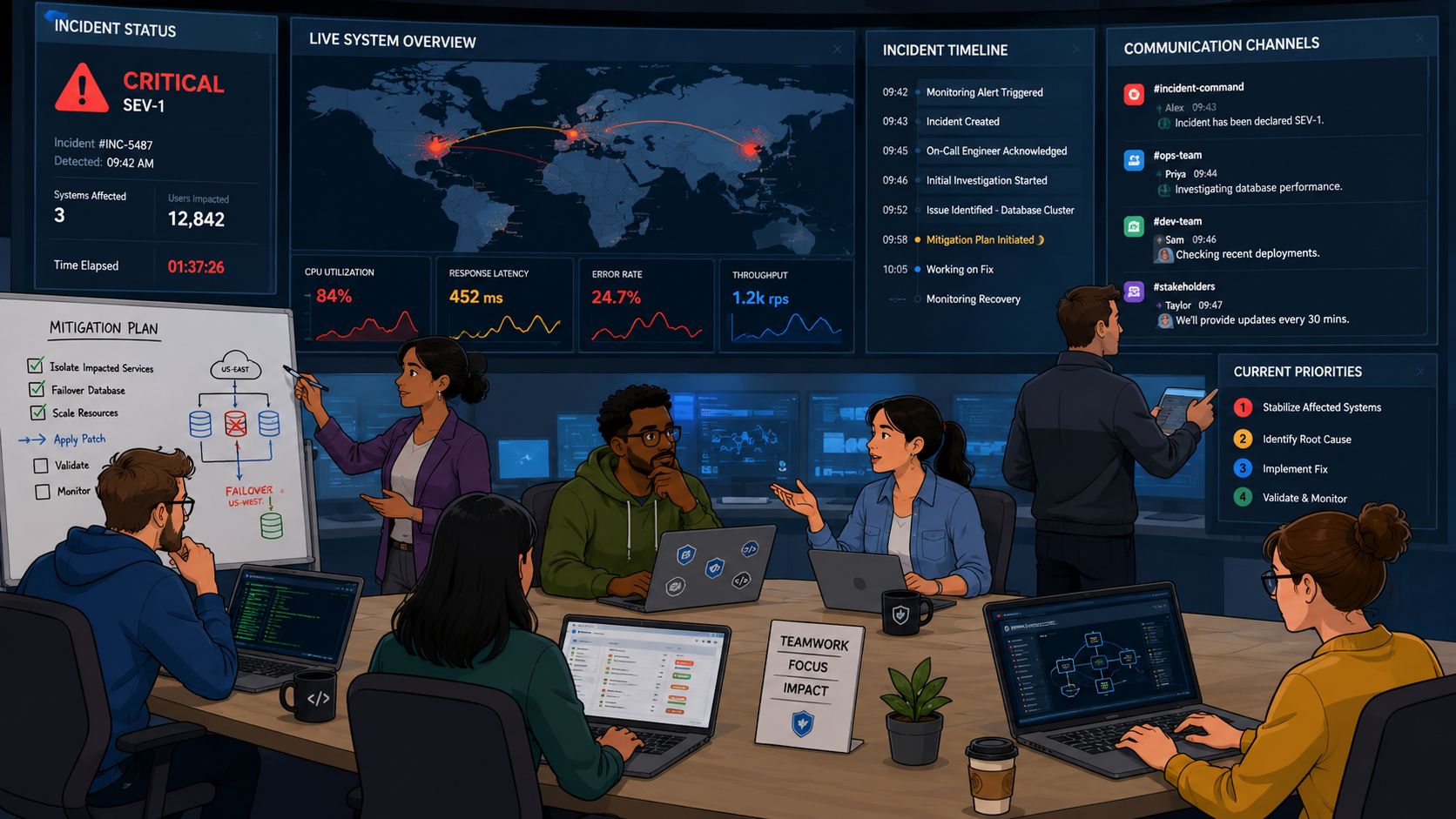
Once an incident is declared, the quality of the response depends less on technical brilliance and more on discipline. Teams lose time when five engineers attempt fixes in parallel, nobody owns communication, and Slack fills with pasted logs, half-formed theories, and repeated questions.
That's why every serious incident needs a single Incident Commander.
One person runs the room
The Incident Commander doesn't need to be the deepest technical expert. That person needs to keep the response coherent.
Their job is to:
- Set the operating cadence: who is investigating, when updates go out, what the current hypothesis is.
- Control change activity: no ad hoc fixes without clear intent and visibility.
- Decide when to contain first: rollback, isolate, or disable before chasing root cause if customer impact is active.
- Protect the responders: technical experts should troubleshoot, not manage stakeholder noise.
Without that role, incidents drift. Engineers argue over tactics while product, support, and leadership keep asking for updates in separate channels.
During a live incident, clarity beats completeness. The team needs one current hypothesis, one owner for each action, and one place where status is updated.
MTTR is a proxy for coordination quality
InvGate's summary of 2024 incident management statistics reports that 86% of organisations used Mean Time to Resolve (MTTR) as a key performance indicator. The same source says the share of proactive responders increased to 68%, and AI usage for incident response rose by 21%.
That says something useful. Mature teams are treating faster recovery as an outcome of better preparation, automation, and coordination, not just faster typing in a terminal session.
In practice, response speed improves when the command structure is simple and the operational view is unified. If the commander can see service health, logs, and recent deployment history together, they can make cleaner calls on rollback versus continue, isolate versus scale, or workaround versus full remediation.
Communication templates beat freestyle updates
Organizations frequently underinvest in incident communications because it feels secondary to technical work. It isn't. Poor communication creates duplicate coordination work and drags senior engineers into answering the same questions repeatedly.
Short templates solve a lot of this.
Internal holding update
We are investigating an incident affecting [service]. Current impact is [brief impact]. Incident lead is [name]. Next update in [time window].
Internal progress update
We have identified [suspected cause or affected area]. Current mitigation is [action]. Customer impact is [current state]. Next update in [time window].
External status message
We are investigating an issue affecting [service experience]. Our team is working to restore normal operation. We will provide further updates as more information is confirmed.
If the incident has a security dimension, the handling model changes. In those cases, it's worth reviewing guidance on handling cyber threats from Pratt Solutions alongside your general operational workflow, especially around containment, evidence handling, and communication discipline.
Calm response needs a single operational view
The hidden weakness in many DIY stacks isn't a lack of skilled engineers. It's the constant context switching. One screen for metrics. Another for logs. Another for deployment history. Another for cloud events. Another for access and audit activity.
That fragmentation increases the odds of contradictory fixes and delayed decisions. The best incident responders I know aren't the noisiest people in the room. They're the ones who can see enough of the system to make one good decision after another.
Turning Downtime into a Competitive Advantage
The incident is over. Revenue has stopped leaking, the support queue is calming down, and everyone wants to get back to shipping. That is usually the moment the critical work gets skipped.
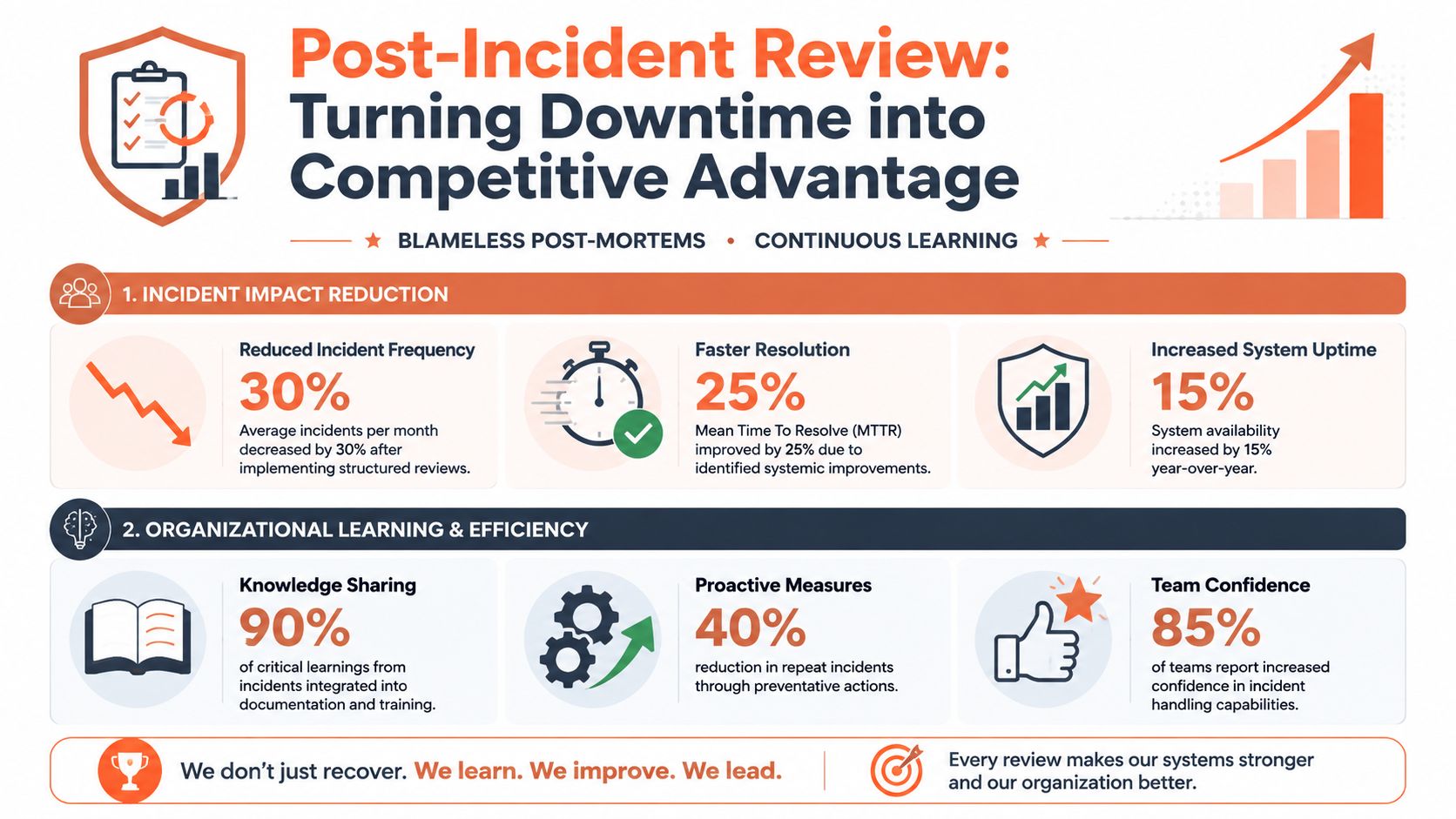
Teams that improve reliability treat the review as part of delivery, not admin work after the fact. If you want downtime to create an advantage, every serious incident has to leave the system better than it found it.
Blameless does not mean vague
A useful review is blameless and specific. It records what failed, which decisions helped, where the team lost time, and what evidence was missing when people had to act under pressure.
The strongest reviews usually answer four questions:
- Detection: How did the team find the issue first?
- Impact: Which users, journeys, or internal teams were affected?
- Response: Which actions reduced impact, and which delays came from process gaps?
- Prevention: What changes belong in code, infrastructure, alerting, release practice, or ownership?
I have seen plenty of postmortems that read well and change nothing. Those are a waste of senior engineering time.
A good review produces follow-up work with owners and due dates. It should also call out uncomfortable truths. Brittle dependencies, missing rollback paths, weak deployment hygiene, and fuzzy service ownership do not fix themselves. Teams that regularly invest in automated deployments for microservices usually find that incidents become easier to contain because releases are more predictable and recovery steps are less improvised.
Track a small set of useful KPIs
Measurement becomes critical at this stage. You do not need a reliability dashboard with twenty lines on it. You need a small set of numbers that helps engineering leaders decide whether the process is getting better or whether the team is just getting used to the pain.
For most scale-ups, three KPIs are enough:
| KPI | What it tells you |
|---|---|
| Incident volume | Whether operational noise is rising, holding steady, or falling |
| MTTR | How quickly the team restores service once an incident starts |
| MTBF | Whether the underlying system is becoming more stable over time |
Track those trends weekly or monthly. Then use them to ask harder questions. Are incidents clustering around certain services? Is recovery getting faster because the system improved, or because the team is relying on the same senior people every time? Is incident count stable while customer impact is getting worse?
That last point matters. Metrics can become theatre if nobody challenges them.
Why DIY postmortems often stall
This is one of the hidden costs of a homegrown incident stack. The review depends on evidence, but the evidence is spread across monitoring tools, chat threads, deployment logs, ticket systems, and cloud consoles. Someone has to gather it, align timestamps, and argue about which record is correct.
That work is slow and expensive. It also gets deprioritised the minute product pressure returns.
A managed platform changes the economics. The timeline, ownership, alerts, deployment history, and service context are already tied together, so the team spends less time reconstructing events and more time fixing the conditions that caused them. That is the difference between having an incident process and running an internal incident product.
The payoff is strategic, not just operational. Teams that learn faster from failure release with more confidence, reduce repeat incidents, and protect roadmap capacity. Reliability work supports the broader roadmap to market success because fewer engineering cycles disappear into preventable operational cleanup.
Stop Building a Platform and Start Building Your Product
By the time a team has a functioning incident management process, it has subtly built a lot more than a checklist.
It has built severity models, runbooks, ownership rules, escalation paths, alert tuning, communication habits, dashboards, audit trails, postmortem templates, and operational metrics. Then it has to maintain all of that while services change, teams grow, and deployment frequency rises.
That is platform work.
For some companies, building and owning that internal capability is the right decision. For many startups and scale-ups, it isn't. They say they want control, but what they instead get is operational drag, documentation debt, and senior engineers spending too much time maintaining systems that exist only to support the core product.
The strategic question leaders should ask
A CTO or VP Engineering should look at the full incident lifecycle and ask one blunt question: is this where our best people should be spending their energy?
If your roadmap depends on faster shipping, cleaner releases, and less operational overhead, your internal systems should support that aim, not become a parallel product line. This is the same broader discipline behind a clear roadmap to market success. Teams need to decide what they will build themselves and what they should standardise so product work keeps moving.
That decision shows up in incident response immediately. Standardised environments are easier to observe. Consistent deployment workflows are easier to roll back. Shared controls are easier to audit. Repeatable release pipelines, including automated deployments for microservices, reduce the amount of incident process that depends on individual memory and heroic intervention.
Build less internal machinery
The hard truth is that most companies don't just build software. They accidentally build a platform team backlog they never meant to own.
If your engineers keep rebuilding incident workflows around a DIY stack, the issue usually isn't talent. It's about working smarter. The team is solving the same operational problems that many other teams have already solved, and paying for that choice in slower delivery and noisier incidents.
A strong incident management process is essential. Building every supporting layer yourself usually isn't.
PushOps gives teams a production-ready path to better operations without turning incident response, deployment tooling, observability, security, and cloud management into a permanent in-house engineering project. If you want your developers focused on shipping product instead of maintaining platform plumbing, explore PushOps.

