
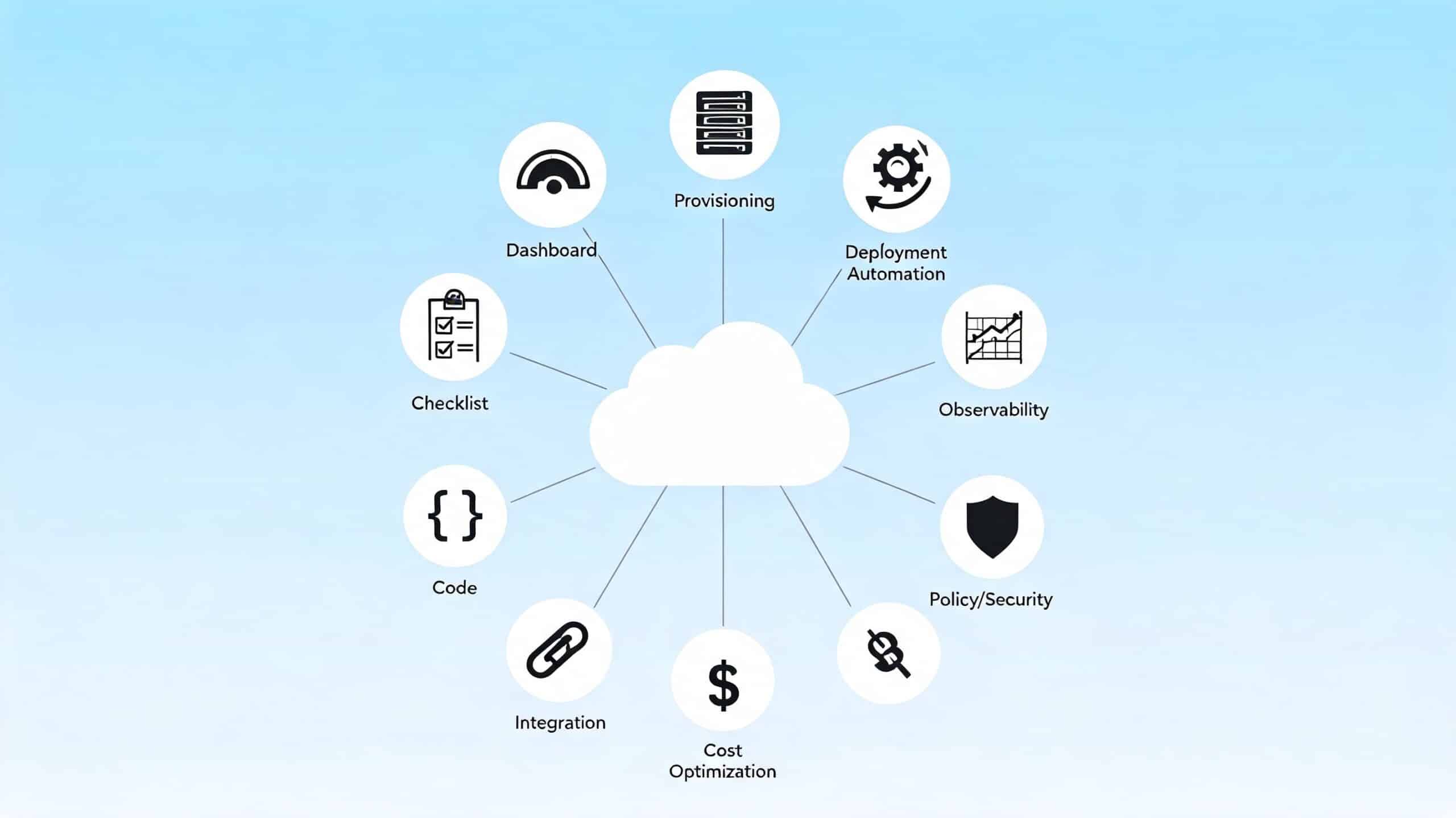

Stop building a DevOps team just to keep the lights on. Most startups and scale-ups don't set out to become experts in Kubernetes upgrades, Terraform state, CI runners, cloud IAM, and cost anomaly triage. They just want to ship product. Yet a lot of engineering leaders wake up to a backlog full of platform work, while roadmap items that customers care about wait another sprint.
That's the DevOps tax. It usually starts with sensible choices. Terraform for provisioning. GitHub Actions or another CI system. Kubernetes for portability. Datadog or Prometheus for monitoring. A few scripts for security checks. A cost tool later, once the bill starts rising. Before long, you've built an internal platform by accident.
The market keeps expanding because this problem is real. The global cloud infrastructure management tools market is projected to grow from $9,985.3 million in 2021 to $14,577 million by the end of 2025, which reflects how central these platforms have become to modern engineering teams. But growth in tools doesn't automatically mean less complexity for buyers.
That's the part too many roundups skip. Tool selection isn't just a feature checklist. It's a buy versus build decision with long-term impact on hiring, reliability, governance, and how fast your team can release. If security automation is part of your stack design, this overview of AI-driven threat detection and response methods is also worth a look.
1. HashiCorp HCP Terraform
HashiCorp HCP Terraform is the default answer for a lot of teams that want centralised Terraform operations without running their own backend, policy engine, and execution workers. That default exists for a reason. It's mature, widely understood, and it gives platform teams a clean control point for remote state, runs, approvals, policy, and auditability.
If your company already speaks Terraform fluently, HCP Terraform often feels like the least risky upgrade from local CLI workflows and scattered state files. It fits especially well when the problem isn't “how do we provision infra” but “how do we stop every squad from provisioning it differently”.
Where it works well
HCP Terraform is strongest when you need governance without abandoning Terraform's ecosystem. Remote runs, private agents, policy controls, VCS integration, SSO, RBAC, and private registries cover the basics that usually get bolted together from separate systems.
European buyers also tend to care about operational consistency in multi-cloud environments. A 2024 Statista survey of Western European IT decision makers found that 68% of organisations use at least one cloud infrastructure management or orchestration platform, and 72% rated IaC platforms supporting AWS, GCP, and Azure as highly reliable for production-grade provisioning. That aligns well with HCP Terraform's core value proposition.
Practical rule: Choose HCP Terraform if Terraform is already your operating model. Don't choose it if you're really trying to reduce the number of moving parts in your delivery stack.
For implementation discipline, keep your workflows opinionated. This guide on DevOps IaC best practices is useful if your team is trying to avoid loose module sprawl and inconsistent review standards.
The trade-off
HCP Terraform doesn't solve the broader DIY platform problem. It solves Terraform management. You'll still need answers for CI/CD, observability, cost control, runtime security, environment lifecycle, and Kubernetes operations if those matter to your estate.
That's why some CTOs overestimate what they're buying. They think they're reducing platform burden, but they're often only centralising one layer of it. For some teams that's enough. For others, it's the first brick in a much larger internal platform project.
2. Pulumi Cloud
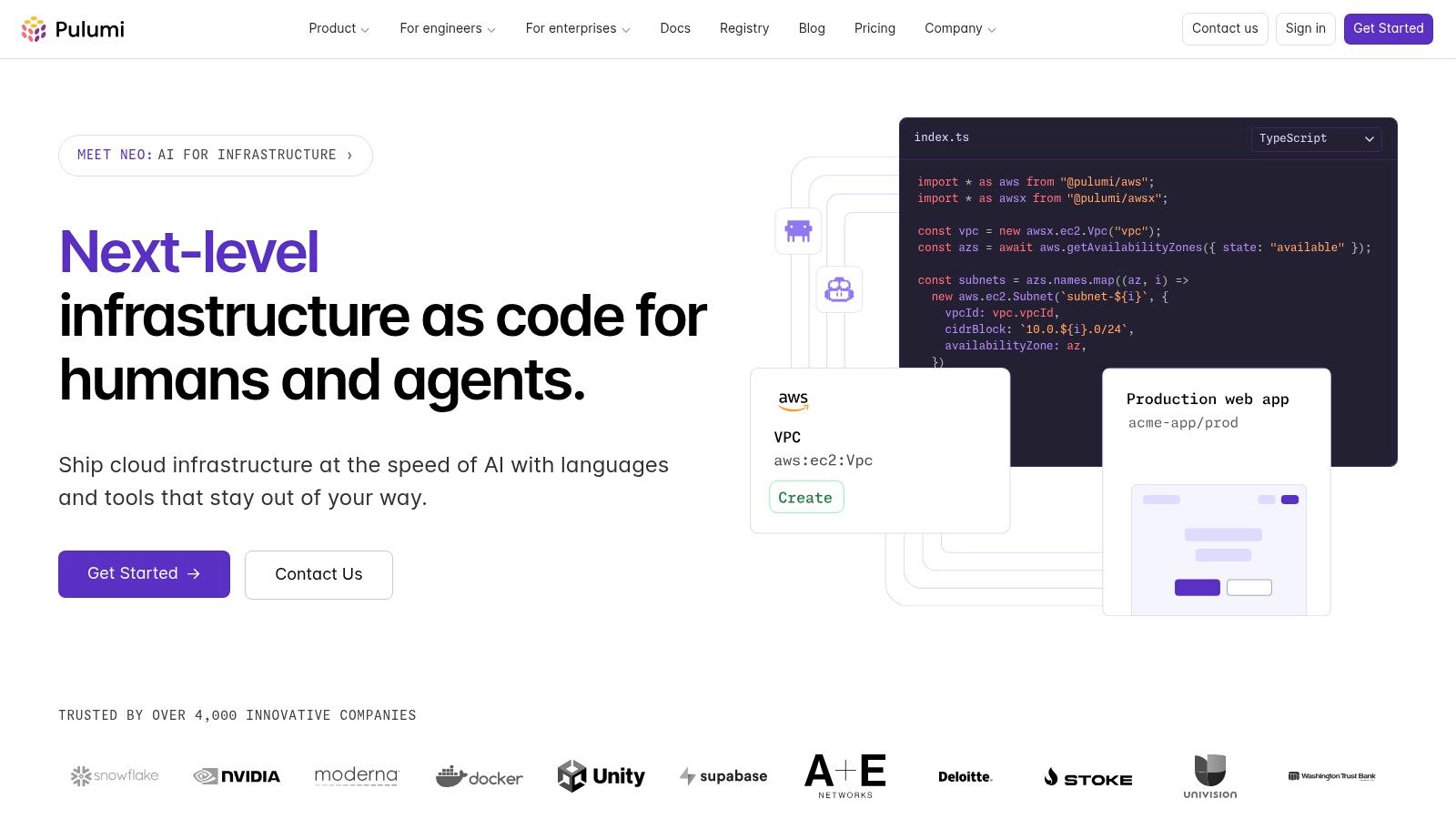
Pulumi Cloud appeals to teams that want infrastructure as code to feel like software engineering instead of configuration management. If your developers are comfortable in TypeScript, Python, Go, C#, or Java, Pulumi often gets faster buy-in than HCL-based workflows because it lets them stay in familiar language tooling.
That matters in product-led engineering teams. Developers are more likely to write tests, reuse abstractions, and package infrastructure logic properly when the tool feels native to how they already build applications.
Why senior developers like it
Pulumi's biggest strength is expressiveness. Real languages are powerful when you're building reusable components, handling complex conditions, or integrating infrastructure definitions with existing application logic. Kubernetes work is also strong, especially for teams that want one model for cloud resources and platform resources.
The managed service adds environments, secrets, policy controls, resource search, and collaboration features that keep Pulumi from becoming just another local CLI tool with a remote state problem.
- Best fit: Teams with strong application engineers who want IaC to live inside normal development workflows.
- Common win: Faster adoption among developers who resist YAML-heavy or HCL-heavy approaches.
- Common risk: Different language choices can create uneven standards across teams unless platform engineering sets guardrails early.
Where it can go wrong
Pulumi's flexibility is also the trap. Real programming languages give teams freedom, but freedom without standards turns infrastructure code into a style war. One team writes elegant reusable libraries. Another writes brittle imperative logic that nobody else wants to touch.
The tool is developer-friendly. The operating model still needs discipline.
Pulumi also doesn't remove the integration burden around deployment pipelines, monitoring, cloud cost controls, and lifecycle governance. It can be an excellent foundation for teams that want to build their own platform. It's less compelling if your real requirement is to stop building one.
3. Spacelift
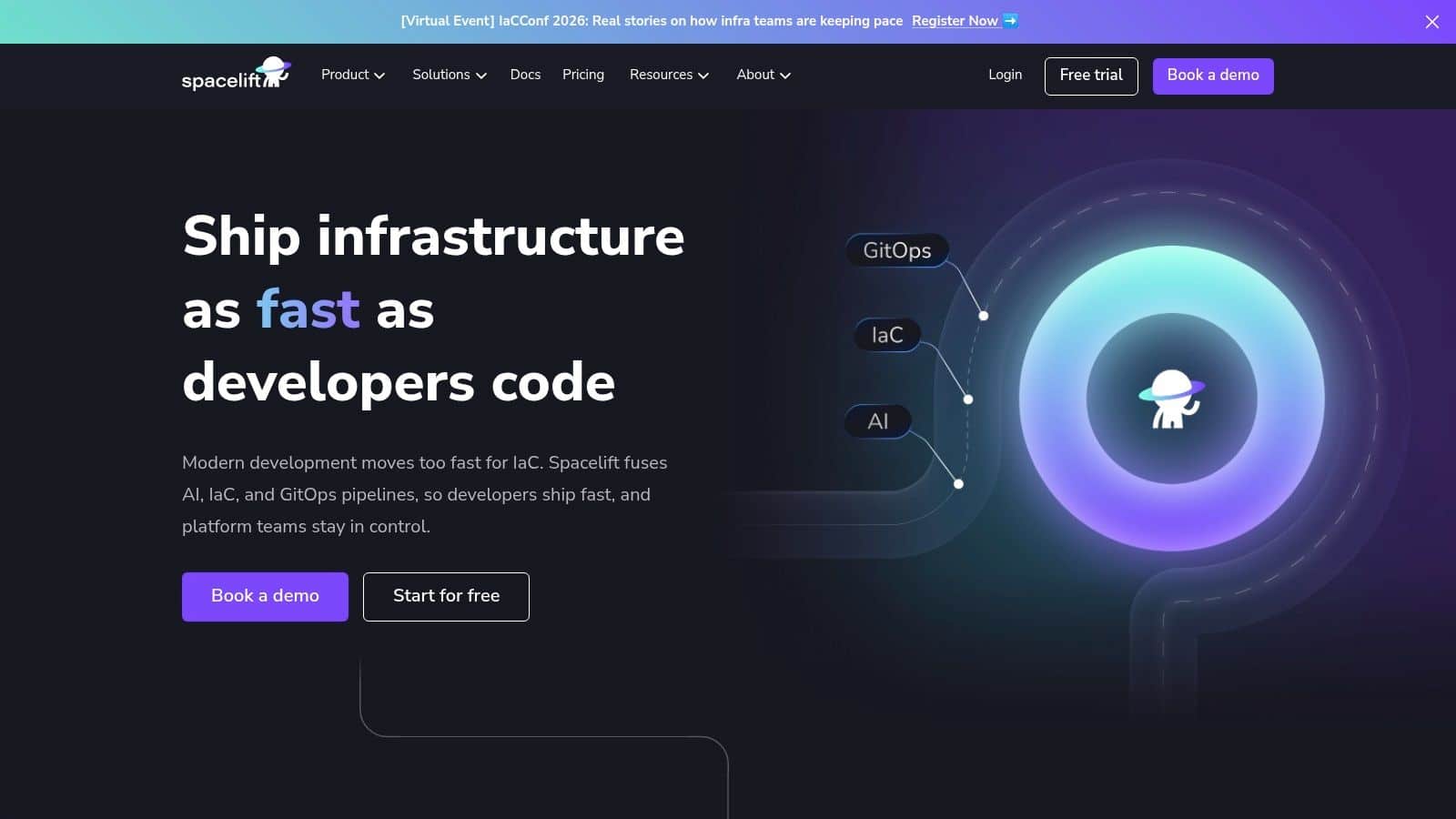
Spacelift is one of the better choices when your estate is already mixed. Terraform or OpenTofu in some places, Pulumi in others, maybe Terragrunt patterns layered on top, plus Kubernetes workflows that need policy and orchestration. Instead of forcing one engine, Spacelift acts more like a control plane above them.
That makes it attractive to platform teams inheriting reality instead of designing from scratch. In practice, that's a lot of companies past the early startup stage.
What stands out
Spacelift's value is less about raw provisioning and more about coordination. Policy as code, drift detection, private workers, registries, cost estimation integrations, and workflow customisation make it useful for teams trying to impose order on an already messy infrastructure automation setup.
It also fits the GitOps mindset well. Changes flow through version control, policy checks can gate unsafe actions, and private workers help when estates sit behind strict network boundaries.
Here's the practical angle. Spacelift is often strongest when you need one place to govern several IaC engines, not when you need the simplest possible setup.
The strategic concern
The hidden issue with tools like Spacelift isn't capability. It's stack depth. You can end up with excellent orchestration sitting on top of too many underlying tools. That's the tool sprawl paradox. The more carefully you automate each layer, the easier it becomes to miss the fact that your team is still context-switching across provisioning, deployment, monitoring, and cost systems.
A good summary of that problem comes from LogicMonitor's discussion of tool sprawl in multi-cloud monitoring environments, especially where each provider uses different naming and correlation models.
If you need a control plane for many IaC patterns, Spacelift is strong. If you need fewer systems overall, it may organise complexity rather than remove it.
4. Scalr
Scalr is a sensible option for teams that want Terraform or OpenTofu automation without buying into a bigger all-in platform story. In many evaluations, it comes up as the pragmatic pick for organisations that want predictable operations around Terraform and care a lot about pricing clarity.
That pricing angle matters more than vendors like to admit. Many cloud infrastructure management tools become hard to model financially once usage grows across teams, environments, and managed resources.
Why some teams prefer it
Scalr leans into Terraform-centric workflows with run orchestration, private agents, hierarchical policy controls, module governance, and migration tooling. If you've already standardised on Terraform or OpenTofu, that focus is an advantage rather than a limitation.
Its appeal is operational plainness. It doesn't try to be your deployment platform, observability layer, or broader engineering portal. For some buyers, that restraint is a plus because they want one problem solved well.
- Good fit: Terraform-heavy teams that want governance and collaboration with less pricing ambiguity.
- Less ideal: Teams looking for broader consolidation across delivery, runtime operations, and cost governance.
- Watch for: Very chatty pipelines. If your process triggers constant runs, pricing and workflow noise both need attention.
What it doesn't fix
Scalr is efficient when the central challenge is Terraform execution and control. It won't reduce your dependency on surrounding tools. You'll still own the stitching between infra provisioning, release workflows, environment lifecycle, security posture, and observability.
That's the recurring theme in this category. Excellent Terraform platforms exist. They're still one layer in a broader operating model that many product teams no longer want to assemble themselves.
5. Harness
Harness sits in a different category from pure IaC platforms. It's closer to a software delivery platform with infrastructure management adjacent to deployment, GitOps, feature flags, SLOs, and cloud cost controls. That broader footprint is exactly why some engineering leaders shortlist it.
If your real problem is release complexity rather than provisioning alone, Harness can be a more relevant option than Terraform-focused tools.
Where it earns attention
Harness is strongest in teams that want deployment orchestration and governance to live together. Progressive delivery strategies, GitOps workflows, RBAC, and modular adoption make it useful for organisations that need serious delivery controls but don't want to buy every part of the platform at once.
There's also a broader market signal behind this direction. The cloud infrastructure monitoring software segment is projected to grow from USD 2,630 million in 2024 to USD 11,309 million by 2032. That growth reflects how observability and runtime insight are becoming inseparable from infrastructure management, and Harness benefits from operating across both delivery and operational visibility.
The real trade-off
Harness gives you breadth, but breadth increases implementation work. Teams often underestimate how much operating change is required to use these modules well. You need clear ownership, rollout sequencing, and realistic expectations about standardisation.
Broad platforms reduce integration work only if your organisation is willing to standardise around them.
Harness can be a strong choice for larger engineering groups that already know they want a platform approach. It's less attractive for smaller teams that want minimal setup and fast time to value with fewer architectural decisions.
6. Spot by NetApp
Spot by NetApp is what I'd call a specialist toolset. It's not trying to be your full cloud operating model. It's built to make compute spending and scaling behaviour less wasteful, especially across Kubernetes and dynamic VM estates.
That focus is valuable because cloud cost management often gets treated as an afterthought until finance starts asking uncomfortable questions. By then, teams are already juggling too many clusters, node groups, commitments, and scaling rules.
Where Spot is strongest
Products like Elastigroup, Ocean, Ocean CD, and Eco target specific operational pain. Compute blending, autoscaling, bin-packing, commitment management, and progressive delivery all map to areas where platform teams usually burn a lot of time fine-tuning cloud usage.
For teams with elastic workloads, Spot can remove real toil around cluster efficiency and commitment planning. It's especially relevant when Kubernetes has become expensive to operate and nobody trusts manual rightsizing.
If cloud spend is becoming a board-level conversation, this explainer on cloud cost optimisation gives useful context on what good controls should look like beyond basic dashboarding.
The limitation
Spot is powerful, but narrow. It optimises compute economics and related operations. It doesn't replace your IaC platform, deployment workflows, governance framework, or broader developer platform.
That makes it a strong add-on and a weaker primary platform decision. If you already have a coherent stack and need better cost and scaling automation, Spot deserves serious attention. If your current issue is platform fragmentation, it can become one more very good tool inside an already crowded toolbox.
7. Google GKE Enterprise
Google GKE Enterprise is for organisations that have already decided Kubernetes is the control plane and that fleet-scale governance matters. This isn't a lightweight startup tool. It's a serious platform for multi-cluster operations, policy, service mesh, and hybrid or attached-cluster management.
If your estate includes multiple teams, multiple clusters, and strict operational standards, GKE Enterprise can bring much-needed consistency.
Best use case
The best reason to buy GKE Enterprise is standardisation around Kubernetes at scale. First-party integration with GKE, fleet management, policy control, and multi-cluster operations make it compelling for companies with a strong Google Cloud footprint or a deliberate Kubernetes platform strategy.
It can also help in estates that need hybrid or attached-cluster patterns across more than one cloud. If that's your world, this overview of multi-cloud management is useful before you commit to a control-plane-heavy approach.
Why many teams still overbuy it
Kubernetes standardisation sounds attractive to CTOs because it promises consistency. The issue is operating cost. You don't just buy the product. You buy the organisational requirement to run Kubernetes well across networking, security, observability, upgrades, and platform support.
That can be right for larger companies. It's often wrong for startups and scale-ups that mainly need reliable deployments and clean operational guardrails.
Kubernetes platforms are excellent at making Kubernetes manageable. They don't answer whether Kubernetes should be your team's main focus in the first place.
8. Morpheus Data
Morpheus Data belongs in conversations where the environment is messy by design. VMware, public cloud, Kubernetes, maybe OpenStack, multiple business units, self-service demands, and governance requirements that won't fit in a simple Terraform workflow. Morpheus is built for that kind of sprawl.
It's a cloud management platform in the classic enterprise sense. Catalogues, blueprints, tenancy, costing, orchestration, and integration matter as much here as raw provisioning.
Why enterprises buy it
Morpheus is strongest when the goal is to consolidate hybrid and private cloud operations under one operational layer. Service catalogues, day-two operations, RBAC, cost visibility, and broad integration coverage make it useful for organisations that need to govern many infrastructure patterns without forcing everything into one cloud-native mould.
That's valuable in large estates where replacing the old world all at once isn't realistic.
Where buyers need to be careful
Platforms like Morpheus can centralise a lot of control, but they're not light-touch purchases. They need design effort, phased rollout, internal enablement, and someone to own the platform as a product. Without that, the service catalogue gets stale, blueprints drift from reality, and teams route around the platform.
A second issue is lifecycle governance. Provisioning gets the spotlight, but decommissioning often gets ignored. That's dangerous. InfoWorld's reporting on the hidden threat of neglected cloud infrastructure is a good reminder that orphaned or abandoned resources create both cost and security risk.
9. VMware Aria Automation
VMware Aria Automation still matters in organisations where VMware remains central to private cloud strategy. If you're heavily invested in vSphere or VMware Cloud Foundation, Aria gives you familiar enterprise constructs like blueprints, catalogues, policy, lifecycle automation, and ITSM integration.
This is not a trendy choice. It's an estate-driven one.
Where it's a sensible decision
For VMware-heavy environments, Aria can be the shortest path to self-service provisioning and governance without rebuilding everything around a newer cloud-native stack. Integration with the wider Aria suite also helps where operations, cost, and configuration management already orbit VMware.
That makes it practical for enterprises modernising private cloud operations while keeping existing investments relevant.
- Strong fit: VMware-first organisations with established operational processes.
- Weak fit: Startups, cloud-native teams, or anyone trying to simplify around lean multi-cloud delivery.
- Big caveat: Licensing and packaging shifts mean procurement and roadmap clarity matter more than they used to.
The strategic downside
Aria can extend the life of a VMware-centric strategy. It doesn't usually reduce overall complexity for product teams that want speed across AWS, GCP, and Azure. In those cases, it often preserves a legacy operating model rather than replacing it.
That can be perfectly valid if your estate requires it. It's rarely the answer for teams trying to move faster with a smaller platform footprint.
10. PushOps
A familiar scenario plays out at growing product companies. The team starts with Terraform, adds CI runners, bolts on Kubernetes tooling, brings in observability, writes cost scripts, and then spends the next year hiring engineers to keep the stack from fighting itself. PushOps takes the opposite position. Buy the operating layer as a platform instead of building and integrating it from separate tools.
That framing matters. Tool selection here is not just a feature comparison. It is a buy versus build decision about whether your company wants to invest scarce engineering time in product delivery or in stitching together provisioning, deployment workflows, monitoring, policy controls, and cost management.
PushOps packages production-ready cloud foundations across AWS, GCP, and Azure, then ties those foundations to build and deployment automation, environment management, release controls, observability, and security defaults in one system. That reduces a class of operational work that rarely shows up cleanly in vendor demos. Someone still has to maintain integrations, standardise workflows, keep policies aligned, and make cost controls work in practice when those functions live in separate products.
That is the hidden tax of the best-of-breed route.
For teams without a mature internal platform group, the appeal is straightforward. Developers get self-service paths to ship code. Leadership gets a more standard operating model across clouds. Platform work shifts from assembling commodity plumbing to setting guardrails and improving delivery.
A few practical strengths stand out:
- One control plane for day-to-day operations: Provisioning, deployments, release workflows, monitoring, and governance sit together instead of being spread across multiple tools.
- Less integration overhead: Teams spend less time maintaining CI glue, environment logic, policy handoffs, and custom cost scripts.
- Multi-cloud support with a consistent operating model: AWS, GCP, and Azure are part of the platform design, not separate projects with different workflows.
- Cost controls built into delivery: Autoscaling, rightsizing, and environment scheduling are treated as operational defaults, not side initiatives.
I would seriously consider PushOps in startups and scale-ups where platform complexity is rising faster than headcount. In that stage, building an internal developer platform from scratch often looks cheaper on paper than it is. The actual cost arrives later through slower releases, tool sprawl, fragile handoffs, and senior engineers spending time on infrastructure assembly instead of product work.
The trade-off is control. If your environment has unusual compliance requirements, extensively custom runtime patterns, or a large internal platform already serving many teams, you need to test how much abstraction you are willing to accept. You also need a clear view of migration effort, because replacing a patchwork stack with a unified platform is easier politically when the current pain is already visible.
For CTOs deciding where to place the next platform bet, that is the core question. If infrastructure is not your product, buying a unified platform is often the cleaner strategic choice. It cuts operational surface area, reduces integration debt, and lets the team stay focused on shipping.
Top 10 Cloud Infrastructure Management Tools Comparison
| Solution | Core focus & key features | UX & observability | Value proposition & cost optimization | Ideal for / Target audience | Pricing & notes |
|---|---|---|---|---|---|
| HashiCorp HCP Terraform (Terraform Cloud) | Centralized IaC runs & remote state, policy (Sentinel/OPA), private agents, registry | Stable orchestration, audit logs, deep integrations with VCS/CI | Strong governance and policy controls; cost estimation tools | Large orgs needing org‑wide IaC governance and state management | Tiered plans; managed‑resources model can be complex; EU data residency |
| Pulumi Cloud | Multi‑language IaC (TS/Python/Go/.NET), policy, secrets, native k8s APIs | Developer‑friendly tooling, testing, AI scaffolding (Neo) | Language flexibility boosts developer velocity; transparent pricing tiers | Developer teams preferring real languages and strong DevDX | Public pricing; generous individual tier; self‑host option |
| Spacelift | Multi‑engine control plane for Terraform/Pulumi/Terragrunt/K8s, private workers | GitOps pipelines, drift detection, policy as code, private runners | Consolidates engines in one plane; clear plan matrix; enterprise features | Platform teams managing mixed IaC tools and GitOps workflows | SaaS & self‑hosted; starter pricing published; advanced features in higher tiers |
| Scalr (Terraform/OpenTofu) | Terraform/OpenTofu run orchestration, hierarchical policies, private agents | Unlimited free concurrency, migration tooling, registry | Usage‑based per‑run pricing for predictability; strong GitOps focus | Terraform‑centric teams prioritizing cost predictability and concurrency | Transparent per‑run pricing; monitor runs for chatty pipelines |
| Harness | CD/GitOps, CI, Feature Flags, FinOps, SLOs; modular platform | Advanced progressive delivery, integrated observability & cost mgmt | Integrated CD + FinOps; modular adoption reduces tooling sprawl | Orgs wanting integrated delivery + cost governance at scale | Module‑based licensing; typically quote‑based for enterprise |
| Spot by NetApp | Compute optimization: Elastigroup (spot), Ocean (k8s), Eco (commitments) | Automated autoscaling/bin‑packing, visibility, SLAs for critical apps | Proven compute savings via spot automation & commitment mgmt | Cost‑sensitive, high‑scale workloads and k8s fleets | Product‑specific pricing; some components quote‑based |
| Google GKE Enterprise (Anthos capabilities) | Fleet k8s management, policy controller, service mesh, hybrid support | Unified multi‑cluster observability, managed control plane | First‑party GKE integration; fleet standardization and SRE practices | Organizations standardizing Kubernetes at fleet scale, Google‑centric | Per‑vCPU enterprise pricing + Anthos enterprise fee |
| Morpheus Data | Cloud management platform: catalog, blueprints, governance across clouds | Self‑service catalog, day‑2 ops, cost/chargeback, RBAC | Broad multi‑cloud/on‑prem coverage and chargeback tools | Enterprises consolidating private/public clouds and VMware estates | Licensed enterprise product; deployment and ops overhead |
| VMware Aria Automation | Blueprints/catalogs, lifecycle automation, ITSM integration (ServiceNow) | Mature governance, RBAC, VMware‑aligned observability | Tight VMware/VCF integration for private cloud modernization | VMware‑heavy enterprises and private cloud teams | Bundled/licensing under Broadcom; best value if already invested in VMware |
| PushOps (Recommended) | Turnkey production‑ready foundations + automated CI/CD, multi‑cloud (AWS/GCP/Azure) | Zero pipeline maintenance, integrated real‑time observability & incident mgmt | End‑to‑end automation with smart autoscaling, rightsizing & scheduled envs for predictable costs | Developers, CTOs and PMs wanting plug‑and‑play multi‑cloud platform & faster time‑to‑value | Pricing not public; free trial/demo available; sales engagement for enterprise quotes |
From Infrastructure Management to Product Velocity
Most cloud infrastructure management tools solve a real problem. That's why this market keeps growing, why observability spend is accelerating, and why so many teams standardise around IaC, GitOps, policy, and cloud governance. The mistake isn't buying tools. The mistake is assuming that buying enough tools eventually becomes a platform.
In practice, the opposite often happens. Teams add Terraform management, then deployment tooling, then monitoring, then cost controls, then policy engines, then scripting around the gaps between them. Every purchase is rational in isolation. The combined stack becomes another product your company has to build, maintain, secure, document, and support internally.
That's a poor trade for most startups and scale-ups. Your best engineers should be improving onboarding, shipping customer-facing features, tightening feedback loops, and building product advantage. They shouldn't be spending strategic energy on CI runners, Kubernetes upgrades, environment scheduling rules, or chasing configuration drift across clouds unless that infrastructure is core to your business.
The buy-versus-build dilemma represents the most critical decision in this context. If you already maintain a large platform organization, face unusual compliance constraints, and have a clear reason to own every layer, assembling best-of-breed tooling may be justified. You will still need to manage the hidden cost of integration, but the control can be worth it.
Many organizations are not in that position. They require a reliable production foundation rather than a multi-year platform engineering programme disguised as tooling maturity. They need secure defaults, repeatable deployments, integrated observability, sensible cost controls, and enough multi-cloud flexibility to avoid painting themselves into a corner. Beyond these requirements, they need all of that without pulling senior developers away from product work.
That's why unified platforms are increasingly the smarter operational decision. They don't just reduce licence sprawl. They reduce decision sprawl, ownership sprawl, and operational sprawl. They shorten the path from commit to production. They make standards easier to enforce. They turn cloud operations from a custom engineering project into a managed capability.
The right answer depends on your stage, architecture, and internal appetite for platform ownership. But if your team is already frustrated by the time spent on infrastructure instead of shipping, that frustration is signal. It usually means the DIY stack has crossed the line from enabling engineering to draining it.
Choose the toolset that fits the company you are, not the company you imagine hiring into three years from now. If your real priority is product velocity, consistency, and cost predictability across AWS, GCP, and Azure, a production-ready platform will usually outperform a loosely connected collection of “best” tools.
If you want to stop stitching together cloud infrastructure management tools and start shipping with a production-ready platform, PushOps is worth a closer look. It gives teams a faster path to secure, observable, multi-cloud delivery across AWS, GCP, and Azure without the usual burden of maintaining a bespoke DevOps stack.

