
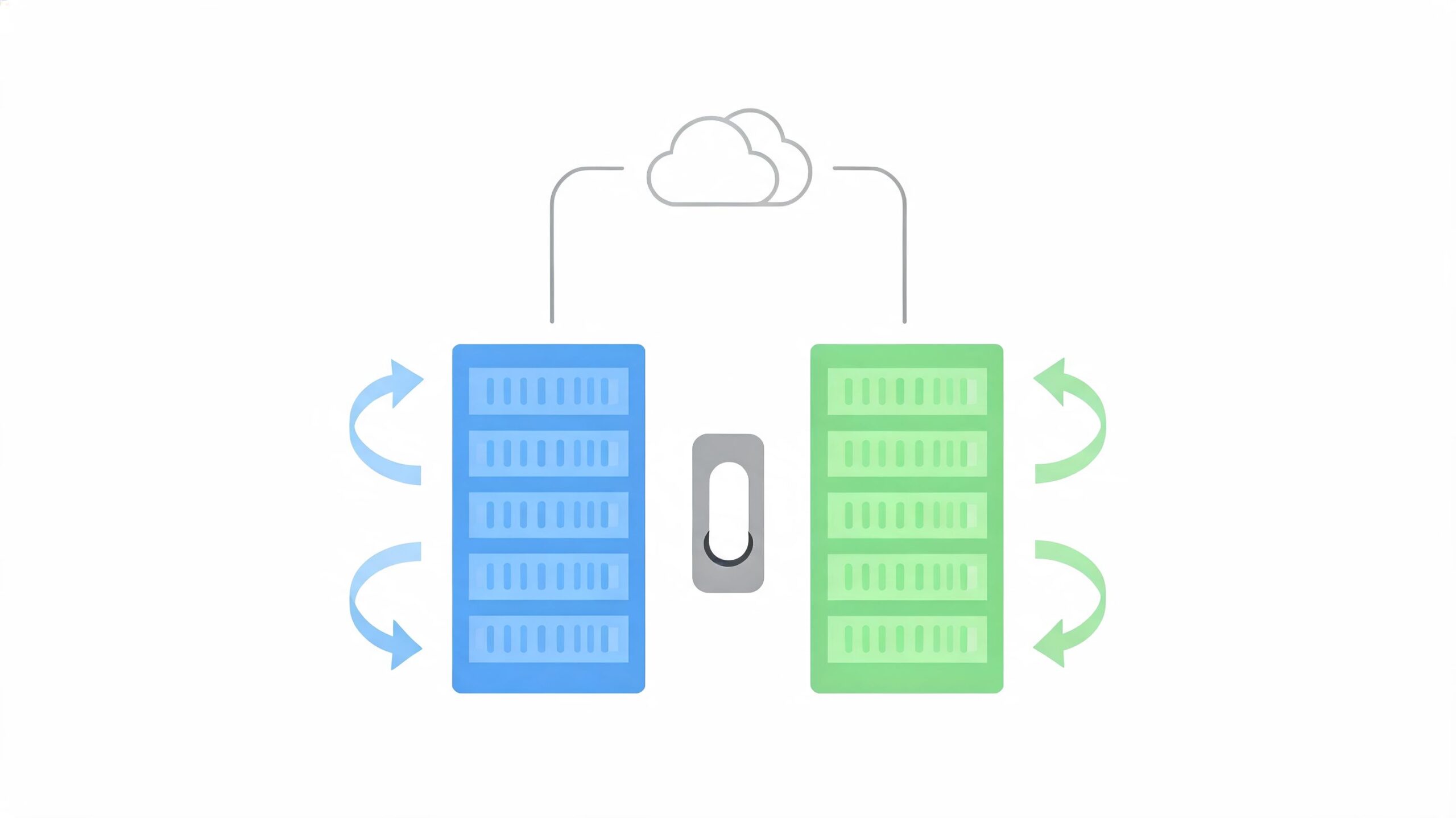

Most engineering leaders don't decide to build a fragile release system. They inherit one. A Jenkins job here, some GitHub Actions there, a few Terraform modules nobody wants to touch, a Kubernetes ingress rule that only one staff engineer fully understands, and a rollback process that still depends on a Slack thread and a lot of adrenaline.
Then a routine release goes sideways. The app slows, errors climb, customers notice, and the team starts debugging production while trying to reverse changes on the live system. That's the moment when blue green deployment starts to sound less like an architectural preference and more like basic operational hygiene.
The catch is that the neat diagram commonly envisioned leaves out the hard part. Blue green deployment is simple to describe and much harder to implement safely in a real company with databases, queues, background workers, session state, multiple services, and more than one cloud account. That gap matters because many startups and scale-ups respond by building more internal DevOps machinery, when what they really need is a dependable platform that lets product teams ship without babysitting infrastructure.
Your Last Late-Night Deployment Rollback
It's late. A release was supposed to be routine. Instead, your primary application is unstable, support is escalating, and senior engineers are comparing logs while someone asks the least comforting question in software operations: “Can we roll back safely?”
If your current release process edits production in place, rollback usually isn't a clean reversal. It's a second deployment under pressure. That means you're depending on the same pipeline, the same scripts, and the same people who are already in the middle of an incident. Teams often discover at that point that their rollback path exists in theory more than in practice.
A lot of mobile teams learn this lesson early when they start thinking seriously about implementing Capacitor app rollbacks. The release mechanism matters, but the operational discipline around reversal matters just as much. Server, web, and API teams face the same reality. If rollback is slow, manual, or uncertain, every release carries more business risk than it should.
Shipping fast isn't the problem. Shipping without a reliable return path is.
Blue green deployment is often presented as the answer. Keep one environment live. Prepare the next release in another identical one. Test it. Switch traffic. Switch back if needed. On paper, that sounds like exactly what a tired engineering team wants after too many stressful releases.
It is a strong pattern. But adopting it properly means building more than a deployment script. You need environment parity, traffic control, validation gates, monitoring, failback logic, and a strategy for stateful components. That's where many teams drift from “safer releases” into “we're accidentally building an internal platform team”.
What Is Blue-Green Deployment
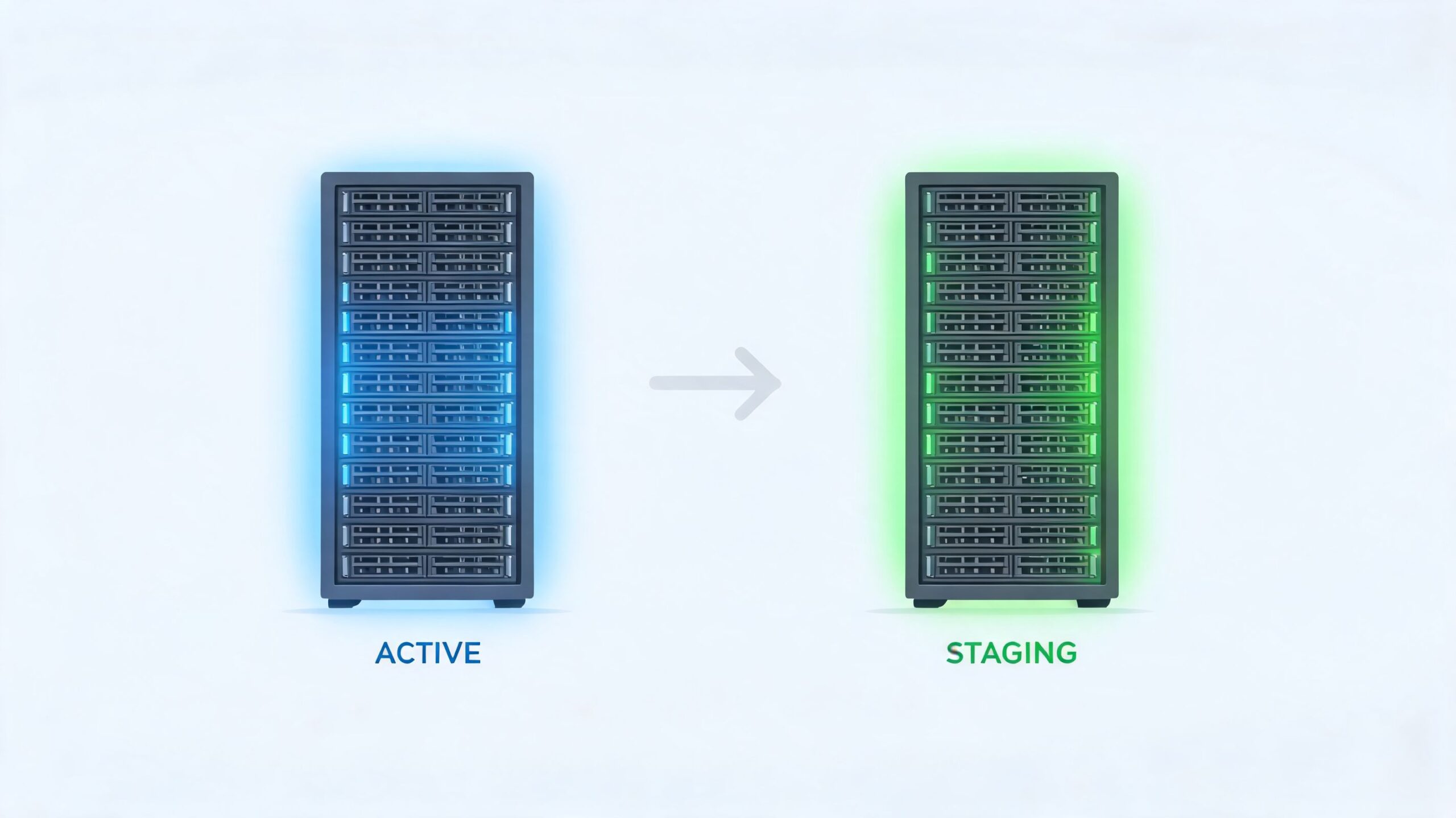
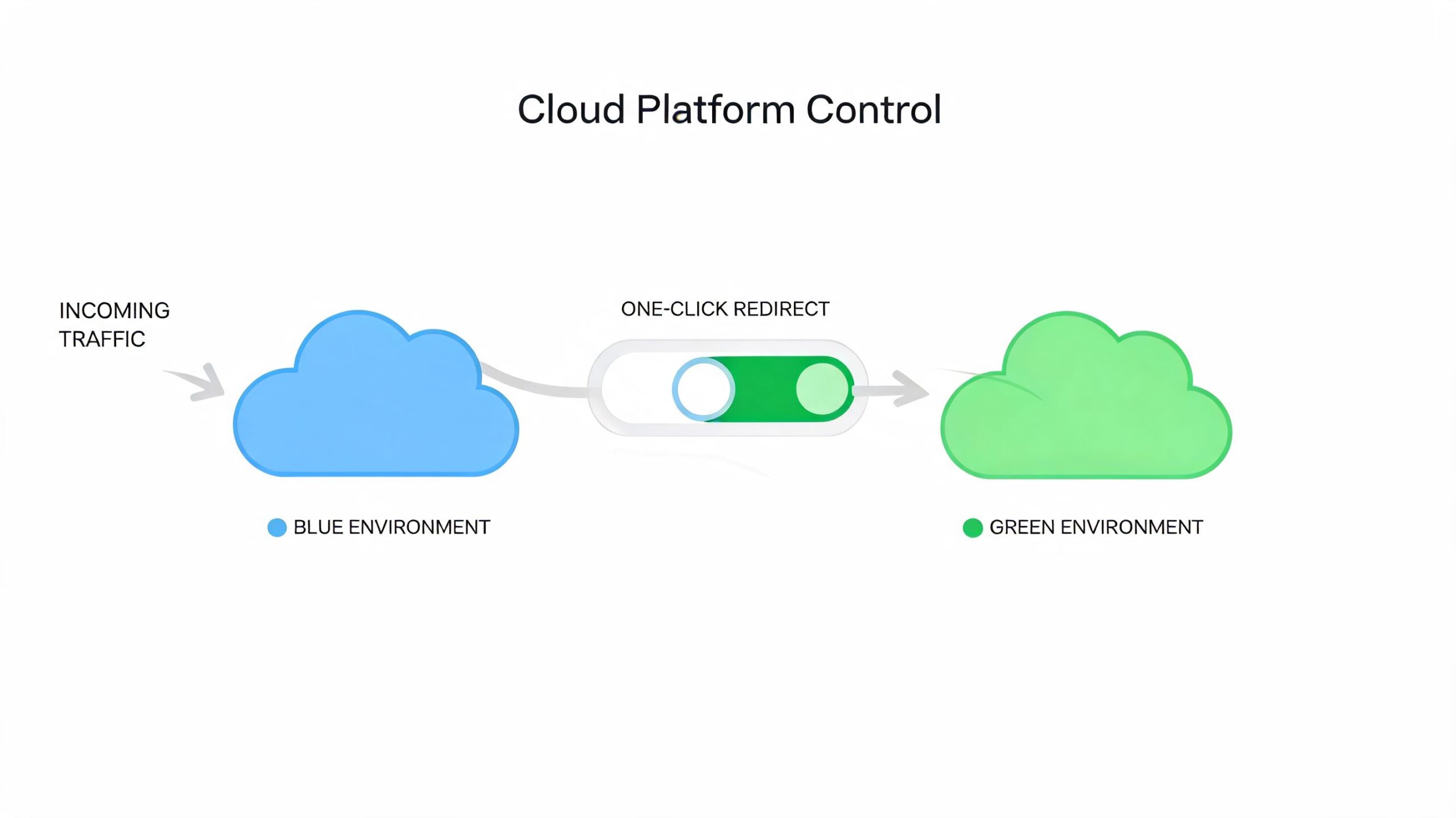
Blue green deployment is a release pattern built around two identical production environments. One serves live traffic. The other sits idle while the team deploys and validates the next version. The approach became widely recognised after Jez Humble and David Farley popularised it in their 2010 book Continuous Delivery, which is why it's better understood as a mature delivery pattern than a passing DevOps trend, as noted by IBM's overview of blue green deployment.
Two stages, one audience
The simplest way to think about it is a theatre with two identical stages.
The blue stage is the one your audience sees. That's production. The green stage is set up backstage with the new version of the application. Engineers deploy there first, run checks, and make sure the release behaves as expected before any user sees it.
The final step is the traffic switch. A router, usually a load balancer or similar traffic control layer, moves live requests from blue to green. If the green environment behaves properly, it becomes the new live system. If it fails, traffic goes back to blue.
Why teams like this pattern
The power of the model is operational, not conceptual. You aren't modifying the active system in place. You're preparing the next version away from users and changing where traffic goes only when you're ready.
That gives teams a few practical advantages:
- Near zero-downtime releases: Users keep hitting the current environment while the next one is prepared.
- Fast rollback: If the release fails after cutover, traffic can be redirected back to the previous environment.
- Safer validation: Teams can run production-like checks against the idle environment before exposing the new version.
Practical rule: blue green deployment only works if blue and green are operationally indistinguishable before the switch.
That last point is where many diagrams stop too early. “Two identical environments” sounds straightforward until you try to keep infrastructure, secrets, networking, dependencies, and runtime configuration in sync across clouds and accounts. The elegance of the model depends on discipline in everything around the model.
The Hidden Costs of a DIY Blue-Green Setup
Blue green deployment looks clean on a whiteboard because the diagram usually ends at the load balancer. Real systems don't end there. They include databases, queues, caches, file stores, scheduled jobs, authentication flows, and session state. That's where a DIY setup starts collecting hidden cost.
Martin Fowler notes that while blue green deployment is powerful for rapid rollback, the pattern itself doesn't solve schema or data compatibility issues. He also highlights the practical difficulty of coordinating the data layer, long-lived sessions, and background jobs in real systems, which is exactly where many generic guides fall short in his explanation of blue green deployment.
The database problem isn't an edge case
If the green release needs a schema change, you need to answer a difficult question before deployment starts. Can both blue and green work against the same data safely?
If the answer is no, rollback gets dangerous fast. The application might switch back cleanly while the database no longer matches the previous version's expectations. That's why teams doing this well spend serious engineering time on backward-compatible migrations, phased data changes, and release sequencing. None of that is visible in the tidy “flip traffic” diagram.
Here's what often has to be designed explicitly:
- Backward-compatible schema changes: Additive changes are easier than destructive ones because blue may still need to run after green is deployed.
- Data migration timing: Bulk migrations during cutover create risk. Staged migrations reduce risk but add process complexity.
- Queue and job coordination: Background workers can process data in formats one environment understands and the other doesn't.
Stateful systems complicate the switch
Stateless services are the happy path. Many businesses don't have only stateless services.
Long-lived sessions, carts, uploads, websocket connections, and in-flight jobs all make cutover more complicated. If user state is pinned to one environment, the switch can break active sessions or produce inconsistent behaviour. If background jobs continue running in both places without careful control, duplicate work and race conditions become likely.
A few common failure modes show up repeatedly:
| Area | What goes wrong in DIY setups |
|---|---|
| Sessions | Users authenticate on one environment and hit another after cutover |
| Background jobs | Blue and green both consume the same work unexpectedly |
| Caches | Green appears healthy in tests but behaves differently under live cache patterns |
| Config | One small environment mismatch creates a production-only defect |
Environment parity is labour, not a checkbox
Blue and green must be equivalent in ways that matter operationally. Same runtime assumptions. Same network paths. Same secrets handling. Same scaling rules. Same policy controls. Same observability hooks.
That pushes teams toward Infrastructure as Code, immutable environments, and a lot of automation. It also creates a maintenance burden that rarely appears in the initial cost estimate. Senior engineers end up owning bespoke scripts, Terraform modules, Kubernetes templates, release runbooks, and cloud glue code instead of shipping customer-facing work.
Most teams don't mean to build an internal developer platform. They just keep solving one deployment problem at a time until they've built one by accident.
For a startup or scale-up, that's the main business trade-off. Blue green deployment can reduce release risk, but a DIY implementation often shifts the burden into ongoing platform engineering work. The release pattern is sound. The operating model around it is where cost accumulates.
Comparing Release Strategies
Blue green deployment is useful, but it isn't the only release strategy worth considering. The better question for a CTO or VP Engineering is which pattern fits which service, and how much operational complexity the team is prepared to own.
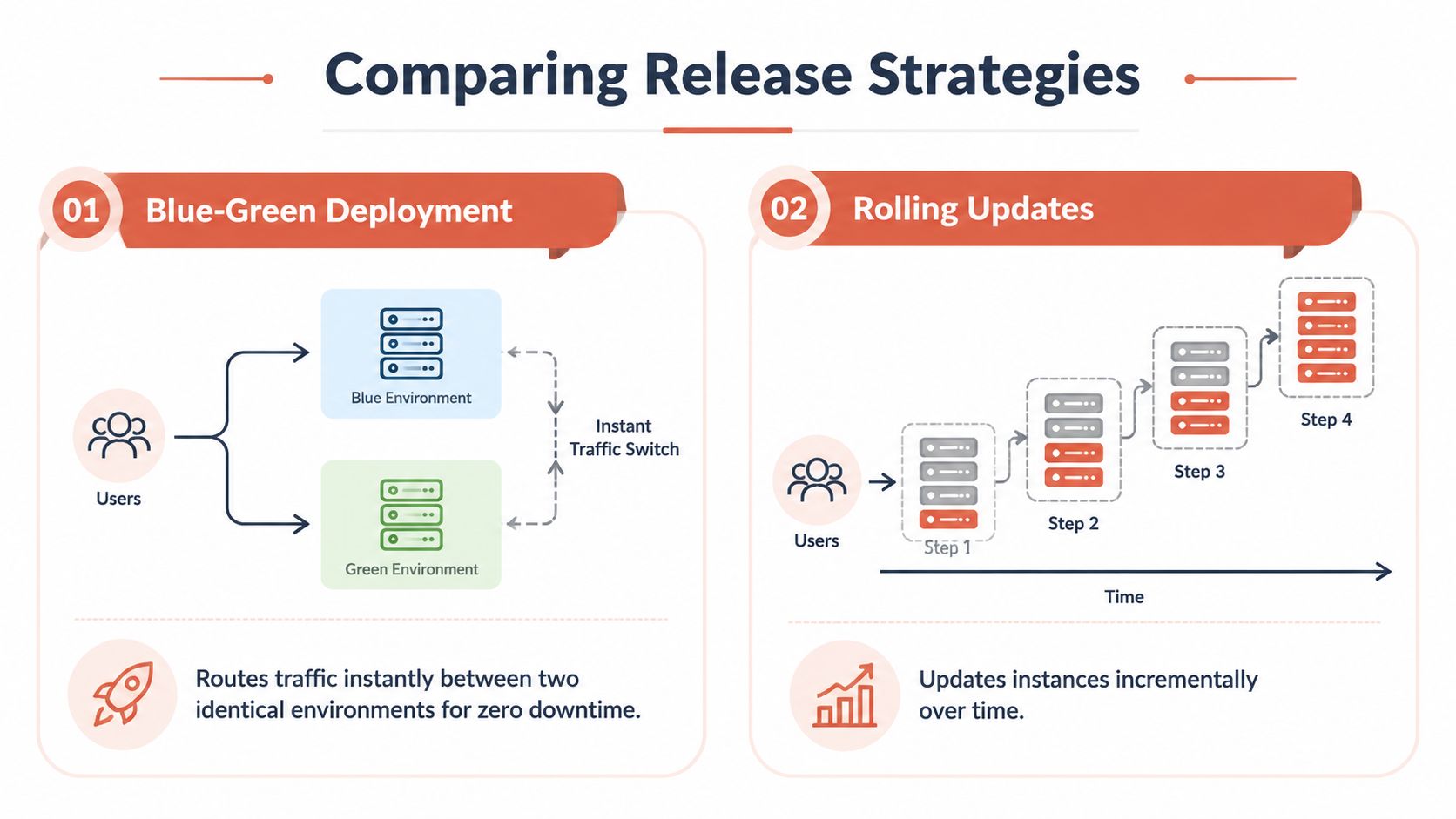
One of blue green deployment's main advantages is that the technical risk shifts from “deploying code” to “switching traffic”, which is a smaller failure domain. That instantaneous traffic cutover after validation is what minimises downtime and enables near-immediate rollback by re-pointing a load balancer, as described in Octopus Deploy's guide to blue green deployment.
Side-by-side trade-offs
Different release patterns solve different problems. The comparison below is how I'd frame it in an architecture review.
| Strategy | Where it works well | Main strength | Main drawback |
|---|---|---|---|
| Blue green | Services where rapid rollback and availability matter | Clean cutover and fast failback | Requires duplicate environments and strong operational discipline |
| Rolling update | Standard stateless services with lower release risk | Simpler to implement | Rollback is less clean because the fleet changes gradually |
| Canary release | Systems where limiting blast radius matters | Exposure starts with a smaller audience | Requires mature traffic shaping and close monitoring |
| Feature flags | Product features that can be controlled independent of deploys | Fine-grained release control | Adds code complexity and state combinations to test |
What works and what usually doesn't
Rolling updates are often the default because orchestration platforms make them easy. They're fine for many internal services. They're less appealing when you need an immediate return to a known-good state and can't tolerate partial rollout ambiguity.
Canaries are strong when you want evidence from a smaller production slice before full rollout. They're also operationally heavier than teams expect. You need meaningful segmenting, metrics you trust, and enough traffic intelligence to decide whether the canary is safe. For teams weighing these options, this comparison of blue green deployments vs canary deployments is a useful framing.
Feature flags solve a different layer of the problem. They decouple release from deployment, which is powerful, but they don't replace infrastructure release strategy. They also create long-term code maintenance costs if the team never retires old flags.
The right answer is rarely one release strategy for the whole company. It's a platform that lets different services use the right strategy without bespoke engineering every time.
That's where DIY approaches start to strain. Supporting one safe release model is already substantial work. Supporting blue green for one service, rolling updates for another, canaries for a customer-facing API, and flags for product launches is a platform concern, not a side task for whichever engineer knows the CI files best.
Production-Ready Deployment Practices
A real blue green deployment process depends on automation. Not nice-to-have automation. The kind that removes manual judgement from the risky part of the release.
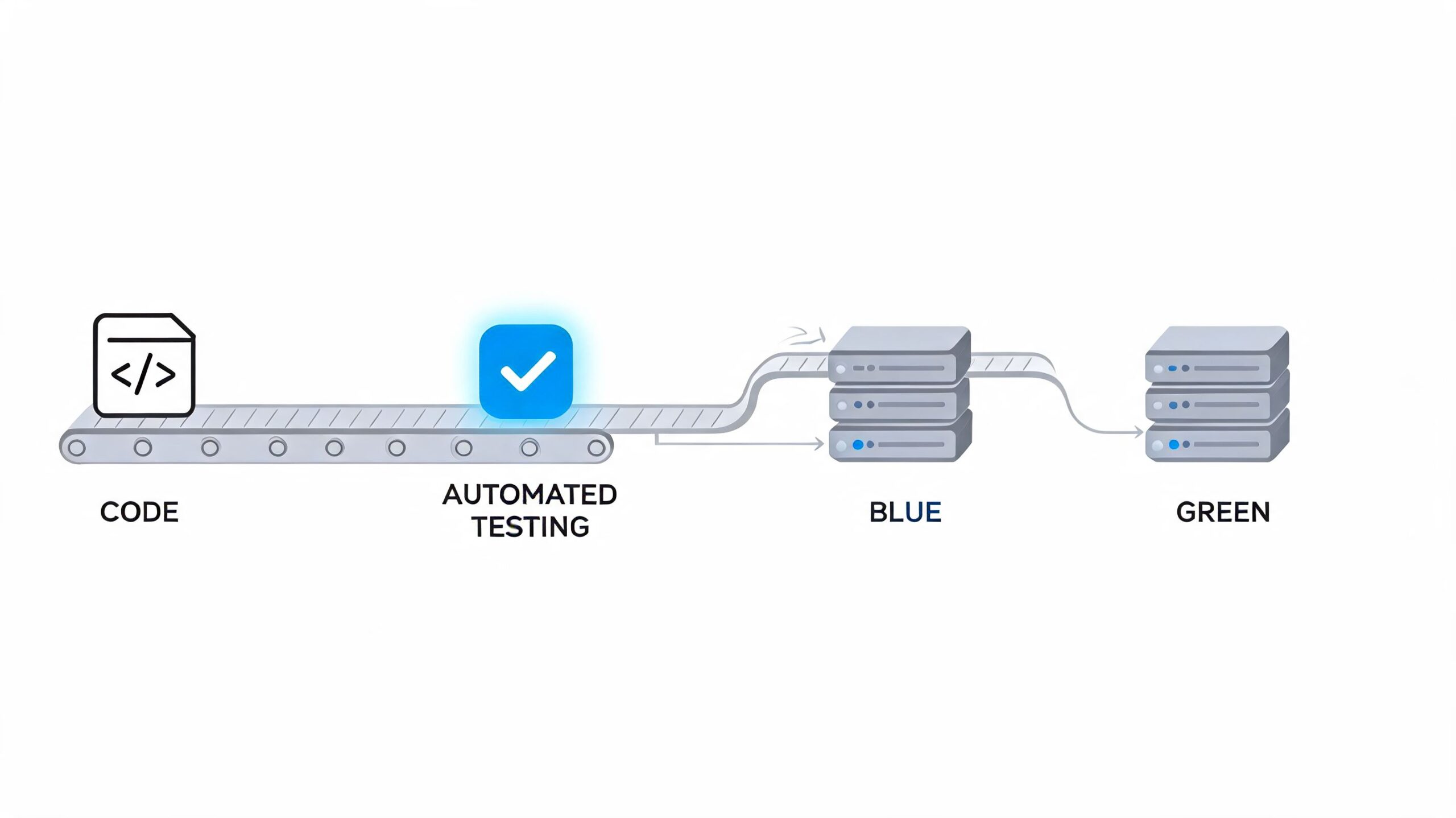
Expert implementations rely on automated validation gates before any traffic switch. The new environment is validated through health, security, and performance checks, then monitored after cutover so anomalies can trigger rapid failback, which is why automation is central to reducing human error in Enov8's write-up on blue green deployment practice.
What a serious setup includes
The minimum bar is higher than many teams think. A production-ready workflow usually needs all of the following:
- Immutable environment creation: Build or provision the green stack as a fresh environment rather than patching an old one.
- Automated test gates: Run health checks, smoke tests, integration validation, and release-specific checks before traffic moves.
- Cutover controls: Make the switch predictable and reversible through the traffic layer, not through ad hoc deployment actions.
- Post-cutover monitoring: Watch application health immediately after release and define clear rollback conditions.
- Runbook discipline: If humans are involved at all, they need clear, current operating steps. Teams that struggle here often benefit from a structured approach to managing engineering runbooks.
Where DIY pipelines stall
Most in-house systems aren't fully automated. They're semi-automated. That means a build passes, a deploy happens, then someone manually checks dashboards, someone else confirms a smoke test, and a senior engineer decides whether to switch traffic. That process can work for a while, but it doesn't scale cleanly across teams or clouds.
The trouble spots are predictable:
Validation gaps
Unit tests pass, but production dependencies behave differently. The green environment looks healthy until real traffic arrives.Observability inconsistency
Logs exist, metrics exist, traces may exist, but they aren't tied tightly enough to the release event to support fast judgement.Manual rollback decisions
Teams know how to switch back, but the trigger isn't codified. During an incident, hesitation costs time.
For teams combining release techniques, feature management often belongs in the same conversation as deployment safety. This overview of feature flags and safe releases is useful because it shows where application-level controls complement infrastructure-level release patterns.
Good release engineering removes heroics from deployment night.
If you're running across AWS, GCP, and Azure, the effort expands again. Every cloud has its own networking model, load balancing behaviour, policy controls, and operational quirks. Building a release system that behaves consistently across all of them is platform engineering work by any honest definition.
How a Modern Platform Solves These Challenges
At some point, the question stops being “can we implement blue green deployment?” and becomes “should we keep investing engineering time in building all the supporting machinery ourselves?”
For many startups and scale-ups, the answer is no. The business doesn't win because the company wrote custom scripts for cutover logic or built its own abstraction for environment parity. It wins because product teams ship reliably, security controls stay consistent, and cloud costs remain understandable.
What the platform approach changes
A modern deployment platform takes the repeated operational problems and turns them into standard workflows. That typically means:
- Provisioning parity by default: Blue and green environments come from the same templates and policies, which reduces drift.
- Integrated deployment orchestration: Build, validation, cutover, and rollback sit in one workflow rather than across multiple disconnected tools.
- Shared observability and governance: Monitoring, access controls, auditability, and policy enforcement aren't bolted on later.
- Multi-cloud consistency: Teams get similar release processes across AWS, GCP, and Azure instead of rebuilding patterns for each provider.
That matters because release safety is rarely an isolated capability. It sits on top of cloud provisioning, secrets, identity, networking, monitoring, and cost management. If each layer is hand-assembled, every deployment strategy becomes harder to trust.
Why this is a business decision, not just a technical one
Hiring more DevOps engineers can help, but it often extends the same pattern. The team continues investing in internal plumbing. Over time, that can turn into a quiet tax on roadmap speed.
A platform approach changes the trade-off. Instead of assigning senior engineers to maintain CI/CD glue, traffic-switching logic, and cloud-specific deployment code, teams consume those capabilities as part of the operating model. For example, developer platform automation is useful precisely because it turns release mechanics into a standard service developers can use without owning the internals.
PushOps is one example of this model. It provisions production-ready foundations across AWS, GCP, and Azure, then automates builds, environments, deployments, release workflows, observability, security controls, and spend management in one system. The practical value isn't that it introduces a new release concept. It's that it reduces the amount of in-house engineering needed to run established patterns like blue green deployment safely.
If release safety depends on a few internal experts being available every time, you don't have a platform. You have operational debt with good intentions.
Focus on Product Not Pipelines
Blue green deployment is a strong release pattern because it gives teams a cleaner way to ship and a faster way to recover. But the pattern only delivers that value when the surrounding system is disciplined, automated, and boring in the best possible sense.
That's why this is bigger than deployment technique. It's a question of where you want your engineering time to go. Into Kubernetes plumbing, CI/CD maintenance, cloud edge cases, monitoring integration, security policy sprawl, and rollback scripting. Or into product work that customers notice.
The hidden cost of DIY DevOps isn't only operational complexity. It's opportunity cost. Every senior engineer maintaining internal platform glue is a senior engineer not improving onboarding, billing, search, analytics, AI features, or whatever differentiates your business.
Blue green deployment can absolutely be worth it. Building and maintaining every supporting layer yourself often isn't.
If your team wants safer releases without turning into a part-time platform engineering group, take a look at PushOps. It's built for teams that want production-ready infrastructure, automated deployments, integrated observability, and multi-cloud support without spending their roadmap on internal DevOps tooling.

