


As a CTO or VP of Engineering, your primary frustration is likely time spent on infrastructure instead of your product. Your best engineers are bogged down maintaining a complex stack of DevOps tools when they should be shipping features. Developer platform automation is the strategic shift to solve this. It means swapping the endless grind of managing Kubernetes and fragile CI/CD pipelines for a reliable, production-ready platform, freeing your team to focus 100% on what grows the business.
The Hidden Infrastructure Tax Slowing You Down
As a technical leader at a startup or scale-up, you know your team's real job is to deliver product value. Yet, many engineering teams are silently burdened by a crippling 'infrastructure tax'. This isn't a line item on a budget sheet; it's the constant, invisible drain on time and talent spent on undifferentiated heavy lifting.
Think of it this way: would you build a custom power plant for a new office? Of course not. You’d plug into the national grid. Building it yourself sounds powerful—total control, right? But the reality is a nightmare of round-the-clock maintenance, specialised staff, and constant fire-fighting. That’s exactly what happens when teams decide to build their own DevOps stack from scratch. Most over-invest in building and maintaining their own Kubernetes, CI/CD, monitoring, security, and cost control stack, when what they really want is a reliable platform to ship features.
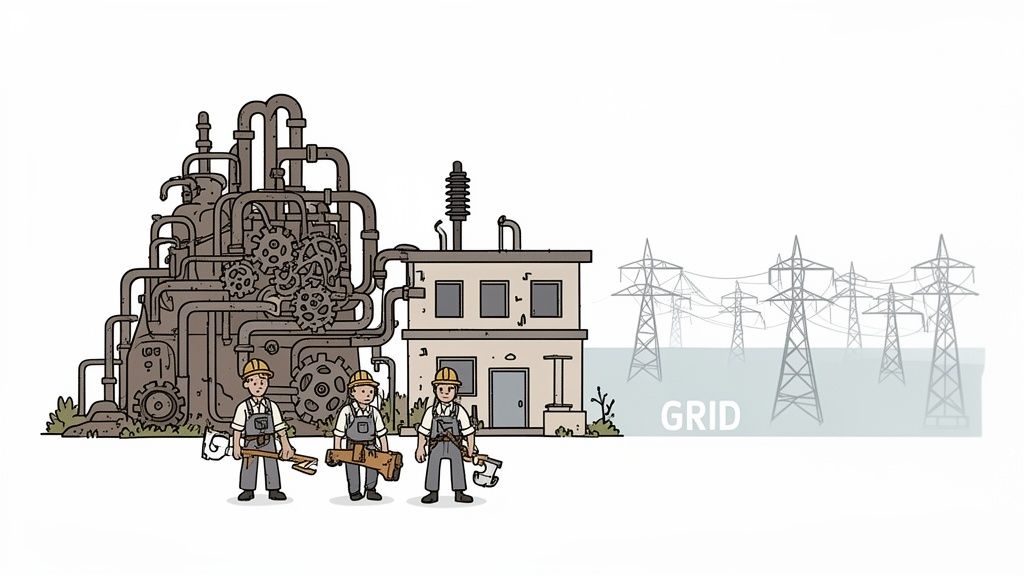
The DIY DevOps Trap
Building your own internal developer platform usually starts with the best intentions. But it almost always spirals into a tangled mess of interconnected tools. Before you know it, your team is spending its most valuable hours on tasks that have nothing to do with your core product:
- Wrestling with complex Kubernetes configurations across AWS, GCP, and Azure.
- Patching brittle CI/CD pipelines that break at the worst possible moment.
- Trying to integrate and update a dozen different tools for monitoring, security, and logging.
- Hiring expensive, hard-to-find DevOps engineers just to keep the lights on.
This cycle of building and maintaining infrastructure is the single biggest bottleneck preventing startups and scale-ups from competing on speed and innovation. It pulls your most talented product engineers away from creating customer value and turns them into full-time infrastructure janitors.
This operational drag is a universal problem. For instance, Lithuania's software development sector has surged to 9,897 businesses by 2025, with an 18.3% compound annual growth rate from 2020-2025. This growth is often fueled by teams that sidestep the DIY infrastructure headache, which you can read more about on IBISWorld. They use automated platforms to manage their multi-cloud environments, enabling them to focus on innovation.
Developer platform automation is more than a buzzword; it's a strategic move to stop paying that infrastructure tax. It’s about plugging into a ready-made 'power grid' for software delivery. A modern multi-cloud DevOps platform can streamline setup, scaling, and costs, letting your team move faster and finally get back to focusing on what truly matters—your customers.
DIY DevOps vs Automated Platform: A Quick Comparison
To see the difference clearly, let's break down the trade-offs between building everything yourself versus adopting a managed, automated platform.
| Aspect | DIY DevOps Approach (The Hidden Tax) | Automated Developer Platform (The Solution) |
|---|---|---|
| Team Focus | On infrastructure maintenance, tool integration, and firefighting. | On shipping product features and delivering customer value. |
| Speed to Market | Slowed by complex, brittle pipelines and manual processes. | Accelerated with self-service workflows and pre-built integrations. |
| Cost | High operational overhead; expensive, specialised hires are needed. | Predictable costs; reduces the need for a large, dedicated DevOps team. |
| Reliability | Prone to human error, inconsistent environments, and frequent outages. | Production-grade reliability with standardised, battle-tested components. |
| Security | A patchwork of tools and configurations creates security gaps. | Integrated, policy-driven security built into the entire lifecycle. |
Ultimately, the DIY approach forces you to invest your most valuable resource—engineering time—into solving problems that have already been solved. An automated platform lets you stand on the shoulders of experts, freeing your team to innovate.
What Is Developer Platform Automation in Practice
Forget the buzzwords for a moment. In practical terms, developer platform automation means building a "paved road" for your engineering team—a smooth, secure, and fast path to get code from a laptop into production. Your developers don't need to get bogged down in the complex Kubernetes configurations, Terraform scripts, or CI/CD pipelines that form its foundation.
They just need to trust that it works. The goal is to treat your internal platform as a finished product for your engineers. Instead of asking them to be part-time infrastructure experts, you provide a polished, self-service experience that lets them focus on building great software.
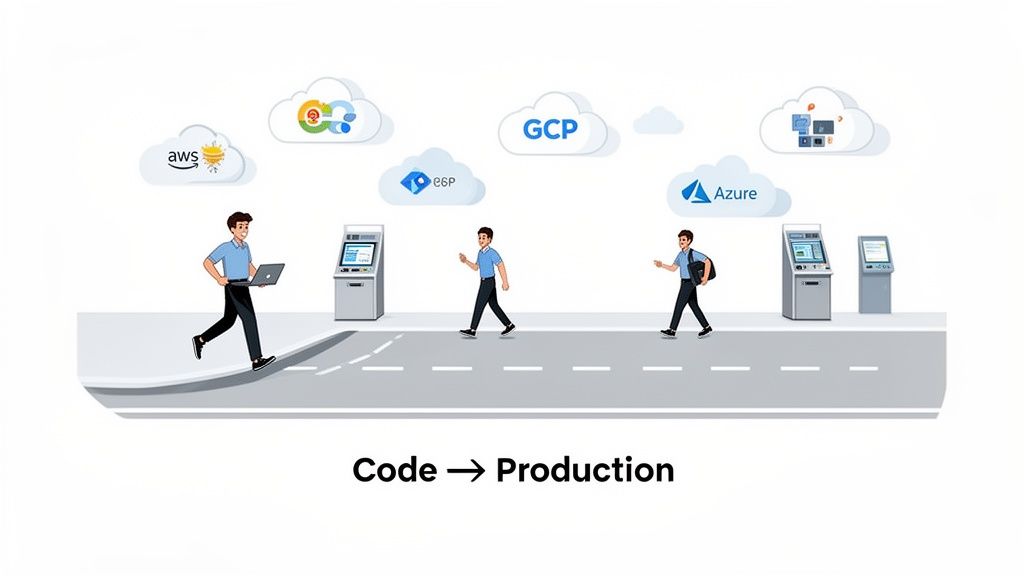
Empowering Developers with Self-Service Autonomy
Developer platform automation replaces the old "file a ticket and wait" model with a set of self-service tools developers use directly. It gives your best people the autonomy to ship software without hitting roadblocks or needing constant hand-holding from a specialised DevOps team.
This shift has a massive impact on team velocity and morale. When engineers are truly empowered, they can:
- Provision new environments instantly: Spin up a production-like environment for a new feature branch in minutes, not days.
- Automate deployments and rollbacks: Push code to staging or production with a single command and roll back just as easily if something goes wrong.
- Access logs and metrics: Diagnose issues immediately without begging for access to a dozen different systems.
- Test and iterate faster: Run tests in isolated, consistent environments for every change, catching bugs long before they hit production.
The goal is to make the "right way" of doing things the easiest way. By providing a standardised and automated path, you eliminate guesswork and inconsistency, allowing developers to focus purely on building product features.
This approach is especially critical for teams working across multiple clouds. A well-designed automated platform abstracts away the unique complexities of AWS, GCP, and Azure, presenting a unified workflow. Developers don’t need to be experts in all three; they just interact with the platform, which handles the underlying cloud-specific details. This is the core function of a unified DevOps cloud infrastructure platform.
From Manual Toil to Automated Flow
Ultimately, developer platform automation changes the entire dynamic of your engineering organization. It moves you from a state of constant, reactive fire-fighting toward a proactive, strategic partnership. Your operations experts are no longer buried under a mountain of repetitive manual tasks.
Instead, they focus on improving the platform itself—strengthening security, optimising performance, and adding new capabilities that benefit the whole engineering organisation. This creates a virtuous cycle: the platform continuously improves, enabling developers to ship faster and more reliably. It transforms your infrastructure from a frustrating bottleneck into a genuine business accelerator.
The True Cost of a DIY Internal Developer Platform
For most engineering leaders, the total cost of ownership (TCO) for a do-it-yourself internal developer platform is a massive blind spot. The salaries for your platform team are just the tip of the iceberg. Lurking beneath the surface is a growing collection of hidden costs that quietly sink your budget, kill productivity, and hand your competitors an easy win.
The idea of building your own platform is always tempting. It promises total control. But in reality, it creates a black hole of undifferentiated work. Your best engineers end up spending their days patching together a brittle collection of open-source tools. This isn’t innovation; it’s operational drag that keeps you from shipping product.
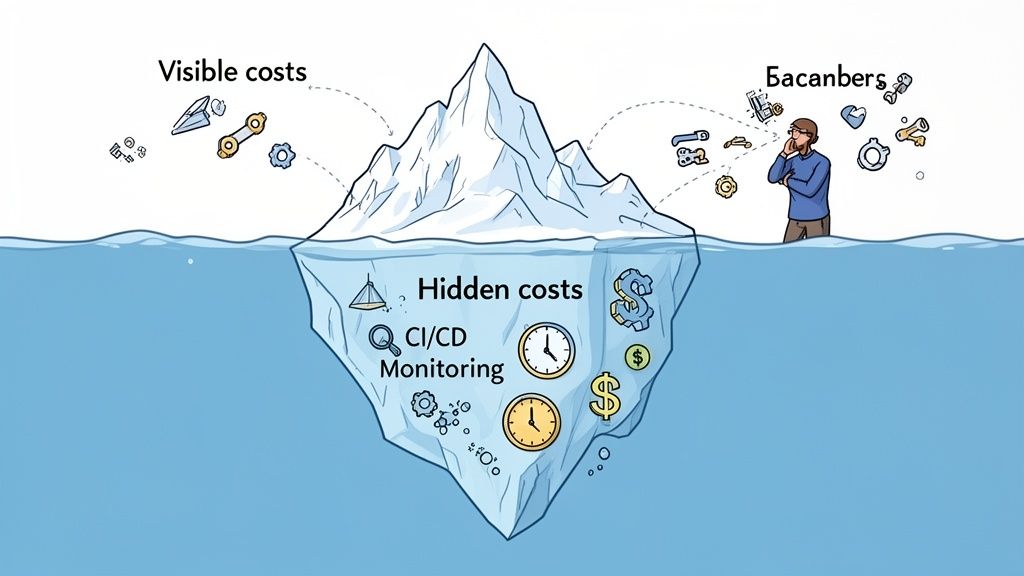
Beyond Salaries: The Iceberg of Hidden Expenses
When you break down the actual finances, the true cost of a DIY platform stretches across engineering, operations, and security. Every new component you bolt on brings its own maintenance burden.
This sprawling, custom-built stack usually includes dozens of different tools that have to be forced to work together:
- CI/CD: Tools like Jenkins, GitLab CI, or CircleCI demand constant script updates and runner management.
- Deployment: ArgoCD or Flux need careful configuration to make GitOps workflows run smoothly.
- Observability: A Prometheus, Grafana, and Loki stack needs to be scaled, secured, and constantly tweaked.
- Security: Adding Vault or another secrets manager just adds another critical system to maintain.
Each of these could be a full-time job. That’s why a DIY approach to developer platform automation never stays as simple or cheap as it first appears, especially in a multi-cloud environment.
The biggest hidden expense is opportunity cost. Every hour your best product engineers spend debugging a broken pipeline or wrestling with a Kubernetes networking problem is an hour they aren't building the features your customers are paying for.
Unpacking the Hidden Costs of a DIY Internal Platform
Let's put some real numbers to this, using a hypothetical scale-up with a 20-person engineering team. What starts with dedicating a couple of senior engineers to build the platform quickly spirals out of control.
The table below breaks down the annual expenses that are so often overlooked when teams decide to build in-house. These are the hidden costs of DIY DevOps.
| Cost Category | Description | Example Annual Cost (for a 20-person engineering team) |
|---|---|---|
| Platform Team Salaries | The direct cost of hiring 2-3 dedicated DevOps or platform engineers. This is the visible, "tip-of-the-iceberg" expense. | £240,000 – £360,000 |
| Tool Maintenance & Integration | The time your platform team spends updating plugins, patching vulnerabilities, and making dozens of tools work together. This easily eats up 20% of their time. | £48,000 – £72,000 (in lost productivity) |
| Productivity Drain on Devs | When the platform is slow or buggy, every developer pays the price. Context switching to fix infrastructure issues can slash overall productivity by 15-25%. | £270,000 – £450,000 (across 18 developers) |
| Cloud Infrastructure Waste | Without automated cost controls, you're almost certainly over-provisioning resources and leaving non-production environments running 24/7. This can inflate your cloud bill by 30% or more. | £90,000+ (on a £300,000 annual bill) |
| Security & Compliance Overhead | A DIY platform is a collection of components, each a potential security hole. Auditing and securing this stack is a constant, time-consuming effort. | £30,000 – £50,000 (in engineer time and tooling) |
| Opportunity Cost | The most significant cost: features not built, products not shipped, and market share lost while your best engineers are stuck on infrastructure plumbing. | Incalculable, but potentially millions. |
When you add it all up, the actual annual cost of a DIY platform can easily be two to three times higher than just the salaries of the platform team. It's a compounding debt that makes it impossible to move fast.
In stark contrast, a modern, multi-cloud DevOps platform like PushOps gives you predictable costs by consolidating this entire toolchain into a single, managed solution. This lets you eliminate the hidden financial drain and refocus your entire team on what they were hired to do: deliver incredible products.
Essential Capabilities of a Modern Automated Platform
An effective developer platform isn't just a random assortment of tools. It's a unified system built to eliminate friction and free up your team to build your product, not wrestle with infrastructure. Real developer platform automation is defined by the capabilities it unlocks.
A modern platform goes way beyond basic CI/CD scripts, focusing on five essential pillars designed to streamline setup, scaling, monitoring, security, and cloud costs across AWS, GCP, and Azure.
Self-Service Infrastructure Provisioning
The first and most impactful capability is self-service infrastructure. In a traditional setup, a developer files a ticket to get a new test environment and waits for hours or days, killing momentum.
An automated platform flips this model on its head. It gives developers the power to spin up production-like environments on demand, in minutes, with a few clicks or a single command. These are fully configured, isolated environments, complete with databases, networking, and secrets. The platform abstracts away all the underlying cloud complexity, offering a consistent, reliable way to create environments regardless of the provider.
Automated and Maintainable CI/CD Pipelines
Many teams have CI/CD, but they’re shackled to brittle, high-maintenance pipelines—a tangled mess of custom scripts that demand constant attention. When they break, development grinds to a halt.
A modern platform delivers truly automated and maintainable CI/CD. Instead of fragile scripts, you get battle-tested, pre-configured pipelines that just work. The platform handles all the underlying complexity of building, testing, and deploying containerised applications, so your team doesn’t have to. You can learn more about this approach in our guide to achieving zero-maintenance CI/CD pipelines. Advanced release strategies like canary and blue-green deployments are baked in, making it simple to roll out new features safely.
Integrated and Unified Observability
When something goes wrong, the last thing you want is your team frantically piecing together data from a dozen disconnected systems. A DIY observability stack—often a mix of Prometheus, Grafana, and Loki—is powerful but complex to manage.
An essential capability of any automated platform is integrated observability. Logs, metrics, and traces are automatically collected and correlated in one unified dashboard for every single application and environment.
With unified observability, the mean time to resolution (MTTR) for incidents plummets. Instead of hunting for clues, engineers get immediate, context-rich insights to diagnose and fix problems fast.
This single pane of glass gives you a real-time, holistic view of your system's health without the operational overhead of maintaining a separate, sprawling monitoring stack.
Intelligent Cloud Cost Optimisation
Cloud bills have a nasty habit of spiralling out of control. Unused development environments and over-provisioned resources can easily inflate your monthly spend by 30% or more.
An automated platform tackles this head-on with intelligent cost optimisation built directly into its workflows. Key features typically include:
- Automatic environment shutdown: Non-production environments are automatically spun down outside of working hours, slashing costs.
- Smart autoscaling: Resources scale based on real-time traffic, ensuring you only pay for what you use.
- Right-sizing recommendations: The platform analyses usage patterns to help you select the most cost-effective instance types.
This transforms cloud spending from a reactive headache into a predictable, optimised expense.
Security and Governance by Default
Finally, security can never be an afterthought. In a DIY setup, ensuring every tool and environment is securely configured is a monumental task. Security by default is a non-negotiable cornerstone of a modern platform.
This means security best practices are embedded from day one. Role-based access control (RBAC) ensures developers only have the permissions they need, and a comprehensive audit trail tracks every change. The platform becomes your single source of truth for governance, making it far easier to maintain compliance and secure your software supply chain across all your cloud providers.
Your Practical Roadmap to Platform Automation
Making the switch to developer platform automation doesn't have to be a risky "big bang" migration. A successful move away from manual infrastructure work is a measured, step-by-step journey that starts with small, high-impact wins and builds momentum. For engineering leaders, the key is to prove the value quickly and de-risk the decision.
This diagram shows the core workflow that developer platform automation simplifies, taking your team from code to deployment and on to monitoring in a single, smooth loop.
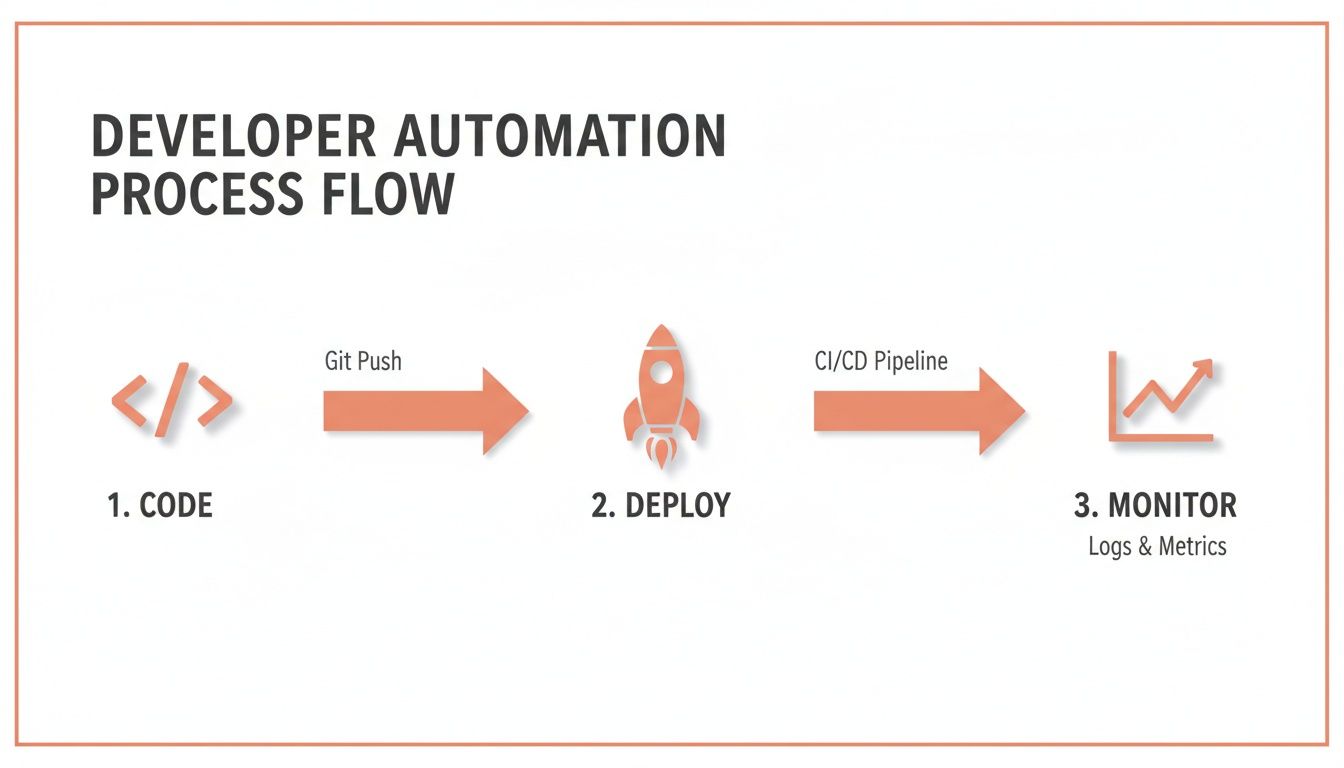
A unified platform gets rid of the friction between development, deployment, and operations, creating a continuous cycle of improvement.
Phase 1: Audit and Define Your Success
First, take stock of where you are right now. You can't improve your processes until you know where the pain points are. Run a thorough audit of your current tools and workflows.
This audit should answer:
- How long does it take to get a new testing environment up and running?
- How many manual steps are in a typical deployment?
- What are developers spending time on when they aren't writing feature code?
Once you have this baseline, define clear Key Performance Indicators (KPIs) to measure success. Skip vanity metrics and track outcomes tied to business value.
A common mistake is adopting new tools without defining what success looks like. Your KPIs should be your North Star, guiding every decision.
Effective KPIs for developer platform automation include the four key DORA metrics:
- Deployment Frequency: How often you can successfully release code to production.
- Lead Time for Changes: The time from a code commit to that code running in production.
- Change Failure Rate: The percentage of deployments that cause a failure in production.
- Mean Time to Recovery (MTTR): How quickly you can restore service after a production failure.
Phase 2: Secure Small Wins and Build Buy-In
With your KPIs defined, find a small, low-risk project where automation can deliver an immediate, obvious benefit. This is how you build confidence and get your team on board.
Good places to start include:
- Automating Preview Environments: Set up your platform to automatically spin up a full, temporary environment for every pull request, improving testing and feedback loops.
- Standardising One Service: Choose a single, non-critical microservice and move its entire CI/CD pipeline onto the new platform. You can find more details in our guide to automated deployments for microservices.
When developers see how these changes eliminate tedious work, they’ll become your biggest advocates. Their success is more powerful than any management directive.
Phase 3: Iterate and Expand Incrementally
After your first few successes, the final phase is gradual expansion. Use what you learned to roll out automation to other services and teams. A modern platform like PushOps makes this easy by letting you connect existing repositories and automate deployments one by one.
This iterative approach is the opposite of a high-risk migration. It lets your team adapt at a comfortable pace, ensuring every step adds value without disruption. As you onboard more services, the platform's network effects kick in—standardisation improves, collaboration gets easier, and the entire engineering organisation starts moving faster.
Making the Strategic Shift to an Automated Platform
Let’s be honest. For far too long, the most talented engineers at startups and scale-ups across Europe, Singapore, the UK, and the US have been stuck paying the ‘infrastructure tax’—that soul-crushing work of keeping a complex DevOps stack from falling over. It’s why your best people are wrestling with Kubernetes instead of building features that matter to your customers.
This constant operational drag is the direct result of the DevOps treadmill. It’s a cycle where teams burn resources, time, and morale just to build and maintain a fragile internal platform that’s always one update away from breaking.
Every CTO and VP of Engineering eventually faces a clear choice. You can keep pouring money and your best engineering talent into this thankless internal project, or you can step off the treadmill for good by embracing developer platform automation.
From Firefighting to Strategic Focus
Adopting a managed, multi-cloud DevOps platform isn't about giving up control; it's about reclaiming focus. It gives you battle-tested best practices for setup, scaling, monitoring, and security right out of the box, letting you skip the years of trial-and-error that come with a DIY approach.
The result is a radical change in your team’s day-to-day reality.
The future state is one where your engineers are happier and more productive because they can ship features without fighting their tools. Your infrastructure is more secure, your cloud costs are under control, and you, as a leader, can finally focus on strategic initiatives instead of fighting infrastructure fires.
This shift transforms your platform from a frustrating cost centre into a strategic accelerator. An automated platform like PushOps scales right alongside your team on AWS, GCP, and Azure, making sure your infrastructure is always a competitive advantage, not a liability.
Imagine your team's velocity when they are empowered with:
- Self-service workflows for creating environments and deploying code on demand.
- Zero pipeline maintenance, which means no more brittle, time-sucking scripts.
- Integrated security and cost controls that just work, automatically.
This is the practical outcome of developer platform automation. It’s time to stop building the plumbing and start focusing on the product that will win your market. Explore how a managed DevOps platform can solve these exact problems and end the endless cycle of infrastructure chores.
Frequently Asked Questions
As a CTO or engineering leader, I get it. Moving to a managed platform can feel like a huge leap. You have questions about control, cost, and complexity. Let’s tackle the most common concerns we hear from technical leaders at startups and scale-ups in Europe, Singapore, the UK, and the US.
Will I Lose Control Over My Infrastructure by Using a Platform?
Not in the slightest. This is the biggest myth holding teams back. A modern developer platform like PushOps doesn't replace your cloud—it runs directly on your own AWS, GCP, or Azure accounts. You keep full ownership and root-level access. Always.
Think of it this way: you still own the race car. The platform is your professional pit crew, handling the complex mechanics so you can focus on winning. It’s an automation layer that manages the tedious work of Kubernetes, CI/CD, and security, but you never hand over the keys.
Is My Team Too Small for a Developer Platform?
Actually, it’s the other way around. Smaller teams often see the biggest and fastest return. At a startup or scale-up, every engineer’s time is gold. Sidelining one or two engineers for full-time DevOps is a massive hit to your product velocity—talent you simply can’t afford to lose.
An automation platform gives a 10-person team the operational maturity and capabilities of a 50-person team. It lets you compete on product innovation, not on who can build the most complex Kubernetes stack.
Instead of stretching your budget to hire more DevOps engineers, you empower your existing team to self-serve their infrastructure needs. This clears the path to a faster roadmap without a bigger headcount, allowing you to invest in product roles instead.
How Difficult Is Migrating Our Existing Services?
A good platform is designed for a gradual, low-risk start. You don’t need a stressful, "big bang" migration. You can begin by connecting a single code repository and automating deployments for one non-critical service to prove the value.
The process builds momentum naturally. Once your team sees the benefits—like automatic preview environments for every pull request and one-click rollbacks—they'll be eager to move more services over. A managed platform takes on the heavy lifting of configuring pipelines, networking, and security, making the whole process far smoother and naturally leading you away from your complex DIY setup.
Ready to stop paying the infrastructure tax and empower your team to ship faster? PushOps provides a production-ready DevOps platform that automates your infrastructure on AWS, GCP, and Azure, so you can focus on building your product. See how PushOps can accelerate your team.

