

Let's be honest, your engineering team isn't paid to fix broken CI/CD pipelines. Yet, so many fast-growing startups and scale-ups find their best developers bogged down, endlessly patching and troubleshooting a fragile, home-grown DevOps stack instead of building your product.
Moving to genuinely zero-maintenance CI/CD pipelines isn't just a 'nice-to-have' anymore. For any company in Europe, Singapore, the UK, or the US that wants to ship features faster than the competition, it's an operational necessity.
The Hidden Cost of High-Maintenance DevOps
For engineering leaders, the story is painfully familiar. You started with a self-managed Jenkins or GitLab instance, and for a small team, it worked. But as you scaled, that once-simple setup morphed into a complex beast of Kubernetes, monitoring tools, and custom scripts demanding constant care and feeding.
What began as a tool to speed up development has now become a major source of friction. And this isn't just a technical problem—it's a strategic drain on your most valuable resource: your engineers' time. Most teams over-invest in building and maintaining this stack, when what they really want is a reliable, production-ready platform so they can focus on shipping features.
Every hour a senior developer spends wrestling with a flaky pipeline script, managing Kubernetes clusters, or debugging a cross-cloud deployment is an hour not spent shipping features your customers actually want. That constant context switching absolutely kills productivity and is a fast track to developer burnout.
The True Business Impact
It’s easy to underestimate the direct costs of a DIY DevOps stack. People often just think about the salary of a dedicated DevOps engineer, but the real burden is in the hidden operational costs that ripple across the entire engineering organisation.
These costs pop up in a few critical areas:
- Deployment Velocity Grinds to a Halt: When pipelines are brittle, every deployment becomes a high-risk, high-stress event. Teams start shipping less frequently, innovation stalls, and your ability to respond to market changes is completely crippled.
- Headcount Balloons for Tool Management: You suddenly find yourself hiring more DevOps engineers just to manage the internal platform instead of building the product. Your DevOps-to-developer ratio creeps up, inflating operational costs without adding any direct value.
- Security and Compliance Gaps Emerge: Manually managing configurations across AWS, GCP, and Azure is a recipe for security gaps and configuration drift. It’s an open invitation to unnecessary business risks.
The goal is to stop treating infrastructure as the product. A modern multi-cloud DevOps platform lets your team focus on building features, confident that a reliable, production-ready system is handling all the complexities of setup, scaling, monitoring, security, and cost control across AWS, GCP, and Azure behind the scenes.
This widespread pain is exactly why the shift towards zero-maintenance CI/CD is happening. Recent data from the Lithuanian Association of Software Developers really puts the problem into perspective. Their study found that teams using conventional GitLab CI configurations were spending an average of 12 hours per week, per engineer, just on debugging and scaling issues across AWS and GCP.
In stark contrast, teams that moved to zero-maintenance approaches with multi-cloud platforms saw that number plummet to just 3.2 hours weekly. That's a 73% reduction in time wasted on pipeline upkeep. You can discover more insights about building efficient CI/CD pipelines on wildnetedge.com.
This reclaimed time is the secret weapon that allows startups and scale-ups to out-innovate their larger, slower-moving competitors.
The True Cost of DIY DevOps vs A Zero-Maintenance Approach
When you quantify the hidden operational burdens, the case for a managed, zero-maintenance platform becomes crystal clear. It's not just about saving time; it's about reallocating your most expensive resources—your engineers—back to work that generates revenue. The table below breaks down the reality of maintaining a traditional in-house CI/CD stack versus the strategic goals of a zero-maintenance approach.
| Area of Impact | DIY CI/CD Pipeline Reality | Zero-Maintenance Pipeline Goal |
|---|---|---|
| Engineering Time | Senior developers spend 10-15 hours/week on pipeline fixes, tool upgrades, and troubleshooting. | Engineers spend less than 3 hours/week on infrastructure, focusing 95% of their time on product development. |
| Deployment Frequency | Risky, manual-gate deployments happen weekly or bi-weekly, slowing down feedback loops. | Automated, reliable deployments occur multiple times a day, accelerating time-to-market. |
| Operational Costs | Rising headcount needed for a dedicated platform/DevOps team, increasing overhead. | A lean team manages a fully automated platform, keeping operational costs low and predictable. |
| Security & Compliance | Inconsistent configurations and manual patching lead to security vulnerabilities and audit failures. | Automated policy enforcement, drift detection, and remediation ensure continuous compliance. |
| Scalability | The system is brittle and struggles to scale with team or user growth, becoming a bottleneck. | Infrastructure scales automatically and elastically, supporting rapid growth without manual intervention. |
| Developer Experience | High cognitive load and constant context-switching lead to frustration and burnout. | A self-service, "golden path" empowers developers to ship code confidently and quickly. |
Ultimately, the choice comes down to a simple question: Do you want your business to be an expert in building your product, or an expert in maintaining a complex DevOps stack? The zero-maintenance approach frees you to focus on what truly matters.
Foundations of a Self-Sustaining Pipeline
Getting to a near-zero maintenance state isn’t about finding a magical new tool. It's about building on a foundation of solid architectural principles. For any engineering leader tired of the constant firefighting that a DIY DevOps stack demands, these concepts are the roadmap away from manual fixes and towards a system that just works.
These principles fundamentally shift how you operate. Instead of reacting to problems and relying on human vigilance to keep things online, you design the pipeline to be inherently predictable and resilient from the start.
This is the only real antidote to the vicious cycle of developer burnout, slowed velocity, and rising headcount that plagues so many growing tech companies.
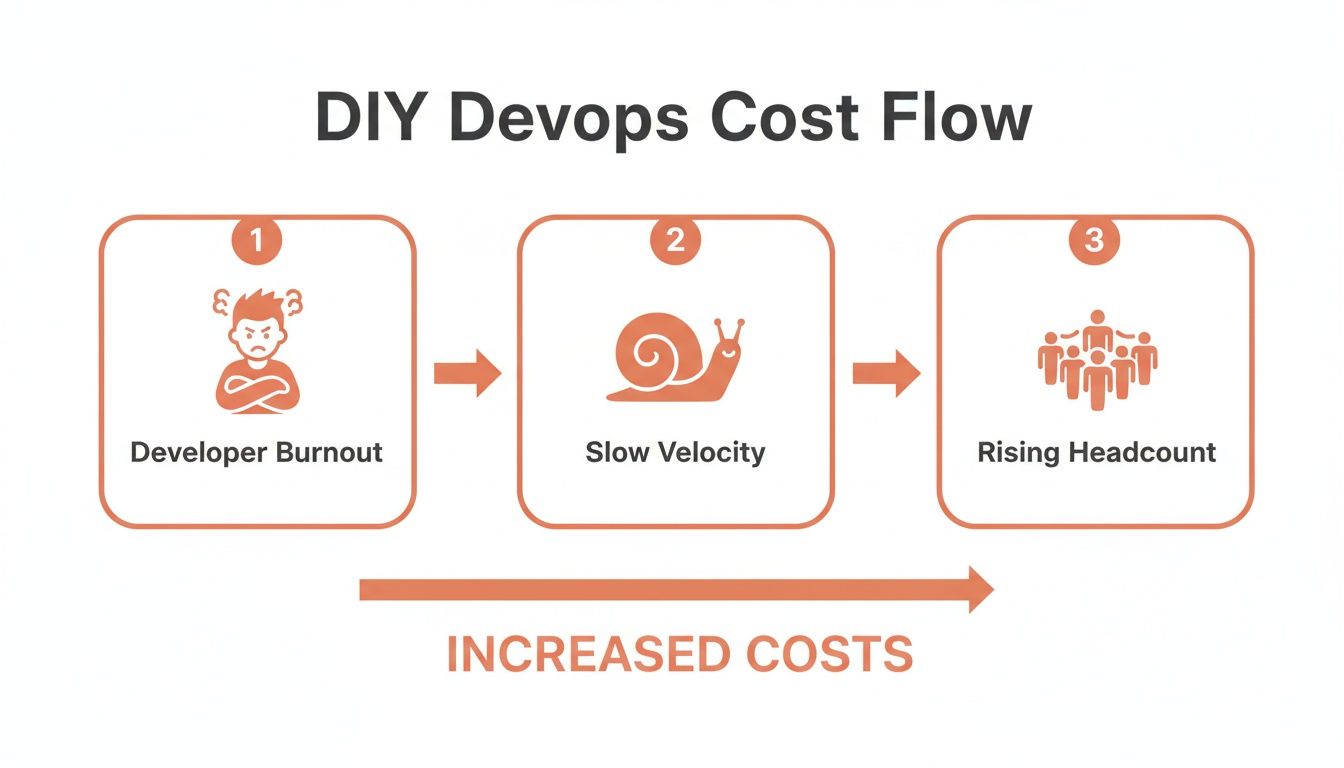
The flowchart above hits the nail on the head. It shows exactly how the hidden costs of wrestling with a complex, in-house DevOps platform directly hurt the business. This is why a foundational shift towards automation isn't just a technical upgrade—it's a crucial business strategy to keep your best people and ship features faster.
Idempotency: The Cornerstone of Predictability
At its core, a zero-maintenance CI/CD pipeline has to be idempotent. It’s a simple but powerful idea: running a deployment script once, twice, or a hundred times produces the exact same result. No cumulative changes, no weird side effects from repeated runs.
Think about a classic real-world disaster: a rollback script that isn't idempotent. The first time it runs, it correctly reverts a service. But when a panicked engineer runs it a second time, the script tries to delete resources that are already gone, causing the entire rollback to fail catastrophically.
An idempotent pipeline, on the other hand, just ensures the system matches the desired state. It doesn't care if it's the first deployment or the fifth attempt to fix a problem; the outcome is always the same correct configuration.
Infrastructure as Code: Preventing Manual Drift
The only way to guarantee that level of idempotency and cut out manual errors is through Infrastructure as Code (IaC). When you use tools like Terraform, every single piece of your environment—from virtual networks on AWS to user permissions on GCP—is defined in version-controlled code.
When your entire production environment is just code, "fixing" a problem no longer means logging into a server. The fix is a pull request. The pipeline automatically applies the correct state, wiping out configuration drift and the need for a human to intervene.
This is a massive departure from the old way of doing things, where engineers would make manual changes directly in the cloud console. Those small, untracked "hotfixes" are exactly what causes configuration drift, creating a fragile system where what’s actually running in production is a complete mystery. With IaC, the code in your repository is the single source of truth.
The Power of Immutability
Take IaC one step further, and you arrive at immutable infrastructure. Instead of patching or updating existing servers, you treat them as disposable. Any change—whether it’s a security patch or a new application version—triggers the pipeline to build and deploy entirely new infrastructure. Then, it just seamlessly swaps the traffic over before terminating the old environment.
This pattern completely eliminates a whole class of painful problems:
- Failed Updates: No more late nights worrying about a patch that fails halfway through and leaves a server in a broken state.
- Configuration Skew: Every server is a perfect clone because it’s built from the same pristine image.
- Simple Rollbacks: Need to roll back? You just deploy the previous version of the infrastructure. It's clean, fast, and dead reliable.
Building this level of automation from the ground up is a monumental engineering effort. It requires deep expertise in multi-cloud APIs, Kubernetes orchestration, and complex scripting. This is precisely the heavy lifting that a modern DevOps cloud infrastructure platform is designed to handle. It abstracts away all that complexity, letting your team get the benefits of these principles without the huge cost and effort of building and maintaining the machinery themselves.
Embedding Automated Security and Compliance
For most engineering leaders at fast-growing companies, security often feels like a bottleneck. It's that final checkpoint that grinds the development process to a halt. Traditional security reviews are painfully manual, happen way too late, and force developers to stop building new things to fix issues found weeks after they wrote the code.
This is exactly the kind of friction a zero-maintenance CI/CD pipeline is built to destroy.
The modern approach is to "shift security left"—in other words, to bake it directly into the development workflow. Instead of a final gate, security becomes an automated, continuous layer of the pipeline itself. Potential issues get flagged instantly, right when the code is committed. You reduce risk without ever slowing down.
Think about it: instead of a security engineer manually poring over code before a release, the pipeline automatically runs a whole suite of tests every single time. It becomes a tireless, vigilant guardian that never gets in the way.
Making Security an Automated Gatekeeper
To pull this off, you need to integrate specific types of security tooling directly into your pipeline. These tools act as automated quality and security gates, stopping vulnerable code from ever making it to production. For any CTO or VP of Engineering, this isn't just about managing risk; it's about making your team more efficient.
The essential automated checks to have in place are:
- Static Application Security Testing (SAST): This is where you scan your source code for well-known vulnerability patterns—think SQL injection or shaky authentication logic—before the application is even built.
- Dynamic Application Security Testing (DAST): DAST tools test your running application for vulnerabilities, usually in a staging environment. They act like an external attacker, probing for security holes that only show up at runtime.
- Container Scanning: Using tools like Trivy, the pipeline automatically scans your container images for known vulnerabilities (CVEs) in their base operating systems or software packages. This stops you from deploying containers with known, exploitable flaws.
Building this automated security fabric is fundamental to a zero-maintenance pipeline. A recent Baltic DevOps Report found that pipelines with this level of automation slashed security vulnerabilities by 67%. Even more impressive, adopters reported zero security incidents in production over a 12-month period. For comparison, traditional pipelines in regional SaaS firms averaged 22 CVEs per quarter. You can read the full research about CI/CD security checks on terrazone.io.
Enforcing Rules with Policy-as-Code
Beyond just scanning for bugs, automation can enforce your critical operational policies using policy-as-code. This is where you define your security and compliance rules in code, and the pipeline automatically checks every single change against them. It’s the ultimate defence against common—and dangerous—cloud misconfigurations.
For instance, you can write a policy that automatically fails any deployment that tries to:
- Create a public S3 bucket.
- Launch a database without encryption turned on.
- Configure a firewall rule that opens risky ports to the internet.
Policy-as-code transforms security from a reactive checklist into a proactive, automated guardrail. It codifies your security standards and ensures they are consistently applied across every environment—AWS, GCP, or Azure—without any manual oversight.
This level of integrated security is incredibly powerful. But let's be realistic: stitching together a bunch of open-source tools—SAST scanners, DAST engines, policy frameworks, and container analysers—is a massive project. Each tool needs to be configured, maintained, and updated. Getting them all to work consistently across multiple cloud providers is a full-time job in itself.
This is where a managed, multi-cloud DevOps platform really shines. It delivers this entire integrated security fabric out of the box, hiding all the underlying complexity. Your team gets a secure, compliant pipeline from day one, so they can focus on shipping features. You can see how one startup launched secure infrastructure at speed without ever hiring a dedicated DevOps team.
Designing for Self-Healing and Proactive Monitoring
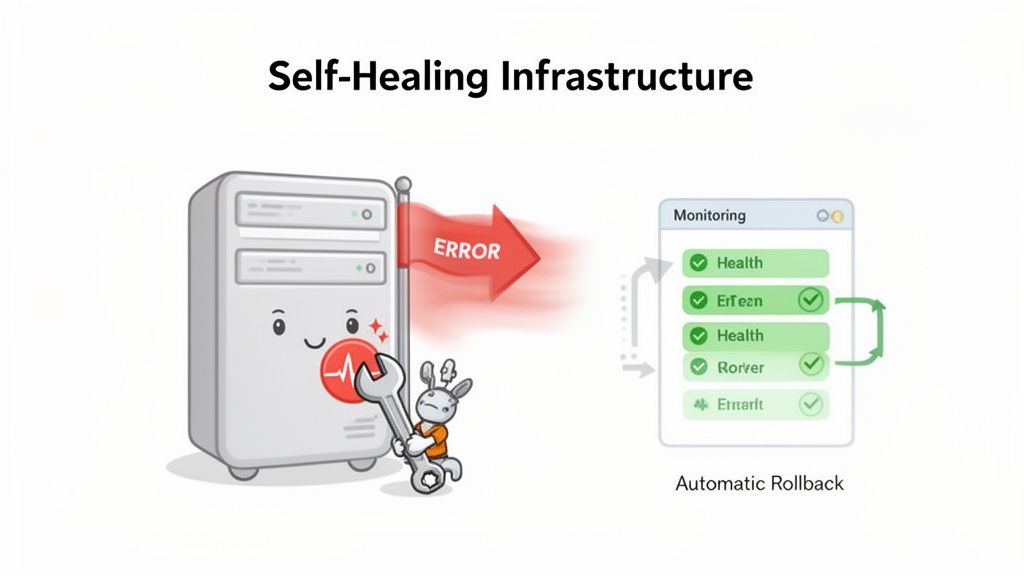
A resilient system doesn't just block issues; it sees them coming and fixes them on its own. This is the whole idea behind self-healing infrastructure, and it's an absolute must if you're serious about building zero-maintenance CI/CD pipelines. The goal is a platform that detects and corrects problems without any human help, moving way beyond simple failure alerts to fully automated recovery.
For engineering leaders, this is about changing the culture from reactive firefighting to proactive engineering. Stop building systems that page an engineer at 3 AM for a common failure. Instead, design a system that handles it gracefully, no intervention needed. This isn't some far-off dream—it's a practical necessity for teams that need to ship product, not babysit infrastructure.
From Reactive Alerts to Automated Actions
The old way of monitoring is painfully simple: a metric crosses a line, and an alert screams for a human. A modern, low-maintenance approach flips this script entirely. Now, the alert becomes a trigger for an automated workflow, not a cry for help.
This proactive stance is built on a few key practices:
- Robust Health Checks: We're talking more than just a simple ping. Deep health checks need to validate not only that a service is running, but that it can actually talk to its dependencies (like databases and other APIs) and is returning sensible data.
- Performance-Triggered Rollbacks: Your pipeline should be watching key performance indicators (KPIs) like latency and error rates right after a deployment. If those metrics tank, the system shouldn't wait for a command—it should automatically kick off a rollback to the last known good version.
- Automated Remediation Scripts: When something predictable happens, like a memory leak or a full disk, the first response shouldn't be a person. The system itself should trigger a script to restart the service, clear out caches, or scale up resources.
The real shift is in mindset. You stop asking, "How do we get notified when something breaks?" and start asking, "How does the platform fix itself when something breaks?" This distinction is what separates a high-maintenance stack from a self-sustaining one.
Correcting Drift Before It Causes an Outage
One of the most dangerous problems in any cloud environment is configuration drift. It starts small: an engineer makes a "quick fix" directly in the AWS console, a security group gets manually tweaked, or a deployment partially fails, leaving the environment in a weird, inconsistent state. These little deviations are ticking time bombs that often lead to major outages.
A self-healing system is constantly on guard against this. Using your Infrastructure as Code (IaC) definitions as the single source of truth, it periodically scans the live environment on AWS, GCP, or Azure. The moment it detects any deviation—an incorrect firewall rule, a wrong instance size, a missing tag—it automatically re-applies the correct configuration to bring the system back into its desired state.
This continuous reconciliation loop is fundamental. It means your infrastructure is always converging towards its intended, tested, and secure state, wiping out a massive category of human-induced errors.
But let's be realistic: building this kind of autonomous system from scratch is a monumental task. It demands sophisticated orchestration, deep integration with cloud provider APIs, and a smart monitoring framework that can tell real problems from transient noise. This is where engineering teams often find themselves sinking huge amounts of time into building an internal developer platform instead of their actual product.
This is exactly where a modern multi-cloud DevOps platform comes in. It provides these resilient, self-healing capabilities right out of the box. It comes pre-configured with the intelligence to monitor, detect, and remediate common failures across all your cloud environments, saving your team from the enormous effort of building this complex automation from the ground up.
Automating Cloud Cost Control and Optimization
For most engineering leaders, cloud cost management is a huge source of operational drag. It’s often a reactive, manual chore that has senior engineers digging through complex bills instead of building your product. This is exactly the kind of high-maintenance burden that a zero-maintenance CI/CD pipeline is built to solve.
By embedding cost control directly into your deployment workflow, you shift from painful, periodic audits to continuous, automated optimisation. It’s not just about saving money; it’s about reclaiming your team’s most valuable resource—their time and focus.
From Manual Audits to Automated Guardrails
A truly automated pipeline becomes your financial gatekeeper, programmatically enforcing cost-saving measures without anyone lifting a finger. This is where you find significant, sustained savings and prevent the kind of accidental overspending that keeps CTOs up at night.
Key automated strategies include:
- Intelligent Resource Scaling: The pipeline automatically scales resources up or down based on real-time demand, ensuring you never pay for idle capacity.
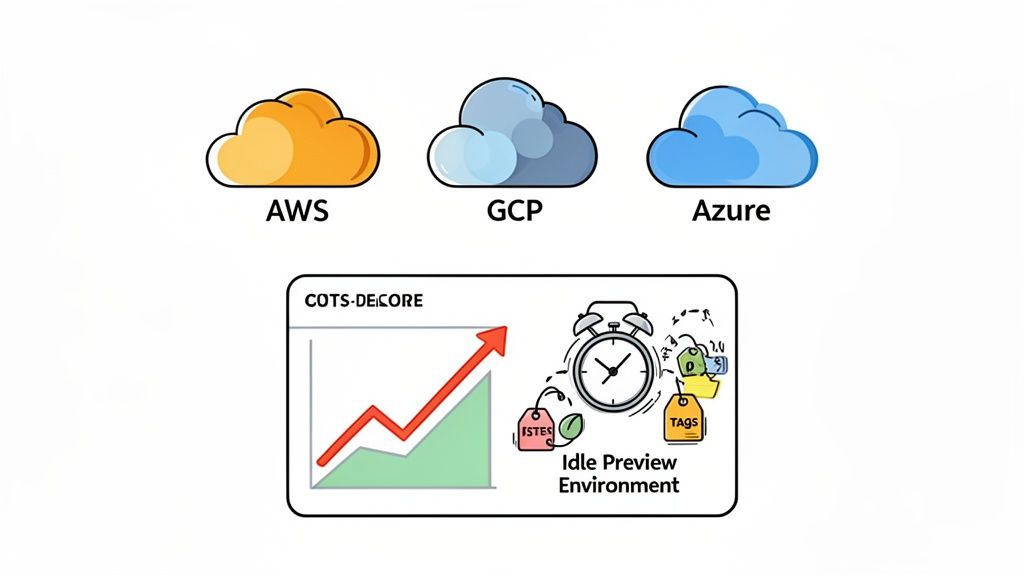
- Ephemeral Environment Cleanup: Preview or staging environments are essential for testing, but they're a massive source of cost waste when left running. A smart pipeline can tie these environments to pull requests, automatically tearing them down the moment a branch is merged or closed.
- Automated Cost Allocation: The pipeline can enforce a strict tagging policy on every single resource it creates. This guarantees 100% of your cloud spend is correctly allocated to the right team, feature, or project, making cost attribution effortless.
This level of automation has a direct and measurable impact. The State DevOps Maturity Index found that teams adopting zero-maintenance CI/CD slashed their deployment costs by an average of 58%. Meanwhile, legacy pipelines cost businesses an average of €45,000 annually in engineer hours just for monitoring and scaling.
The zero-maintenance model, powered by built-in AIOps, automated 95% of scaling events and achieved an elite-level change failure rate of just 7.2%.
A Single Pane of Glass for Multi-Cloud Costs
For any scale-up operating across AWS, GCP, and Azure, the complexity of managing costs multiplies fast. Each cloud provider has its own billing quirks, resource types, and reporting tools. Trying to get a consolidated view of your total spend is a nightmare of spreadsheets and custom dashboards—another maintenance trap.
This is where the value of a unified multi-cloud platform becomes undeniable. It provides a single, coherent dashboard that normalises cost data from all your providers. Suddenly, you can see your entire cloud expenditure in one place, analyse trends, and spot anomalies instantly.
This centralised view is the foundation for effective governance. A modern DevOps platform can implement automated budget alerts and spending guardrails that work consistently across every cloud. For example, it can automatically halt non-production deployments if a team is about to exceed its monthly budget, preventing financial surprises before they happen.
Building this level of sophisticated, cross-cloud cost automation in-house is a massive engineering project. It requires complex integrations with multiple cloud billing APIs, a robust tagging and enforcement engine, and a separate monitoring infrastructure.
As our case study shows, you can see how one bank scaled rapidly while cutting costs 3x by using a managed platform instead. This approach delivers all these capabilities out of the box, turning cost optimisation from a periodic, painful project into a continuous, automated process that just runs in the background.
Frequently Asked Questions About Zero Maintenance CI/CD
Even with a clear strategy, moving towards a truly hands-off CI/CD model brings up a lot of questions. We get it. Here are some of the most common things we hear from CTOs and engineering leaders who are tired of babysitting their infrastructure.
What Is the First Step Towards a Zero-Maintenance Pipeline?
The single most impactful thing you can do is adopt Infrastructure as Code (IaC) for one, non-critical service. Don't try to boil the ocean.
Pick a small internal tool or a microservice with low business impact. Then, commit to managing its entire environment—networking, compute, security groups, and configuration—using a tool like Terraform. This small-scale experiment forces a crucial mental shift away from manual "hotfixes" and towards a declarative, version-controlled mindset.
You’re not just writing a script; you're creating a repeatable, automated process that eliminates the manual drift that causes most outages. By starting small, you prove the value, build the skills on your team, and lay the foundation for a truly low-touch system across your entire organisation.
Is "Zero Maintenance" Actually Realistic?
It depends on what you mean by "zero". If you're thinking you'll never have to look at it again, then no. But if the goal is to eliminate unplanned, manual maintenance, then yes, it's absolutely realistic.
A well-architected system still needs strategic oversight—planning for major version upgrades or exploring new cloud services. But it should handle all the routine, day-to-day work on its own.
Think about things like scaling events, security patching, and failure recovery. Those should be fully automated processes. It's a fundamental shift from reactive firefighting to proactive system design. Your engineers' time is better spent on strategic work, not rebooting a server or debugging a flaky deployment script.
A modern multi-cloud DevOps platform is designed to get you 95% of the way there. It abstracts away the immense complexity of Kubernetes, multi-cloud APIs, and integrated monitoring tools, letting your team focus on application logic, not infrastructure bugs.
This approach transforms your operations-focused engineers from tool maintainers into platform enablers. They can focus on improving the developer experience and building golden paths, which adds far more value than simply keeping the lights on.
How Does This Approach Affect Developer Productivity?
It boosts it—dramatically. When your developers can push code and have complete trust that the platform will handle the entire lifecycle—testing, security scans, provisioning on AWS or GCP, and safe deployment—they can stay in a creative flow state.
This completely removes the "ops tax," which is the enormous amount of time developers waste dealing with infrastructure friction.
This model enables a true "you build it, you run it" culture by giving them powerful, reliable tools that work the same way every single time. It democratises operations, empowering any developer to ship code confidently without needing to be a cloud infrastructure expert. Teams that adopt this model consistently report that their deployment frequency increases by up to 5x, while their change failure rates plummet.
We Only Use AWS. Do We Need a Multi-Cloud Platform?
Yes, absolutely. Even if your entire footprint is on AWS today, building your processes on a multi-cloud native platform is a critical strategic decision. It future-proofs your architecture, providing immense flexibility and preventing the kind of vendor lock-in that can become a serious business liability down the road.
Just think about these common scenarios:
- Acquisitions: What if you acquire a company that runs entirely on GCP? A multi-cloud platform makes that integration seamless.
- New Client Demands: A major enterprise client might require you to host their data in Azure for compliance reasons.
- Cost Optimisation: A new service or pricing model from another cloud provider could offer significant savings, but only if you have the flexibility to take advantage of it.
More importantly, these platforms are engineered with a higher level of abstraction precisely because they have to handle the diverse environments of multiple clouds. You benefit from that robust, battle-tested automation and resilience even if you're only using it on a single cloud today. It ensures your internal processes aren't tightly coupled to one provider's proprietary services, giving you freedom and agility as you scale.
Ready to stop wasting engineering hours on infrastructure and start building a truly zero-maintenance CI/CD pipeline? The PushOps platform streamlines setup, scaling, monitoring, security, and costs across AWS, GCP, and Azure, so your team can get back to creating real value for your customers.
Book a demo with PushOps today and see how you can reclaim your team's focus.

