
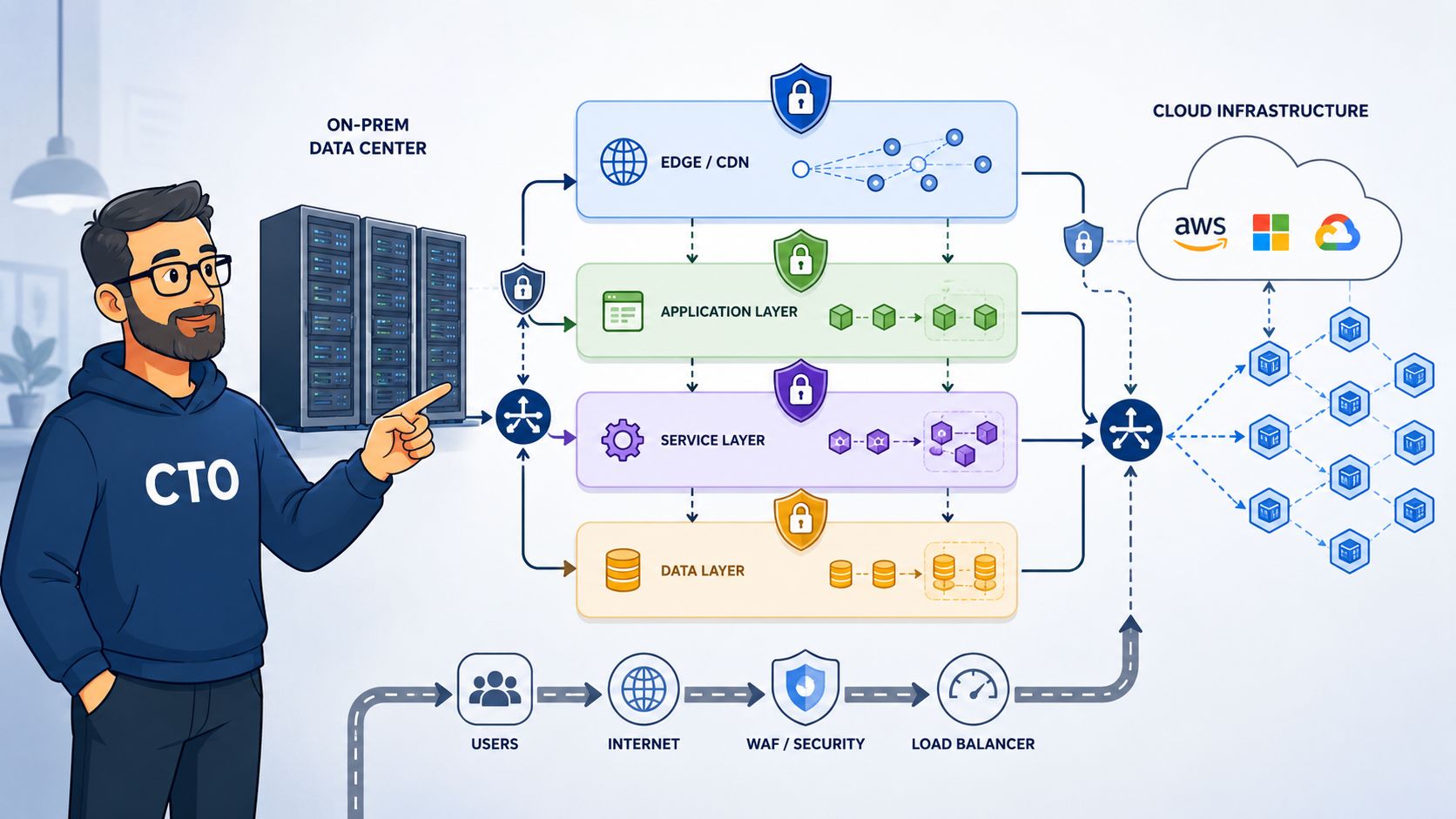

Your team doesn't decide to spend a sprint on networking. It happens by drift. A release needs private connectivity to a managed database. A customer asks for stricter isolation. Someone adds a second cloud account. A compliance review blocks deployment because ingress rules grew ad hoc. Within a few months, senior engineers are tracing packets, rewriting Terraform, and debating whether the problem sits in the app, the load balancer, or the network path between them.
This underscores why network architecture matters. Not because it's academically interesting, but because it gradually becomes the constraint on delivery. For a startup or scale-up, every hour spent maintaining bespoke connectivity, firewall policy, peering, and observability is an hour not spent improving the product.
Why Your Network Architecture Is a Product-Killer
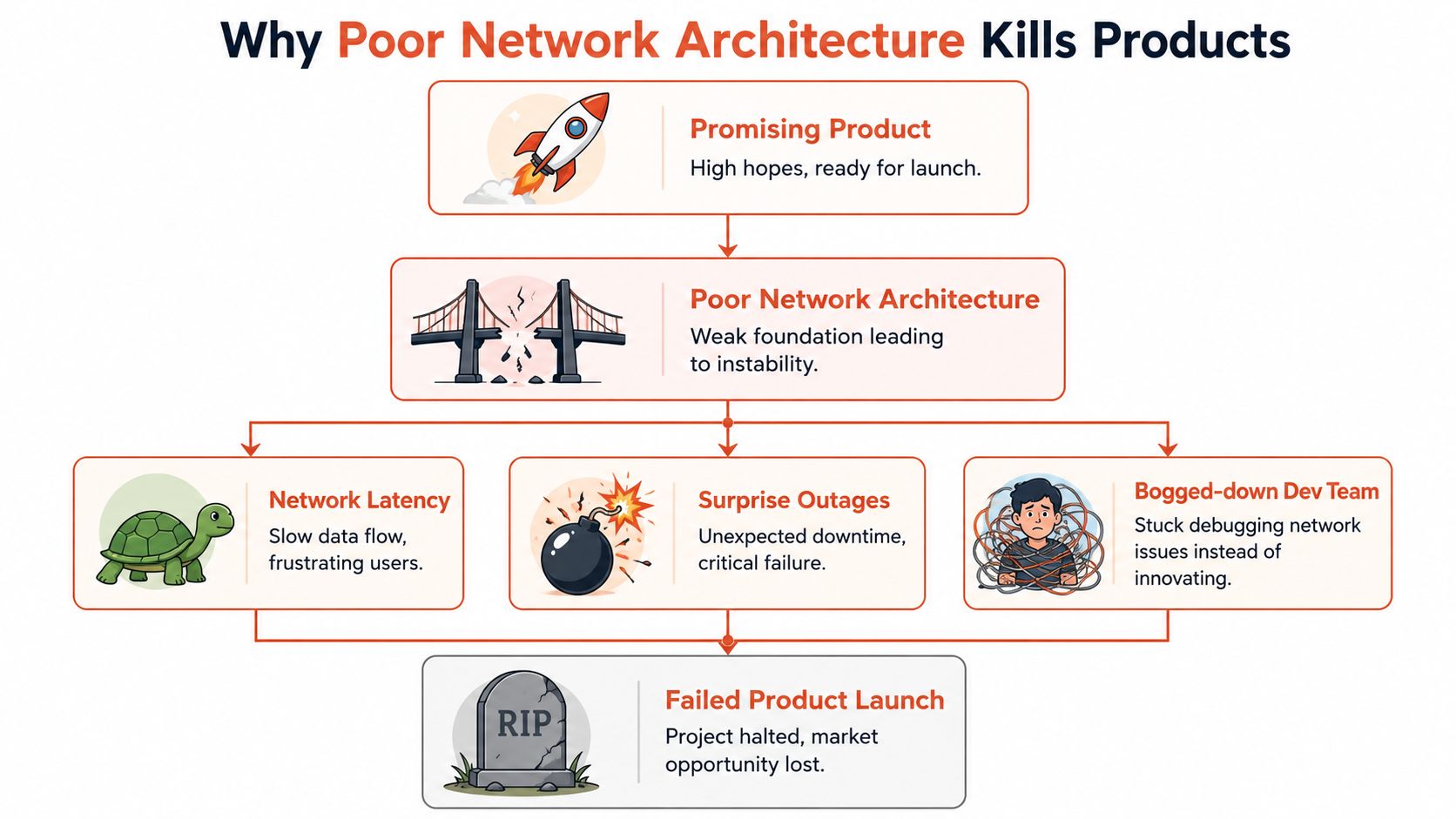
A product can be well built and still feel broken if the network path behind it is brittle. Users don't care whether the problem came from a misrouted request, a congested private link, or an overloaded gateway. They see lag, failed requests, and downtime.
That's why network architecture is better understood as the operating system for movement inside your business. If the application is the service your customers buy, the network is the system that lets every dependency reach every other dependency at the right time, with the right controls, and without constant manual intervention.
Think like a road planner, not a rack installer
The easiest way to explain network architecture is to compare it to a city's road system.
- Roads and junctions are your links, routers, gateways, and switches.
- Traffic rules are your protocols, policies, and segmentation rules.
- Delivery priorities are your routing decisions, service classes, and access controls.
- Ring roads and bypasses are your resilience patterns, failover paths, and alternate routes.
A city fails when every new building gets its own improvised road. Networks fail the same way. Teams bolt on VPNs, point-to-point rules, one-off peering, and temporary exceptions until the architecture stops behaving like a system and starts behaving like a patchwork.
Poor network architecture rarely breaks all at once. It leaks engineering time first.
The Internet itself was built on a very different idea. Modern Internet design grew from the early work on internetworking in the early 1970s, after the first ARPANET hosts were connected in 1969, with Bob Kahn developing the concepts that became TCP/IP-style internetworking by 1972. The important design choice was to connect different networks without forcing them to share the same internal design, which is why multi-cloud and hybrid estates still depend on bridging heterogeneous systems rather than standardising everything into one shape, as explained in this history of internetworking and Internet design.
What CTOs usually underestimate
A scale-up usually recognises compute complexity before network complexity. Kubernetes gets attention. CI/CD gets attention. Networking often gets treated as background plumbing until it starts blocking releases.
Three symptoms usually show up together:
- Latency becomes political. The app team blames the platform team. The platform team blames the cloud provider. Nobody has end-to-end visibility.
- Security exceptions multiply. Temporary access rules become permanent because nobody wants to break production.
- Delivery slows down. Engineers wait for networking changes, review cycles, and manual validation before they can ship.
If you want a concise external reference for what solid infrastructure support looks like in practice, the overview of Constructive-IT network capabilities is a useful benchmark. It shows the breadth of work teams inherit when they decide to manage connectivity as a bespoke internal function.
A reliable delivery practice also depends on the network layer being boring. If your release process is maturing, this guide to continuous delivery for early-stage startups is worth reading because deployment speed and infrastructure predictability are tightly linked.
Choosing Your Foundation On-Prem vs Cloud Architectures
The first serious architecture decision isn't about VLANs, gateways, or service meshes. It's about where your network lives and who carries the operational burden.
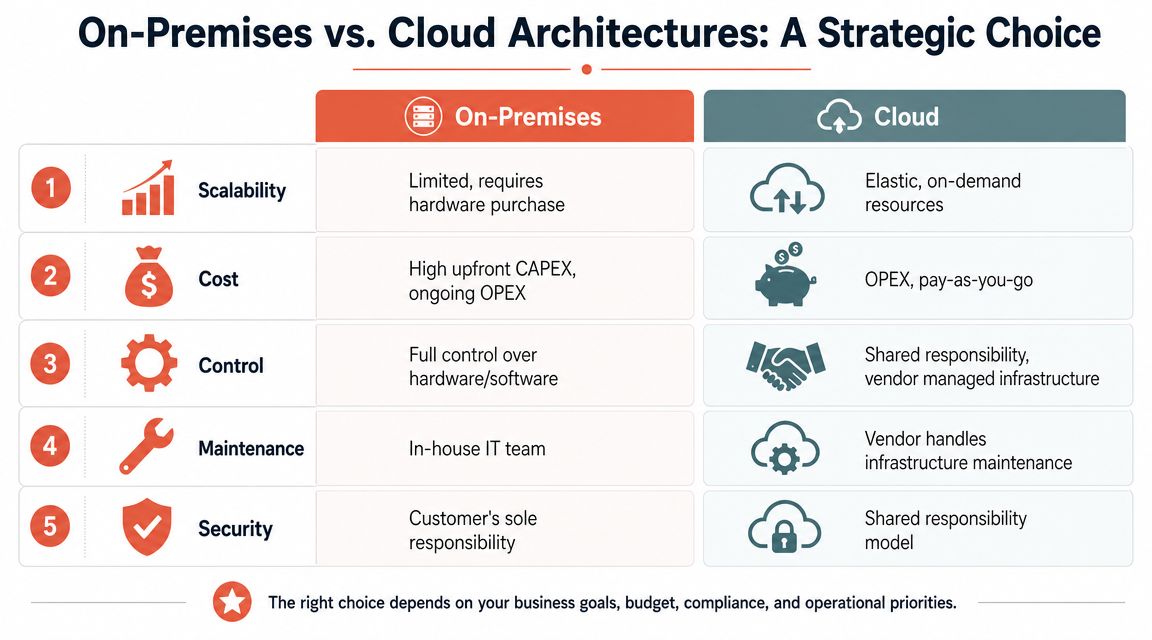
On-prem and cloud architectures solve different problems. Neither architecture is cleaner. Each creates a different failure mode and a different budget profile.
On-prem gives control and fixed constraints
On-prem architecture still makes sense when you need tight control over hardware placement, bespoke compliance boundaries, or deterministic local connectivity. You can design around three-tier, leaf-spine, dedicated firewalls, private links, and physical segmentation with a lot of precision.
That precision has a cost. Capacity planning becomes your problem. Redundancy becomes your problem. Hardware lifecycle, maintenance windows, cable plant, and vendor coordination become your problem.
A short comparison makes the trade-off clearer:
| Decision area | On-prem reality | Cloud reality |
|---|---|---|
| Scaling | Capacity must be planned before demand arrives | Capacity can be added faster, but policy sprawl follows |
| Change control | Slower, often safer by necessity | Faster, but easier to misconfigure |
| Cost shape | Upfront investment plus ongoing operations | Usage-based spend with surprise line items |
| Failure domains | More visible and physically bounded | More abstract, often spread across services and accounts |
Cloud removes hardware work, not architecture work
A lot of teams move to cloud expecting simplification. What they get is abstraction. That's useful, but abstraction is not the same thing as reduced responsibility.
The long shift from leased wireline enterprise networks in the 1980s to LTE and SD-WAN reflects a broader truth: network architecture follows computing architecture. As workloads moved toward distributed systems, hybrid environments, and edge computing, the network had to adapt to support more latency-sensitive and decentralised application patterns, as described in Ericsson's oral history of enterprise network architecture.
Practical rule: Moving from a data centre to AWS, Azure, or Google Cloud changes the shape of networking work. It doesn't make that work disappear.
In cloud, you trade hardware management for a different class of complexity:
- Account sprawl creates duplicated routing, IAM, and policy logic.
- Regional design decisions affect latency, resilience, and cost.
- Managed services reduce ops effort while increasing dependency on provider-specific networking patterns.
- Hybrid links introduce edge cases that don't show up in architecture diagrams.
The strategic question isn't where
For most CTOs, the better question is this: which foundation lets your team move without building an internal networking consultancy by accident?
If your product spans multiple providers or you're trying to avoid platform lock-in, this explainer on multi-cloud management gives a practical view of why cross-cloud consistency is usually the hard part, not provisioning the first environment.
A cloud-first path is often the right decision for a scale-up. But it only pays off if you standardise how networks are laid out, connected, secured, and observed. Otherwise you replace hardware friction with configuration friction, and your engineers still spend their week on infrastructure instead of product.
Decoding Modern Cloud Networking Patterns
The cloud patterns that look elegant in diagrams are the ones that tend to consume the most engineering time in production. They solve real problems, but each one introduces an operating model your team has to own.
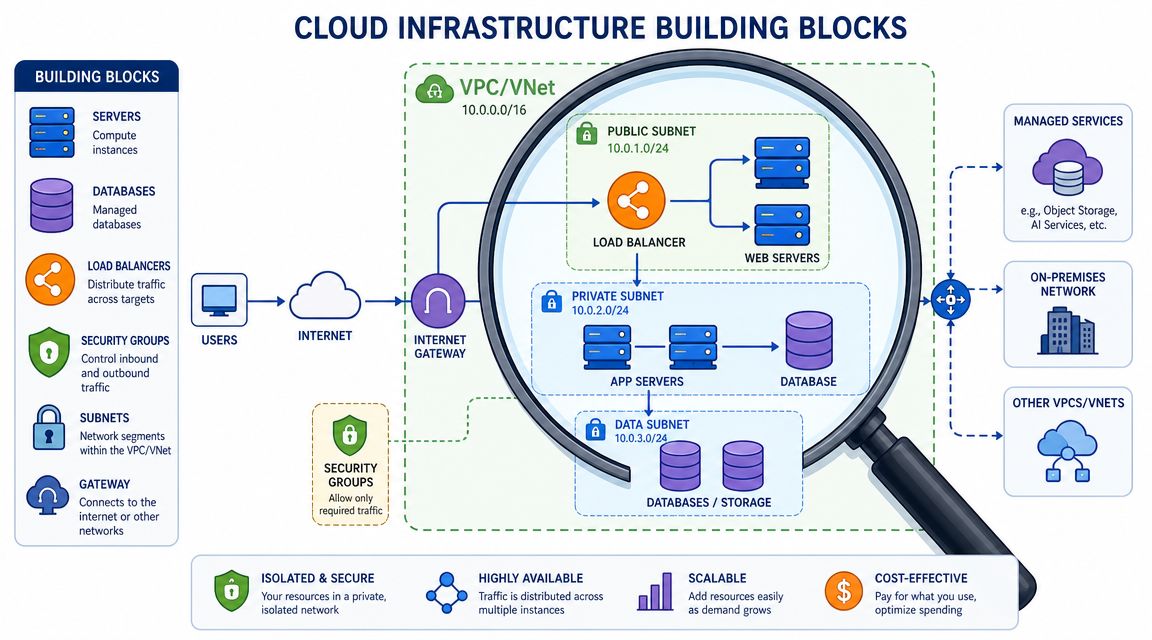
VPC and VNet layouts
A virtual network layout answers a basic question. Which systems should be able to talk to which other systems, and over what path?
At small scale, teams start with one flat environment per stage. It feels efficient. Then they add private services, isolated workloads, shared services, customer-specific environments, or a second region. The original layout starts to fight every new requirement.
What works:
- Clear separation of environments so dev, staging, and production don't bleed into each other.
- Deliberate CIDR planning before peering, private endpoints, or hybrid links make overlap painful.
- Shared services patterns for logging, secrets, or ingress that don't require every team to reinvent them.
What usually doesn't work is the “we'll clean it up later” approach. Networking debt is harder to unwind than application debt because it sits underneath everything.
Microsegmentation and policy boundaries
Microsegmentation is the move from broad trust zones to narrowly defined communication paths. In plain terms, it means a compromised service shouldn't be able to wander across your estate just because it sits on the same network.
This is valuable. It's also where many DIY setups become brittle.
A mature segmentation model needs consistent policy expression across security groups, firewall rules, namespaces, service identities, and workload boundaries. If each team writes its own rules by hand, you get drift. If every change needs central approval, delivery stalls.
The best segmentation policy is the one your team can enforce repeatedly, review quickly, and understand during an incident.
Transit and shared connectivity
As soon as you split workloads across accounts, subscriptions, or projects, you need a connectivity pattern. That usually means some version of hub-and-spoke, shared transit, or central egress control.
The attraction is obvious. Central routes. Central inspection. Fewer one-off peerings.
The hidden cost is operational coupling. One routing change can affect multiple teams. One shared component can become a choke point. One badly timed change window can create a cross-environment outage.
A useful decision frame is below:
| Pattern | Good fit | Hidden tax |
|---|---|---|
| Direct peering | Small number of environments | Becomes hard to reason about as relationships grow |
| Hub-and-spoke transit | Shared governance and central control | Adds dependency on the hub team and shared infrastructure |
| Full service isolation | Strong blast-radius control | More duplicated policy, tooling, and support effort |
Service meshes and endpoint logic
Service meshes promise policy, identity, encryption, and traffic control between services. They can be powerful in microservice-heavy environments. They can also become one more distributed system your platform team has to debug at 2 a.m.
The end-to-end argument matters. Classic Internet architecture treats some functions as better implemented at the endpoints rather than inside the network, while still allowing incomplete in-network functions when they improve performance. That's a useful reminder from the CS168 networking architecture notes: not every control belongs in the network layer, and not every endpoint concern should be pushed into infrastructure.
For CTOs, the practical takeaway is simple. Put functionality where your team can operate it reliably. If service-to-service identity, retries, policy, and telemetry become too expensive to manage as bespoke infrastructure, the architecture is no longer helping.
Building a Secure Network Without the Bottlenecks
Most cloud security failures don't come from exotic attacks. They come from ordinary configuration mistakes made under delivery pressure.
Gartner projects that through 2026, 99% of cloud security failures will be the customer's fault, driven mainly by misconfigurations in security groups, access controls, and similar foundational settings, according to Gartner's analysis of cloud security responsibility and misconfiguration risk. That's the strongest argument for treating security as a default property of the platform, not a review process bolted on after engineers have already built the thing.
Manual security doesn't scale
A manual model looks responsible on paper. Developers request access. A platform engineer edits rules. Someone from security reviews the change. Another person checks whether it violates a policy. The release waits.
That process creates two bad outcomes. It either slows delivery enough that teams start bypassing it, or it becomes so overloaded that reviews turn superficial. Neither gives you a strong security posture.
A better approach is to define constraints that are enforced automatically:
- Least privilege by default so workloads start with minimal access.
- Environment isolation so lower-risk changes don't expose production pathways.
- Policy-backed templates so common patterns are pre-approved and repeatable.
- Auditability so teams can see who changed what and when.
Zero Trust works when it's operationally boring
Zero Trust is often discussed as a strategy document. In practice, it's a set of habits. Verify identity. Limit access. Assume broad network trust is unsafe. Keep permissions narrow and temporary where possible.
Those habits only hold if the defaults support them. If engineers need bespoke tickets to get internal monitoring working, someone will eventually open a port because it's faster.
For teams dealing with that exact problem, this guide on preventing firewall port exposure for monitoring is a practical example of how to keep observability without taking the easy but risky route.
Security controls should remove repeated judgement calls, not create a bigger queue.
The real bottleneck is policy translation
The hardest part of network security isn't writing principles. It's translating principles into cloud-native controls that stay consistent across environments.
That means aligning IAM, workload identity, network segmentation, ingress policy, egress rules, and logging in one operating model. If each layer is managed by a different team with different tooling, security becomes slow because nobody owns the whole path.
For a scale-up, the answer usually isn't hiring more people to review more tickets. It's reducing the amount of custom interpretation required in the first place.
Balancing Network Performance, Cost, and Observability
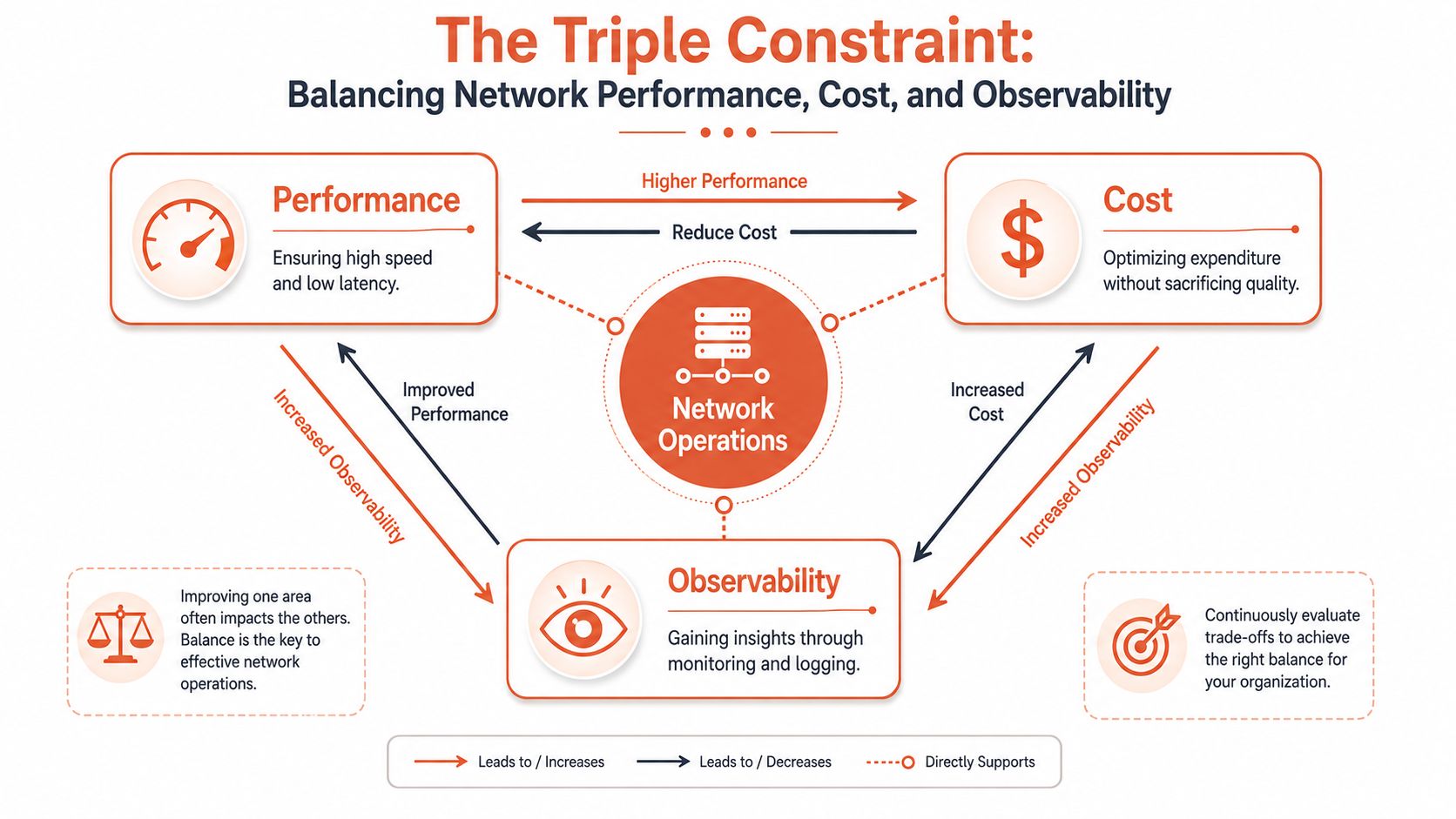
Every network decision sits inside a three-way trade-off. You want low latency and high reliability. You want costs under control. You want enough telemetry to understand what's happening when something degrades. Pushing hard on one side usually changes the other two.
Performance is easy to demand and expensive to engineer
Teams ask for faster response times, lower jitter, and stronger resilience. Fair enough. The difficulty is that performance usually comes from redundancy, locality, premium services, overprovisioned headroom, or extra control points.
In real systems, the expensive part isn't usually one obvious line item. It's the accumulation of decisions such as duplicate links, private interconnects, always-on staging, oversized gateways, aggressive replication, and traffic paths that weren't reviewed after the product changed.
Cost drifts when nobody can see the path
Cloud waste is often discussed at the compute layer, but networking contributes more than many teams expect. Flexera reports that organisations overestimate their cloud efficiency, with the average company wasting around 32% of cloud spend, and calls out overprovisioned resources, unmonitored transfer, and idle environments as common causes in its State of the Cloud coverage.
That matters because networking costs don't always announce themselves clearly. Data transfer fees, duplicated inspection, unnecessary cross-region traffic, and forgotten test environments often show up after architecture choices are already embedded.
A practical way to approach this is:
| Goal | What teams do first | What usually gets missed |
|---|---|---|
| Improve performance | Add capacity and shorten paths | Ongoing spend and duplicated components |
| Cut cost | Remove headroom and consolidate | Incident risk and debugging difficulty |
| Improve visibility | Turn on more logs and tracing | Telemetry storage cost and alert fatigue |
Observability is not optional overhead
Without observability, teams guess. They blame the app when the route is wrong. They blame the cloud when a firewall policy changed. They blame traffic volume when the actual problem is an internal dependency creating retries.
Good observability for network architecture means seeing enough of the path to answer four questions quickly:
- Where is the slowdown?
- What changed recently?
- Which services are affected?
- Is the problem capacity, policy, or dependency?
If your team can't explain network behaviour without opening three dashboards and a chat thread, you don't have observability. You have clues.
Optimisation becomes a part-time platform organisation
Many scale-ups face a common trap: The network isn't broken enough to trigger a major redesign, but it's noisy enough to consume senior attention every week. Engineers tune egress, right-size resources, adjust logging, and revisit topology in small increments.
That work is legitimate. It's also ongoing. There is no “done” state. Product traffic changes, cloud services evolve, regions expand, and compliance requirements tighten. DIY optimisation becomes a standing commitment, not a project.
For organisations in Lithuania, that operational importance is even easier to justify at board level because the digital economy already represents a material share of output. Lithuania's ICT sector generated 5.7% of total gross value added in 2023, the broader digital economy and society value added was 3.8% of GVA, and 20.2% of firms used cloud computing in 2023, which underlines why resilient cloud connectivity and strong network controls matter to business performance, as noted in this Lithuania digital economy and cloud adoption summary.
Escape the DIY Trap with a Unified DevOps Platform
By the time a company realises it has a networking problem, the issue usually isn't one bad subnet or one messy firewall policy. It's that infrastructure ownership has spread across too many tools, too many conventions, and too many people carrying tribal knowledge.
That's the DIY trap. You don't just build a network. You build provisioning workflows, access controls, deployment paths, observability pipelines, security guardrails, cost reviews, incident playbooks, and cloud-specific exceptions around it. Each layer makes sense in isolation. Together they create an internal platform team, whether you meant to build one or not.
What high-performing teams do differently
High-performing teams in the DORA research spend less time on manual infrastructure work, and automating foundational tasks such as network provisioning correlates with stronger delivery outcomes like higher deployment frequency and lower change-fail rates, according to Google Cloud's State of DevOps research overview.
The lesson for a CTO is straightforward. If your best engineers are still hand-assembling the basics, you're using expensive talent to rebuild undifferentiated plumbing.
Why consolidation beats custom assembly
A unified platform approach changes the operating model:
- Provisioning becomes standardised instead of ticket-driven.
- Security becomes enforced by default instead of reviewed after the fact.
- Observability arrives pre-wired instead of stitched together from separate products.
- Cloud cost controls become continuous instead of reactive.
For teams evaluating that operating model, this overview of a DevOps cloud infrastructure platform is a useful reference point. The strategic value isn't the interface. It's the removal of repeated infrastructure decisions that don't improve your product.
The companies that move fastest usually aren't the ones with the most handcrafted infrastructure. They're the ones that decided early which parts of the stack deserved custom engineering and which parts should become a reliable internal utility.
If your team wants to stop burning senior engineering time on networking, deployment plumbing, security drift, and cloud cost clean-up, PushOps is worth a look. It gives software teams a production-ready platform across AWS, GCP, and Azure so they can ship features instead of assembling and maintaining their own DevOps stack.

