


Your team probably didn't set out to build a privacy programme. You set out to ship product.
Then the questions started. Where is customer data stored? Who can access production records? Can you prove consent history? How do you delete a user across services, backups, logs, and third-party processors? Why does your release process let a new data flow reach production without anyone checking retention or lawful basis?
That's when many engineering leaders realise privacy compliance isn't sitting neatly with legal. It's landing in platform, cloud, security, delivery, and support. And if your stack grew the usual startup way, with Kubernetes clusters, CI/CD scripts, cloud IAM policies, ticket-based approvals, and a handful of SaaS tools glued together, compliance becomes a quiet tax on every sprint.
The Compliance Drag on Your Development Velocity
Many teams feel the drag before they name it.
A product squad wants to launch a feature. Security asks for access reviews. Legal asks for data mapping. Sales wants answers for a customer questionnaire. Someone raises data residency concerns. An auditor wants proof that a control wasn't just documented, but was enforced. Engineering stops building for customers and starts assembling evidence.
That's why privacy compliance is rarely just a policy exercise. It changes release processes, cloud permissions, observability requirements, and the way teams handle incidents. Guidance often stays at the legal and policy layer, but misses what this means for engineering and deployment workflows. It also ties compliance to continuous monitoring, training, audits, and IT release processes across multiple jurisdictions, which is exactly why so many teams struggle to operationalise it in day-to-day delivery, as noted in Sprinto's privacy compliance overview.
Where velocity gets lost
In practice, the time sink usually shows up in a few places:
- Manual evidence gathering: Engineers pull screenshots, log extracts, and change records every time a customer, auditor, or regulator asks a question.
- Release friction: Teams pause deployments because nobody can quickly verify whether a change introduces new personal-data processing.
- Cloud sprawl: Permissions, environments, and vendors drift faster than internal documentation can keep up.
- Ownership gaps: Legal owns the requirement, but engineering owns the systems that must prove it.
Practical rule: If compliance evidence is assembled by hand after the fact, your delivery process is already paying the cost.
Why DIY turns into a platform problem
A lot of startups try to bolt controls onto infrastructure that wasn't designed for them. They add another scanner, another approval step, another spreadsheet, another policy doc. The result isn't a compliance system. It's an obstacle course.
The deeper issue is architectural. If your stack doesn't produce consistent access logs, enforce role boundaries, and carry policy checks into deployment, every privacy requirement becomes custom project work. That's expensive, brittle, and hard to audit.
What Privacy Compliance Really Means for Your Tech Stack
The common assumption is that privacy compliance lives in notices, policies, and legal reviews. That view is outdated.
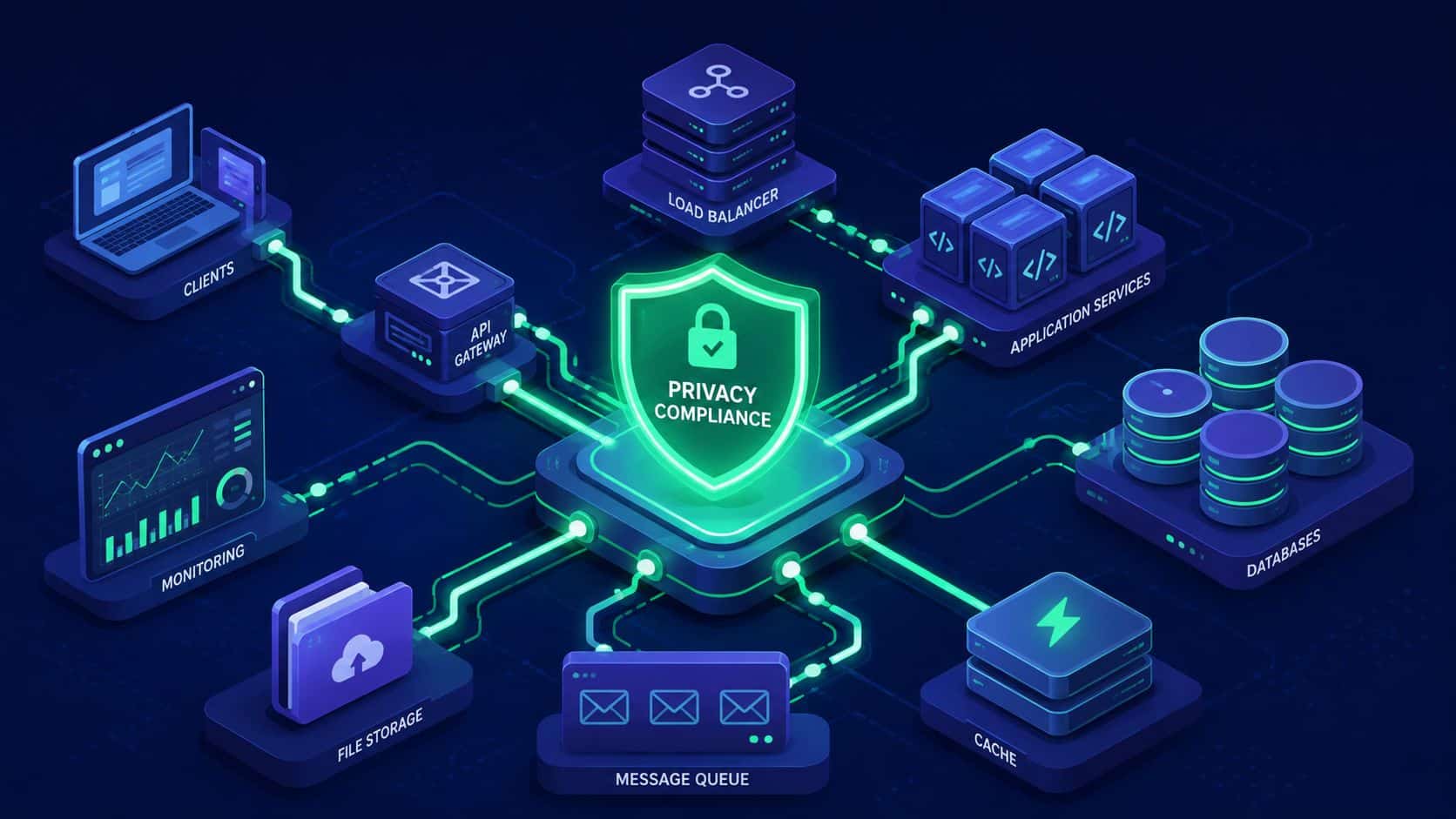
Today, privacy compliance is an operating system of controls, metrics, and evidence. Global privacy-law coverage now spans 172 countries, or 79% of all nations worldwide, and organisations increasingly track concrete indicators such as the percentage of privacy-compliant apps, the status of compliance actions, and counts of complaints, incidents, and training activities, according to StationX's privacy statistics summary.
Auditable proof beats policy language
For a CTO or senior developer, that means the question isn't “Do we have a privacy policy?” It's “Can our systems prove how personal data moves, who touched it, why we kept it, and when it should be deleted?”
A compliant stack usually needs to support:
- Data inventory: You need a reliable view of where personal data lives across apps, databases, queues, warehouses, and vendors.
- Access control: You need role-based restrictions that map to actual job responsibilities, not broad admin defaults.
- Event traceability: You need logs that show data access, permission changes, and operational actions.
- Workflow evidence: You need records of approvals, remediation actions, incident handling, and training completion.
What teams underestimate
Building those capabilities in-house sounds manageable when discussed as principles. It's much harder in production.
A DIY stack often spreads these responsibilities across Kubernetes, a CI tool, a cloud provider's IAM layer, a secrets manager, observability tooling, ticketing, and internal scripts. Each tool may be competent on its own. The problem is coherence. Auditors and enterprise customers don't assess your intent. They assess whether the controls are consistent and whether the evidence is complete.
Here's the hidden cost:
| Area | What teams think they need | What they actually need |
|---|---|---|
| Access | Admin roles and SSO | Granular RBAC, review workflows, and access history |
| Logging | Basic infrastructure logs | Searchable audit trails tied to users, systems, and actions |
| Releases | CI passing builds | Policy checks before production promotion |
| Documentation | A written policy | Evidence that the policy is enforced |
Compliance stops being painful when the platform generates evidence as a by-product of normal engineering work.
If your tech stack doesn't do that, engineers become clerks. They spend time reconciling tools instead of shipping features.
Decoding the Global Privacy Landscape
The acronyms vary by market. GDPR in Europe. CCPA and CPRA in California. Other national and sector rules elsewhere. Engineering teams often react by treating each law as a separate project.
That's the wrong level of abstraction.
The shared burden usually comes from a small set of recurring principles: collect less data, keep it for a defined reason, restrict access, respond to user requests, and document what happened. Once you see privacy compliance through that lens, the work looks less like legal interpretation and more like system design.
Why GDPR still sets the tone
For teams operating in Europe, or selling into Europe, GDPR still shapes the technical baseline. It has been in force since 25 May 2018, and regulators can issue penalties up to €20 million or 4% of annual global turnover, whichever is higher. By January 2026, cumulative GDPR fines had reached €7.1 billion, up from €5.88 billion a year earlier, and authorities were recording more than 400 personal data breach notifications per day, a 22% year-over-year increase, according to Osano's GDPR enforcement summary.
Those figures matter because they show two things clearly. Enforcement is active, and breach handling is operationally intense. Privacy compliance isn't dormant legal text waiting in a binder. It's a live governance discipline with real financial exposure.
The engineering common ground across laws
You don't need a different delivery model for every jurisdiction. You need a common control model that can satisfy several laws at once.
That usually means engineering around questions like these:
- Purpose limitation: Why are we collecting this field, and where is that purpose recorded?
- Data minimisation: Can the feature work with less personal data?
- Storage limitation: When does this data expire, and what deletes or anonymises it?
- Data subject rights: Can we export, correct, or erase records without bespoke scripts?
For teams that need a concise reference point, this GDPR compliance information is useful because it frames the regulation in a way that helps technical leaders connect legal requirements to system behaviour.
The fastest way to lose time is to implement privacy one region at a time, one questionnaire at a time, and one incident at a time.
A stronger pattern is to build once around shared control objectives, then map those controls to each market's obligations.
Mapping Legal Requirements to Technical Controls
Legal language gets abstract fast. Engineering work doesn't. The useful move is to translate each requirement into a system capability that can be tested, enforced, and audited.
Privacy compliance works better when teams ask a blunt question: if the law says a user has a right, what must the platform be able to do reliably?
The direct translation model
Here's what that mapping looks like in practice:
Right to be forgotten becomes a deletion workflow.
Not just a button in the admin panel. You need a service or job that removes or anonymises data across primary stores, replicas, search indexes, analytics sinks, and processors where required.Data portability becomes an export function.
The system needs to gather a user's personal data into a structured format without engineers manually querying half the stack.Privacy by design becomes release gating.
New services, schemas, and integrations should trigger checks before production if they introduce sensitive processing, retention changes, or new vendors.Purpose limitation becomes data classification and ownership.
Fields and datasets need a business purpose, an owner, and a retention expectation.
The controls that carry the real weight
Effective privacy compliance requires technical proof, not only policy wording. That includes maintaining a personal-data inventory, running DPIAs for high-risk processing, and enforcing vendor controls. The operational goal is to reduce data sprawl, because failures often start in untracked systems, shadow SaaS, and unmanaged processors, as described in OvalEdge's privacy compliance checklist.
A practical implementation normally includes:
A current data inventory
If you can't enumerate stores, processors, and data flows, deletion, export, retention, and incident response all become guesswork.DPIAs tied to delivery decisions
High-risk processing shouldn't live in a document repository detached from release management. It should influence whether a feature proceeds, with mitigations recorded.Vendor control enforcement
Every third-party tool that touches personal data needs ownership, contract review, and technical boundaries around what it can access.
Implementation test: if a privacy request arrives today, can your team answer it from systems and logs, or do they need Slack archaeology and manual database work?
Why this breaks on fragmented tooling
Homegrown platforms usually struggle. The deletion workflow lives in one service. Audit logs live elsewhere. IAM sits inside each cloud. Vendor inventory is in procurement. DPIAs are in docs. Nobody has a complete picture.
Secure coding practices matter here too, because weak defaults in application code often undermine otherwise sensible control design. The DeepDocs guide to secure coding is a worthwhile reference for teams tightening that layer.
The trade-off is simple. You can build this map yourself, but then you also own keeping it synchronised with every release, cloud change, vendor addition, and architecture shift.
A Cloud Focused Privacy Compliance Checklist
A cloud privacy programme doesn't fail because teams don't care. It fails because controls are scattered across providers, pipelines, runtime environments, and vendors.
The checklist below is the one I'd use to assess whether a team is doing real privacy compliance or just accumulating documents. The technical baseline is well understood: encryption in transit and at rest, MFA or SSO, least-privilege RBAC, monitoring for anomalous access, and runtime controls that generate evidence continuously, as outlined in Salesforce's data privacy compliance overview.
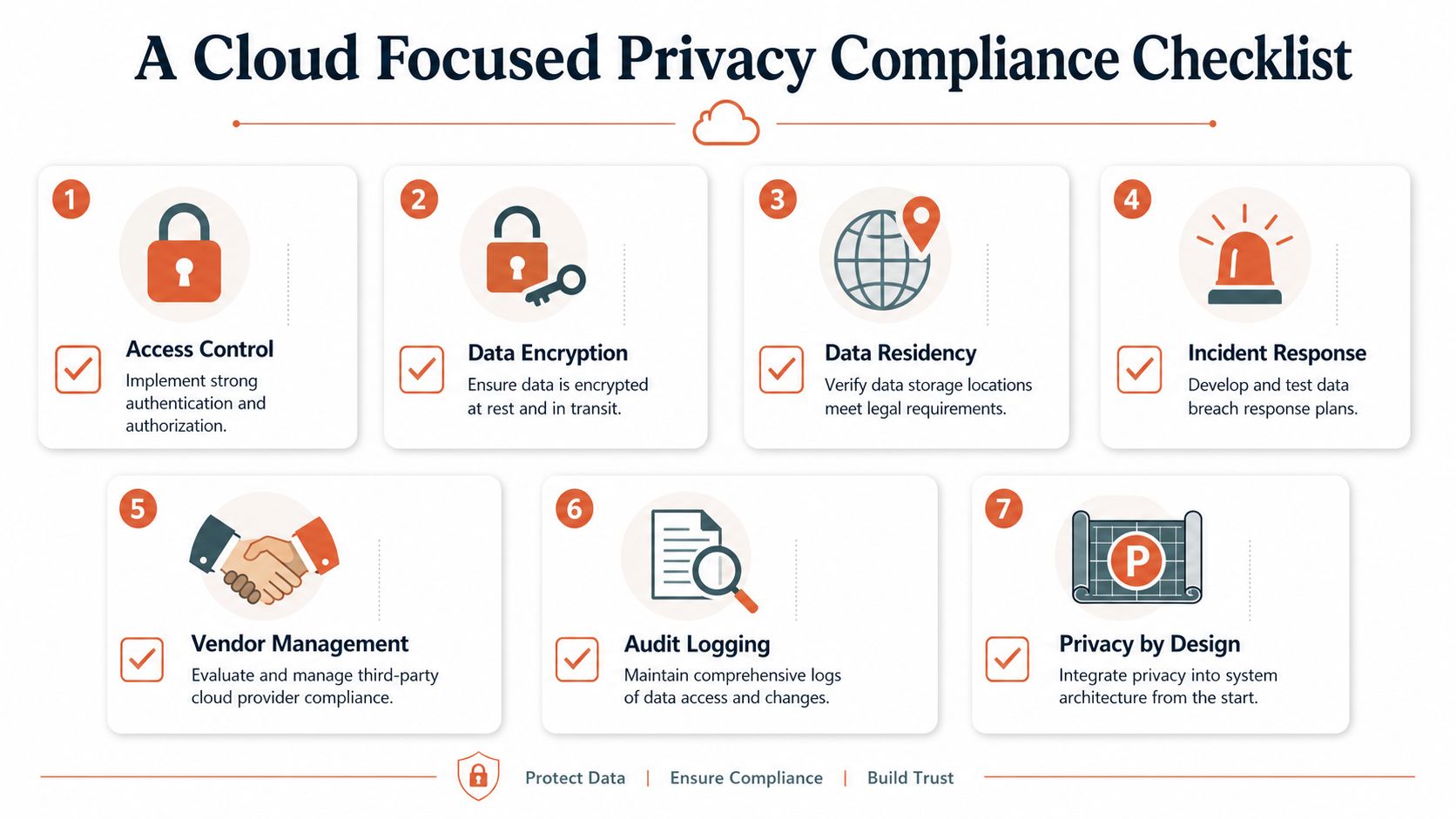
Seven areas to check now
Access control
Start with least privilege. Every engineer, support user, service account, and contractor should have access aligned to a role, not to convenience.
DIY complexity: AWS, GCP, and Azure all expose IAM differently. Getting consistent privilege boundaries across clouds is slower than often expected.Data encryption
Encrypt data at rest and in transit, then make sure key handling and service-to-service traffic aren't left as assumptions.
DIY complexity: Teams often enable encryption in some services and forget edge cases such as snapshots, staging stores, or ad hoc exports.Data residency
Verify where data is stored, processed, replicated, and backed up. A lot of privacy risk sits in “temporary” copies and analytics pipelines rather than the primary app database.
DIY complexity: Multi-cloud and third-party services make residency drift hard to spot without central visibility.Incident response
Build a breach-response process that includes detection, triage, escalation, legal review, and evidence preservation. Then test it.
DIY complexity: Many teams have a security runbook but no privacy-specific workflow for personal-data incidents.
What usually gets missed
Some controls look straightforward on paper and still break under load.
Vendor management
Every processor needs a clear owner and a bounded role in your architecture.
DIY complexity: Vendor review often lives outside engineering, while the actual data flows live inside engineering. That split causes blind spots.Audit logging
You need immutable, searchable logs of access, changes, and privileged actions. These logs should help with investigations, DSAR handling, and customer due diligence.
DIY complexity: Cloud-native logs are plentiful but rarely unified enough to answer compliance questions quickly.Privacy by design
Treat privacy checks like quality gates. New processing should trigger review before release, not after customer data is already flowing.
DIY complexity: This requires policy checks inside CI/CD, not just an approval note in a ticket.
The platform question
A useful test is whether your controls are cloud-specific workarounds or reusable platform capabilities. If every team has to interpret IAM, logging, network boundaries, and deployment policy differently, compliance quality will vary with whoever happens to be on call.
That's where a consolidated platform model becomes attractive. A cloud delivery layer that standardises environments, permissions, auditability, and release controls removes a lot of repeated engineering effort. If you're evaluating what that kind of approach looks like in practice, this DevOps cloud infrastructure platform explainer gives a good reference for how teams reduce bespoke setup across AWS, GCP, and Azure.
How a Modern Platform Automates Compliance
The best compliance automation doesn't feel like compliance automation. It feels like normal delivery with safer defaults.
That's the core advantage of a modern platform. Instead of asking every team to wire together CI checks, IAM roles, audit trails, retention logic, secrets handling, and cloud policies on its own, the platform standardises those controls once and applies them repeatedly.
What automation should actually do
A platform-led approach should make a few things boring:
| Control area | DIY pattern | Platform pattern |
|---|---|---|
| Access | Per-cloud IAM tuning by hand | Central RBAC model with standard roles |
| Auditability | Logs spread across tools | Unified, immutable activity history |
| Releases | Manual checks in tickets | Policy enforcement in deployment workflows |
| Environments | Drift between teams | Standardised foundations across clouds |
When this is done well, privacy compliance stops relying on memory. Engineers don't need to remember every control because the workflow enforces the important ones.
The practical effect on engineering teams
For teams running across AWS, GCP, and Azure, the payoff is consistency.
Instead of separate cloud-specific patterns for access, deployment, logging, and environment setup, the platform provides a single operating layer. Instead of rebuilding audit evidence for each review, the system already has a trace of who deployed what, who accessed which environment, and what changed. Instead of bolting privacy checks onto release management, policy can sit directly in the path to production.
That's why platform engineering matters here. A managed option such as PushOps developer platform automation fits this problem because it consolidates deployment workflows, role-based access, audit logging, policy enforcement, and multi-cloud operations into one layer. For a startup or scale-up, that can remove a lot of the hidden labour involved in making privacy controls repeatable.
Good automation doesn't replace judgement. It removes the repetitive setup, evidence gathering, and drift correction that consume senior engineering time.
What works and what doesn't
What works:
- Standard roles rather than ad hoc privilege grants
- Policy checks in pipelines rather than after release
- Central audit trails rather than log hunting
- Shared environment patterns rather than team-by-team infrastructure improvisation
What doesn't:
- Screenshots as your primary evidence model
- One-off scripts for deletion or export requests
- Audit prep that starts when the auditor arrives
- Hiring more DevOps engineers just to maintain internal plumbing that product teams never wanted to own
Stop Building a Compliance Engine and Start Shipping Product
Privacy compliance is essential. Building a bespoke compliance machine usually is.
That distinction matters. Many startups and scale-ups treat privacy work as an unavoidable by-product of growth, then absorb it by expanding the internal DevOps burden. More clusters. More scripts. More custom IAM. More manual review. More platform work disguised as “just one more control”. Engineering capacity gets redirected from roadmap delivery into maintaining the machinery around delivery.
The strategic mistake isn't taking privacy seriously. It's assuming your product team should also become an infrastructure governance team.
The better trade-off
A strong engineering organisation still needs to understand its obligations. It still needs clear data ownership, vendor discipline, incident response, and release hygiene. But it doesn't need to hand-build every mechanism that makes those controls auditable.
A platform approach changes the economics. It turns recurring compliance tasks into standard operating behaviour, reduces drift, and frees senior engineers to work on the product instead of reconstructing evidence or debugging internal tooling. That's a better use of time, and usually a better use of budget too.
If your team is spending too much energy maintaining the operational substrate around compliance, this guide on reducing DevOps overhead is a sensible place to reassess what should remain in-house and what should become platform capability.
If privacy compliance is slowing releases, consuming engineering time, and forcing your team to maintain more infrastructure than product, it may be time to simplify the stack. PushOps provides a production-ready cloud platform that standardises deployment, access control, auditability, and multi-cloud operations so teams can focus on shipping software instead of building internal DevOps machinery.

