
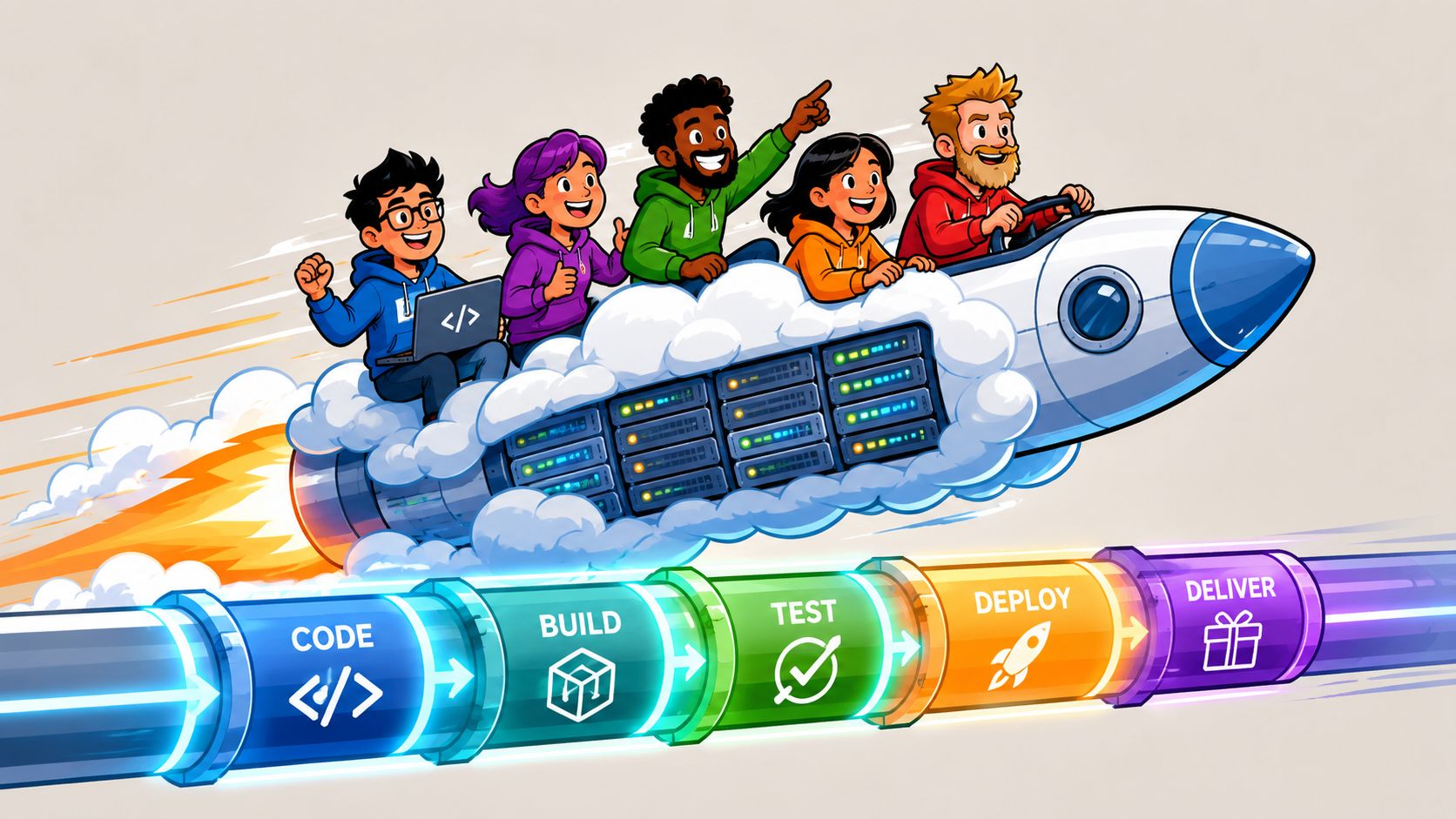
You've seen this week already. Monday starts with a promise to ship something customer-facing, and by Tuesday the senior engineer who owns it is buried in Terraform drift, a certificate that's about to expire, and a staging alert that nobody quite owns. The product work hasn't become less important, but the platform underneath has become the job.
That's the trap with agile tech in modern startups and scale-ups. The process looks tidy on the board, the sprint goals sound reasonable, and the ceremonies are in place. Then the delivery path from commit to production breaks down, and the team spends its week acting like an unpaid platform group instead of shipping product.
The Monday Morning Every Engineering Leader Recognises
A good engineering week starts with a clear target. Someone has scoped the feature, the team has split the work, and the release plan looks realistic on paper. Then the platform starts collecting its tax.
By Tuesday afternoon, the story has changed. One engineer is checking why a Terraform plan is failing. Another is trying to understand why a container image won't deploy cleanly. A third is pulled into a staging incident because the alerting stack belongs to nobody in particular, which usually means it belongs to everyone and gets fixed by whoever is most tired.
Context switching is the real cost
That constant hand-off between product work and operations work is what burns teams out. It is not just annoyance, it is drag on every delivery decision. When the same people who are meant to build features also have to keep the pipeline alive, feature velocity drops, morale drops, and the team starts treating releases as events instead of a normal operating rhythm.
Practical rule: if your best engineers are spending their attention on cluster hygiene, build failures, and access issues, you do not have an agility problem. You have a platform problem.
The original Agile idea was never “move fast and hope”. The Agile Manifesto, produced in February 2001 by 17 software practitioners at Snowbird, Utah, gave teams 4 core values and 12 principles, including early and continuous delivery and using working software as the main measure of progress, not paperwork or ceremony Planview history of Agile. That matters because working software only stays the primary measure when the path to production is repeatable.
In other words, the Monday morning problem is not a side issue. It is the hidden reason agile teams stop feeling agile.
What Agile Tech Means in 2026
Agile tech is the delivery system behind the process. It is the operating rhythm that lets a team move from idea to production without turning every release into a firefight. The manifesto gave teams the philosophy, but the value comes from the delivery loop underneath it.
The sprint is the unit that matters
Scrum turned that philosophy into a working cadence. A sprint is usually 2 to 4 weeks, which gives teams a short cycle to inspect progress, adapt, and release instead of waiting for long, brittle delivery windows. That rhythm became the default because it matches how product teams learn, ship, and correct course Timetoast on the history of Agile.
For engineering leaders, the point is blunt. Agile works when the organisation can do three things repeatedly, plan a small increment, build it cleanly, and get it to a real environment without drama. If any one of those steps gets blocked by platform friction, the agile process turns into theatre.
Working software is not a slogan. It is a delivery condition.
That is why the language around iterations, retrospectives, and backlog grooming matters less than people think. Those practices are useful only if the team can produce a reliable increment at the end of the cycle. If the platform cannot support that, the process exposes the dysfunction faster.
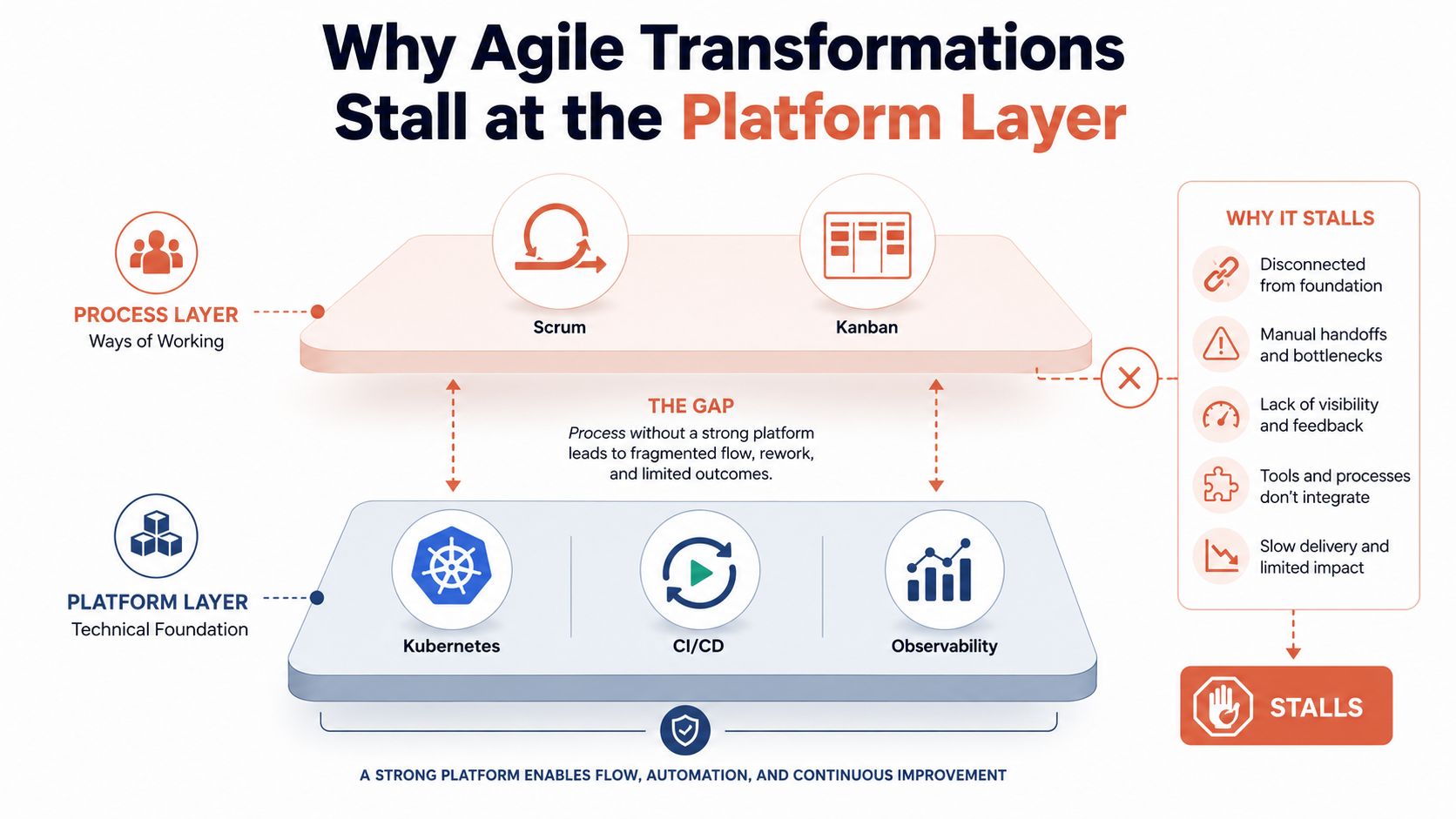
The gap between process and platform is the core story. Scrum boards do not ship code. Kanban does not provision environments. Retrospectives do not fix release tooling. A team that understands this starts treating the platform as part of agile delivery, not as a separate infrastructure concern parked somewhere else.
For that reason, the clearest way to frame agile tech is through the delivery layer itself. The team can run every ceremony correctly and still fail if the path from merge to production is brittle. Internal developer platform thinking makes that gap obvious, because it forces teams to standardise the developer experience instead of asking every engineer to become part-time platform support.
Why Most Agile Transformations Stall at the Platform Layer
The common mistake is to assume process reform creates delivery reform. It does not. Teams adopt Scrum, run standups, draw prettier boards, and still miss sprint goals because the merged pull request takes too long to become a running service.
The manifesto talks about working software. Real teams spend their time on pipeline maintenance, environment drift, flaky tests, cost reviews, and security tickets. That is not agile delivery, it is platform administration wearing agile clothing.
The bottleneck is rarely the ceremony
A lot of organisations keep pushing the process layer harder when the platform layer is the thing failing. They add more rituals, more estimation discipline, more retrospectives. None of that matters if one overloaded engineer owns the path from merge to production.
The failure usually shows up in the release path, not the meeting cadence. A fragile platform breaks sprint commitments because builds stall, environments drift, approvals pile up, and the team cannot turn a finished increment into a release on demand. That is the primary reason commitments slip. The delivery system is unstable.
If you want the blunt diagnosis, here it is. Agile fails most often where the delivery path is fragile. Not because the team does not care, but because the system they work inside is hand-built, under-documented, and too dependent on a few people.
That is where an internal developer platform becomes the right lens. It forces teams to standardise the developer experience instead of asking every engineer to act like part-time platform support.
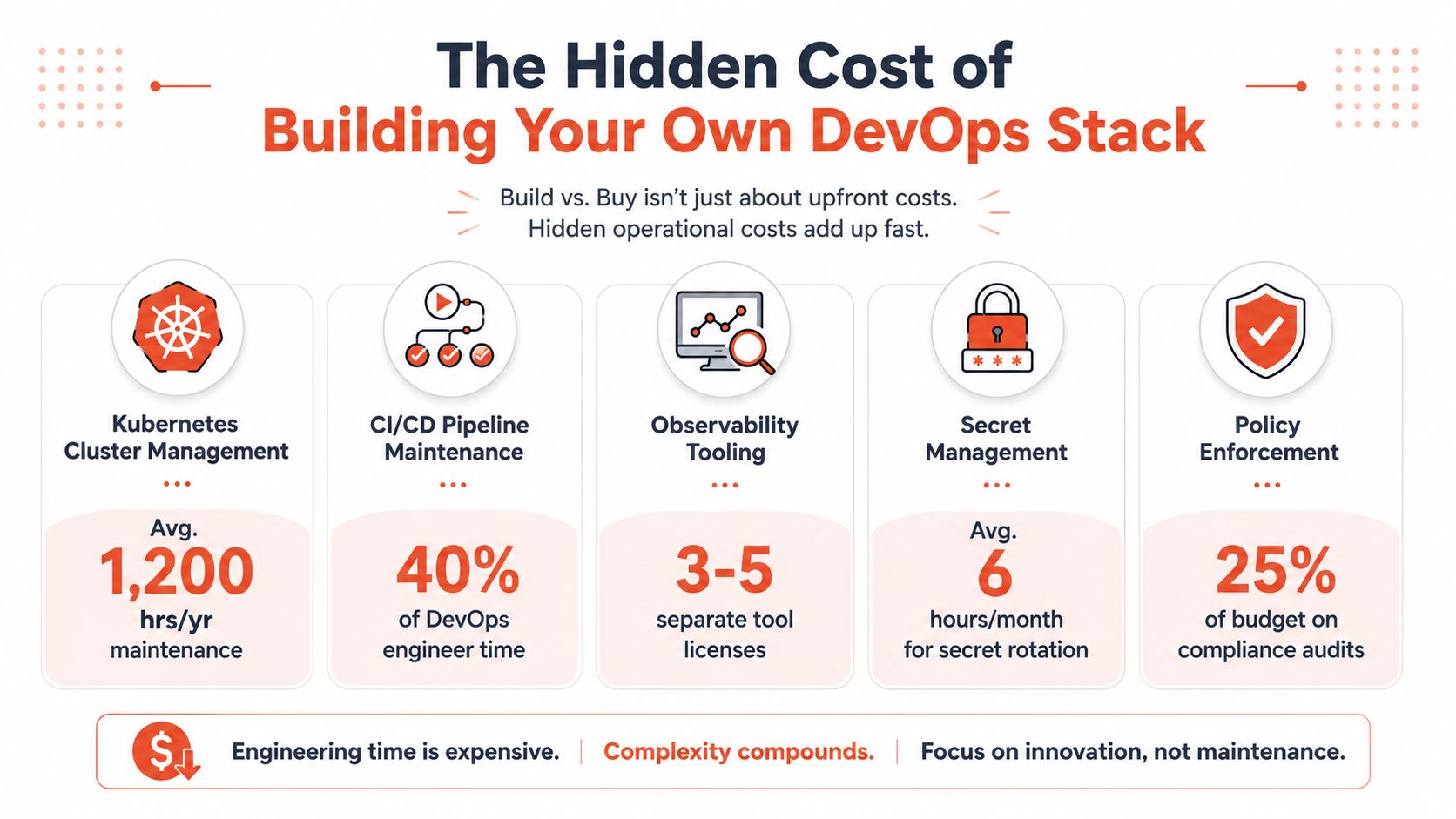
That is why I treat agile tech as process plus platform, with the platform usually being the bigger lever. If the delivery foundation is weak, even the best agile habits just expose the weakness faster.
The Hidden Cost of Building Your Own DevOps Stack
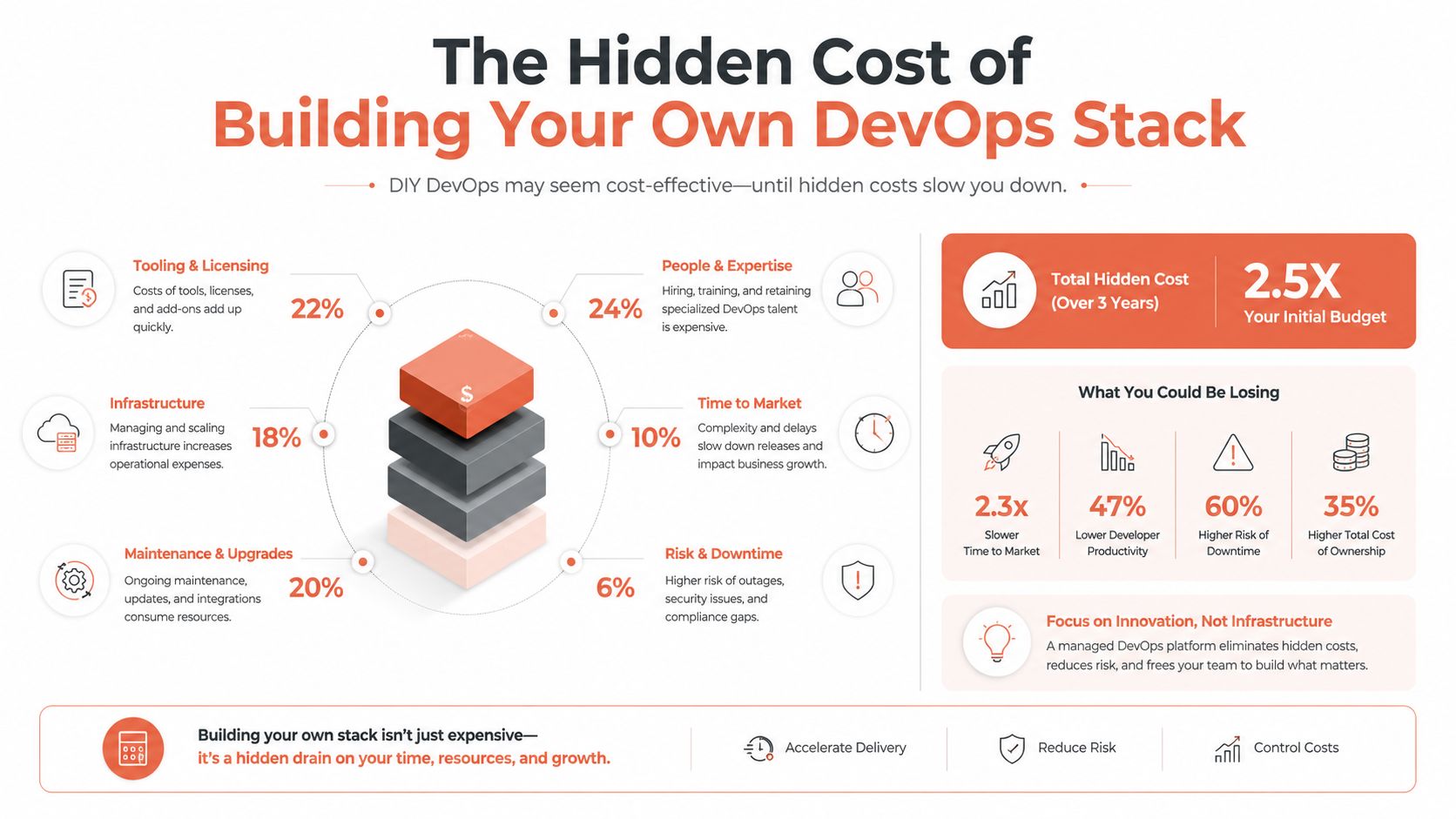
DIY DevOps looks cheap until you count the cost. Kubernetes is open source, CI/CD tools look accessible, observability stacks feel modular, and secret management looks manageable when the team is small. Then the invoice shows up in headcount, on-call load, slow releases, and hours spent on work that never ships product.
The unpaid work behind the stack
A home-grown platform needs upgrades, access controls, release logic, deployment guardrails, incident response, and someone who keeps every piece aligned. That work does not come for free, and it does not stay simple. It becomes a permanent maintenance function that competes directly with feature delivery.
For regulated teams, the burden gets heavier fast. In the EU, DORA became applicable on 17 January 2025 and requires financial entities to maintain formal ICT risk management, incident reporting, resilience testing, third-party risk management, and register-level oversight of ICT providers DORA reference in the Agile report. In the US, NIST Cybersecurity Framework 2.0 adds a dedicated Govern function for strategy, roles, policy, oversight, and supply-chain risk management NIST CSF 2.0 reference.
That changes the decision. A DIY platform is a governance choice as much as an infrastructure choice. You are not just building pipelines and clusters, you are building evidence, ownership, and control processes around them.
Practical rule: if the platform is custom, the governance is custom too. Leaders miss that cost all the time.
Cloud makes one part easier and another part harder. The UK's National Audit Office noted that the Government Digital Service's Cloud First policy has been in place since 2013, and that cloud can reduce upfront capital spend by shifting organisations towards operating expenditure, while also improving agility through elastic scaling. It also said cloud demands stronger supplier, security, and cost management disciplines than traditional hosting NAO discussion of cloud and agility. That is the trade-off. Less hardware ownership, more operational discipline.
If the team is still betting its future on bespoke scripts and a couple of overloaded engineers, the company is not saving money. It is delaying the invoice.
See our overview of CI/CD pipeline patterns for more context.
For teams that want a better developer experience without building all the plumbing themselves, benefits of AI operations control is a useful adjacent read. AI does not solve platform sprawl. Control and visibility matter just as much as raw automation.
Three Delivery Models and Where Each One Breaks
There are three honest ways to run delivery today. You can assemble a DIY open-source stack, you can staff an in-house platform team, or you can use a managed DevOps platform. Each one works. Each one also fails in a very predictable way.
Comparing agile delivery models
| Dimension | DIY Open-Source Stack | In-House Platform Team | Managed DevOps Platform |
|---|---|---|---|
| Setup speed | Slow, because every component is assembled and wired by your team | Faster than DIY, but still requires internal design and coordination | Fast, because the baseline is already provisioned |
| Attention cost | High, because product engineers get dragged into tooling work | Medium to high, because the platform team becomes a dependency | Lower, because the platform work is largely externalised |
| Main strength | Flexibility and control | Standardisation across internal teams | Repeatability across environments and clouds |
| Typical failure mode | Upgrades, drift, and ownership gaps | Bottlenecking when hiring slows or priorities shift | Lock-in if the platform is too narrow or cloud-specific |
| Agile impact | Releases slow down when the stack breaks | Delivery slows when the platform queue grows | Agile cadence stays closer to the sprint rhythm |
The DIY route is attractive when teams are small and ambitious. It starts with a few scripts, a cluster, and the belief that “we'll automate the rough edges later.” Later arrives fast. Then upgrades pile up, security reviews take longer, and the original product team starts doing infrastructure rescue work.
An in-house platform team sounds more mature, and sometimes it is. But if the team has only two to five engineers, it can become a queue that everyone else waits on. That model breaks when hiring freezes, priorities change, or the platform group gets pulled into too many one-off requests.
A managed DevOps platform is the only model that directly protects product focus at scale. It removes a lot of the maintenance burden while giving teams a consistent way to ship. I'll be blunt. For most startups and scale-ups, especially those operating across Europe, Singapore, the UK, and the US, this is the model that preserves agility instead of just talking about it.
What a Modern Multi-Cloud DevOps Platform Replaces
A serious managed platform doesn't just “host code”. It replaces a long list of work that teams usually underestimate. Provisioning, deployment, observability, security, and spend control are all part of the delivery path, and every one of them takes real engineering time when handled in-house.
Provisioning and release work
A modern platform gives you production-ready foundations on AWS, GCP, and Azure without forcing engineers to assemble every environment by hand. That matters because each new environment in a DIY stack brings setup, validation, and maintenance work with it. The business value is simple, the team spends less time wiring infrastructure and more time shipping features.
Builds, deployments, environments, and release strategies should also come from the same workflow from commit to production. That's what protects the agile loop. If deployment is still a special event managed by a few people, then the sprint ends with a handoff instead of a release.
Observability, security, and cost control
A platform also needs to surface what's happening in production, not hide it behind dashboards no one uses. Integrated observability means health metrics, incident management, and performance insights live where the delivery work lives. Security should be default-on, with role-based access, permissions, audit logs, policy enforcement, and continuous updates. Cost control should come from autoscaling, right-sizing, and environment scheduling, not from panic and spreadsheet archaeology.
For teams comparing platform categories, PushOps is one example of a managed cloud infrastructure and deployment platform that covers this style of delivery, including self-service workflow and zero pipeline maintenance. Its developer platform automation explainer is a useful reference if you want a concrete picture of what automation looks like when it's built into the operating model rather than bolted on.
The important part isn't the brand name. It's the operating principle. If the same capability takes weeks to build, needs a dedicated engineer to own it, and still requires ongoing maintenance, it's not a lightweight internal feature. It's a platform commitment.
Why Managed Platforms Make Teams More Agile, Not Less
The objection is control. Leaders assume a managed platform will slow delivery or make the team dependent on someone else's system. In practice, the stronger setup is usually the managed one, because it standardises environments and makes releases repeatable instead of improvised.
Control comes from consistency
A managed platform cuts down the dependency on tribal knowledge sitting in one senior engineer's head. That matters. If a cloud migration, a regional deployment change, or a rollback only works because one person remembers the right sequence, you do not have resilience. You have a fragile memory system.
A multi-cloud platform helps teams stay aligned with the agile principle of responding to change as noted earlier. Teams that can move workloads, shift regions, or change cloud direction without rebuilding the delivery pipeline from scratch are more agile than teams that have spent months locking themselves into a bespoke setup.
The team that can change direction in a sprint is more agile than the team that spent six months building machinery to avoid that change.
Managed platforms reduce delivery drag
The point is not less discipline. The point is less drag. Managed platforms remove the busywork that turns every release into a small infrastructure project, and they make the path from commit to production much easier to repeat.
For teams that want a concrete example of developer platform automation, PushOps sits in this category as a managed, multi-cloud delivery platform for teams that want to ship without maintaining their own release engine. That matters because the bottleneck is usually the platform underneath the methodology, not the methodology on top.
A Short Decision Checklist for Choosing Your Delivery Model
Start with the uncomfortable questions. If more than a sliver of your engineers are spending their time on platform work instead of product, the platform is already taxing your roadmap. If you can't swap clouds, regions, or environments without a painful rebuild, your delivery model is too brittle for serious agile work.
Ask whether your stack can show DORA- or NIST-style governance on demand, not after a two-week scramble. Ask who owns the pipeline when something breaks, and whether that answer still works if one key engineer is on holiday. Ask whether the current setup protects sprint cadence or keeps interrupting it.
If the answers keep pointing to fragility, the fix isn't another layer of ceremony. The fix is a better delivery platform.
A CTA for PushOps. If you want agile tech to mean faster shipping instead of more infrastructure chores, talk to PushOps about replacing your fragile DevOps stack with a managed multi-cloud platform that lets your team focus on product, not operations.

