
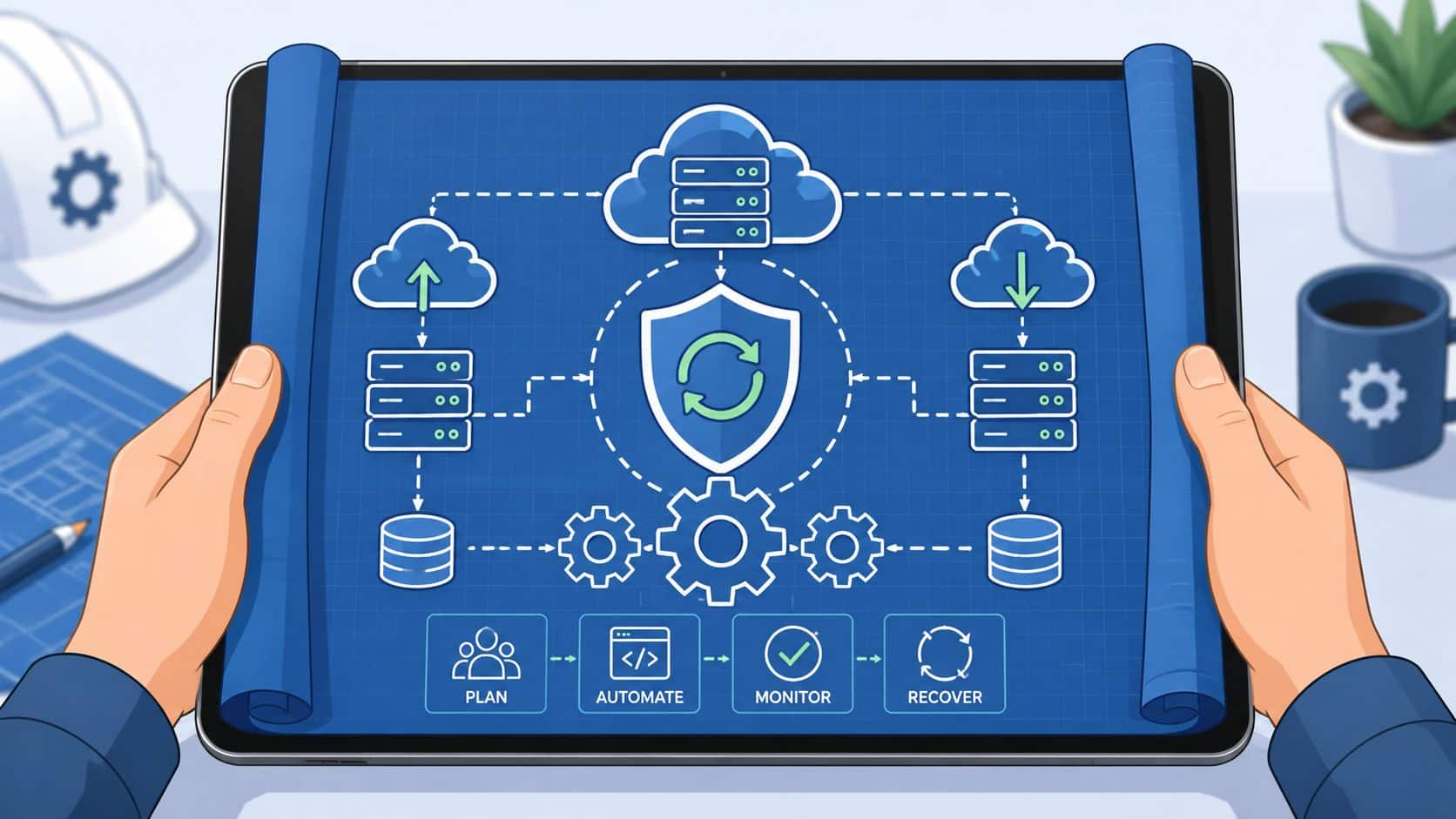

Your team ships through a stack that grew one urgent decision at a time. A Kubernetes cluster tuned by one staff engineer. CI/CD glued together from GitHub Actions, shell scripts, and a few undocumented approvals. Monitoring split across Grafana, CloudWatch, Datadog, and Slack alerts that half the team has muted. It works, until a routine change collides with a hidden dependency and a revenue-critical service stops.
That's where business continuity planning stops being a compliance document and becomes an engineering discipline. For modern software teams, the continuity problem usually isn't a dramatic physical disaster. It's operational fragility inside the platform you built to move fast.
Your Infrastructure Is Your Biggest Business Risk
A common failure pattern looks boring right up to the point it becomes expensive. A team updates a shared secret in one environment but not another. A deployment pipeline retries aggressively and amplifies load on an already unhealthy service. The database restore process technically exists, but only one engineer has ever run it end to end. The incident starts as a tooling issue and ends as a business issue.
That's why I don't treat business continuity planning as a policy exercise. I treat it as protection for product delivery, customer trust, and engineering focus. If your ability to ship depends on a brittle internal platform, your infrastructure is already part of your core business risk surface.
The adoption gap is still larger than many leaders assume. Only 61% of businesses globally report having a business continuity plan, and downtime in critical sectors can cost more than $5 million per hour, according to this continuity statistics review. Even if your company isn't in one of those sectors, the direction of the problem is obvious. Outages hit revenue, support load, roadmap credibility, and executive attention fast.
DIY resilience creates hidden failure modes
The problem isn't just that hand-rolled infrastructure fails. It's that it often fails in ways your team hasn't modelled clearly.
- Undocumented dependencies mean recovery depends on memory, not process.
- Custom scripts solve last month's problem but hard-code today's assumptions.
- Tool sprawl splits ownership across teams that don't share the same view of service health.
- Platform drift creeps in when one environment gets “just this one” exception.
Practical rule: if restoring service requires the same people who built the system to be awake, available, and perfectly informed, your continuity posture is weaker than it looks.
A useful lens here is to differentiate inherent and residual risk. Inherent risk is what the service faces by existing at all. Residual risk is what remains after you've applied controls. Many engineering teams underestimate the residual risk created by custom platform work because the controls feel familiar. Familiar doesn't mean resilient.
Product velocity is part of continuity
Continuity planning is often framed as “how to recover after failure”. For engineering leaders, the sharper question is different. How much of your best team's time are you spending building internal resilience machinery instead of shipping product?
That trade-off matters. Every hour spent stitching together failover logic, backup checks, access reviews, deployment approvals, and environment parity is an hour not spent on customer-facing work. Some of that effort is necessary. A surprising amount is undifferentiated platform labour.
The teams that struggle most with continuity usually aren't reckless. They're overloaded. They've accepted too much bespoke operational surface area, and they're paying for it in complexity, distraction, and slow recovery when something breaks.
The Real Goal of Business Continuity Planning
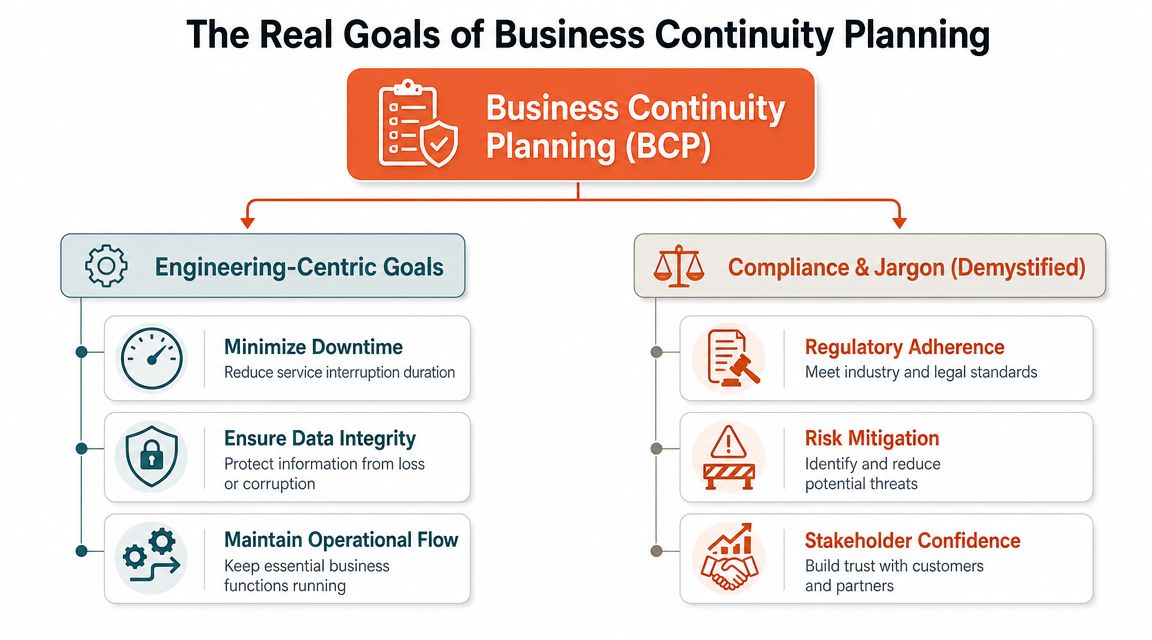
Business continuity planning has matured well beyond the old “disaster recovery binder on a shelf” model. The more useful definition comes from formal management practice. ISO 22301 defines a business continuity plan around the ability to respond, recover, resume, and restore operations to a predefined level after disruption, as described in the NIH/PMC review of business continuity management.
For engineering teams, that wording matters because it ties continuity to operating conditions you can design for. Not vague resilience. Specific, testable recovery expectations.
Translate the jargon into engineering decisions
The core terms are simple once you strip out compliance language.
Business impact analysis asks which services matter, what they depend on, and what breaks when they stop.
Recovery time objective asks how long the business can tolerate that service being unavailable.
Recovery point objective asks how much data loss the business can tolerate when you restore.
If you run a SaaS product, these aren't abstract governance terms. They shape architecture. A low RTO pushes you towards faster failover, preprovisioned capacity, and cleaner runbooks. A low RPO pushes you towards tighter backup frequency, replication choices, and more disciplined restore paths.
The old mistake is writing plans that never meet reality
Teams often produce continuity documents that describe intent but not execution. The plan says “fail over to secondary infrastructure” without naming what triggers that decision, who has access, what state must be validated first, or how customer-facing dependencies behave during the move.
That gap is where DIY platforms get costly. Mapping business requirements onto a real stack means answering awkward questions such as:
| Question | What it really means |
|---|---|
| Which service is truly critical | Not every workload deserves the same resilience budget |
| What dependency can stop recovery | Identity, DNS, secrets, queues, build runners, and SaaS tools all count |
| Who can execute recovery | If the answer is “the person who built it”, that's not a plan |
| What gets restored first | Recovery order matters more than most teams expect |
A useful continuity plan doesn't promise perfection. It defines which failures you can absorb, how quickly you can recover, and what compromises the business will accept on the way back.
Good BCP sharpens technical trade-offs
This is why strong business continuity planning is valuable even for teams that already run solid cloud infrastructure. It forces explicit trade-offs.
You may decide that one internal admin tool can tolerate a slower restore, while customer authentication can't. You may accept more operational overhead for billing systems but not for sandbox environments. You may realise that your “multi-cloud strategy” is mostly duplicated complexity without a realistic recovery model behind it.
The hard part isn't understanding BIA, RTO, and RPO. The hard part is implementing them in a stack assembled from separate tools, custom scripts, and tribal knowledge. That's where continuity work starts to consume senior engineering time that could be better used on the product itself.
A Modern Framework for Building Your BCP
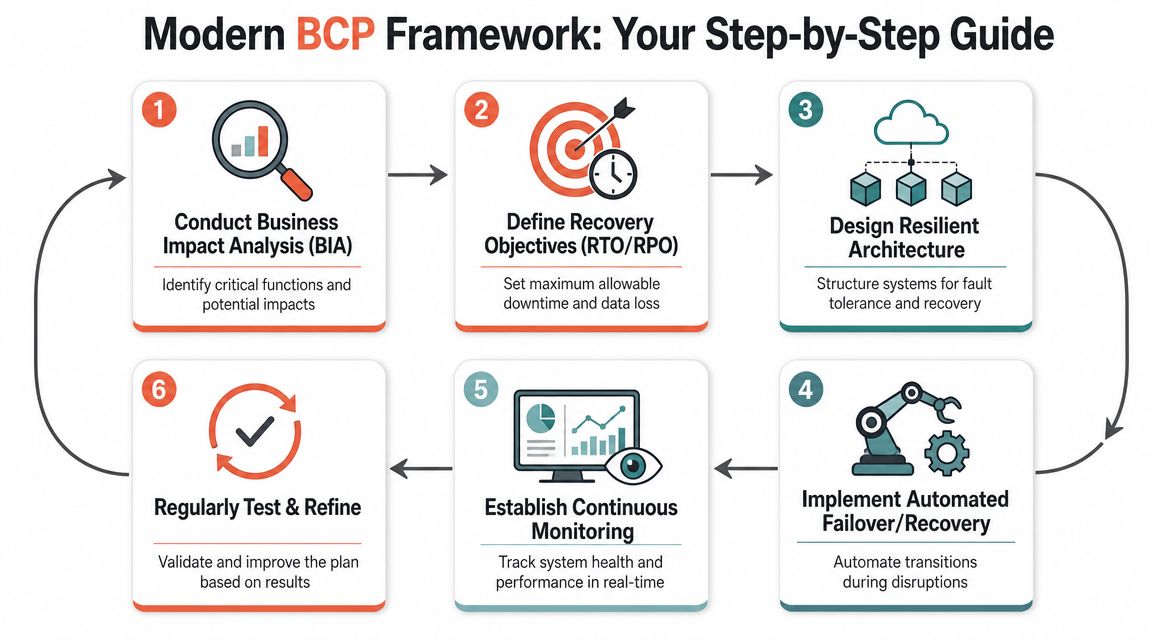
The most practical way to build a continuity plan is to start from business impact, then push those decisions down into architecture, automation, and operating habits. The technical core is the chain from BIA to RTO and RPO, which then drives failover design, backup frequency, and restoration procedures, as explained in TierPoint's guide to business continuity planning.
That sounds straightforward. In practice, two teams diverge. One team manages continuity through spreadsheets, side documents, and heroic knowledge. The other treats continuity as part of the platform itself.
Start with service impact, not infrastructure inventory
A lot of BCP efforts begin by listing servers, clusters, or vendors. That's backwards. Start with what the business must keep doing.
A practical sequence looks like this:
Name the critical services
Revenue paths, authentication, customer support workflows, payment processing, delivery pipelines, and anything tied to contractual or regulatory obligations belong here.Map dependencies underneath them
Databases, queues, object storage, IAM, DNS, observability, CI runners, third-party APIs, and cloud services all need to be visible.Set tolerances
Decide what downtime and data loss are acceptable for each service. Don't give everything the same target.
The DIY version of this exercise usually lives in a shared document that ages badly. The better version keeps dependency information close to the systems themselves, where teams can update it as architecture changes.
Turn objectives into architecture choices
Once RTO and RPO are defined, architecture stops being a matter of taste.
- Lower downtime tolerance usually means prebuilt failover paths, cleaner environment parity, and fewer manual approvals.
- Lower data loss tolerance pushes backup and replication design into the foreground.
- Higher criticality often justifies stronger isolation, stricter access control, and tighter observability.
Modern platforms reduce toil. Instead of hand-maintaining shell scripts, bespoke Terraform variants, and different deployment paths for each environment, teams can standardise recovery mechanics. Version-controlled automation is much easier to trust than a runbook full of commands someone last edited during the previous incident.
Build runbooks people can actually execute
A runbook isn't useful because it exists. It's useful when a tired engineer can follow it under pressure.
Good runbooks usually have these traits:
- Clear activation criteria so people know when to use them.
- Named owners and backups for each decision point.
- Ordered steps that reflect restore dependencies.
- Validation checks to confirm the system is safe to bring back.
- Communication prompts so customer-facing teams aren't guessing.
A lot of generic guidance on effective business continuity planning is solid on process, but engineering teams need one extra layer. They need runbooks tied to real infrastructure states, release mechanisms, and access controls, not just incident roles.
Make communications part of the technical plan
Engineering leaders often underweight this piece because it feels less technical. That's a mistake. During an outage, communication delays create operational drag.
A strong continuity plan defines:
| Situation | What needs to be ready |
|---|---|
| Internal incident declaration | Who can trigger the process and where updates are posted |
| Customer impact | Pre-agreed message owners and approval paths |
| Vendor dependency failure | Contacts, escalation routes, and workaround options |
| Recovery complete | Criteria for standing down and documenting follow-up work |
Review cost with the same discipline as risk
The final framework step is budget realism. Not every service needs gold-plated resilience. Some need fast failover. Others need a credible restore path and calm communications.
That's where engineering leadership matters. The wrong approach is trying to engineer maximum resilience everywhere. The better approach is protecting the few services whose outage would stop revenue, delivery, or compliance, then reducing the operational burden of those protections as much as possible.
Operational Realities in a Multi-Cloud World
Business continuity planning gets much harder when your production path crosses AWS, GCP, Azure, and a stack of external services. What looks like diversification on a slide often becomes coordination overhead in real operations.
The biggest gap in many continuity plans is third-party and cloud dependency handling. That matters more now because the EU's Digital Operational Resilience Act has applied since 17 January 2025 to financial entities in the EU, including Lithuania, and strengthens ICT third-party oversight and testing expectations, as discussed in Bryghtpath's piece on business continuity planning success. Even outside regulated sectors, the operational lesson is the same. If a critical dependency sits outside your direct control, your continuity design has to account for that explicitly.
Multi-cloud doesn't remove risk by itself
Many teams assume that “we're in multiple clouds” means “we're resilient”. It can mean that. It can also mean you've multiplied the number of places where recovery can fail.
Common fault lines include:
- Identity fragmentation across different IAM models and role assumptions
- Uneven observability because each cloud exposes health and telemetry differently
- Inconsistent deployment paths that make failover environments behave unlike primary ones
- Third-party coupling through hosted databases, SaaS auth, messaging, billing, and support tooling
If your backup environment requires a different deployment process, different access pattern, and different monitoring workflow, it isn't really a backup environment. It's a second primary system your team rarely uses.
The operational pain shows up in ordinary incidents
You don't need a catastrophic event to feel this complexity. A regional degradation, a broken identity provider, or a failed managed service can trigger the same continuity questions.
Can your team deploy safely into another environment without re-learning the process?
Can they observe health consistently across clouds?
Can they enforce the same security controls and audit trail under incident pressure?
Most DIY stacks answer those questions with “it depends”. That's exactly the problem.
A unified control plane is the saner pattern. Teams need one operational layer for deployments, observability, policy enforcement, and environment management, even if workloads span multiple providers. If your organisation is working through that challenge, this explainer on multi-cloud management is a useful reference for thinking about consistency above the cloud-vendor layer.
Resilience should reduce cognitive load
The point of continuity work isn't to give your team more operational permutations to memorise. It's to make abnormal conditions manageable with the same tools and behaviours they already use day to day.
That's why DIY multi-cloud resilience often disappoints. It creates a beautiful architecture diagram and a painful operating model. Senior engineers become translators between clouds, between tools, and between teams. Recovery works, if the right people are available.
That's not the bar most scaling companies should accept. Continuity should be designed to survive stress, staff changes, and vendor problems without pulling half the engineering org away from product work.
Testing Your Plan Without Disrupting Your Team
Most continuity advice says “test the plan regularly” and leaves out the part engineers know too well. Manual testing is expensive, awkward, and disruptive, so teams postpone it until a compliance deadline or a painful incident forces the issue.
That's one reason plans degrade. A BCP needs continuous maintenance because infrastructure, processes, and people change. Plans that aren't revalidated after those changes often fail during a real incident because procedures are outdated and dependencies have shifted, as Linford & Co explains in its article on BCP importance and maintenance.
Stop treating testing as a yearly event
The annual full-scale exercise has value, but it shouldn't be your primary validation method. It creates too much ceremony and too much reluctance.
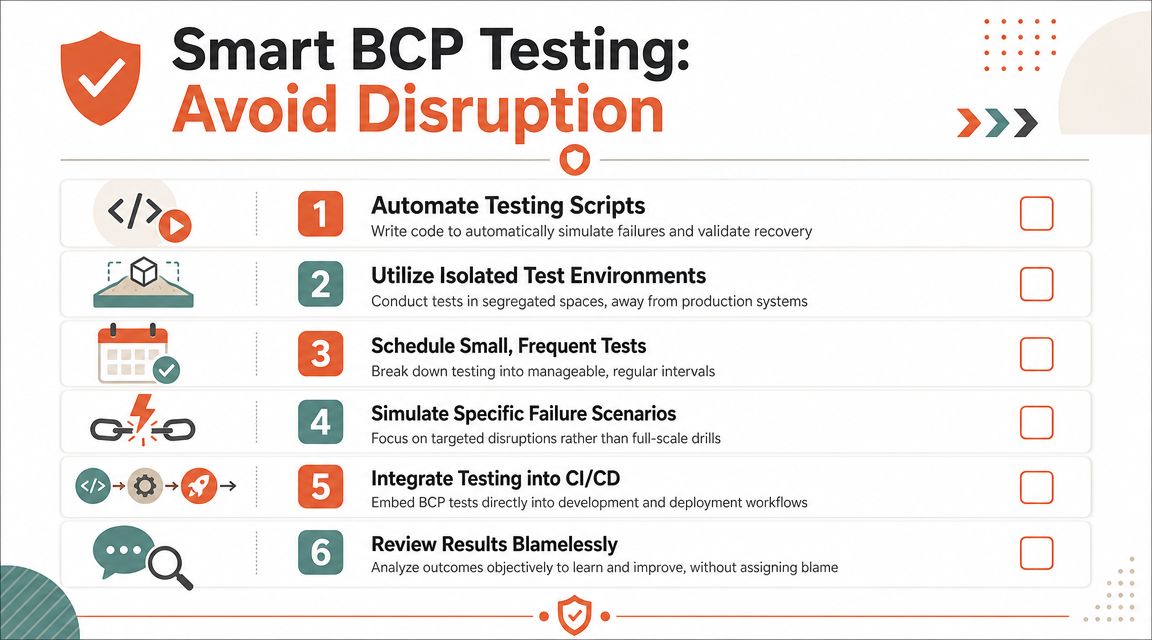
Smarter teams break testing into smaller, more frequent checks:
- Tabletop reviews for decision paths, comms, and escalation
- Targeted recovery drills for one service or one dependency at a time
- Backup validation that confirms data can be restored
- Deployment safety tests that prove rollback and release controls work
- Access checks to ensure incident roles still have the permissions they need
A small, repeatable exercise tells you more about operational readiness than a polished annual meeting ever will.
Build validation into normal engineering flow
Platform capability is vital. If your team can create isolated environments quickly, test recovery scripts away from production, and run controlled release mechanisms through the same delivery pipeline, continuity testing becomes much less invasive.
Feature flags, progressive delivery, and rollback controls aren't just release tools. They're continuity tools because they let teams limit blast radius and validate recovery behaviour under safer conditions. This explainer on feature flags and safe releases is useful if you're trying to connect release engineering with resilience work.
Test the parts that change most often. That's where continuity plans usually drift first.
Favour blameless evidence over theatre
Continuity testing often fails culturally before it fails technically. Teams treat exercises as performances rather than evidence-gathering. People avoid surfacing weak points because they don't want to look unprepared.
A better model is narrower and more honest. Pick a scenario. Validate one runbook. Check whether the right people can execute it with current tooling and permissions. Record what broke. Fix it. Repeat.
That approach is less dramatic, but it fits how modern engineering organisations improve systems. It also avoids the worst continuity anti-pattern of all: a plan that passes review and fails in production.
From Manual Recovery to Automated Resilience
The old model of business continuity planning treated resilience as documentation supported by specialist effort. That isn't enough for modern software delivery. Too much of the risk lives in release pipelines, cloud permissions, vendor dependencies, environment drift, and operational complexity that changes every week.
Manual recovery still has a place, but it shouldn't be the centre of your strategy. The more recovery depends on memory, ad hoc scripts, and a handful of senior engineers, the more fragile your business is.
Leaders evaluating resilience should think in two columns:
| Manual recovery model | Automated resilience model |
|---|---|
| Tribal knowledge and one-off scripts | Standard workflows and repeatable automation |
| Infrequent, disruptive tests | Smaller, continuous validation |
| Separate tooling for deploy, observe, and recover | Shared operational layer across those tasks |
| Recovery effort concentrated in specialists | Execution distributed through clear platform patterns |
That shift also changes the build-versus-buy decision. A lot of internal platform work feels strategic because it touches uptime and security. In reality, much of it is undifferentiated heavy lifting. The same applies to backup and recovery mechanics. Teams that need a grounding in the infrastructure side often benefit from reading about cloud-native backup and disaster recovery, then asking a harder question: which of these capabilities needs to be custom in our business?
The strategic decision isn't about one tool
For CTOs and VP Engineering leaders, the actual choice usually isn't “should we buy a continuity product”. It's broader than that.
Do you want your best engineers spending the next year refining cluster operations, deployment plumbing, monitoring integration, access policies, rollback logic, failover routines, and cost controls across cloud environments? Or do you want them building the product customers pay for?
A modern delivery platform changes the economics of continuity because it standardises the operational surface area that otherwise becomes custom work. Provisioning, deployments, observability, release safety, and recovery automation start to reinforce each other instead of living in separate tools and documents. If you're weighing what that looks like in practice, a guide to an automated deployment pipeline is a good place to evaluate how much recovery capability should be embedded directly in delivery.
The strongest continuity posture for a growing software company is usually not the most elaborate one. It's the one your team can operate consistently, test often, and maintain without sacrificing product momentum.
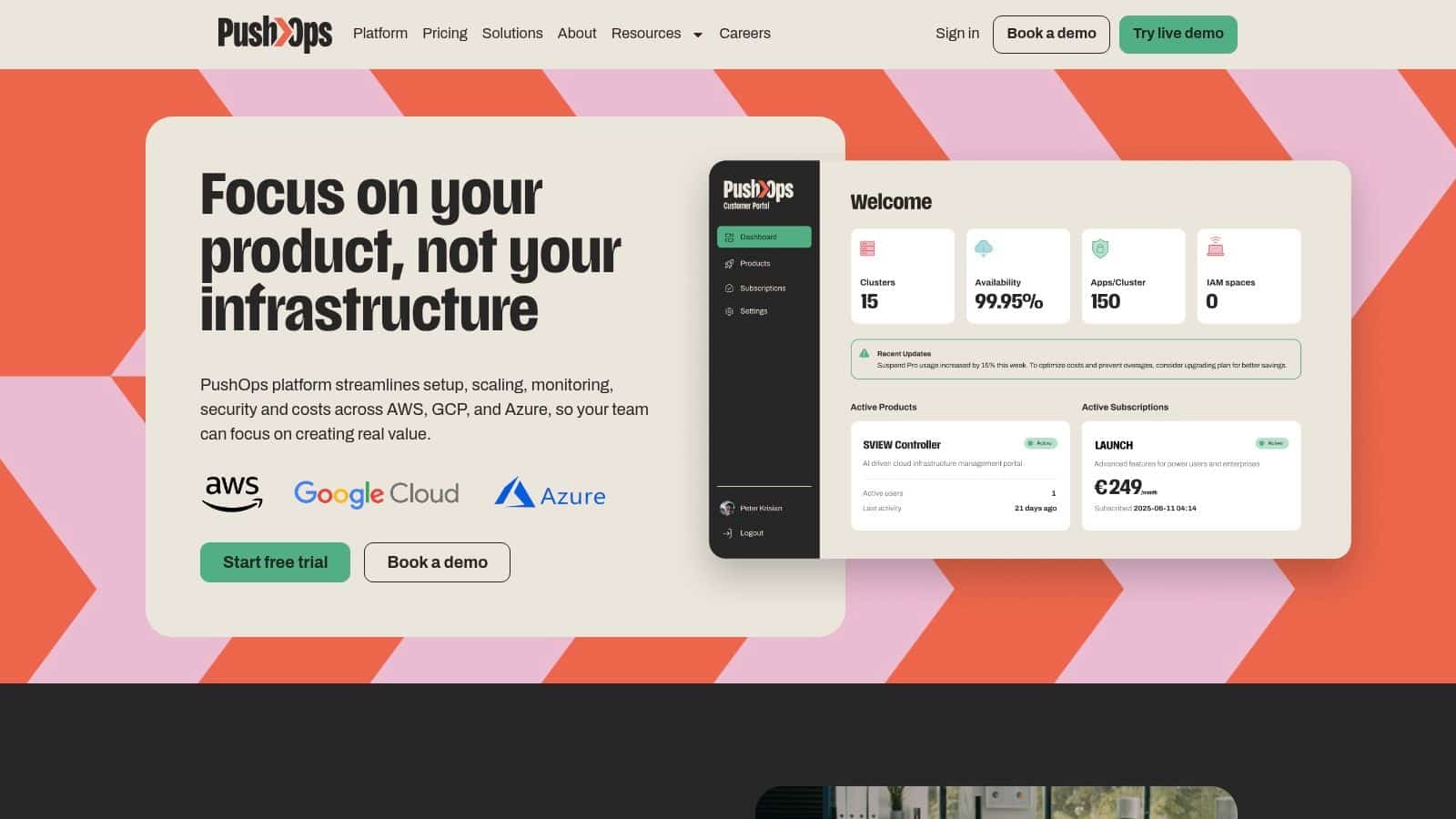
If your team is tired of spending senior engineering time on platform plumbing instead of product delivery, PushOps is worth a look. It gives you a production-ready cloud foundation across AWS, GCP, and Azure, with deployments, observability, security controls, and cost management built in, so resilience becomes part of how you ship rather than another internal system you have to build and maintain yourself.

