
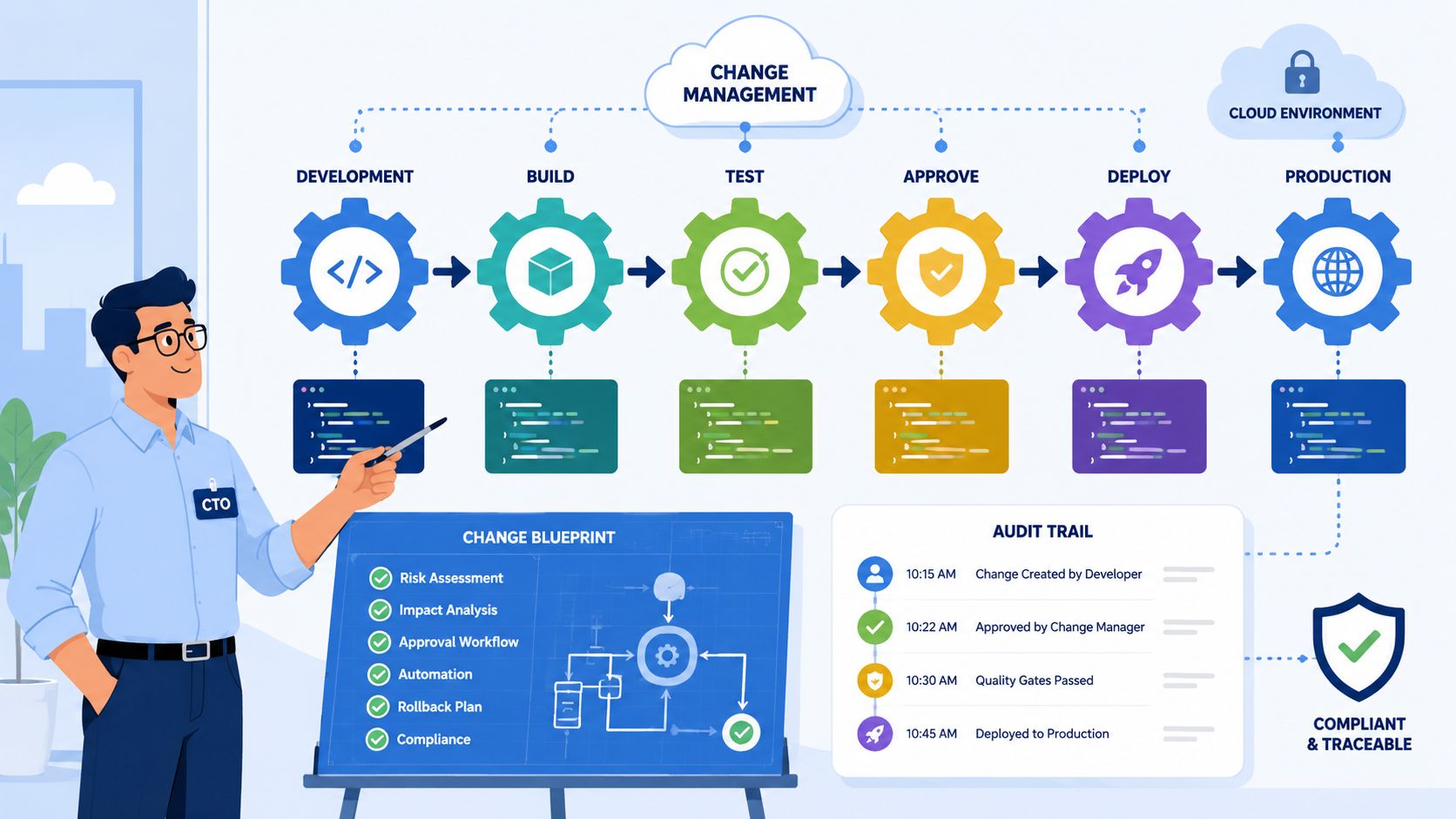

A release goes out late on Friday. It looked small in the pull request. A config tweak, a pipeline change, one dependency bump, one permission update. By Saturday morning, alerts are firing, customer support is swamped, and the team is trying to reconstruct what changed across GitHub Actions, Kubernetes manifests, cloud IAM, feature flags, and three Slack threads.
That scene isn't unusual. It's what happens when a growing engineering organisation treats change as a series of technical tasks instead of an operating discipline. The code may be correct. The rollout may still fail. The cloud resources may exist. The team may still be unable to recover quickly because nobody agreed on risk, ownership, validation, or rollback before the change shipped.
For CTOs and VP Engineering leaders, this is the point of a change management process. It isn't corporate theatre. It's the set of controls that lets teams move fast without converting every release into operational roulette. And in cloud-native delivery, where the stack spans infrastructure, security, deployment, observability, and cost controls, a casual approach breaks down fast.
The Unseen Cost of Unmanaged Change
The pattern usually starts innocently. A startup ships from a monolith, a few people understand the whole system, and the deployment path lives in someone's head. Then the company grows. Services multiply. One team adds Terraform, another adds Argo CD, another standardises on Helm, someone else wires in custom scripts for approvals, and suddenly “just deploy it” depends on a fragile chain of tribal knowledge.
The first few incidents get explained away as normal scaling pain. They aren't. They're symptoms of unmanaged change.
A lot of leaders still hear “change management” and picture steering committees, bloated forms, and approval theatre. In engineering, the useful version is much simpler. Define the change. Assess the blast radius. Decide who signs off. Test the path. Roll out safely. Verify the result. Learn from what happened.
The reason this matters is brutally practical. The change-management literature consistently reports that about 70% of change initiatives fail because of ineffective change management, while only 30% of transformational changes succeed according to this review of change management statistics. The same source notes that when change management is applied well, 71% of participants using the techniques completed projects on schedule.
That isn't a soft people issue. It's delivery performance.
Practical rule: If your team can't answer “what changed, who approved it, how was it tested, and how do we roll it back?” in under a minute, your release process is weaker than it looks.
In software teams, unmanaged change creates costs that don't show up neatly in a budget line:
- Lost engineering time: Senior developers spend nights tracing failures through home-grown scripts and inconsistent environments.
- Slower product work: Teams hesitate to ship because every release carries political and operational risk.
- Blame-heavy retrospectives: People argue about who touched what because the process recorded almost nothing.
- False confidence: A green pipeline is mistaken for a safe release.
If you're trying to reduce deployment failures, you don't start with more meetings. You start by treating change as a system with defined controls, not a collection of good intentions.
Why Ad-Hoc Changes Fail in the Cloud
Cloud-native teams often keep using change habits that belonged to a much simpler era. A spreadsheet for release tracking. A Slack approval from whoever's online. A Confluence page nobody updates. That might limp along in a small monolith. It doesn't survive modern delivery across AWS, GCP, Azure, Kubernetes, managed databases, queues, SaaS integrations, secrets managers, and infrastructure as code.
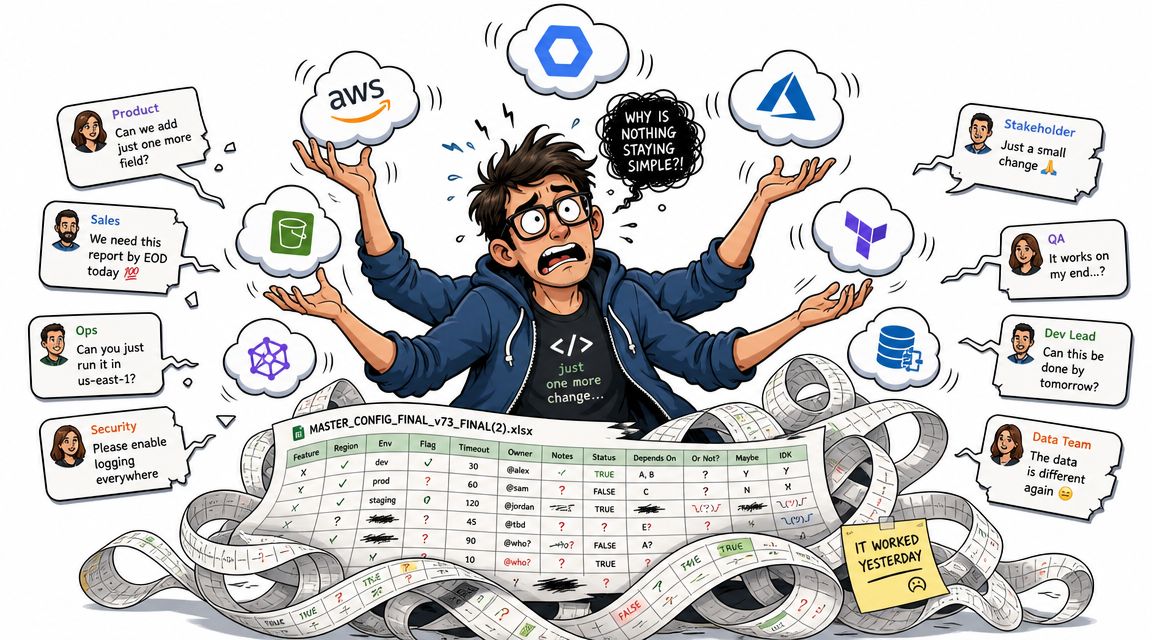
The pressure is also continuous now, not occasional. One executive survey found that 85% of executives and project managers reported an increase in change-management projects, and organisations now typically undergo five significant changes every three years, as summarised in this change management statistics review. For engineering leaders, that means the process can't be a one-off reaction to a migration or reorg. It has to be a repeatable operating capability.
Complexity beats memory every time
In a cloud-native estate, a single product change can touch:
- Application code in one or more repositories
- CI/CD logic in GitHub Actions, GitLab CI, Jenkins, or bespoke runners
- Infrastructure definitions in Terraform or Pulumi
- Cluster and runtime settings in Kubernetes, ECS, or serverless platforms
- Security controls such as IAM roles, secrets, scanners, and policy checks
- Observability tooling spanning logs, traces, dashboards, and alerts
No engineer can reliably track all of that manually. No release manager can infer true risk from a ticket title. Once dependencies sprawl across services and teams, ad-hoc change control becomes guesswork wearing a process costume.
DIY DevOps creates hidden operational debt
The bigger mistake is assuming the answer is to build more internal tooling. Such an approach leads many startups and scale-ups to burn time they can't really afford.
A typical in-house path looks sensible at first. Build a deployment wrapper. Add approval logic. Add templates. Add a dashboard. Add policy checks. Add cost visibility. Add role-based access. Add audit logs. Add support for canaries. Then maintain all of it every time a cloud provider, security standard, or internal workflow changes.
What looked like enablement work turns into a side business.
Teams rarely decide to build an internal developer platform because it's strategic. They do it because the pain of manual operations becomes unbearable, and building feels faster than evaluating alternatives.
The catch is that home-grown platforms inherit all the usual software problems. Incomplete ownership. patchy documentation. version drift. brittle integrations. unclear support boundaries. Eventually the platform team becomes a bottleneck, and product teams still don't have a clean self-service path.
Manual change control fails in specific ways
The common failure modes are painfully familiar:
- Approvals live in chat: Somebody types “looks good” in Slack, then disappears when the rollout breaks.
- Pipelines differ by team: Each service evolves its own release logic, so no one can reason consistently about risk.
- Rollback is theoretical: Teams say they can revert, but the path hasn't been exercised recently.
- Security is bolted on late: Checks happen after the build or after release pressure rises.
- Cost impact is invisible: New environments and services spin up with no durable guardrails.
The result isn't just outages. It's engineering drag. People spend their best hours maintaining plumbing instead of shipping features customers asked for.
Decoding Common Change Management Models
Most change management models sound abstract until you translate them into engineering language. Then they become useful. They stop being HR jargon and start acting as prompts for better technical rollouts.
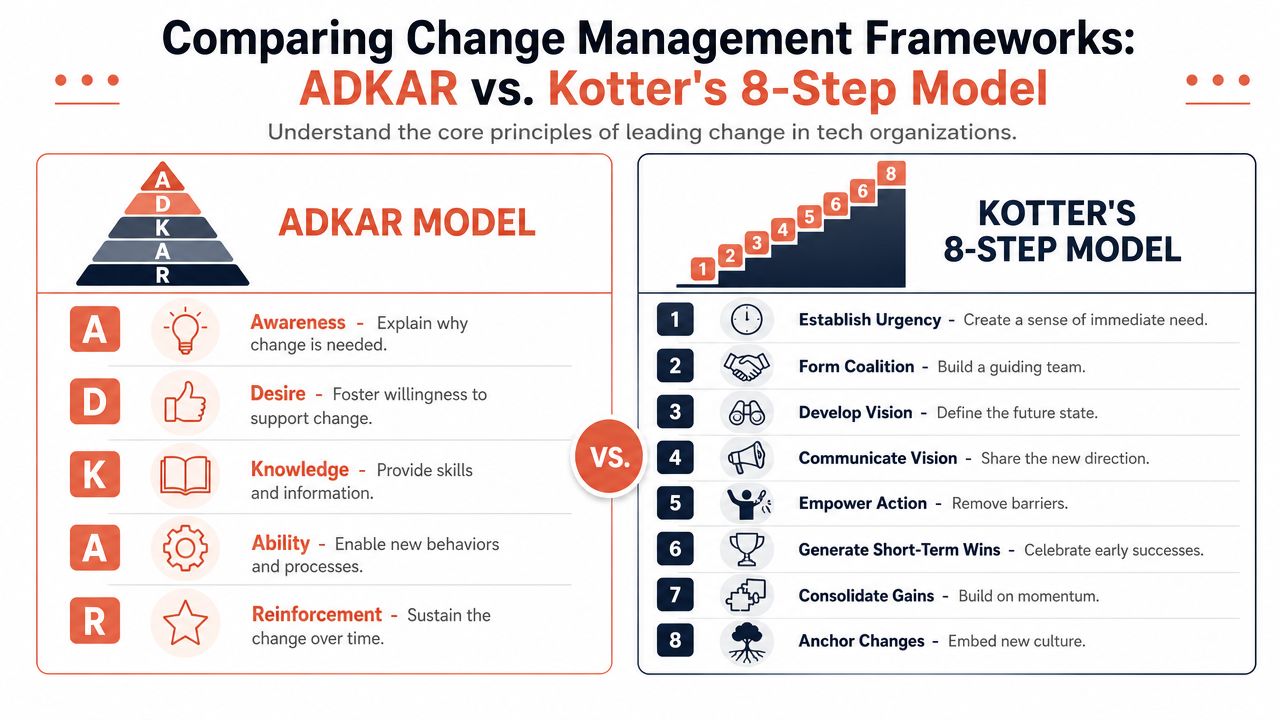
The two models that map well to software delivery are ADKAR and Kotter's 8-Step Model. Neither should be followed like scripture. Both are good lenses for asking the right questions before you force a new tool, architecture, or release process onto a team.
What these models mean for engineering leaders
ADKAR is useful when the challenge is adoption at the individual and team level.
- Awareness means engineers understand why the current deployment model is no longer acceptable.
- Desire means they see some benefit for themselves, not just for leadership.
- Knowledge means they know how the new workflow, tooling, or architecture works.
- Ability means they can use it under real delivery pressure.
- Reinforcement means the old shortcuts don't return after two sprints.
Kotter is stronger when the change is organisational. Maybe you're standardising release engineering, moving to multi-cloud, or replacing a patchwork of CI/CD systems with one delivery model. It focuses less on individual skill transfer and more on momentum, alignment, and institutional follow-through.
Change Management Models for Engineering Teams
| Model | Core Idea | Best For |
|---|---|---|
| ADKAR | Adoption happens person by person and team by team | Tooling changes, workflow changes, platform adoption |
| Kotter's 8-Step Model | Large change needs urgency, coalition, communication, and reinforcement | Org-wide platform shifts, cloud migrations, operating model changes |
A good technical leader usually borrows from both. Use ADKAR to make sure developers can work differently on Monday morning. Use Kotter to make sure the wider organisation stops undermining the change by keeping old paths alive.
A practical translation
Here's the simplest way to pressure-test a proposed change:
- If you're using ADKAR, ask: do engineers know why we're changing, how to work in the new model, and where they'll get help when the first deployment fails?
- If you're using Kotter, ask: who is sponsoring this, who is carrying it inside teams, and what early evidence will prove the new path is better?
- If neither model answers rollout risk, your engineering process still needs release controls such as feature flags and safe releases.
The model matters less than whether your team can connect strategy to daily behaviour. If a framework doesn't change what engineers do in pull requests, deployments, and incident response, it's decorative.
For software organisations, that's the critical test. Not whether the framework sounds polished in a slide deck, but whether it reduces friction during live technical change.
Your Blueprint for a DevOps Change Process
A workable change management process for software delivery should be boring, clear, and lightweight enough that teams use it. If it feels like ceremony, engineers will route around it. If it's too loose, it won't protect production. The sweet spot is a small set of mandatory controls applied consistently.
One modern view of change management argues that the work has to cascade into teams, with each group adapting tasks and tracking progress through measurable targets. That's the point made in this discussion of next-level change management approaches. For engineering leaders, that means the process cannot end at “leadership announced a new platform standard”. Teams need explicit workflow changes.
The stages that actually work
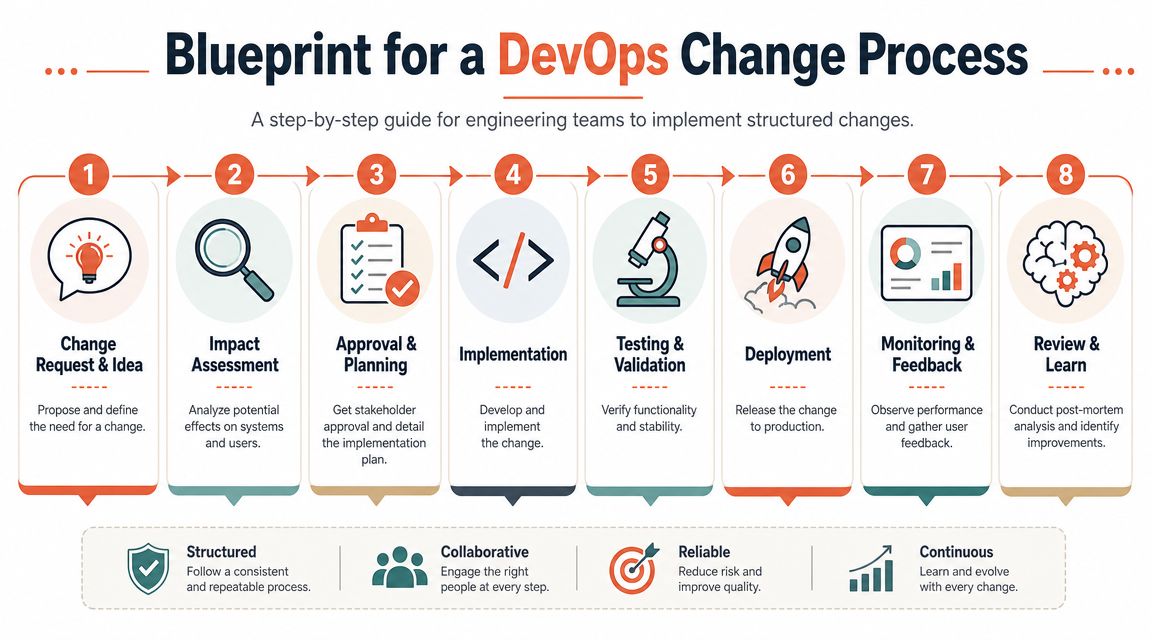
I'd keep the process to eight steps and make every one visible.
Change request and intent
Start with a short record of what is changing and why. This isn't a novel. It's a crisp summary of the service, environment, affected systems, and expected outcome.Impact assessment
Most failed changes should have been caught during this assessment. Ask what could break, which dependencies are involved, what customer-facing risk exists, and whether the change affects security, data handling, reliability, or cost.Approval and planning
Don't send every change to a heavyweight committee. Match sign-off to risk. A routine app update is not the same as a network policy rewrite or production database migration.Implementation
Build the change in version-controlled systems. Avoid manual production edits unless you're handling an incident and explicitly recording the exception.Testing and validation
Validate in a non-production environment that resembles reality closely enough to matter. Unit tests alone don't count as change validation for infrastructure and deployment logic.Deployment
Use controlled rollout methods. Progressive delivery, canaries, feature flags, and staged environment promotion all reduce blast radius.Monitoring and feedback
Watch service health, logs, traces, error rates, and user-facing symptoms immediately after release. Don't declare success because the pipeline turned green.Review and learning
Capture what happened, especially if rollback was needed or if the process created friction. Then improve the process itself.
Define roles without creating bureaucracy
You don't need a large governance body. You do need named accountability.
- Change requester: Usually the engineer or team proposing the change.
- Technical approver: A tech lead, staff engineer, or service owner who understands the blast radius.
- Operational approver: Needed for high-risk production changes, especially where support, security, or compliance implications exist.
- Release owner: The person responsible for the actual rollout window and coordination.
- Review owner: The person who closes the loop after deployment.
Make risk rules explicit
The process achieves usability, shedding its political nature. Define what counts as low, medium, and high risk in your context.
A low-risk change might be a routine application deployment with no infrastructure changes and a proven rollback path. A medium-risk change might alter runtime config or service dependencies. A high-risk change might touch IAM, networking, database schema, shared platform components, or production traffic routing.
Working rule: Teams move faster when low-risk changes are mostly automatic and high-risk changes are obvious early.
What teams should do on Monday morning
This is the part generic guides often skip. Team-level adoption should look concrete:
- Update service templates: Standardise deployment manifests, environment definitions, and required checks.
- Document minimum release checks: Define what must be true before a service can ship.
- Assign service ownership: Every production system needs a current technical owner.
- Track adoption visibly: Teams should know which services still rely on manual deploys, inconsistent permissions, or weak rollback paths.
- Run one real rehearsal: Practice rollback and incident response on the new process.
If you can't tell which services still bypass the standard path, the process hasn't really landed.
Automating Change with a Modern DevOps Platform
A change process written on paper is still fragile if teams must execute it through a pile of scripts, dashboards, approval messages, and manually stitched tools. Many engineering organisations get trapped in this situation. They design a sensible operating model, then try to run it with DIY glue.
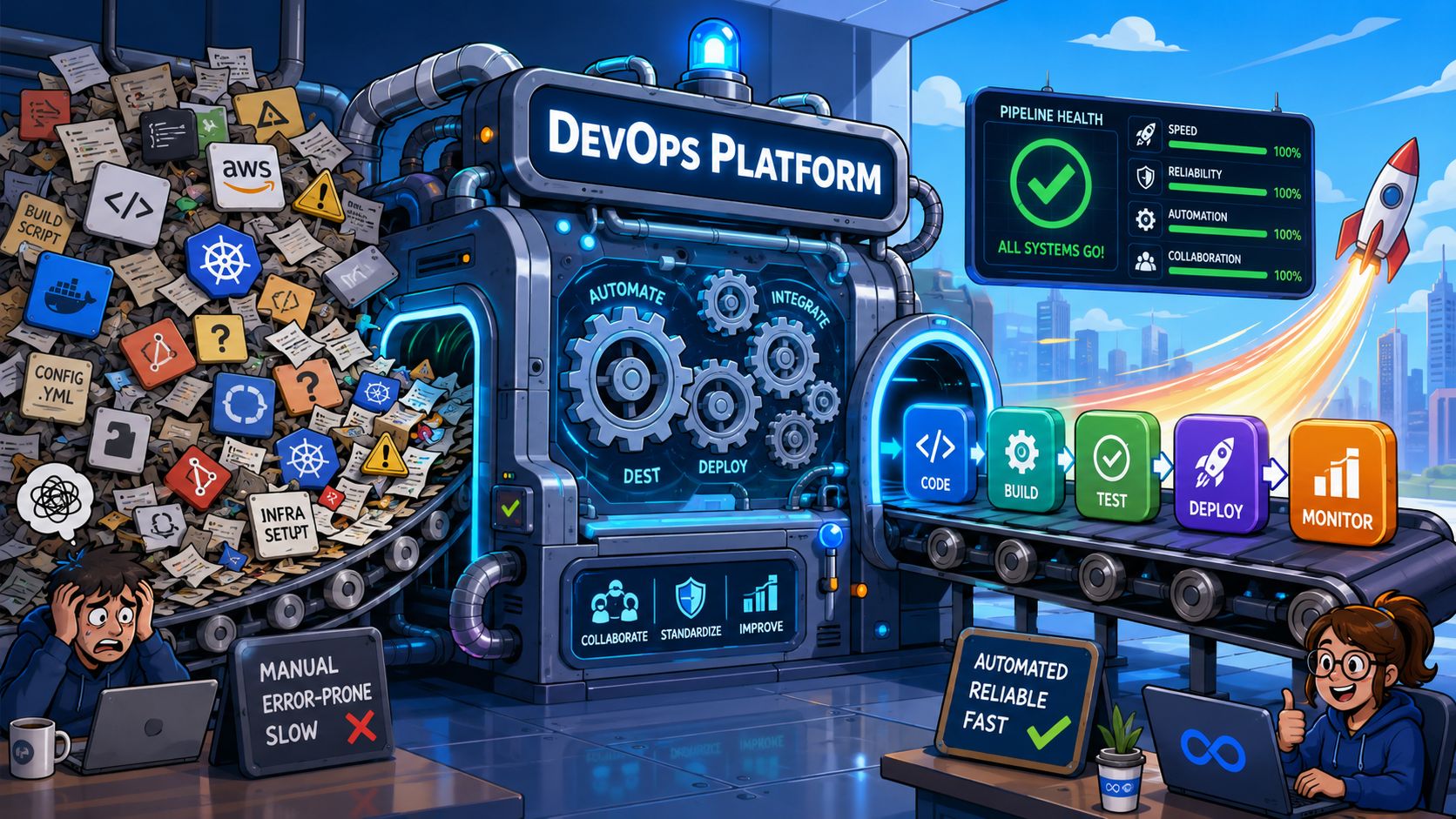
Automation matters because the process only works at scale if the safe path is also the easy path. If following the standard requires more effort than bypassing it, engineers under delivery pressure will bypass it.
What the platform should take off your plate
A modern DevOps platform should handle the repetitive, failure-prone parts of change control by default.
- Structured requests: Instead of vague tickets, teams start from templates that capture service, environment, risk type, dependencies, and rollback expectations.
- Workflow enforcement: Required approvals, policy checks, and release gates are built into the delivery flow.
- Consistent environments: Provisioning across AWS, GCP, and Azure follows a standard pattern instead of team-by-team improvisation.
- Integrated evidence: Build status, test results, deployment history, and audit records sit in the same operating surface.
- Release safety: Canary, blue-green, staged rollout, and rollback options are available without every team rebuilding them.
- Observability in context: Logs, health metrics, and incident signals are visible where the change happened, not buried in another tool chain.
That last point matters more than most leaders admit. Separate systems create decision lag. During a risky release, teams waste time switching between CI, cloud consoles, dashboards, alerting tools, and chat.
Why building this yourself is usually a strategic error
I'm opinionated here because I've seen the pattern too many times. Companies say they want developer productivity, but then they assign strong engineers to become part-time vendors for internal infrastructure.
Those engineers don't just build pipelines. They inherit maintenance for runners, secrets handling, policy enforcement, IAM wiring, cost controls, deployment strategies, auditability, and support. The organisation calls it a platform investment. In practice, it often becomes a tax on product delivery.
A managed platform changes the economics. Instead of hiring more people to maintain undifferentiated operational machinery, you adopt a standardised system that already solves the common plumbing problems well enough for numerous groups.
Map the blueprint to automation
Take the blueprint from the previous section and run it through a platform lens:
| Process stage | Manual reality | Platform-driven reality |
|---|---|---|
| Request | Free-text ticket or Slack message | Standardised form with required fields |
| Assessment | Human memory and scattered docs | Linked service context and policy checks |
| Approval | Chat-based sign-off | Automated workflow with audit trail |
| Implementation | Bespoke scripts and local habits | Reusable pipelines and templates |
| Validation | Inconsistent tests by team | Enforced checks before promotion |
| Deployment | One-shot release with high stress | Controlled rollout and rollback options |
| Monitoring | Separate dashboards and guesswork | In-context telemetry and release visibility |
| Review | Retro based on partial evidence | Clear history of who changed what and when |
For teams evaluating developer platform automation, this is the key distinction. Automation isn't there to make the process feel modern. It's there to make disciplined change possible without asking engineers to become full-time operators.
Manual process scales through heroics. Platform process scales through consistency.
That's why DIY DevOps stacks become such a strategic distraction. You end up owning complexity that does nothing to differentiate your product.
How to Implement and Scale Your Process
The fastest way to make a change management process unpopular is to launch it everywhere at once, attach a thick policy document, and force every team into the same motion overnight. Good engineering organisations don't need a big-bang rollout. They need a process that proves itself in real work.
Start with one service and one team
Pick a service that matters enough to reveal real issues, but not one so politically loaded that every disagreement becomes theatre. A customer-facing service with active deployments is usually better than an obscure internal tool. You want enough release activity to learn quickly.
Keep the pilot narrow:
- Choose one team with clear ownership: Avoid shared ownership during the first rollout.
- Define a minimum process: Request, assess, approve, test, deploy, verify, review.
- Remove avoidable complexity: Don't redesign your whole SDLC at the same time.
- Collect friction points immediately: Where did engineers hesitate, bypass, or get confused?
Then refine the process before expanding it.
Control the pace of change
One of the least appreciated leadership skills here is tempo control. Teams don't resist change only because they dislike it. They resist when leaders pile new tools, new governance, new architecture, and new expectations on top of existing delivery pressure.
That's why implementation should be sequenced. Standardise the release path first. Then tighten approvals for riskier categories. Then improve cost and security controls. Then fold more teams into the operating model. If you do everything at once, people stop hearing the rationale and start looking for shortcuts.
Treat regulation and resilience as design inputs
Some organisations can treat process discipline as optional until a painful incident teaches otherwise. Others don't have that luxury. In Lithuania, for example, the National Cyber Security Centre requires state information systems and critical infrastructure operators to apply risk assessment, incident handling, and control updates in line with national cyber-risk management rules, which means change processes should include formal impact assessment, rollback planning, and post-change verification before production release, as summarised in this discussion of data-driven organisational change management.
Even if you're not in a regulated environment, that's still a sensible engineering baseline.
Tie process adoption to culture, not just policy
A process sticks when teams see how it connects to goals, ownership, and team norms. If you're trying to connect operational discipline with execution habits, this piece on embedding OKRs through cultural change is a useful read. It's relevant because release quality, incident reduction, and platform adoption often fail when they live outside the company's real management system.
A process becomes bureaucracy when nobody can explain how it helps teams ship better. It becomes a capability when engineers can see the trade-off and trust the rules.
Scaling is mostly repetition with judgement. Keep the core controls stable. Let implementation details adapt by team where that doesn't weaken safety. Standardise the important parts. Stay flexible on the rest.
From Change Chaos to Controlled Velocity
The argument for a structured change management process in cloud-native engineering is simple. It gives teams a reliable way to ship without turning every release into a gamble. It reduces the human dependency on memory, heroics, and undocumented tribal knowledge. And when the process is supported by a modern platform, it stops feeling like extra work.
That's the shift. Good change management doesn't slow delivery. It removes the avoidable drag created by bespoke scripts, inconsistent pipelines, scattered approvals, and late-night recovery work. Teams spend less time stitching together Kubernetes, CI/CD, monitoring, security controls, and cost tooling. They spend more time building product.
For CTOs and VP Engineering leaders, the strategic mistake isn't adopting more process. It's pretending that a growing software organisation can keep scaling on top of DIY DevOps machinery held together by internal goodwill. That path consumes strong engineers, creates operational fragility, and keeps your most expensive talent focused on pipes instead of product.
Controlled velocity is better than chaotic speed. It scales further, burns out fewer people, and produces a system your organisation can trust.
If your team is tired of maintaining a fragile in-house DevOps stack and wants a production-ready path across AWS, GCP, and Azure, PushOps is worth a look. It gives engineering teams a managed platform for infrastructure, deployments, environments, observability, security, and cloud cost control, so developers can focus on shipping features instead of rebuilding platform plumbing.

