


As a CTO or VP of Engineering, you’re watching your best engineers—the ones you hired to build game-changing features—spend weeks buried in Kubernetes configurations, wrestling with CI/CD pipelines, and trying to decipher monitoring alerts. It's intensely frustrating to watch infrastructure constantly derail the product roadmap, but you're not alone.
Most teams over-invest in building and maintaining their own DevOps stack. They believe they need total control over Kubernetes, CI/CD, and security, but what they really want is a reliable, production-ready platform so they can focus on shipping features. This endless battle with infrastructure isn't a sign of a failing team; it's a symptom of a much deeper problem.
Why Infrastructure Is Not Your Real Problem
The real issue is often a fundamental disconnect between your software's architecture and your company's core business. When your code doesn't accurately model the reality of your business, complexity spirals out of control. This architectural mess inevitably spills over into operations, turning deployment, scaling, and monitoring into a recurring nightmare of hidden costs and wasted time.
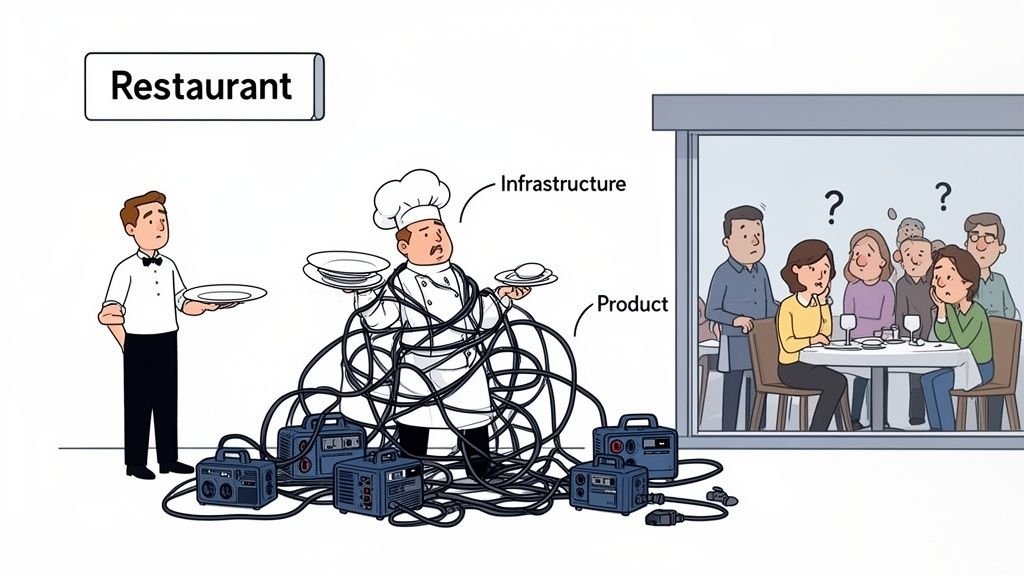
The Restaurant That Built Its Own Power Grid
Imagine a brilliant chef opening a new restaurant. Her entire mission is to create unforgettable food. But instead of obsessing over the menu, she decides her team must first build a custom power grid, a water filtration system, and a delivery fleet—all from scratch. While her team toils away on infrastructure, the kitchen sits empty. No customers are being served.
This is exactly what happens when scale-ups over-invest in building their own DevOps platform. You're solving problems that are not unique to your business. The time sunk into your DIY stack includes:
- Kubernetes Management: Configuring and maintaining clusters across different cloud providers like AWS, GCP, or Azure is a full-time job in itself, filled with complexity and hidden costs.
- CI/CD Pipeline Maintenance: Building and patching fragile, custom deployment scripts constantly pulls senior engineers away from product development.
- Observability Integration: Stitching together logging, monitoring, and alerting tools creates a complex and brittle system that's a headache to maintain and even harder to get clear insights from.
- Security and Compliance: Enforcing policies and managing access controls across a bespoke setup is a constant source of operational drag, slowing down your entire delivery cycle.
The endless infrastructure struggle is a symptom, not the disease. The root cause is often software architecture that has drifted too far from the business it's meant to serve.
Shifting Focus With Domain-Driven Design
This is where Domain-Driven Design (DDD) comes in. DDD isn't some abstract academic theory; it’s a practical, business-first strategy for untangling complexity. It forces you to model your software around what your business actually does—your core domains.
By aligning your code with your business logic, you naturally create a clearer, more modular architecture. This architectural clarity, in turn, directly simplifies your operational needs. Well-defined services are simply easier to build, deploy, and manage. You can explore how this focus impacts your delivery process in our guide on continuous delivery for early-stage startups.
Instead of hiring more DevOps engineers or dedicating a platform team to build commodity infrastructure, you can offload the entire operational burden. A modern multi-cloud DevOps platform handles the setup, scaling, monitoring, security, and cloud costs across AWS, GCP, and Azure for you. This allows your team to finally stop building the power grid and get back to cooking.
Understanding Domain Driven Design in Plain English
Let's cut through the academic theory for a moment. At its core, Domain Driven Design (DDD) is a communication strategy. It’s about getting your business experts and your technical teams to speak the same language so you stop building software that creates more problems than it solves.
When developers don't fully grasp the business nuances, they often build software that technically works but misses the mark on what the business actually needs. This gap creates architectural debt, and it's your engineers who pay the price—usually with late nights spent untangling code and wrestling with complex infrastructure. DDD offers a structured way to avoid this chaos from the start.
The Power of a Ubiquitous Language
Imagine a building site where the architect, electrician, and plumber all use different terms for the same thing. The architect’s "central conduit" is the electrician's "main trunk line" and the plumber's "primary stack." The result? Confusion, expensive mistakes, and massive delays.
This happens in software development constantly. Ubiquitous Language is the simple yet powerful idea of creating a single, shared vocabulary between domain experts (your business folks) and the development team. This language isn't just for meetings; it's used in documentation, diagrams, and right down to the code itself.
When a term like "Premium Customer" has a precise, agreed-upon meaning for everyone, ambiguity vanishes. Developers can then model the software around real business concepts, leading to code that is far more intuitive and easier to maintain. This shared understanding is the first step toward breaking the cycle of building the wrong thing.
Bounded Contexts as Clear Boundaries
A shared language is a great start, but in any complex business, words can mean different things in different departments. A "customer" to the Sales team (a prospect) is not the same as a "customer" in the Support department (an existing user with a ticket history). Trying to force a single, universal definition for "customer" across the entire company leads to a tangled, monstrous software model.
This is where Bounded Contexts come into play. A Bounded Context is a clear boundary within which a specific domain model and its Ubiquitous Language are consistent and valid.
Think of Bounded Contexts as distinct departments in your software. Inside the "Billing Department" context, a "Customer" has a subscription and payment method. Inside the "Support Department" context, that same "Customer" has support tickets and interaction logs. Each context is self-contained and explicit.
This separation is absolutely critical. It allows different parts of your system to evolve independently without breaking each other. It’s the blueprint for a clean architecture, preventing the "big ball of mud" that makes deployments slow, risky, and a nightmare to manage.
To bring these ideas together, here’s a quick-reference table that breaks down the core strategic concepts of DDD.
Core DDD Concepts Explained
| DDD Concept | Simple Explanation | Business Benefit |
|---|---|---|
| Ubiquitous Language | A shared vocabulary used by both business and technical teams. | Reduces misunderstandings, leading to software that solves the right problems. |
| Bounded Context | A clear boundary where a specific model and language apply. | Enables teams to work independently and prevents code from becoming a tangled mess. |
| Domain Model | A blueprint of a business area, including its rules and logic, captured in code. | Ensures the software accurately reflects how the business operates, making it more intuitive. |
With these concepts, you can start building a system that is a true reflection of your business, not just a collection of disconnected features.
The Domain Model as a Blueprint
The Domain Model is where the Ubiquitous Language comes to life within a Bounded Context. It is the organised blueprint of a specific business area, captured directly in the code. This is more than just a data model; it’s a living representation that includes all the business rules, logic, and behaviours that define that part of the domain.
For many companies, formalising this blueprint is a significant hurdle. In Lithuania's growing tech scene, for example, only 4% of growth firms have a formalised digitalisation strategy, a stark contrast to the EU average of 22%. This gap highlights a critical need for structured approaches like Domain Driven Design to connect development work directly to business goals, reducing wasted effort and operational overhead. You can review the complete findings about Lithuania's digital potential on oecd.org.
By focusing on these strategic patterns, you build a system that truly mirrors your business. This clarity doesn't just make developers' lives easier—it directly simplifies your infrastructure and operational needs, paving the way to offload the complexity of DIY DevOps.
How to Map DDD to Your Microservices Architecture
The allure of microservices is undeniable. Who doesn’t want agility, scalability, and independent deployments? The problem is, many engineering leaders wake up one day to find they’ve built a “distributed monolith”—a tangled mess of services even more complex and costly than what they started with.
The issue isn't the microservice pattern itself. It's the lack of a coherent strategy for drawing the service boundaries. This is exactly where Domain-Driven Design offers the perfect blueprint. The strategic concepts of DDD aren't just for organising code; they provide a direct roadmap for designing a clean, maintainable microservices architecture.
From Bounded Context to Microservice
The most effective way to design your microservices is to treat each Bounded Context as the natural boundary for a single service. Think of a Bounded Context as a "department" in your software with its own specialised language and model. It follows, then, that a microservice is the independent, deployable unit that brings that department's logic to life.
This one-to-one mapping is the secret to creating services that are truly autonomous.
- Cohesion: Each microservice has a single, well-defined responsibility that aligns with a specific business capability, like "Billing," "Shipping," or "User Authentication."
- Loose Coupling: Services communicate through well-defined APIs, just as Bounded Contexts interact via explicit contracts. This is how you avoid those "chatty," interdependent services that turn every deployment into a high-stakes, all-or-nothing affair.
This diagram shows how the core DDD concepts fit together to guide this architectural approach.
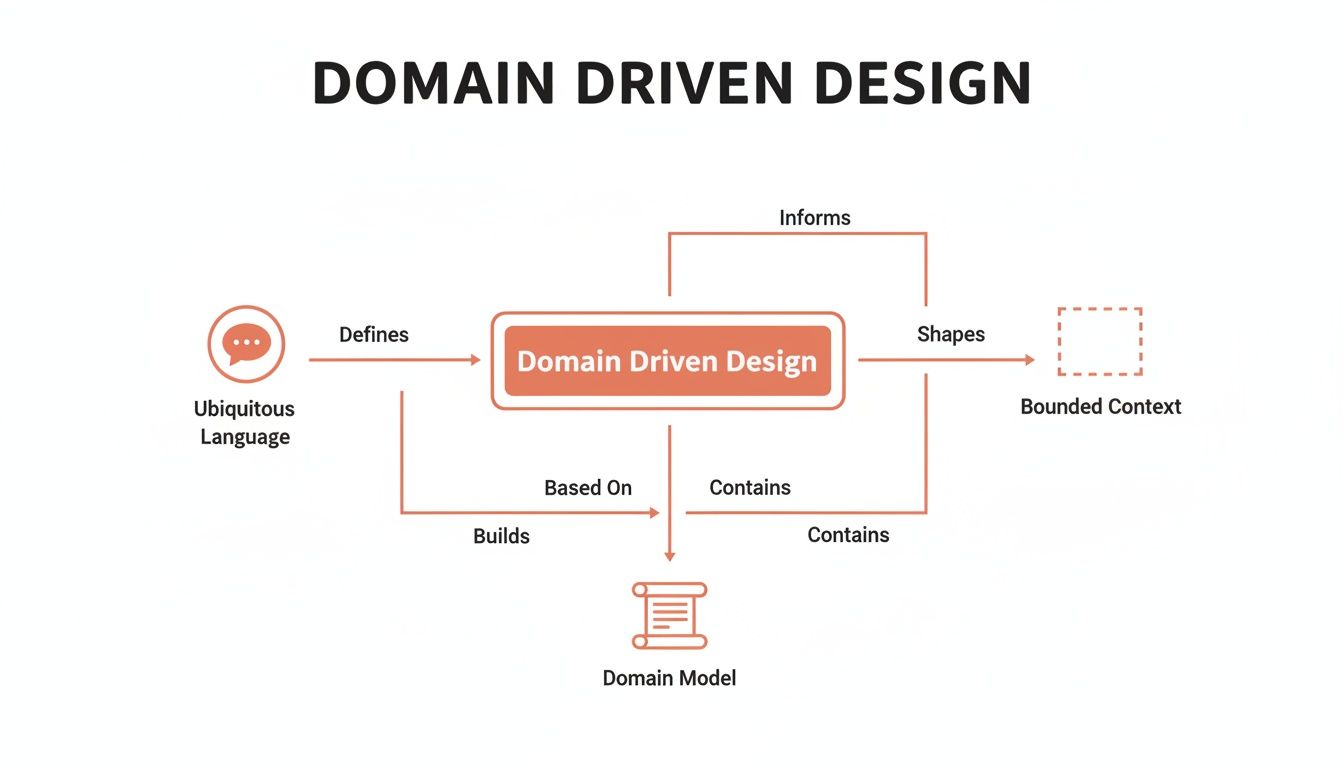
As you can see, the Ubiquitous Language informs the Domain Model within a specific Bounded Context. That context then becomes the blueprint for an independent microservice. When you stick to this structure, you design services that are simpler to operate by default.
Simplifying Operations by Design
This architectural clarity pays huge dividends when it comes to operations. When your microservices map directly to business domains, the complexity of your DevOps stack drops dramatically. The hidden costs of managing a distributed monolith—tangled dependencies, painful testing strategies, and debugging nightmares—finally start to fade.
What you get instead is a system where:
- Deployments are simplified. Each service can be deployed on its own schedule without the fear of breaking another part of the system. This makes modern delivery practices like canary releases and blue-green deployments far easier to automate. You can learn more about how this structure supports automated deployments for microservices in our related guide.
- Scaling is precise. If your "Inventory" service is under heavy load, you can scale it up independently without touching the "Customer Support" service. This targeted scaling is infinitely more cost-effective than scaling an entire monolith.
- Monitoring is clear. With well-defined service boundaries, pinpointing the source of a problem becomes trivial. Dashboards and alerts suddenly become more meaningful because they are tied to a specific business function.
A DDD-aligned architecture doesn't just produce cleaner code; it creates services that are inherently easier to deploy, scale, and monitor. It transforms operational complexity into predictable, manageable workflows.
Paving the Way for a Managed Platform
By using Domain-Driven Design to define your microservices, you’re creating the ideal foundation for operational efficiency. Your services become logically separated, independently deployable, and aligned with your business. This is the exact state a modern DevOps platform is designed to manage.
Instead of tasking your team with building a bespoke internal developer platform to handle CI/CD, monitoring, and multi-cloud orchestration, you can offload the entire effort. A managed platform can take your well-defined services and give you a production-ready environment on AWS, GCP, or Azure in minutes.
From there, the platform can automate the builds, deployments, and observability for each service, freeing your team from the endless cycle of infrastructure maintenance. This synergy between DDD architecture and a managed platform is how you finally escape the infrastructure trap and get back to focusing on your product.
The Hidden Cost of Building Your Own Developer Platform
You’ve done the hard work. Your team has collaborated with business experts, defined a Ubiquitous Language, and mapped your Bounded Contexts into a clean microservices architecture. Your system design is elegant, logical, and perfectly aligned with your business.
So, how do you actually run it?
This is where many engineering leaders at promising scale-ups fall into a dangerous trap. The gut reaction is to build an in-house developer platform to manage it all. It seems appealing at first—total control, a solution perfectly sculpted to your needs. But this is a siren song that leads directly to a massive, often-underestimated drain on your resources.
The Hidden Factory Inside Your Engineering Team
Building your own internal developer platform (IDP) is like deciding to run a "hidden factory" inside your engineering department. Its only job is to produce and maintain the tools your product teams need to ship software. This factory doesn't generate a single pound of revenue; it only consumes your most valuable asset—your senior engineering talent.
Suddenly, your best developers aren't working on the core domain driven design models that create your competitive advantage. Instead, they're stuck assembling a complex and brittle DevOps stack from scratch.
Building a DIY developer platform is a distraction from your core mission. It forces your best engineers to solve generic infrastructure problems instead of the unique business problems that drive your company’s growth.
And the list of jobs for this hidden factory is immense and never-ending. This isn’t a one-and-done setup; it's a commitment to perpetual maintenance, security patching, and complex integrations that will quietly bleed your budget and roadmap dry.
Quantifying the Real Cost of DIY DevOps
The true cost of a DIY platform goes far beyond your monthly cloud bill. The real price is measured in engineering salaries, lost productivity, and—most critically—the opportunity cost of not shipping features that matter to your customers.
Here's just a glimpse of the ongoing effort you're signing up for:
- Multi-Cloud Kubernetes Provisioning: Setting up and managing Kubernetes consistently across AWS, GCP, and Azure is a monumental task. It demands deep expertise in each cloud's specific quirks for networking, identity management, and storage. This complexity doesn't just slow you down; it creates subtle inconsistencies that turn into bugs and security holes.
- Brittle CI/CD Pipelines: You'll find yourself building and maintaining separate CI/CD pipelines for every single microservice. These custom scripts are notoriously fragile, breaking with every minor update to a tool or a cloud provider's API. Your senior engineers will spend countless hours debugging YAML files instead of writing actual product code.
- Fragmented Logging and Monitoring: When you stitch together various tools for logging, metrics, and tracing, you create a disjointed observability stack. When an incident inevitably happens, your team will waste precious time trying to correlate data across five different dashboards instead of just fixing the problem.
- Uncontrolled Cloud Costs: Without a unified platform, getting a grip on cloud spend becomes nearly impossible. Developers spin up resources with zero visibility into their cost. Optimising usage across multiple services and clouds is a manual, soul-crushing process that often gets neglected, leading to eye-watering bills.
This operational overhead isn’t just a technical problem; it’s a fundamental business problem. Take a look at Lithuania's economy, for example. It shows a high rate of digitalisation in public business services (94%) but a remarkably low business R&D expenditure (0.2% of GDP). This suggests a strong cultural focus on operational efficiency over building expensive, custom technology stacks from the ground up.
For companies in SME-heavy economies across Europe and beyond, this mindset is crucial for survival. You can discover more about Lithuania’s digital journey on nrdcompanies.com.
The conclusion is clear. For startups and scale-ups whose survival depends on speed and focus, the DIY approach is a critical mistake. It diverts your most valuable resources away from your core business domains and into a battle with commodity infrastructure that you simply can't win.
Instead of building the platform, you should be building on one.
How a Modern DevOps Platform Accelerates DDD
You've done the hard strategic work. You’ve sat down with business experts, hammered out a Ubiquitous Language, and carefully mapped your Bounded Contexts to a clean microservices architecture. That's the blueprint for building software with focus and speed. But even the most brilliant blueprint is just paper if you don’t have the right tools to actually build the thing.
This is the exact point where your domain driven design strategy smacks into operational reality. A beautifully designed system still needs to be deployed, scaled, and monitored. Instead of getting bogged down building a DIY developer platform, you can use a modern DevOps platform as the operational engine that brings your entire DDD architecture to life.
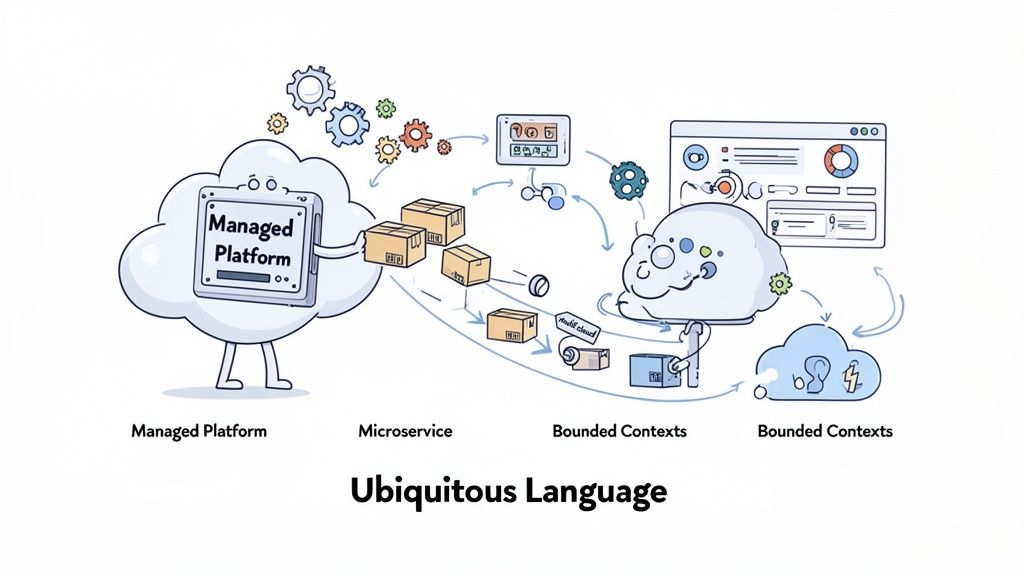
From Bounded Contexts to Real-World Environments
Your Bounded Contexts are the most powerful organisational tool in DDD, drawing clear lines between different business capabilities. A modern DevOps platform makes these lines tangible by mapping each context directly to its own isolated, self-service environment.
Think about it this way. Your "Billing" context, "Inventory" context, and "User Profile" context can now each have their own dedicated production, staging, and development environments. This is no longer just a conceptual boundary in your codebase; it's a real, operational boundary enforced by the platform itself.
This direct mapping pays off immediately:
- True Autonomy: Teams can deploy, test, and manage their services within their own context's sandbox without stepping on anyone else's toes.
- Clear Cost Tracking: You can allocate and monitor resources per Bounded Context, giving you a crystal-clear view of what each business capability actually costs to run.
- Stronger Security: By isolating environments, you shrink the blast radius of any potential issue, whether it's a nasty bug or a security vulnerability.
Making Your Ubiquitous Language Visible with Shared Dashboards
The Ubiquitous Language is the heart of DDD, ensuring everyone—from the CTO to the product manager and the developer—is on the same page. A managed platform reinforces this shared understanding by translating that language into unified, accessible dashboards that everyone can understand.
Forget about fragmented monitoring tools that only DevOps gurus can decipher. A modern platform gives you a single pane of glass where your key business metrics are displayed right alongside system health indicators, all using the same terminology your team agreed on.
A managed platform makes your Ubiquitous Language operational. When monitoring dashboards for the "Logistics" service use terms like "Shipment" and "Delivery Route," everyone in the company can see how it's performing at a glance.
This means when a problem pops up in the "Payments" service, the alert doesn't just scream "CPU spike on pod XYZ." It points directly to the business context, sparking faster, more effective collaboration between your technical and non-technical stakeholders.
Turning Clean Architecture into Zero-Maintenance CI/CD
The loose coupling and high cohesion you fought for by mapping microservices to Bounded Contexts are the perfect ingredients for effortless Continuous Integration and Continuous Deployment (CI/CD). A modern platform takes full advantage of this clean architecture.
Because each service is independent, the platform can provide streamlined, zero-maintenance CI/CD pipelines right out of the box. Your developers just commit their code, and the platform handles the rest: building the container, running tests, and deploying it to the right environment on AWS, GCP, or Azure. No more fragile YAML scripts to write, patch, and curse at.
This completely wipes out a massive source of toil for your senior engineers. They no longer need to moonlight as pipeline experts; they can get back to focusing on writing brilliant domain logic. You can see how to set up this kind of automated system in our guide on creating a DevOps cloud infrastructure platform.
Offloading the DevOps Stack to Focus on Your Core Domain
Ultimately, a modern multi-cloud DevOps platform lets you finally deliver on the core promise of domain driven design: focusing your team's energy exclusively on the business problems that give you a competitive edge. It gets this done by taking the entire undifferentiated heavy lifting of infrastructure off your plate.
Imagine getting production-ready infrastructure on any major cloud in minutes, complete with:
- Built-in Observability: Integrated logging, tracing, and metrics that are automatically correlated and tied back to your business contexts.
- Security by Default: Role-based access control, automated policy enforcement, and continuous security patching all handled for you.
- Optimised Cloud Costs: Intelligent autoscaling and resource management that prevent runaway spending without anyone having to intervene manually.
By offloading this entire stack, you stop burning precious engineering cycles on building and maintaining commodity infrastructure. Your team can finally escape the "hidden factory" of DIY DevOps and dedicate their time to what you hired them to do: build excellent software that solves your customers' real problems.
Your 4-Step Plan to Escape the Infrastructure Trap
Right, you've seen the theory. Now, how do you actually put it into practice and escape the infrastructure trap?
It’s not about some massive, big-bang re-architecture that grinds everything to a halt. It’s a practical, step-by-step process for reclaiming your team's most valuable resources: their time and creative energy. Instead of pouring more engineering hours into a DIY DevOps stack, you can combine the strategic clarity of domain driven design with a managed platform that just works.
Here’s a four-step plan to get your engineering leaders focused back on what truly matters—building your product.
Step 1: Host a Domain Discovery Workshop
First things first: get your key business stakeholders and senior technical leads into the same room. Call it a Domain Discovery Workshop. The goal is simple but incredibly powerful: start building your Ubiquitous Language.
This isn’t a tech-only meeting. It’s a collaborative session to map out your company’s core activities. You'll begin to identify the high-level business domains and, just as importantly, the Bounded Contexts where different teams use different terms for the same concepts. This exercise is fundamental to aligning your entire organisation, making sure the software you build is a direct reflection of business strategy, not just a collection of siloed features.
Step 2: Pilot a Single Bounded Context
Don't boil the ocean. You don’t need to rewrite your entire system overnight. Look at the domains you mapped out in the workshop and pick just one—a single, high-value Core Domain. This should be a Bounded Context that represents a real competitive advantage for your business.
This context becomes the pilot for your first properly-defined microservice. Focus all your energy on modelling this one area cleanly. It’s a manageable, focused approach that lets you practice domain driven design principles on a small scale, prove its value, and build momentum without the massive risk of a large-scale project.
Step 3: Audit Your Team’s Time
If you want to make a compelling case for change, you need data. Cold, hard facts. Run a simple audit to find out where your engineering team's time is really going. Get specific and quantify the hours spent each week on tasks that have nothing to do with building your product:
- Patching broken CI/CD pipelines.
- Wrestling with Kubernetes configurations on AWS, GCP, or Azure.
- Juggling a dozen fragmented monitoring tools just to see what’s going on.
- Manually trying to optimise cloud costs.
When you calculate the cost of these activities in terms of senior engineering salaries and delayed product launches, the expense of your DIY DevOps platform becomes impossible to ignore. This audit reveals the true price of building infrastructure instead of your product.
Step 4: Evaluate a Managed Platform
Finally, it's time to see the alternative for yourself. Sign up for a trial of a modern DevOps platform like PushOps. Connect the code repository for your pilot microservice and just watch the workflow.
See how a platform designed for this purpose can provision production-ready infrastructure, completely automate your deployments, and give you integrated observability across multiple clouds—all in a matter of minutes.
By combining the strategic focus of DDD with a platform that kills operational toil, you create a powerful engine for growth. Your team is finally free to solve the unique business problems that drive your success. They get back to doing what they were hired to do: ship more and build less.
Frequently Asked Questions
As a CTO or VP of Engineering, you have to be careful about which architectural buzzwords you bet on. Let’s tackle some of the most common questions about putting Domain-Driven Design to work in a way that actually delivers results.
Is Domain-Driven Design Only for Large Enterprise Projects?
Not a chance. While DDD is a lifesaver for taming complexity in big, legacy systems, its core ideas are just as powerful for startups and scale-ups—especially in fast-moving markets across Europe, Singapore, and the US.
For a growing company, the biggest win is preventative. By hammering out a Ubiquitous Language and defining clear Bounded Contexts early on, you stop the dreaded "big ball of mud" architecture from ever forming. For a startup, that means you’re building on a solid foundation that can scale without needing a massive, painful rewrite later. It helps you stay nimble and focused on shipping real business value, right from day one.
How Much Upfront Design Does DDD Require Before Coding?
This is a huge misconception. Domain-Driven Design isn't about getting stuck in "analysis paralysis" or creating a massive, rigid spec before a single line of code gets written. It’s an iterative, collaborative process of discovery.
You start by modelling one core domain and its Bounded Context, build it out, and then refine and expand the model as your team and the business experts learn more together. The initial effort is all about collaboration to create a shared language, which actually saves a ton of time and rework later. It’s far more efficient than building features on vague requirements, only to realise you have to rebuild them from scratch.
Can We Adopt DDD if We Already Have a Monolith?
Absolutely. In fact, DDD gives you one of the best roadmaps for safely and incrementally breaking down a monolith. You can use battle-tested patterns like the "Strangler Fig" to get started.
First, you identify a single, well-defined Bounded Context inside your monolith. Then, you build it out as a brand-new microservice using DDD principles. Once the new service is ready and tested, you gradually reroute traffic from the old monolithic code to the new service.
This step-by-step approach is way less risky than a "big bang" rewrite. Using a managed platform can make this transition feel almost seamless, letting you easily deploy and run these new services alongside your existing monolith without piling more operational work onto your team.
Ready to stop building infrastructure and start building your product? PushOps gives you a production-ready, multi-cloud DevOps platform that lets you unlock the power of Domain-Driven Design without the operational headaches. Get your self-service developer workflow at https://pushops.com.

