
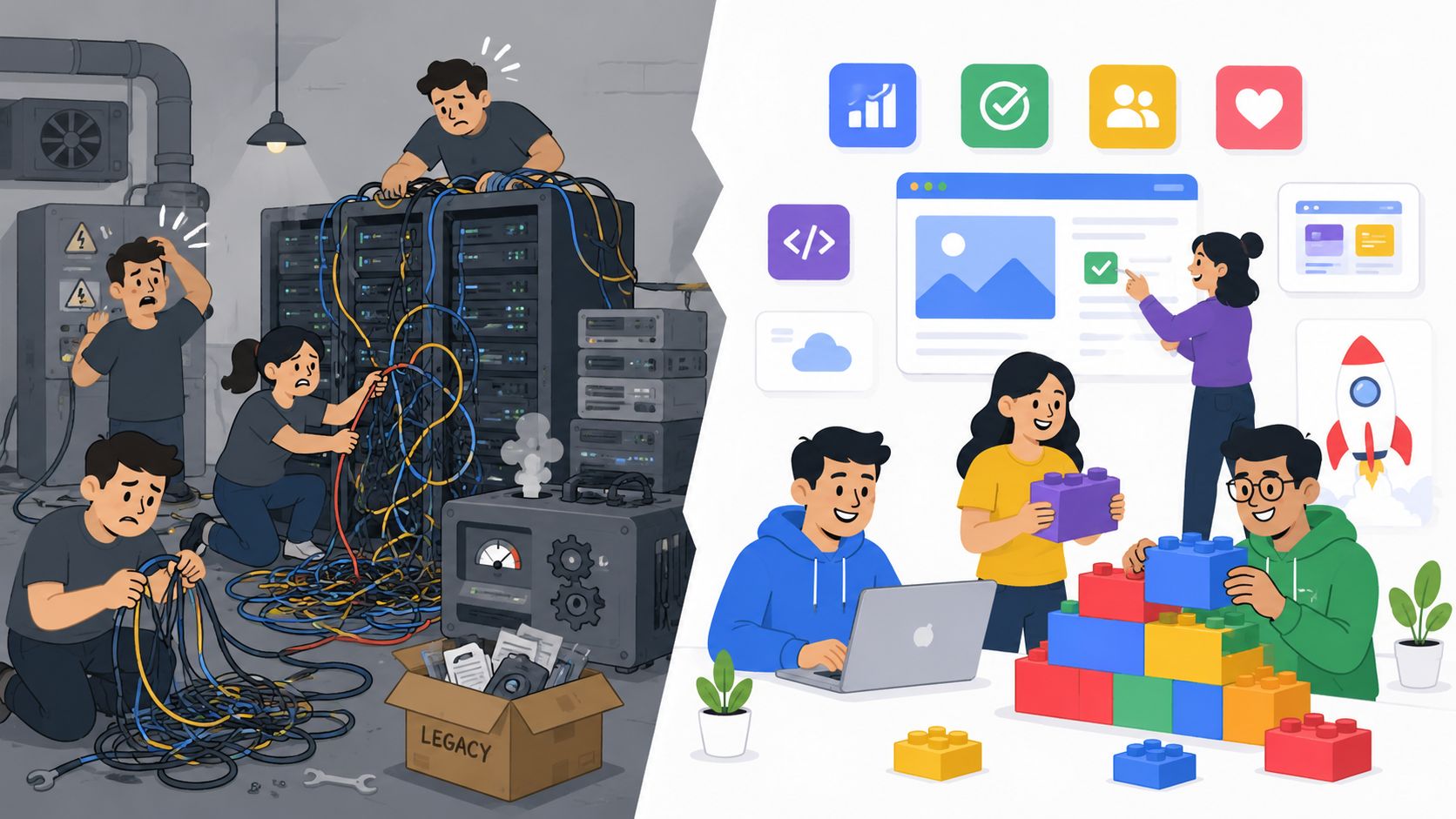

Your product roadmap is slipping again.
Not because your engineers are weak. Not because Kubernetes is bad. Not because your team lacks discipline. It's slipping because smart people are spending their best hours on infrastructure glue work they should never have owned in the first place.
I've seen this pattern repeatedly in startups and scale-ups across Europe, Singapore, the UK, and the US. A team starts with a simple stack. Then come the add-ons: CI/CD pipelines, secrets management, observability, cost controls, security policies, environment promotion rules, rollback logic, autoscaling, multi-cloud exceptions. At some point, the company says it's “building operational excellence”. What it's building is an internal tax.
That tax shows up in slower releases, fragile scripts, hiring delays, and senior engineers debugging platform issues instead of shipping features. If you're frustrated that your team spends more time discussing infrastructure than building product, you don't have an execution problem. You have a platform strategy problem.
What Operational Excellence Really Means for Software Teams
On Monday, your VP Engineering is in a pricing review because cloud spend jumped. By Tuesday, a release stalls because the deployment pipeline behaves differently in staging and production. Wednesday is spent chasing an alert storm that nobody trusts. Thursday disappears into IAM permissions, container registry issues, and a rollback that should have been automatic. Friday ends with everyone agreeing to “clean up the platform” next sprint.
That's not unusual. It's the default state for teams that confuse operational excellence with owning more infrastructure.
In software, operational excellence isn't a manufacturing slogan. It's the ability to deliver product changes safely, predictably, and without turning your engineers into part-time cloud mechanics. The question is simple: how much of your engineering week goes into product work, and how much goes into keeping the delivery machine alive?
Product work versus platform babysitting
Organizations often state a desire for control. What they want is confidence. They want production-ready environments, consistent deployments, sensible guardrails, useful visibility, and costs that don't drift every month. They don't want to maintain custom CI runners, hand-stitched Terraform modules, or a monitoring stack made of five loosely connected tools.
If you're trying to get more disciplined about reliability, a practical starting point is understanding the right server performance monitoring metrics so you can separate meaningful signals from noise. That matters. But metrics alone won't fix the deeper issue if your team still owns too much undifferentiated platform work.
Operational excellence in software means removing recurring infrastructure effort, not documenting it better.
The modern definition that actually matters
In 2026, software teams should treat infrastructure the way mature product teams treat payroll systems. It must work. It must be secure. It must be visible. But it should not consume your best builders.
McKinsey's 2024 operational excellence research shows that organisations with higher maturity materially outperform weaker operators, while companies stuck at a basic level face much higher operational risk and lose profit margin through inefficiency (McKinsey on next-generation operational excellence). The lesson for software teams is straightforward. Operational excellence isn't an abstract leadership ambition. It's a hard business lever.
For software organisations, that lever works best when you maximise engineer time on feature development and ruthlessly minimise bespoke infrastructure maintenance.
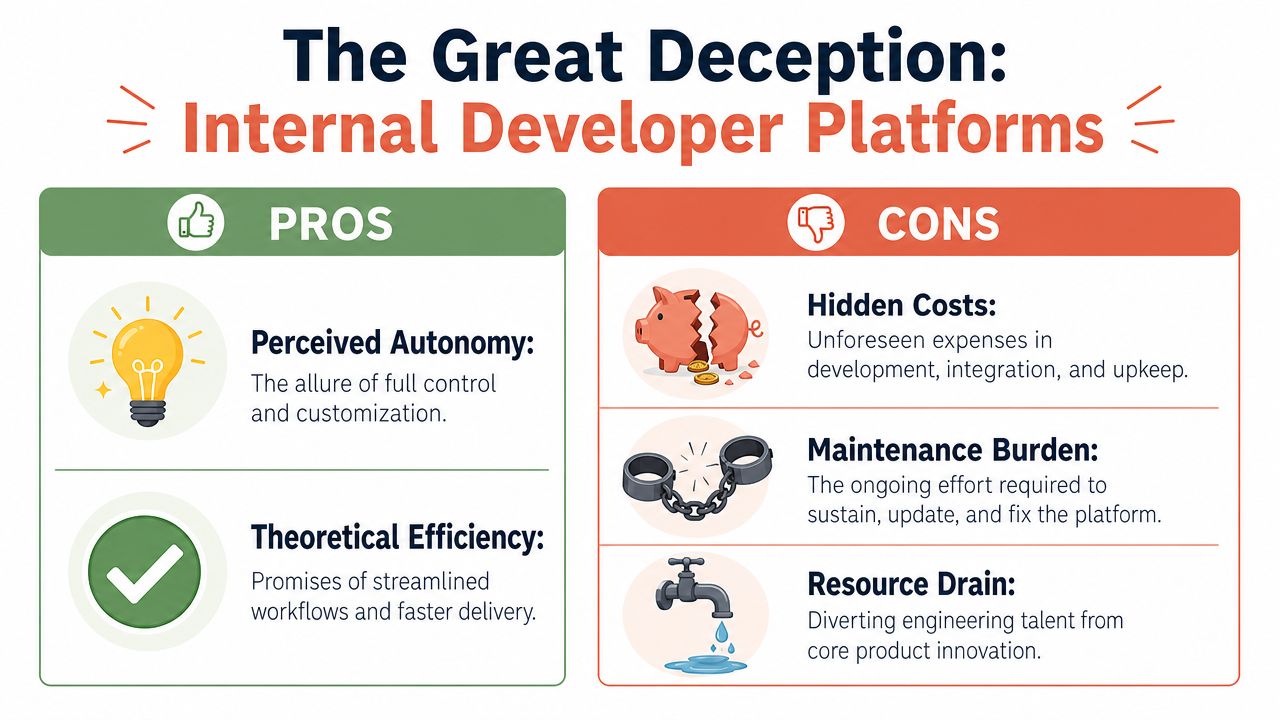
The Great Deception The Internal Developer Platform
The internal developer platform pitch sounds brilliant in a board deck.
Build a golden path. Standardise deployments. Give developers self-service. Wrap Kubernetes, CI/CD, monitoring, security, and cloud controls behind an elegant internal interface. Amplify efficiency. Move faster.
I've bought that pitch before. I've approved the hires. I've sat in the demos. And I'll be blunt: for most startups and scale-ups, a DIY internal developer platform is a distraction dressed up as strategy.
Why teams fall for it
The trap usually starts with reasonable instincts:
- Control feels safer: Leadership wants platform decisions in-house because cloud complexity feels too important to outsource.
- Engineers want elegance: Strong teams hate repetitive setup and want a cleaner developer experience.
- Everyone underestimates upkeep: Building the first version looks achievable. Running version seven across changing services, policies, and team needs is the part nobody budgets for.
Then reality arrives. Your internal platform team becomes the bottleneck for every edge case. Product engineers start opening tickets for things that were supposed to be self-service. Security requests pile up. Cost reporting lags behind actual usage. Monitoring remains fragmented. The “platform” becomes a second product with the worst possible customer base: your own impatient engineers.
The timeline mismatch nobody talks about
There's another problem. Internal platform advocates often borrow thinking from long operational maturity journeys in manufacturing. That logic breaks in software.
LNS Research notes that the average manufacturing organisation has been on an operational excellence journey for exactly 2.5 years, with some spanning 20 years (LNS Research operational excellence statistics). In cloud software, you don't have that luxury. Your market shifts in quarters. Your hiring plan changes mid-year. Your architecture evolves before your platform backlog is stable.
If your platform strategy needs years to become useful, it's already misaligned with startup reality.
What teams should do instead
When leaders compare options for developer tooling, they often spend more time evaluating leading app building software than they do questioning whether they should build the delivery platform underneath it. That's backwards. Your app stack should accelerate product work. Your infrastructure stack should disappear into the background.
A useful mental check is this: are you building a platform because it creates market advantage, or because you've normalised infrastructure toil?
If you're tempted to launch an in-house IDP initiative, read this breakdown of an internal developer platform and ask a harder question. Does your company need a proprietary platform, or does it need a reliable one?
For most startups, the honest answer is the second.
Calculating the True Cost of Your DIY DevOps Stack
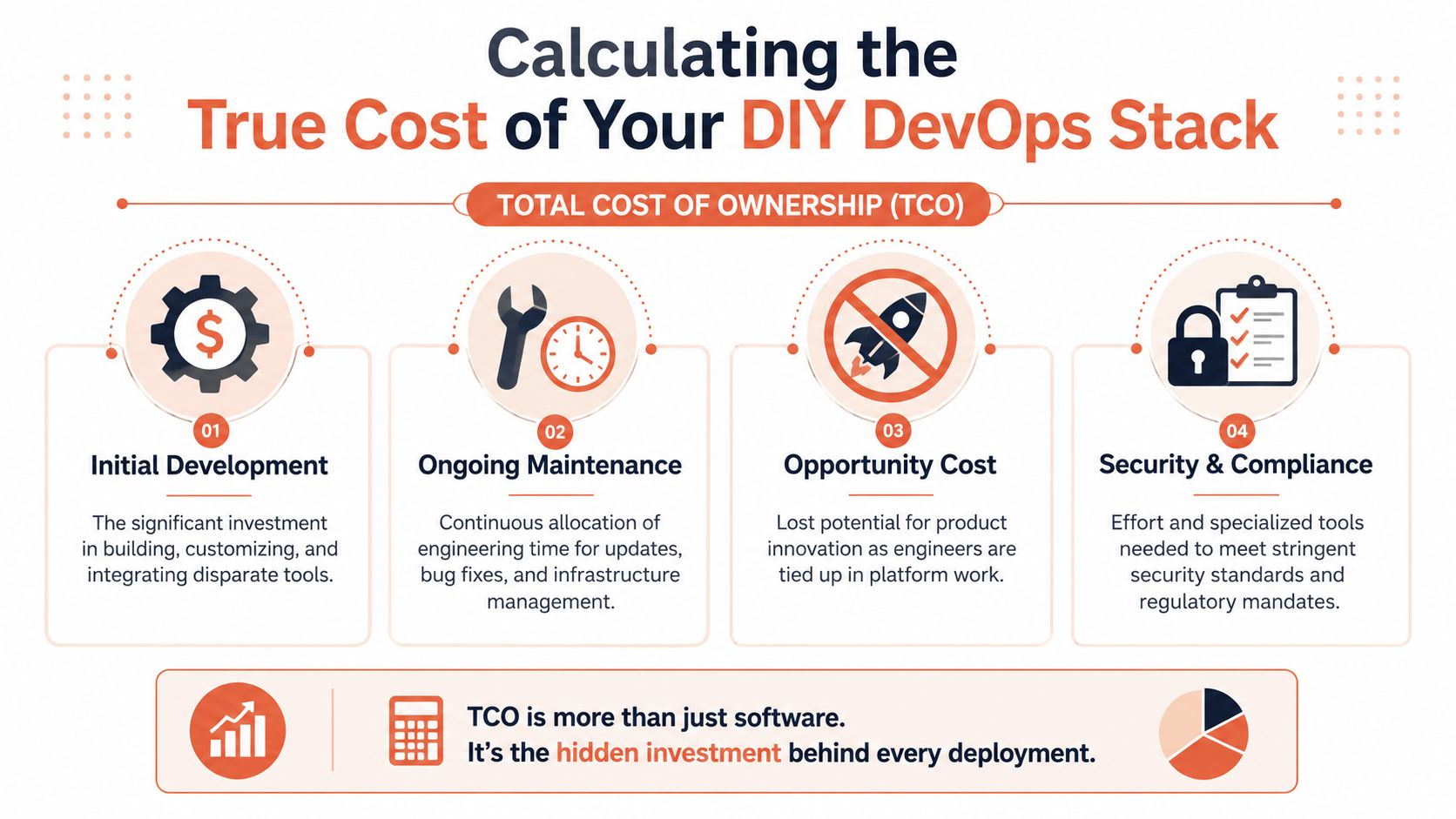
DIY DevOps costs are massively underpriced.
They count salary. They forget attrition, tooling, training, outages, cloud waste, slow hiring, context switching, and the opportunity cost of dragging senior engineers into platform work. That's how a “lean” in-house setup turns into one of the most expensive systems in the company.
Start with the people cost
A full-time senior DevOps engineer in Europe costs €80–120K/year, but the fully loaded total cost reaches €165K–210K annually once you include tools, AWS certifications, ongoing training, and repeated hiring cycles tied to short tenure. Most scale-ups also need separate DevOps, FinOps, and Cloud Engineering lanes, which pushes minimum annual cost to €540K (Louis Mauclair on real DevOps hiring cost).
That number is before you count the cost of your product engineers getting pulled into platform gaps.
Here's what this usually looks like in practice:
| Cost area | What leaders usually budget | What actually happens |
|---|---|---|
| Hiring | One senior DevOps engineer | You need broader coverage across delivery, cloud, and cost control |
| Enablement | Base salary | Training, certifications, tools, and onboarding add up fast |
| Continuity | Stable tenure | Re-hiring and knowledge loss keep resetting momentum |
| Product impact | Assumed zero | Senior product engineers spend time unblocking infra issues |
Outages make the cheap option expensive
A lot of leaders still think, “Fine, it's costly, but at least we own it.”
That logic collapses the first time your home-grown stack fails during a release window. More than half of significant IT outages now cost over $100,000, and one in five tops $1 million (Deployflow on the cost of DIY DevOps outages). The expensive part isn't just downtime. It's slower releases, repeated incidents, and high-value engineers fighting infrastructure instead of shipping product.
Practical rule: If your best backend engineer is debugging CI runners or Terraform drift, your platform is already too expensive.
Cloud inefficiency is a hidden tax
Most startup cloud bills don't explode because traffic suddenly became amazing. They explode because nobody has time to continuously optimise. Overprovisioning resources can double or triple monthly cloud costs, and deep dependence on proprietary cloud services creates vendor lock-in that makes future changes painful and expensive (REDu on affordable cloud hosting and cloud waste).
DIY stacks make this worse because cost optimisation becomes everyone's side job and nobody's owned system.
A disciplined cloud setup needs:
- Right-sizing: Reduce oversized compute and storage before they become permanent defaults.
- Environment scheduling: Shut down non-production environments when nobody needs them.
- Cross-cloud flexibility: Avoid baking critical workflows so tightly into one provider that every future decision becomes expensive.
- Clear visibility: Tie resource use to services and teams, not a giant monthly invoice nobody can interpret.
If you're trying to get a handle on that side of the equation, this guide to cloud cost optimisation is worth reviewing alongside your current tooling map.
The opportunity cost is usually the biggest line item
This is the one finance rarely sees and engineering always feels.
When senior developers spend release days fixing deployment templates, rebuilding observability dashboards, or untangling Kubernetes issues, your company isn't just paying infrastructure cost. It's sacrificing roadmap progress. Features arrive later. Experiments wait. Customer requests sit in backlog because the team is maintaining the factory instead of improving the product.
DIY DevOps looks cheaper only when you ignore what your best people could have built instead.
The Four Pillars of Modern Software Operations
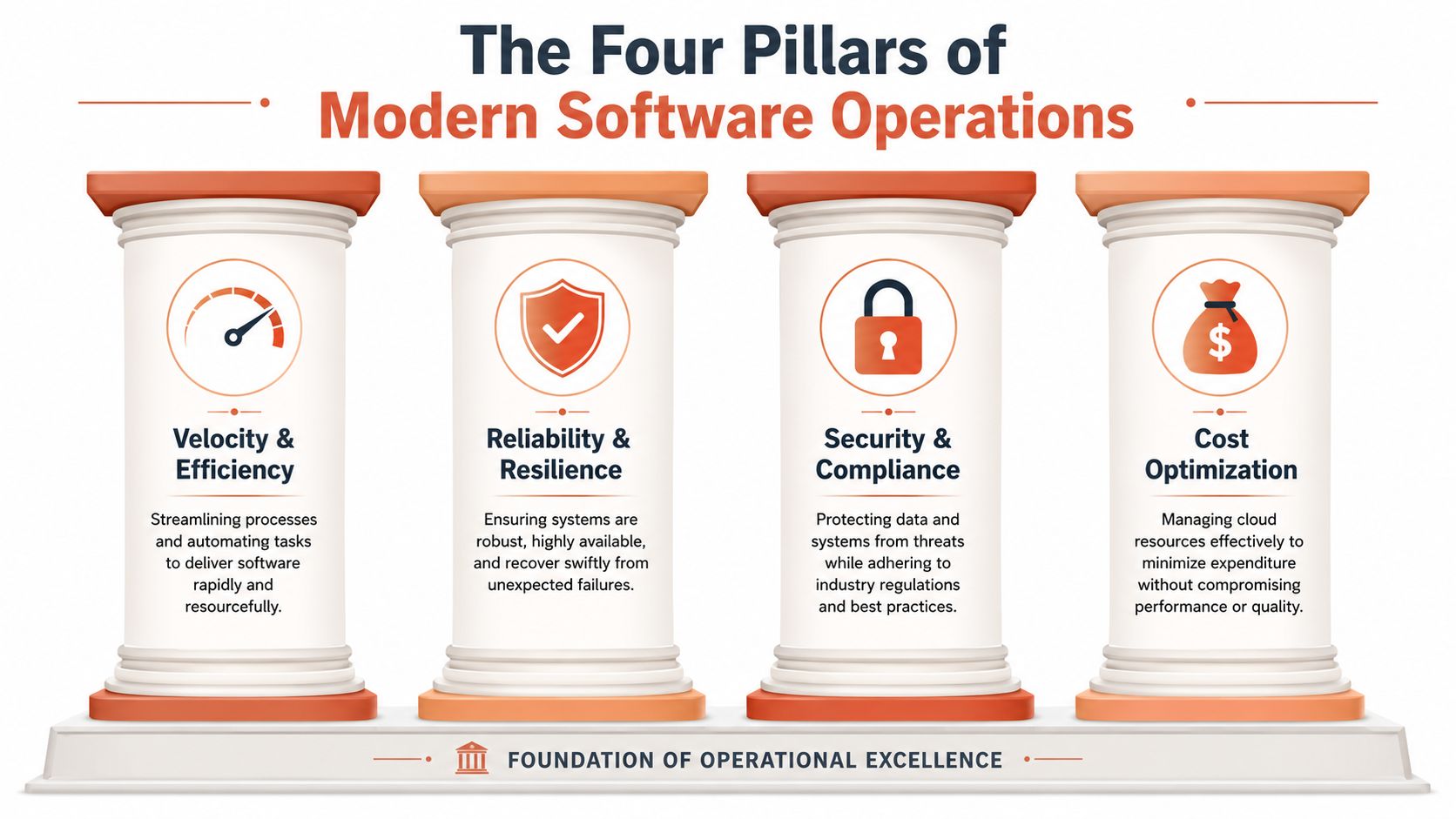
A software team doesn't need a grand philosophy of operational excellence. It needs a clear operating model. I use four pillars: velocity and agility, reliability and resilience, security and compliance, and cost optimisation.
If one pillar is weak, the others suffer. Fast releases without reliability create chaos. Strong security without developer usability creates shadow processes. Cloud savings without performance discipline produce false economy.
Velocity and agility
Velocity is not about making engineers hurry. It's about removing waiting, handoffs, and fragile release mechanics.
For software leaders, that means paying attention to practical flow signals such as deployment frequency and lead time for changes. If every release requires specialist intervention, your delivery path isn't scalable. If your developers need to understand the guts of CI, infra templates, and cloud networking just to ship a feature, your system is poorly designed.
Good velocity feels boring. Code moves through a standard path. Environments behave consistently. Promotion rules are predictable. Release strategy is routine, not a bespoke ceremony.
Reliability and resilience
Reliability starts with a simple question: when change hits production, how often does it work the first time?
A key metric here is First Pass Yield, the share of deployments that complete without defects, rework, or rollback. Mature DevOps teams achieve FPY rates over 95%, which correlates with lower MTTR and can improve COGS efficiency by up to 20% (Process Excellence Network on FPY and process excellence metrics).
That's why I care less about how clever your pipeline is and more about whether it produces repeatable, low-drama releases.
Reliability work should include:
- Rollback readiness: Teams need safe release mechanisms that don't depend on heroics.
- Useful observability: Metrics, logs, and alerts should help engineers decide, not just notify them that something is wrong.
- Incident discipline: MTTR improves when ownership and response paths are already clear.
- Standard environments: Fewer one-off exceptions means fewer production surprises.
The most reliable teams don't rely on brilliant recovery. They reduce the number of situations that require it.
Security and compliance
Security belongs inside the delivery system, not beside it.
When security is bolted on later, teams end up with approval queues, manual policy checks, and permission sprawl. That slows delivery and still leaves gaps. A stronger model builds guardrails into environments, access, audit trails, and deployment paths by default.
The overlooked operational excellence idea of data governance as a living operating model matters. Governance can't be a static policy document. It needs clear ownership, practical controls, and daily workflows that make accountability real. Teams struggle when analytics, cost, security, and operations all live in separate systems with no shared operating model.
Cost optimisation
Cost control is part of operational discipline, not a quarterly finance exercise.
Teams with mature software operations treat spend the same way they treat latency or error budgets. They observe it continuously. They automate the obvious savings. They avoid lock-in where practical. They connect cost decisions to engineering choices early, not after invoices land.
There's also a broader digital operations lesson here. Technology and digital integration are valuable when they improve decision-making, connect systems, and support customer outcomes. Automating a messy process without fixing fragmentation just gives you a faster messy process.
A Practical Roadmap from Chaos to Control
Most leaders face two paths.
One is to build the whole thing yourself. Stand up Kubernetes patterns, standardise CI/CD, layer on monitoring, wire in secrets, define access controls, add cost guardrails, then spend the next year maintaining and revising all of it.
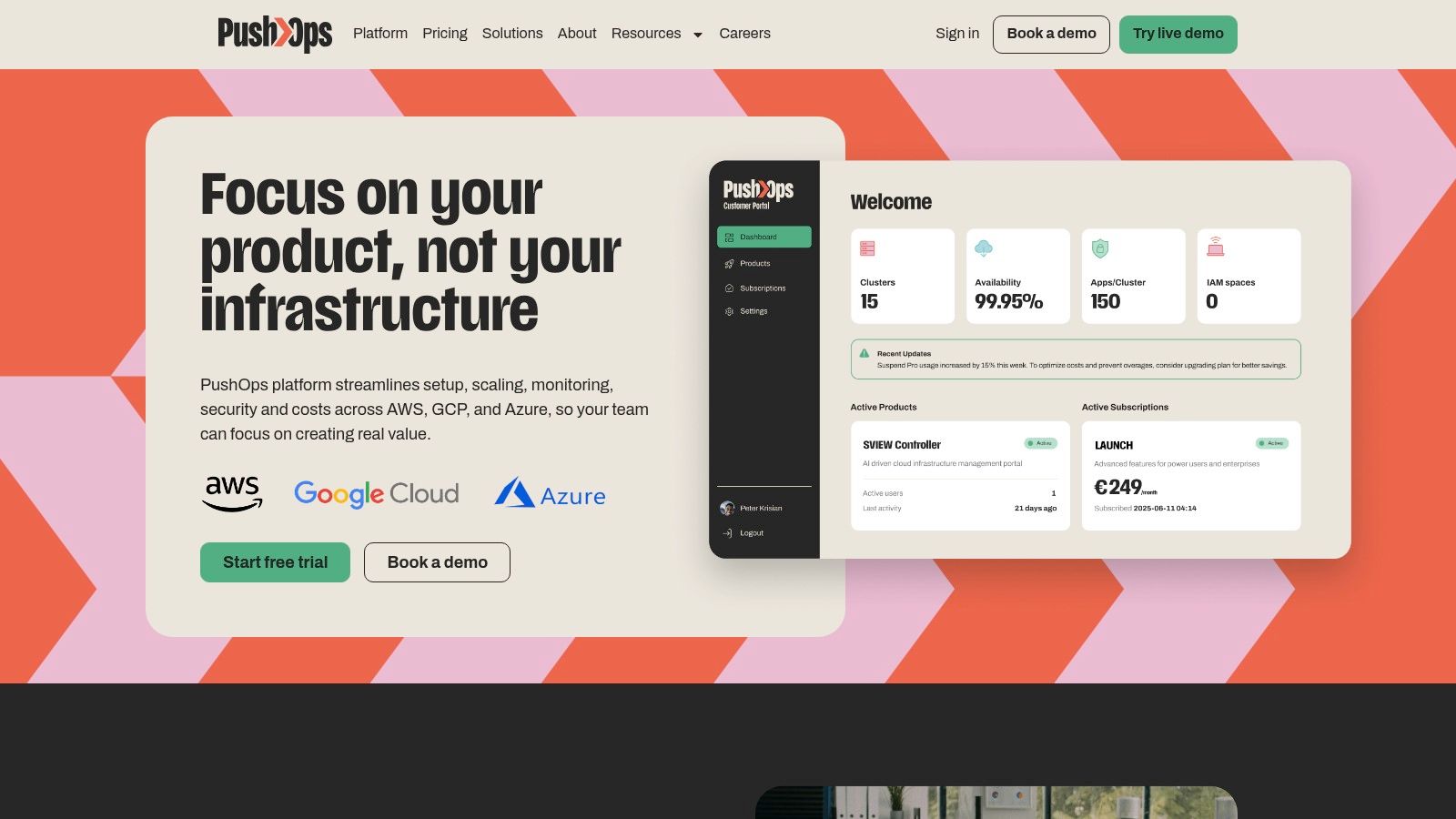
The other is to adopt a modern multi-cloud DevOps platform that already handles setup, scaling, monitoring, security, and cost management across AWS, GCP, and Azure, so your team can get back to shipping product.
The difference isn't philosophical. It's operational.
Path A builds a platform team
The build path usually starts with confidence. Your engineers know containers. They know CI. They've used Helm, Terraform, ArgoCD, GitHub Actions, Datadog, Prometheus, Grafana, or some combination of all of them. It feels possible.
Then the work expands:
- Provision foundations: Network design, environments, access models, state management, and provider-specific decisions.
- Build deployment standards: Pipelines, release logic, rollback strategy, secret injection, and environment promotion.
- Add observability: Logs, metrics, traces, alert routing, dashboards, and incident workflows.
- Enforce security: Role-based access, auditability, policy checks, secret rotation, and update discipline.
- Control spend: Autoscaling, rightsizing, idle environment shutdown, and cost attribution.
None of those tasks is impossible. Together, they become a permanent platform product.
The labour impact is obvious. Developers waste up to 40% of their time on manual deployment tasks and infrastructure maintenance, and hiring a qualified Kubernetes engineer can take 6–12 months (Ellty on DevOps productivity drag and Kubernetes hiring delays). That's a brutal combination for startups that need to move now.
Path B adopts a platform
The smarter route is to treat delivery infrastructure like any other mature operational capability. Buy the commodity. Keep your differentiation in the product.
A capable managed DevOps platform should give your team:
- Production-ready environments: Standard foundations on AWS, GCP, and Azure without months of platform assembly.
- Automated deployments: Builds, release strategies, and environment workflows without pipeline babysitting.
- Integrated observability: One operating surface for service health, incidents, and performance signals.
- Security by default: Permissions, audit logs, policy controls, and continuous updates built into the workflow.
- Spend control: Autoscaling, scheduling, and rightsizing that reduce waste without requiring a separate cost task force.
The broader benefits of process automation become pertinent. Automation is valuable when it removes repetitive work and standardises execution. It's not valuable when it merely wraps a fragile manual process in nicer language.
Adopt when the work is necessary but not differentiating. Build only when the capability itself gives you strategic advantage.
A side-by-side decision test
| Question | Build in-house | Adopt a managed platform |
|---|---|---|
| Does it require scarce specialist hiring? | Yes | Much less |
| Will your product engineers get dragged into maintenance? | Usually | Far less |
| Can you standardise across AWS, GCP, and Azure quickly? | Difficult | Built for it |
| Do you own ongoing patching and platform evolution? | Yes | Mostly abstracted away |
| Does it help you focus on product sooner? | Rarely | Yes |
There's also a less obvious advantage in the adopt path. It forces discipline. Teams stop endlessly customising the platform and start improving delivery outcomes. That's the move from chaos to control.
The shortcut most teams resist
Leaders often worry that adopting a platform means losing engineering standards or flexibility. In practice, the opposite is more common. Standardisation improves because fewer workflows depend on tribal knowledge and custom scripts.
That's how software teams should think about operational excellence. Not as perfecting CI/CD scripts forever, but as eliminating whole categories of infrastructure work so the people who understand your market can spend their time building for it.
Shift Your Focus from Operations to Innovation
The companies that win don't award prizes for the most advanced internal deployment stack. They win because their engineers ship useful product, respond quickly to customers, and change direction without platform drag.
That's the point of operational excellence in software. Not more dashboards. Not prettier pipelines. Not a larger DevOps headcount. The point is making operations so reliable and so standardised that it stops consuming your best technical talent.
If your current model still depends on custom scripts, specialist gatekeepers, and constant infrastructure attention, you're not achieving systemic efficiency. You're carrying avoidable overhead. The fix isn't hiring your way out of it forever. It's changing the system.
A good place to challenge your current assumptions is this explainer on how to reduce DevOps overhead. Then look hard at where your senior engineers spent their last two weeks. If too much of that time went into pipelines, cluster issues, permissions, monitoring glue, or cloud cost clean-up, you already know what needs to change.
Operational excellence is an outcome. The best version of it is almost invisible. Your product team gets a dependable platform. Your operations burden drops. Your engineers focus on innovation instead of infrastructure maintenance.
If your team is tired of rebuilding the same cloud and deployment machinery, take a look at PushOps. It gives software teams a production-ready multi-cloud DevOps platform across AWS, GCP, and Azure, with deployments, observability, security, and cost controls built in, so your engineers can spend more time shipping product and less time running infrastructure.

