
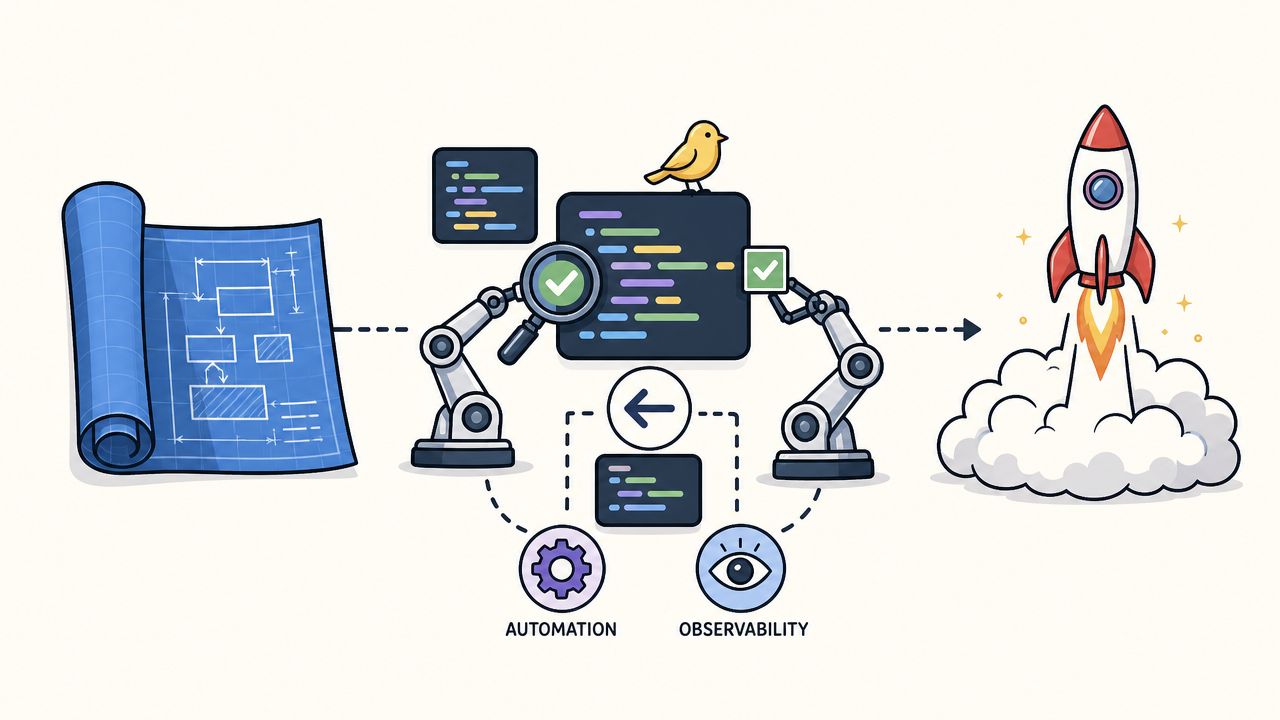

Your team probably didn't plan to spend this quarter tuning Kubernetes manifests, fixing brittle GitHub Actions jobs, chasing noisy alerts, and explaining to customers why a release that passed tests still broke production.
Yet that's where many startups and scale-ups end up. The product roadmap says “ship faster”. The engineering calendar says “stabilise the platform first”. CTOs, VP Engineering leaders, and senior developers across Europe, Singapore, the UK, and the US feel that tension every week.
The usual response is to add more tooling and more process. Another pipeline. Another dashboard. Another approval step. But quality assurance done well doesn't slow delivery. It removes the recurring friction that keeps pulling engineers away from product work and back into operational repair.
Why Your Team Spends More Time Fixing Than Shipping
A familiar cycle plays out in a lot of software teams. A feature goes live on Friday. A dependency change behaves differently in production than it did in staging. Logs are split across tools. Alerts fire, but nobody trusts which one matters. Two backend engineers, one frontend lead, and the CTO spend the evening tracing a failure path through services that were supposed to be isolated.
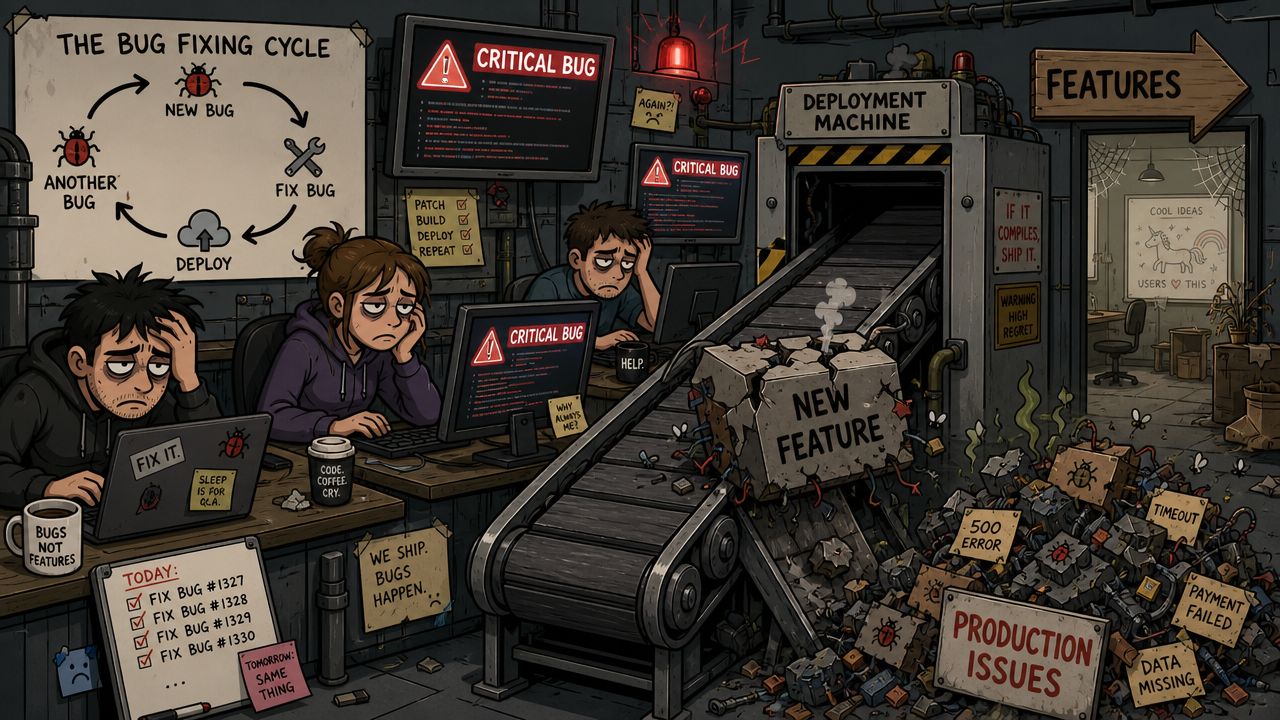
That's rarely a talent problem. It's usually a systems problem. Teams build a delivery setup from strong individual tools like Kubernetes, Terraform, Jenkins, GitHub Actions, Datadog, Prometheus, cloud-native IAM, and a handful of scripts that glue everything together. Each tool is useful. The combined stack often becomes fragile.
The hidden maintenance loop
The damage starts in small ways. A pipeline needs one more conditional. A Terraform module works for AWS but needs special handling for Azure. Environment scheduling saves money until the scheduling script fails and someone has to debug why a database woke up but an API did not.
That's why the operational burden grows quietly inside “we built it ourselves”. As PushOps explains in its breakdown of cloud cost optimisation for startups, DIY approaches to DevOps often lead to spiraling cloud bills because custom scripts for environment scheduling break, CI/CD pipelines demand constant attention, and Terraform modules require debugging. Hours lost that directly reduce time available for product development, bug fixes, or competitive advantage.
The most expensive platform work is often the work nobody planned for. Pipeline babysitting, tool drift, and late-night release fixes.
Why firefighting keeps repeating
When delivery infrastructure is stitched together internally, quality gets treated as a last checkpoint instead of an operating model. Teams test the application, but they don't consistently validate the release process, the environment assumptions, the rollback path, or the health signals that tell them whether a deployment is safe.
A lot of deployment failures aren't mysterious. They're predictable. Release steps differ between services. Monitoring isn't tied closely enough to change events. The team lacks a safe release pattern, so every production push carries more risk than it should. If that sounds familiar, a practical starting point is reducing release risk with approaches like those covered in this guide to reducing deployment failures.
Here's the uncomfortable trade-off. Every hour your senior developers spend repairing CI/CD, maintaining cluster policies, or reconciling monitoring gaps is an hour they aren't spending on onboarding, product differentiation, or customer-facing improvements. For many teams, quality assurance becomes the escape route from reactive operations, but only when it's embedded into how software moves from commit to production.
Quality Assurance Is Not Just More Testing
Organizations say they care about quality. Many still treat quality assurance as a synonym for testing. That confusion is expensive.
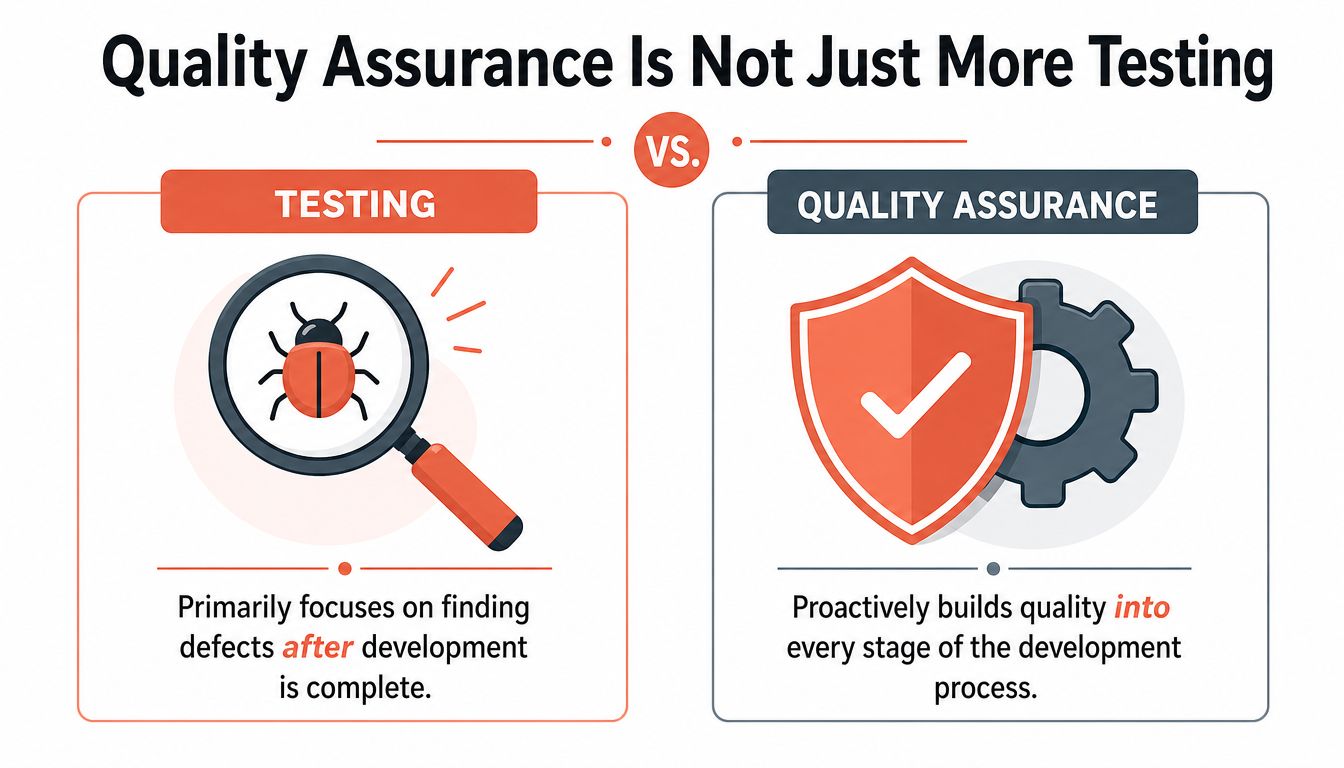
Testing checks whether the product behaves as expected. Quality assurance shapes the conditions that make reliable outcomes more likely in the first place. One is inspection. The other is system design.
The assembly line distinction
Think about a car factory. Testing is inspecting finished cars for faulty brakes, electrical issues, or paint defects. Quality assurance is designing the assembly line, supplier standards, calibration routines, and safety checks so fewer faults are created at all.
Software teams often invest heavily in the first part and underinvest in the second.
According to Wikipedia's quality assurance overview, most quality assurance content conflates QA with quality control (QC), failing to address how teams can implement a true shift-left strategy. While Wikipedia defines QA as defect prevention, only 15% of recent developer surveys report having formalized shift-left QA processes, leaving teams without clear frameworks for pre-deployment quality gates.
That gap shows up everywhere. Teams have unit tests, maybe integration tests, maybe end-to-end coverage for critical paths. But they still don't have shared rules for what must happen before merge, before deploy, or before a risky release reaches all users.
What testing alone misses
Testing is necessary. It just isn't sufficient on its own.
A test suite won't fix:
- Inconsistent release controls when one service uses approvals and another deploys directly
- Weak policy enforcement when security, audit logging, or role boundaries are bolted on later
- Environment drift when staging behaves differently from production
- Blind rollback decisions when the team lacks confidence signals after release
Practical rule: If your team finds the same class of defect repeatedly, you don't have a testing problem. You have a quality assurance problem.
A strong QA practice changes the development system. It defines how teams work, how changes are validated, how exceptions are handled, and how release safety is measured. It also makes modern release patterns possible. Feature flags, staged rollouts, and progressive delivery are all easier when quality is built into the workflow instead of delegated to a final test pass. Safe rollout patterns like those in this guide to feature flags and safe releases are useful because they reduce the blast radius of normal engineering mistakes.
The practical shift is simple to describe and harder to implement in-house. Stop asking, “How do we catch more bugs?” Start asking, “How do we make bad changes harder to introduce, easier to detect, and safer to release?”
How to Shift Left and Automate Quality
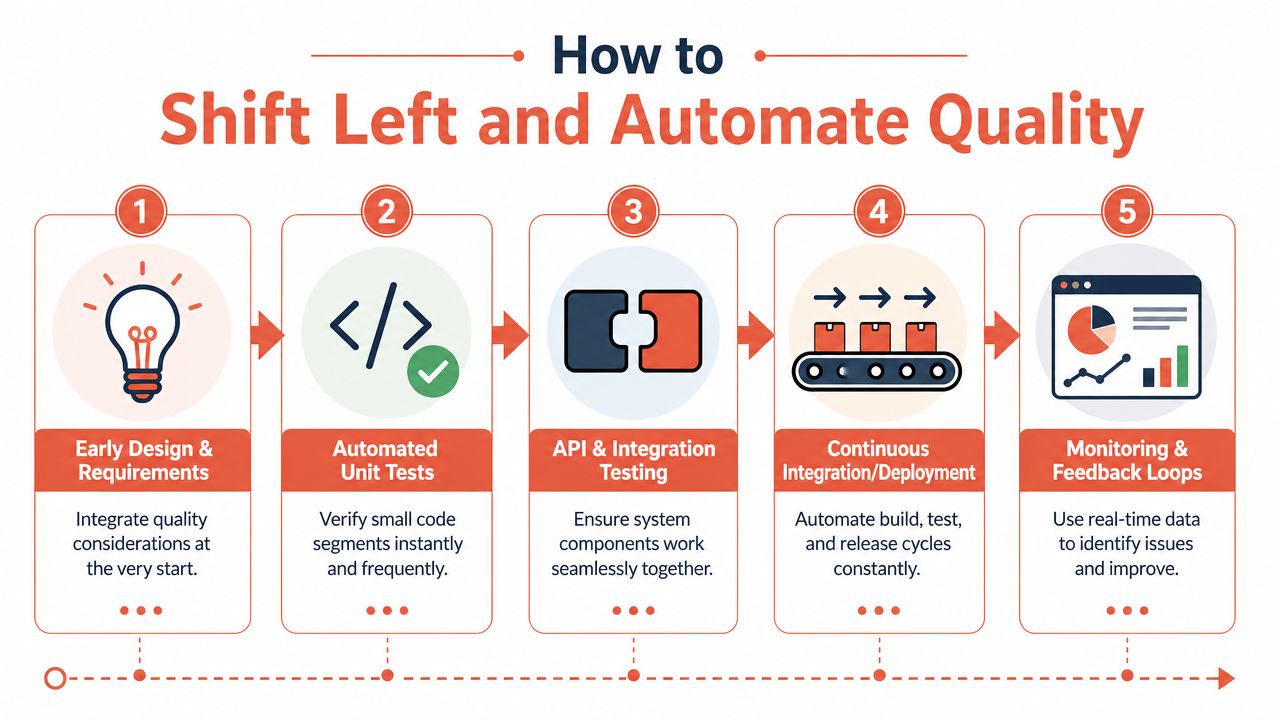
Teams hear “shift left” so often that the phrase has lost some meaning. In practice, it means moving quality decisions to the earliest point where they're still cheap to act on. That starts before code review and continues after deployment through fast feedback.
Start with four operating principles
For cloud-native teams, manual QA doesn't scale. As Trigyn notes in its guidance on QA for cloud-native applications, automation is non-negotiable in microservices environments. It also points out that risk-based testing frameworks prioritise critical paths and high-usage services, enabling quality gates that balance deployment speed with control. That's the right mental model for modern delivery.
The practical version comes down to four principles.
Shift-left checks in the developer workflow
Quality gates belong close to the pull request, not at the end of a release train. Linting, unit tests, dependency checks, policy validation, and contract checks should run before a change gets merged. Developers get feedback while the code is still fresh, and reviewers spend less time spotting issues that automation should catch first.Automation that follows risk, not vanity coverage
A hundred passing tests don't matter if they don't cover the path that breaks checkout, authentication, billing, or provisioning. Good teams map tests to business-critical flows. They automate the checks that protect those flows and avoid pretending that static coverage targets equal safety.Observability tied to release events
Logs, metrics, traces, and health indicators matter more when they're connected directly to a deployment. The team needs to see whether this release changed latency, error rates, queue depth, or downstream failures. Observability isn't a separate operations concern. It's part of quality assurance because it closes the loop between change and outcome.Feedback that changes behaviour
If incidents happen and the delivery system stays the same, the team is only documenting pain. Good QA practices turn failures into new guardrails. That might mean adding a policy check, tightening a rollout strategy, or creating an ephemeral environment for a risky service path.
What this looks like in a real workflow
A healthy workflow usually includes a mix of automated and human checks:
Before merge
Static analysis, unit tests, secret scanning, dependency review, schema validation, and infrastructure policy checksBefore release
Integration tests, API contract validation, migration safety checks, smoke tests, and release approvals for higher-risk changesAfter deployment
Canary analysis, service health checks, alert correlation, rollback triggers, and team review of abnormal signals
A release isn't “done” when the pipeline turns green. It's done when the service behaves correctly under real production conditions.
Accessibility belongs in this model too. If your application serves broad customer segments, accessibility regressions are quality regressions. Teams that want a practical view of that discipline should read this guide to digital accessibility regression testing, especially when UI changes ship frequently.
What doesn't work
Some patterns look disciplined but create drag:
- Late testing bottlenecks where one team becomes the last gate before production
- Manual sign-offs for routine changes that could be validated automatically
- Custom scripts everywhere because each repo solves the same quality problem differently
- Observability afterthoughts where teams add dashboards only after an incident
The teams that move fastest don't skip quality. They reduce the amount of quality work humans need to do manually.
The True Cost of a DIY Quality Assurance Stack
The strongest argument against a DIY QA stack isn't that tools are expensive. It's that fragmented systems consume senior attention, and senior attention is your scarcest engineering resource.
A startup or scale-up often tells itself a flattering story here. We'll assemble a lightweight platform. We'll standardise later. We only need a few scripts, a pipeline template, a Helm chart library, a couple of cloud policies, and some dashboards. Then the estate grows. More services. More teams. More exceptions. More release pressure.
Where the bill actually shows up
The cost lands in places that rarely appear on the original plan.
| Cost area | What teams expect | What often happens |
|---|---|---|
| CI/CD | A one-time setup | Ongoing maintenance, flaky jobs, version drift |
| Kubernetes | Standard orchestration | Constant policy tuning, permissions work, upgrade planning |
| Monitoring | Better visibility | Multiple tools, duplicated alerts, unclear ownership |
| Security controls | Compliance support | Manual patching, exception handling, audit trail gaps |
| Cloud optimisation | Lower spend | Broken scheduling scripts, inconsistent rightsizing decisions |
DIY quality systems also increase business risk. According to Deployflow's analysis of DevOps services for small teams and startups, more than half of significant IT outages now cost over $100,000, and one in five exceed $1 million. If your stack lacks dependable incident management, reliable rollout controls, and clear operational ownership, you're not only carrying engineering overhead. You're carrying financial exposure.
Why internal platforms become a second product
Once a company builds enough wrappers around GitHub Actions, ArgoCD, Terraform, cluster access, secret handling, environment templates, and observability, it effectively owns an internal product. That product has users, edge cases, documentation needs, support load, and a backlog.
That isn't wrong in itself. Some companies need that. Most startups don't mean to sign up for it.
If you're weighing where that line sits, the logic is similar to other build-vs-buy decisions. This piece on optimising operations with AI tooling decisions is useful because it separates strategic differentiation from operational plumbing. The same question applies to quality assurance infrastructure. Is this where your company wins?
The opportunity cost leaders underestimate
A bespoke stack doesn't just cost money. It creates delays that compound:
- Senior engineers context-switch from feature work into platform support
- Developers wait on pipeline fixes instead of shipping code
- Release confidence drops because every service behaves a bit differently
- Platform knowledge centralises around a few people, which creates delivery bottlenecks
For teams dealing with that sprawl, browsing practical patterns around a CI/CD pipeline tag archive can be a good reality check. The recurring problems are rarely unique. The mistake is assuming each one deserves a custom internal solution.
If your developers need tribal knowledge to deploy safely, your quality system is too fragile.
The hard part is that DIY often feels cheaper month to month because the spend is hidden inside existing salaries. But the business still pays. It pays in slower releases, avoidable outages, and engineers who spend more time maintaining delivery infrastructure than building customer value.
A Smarter Way to Implement Quality Assurance
The cleanest QA model is one where developers don't have to assemble it service by service. Quality assurance works best when it's built into the delivery path itself.
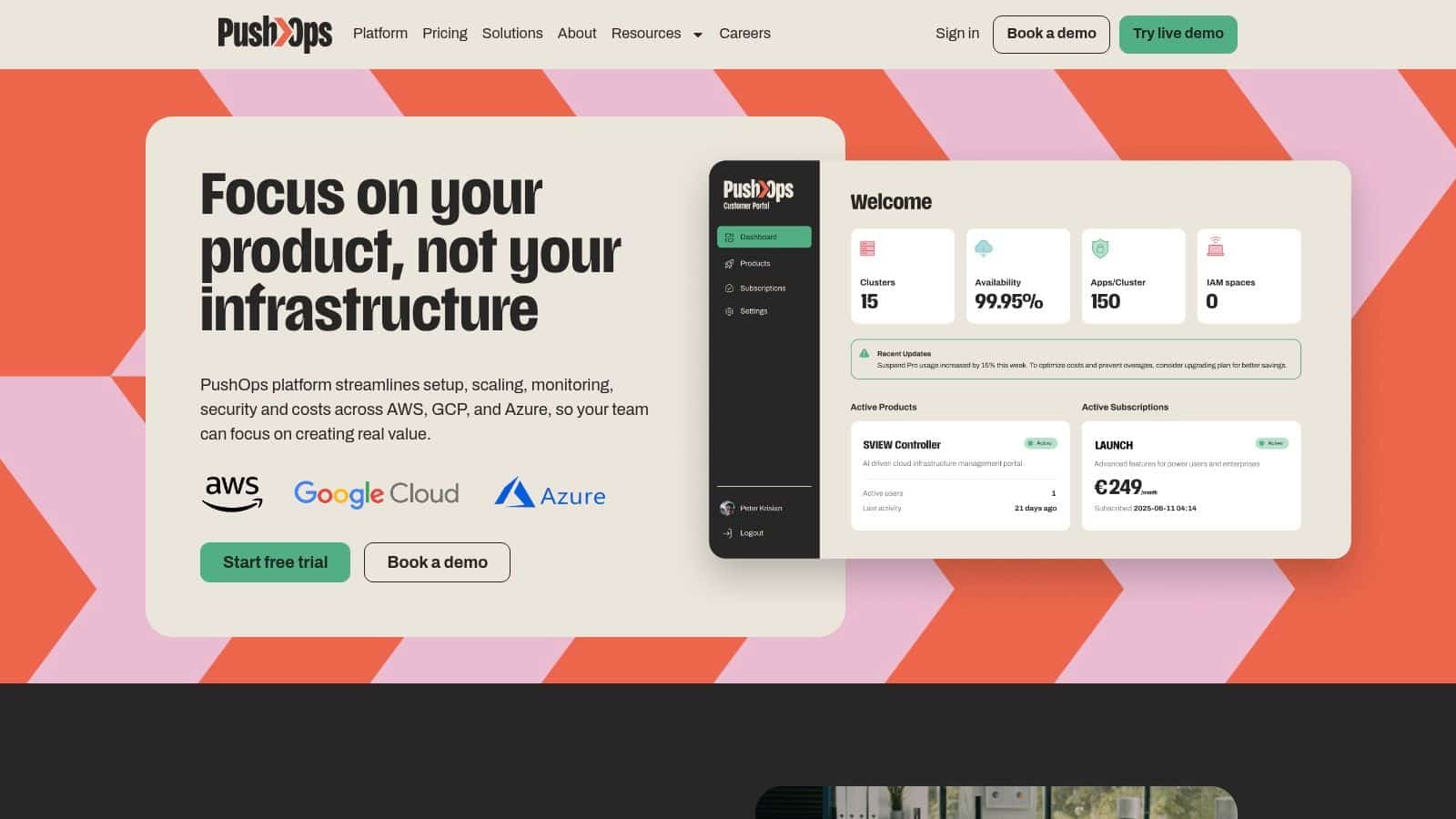
From commit to production without duct tape
A modern multi-cloud DevOps platform should handle the common path automatically.
A developer pushes code. The platform creates the build, runs the defined checks, provisions or updates the correct environment, applies policy controls, and exposes release health in one place. If the change is low risk, it moves quickly. If the change touches a sensitive path, the platform applies stricter gates without requiring engineers to hand-build that logic in every repository.
That matters because quality isn't one action. It's a sequence of controls that need to remain consistent across AWS, GCP, and Azure without becoming a maintenance project.
What integrated quality looks like
The most useful platforms turn quality assurance into default behaviour:
- Automated pipelines run the same way every time, which improves release predictability
- Ephemeral environments let teams validate risky changes in production-like conditions
- Policy enforcement handles permissions, auditability, and guardrails before release
- Integrated observability shows whether a deployment is healthy without jumping across tools
- Release strategies like canaries or staged rollouts reduce the blast radius of failure
- Cost controls such as autoscaling, rightsizing, and scheduled environments reduce the waste that often comes with ad hoc infrastructure
This approach lines up well with established quality models. As Orbicap's summary of quality assurance frameworks explains, quality assurance frameworks define five core dimensions of quality: Relevance, Accuracy and Reliability, Timeliness and Punctuality, Coherence, and Accessibility. It also notes how a managed platform maps directly to those dimensions: automated pipelines ensure Timeliness, integrated tests ensure Accuracy, and built-in observability ensures Accessibility.
Why platform-based QA is faster
Platform-based quality assurance changes the economics of delivery.
Instead of every team solving the same pipeline design, environment provisioning, monitoring setup, secret handling, and rollback mechanics on its own, the platform standardises those capabilities. Developers get self-service delivery. Engineering leaders get consistency. Security and operations get enforceable controls instead of best-effort conventions.
That doesn't remove judgement. Teams still decide what to test, which risks matter, and what quality means for their product. But they stop rebuilding the machinery around those decisions.
Good QA systems don't ask developers to remember every safeguard. They make the safe path the default path.
The practical result is less glue code, fewer one-off scripts, and less dependency on the handful of engineers who know how the delivery stack really works. That's the point. Quality assurance should increase confidence without forcing the company to operate a shadow platform team before it's ready.
Stop Building Infrastructure Start Shipping Product
At some point every engineering leader has to answer the same question. Are your best people meant to build customer value, or are they meant to maintain the machinery that gets code into production?
For many startups and scale-ups, the answer gets blurred. They say they want speed, but they keep assigning strong engineers to pipeline maintenance, Kubernetes operations, monitoring cleanup, security patching, and cloud cost tuning. Those jobs matter. They just aren't the product.
Quality assurance is often misunderstood as a brake pedal. In practice, modern QA is what lets teams release more often without gambling every time they ship. The problem isn't quality itself. The problem is trying to implement quality through a patchwork of scripts, tools, and internal conventions that nobody has time to maintain properly.
The strategic choice
The decision isn't really “build versus buy”. It's focus versus distraction.
- Choose internal build-out if delivery infrastructure is a core differentiator and you're willing to fund it like a real product
- Choose a managed platform if what you need is reliable setup, scaling, monitoring, security, and cloud cost control across AWS, GCP, and Azure so your team can get back to product delivery
That's why more engineering leaders are rethinking the assumption that they need to hire more DevOps engineers before they can improve release quality. Often they don't need more people. They need less operational surface area.
A strong platform approach gives teams a production-ready foundation, safer releases, integrated observability, and lower maintenance overhead. That's what makes quality assurance useful instead of bureaucratic. It stops being a separate function and becomes part of how software is delivered.
If your team is spending too much time on infrastructure and not enough on product, the answer usually isn't another bespoke layer. It's a simpler operating model.
If you want a faster path to reliable delivery, PushOps gives software teams a production-ready DevOps platform across AWS, GCP, and Azure without the overhead of building and maintaining it all in-house. It automates environments, deployments, observability, security controls, release workflows, and cloud cost optimisation so your engineers can spend more time shipping product and less time running infrastructure.

