
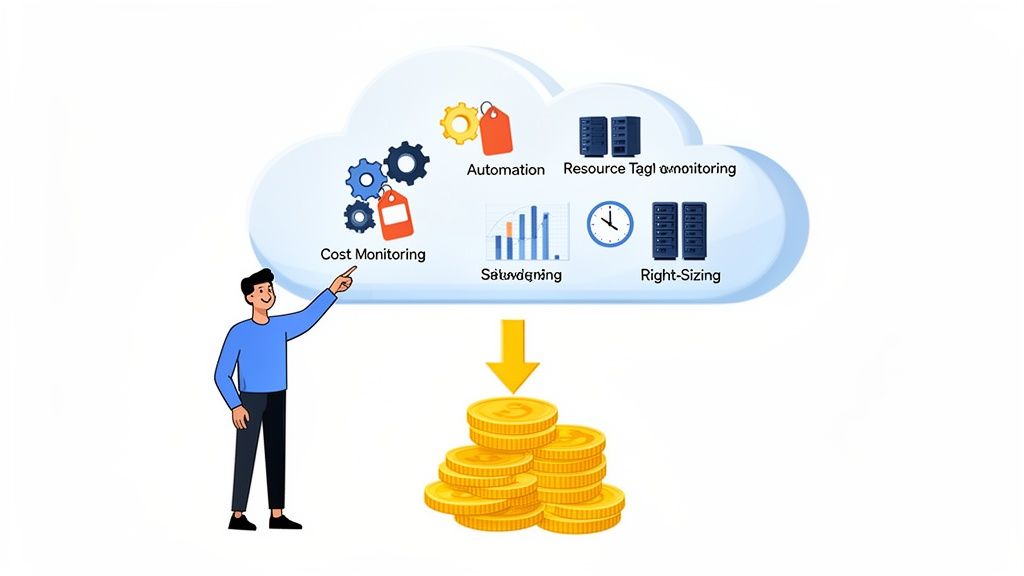

Effective cloud cost optimisation for startups isn't about finding a cheaper server or a discount code; it’s about fixing the real source of your overspending. For most CTOs and VPs of Engineering, the problem is a toxic mix of consistently overprovisioned resources and a glaring lack of automation—a mess that almost always grows out of a complex, self-built DevOps stack that’s quietly consuming your team’s time and your runway.
The Real Reason Your Cloud Bill Is Out of Control
That spiralling cloud bill isn't just another line item on a spreadsheet. It's a symptom of a much deeper problem that engineering leaders in fast-moving tech hubs across Europe, Singapore, the UK, and the US know all too well. You hired brilliant engineers to build a game-changing product, but they're spending an alarming amount of time just wrestling with infrastructure.
Your team is frustrated. They're sinking valuable hours into Kubernetes triage, CI/CD pipeline maintenance, and security patching instead of shipping features that customers want. This is the hidden, crushing weight of a do-it-yourself (DIY) DevOps stack. What began as a quick way to get your product running has slowly morphed into a complex, time-consuming monster that quietly eats your budget and your team's focus. Most teams over-invest in building and maintaining this stack, when what they really want is a reliable, production-ready platform so they can focus on shipping product.
The Unseen Costs of a DIY Internal Platform
The financial drain goes way beyond the invoice you get from AWS, GCP, or Azure. The true cost is often hidden in plain sight, scattered across your operations and payroll. Just think about the hours your most expensive engineers spend debugging a flaky deployment script or trying to make sense of a chaotic monitoring setup. That’s engineering time that should be invested in product innovation, not infrastructure plumbing.
The problem only gets worse as you scale. Your custom internal developer platform, stitched together with a dozen open-source tools and custom scripts, becomes increasingly fragile and a nightmare to manage. This leads to some very common, and very costly, scenarios:
- Overprovisioned Resources: To avoid performance issues, your engineers default to choosing larger, more expensive instances "just in case." Without the right monitoring and right-sizing in place, this waste becomes a permanent part of your monthly bill.
- Idle Environments: Development and staging environments are notorious for running 24/7, silently racking up costs when nobody is using them. A recent analysis found that these idle resources can account for up to 27% of a startup's entire cloud budget.
- Lack of Automation: Manually managing deployments, scaling, and cost controls is a recipe for human error and massive inefficiency. The effort it takes to build and maintain this automation in-house is a huge, ongoing investment.
The real issue isn’t that your engineers are being careless; it's that your DIY platform makes being cost-efficient incredibly difficult. It forces them to choose between moving fast and being frugal—and in a startup, speed almost always wins.
Shifting Focus from Infrastructure Back to Product
What your team actually needs isn't another tool to manage. They need a reliable, production-ready platform that handles all the operational heavy lifting for them. Imagine an environment where developers can self-serve, where infrastructure is provisioned securely and cost-effectively by default, and where monitoring and security are baked in from the start.
This is exactly what a modern multi-cloud DevOps platform delivers. It simplifies setup, scaling, monitoring, and security across AWS, GCP, and Azure, freeing your team from the endless cycle of building and maintaining an internal stack. Instead of hiring more DevOps engineers just to manage complexity, you can empower your existing team to focus on what they do best: building features that drive business growth.
This guide gives you a practical framework for moving from a chaotic, custom-built setup to a streamlined, cost-optimised environment. By using the right platform, you can finally get a grip on your cloud costs and, more importantly, redirect your team’s energy toward creating real value for your customers.
Achieving Full Visibility into Your Cloud Spend
You can't optimise what you can't see. It's a cliché for a reason. Once you’ve acknowledged the chaos of a spiralling cloud bill, the very first real step is figuring out where your money is actually going. For most startups, this is harder than it sounds. The native billing dashboards from AWS, GCP, or Azure are often a confusing mess of line items that feel completely disconnected from what your teams are building.
True visibility isn’t just about looking at the total spend. It’s about breaking that number down into meaningful business contexts. Who spun up that resource? Which project is it tied to? Is it for production, staging, or just a temporary experiment someone forgot to turn off? Getting clear answers here is the entire foundation of effective cost management.
This is a problem we see constantly. A DIY approach to DevOps might feel scrappy and fast at first, but it almost always leads to spiralling cloud bills and wasted engineering time.
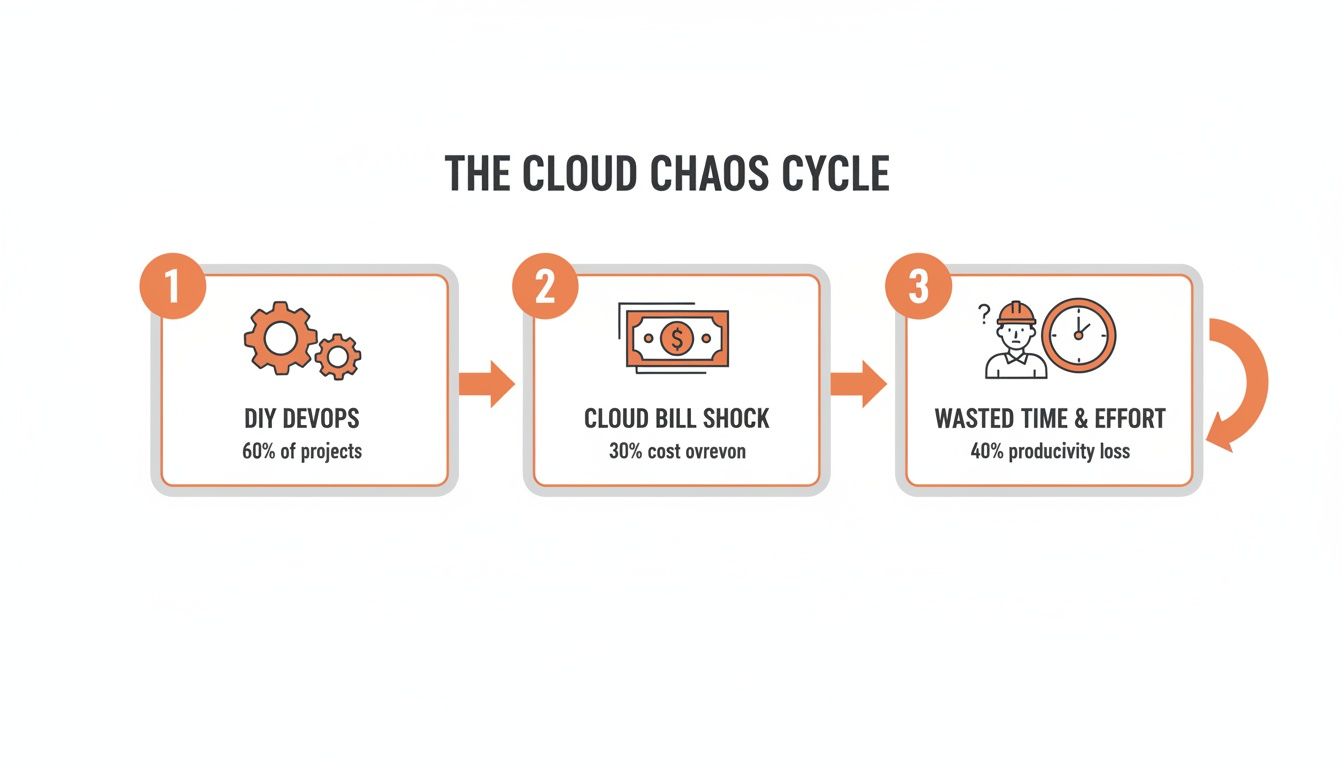
The cycle is painfully clear: a complex, self-managed infrastructure obscures spending, which leads to bill shock. This forces your most valuable engineers to drop everything and spend their days on reactive clean-up instead of building the product.
The Manual Pain of Resource Tagging
The conventional wisdom for solving this is to implement a strict tagging strategy. The idea is to manually apply metadata tags to every single cloud resource—every EC2 instance, S3 bucket, and database—to categorise spend by project, team, service, or environment.
While it sounds straightforward on paper, in reality, it’s a massive, ongoing engineering chore. It's a classic example of undifferentiated heavy lifting. Your team is suddenly on the hook to:
- Define a rigid schema: Deciding which tags are mandatory and what the naming conventions are.
- Enforce it everywhere: This means writing custom scripts, complex IAM policies, and maintaining constant vigilance. A single untagged resource can throw off your entire cost analysis.
- Maintain it forever: Your architecture is always changing. Every new service or environment requires immediate and perfect tagging, or the system breaks down.
Your engineers end up spending their valuable time building and maintaining a bespoke cost attribution system instead of shipping features. The complexity and hidden costs of this DIY approach are immense. For many scaling firms, this lack of visibility and control translates to thousands—even tens of thousands—of dollars down the drain every month.
The Limits of Native Cloud Cost Tools
Native tools like AWS Cost Explorer and Azure Cost Management are a decent starting point, but they come with serious limitations for a fast-moving startup. They are powerful, but only after you’ve done all the painful manual work of tagging every single thing perfectly.
Even then, they often give you a lagging view of your spend. You might not spot a costly mistake until it’s already shown up on the bill days or even weeks later. To get actionable, real-time insights, you have to layer on more effort by configuring budgets, alerts, and custom reports. It's yet another infrastructure management task pulling your team away from the product.
The core issue is that these tools were built for cost reporting, not proactive cost management within a developer's workflow. They tell you how much you spent last month, but they do little to help your engineers make smarter cost decisions today.
From Manual Reporting to Automated Visibility
This is where a modern multi-cloud DevOps platform completely changes the game. Instead of wrestling with manual tagging and lagging reports, a platform provides visibility right out-of-the-box. Because it handles the entire lifecycle across AWS, GCP, and Azure, cost attribution becomes automatic.
Because the platform manages the entire deployment lifecycle, it already knows which service, environment, and even which specific commit each resource is associated with. There’s no need to build a complex tagging strategy because cost attribution is completely automatic.
You can instantly see metrics that actually matter:
- Cost per service: How much is your authentication microservice costing you across all environments?
- Cost per environment: What’s the daily burn rate of your staging environment?
- Cost per deployment: Did that last feature release cause a sudden spike in cloud spend?
This shifts the entire paradigm. Instead of your engineers spending weeks trying to set up a fragile cost-tracking system, they get this insight automatically. This frees your team to pinpoint waste quickly and accurately without any manual effort, so they can get back to focusing on building, not billing forensics. If you are using Azure, understanding these cost dynamics is especially important, and you might find our guide on using the Azure Price Calculator helpful.
Implementing Tactical Changes for Immediate Savings
With a clear picture of your cloud spend, it's time to stop analysing and start acting. Identifying waste is one thing, but actually eliminating it calls for a tactical playbook. For CTOs and engineering leaders, this is where you score quick wins and show an immediate impact on the bottom line. The secret is to go after the low-hanging fruit: overprovisioned resources, clumsy scaling, and mismatched purchasing models.
But here’s the paradox of DIY cloud cost optimisation—each of these tactics, when done manually, brings its own flavour of complexity and risk. The very effort to save money can end up costing you a fortune in engineering hours and, worse, potential downtime.
The Myth of Easy Right-Sizing
Right-sizing is the process of matching your instance types and sizes to what your workload actually needs—no more, no less. In theory, it sounds simple: just downgrade oversized instances and cut out the waste without hurting performance. In practice, it’s a minefield.
Doing this by hand forces your engineers to:
- Analyse historical data: They have to sift through weeks of CPU, memory, and network metrics for every single instance.
- Predict future needs: They're left guessing how upcoming traffic spikes or new features will change performance requirements.
- Execute changes carefully: One wrong move can lead to application crashes, sluggish performance, and a miserable user experience.
This isn’t a one-and-done task; it’s a continuous, nerve-wracking cycle. For most startups, the fear of causing an outage means engineers will almost always err on the side of overprovisioning. The cycle of waste just keeps going.
Perfecting Autoscaling Is Deceptively Hard
Autoscaling is another powerful weapon in your cost-optimisation arsenal. It lets you automatically add or remove resources to match demand in real time. The problem? Configuring it to work well for dynamic workloads, especially on a platform like Kubernetes, is notoriously difficult.
A poorly tuned autoscaling policy can cause chaos:
- Slow scale-up times: The system doesn’t react fast enough to a traffic spike, leaving users with slow response times or a service that’s completely unavailable.
- Aggressive scale-down: The system kills instances too quickly, causing instability or dropped connections.
- Constant flapping: The system gets stuck in a loop of scaling up and down, which can sometimes cost more than just leaving the extra resources running.
Getting this right demands deep expertise and constant fine-tuning. Your team ends up burning hours tweaking configuration files and staring at performance charts instead of building your product. It’s a classic case of high-effort, low-reward infrastructure management. This complexity and the hidden cost of a DIY approach is immense, with firms often overspending significantly on unoptimised Azure and GCP clusters. You can explore how one company achieved a 47% cost cut using advanced platform automation by reading more about these cloud cost optimisation startup strategies.
Choosing the Right Commitment Models
Cloud providers like AWS, GCP, and Azure dangle massive discounts through Savings Plans and Reserved Instances (RIs) if you commit to a certain level of usage for one or three years. For your predictable, baseline workloads (like core production services), this is a financial no-brainer.
The real challenge, though, is forecasting that baseline with any accuracy.
Committing too much locks you into paying for resources you don't need, completely wiping out your savings. Commit too little, and you're just leaving money on the table. For a fast-growing startup where the future is anything but certain, locking into a three-year commitment can feel like a high-stakes gamble.
The Platform Approach to Tactical Savings
This is exactly where a modern multi-cloud DevOps platform shows its true worth. Instead of your team having to become experts in the arcane details of instance metrics and scaling policies across AWS, GCP, and Azure, the platform automates these tactical decisions for you.
- Intelligent Right-Sizing: The platform continuously analyses real-time metrics and uses that data to deliver actionable right-sizing recommendations. It takes the guesswork out of the equation and gives you the confidence to apply changes without risking performance.
- Smart Autoscaling by Default: A modern platform comes with pre-configured, intelligent autoscaling that just works. It understands application performance and scales resources efficiently, so your team doesn't have to become Kubernetes scaling gurus.
- Simplified Commitment Management: By giving you a clear, consolidated view of your stable, long-term usage across all services, the platform makes it much easier to make smart decisions about Savings Plans or RIs.
By abstracting away all this complexity, a platform lets you implement these powerful cost-saving tactics immediately—without the engineering overhead or operational risk. Your team can finally stop worrying about infrastructure tweaks and get back to shipping features that matter.
Optimizing Your Non-Production Environments
Once you’ve tackled the obvious waste in production, it's time to look at one of the biggest, yet most overlooked, sources of cloud cost bloat: your non-production environments.
For a lot of CTOs, it’s an uncomfortable truth. Your development, staging, and testing environments often run 24/7, eating up resources at a scale that can sometimes rival production itself.
This is a classic case of hidden costs piling up through sheer inertia. A developer pushes a fix on a Friday afternoon, forgets to tear down their test environment, and it sits idle all weekend, quietly burning through your budget. Multiply that across your entire team, week after week, and the financial damage gets real, fast.
Why Persistent Staging Environments Drain Your Budget
Persistent staging or QA environments are standard practice, but their cost-to-value ratio is often terrible. To be useful, they have to mirror production closely, which means they aren’t cheap. Yet, for much of the day—and certainly overnight and on weekends—they sit completely idle. Their only job at that point is to rack up charges on your AWS, GCP, or Azure bill.
The old-school "solution" involves manual checklists reminding engineers to shut things down. This approach is not only unreliable, but it also creates friction. You want your team focused on building and shipping features, not micromanaging infrastructure toggles.
A Better Way: Ephemeral and Scheduled Environments
The real fix here is automation, and it comes in two powerful forms.
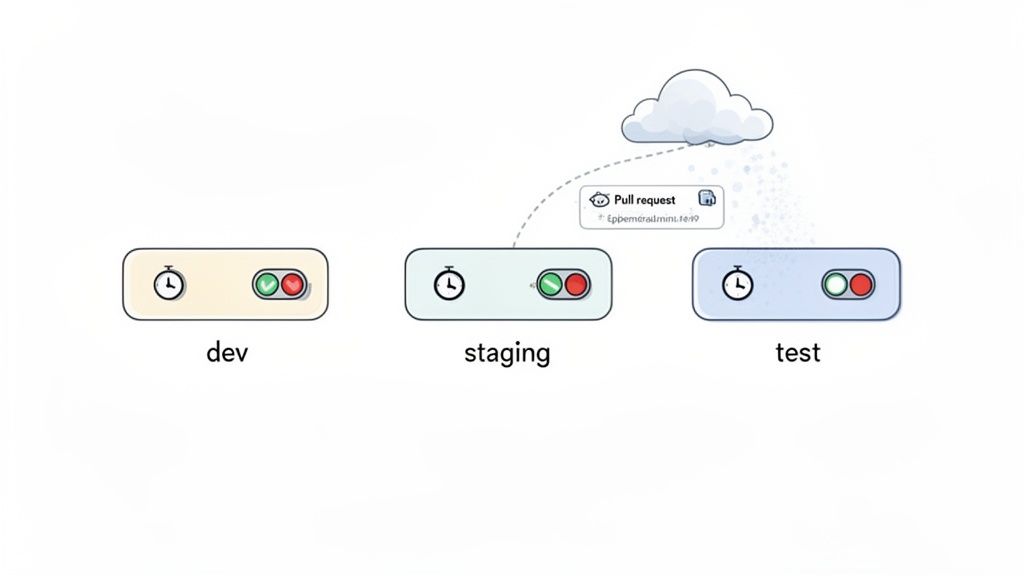
First, you have ephemeral preview environments. This is a modern approach where a complete, isolated environment is spun up automatically for every single pull request. A developer pushes new code, and a fully functional "preview" of the application is instantly ready for review. Once the PR is merged, the entire environment is automatically torn down. This model eliminates waste by ensuring resources only exist when they are actively needed.
Second, for those environments that do need to stick around, like a shared staging environment, the key is automated scheduling. By simply automating shutdown sequences to power down these environments outside of business hours—say, from 7 PM to 8 AM and all weekend—you can slash their costs by 70% or more. Instantly.
But building this automation yourself is a major engineering project. It means writing and maintaining custom scripts, managing cron jobs, and often wrestling with complex serverless functions just to orchestrate the startup and shutdown of dozens of interdependent services. It's yet another piece of the DIY DevOps puzzle that pulls your best engineers away from your actual product.
This is a perfect example of where a modern multi-cloud platform delivers immediate value. Capabilities like ephemeral environments and automated scheduling are built-in features, ready to go from day one with zero DevOps effort across AWS, GCP, and Azure. You can learn more about how this works in our guide to automated deployments for microservices. This isn't just a minor tweak; it’s a direct assault on a massive source of cloud waste.
The Real-World Impact of Environment Automation
The savings from this strategy are not just theoretical. Platform automation is helping startups eliminate the vast majority of idle resource costs. Companies that adopt built-in features like scheduled environment shutdowns consistently cut their non-production development costs by a staggering 70-80%. You can dig into more insights on how platform-based automation is reshaping budgets in the full cloud optimisation report.
For a startup, this is about more than just saving money. It's about reallocating that budget—and more importantly, your team's focus. By automating away the management and cost control of non-production environments, you free your developers to do what you hired them for: to ship great features, faster.
Building a Culture of Cost-Conscious Engineering
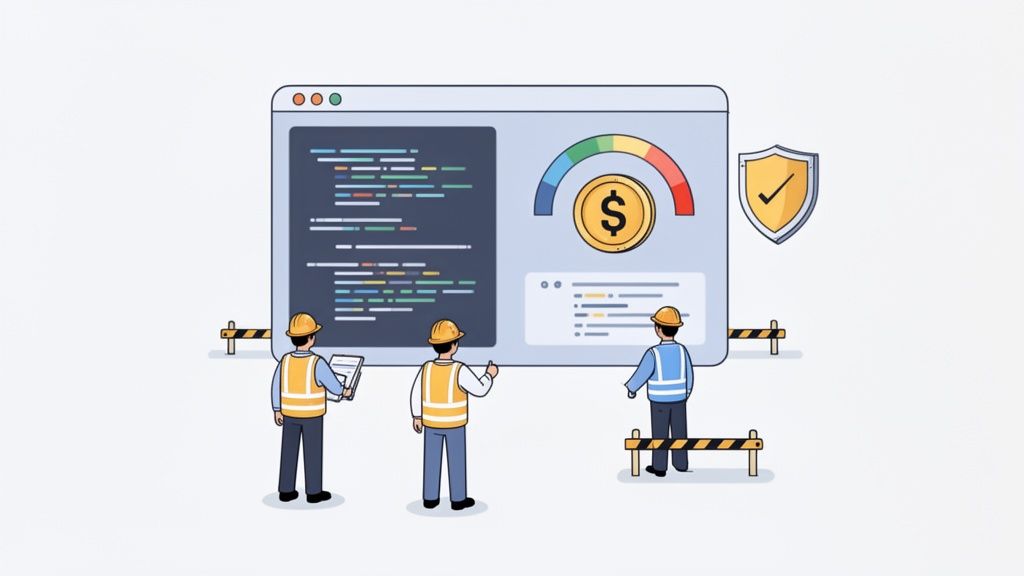
Tactical fixes like right-sizing and scheduling environment shutdowns offer quick wins, but they're just bandages on a deeper issue. Lasting cloud cost optimisation for startups isn’t a one-and-done project handed down from the CTO. It’s a cultural shift that needs to be woven into the daily habits of your engineering team.
This is all about moving from a reactive, top-down firefighting mode to a proactive, team-wide sense of responsibility.
For a long time, the unwritten rule in many startups has been to prioritise speed above all else. That "just spin up a bigger instance, we'll deal with it later" mindset is a familiar crutch for teams racing to beat the competition. This isn't laziness or malice; it’s the logical result of a system where developers have zero visibility into costs while they're actually building.
The real goal is to foster a genuine FinOps culture, where engineers feel ownership over the cost of the services they create and maintain. This doesn’t mean turning your developers into accountants. It means giving them the visibility and tools they need to make smarter, cost-aware decisions without slowing them down.
Shifting Cost Awareness Left
The most effective way to build this culture is to "shift cost awareness left." It's a concept borrowed from the worlds of DevOps and security, where testing and validation are pulled much earlier into the development lifecycle. Instead of waiting for a scary month-end cloud bill, you empower developers with cost insights before a single line of code is deployed.
Imagine a developer creates a pull request. Alongside the usual CI checks for tests and code quality, they see a clear estimate of the cost impact of their changes. It's a simple but incredibly powerful feedback loop. It directly connects their work to its financial footprint, turning an abstract budget number into a concrete metric they can actually influence.
But let's be realistic. Building this capability from scratch is another mammoth project for your already-stretched DevOps team. It means wrestling with billing APIs, creating complex cost estimation models, and then figuring out how to pipe that data back into your CI/CD pipelines. It’s a bespoke, high-maintenance system most startups can’t afford to build.
Governance Through Automated Guardrails
The other side of the coin is proactive governance. This isn't about creating bureaucratic approval gates that grind everything to a halt. It’s about using Infrastructure as Code (IaC) to set up smart, automated guardrails that prevent costly mistakes from ever happening.
These guardrails can enforce critical policies, such as:
- Preventing oversized instances: Block developers from provisioning ridiculously large or expensive machine types in dev or staging environments.
- Enforcing mandatory tagging: Automatically reject any new resource that's missing the essential tags for project and owner attribution.
- Restricting expensive services: Limit the use of certain high-cost services to specific projects or require an explicit approval flag.
Implementing these guardrails manually means writing and maintaining a web of complex policies for tools like Open Policy Agent (OPA) and plugging them into your IaC pipeline. It’s yet another piece of the DIY DevOps puzzle that pulls your best engineers away from building your product.
The Platform Approach to a FinOps Culture
This is precisely where a modern multi-cloud DevOps platform becomes a cultural catalyst. It doesn't just suggest a FinOps culture; it enforces it by design, embedding cost-conscious practices directly into the daily workflow without adding friction.
A platform-based approach makes this shift almost effortless by:
- Providing Pre-Deployment Cost Estimates: Developers see the potential cost impact of their changes right inside their workflow, making cost a first-class metric alongside performance and security.
- Embedding Cost Metrics: The platform dashboard gives teams a real-time view of the cost of each service and environment, making it simple to connect their work to its financial impact.
- Automating Governance: IaC guardrails are built-in, preventing common overspending mistakes without anyone needing to become a policy management expert.
By making cost visible, understandable, and actionable for every single developer, a platform reframes cloud cost optimisation for startups. It turns it from a reactive, dreaded chore into a proactive, shared responsibility. This gives your team the ownership they need to build not just great software, but efficient and sustainable software—all while freeing them from the burden of managing the underlying complexity.
Why a Platform Beats a DIY Approach for Startup Efficiency
The road to effective cloud cost optimisation for startups is paved with good intentions, but it often leads straight to a mountain of technical debt. We've walked through the common headaches in this guide: the manual slog of tagging, the tricky art of right-sizing, the dark magic of autoscaling, and the endless cash burn from idle environments.
Tackling any one of these is a major project. It pulls your sharpest engineers away from what they should be doing—building your product—and throws them into the deep, murky weeds of infrastructure management.
As a CTO or engineering leader, your job isn't to master the finer points of AWS billing or Kubernetes configs. Your job is to ship features customers want and drive the business forward. Building and maintaining a custom DevOps and FinOps stack works directly against that mission. It quietly creates a second, internal workload that eats your most precious resource: your engineering team's time and focus.
The True Cost of Building It Yourself
When you start to add up the hidden expenses of a home-grown internal developer platform, the numbers are genuinely startling. It’s not just about the salary for a dedicated DevOps engineer. It’s about the countless fragmented hours your entire team loses on tasks that deliver zero value to your actual customers.
- Continuous Maintenance: Those custom scripts you wrote for scheduling environments? They will break. Your CI/CD pipelines will demand constant attention. The cost-monitoring tools you hacked together will inevitably drift out of sync. This isn't a one-and-done build; it's a permanent tax on your operations.
- Expertise Bottlenecks: What happens when the one engineer who actually understands your complex deployment system decides to leave? Your whole R&D organisation can grind to a halt while everyone else tries to figure out what on earth they built.
- Opportunity Cost: Every single hour spent debugging a Terraform module or fighting with a flaky deployment is an hour not spent improving your product, fixing a critical bug for a user, or getting ahead of the competition.
The ultimate trap of the DIY approach is that it forces your startup to build a second product: a complex, internal DevOps platform. This is an expensive, distracting, and undifferentiated effort that pulls focus from the one product that actually matters—yours.
A Strategic Choice for Speed and Efficiency
For any CTO who sees the full scale of these challenges, the answer becomes pretty clear. Adopting a modern multi-cloud DevOps platform isn't about outsourcing a function; it's a strategic move to accelerate your business. It's about choosing to focus your engineering talent on creating value, not managing infrastructure.
A platform handles the setup, scaling, monitoring, security, and costs across AWS, GCP, and Azure right out of the box. It gives your team a reliable, production-ready foundation so they can get back to shipping features. Instead of burning months building a fragile system from the ground up, you get a mature, battle-tested solution on day one. To get a better sense of the core benefits, you might want to read our deep dive on what a DevOps cloud infrastructure platform actually is.
In the end, the choice is simple. You can keep pouring resources into building and maintaining an internal platform, accepting the hidden costs and distractions as a fact of life. Or, you can give your team a platform that does the operational heavy lifting, freeing them up to build, innovate, and win.
The challenges of a DIY DevOps stack are clear, but the path forward is even clearer. A modern platform gives your team a secure, scalable, and cost-optimised foundation on AWS, GCP, and Azure from day one. Stop managing infrastructure and start shipping features that matter. See how PushOps can accelerate your startup.

