
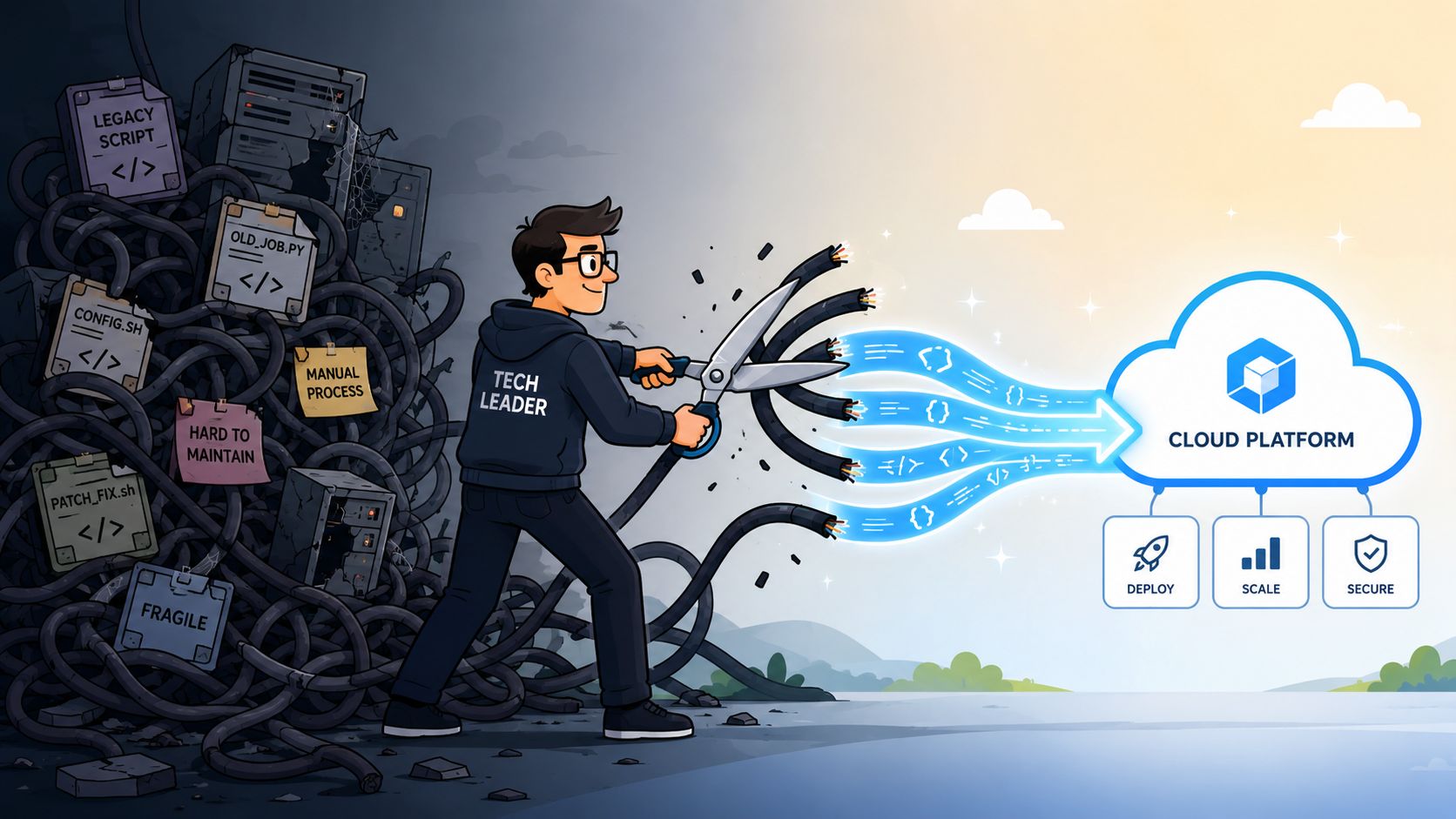

You hired strong engineers to build product. Instead, they're nursing a home-grown Kubernetes cluster, fixing brittle CI jobs, chasing noisy monitoring alerts, and debating why one environment on AWS behaves differently from another on Azure. The roadmap says customer-facing work. The sprint board says platform housekeeping.
That gap is where a lot of technical debt lives.
Most discussions about reducing technical debt stay close to the codebase. They focus on duplicated logic, rushed abstractions, and old tests. Those matter. But for startups and scale-ups, especially across Europe, Singapore, the UK, and the US, the bigger drag often sits below the application layer. It's the DIY DevOps stack that seemed sensible at ten engineers and starts fighting back at thirty.
Your Team Is Drowning in an Ocean of Your Own Making
A familiar pattern shows up in scaling teams. A few pragmatic choices turn into an accidental internal platform. First it's Kubernetes because it feels future-proof. Then a custom CI/CD setup because the defaults don't quite fit. Then separate tooling for secrets, logging, alerting, cost visibility, and security controls. Each choice is defensible on its own. Together, they create a system that demands constant attention.
The painful part is who ends up doing that work. Usually it isn't a dedicated platform group with clear ownership and long-term funding. It's your strongest back-end engineers and senior developers. They become part-time cluster operators, pipeline maintainers, and incident responders.
Bridge Global's technical debt insights are useful here because they frame debt as an accumulation of trade-offs, not just messy code. That's the right lens for infrastructure. A hand-rolled stack often begins as speed and ends as drag.
A lot of teams call this "platform investment". Sometimes it is. Often it's just overhead wearing strategic language.
Practical rule: If your engineers spend more time keeping delivery machinery alive than improving the product, your platform isn't giving you leverage. It's taking it away.
The hard question for a CTO isn't whether the stack is clever. It's whether it creates advantage. In many cases, the answer is no. You're spending scarce engineering time on plumbing that customers never chose you for. A simpler operating model usually starts by cutting DevOps overhead without growing the team.
The Real Cost of Technical Debt Hiding in Your DevOps Stack
Code debt gets attention because it is easy to see. Platform debt usually sits in the background until it starts dictating how the team works. It shows up in brittle deployment scripts, undocumented cluster settings, IAM exceptions no one wants to revisit, scattered dashboards, and release steps that only succeed because two senior engineers remember the order.
That kind of debt is expensive because it spreads through day-to-day operations. Technical debt consumes up to 40% of a business's entire IT budget on average, with organisations regularly losing 20% or more of their development time, according to Neveen Awad's analysis. In teams running a bespoke DevOps stack, a large share of that cost sits outside the application itself. It lands in pipelines, environments, permissions, patching, and support work that never makes the roadmap.
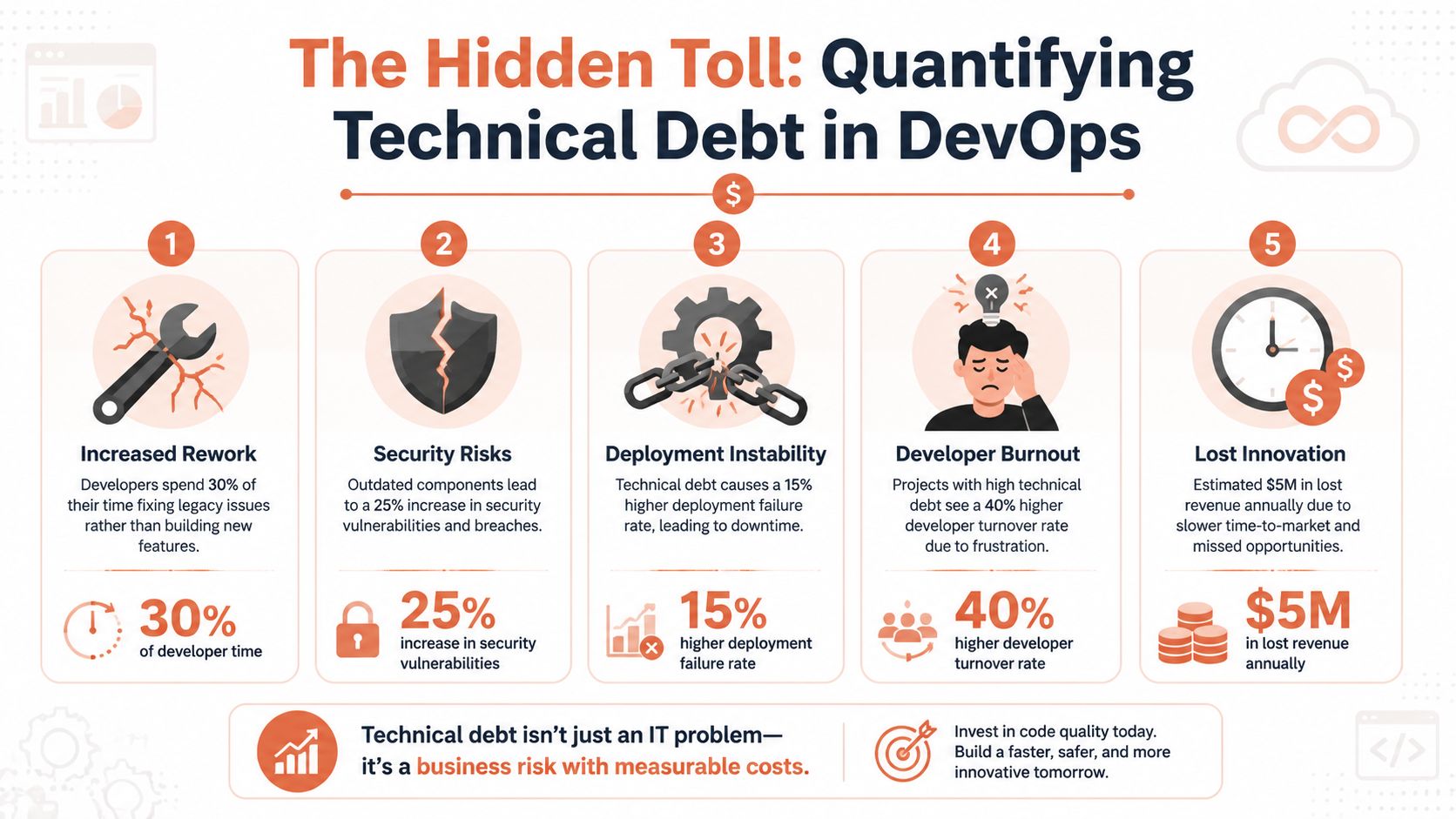
Where the cost shows up
Finance often sees cloud spend and payroll. It rarely sees the hidden tax created by a hand-built platform.
- Senior engineering time disappears into upkeep. Teams spend hours fixing runners, updating Helm charts, tuning deployments, rotating secrets, and cleaning up access policies instead of shipping customer-facing work.
- Cloud waste becomes normalised. Idle environments, oversized services, and weak autoscaling policies blend into the monthly bill unless someone owns cloud cost optimisation.
- Delivery slows at every handoff. Each extra integration between CI, secrets, observability, and infrastructure introduces another failure point, another approval path, and another place where release confidence drops.
- Security maintenance turns into a permanent side job. Self-managed components need patching, review, hardening, and policy checks. If no platform team owns that work, product engineers inherit it.
The result is predictable. Roadmaps slip, lead times stretch, and the team starts treating platform friction as normal operating reality.
Why platform debt hurts more than code debt
Code debt is often contained. It slows one service, one domain, or one team. Platform debt spreads across every team that ships software. A fragile pipeline delays every release. Inconsistent environments create recurring production issues. Weak observability slows every incident, because engineers spend the first hour establishing basic facts instead of fixing the problem.
DIY infrastructure makes this worse because the blast radius is larger than the original decision. A team might choose Kubernetes, custom CI workflows, self-managed observability, and hand-rolled access controls for sensible reasons at the time. Over time, each choice adds operational surface area. Someone has to handle upgrades, patching, ingress, secrets, scaling rules, policy enforcement, and incident recovery.
Kubernetes is a good example. It can be the right call for organisations with the scale, standardisation needs, and platform depth to run it well. For smaller companies, it often becomes infrastructure debt disguised as sophistication. As noted in this discussion of managed container trade-offs, managed options can remove a substantial part of that operational burden and lower total cost of ownership for teams without dedicated platform manpower.
The most expensive infrastructure is rarely the one with the highest monthly bill. It is the one that keeps pulling senior engineers off the roadmap to keep delivery working.
A useful way to frame this at leadership level is simple:
| Debt type | Typical blast radius | Common symptom |
|---|---|---|
| Code debt | Local to a service or module | Slower change in one area |
| Platform debt | Across teams and workflows | Slower delivery everywhere |
| Infrastructure debt | Across environments and operations | Incidents, spend creep, release instability |
If your stack needs constant specialist care, it is not a strategic asset by default. In many companies, it is accumulated platform debt. The better move is often to reduce custom infrastructure, automate the repeated platform work, and shift the team onto a platform model that gives engineering time back.
How to Identify and Measure What Truly Matters
A lot of technical debt programmes fail because teams measure what's easy, not what's decisive. They track code smells and stale dependencies, then miss the platform constraints turning normal work into slow work.
Start with application-level signals, but don't stop there.
Start with hotspots
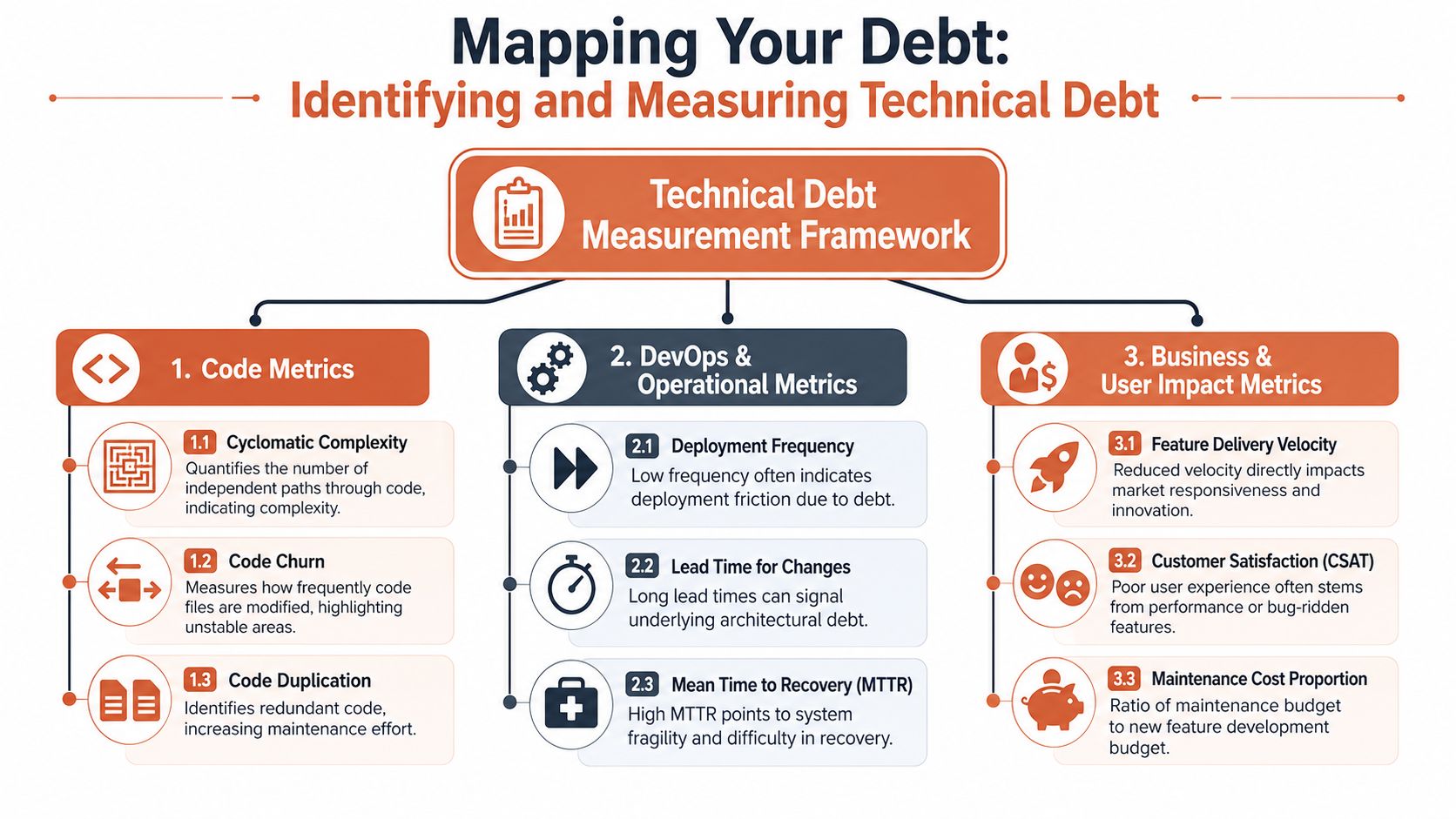
The practical first pass is architectural analysis and hotspot detection. The methodology outlined by vFunction's measurement guide focuses on three useful categories: Complexity, Risk, and Overall Debt, alongside continuous monitoring of code churn, test coverage, and cyclomatic complexity. That gives you a map of unstable areas.
It also ties debt measurement to delivery outcomes. Gartner, cited in the same piece, reports that companies that effectively measure and manage technical debt can achieve at least 50% faster service delivery times.
That's important because the metric isn't valuable on its own. It matters because it changes how quickly the business gets working software.
Then follow the friction into the platform
Once you know where code churn and complexity are high, ask what sits underneath:
- Lead time for changes. Is the delay in coding, or is it waiting for a pipeline, environment, approval, or manual check?
- Deployment frequency. Are teams releasing slowly because the product is risky, or because the release machinery is fragile?
- Mean time to recovery. When something fails, can the team see what's wrong quickly, or are they hopping between logs, dashboards, and cloud consoles?
- Change failure patterns. Do failed deployments cluster around specific services, or around common infrastructure steps?
Those questions often reveal that the code isn't the main bottleneck. The platform is.
Leadership lens: When every team reports different local problems but the same delivery friction, the shared platform is usually the common cause.
What to instrument first
Don't build a giant measurement programme. Add just enough visibility to expose drag.
- Track pipeline wait and execution time for each service.
- Record environment provisioning friction, including manual handoffs.
- Map incidents to platform components, not only to application services.
- Review repeated rollback causes. If several teams trip over the same release mechanism, that's shared debt.
- Connect maintenance effort to delivery impact. If a squad spends time stabilising infrastructure, note what product work moved out.
A lot of teams make this harder by building a second internal system just to observe the first one. That's more debt. If you're already dealing with unstable deployments, it's worth studying patterns that reduce deployment failures through tighter delivery workflows.
The key is to stop treating poor metrics as evidence of weak execution by developers. Long lead times often come from slow pipelines, manual approvals, inconsistent environments, and fragmented tooling. Those are infrastructure problems wearing software symptoms.
A Practical Framework for Prioritising Debt Repayment
Once you can see the debt, don't dump everything into one remediation backlog. That usually turns into a graveyard of worthy work with no decision logic. Prioritisation gets better when you separate rent from mortgage.
Rent versus mortgage
Rent is the debt you keep paying to keep things usable. It includes recurring fixes, pipeline clean-ups, flaky test stabilisation, documentation gaps, and routine patching. You can't ignore it. But if rent consumes all available attention, the team never changes the system that's generating the bill.
Mortgage is the deeper structural debt. This includes the bespoke internal platform, the self-managed Kubernetes estate no one really wants to own, the tangled CI/CD model, or the observability setup that requires constant manual interpretation.
The greatest impact usually sits in the mortgage category. That's where a replacement or major simplification can remove whole classes of future work.
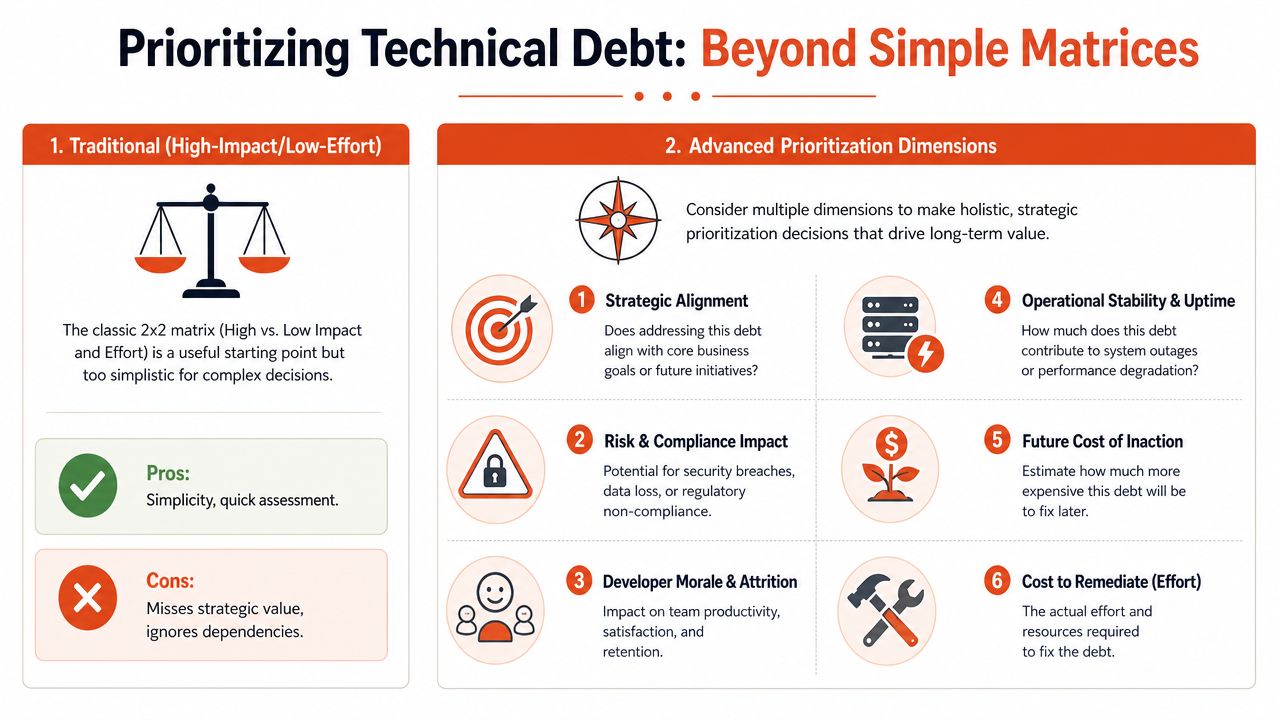
Questions that surface real priority
A simple matrix of effort and impact doesn't go far enough. Use these questions instead.
| Question | If the answer is yes | What it suggests |
|---|---|---|
| Does this slow every team, not one team? | Shared friction | Platform debt |
| Does it create repeat incidents or risky deploys? | Operational exposure | Prioritise sooner |
| Are engineers fixing symptoms again and again? | Root cause unresolved | Stop local patching |
| Would replacing this remove several toolchain tasks at once? | High leverage | Consider replacement |
| Is this tightly linked to compliance or security? | Business risk | Elevate to leadership |
Capacity discipline matters
The teams that make progress don't wait for a mythical quiet quarter. They reserve engineering capacity deliberately. Apriori's write-up notes that teams allocating approximately 20% of sprint capacity to debt repayment and including a quarterly hardening sprint can reduce innovation bottlenecks. The same source notes that ignoring debt can cause ROI to decline by 18% to 29%.
That doesn't mean every debt item deserves equal treatment. It means repayment has to be scheduled, visible, and protected.
If a debt item disappears whenever product pressure rises, it wasn't prioritised. It was merely acknowledged.
A strong practical pattern is this:
- Use routine capacity for rent. Keep services operable and remove recurring irritants.
- Use leadership attention for mortgage. Systemic platform debt needs explicit sponsorship.
- Replace before you refactor endlessly. If the same infrastructure problem keeps resurfacing, a cleaner operating model beats another tidy-up sprint.
Teams often overvalue the comfort of incremental fixes. But if the stack itself is the bottleneck, polishing its edges won't change the economics.
Role-Specific Actions for Taming Technical Debt
Reducing technical debt works when each role acts on the part it can control. The biggest failures usually come from misalignment. CTOs want speed, project managers optimise for roadmap certainty, and developers absorb the operational mess in silence. That arrangement keeps debt hidden.
For CTOs and VPs of Engineering
Treat platform debt as a strategic cost problem, not an engineering hygiene issue.
- Compare total cost of ownership, not headcount alone. Don't ask whether hiring another DevOps engineer is cheaper this quarter. Ask what ongoing ownership of Kubernetes, CI/CD maintenance, monitoring integration, access control, and cloud spend governance will require over time.
- Put debt into business language. Tie recurring platform work to delivery delays, release risk, and time your senior people can't spend on product.
- Set guardrails on platform sprawl. Every exception, custom script, and one-off deployment path adds future cost.
- Choose standardisation over cleverness. Multi-cloud support across AWS, GCP, and Azure can be valuable. Running three different patterns badly isn't.
A useful executive test is simple. If a platform decision requires deep institutional memory to operate safely, you've built a dependency on specific people rather than a stable capability.
For project and delivery leaders
Your job isn't to protect feature throughput at any price. It's to protect sustainable throughput.
- Keep debt in the main backlog. Hidden debt gets deferred indefinitely.
- Use a distinct issue type for platform debt. That makes it reviewable and reportable.
- Plan capacity openly. Don't let technical work compete through side conversations.
- Escalate repeated operational work. If the same category returns sprint after sprint, the system needs redesign, not better ticket hygiene.
For senior developers and platform-minded engineers
You don't need to win an abstract purity argument. You need to reduce repeat work.
- Challenge hand-built infrastructure patterns when managed or standard options remove toil.
- Push for self-service workflows so teams can provision, deploy, and inspect without waiting on a specialist.
- Prefer opinionated defaults for build, release, and security controls. Flexibility is useful. Unlimited variation is costly.
- Document where the platform hurts delivery. Concrete examples change leadership decisions faster than general frustration.
The goal across all three roles is the same. Stop rewarding heroics that keep a brittle platform alive, and start rewarding decisions that remove operational burden altogether.
Strategic Refactoring and When to Replace Instead
Refactoring has its place. Cleanup of modules, test suites, service boundaries, and deployment scripts can all be worthwhile. But many teams use refactoring as a comfort activity when they should be considering replacement.
That matters most in infrastructure.
Incremental cleanup versus structural simplification
Consider two common paths.
The first team keeps its existing internal platform. It refines Terraform modules, tidies pipeline YAML, tunes Kubernetes resources, and improves observability dashboards. This can help. But the team still owns upgrades, patching, cluster operations, toolchain integration, release strategy mechanics, and environment consistency. The debt becomes better organised, not smaller.
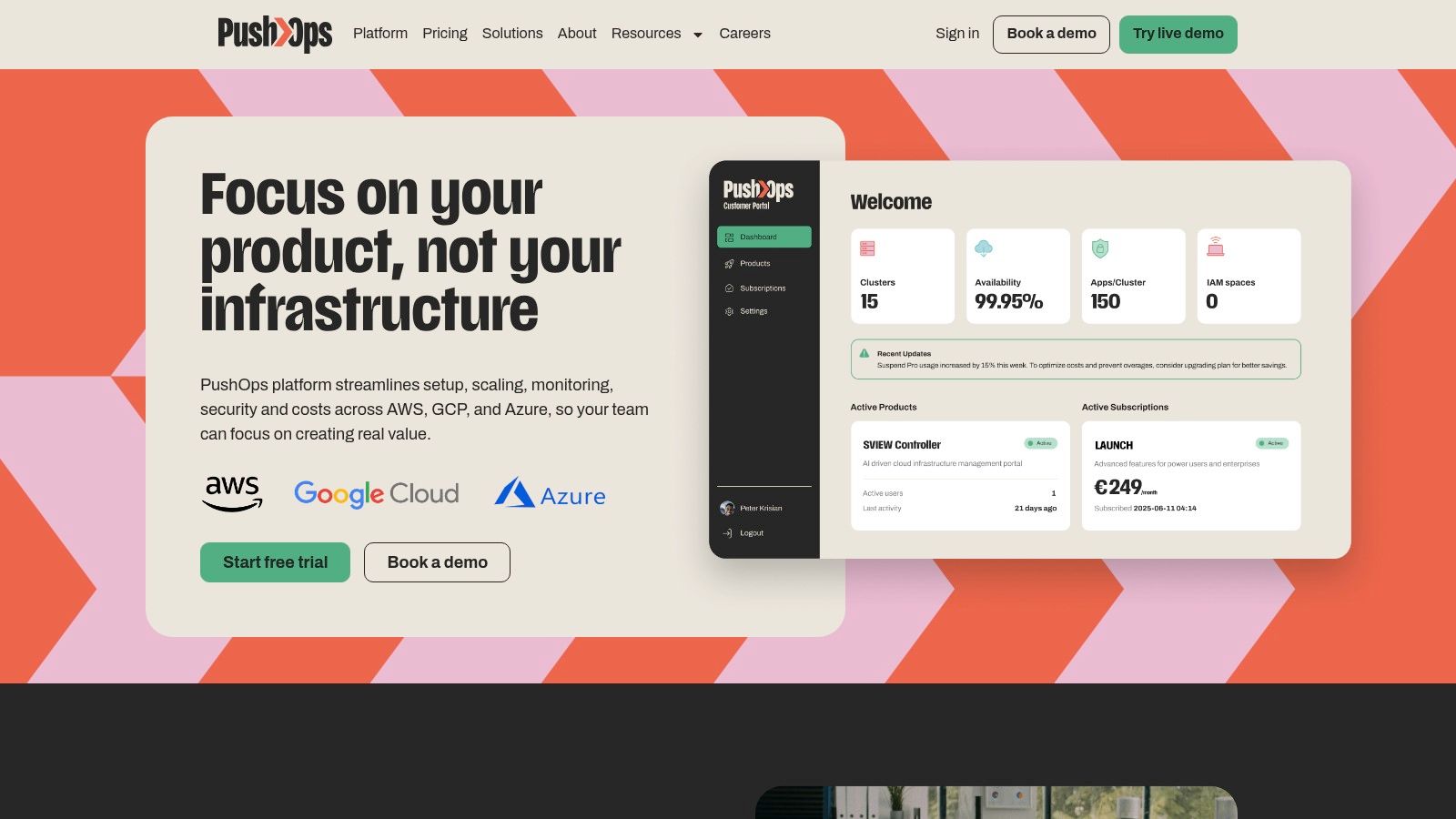
The second team decides the internal platform isn't a core advantage. It standardises on a production-ready operating model with built-in deployment workflows, integrated observability, security defaults, and cost controls across AWS, GCP, and Azure. Instead of improving every custom component, it removes the need to own many of them.
That is often the highest-value refactor available.
The replacement threshold
How do you know it's time to replace rather than optimise?
Replace when the effort to operate the platform keeps returning, even after competent cleanup.
A few signals usually show up together:
- Every improvement creates another maintenance obligation.
- The team needs specialists to perform routine changes safely.
- Deployments depend on tribal knowledge.
- Observability is assembled, not cohesive.
- Security and permissions require repeated manual review.
- Cloud costs fluctuate because optimisation is ad hoc, not built in.
In those conditions, a platform-based approach isn't a shortcut. It's a strategic simplification.
Deloitte's analysis found that infrastructure modernisation alone can reduce technical debt by 18% over a five-year period. That's why infrastructure choices deserve the same attention leaders usually reserve for application architecture.
Refactor code where it matters, replace infrastructure where it drags everyone
This isn't an argument against engineering craft. It's an argument for applying craft where it produces differentiated value.
If your product depends on specialised domain logic, invest there. If your business depends on unique workflow, modelling, analytics, or customer experience, build there. But if you're spending expensive engineering effort reproducing capabilities that modern platforms already handle well, you're funding debt creation.
For teams dealing with older environments and brittle foundations, this guide on how to solve legacy system problems is a useful companion read because it pushes the conversation beyond patching and into modernisation choices.
The trade-off is straightforward. You can spend months making your internal platform slightly less painful, or you can remove large categories of pain by adopting a standardised, managed approach. For most startups and scale-ups, especially those trying to move fast without building a large platform organisation, replacement wins.
Building a Debt-Resistant Engineering Culture
Monday starts with a failed deploy. One team patched the pipeline last week, another changed a Terraform module without updating the runbook, and now senior engineers are stuck in Slack reconstructing how the platform is supposed to work. That is technical debt in its most expensive form. It sits below the application layer, drains delivery time, and turns your DevOps stack into a side business you never meant to run.
A debt-resistant culture starts by refusing to celebrate DIY infrastructure heroics. Teams need fewer one-off fixes and more shared standards. Standard pipeline patterns, standard observability, standard security controls, standard recovery paths. Every exception adds cognitive load and another maintenance obligation for someone to carry later.
Automation matters for the same reason. Manual steps do not stay manual in one safe corner. They spread across environments, release processes, and incident response until basic delivery depends on tribal knowledge. Self-service matters too, but only when it sits on top of clear guardrails. Giving developers fast access to deploy, inspect, and recover is useful. Making every product team assemble its own delivery platform is how infrastructure debt grows.
Culture shows up in staffing choices. If strong engineers spend their week nursing Kubernetes upgrades, fixing CI runners, cleaning up cloud tagging, and reconciling drift across clouds, the organisation is using product talent to maintain commodity plumbing. A platform approach changes that equation. It reduces variation, makes the safe path the easy path, and cuts off whole categories of repeat debt before they hit the backlog.
The same discipline applies beyond platform work. AI Academy's piece on how sound software engineering principles can improve AI project outcomes makes the point well. Better delivery comes from repeatable engineering systems, clear constraints, and less operational improvisation.
Leaders set the tone here. Fund standards. Remove incentives for bespoke tooling. Measure teams on delivery quality and recovery time, not on how creatively they can keep fragile infrastructure alive. The healthiest engineering cultures treat internal platforms as products with owners, defaults, and lifecycle decisions. For many startups and scale-ups, the smartest move is simpler still. Stop building so much of that platform yourself.
If your team is spending too much time on Kubernetes upkeep, CI/CD maintenance, cloud cost clean-up, and cross-cloud operational drift, it's worth looking at PushOps. It gives software teams a production-ready platform across AWS, GCP, and Azure, with deployments, environments, observability, security controls, and cost optimisation built in, so engineers can get back to shipping features instead of maintaining the machinery around them.

