


Your team didn't join to babysit Kubernetes.
Yet that's what happens in a lot of scale-ups. A backend engineer gets pulled off roadmap work because a deployment wedged itself halfway through. A senior developer spends the morning tracing an alert across Prometheus, Grafana, cloud logs, and a CI runner nobody wants to own. Your engineering managers call it “platform work”. Your CFO experiences it as delayed releases, extra hiring pressure, and infrastructure spend that keeps drifting upward.
That's why reliability engineering matters. Not because it sounds mature. Because without it, your product team turns into an operations support desk.
The mistake most companies make is assuming reliability engineering means hiring more DevOps engineers, assembling a bigger SRE function, and stitching together a custom internal platform from open-source parts. For a tiny minority, that makes sense. For most scale-ups, it's a trap. You end up investing heavily in undifferentiated infrastructure while your competitors keep shipping.
Introduction Why Are Your Best Engineers Still Fixing Infrastructure
The pattern is predictable. You move fast, win customers, and outgrow the simple setup that got you through the first stage. So you add Kubernetes, tighten deployment controls, bolt on monitoring, improve secrets handling, and create a release process with more checks.
Soon you've got a maze.
The issue isn't that these tools are bad. Kubernetes, Jenkins, Grafana, Prometheus, cloud IAM, container registries, and policy tooling can all be useful. The issue is that assembling them into a reliable operating model is a full discipline in its own right. If your product engineers are carrying that burden, they're not building product.
That's where reliability engineering earns its keep. It gives you a framework for running systems that behave predictably under pressure. It pushes teams to measure failure risk, understand how services break, and reduce downtime before customers feel it. It's a professional response to chaos, not a collection of heroics.
Reliability isn't the absence of incidents. It's the presence of systems, controls, and habits that stop one bad day becoming a recurring pattern.
A lot of leaders respond by trying to hire their way out. Sometimes that's necessary. If you're defining roles or benchmarking what good operational ownership looks like, these specialized SRE staffing solutions are a useful reference for responsibilities and expectations. But staffing alone doesn't fix the underlying economics.
The real cost of infrastructure firefighting
When your strongest engineers handle reliability reactively, three things happen:
- Product delivery slips: Roadmap work loses to incident response, pipeline repair, and environment drift.
- Standards fragment: Each team invents its own deployment conventions, dashboards, and rollback habits.
- Burnout rises: The same capable people become the unofficial safety net for every production issue.
That's expensive because reliability work is essential, but bespoke platform building usually isn't your edge. Your customers don't buy from you because your alert routing is custom-built. They buy because your product solves a problem.
What Reliability Engineering Really Means for Your Business
At a business level, reliability engineering is simple. It's the discipline of keeping promises to users.
That discipline has deep roots. Reliability engineering was formally shaped in the post-World War II era, with a major milestone in the 1950s when aerospace and defence teams used statistics to quantify and manage failure risk in complex systems, moving beyond inspection toward prediction, as outlined by NY Engineers on the role of statistics in engineering.
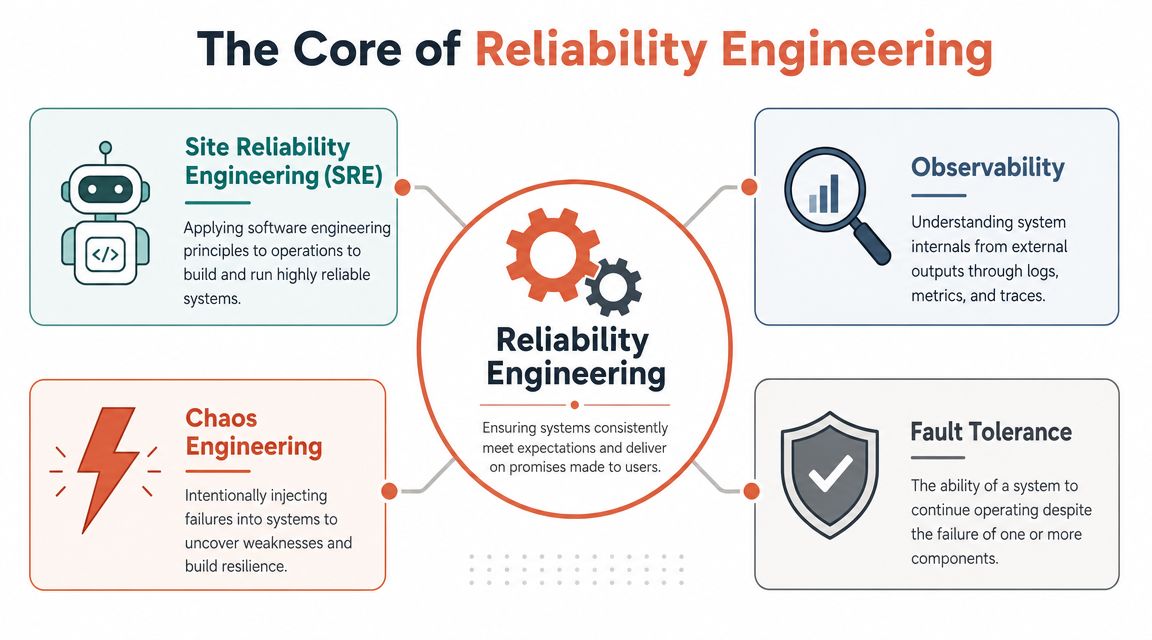
That history matters because it cuts through modern jargon. Reliability engineering isn't mystical. It's measured. You decide what acceptable service looks like, observe actual behaviour, and close the gap.
Think in promises, not tools
Most CTOs hear terms like SRE, SLI, SLO, and SLA so often that they stop being useful. Strip them back.
Use a delivery business as the analogy:
| Term | Plain meaning | Business interpretation |
|---|---|---|
| SLI | What you measure | Did the package arrive on time |
| SLO | Your internal target | We aim to deliver on time consistently |
| SLA | Your external commitment | If we fail badly enough, the customer gets compensation |
| SRE | How you operationalise it | Engineers build systems and automation that keep the promise |
If you run a SaaS product, your SLIs might include successful request handling, latency, or deployment health. Your SLO is the target your teams use to judge whether the service is operating acceptably. Your SLA is the contractual line you may put in front of customers.
Why this matters to a scale-up
Without these distinctions, every reliability discussion becomes emotional. One team says stability is poor. Another says things are mostly fine. Leadership hears opinions instead of evidence.
With a reliability model, the conversation changes:
- Engineering gets clarity: Teams know what they're aiming for.
- Product gets trade-offs: Leaders can decide when to push change and when to slow down.
- Customers get consistency: Commitments become operational, not aspirational.
Practical rule: If your teams can't state the service promise in one sentence and show the metric behind it, you don't have a reliability strategy. You have a collection of hopes.
SRE sits inside this model as the execution arm. It applies software engineering discipline to operations. That means more automation, more standardisation, better guardrails, and fewer manual interventions. Not because automation is fashionable, but because manual reliability doesn't scale.
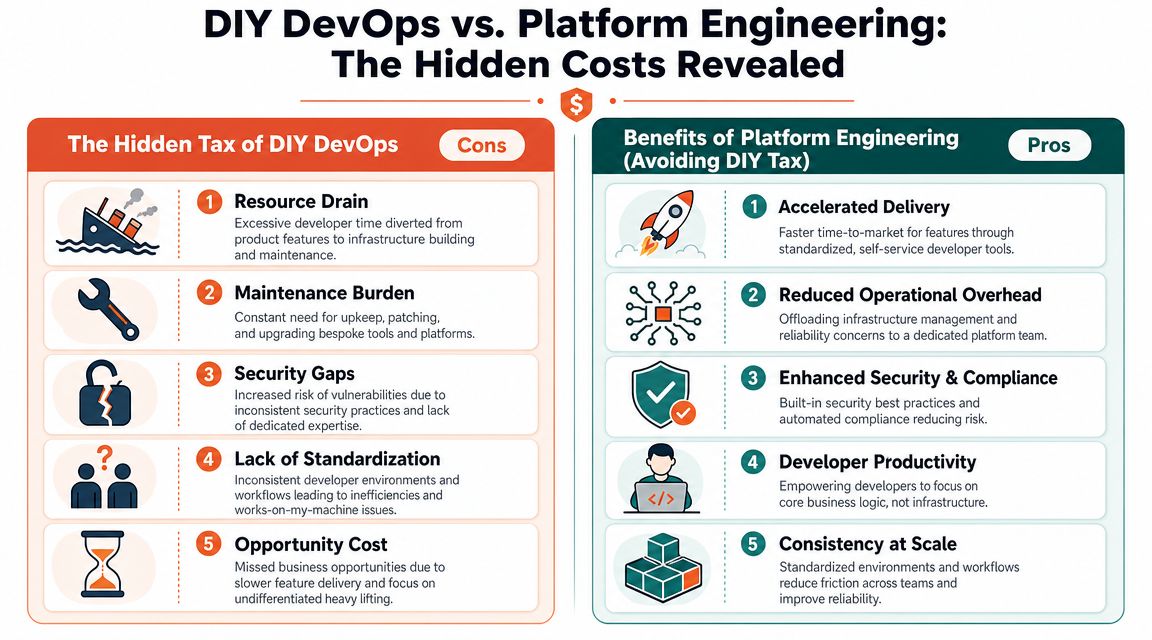
The Hidden Tax of a DIY DevOps Platform
Most internal platforms begin as a reasonable decision.
You need repeatable deployments. You want standard observability. You don't trust developers to configure IAM, networking, release controls, and rollback logic from scratch. So you start building a platform team. Then the platform team starts building a product.
That's when the tax shows up.
Open source isn't free in practice
The line item for Kubernetes might be zero. The line item for Prometheus might be zero. The line item for Jenkins might be zero.
Your actual bill isn't zero. It arrives as salaries, on-call burden, integration work, upgrades, migration projects, security patching, broken plugins, and hand-maintained documentation that drifts out of date the moment someone changes a workflow.
A DIY stack usually creates these problems:
- Toolchain sprawl: Every component has its own lifecycle, configuration model, and failure mode.
- Operational glue code: Your team writes scripts and wrappers that nobody wants to maintain but everybody depends on.
- Uneven developer experience: One service deploys cleanly. Another needs tribal knowledge and a Slack message to the right person.
- Security inconsistency: Policies exist, but enforcement is fragmented across clouds, CI, registries, and runtime environments.
Complexity compounds faster than headcount
Leaders often underestimate how much platform complexity expands with growth. More teams means more services, more environments, more exceptions, and more pressure for self-service. Every exception weakens the platform. Every workaround becomes precedent.
If you're looking at how teams reduce that operational drag through standardised workflows and self-service environments, the material on developer platform automation is worth reviewing.
Here's the expensive truth. Once you commit to a DIY platform, you inherit a permanent maintenance obligation. You don't just build the thing once. You become the vendor, support team, integrator, security owner, and roadmap manager for your own internal product.
Ask the uncomfortable question
A good CTO should force this discussion early:
| Question | If the answer is yes |
|---|---|
| Are product engineers maintaining delivery pipelines? | You're leaking focus |
| Are environment standards inconsistent across teams? | You're scaling chaos |
| Are upgrades and security fixes lagging because nobody owns them end to end? | Your platform is underfunded |
| Are you hiring infra specialists before validating whether the stack should exist at all? | You may be building the wrong asset |
Building a platform in-house only makes sense if platform engineering is one of your strategic capabilities. For most scale-ups, it isn't.
The hard part isn't provisioning infrastructure. The hard part is making that infrastructure safe, repeatable, observable, cost-aware, and easy for developers to use without creating fresh failure modes every quarter.
Essential Reliability Patterns and Practices
Reliability engineering becomes real when it shows up in operating habits. Not slogans. Not architecture diagrams. Habits.
The common failure in growing teams is trying to implement these patterns one tool at a time. That creates fragmented ownership. The better approach is standardisation from the start.
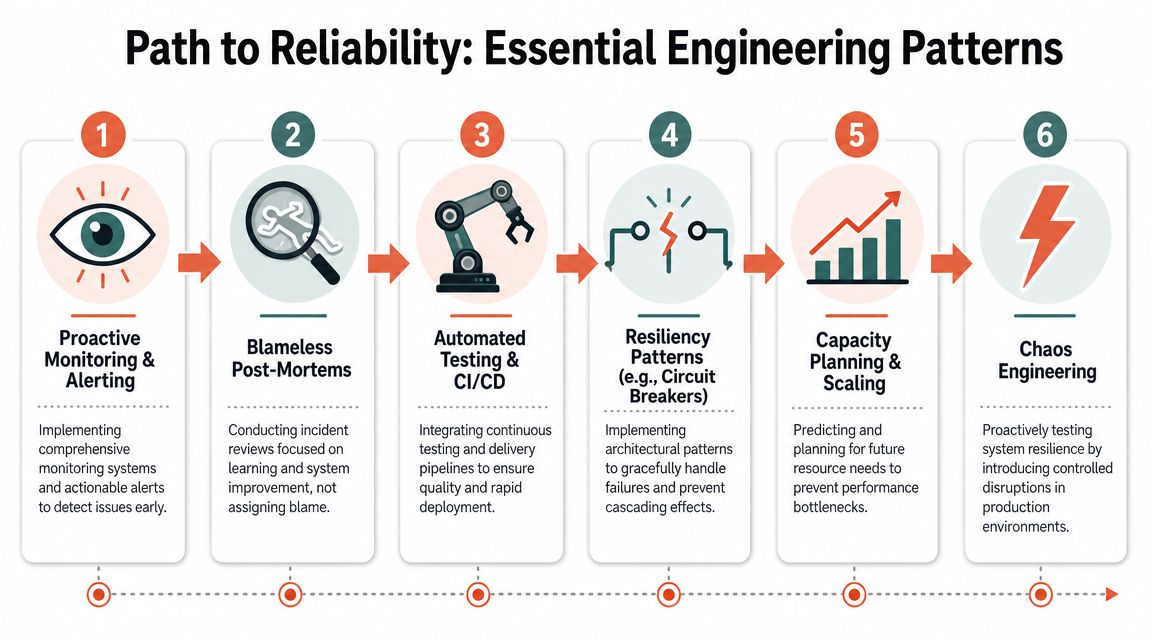
A core technical challenge in reliability engineering is quantifying failure mechanisms well enough to redesign systems before downtime becomes recurring pain. Standard methods such as FMEA and fault tree analysis depend on comprehensive field data collection, which is why integrated observability is essential, as described in Wikipedia's overview of reliability engineering.
Observability that operators can trust
DIY observability often looks comprehensive on paper and messy in practice. Logs live in one place, metrics in another, traces somewhere else, and the dashboards only make sense if the engineer who built them is still employed.
A reliable setup needs one thing above all. Correlation.
When an alert fires, the on-call engineer should be able to move quickly from symptom to likely cause. That means tying incidents to deploys, infrastructure changes, service dependencies, and workload behaviour. If your team is still stitching that context together manually, your observability stack is underpowered.
- Logs need context: Raw lines without deployment and service metadata waste time.
- Metrics need intent: Dashboards should support decisions, not look impressive in reviews.
- Traces need adoption: Partial tracing is often worse than none because it creates false confidence.
Deployment safety must be boring
If every service needs a custom release script, your deployment model is fragile. Safe releases should be a standard product capability inside your engineering system.
Compare the two approaches:
| Pattern | DIY approach | Better operating model |
|---|---|---|
| Canary releases | Hand-built traffic splitting and manual watchfulness | Standard rollout policy with automated rollback |
| Blue-green deploys | Service-specific scripts and edge-case handling | Repeatable release option across services |
| Pre-deploy checks | Ad hoc validation in CI | Consistent policy gates before release |
| Post-deploy verification | Manual dashboard checks | Automatic health validation tied to rollback logic |
If deployment reliability is a recurring headache, this guide on how to reduce deployment failures is a sensible operational reference.
The best release process is the one your average team can use safely without asking the platform team for favours.
Incident response needs systems, not heroes
Many companies still run incidents through a mix of chat channels, loose runbooks, and institutional memory. That doesn't scale. During an outage, people need crisp ownership, known escalation paths, and enough automation to reduce guesswork.
Strong incident response usually includes:
- Actionable alerts: Alerts should point to a customer-impacting condition, not generic noise.
- Clear runbooks: The first response steps must be obvious, current, and easy to follow.
- Change visibility: Teams need immediate awareness of recent deploys and config changes.
- Blameless review: Post-incident analysis should improve the system, not punish individuals.
Controlled failure is part of reliability
Chaos testing still scares some teams because they associate it with recklessness. That's backwards. Controlled failure injection is a disciplined way to discover brittle assumptions before customers do.
Start small. Kill a non-critical instance. Simulate dependency slowness. Test whether scaling, retries, and fallbacks work as intended. If your environment can't support that safely, your reliability posture is weaker than your dashboards suggest.
Autoscaling belongs in the same category. It isn't just a cost tool. It's a reliability control. But if every service has bespoke scaling logic, you've created another surface area for silent failure.
Key Reliability Metrics That Drive Business Value
Most engineering dashboards are overcrowded. They track everything because nobody wants to choose. That creates noise, not control.
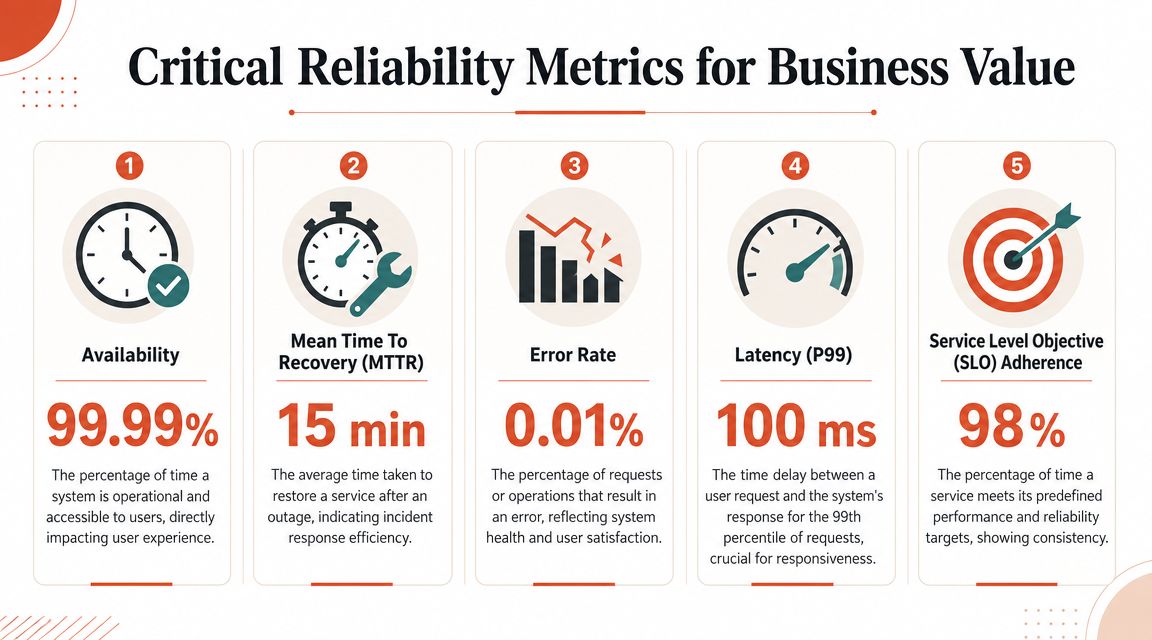
Reliable organisations focus on a small set of metrics that influence customer trust and operating discipline. Expert practice in reliability engineering is to optimise for availability using quantitative metrics such as MTTR and failure rate, with the aim of showing that the system operates at an acceptable level of risk, using mitigations like redundancy and predictive maintenance where appropriate, as explained by Limble's reliability assessment guide.
The metrics that matter most
For a scale-up, I'd keep the executive reliability view tight:
- Availability: Are customers able to use the service when they need it.
- MTTR: When failure happens, how quickly do you restore service.
- Failure rate: How often are services or components failing in meaningful ways.
- Latency: Is the system responsive enough to feel dependable.
- Change failure rate: Are your releases a source of instability or a controlled process.
How to read them properly
Availability is the external promise. Customers experience this directly. If it degrades, support volume climbs and confidence drops.
MTTR is the internal maturity signal. You won't eliminate every incident. You can absolutely reduce the time your team spends confused, searching for context, or coordinating manually. If you want a more practical operational framing of recovery expectations, this article on CTO Input on Recovery Time Objective is useful.
Failure rate helps you spot chronic weakness. A service that “usually comes back” may still be unacceptable if it fails often enough to create recurring operational drag.
Latency matters because users interpret slowness as unreliability, even when the service is technically up.
Change failure rate is the uncomfortable but necessary metric for modern teams. If your deployment process introduces incidents regularly, you don't have a scaling problem. You have a delivery problem.
Board-level translation: Reliability metrics aren't vanity dashboards. They're evidence of whether engineering can ship change without damaging customer trust.
Keep the metric model simple
A useful rule is to pair each metric with an action:
| Metric | Leadership question |
|---|---|
| Availability | Did customers feel disruption |
| MTTR | How fast did we recover |
| Failure rate | What keeps breaking |
| Latency | Is the experience acceptable under load |
| Change failure rate | Are releases safe enough to sustain speed |
If your teams need a quarterly project to collect these numbers, your operating model is already too manual.
How PushOps Operationalises Your Reliability Strategy
A reliability strategy fails when it lives in slides, team rituals, and a handful of overworked specialists. It works when the controls are baked into the daily path from commit to production.
That's where a platform approach changes the economics.
A modern cloud platform should remove repetitive infrastructure work from product teams while keeping the core reliability disciplines intact. Provisioning shouldn't require bespoke Terraform surgery for every new environment. Release controls shouldn't depend on one engineer who understands the current pipeline layout. Observability shouldn't be an integration project every time a team launches a service.
What execution should look like
A practical platform model does a few things by default:
- Standardises environments: Teams get production-ready foundations across AWS, GCP, and Azure without reinventing setup each time.
- Automates delivery workflows: Builds, deployments, and release strategies become repeatable instead of service-specific craft projects.
- Integrates operational visibility: Health signals, incident context, and performance data sit close to the deployment path.
- Applies security guardrails: Access control, permissions, auditability, and policy enforcement aren't optional extras.
- Reduces cloud waste: Scaling and environment usage become easier to control without asking developers to become FinOps analysts.
That's the underlying logic behind a managed platform model. You stop treating reliability as a side quest for senior engineers and start treating it as an embedded system capability.
Why this matters more in multi-cloud teams
Multi-cloud sounds strategic until your teams have to live inside it. Differences in networking, IAM, service behaviour, and deployment patterns create drift fast. Standardisation becomes harder. So does troubleshooting.
A platform that abstracts the repetitive infrastructure layer without hiding critical operational detail is usually the right compromise. If you want a concrete view of that operating model, PushOps has a clear explainer on its DevOps cloud infrastructure platform.
Good platform engineering doesn't remove control from developers. It removes repetitive risk.
The strongest argument for a managed platform isn't convenience. It's focus. Your engineers should still own service quality, code paths, and customer-facing performance. They just shouldn't spend their time rebuilding the same deployment plumbing, observability wiring, and policy scaffolding that every other scale-up is also struggling to maintain.
Conclusion Stop Building the Platform and Start Using It
Most scale-ups don't need a bigger homemade reliability stack. They need fewer moving parts, better defaults, and an operating model that doesn't consume their best engineers.
That's the strategic shift. Reliability engineering matters, but building every layer of the reliability system yourself usually doesn't. As organisations adopt more ephemeral environments and AI-generated code, traditional metrics like MTBF may become insufficient, and operational complexity becomes the harder problem to manage. In that context, more redundancy can sometimes reduce reliability rather than improve it, as discussed by ReliabilityWeb's introduction to reliability engineering.
If you're leading a fast-growing team, stop asking whether you can assemble the stack in-house. Of course you can. Ask whether that's the best use of scarce engineering talent.
Your advantage is in the product. Not in maintaining CI runners, tuning autoscaling rules by hand, or debugging another brittle release workflow. Reliability engineering should protect product velocity. It shouldn't become a parallel business you accidentally build inside your company.
If your team is spending too much time on infrastructure and not enough on shipping, it's worth looking at PushOps. It gives software teams a production-ready path across AWS, GCP, and Azure with integrated deployments, observability, security guardrails, and cost controls, so engineers can focus on building the product instead of maintaining the platform.

