
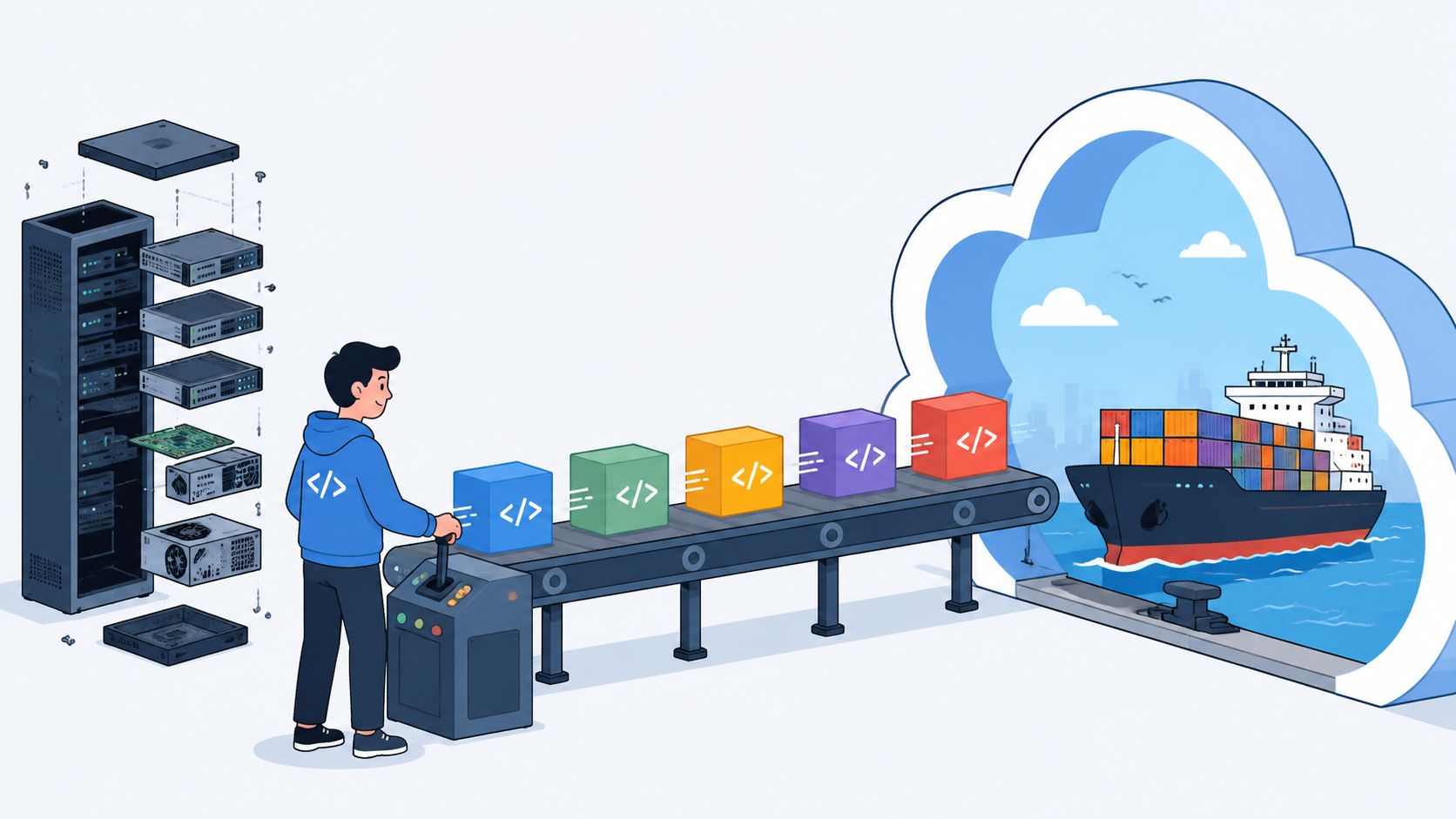

Your team didn't hire senior engineers so they could spend their week untangling Terraform drift, rebuilding CI jobs, chasing noisy alerts, and arguing about whether Kubernetes needs another layer of abstraction. Yet that's where many startups and scale-ups end up. The product roadmap slows down, infrastructure work expands to fill every sprint, and the promised advantage from cloud tooling starts to look like another internal platform project.
That frustration is one reason serverless architecture keeps attracting CTOs and VP Engineering leaders. On paper, it offers exactly what busy product teams want. Less server maintenance, less capacity planning, faster releases, and a cost model tied more closely to actual usage. But adopting serverless doesn't remove operations. It changes where operations live, who carries the burden, and how visible the costs are.
For teams across Europe, Singapore, the UK, and the US, that distinction matters. If your goal is to ship features faster across AWS, GCP, and Azure, the winning move usually isn't building more infrastructure yourself. It's choosing an operating model that gives developers a production-ready platform without forcing them to become part-time cloud systems engineers.
The Promise of Serverless vs The DevOps Reality
The appeal of serverless is easy to understand. Your engineers want to write business logic, not babysit clusters. Your product leaders want releases to move without a long pre-flight checklist of environment issues, deployment scripting, and cost reviews. Your finance team wants cloud spend that doesn't balloon because a staging environment stayed oversized all month.
The cost of staying stuck in manual operations is already visible. Developers waste 40% of their time on manual deployment tasks and infrastructure maintenance, costing companies $1 trillion annually in lost productivity globally. The same source notes that this inefficiency is particularly sharp in European startups, where teams over-provision cloud resources and end up doubling or tripling monthly costs during quieter periods, according to Ellty's analysis of DevOps inefficiency.
What leadership usually sees
From the CTO seat, the pattern is familiar:
- Senior talent gets diverted: Strong backend engineers spend time on CI/CD scripts, IAM policy debugging, and monitoring setup instead of customer-facing work.
- Platform work keeps expanding: A simple goal like "make deployments reliable" turns into Kubernetes management, secret rotation, release orchestration, tracing, cost governance, and security enforcement.
- Delivery becomes uneven: Teams can ship quickly when everything is stable, then lose days when one brittle part of the toolchain breaks.
Serverless sounds like the escape hatch because it promises a narrower responsibility boundary. Let the provider run the infrastructure. Let engineering focus on the application.
Practical rule: If a platform decision doesn't give product teams more uninterrupted time to ship, it's not simplification. It's cost moved to another line item.
Why the reality feels different
The trap is assuming serverless eliminates DevOps work. It doesn't. It replaces server management with distributed operational work. Instead of patching virtual machines, teams now manage function packaging, event flows, permissions, release sequencing, observability gaps, and cloud-specific service behaviour.
That's why many teams that move to serverless still feel operationally overloaded. They stop running some infrastructure directly, but they start stitching together more managed services, more event-driven components, and more tooling to make the whole system visible and governable. The promise is real. The operating model is where most organisations get surprised.
What Serverless Architecture Really Means
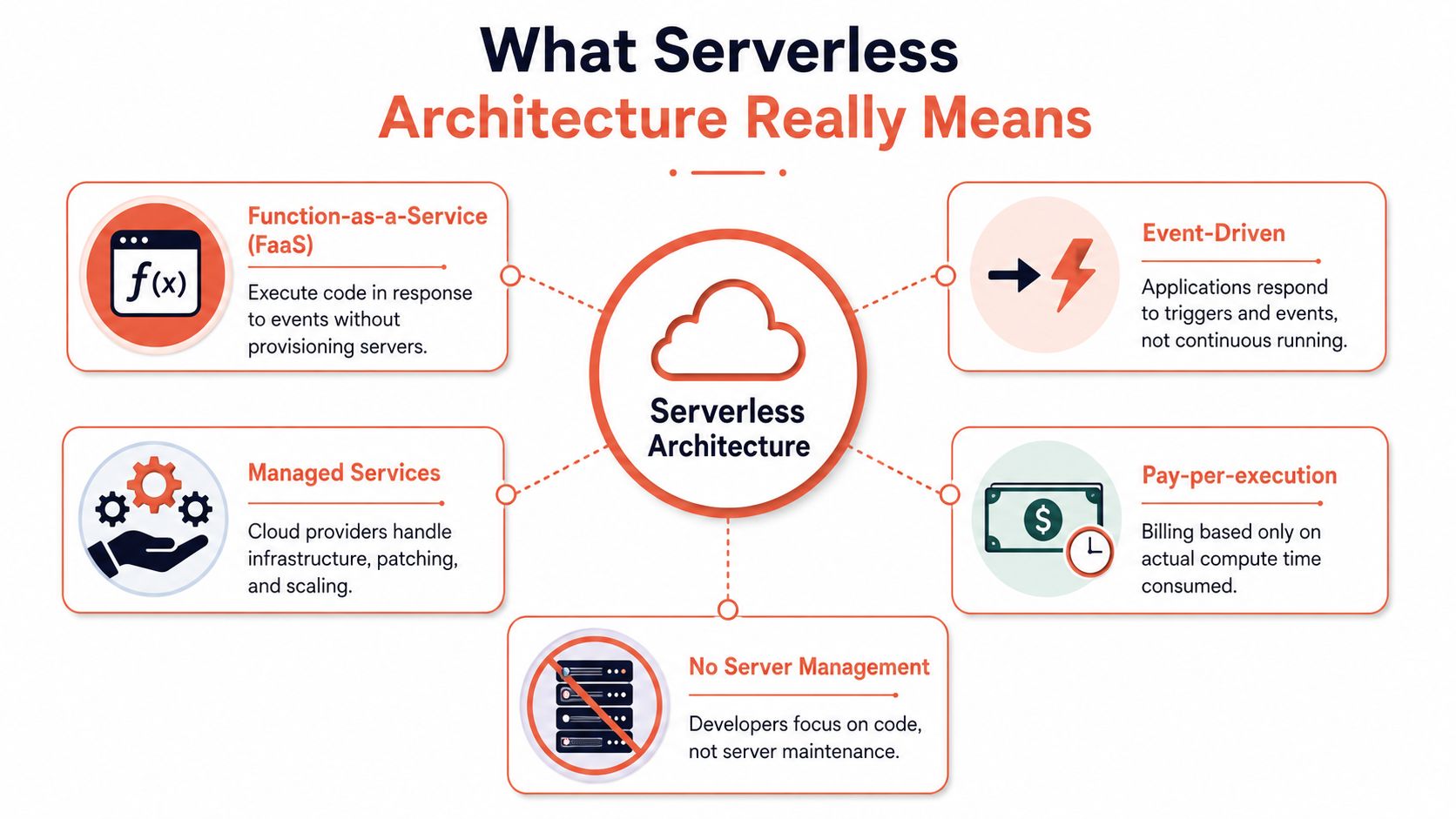
The phrase gets oversimplified. Serverless architecture doesn't mean servers disappeared. It means your team no longer provisions and manages the underlying server estate directly. The cloud provider runs that layer, while your team ships functions, event handlers, APIs, storage integrations, and workflow logic.
A practical way to explain it is this. Running traditional infrastructure is like building and operating your own commercial kitchen. You pay for the space, the equipment, the maintenance, and the staff whether dinner service is busy or quiet. Serverless is closer to ordering from a premium delivery service. You pay for the meal when you place the order, not for the kitchen sitting idle all day.
The core mechanics
At the centre of most serverless platforms is Function-as-a-Service (FaaS). This is the model used by AWS Lambda, Google Cloud Functions, and Azure Functions. Functions stay idle until an event triggers them, then the provider runs the code and tears the runtime down when the work is done.
According to New Relic's explanation of serverless architecture, serverless delivers a pay-as-you-go cost model that eliminates charges for idle capacity, charging only for the computing time and memory consumed during execution. The same source notes that it can scale from zero to thousands of instances within seconds in response to specific events.
What shifts from your team to the provider
A serverless platform usually takes over several jobs your team would otherwise handle:
| Responsibility | Traditional setup | Serverless setup |
|---|---|---|
| Compute provisioning | Your team sizes and manages it | Provider provisions it on demand |
| Scaling | Engineers configure and tune it | Provider scales automatically |
| Patching | Internal responsibility | Provider handles the runtime layer |
| Idle capacity cost | You pay for reserved resources | You pay when functions execute |
That shift matters because it changes both engineering workflow and budgeting. Teams don't spend the same time planning baseline capacity, and they don't get billed the same way for quiet periods.
Where serverless fits best
Some workloads fit the model immediately:
- Event-triggered processing: File uploads, webhook handlers, notifications, and background jobs.
- Burst-heavy APIs: Workloads with uneven demand that would be expensive to size conservatively on always-on infrastructure.
- Short-lived tasks: Work that's naturally discrete rather than long-running.
Serverless works best when the workload is intermittent, event-driven, or hard to predict in volume.
For leadership teams, the key point isn't the branding. It's the operating shift. You aren't buying "no servers". You're buying a different allocation of responsibility, one that can speed delivery if the surrounding deployment, monitoring, and governance model is mature enough.
Common Serverless Patterns and Use Cases
The fastest way to judge serverless architecture is to look at the work it handles well. Not every system belongs there, but several patterns are a strong match for startups and scale-ups trying to reduce infrastructure drag.
APIs and mobile backends
A young product team launches a new feature, usage spikes after a campaign, then traffic settles down. In a conventional setup, someone still has to think about baseline server size, autoscaling rules, ingress, patching, and how deployment risk affects peak periods. With a serverless API layer, the provider handles scaling at the function level, which is useful when demand is bursty and hard to forecast.
This pattern works especially well for:
- Customer-facing APIs: Lightweight endpoints for web and mobile applications.
- Internal service endpoints: Back-office operations, admin tools, and integration hooks.
- Webhook processors: Systems that wait for external events rather than serving constant traffic.
When these APIs are part of a broader microservices estate, release automation matters as much as the function code itself. Teams that need a cleaner service rollout model often benefit from approaches like automated deployments for microservices, because independently deployable functions still need dependable promotion, rollback, and environment handling.
Real-time event processing
Serverless shines when systems react to incoming events instead of running continuously. Think product analytics pipelines, IoT telemetry ingestion, payment notifications, or workflow triggers from third-party SaaS tools. A function wakes up when the event arrives, processes it, then disappears.
Statista's overview of serverless highlights that serverless architecture is event-driven, with functions responding to triggers or activity in event queues. The same source points to use cases such as building APIs, processing real-time event streams, and running trigger-based workflows.
A practical example is a SaaS product that emits usage events every time a user completes a workflow. Those events can trigger enrichment, storage, notifications, and analytics updates independently. That keeps the customer-facing application responsive while backend jobs run on demand.
Scheduled and infrequent backend work
Some tasks don't need permanent infrastructure at all. Report generation, nightly clean-up jobs, periodic syncs, and compliance checks often sit idle most of the day if they run on dedicated servers. In a serverless model, they execute only when scheduled.
This tends to be a strong fit where the work is predictable but infrequent:
- Generate a finance export.
- archive logs or rotate derived data.
- sync partner records from an external system.
The business value is simple. You stop paying for a continuously available environment whose main purpose is to wait.
Not every team should force every workload into these patterns. But if your application already contains event handlers, background jobs, scheduled tasks, or unpredictable API demand, those are often the first places where serverless architecture earns its keep.
The Unspoken Trade-offs of Going Serverless
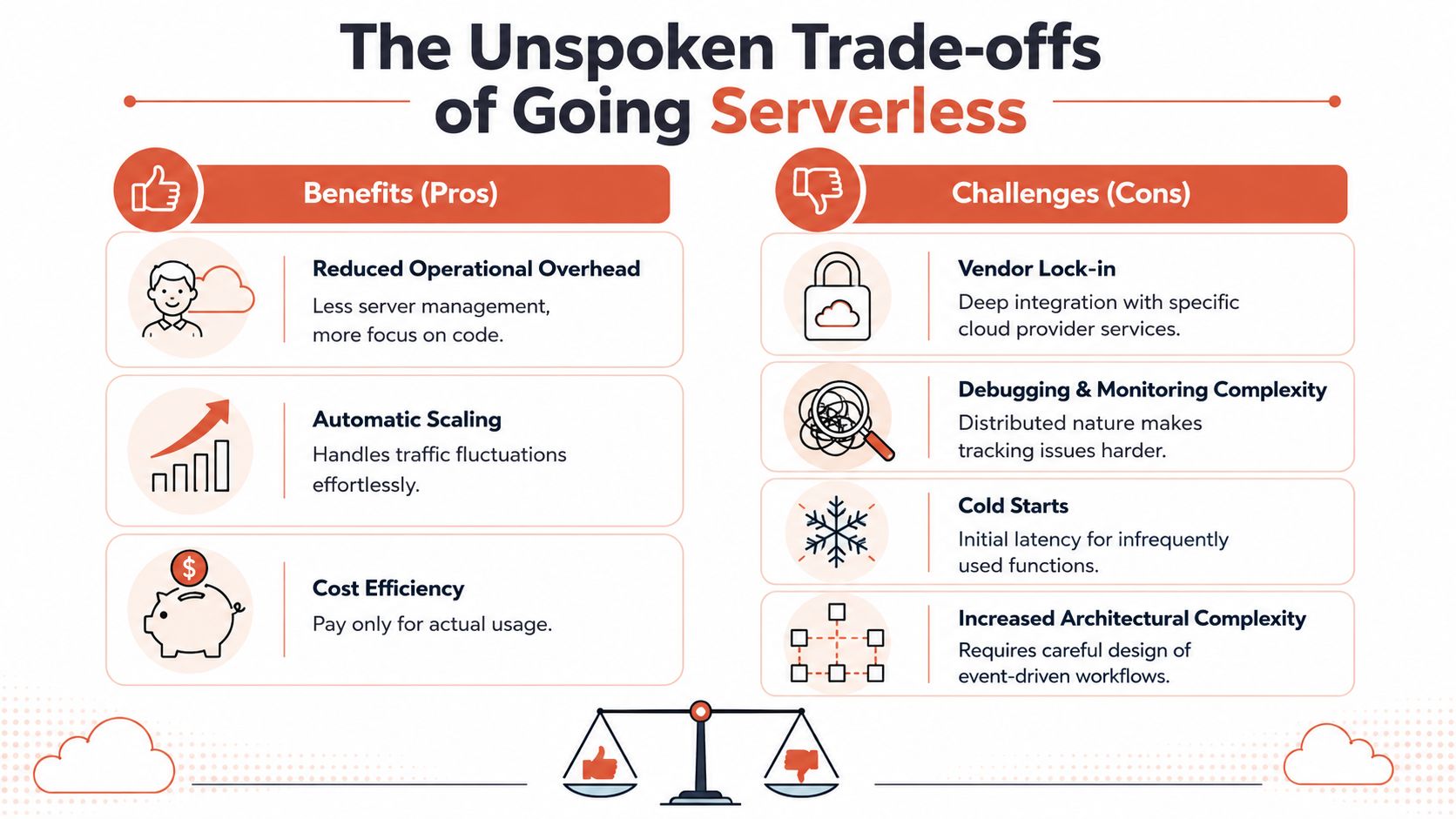
The problem with most serverless advocacy is that it treats infrastructure removal as complexity removal. That's not how it works in production. Serverless architecture reduces some categories of toil, but it also creates a more distributed system with more moving parts, more event boundaries, and more failure modes that are harder to trace.
Complexity moves up the stack
In a traditional service, one team might debug a single runtime process and a supporting database. In a serverless system, the same business transaction can cross an API gateway, multiple functions, a queue, a workflow engine, and one or more managed data services. Each hop adds another place where retries, duplication, timing issues, and permission failures can appear.
The Architect Elevator's critique of serverless is useful because it avoids the marketing version. It argues that serverless forces fine-grained, distributed, and concurrent design patterns that increase runtime complexity and demand deep expertise in concurrency and failure handling. It also shifts burden from infrastructure management to application architecture design and release coordination.
The trade-offs that matter most
A CTO doesn't need a generic pros-and-cons list. The important question is which downsides have operational consequences.
- Debugging gets harder: Short-lived functions don't behave like long-running services. Reproducing failures and tracing a request path across events takes more discipline and better tooling.
- Cold starts affect user experience: Infrequently used functions can introduce startup latency at exactly the wrong moment.
- Vendor lock-in becomes real: The more you integrate with provider-specific queues, triggers, databases, identity, and workflow services, the harder it is to move without rewiring the application.
Teams that struggle with serverless usually don't fail because functions are hard to write. They fail because distributed systems are hard to operate.
Release coordination doesn't disappear
One common misconception is that smaller deployable units always mean simpler delivery. Sometimes they do. But they also create more release surfaces. A single feature might require coordinated changes to an event schema, a producer, several consumers, permissions, and monitoring rules.
Here's a compact view of the shift:
| What gets easier | What gets harder |
|---|---|
| Capacity planning | End-to-end debugging |
| Idle cost management | Cross-service tracing |
| Server maintenance | Event and schema coordination |
| Baseline scaling setup | Provider-specific architecture decisions |
This is why serverless architecture should be treated as an operating model decision, not just a compute choice. If leadership adopts it for speed, the surrounding delivery and governance model has to support that speed. Otherwise the team trades visible infrastructure toil for hidden architectural friction.
The Operational Nightmare of DIY Serverless DevOps
The hardest part of serverless isn't writing functions. It's building the operational system around them without recreating a full platform engineering burden inside your company.
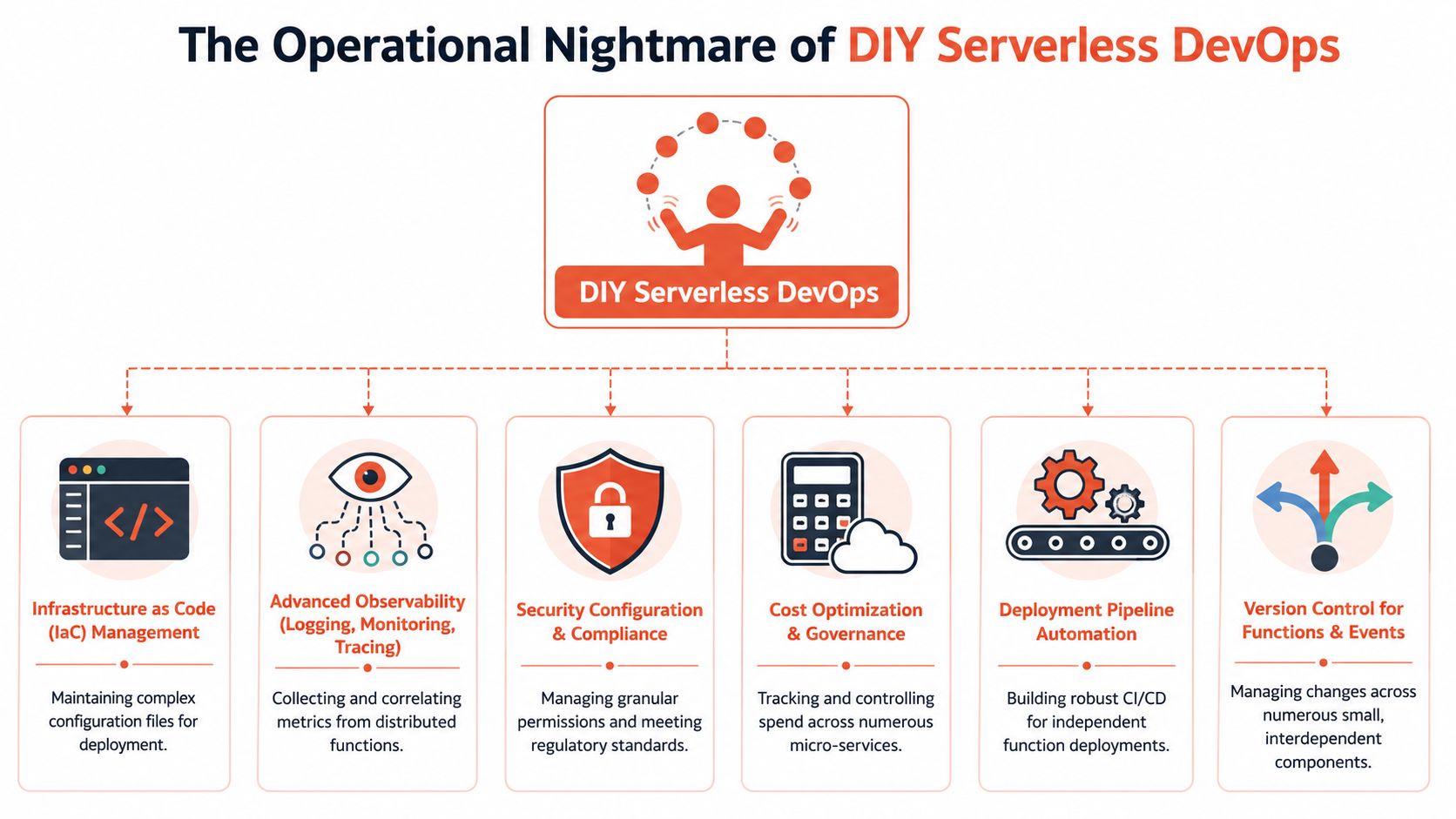
A DIY serverless stack usually starts innocently. The team chooses AWS Lambda or Azure Functions, adds GitHub Actions or GitLab CI, wires in Terraform, picks a logging tool, bolts on alerts, chooses a secrets manager, adds policy checks, and promises to standardise it later. A few quarters on, "later" has become a fragile pile of scripts, custom conventions, half-documented IAM patterns, and a release process only two engineers fully understand.
Observability is where the hidden bill arrives
This is the part many serverless guides skip. In distributed function estates, logs, traces, metrics, and event correlation don't organise themselves. You need to collect them consistently, retain them sensibly, search them quickly, and connect them across services during an incident.
A widely underserved reality is that serverless observability can consume 20–30% of total cloud spend in large-scale deployments, especially once tracing, log aggregation, and debugging workflows expand across many functions and services. That hidden bill is one reason some teams feel disappointed after moving to a supposedly leaner operating model.
Operator's view: Pay-per-execution sounds efficient until every execution also emits logs, traces, metrics, alerts, dashboards, and retention costs that nobody priced into the initial design.
DIY multiplies across every operational concern
The trouble isn't one tool. It's the dependency chain between them.
- Infrastructure as Code drift: Terraform and cloud-native templates are manageable at small scale, then turn brittle when multiple teams update shared modules without strong platform conventions.
- CI/CD fragmentation: Every function can become its own pipeline problem. Packaging, secrets injection, approval flow, rollback, and promotion rules sprawl quickly.
- Security overhead: Fine-grained permissions are good practice, but they create constant work in multi-team estates where functions, queues, storage, and identity boundaries keep changing.
- Cloud cost governance: Serverless may reduce idle compute waste, but spend still spreads across functions, data transfer, logs, managed databases, API gateways, and event services.
Teams trying to clean this up often look for patterns from practitioners who have dealt with deployment sprawl in anger. One useful example is Webtwizz's founder deployment strategies, which grounds deployment pipeline thinking in practical trade-offs rather than tooling theatre.
Multi-cloud makes the gap wider
Many scale-ups don't live on one cloud forever. Acquisitions, customer requirements, regional constraints, and product history often leave teams operating across AWS, GCP, and Azure. That changes the challenge completely. You no longer just need serverless expertise. You need consistent deployment workflows, observability standards, security controls, and cost views across different provider models.
Internal platform efforts often emerge. The intent is reasonable. Create common workflows, abstract provider quirks, and give developers self-service paths. But building that in-house is a major product in its own right. Teams exploring this route usually end up confronting the same issues covered in developer platform automation approaches: standardisation, governance, release ergonomics, and support ownership.
The core mistake
The strategic mistake is thinking serverless frees you from platform work when, for most organisations, it instead increases the need for platform discipline. If you do it yourself, you're still building a platform. It just happens through scattered scripts, cloud-specific patterns, and operational glue instead of one explicit project plan.
That's why so many teams end up in an awkward middle state. They aren't maintaining servers in the old sense, but they are absolutely maintaining an operating system for delivery. And because it's DIY, it's often harder to see, harder to budget, and harder to hand over safely.
A Smarter Path to Serverless Implementation
Once the hidden work becomes visible, the decision gets clearer. This isn't really a question of whether serverless architecture is good or bad. It's a build versus buy decision about the operational layer around it.
Two paths with very different consequences
The first path is the familiar one. Hire more DevOps or platform engineers. Standardise templates. Build internal abstractions. Maintain pipelines, environments, policy enforcement, dashboards, cost controls, and cross-cloud conventions yourself. This can work for large organisations with strong platform maturity and the appetite to treat internal tooling as a product.
The second path is to adopt a managed DevOps platform that already handles the repetitive platform work. That means production-ready setup, CI/CD, observability, security guardrails, and spend controls are available from the start instead of assembled over time.
A simple comparison makes the trade-off easier to judge:
| Decision factor | DIY internal platform | Managed DevOps platform |
|---|---|---|
| Time to standardise | Slower | Faster |
| Operational ownership | Internal team carries it | Shared with platform provider |
| Multi-cloud consistency | Must be built | Usually built in |
| Tool sprawl | Often grows over time | Consolidated by design |
Cost is more than headcount
A lot of leaders still compare options only through salary versus subscription. That's too narrow. The full cost of DIY shows up in delayed releases, recurring incidents, and senior engineers trapped in tooling work.
According to Fullstack Techies' review of DevOps as a service pricing, most startups spend between $3,000 and $7,000 per month for a managed DevOps retainer, and that model is financially superior to DIY setups when you account for slower releases, repeat outages, and engineers pulled away from product delivery.
What good implementation looks like
A smarter implementation path usually includes these characteristics:
- Self-service by default: Developers can deploy without opening a long chain of infrastructure tickets.
- Pipelines that don't need babysitting: Teams shouldn't spend their week maintaining release machinery. Resources like zero-maintenance CI/CD pipelines are useful because they show what modern release workflows should feel like.
- Cross-cloud discipline: AWS, GCP, and Azure all differ. Your platform layer should hide routine differences without hiding critical control.
- Built-in operational guardrails: Monitoring, auditability, permissions, and cost visibility need to exist before the first incident, not after it.
For teams building AI-heavy or agent-driven workloads alongside serverless systems, even a concise operational reference like the AgentStack quickstart is a reminder that developer velocity improves when platform conventions are already in place.
The strategic point is straightforward. Most startups and scale-ups should not be building an internal DevOps product unless that capability is itself a competitive advantage. In nearly every other case, the better move is to give engineering a mature platform and keep product talent focused on shipping.
From Infrastructure Burden to Innovation Engine
Serverless architecture is valuable for one reason. It can improve the ratio between time spent on customer value and time spent on infrastructure work. That's the whole point. Not fashion, not architecture purity, not cloud theatre.
But the model only delivers on that promise when the surrounding operational burden is handled properly. If your team adopts serverless and then spends the next year building observability stacks, deployment workflows, security controls, governance rules, and cross-cloud abstractions, you've changed the shape of the work without reducing it.
The better outcome is simpler. Use serverless where it fits. Avoid forcing every workload into it. And make sure the platform around it is already organised enough to support reliable delivery, security, monitoring, and cost control. That's how serverless stops being a source of hidden complexity and starts providing real advantage.
Engineering teams are most effective when they can treat infrastructure as a dependable product, not an endless side project. When that happens, release speed improves, operational noise drops, and senior developers get back to building the features customers notice.
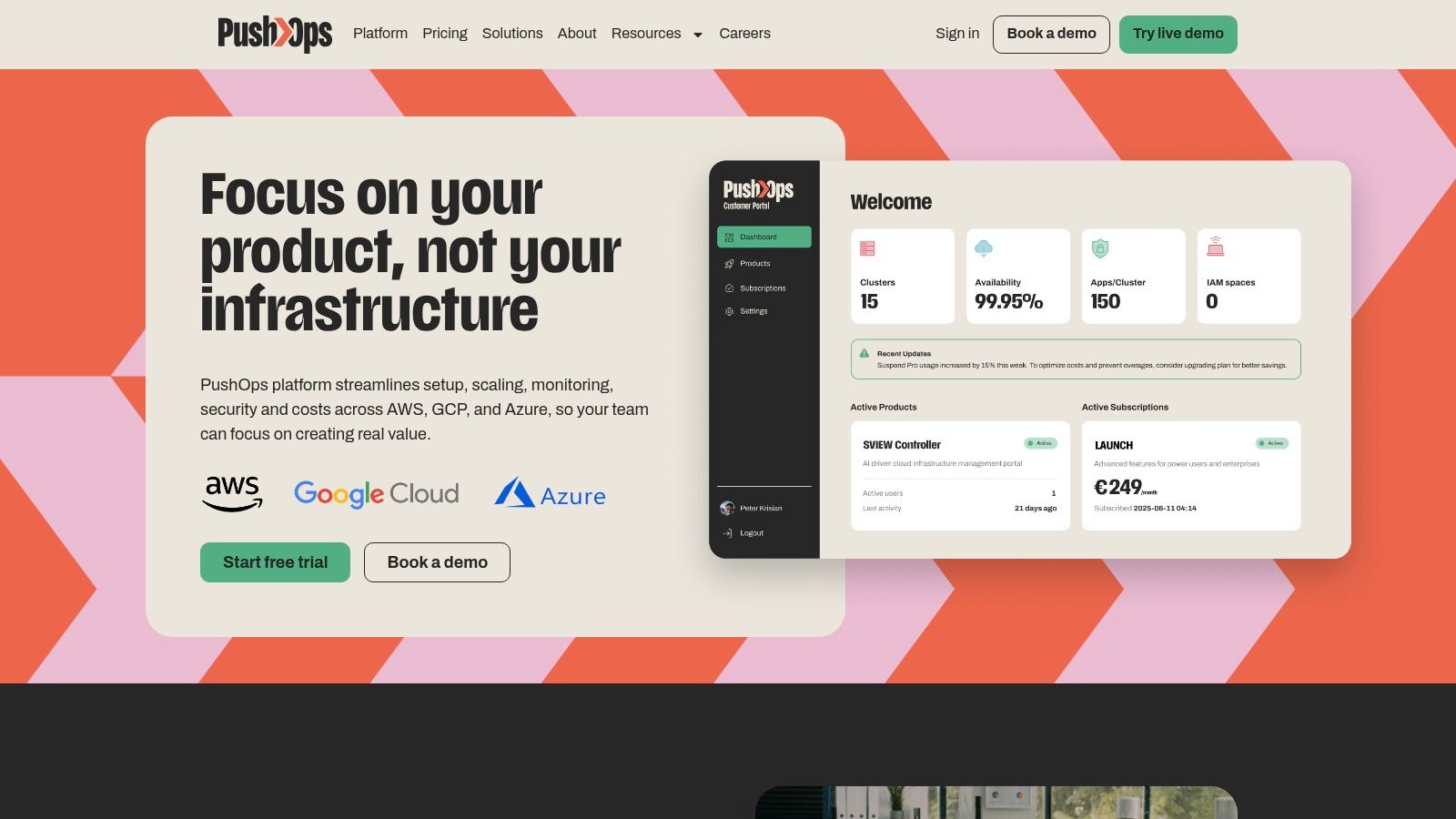
If you're trying to get the benefits of serverless without building an internal platform team around it, PushOps is worth a look. It gives software teams a production-ready path across AWS, GCP, and Azure with built-in deployments, observability, security, and cost controls, so engineers can spend more time shipping product and less time maintaining the machinery behind it.

