
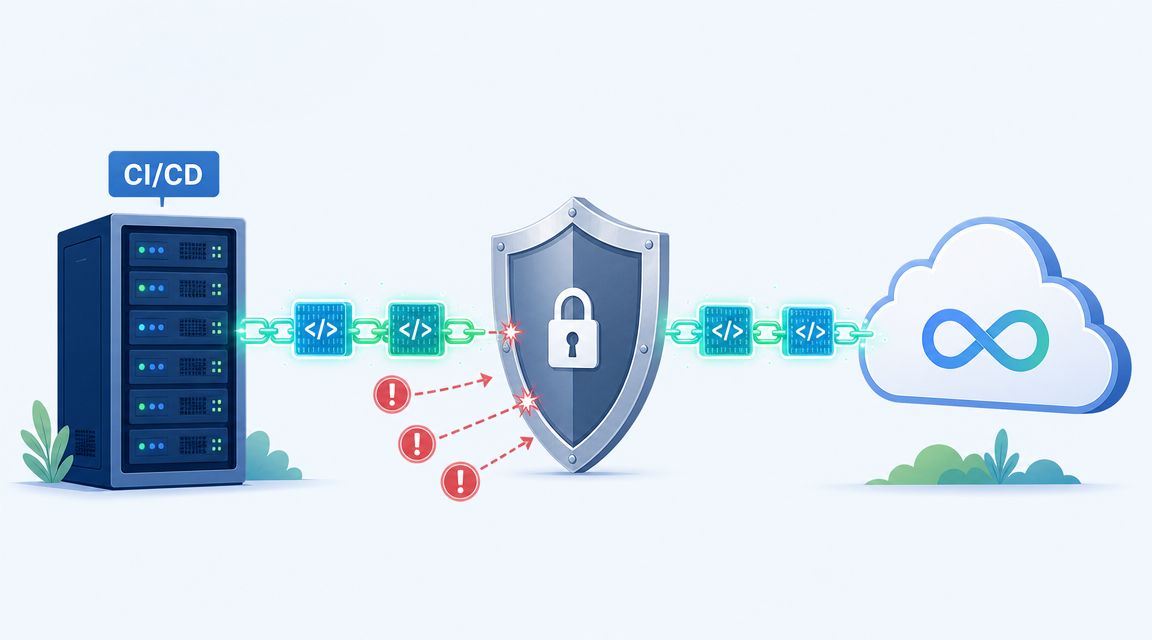

You close a new enterprise customer, or you're close to it. Procurement sends over the security questionnaire. It starts with the usual access control and encryption questions, then gets more specific.
How do you verify third-party packages? Do you generate and retain SBOMs? Are build agents ephemeral? Can you prove artifact provenance? What are your breach-notification obligations for critical suppliers? Which sub-processors can affect production delivery?
At that point, most growing engineering teams realise they don't have a supply chain security problem in theory. They have one in backlog, staffing, release velocity, and revenue. The awkward part is that the fix rarely fits into a sprint. It usually turns into a platform engineering programme disguised as a security task.
Why Supply Chain Security Is Your Next Big Problem
The common mistake is to treat supply chain security as a niche concern for regulated industries or huge enterprises. In practice, it hits startups and scale-ups at exactly the moment they can least afford distraction. You win larger customers, expand into stricter markets, add more cloud services, adopt more SaaS tooling, and increase deployment frequency. Your attack surface grows faster than your process maturity.
That mismatch is already visible in the market. In the ISC2 2025 Supply Chain Risk Survey, 70% of respondents said their organisations are highly concerned about cybersecurity risks in their supply chains, and 28% reported a cybersecurity incident originating from a third-party vendor or supplier in the past two years.
The problem shows up first as business friction
A CTO usually doesn't first encounter supply chain security through a breach. They encounter it through delay.
Sales needs answers for a prospect. Legal wants stronger supplier language in contracts. Security asks engineering to prove where dependencies come from. Platform engineers are suddenly discussing code signing, build isolation, registry policy, and audit trails instead of shipping customer-facing work.
That creates a bad trade-off:
- Move fast and accept blind spots so the product roadmap keeps moving.
- Slow down and build controls that typical teams never planned to own internally.
Neither option is attractive if your engineering organisation is still lean.
Practical rule: If a customer can block the deal because you can't explain how software gets built and shipped, supply chain security is already an executive issue, not just a security issue.
Every integration widens the blast radius
Supply chain security isn't only about open-source libraries. It's also your CI runners, artifact registries, base images, deployment workflows, cloud roles, SaaS integrations, and suppliers with access to code or production paths.
Each of those components saves time individually. Together, they form a chain of trust that's often assembled quickly and reviewed only when a customer asks awkward questions.
What's changed is that "we trust this vendor" no longer satisfies serious buyers. They want evidence, repeatability, and some confidence that your engineering team can detect tampering before customers do. If you try to meet that expectation with ad hoc scripts and scattered scanners, you'll spend a lot of your best engineers' time maintaining controls that still don't give you complete coverage.
Understanding the Modern Software Supply Chain
A physical supply chain is easy to picture. Raw materials arrive from suppliers, a factory assembles them, a warehouse stores the result, and logistics gets the product to customers. If any step is compromised, delayed, or poorly controlled, the final product is at risk.
Software works the same way. Your "raw materials" are source code, dependencies, base images, and external services. Your "factory" is the build system and CI/CD pipeline. Your "warehouse" is the artifact registry. Delivery happens through deployment automation and cloud infrastructure.
What actually belongs in the chain
Many teams define the software supply chain too narrowly. They focus on package managers and miss the rest of the path to production.
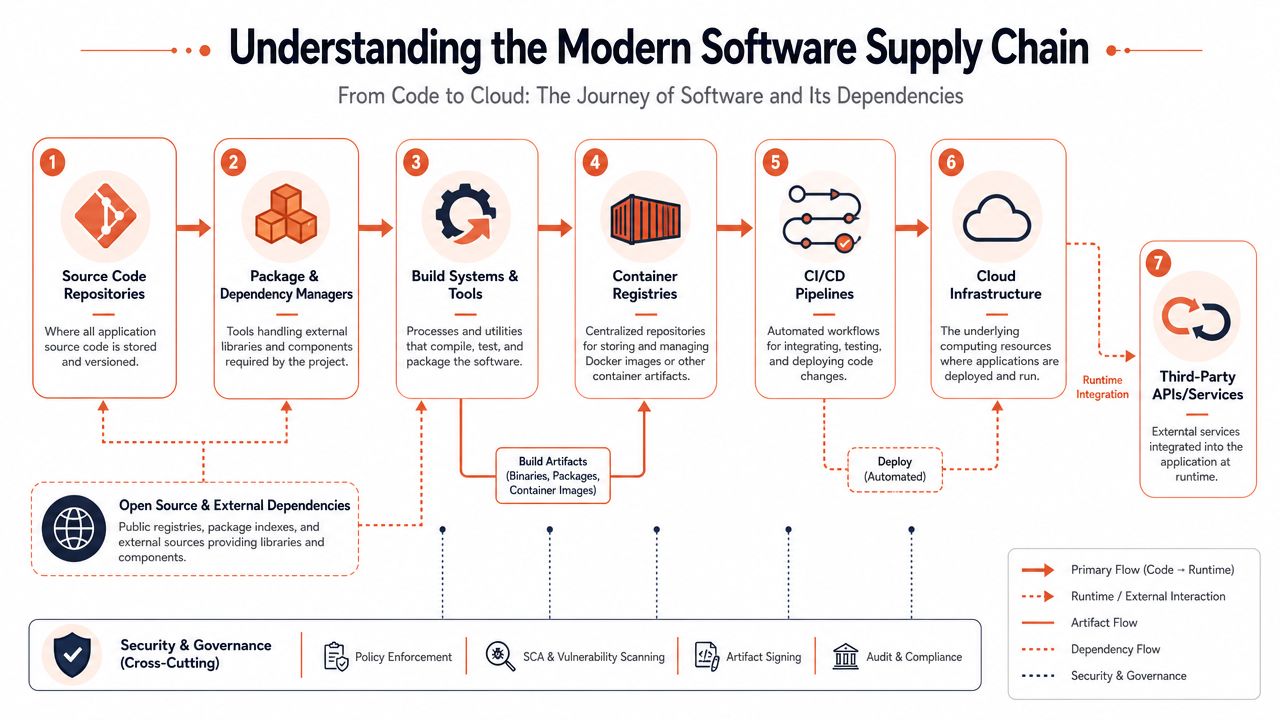
A more useful model includes these parts:
- Source repositories where application and infrastructure code is stored, reviewed, and merged
- Dependency and package managers such as npm, pip, Maven, or Cargo
- Build systems that compile, test, package, and prepare release artifacts
- CI/CD pipelines that automate promotion from commit to production
- Container registries and artifact stores that hold images and binaries
- Cloud infrastructure across AWS, GCP, and Azure where software runs
- Third-party APIs and services that become part of runtime behaviour
None of these components is risky because it exists. The risk comes from weak trust boundaries between them.
The operational burden is usually underestimated
This situation often traps CTOs. On paper, each control looks manageable. Add SCA scanning. Add image scanning. Add branch protection. Add signing. Add policy checks. Add IAM reviews. Add logging.
In reality, every layer introduces tool selection, rollout work, false-positive handling, upgrade churn, exceptions, training, and ownership questions. Multi-cloud makes this harder because identity, networking, policy, and audit models differ enough across providers to create real operational drag.
The broader market reflects that urgency. One estimate says the supply chain security market is projected to reach USD 5.14 billion by 2030 at a 12.6% CAGR, according to Grand View Research's supply chain security market outlook.
For delivery teams, the practical issue isn't just security posture. It's whether your organisation wants to keep assembling and maintaining this machinery itself. That's the same build-versus-buy decision many teams already face in release automation, environment management, and cluster operations. If you're already rethinking your deployment model, the trade-offs in GitOps vs traditional CI/CD are closely related because supply chain controls live inside those delivery choices.
Mapping the Supply Chain Threat Landscape
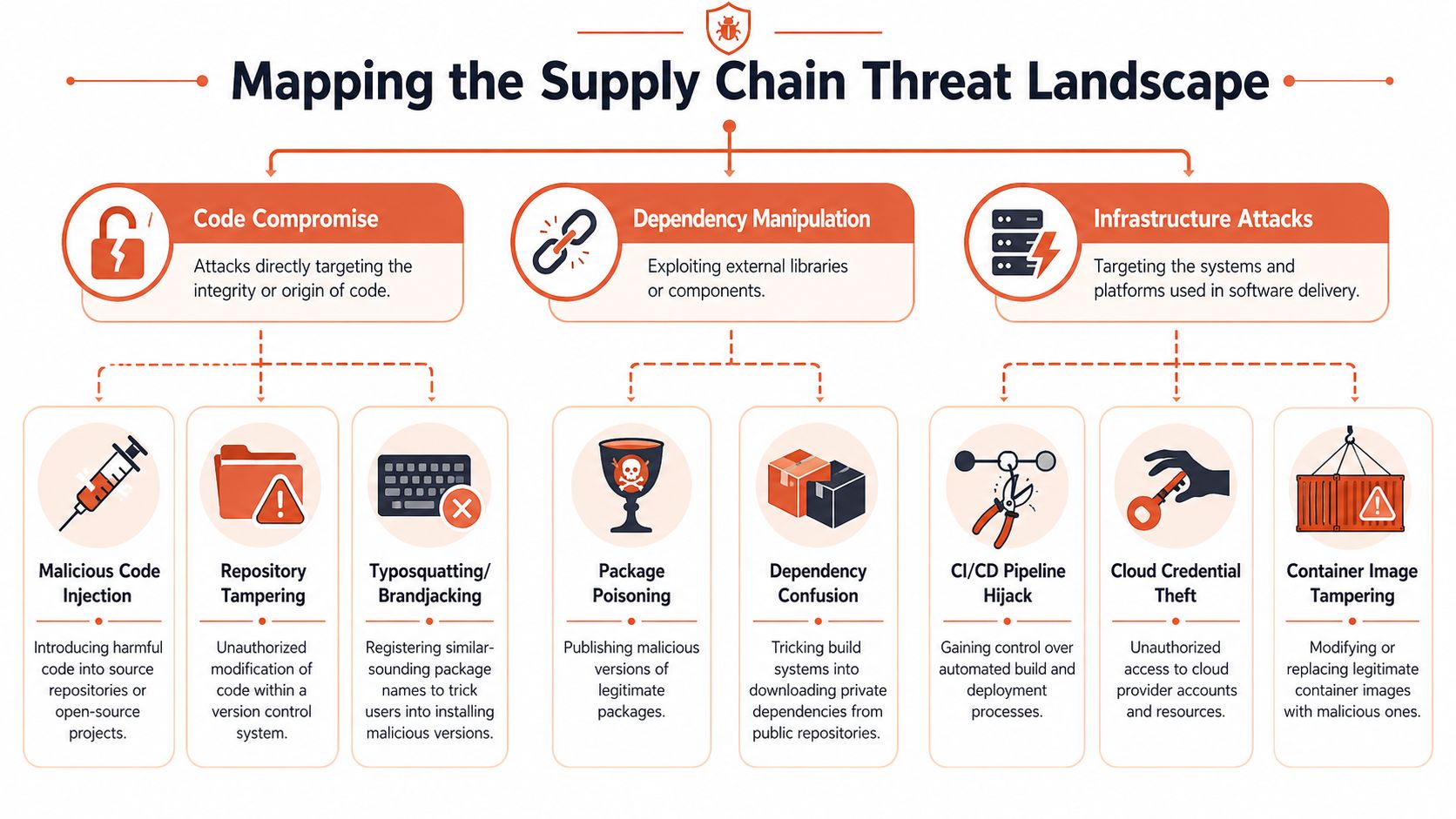
The easiest way to think about the threat environment is to ask a blunt question. Where can an attacker alter what you build, what you trust, or what you run?
That leads to four practical failure modes. They don't cover everything, but they explain most of the incidents engineering leaders worry about.
Dependency tricks that look ordinary
Dependency confusion and typosquatting work because modern builds are automated and developers are busy. A malicious package can look close enough to a legitimate one, or a public package can be resolved instead of an internal dependency, and the build still appears successful.
Real incidents have made this pattern familiar. The technical detail varies by ecosystem, but the business effect is the same. You import something you didn't intend to trust, and it now executes inside a privileged path.
This is why package allow-lists and version pinning help, but don't solve the entire problem. They reduce careless intake. They don't verify the entire chain behind the artifact.
Pipeline compromise is more dangerous than app compromise
If an attacker owns the build pipeline, they don't need to touch your application repository. They can tamper with inputs, outputs, or signing steps and still ship something that looks legitimate.
SolarWinds remains the classic example because it showed how compromise at build time can propagate trust downstream. That's the nightmare scenario for any CTO because your own customers may consume the poisoned output before anyone notices.
A secure repository with an insecure build system is still an insecure software factory.
Base images and registries quietly inherit risk
Teams often harden application code but assume the container base image is "somebody else's problem". It isn't. If the base image contains vulnerable or unexpected components, every downstream image inherits that exposure.
The same applies to registries. If artifact storage isn't tightly controlled, teams can accidentally pull stale, unsigned, or unverified images into environments that should have stricter guarantees.
A useful mental model is this: every inherited artifact is borrowed trust.
Secret leakage turns small mistakes into major incidents
Leaked credentials are still one of the most expensive ways to lose control of the supply chain. A token in CI, a registry credential with broad scope, an over-privileged cloud role, or a signing key stored badly can turn one compromised workflow into broad access.
This risk gets worse when teams run many tools stitched together by service accounts and automation tokens. Each one is operationally convenient. Each one is also a path an attacker can reuse.
Visibility is where most teams still fall short
The hardest part is that many organisations still only understand Tier 1 suppliers and direct dependencies. Hidden sub-tier vendors, inherited components, and long-tail services remain blurry. Research highlighted by Industrial Cyber on hidden dependencies and continuous verification notes that supplier visibility is still the most overlooked gap and points to a shift from "trust us" towards continuous verification with SBOMs and independent validation.
A checklist-based vendor review won't catch most of these issues. It may satisfy procurement for a moment, but it won't tell you whether the software factory behind the supplier is trustworthy.
Frameworks and Controls for Stronger Security
Most security frameworks sound abstract until you translate them into engineering work. The useful ones all point to the same three ideas. Know what went into the software. Secure the system that built it. Prove the output is genuine.
That's the practical value behind models such as SLSA and NIST SSDF. You don't need every team lead to memorise framework terminology. You need the platform and delivery model to enforce the behaviours those frameworks are trying to encourage.
Know your ingredients
This starts with an inventory you can trust. Not a spreadsheet. Not a once-a-year audit. A living view of dependencies, build inputs, and third-party components that changes as the codebase changes.
For software teams, that usually means:
- Generating SBOMs consistently so teams know what is shipped
- Tracking dependency sources rather than only package names and versions
- Reviewing third-party software risk continuously instead of during procurement only
The supplier side matters too. Tanium's guidance is useful here because it shifts the conversation away from static questionnaires. A technically effective control is to move from point-in-time checks to continuous third-party visibility, secure SDLC scoring, and contract-backed requirements such as breach-notification SLAs and ISO 27001 minimums.
Secure your factory
The build system deserves the same attention as production. In many organisations, it deserves more.
A secure software factory has clean build environments, tightly controlled secrets, network restrictions where practical, centralised logging, and strong separation between development convenience and release integrity. That sounds straightforward until someone has to implement it across multiple repos, teams, and cloud accounts.
The trade-off is always the same. You can leave these controls to team-by-team discretion and get uneven results, or you can centralise them through platform engineering and accept the cost of maintaining that platform.
The strongest supply chain control is often boring. Remove shared state, reduce privilege, and make builds repeatable.
Sign your packages
Provenance matters because trust by naming convention isn't enough anymore. A package name, a registry path, or a pipeline status check doesn't prove authenticity. Signed artifacts and verifiable build provenance get you closer to that.
A CTO doesn't need to obsess over every implementation detail. The strategic question is simpler: can your organisation prove that what reached production was built from the expected source, in the expected way, through a controlled path?
If the answer is no, you're not deciding between "high maturity" and "low maturity". You're deciding whether to keep relying on assumption.
Hardening Your CI/CD Pipelines and Cloud Infrastructure
If you choose the DIY route, hardening the delivery path is possible. It's also ongoing work, not a one-off remediation. The pattern that works is to treat CI/CD and cloud infrastructure as one security surface, because the pipeline usually has permissions to create, deploy, and modify production assets.
What a platform team would actually need to build
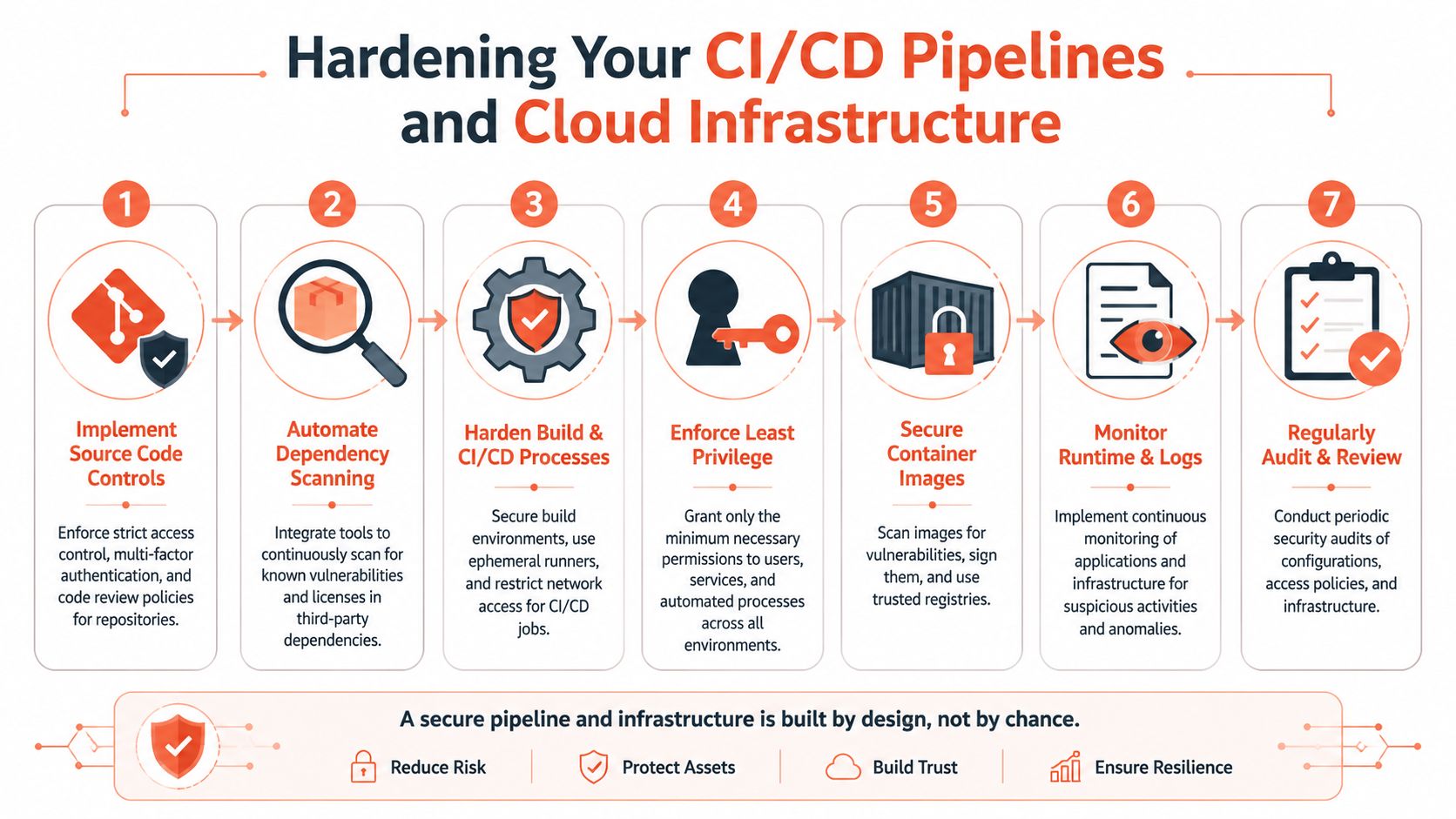
A serious implementation usually includes the following:
Lock down source control
Enforce strong repository access, mandatory review paths, protected branches, and tighter admin permissions. This sounds basic, but exceptions accumulate quickly when delivery pressure rises.Automate dependency and image checks
Add software composition analysis, license review, and container scanning directly into the build path. The hard part isn't installing scanners. It's deciding which findings block releases, who owns remediation, and how to stop teams bypassing noisy gates.Harden build execution
OWASP's guidance is clear that the highest-impact control is cryptographic provenance with automated SBOM generation and consumption in CI/CD, hardened build systems using ephemeral build agents, and code signing backed by hardware security modules. That requires more than toggling on a feature. It means build isolation, secret handling discipline, key management, and careful release design.Reduce privilege in cloud environments
Pipelines, runners, registries, and deployment services shouldn't have broad standing access. Least privilege takes real effort across AWS, GCP, and Azure because permission models differ. Teams looking for a broader operational checklist often benefit from reviewing these cloud security best practices alongside supply chain controls.
The maintenance burden never really disappears
Once the basics are in place, the work continues:
- Policy tuning because blocking too much slows delivery and blocking too little creates theatre
- Exception handling for legacy repos, urgent releases, and vendor packages that don't fit your standards
- Key rotation and secrets hygiene across CI systems, registries, and cloud accounts
- Log centralisation and review so investigators can trace tampering across VCS, build tooling, registries, and runtime systems
- Toolchain updates because security tooling itself needs patching, replacement, and verification
A lot of teams discover at this stage that they aren't building "a few security controls". They're building an internal delivery platform with security enforcement baked in. That's one reason many engineering leaders start looking for zero-maintenance CI/CD pipelines rather than adding more bespoke automation.
What doesn't work well
The least effective pattern is partial hardening. Teams add scanners but don't sign artifacts. They generate SBOMs but don't consume them. They restrict production access but leave CI with broad credentials. They review direct vendors but ignore hidden dependencies and inherited images.
That creates the appearance of control without the operational discipline behind it.
| Approach | What happens in practice |
|---|---|
| Tool-first rollout | Coverage appears quickly, but ownership and policy drift stay unresolved |
| Repo-by-repo exceptions | Teams keep shipping, but standards become inconsistent |
| Central platform enforcement | Slower to stand up, but easier to audit and repeat |
Enforcing Security by Default with a Managed Platform
At some point, the question stops being "Can we build this?" and becomes "Should our product engineering team own this forever?"
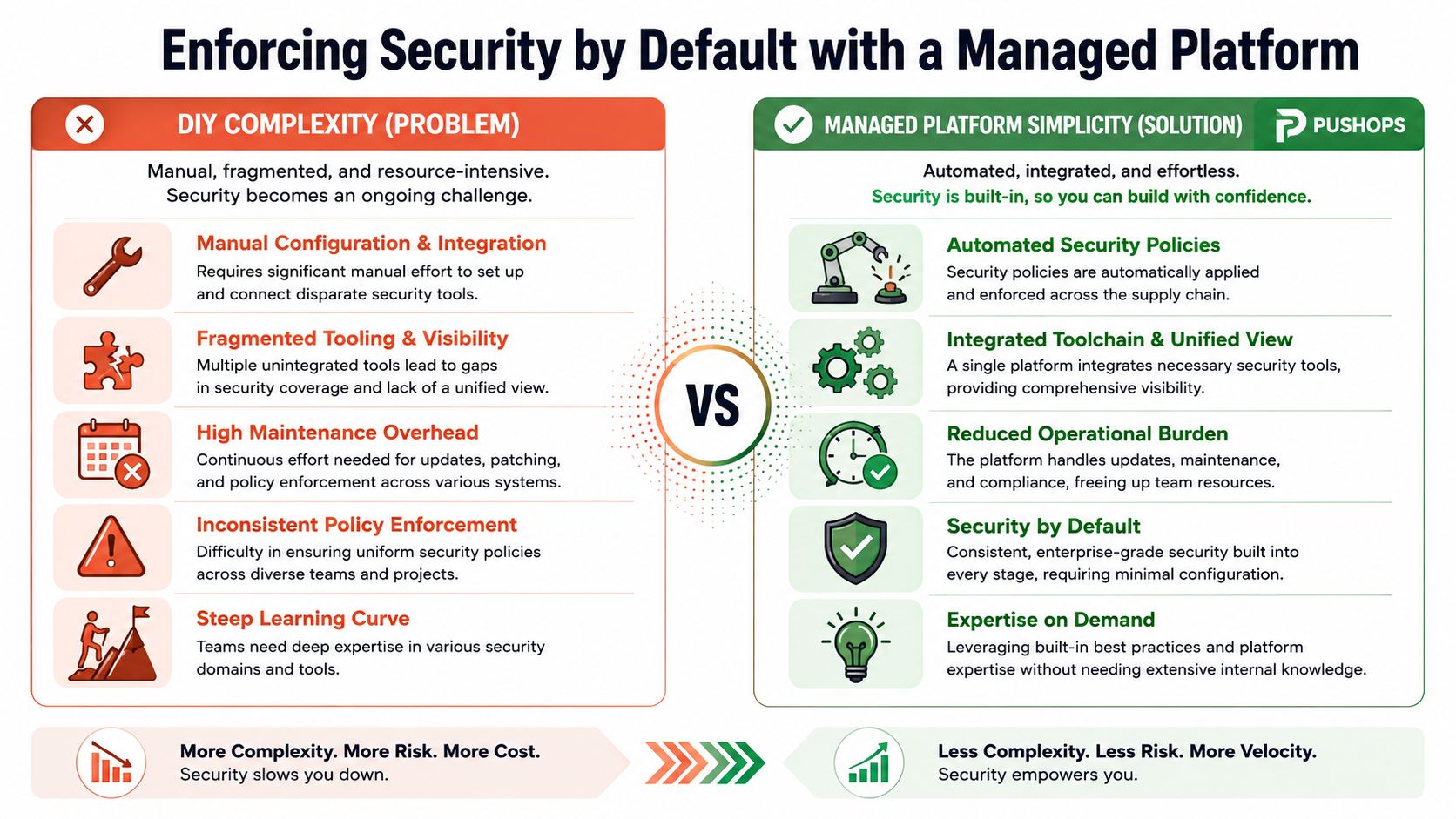
That's the build-versus-buy decision in supply chain security. If you build internally, you're committing to a platform team that can maintain secure pipelines, cloud guardrails, provenance, logging, policy enforcement, and multi-cloud consistency over time. If you adopt a managed platform, you're choosing to standardise the path to production so security controls are built into the workflow by default.
Why managed usually wins for growing teams
The operational advantage isn't magic. It's consolidation.
Instead of hand-assembling scanners, signing workflows, access policies, observability, rollout logic, and cloud configuration across separate tools, a managed platform gives teams one controlled path from commit to production. That makes supply chain security more enforceable because engineers are using the same paved road, not inventing their own.
The best outcome is simple. Developers keep a self-service workflow. Security gets consistent policy enforcement. Leadership gets fewer hidden infrastructure projects.
What this looks like in practice
A managed internal platform should cover the boring but critical parts:
- Standardised build and deployment workflows so every service doesn't reinvent CI/CD
- Policy enforcement and access controls applied consistently across environments
- Integrated observability and audit trails for release activity and infrastructure changes
- Multi-cloud support without asking every team to become expert in AWS, GCP, and Azure security nuances
If you're evaluating that route, it's worth grounding the conversation in what an internal developer platform is meant to do. The goal isn't more abstraction for its own sake. It's to package operational best practice in a way product teams can use safely.
One example is PushOps, which provides cloud infrastructure and deployment workflows across AWS, GCP, and Azure, with security controls such as role-based access, audit logs, policy enforcement, and continuous platform updates built into the operating model. That's not the only possible route. But it reflects the strategic shift many CTOs are making: stop treating supply chain security as a collection of side tools and start treating it as a platform capability.
If you need platform-engineering-grade controls but don't want to build a permanent platform-engineering organisation around them, managed infrastructure starts to look less like outsourcing and more like focus.
Frequently Asked Questions About Supply Chain Security
Is an SBOM the same thing as SCA
No. An SBOM is an inventory of components in what you ship. SCA tools analyse dependencies and usually flag known vulnerabilities, licenses, and policy issues. They work well together. SCA helps you assess risk. SBOMs help you document and verify what is present.
Where should a small startup begin
Start with the delivery path you already control. Tighten repository access. Add dependency and image scanning. Standardise builds. Reduce CI privileges. Generate SBOMs for production artifacts. If you do this manually, keep the implementation narrow enough that your team can maintain it.
Does supply chain security only apply to open source
No. It also includes commercial packages, build tools, CI systems, container images, cloud infrastructure, and third-party APIs. If a component affects how software is built, deployed, or run, it's part of the chain.
Do we need a dedicated platform team
Not always at first. But mature supply chain security usually turns into platform work. Someone has to maintain standards, enforce policy, operate shared tooling, and keep workflows consistent across teams. That's why many scale-ups eventually choose a managed platform instead of hiring deeper into platform and DevOps roles.
What's the biggest mistake teams make
Treating supply chain security as a procurement checklist instead of an engineering system. Questionnaires matter, but they don't secure builds. Controls have to live in the path from commit to production.
If your team is spending too much time stitching together CI/CD, cloud controls, observability, and release security, PushOps is worth evaluating as a managed platform option. It gives engineering teams a production-ready delivery foundation across AWS, GCP, and Azure so they can spend less time maintaining infrastructure and more time shipping product.

