
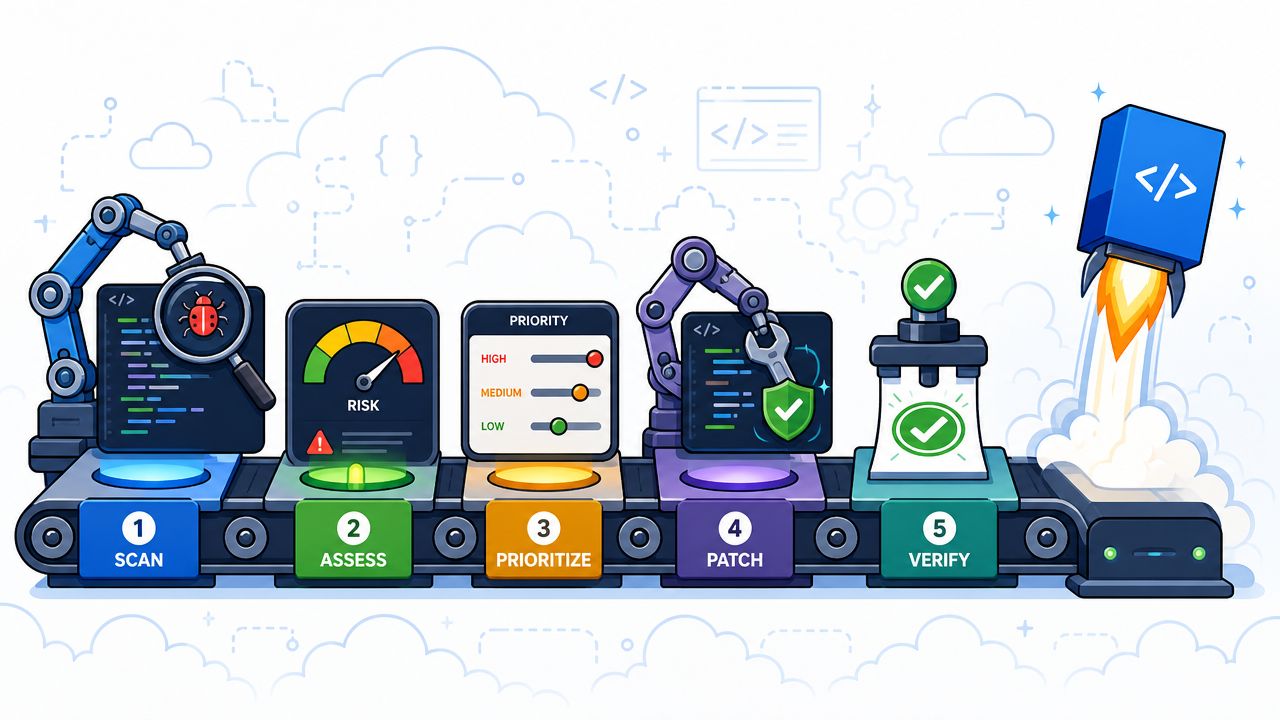

Most engineering leaders don't wake up thinking about CVEs. They wake up thinking about roadmap slip, release risk, cloud spend, and the fact that senior developers keep getting pulled into operational work that nobody planned for.
Then a critical package issue lands in Slack, someone asks whether production is exposed, another team isn't sure which service versions are running in which environment, and your best backend engineer loses half a day chasing an answer that should have been available in minutes. That's the true shape of vulnerability management in a scale-up. It isn't a security slide for the board. It's a delivery problem.
The textbook model says you inventory everything, scan continuously, prioritise perfectly, patch quickly, verify every fix, and report clean metrics. In practice, most startups are trying to do that across AWS, GCP, or Azure, a mix of containers and managed services, several CI systems, and too many hand-built scripts. Security work then turns into DevOps drag. Teams spend more time maintaining the machinery around vulnerability management than reducing actual exposure.
Your Product Is Leaking Value Through Vulnerabilities
A lot of teams still treat vulnerability management as a periodic clean-up task. Run a scan. Export a report. Open tickets. Chase owners. Repeat next month. That model has already broken.
The backlog now grows faster than many teams can process by hand. Health-ISAC reported 29,066 CVEs in 2023 and 24,455 CVEs already in 2024 at the time of writing, which is why a patch-by-count model no longer works well in practice (Health-ISAC vulnerability metrics report).
That number matters less as a headline than as an operating constraint. Your team can't review everything with the same urgency. If your process depends on security engineers manually sorting scanner output, triaging package alerts, and nudging service owners across multiple repos, you're building a queue that never clears.
The hidden leak isn't only risk
The obvious cost is exposure. The less obvious cost is engineering attention.
A typical scale-up doesn't just patch software. It has to answer a chain of operational questions:
- What assets exist: Not what was in Terraform last quarter, but what's running now across clusters, previews, worker nodes, and managed services.
- Who owns the asset: If ownership is fuzzy, remediation stalls.
- What changed recently: A vulnerability in an image template behaves differently from a one-off package pinned in a single repo.
- Whether the fix is safe: Teams delay changes when release confidence is low.
Practical rule: If fixing a vulnerability requires three systems, two approvals, and a spreadsheet, the bottleneck isn't security knowledge. It's platform design.
This is why vulnerability management belongs next to delivery engineering, not off to the side as a separate compliance ritual. When the process is clumsy, product velocity drops. Release confidence drops. Infrastructure overhead rises. You pay for the weakness twice: once in security risk, then again in slower shipping.
Why this becomes a platform problem
DIY programmes usually start with good intentions. Add a scanner. Wire some alerts. Build dashboards. Push tickets into Jira. Over time, that stack becomes another internal product that needs ownership, upgrades, integration work, and constant repair.
For a fast-moving company, that's backwards. The goal isn't to become excellent at operating a homemade security toolchain. The goal is to give developers a production-ready path where discovery, prioritisation, remediation, and verification happen with far less manual coordination.
The Five Stages of Modern Vulnerability Management
Modern vulnerability management isn't a single scan. It's a loop. If one stage is weak, the rest become noisy or slow.
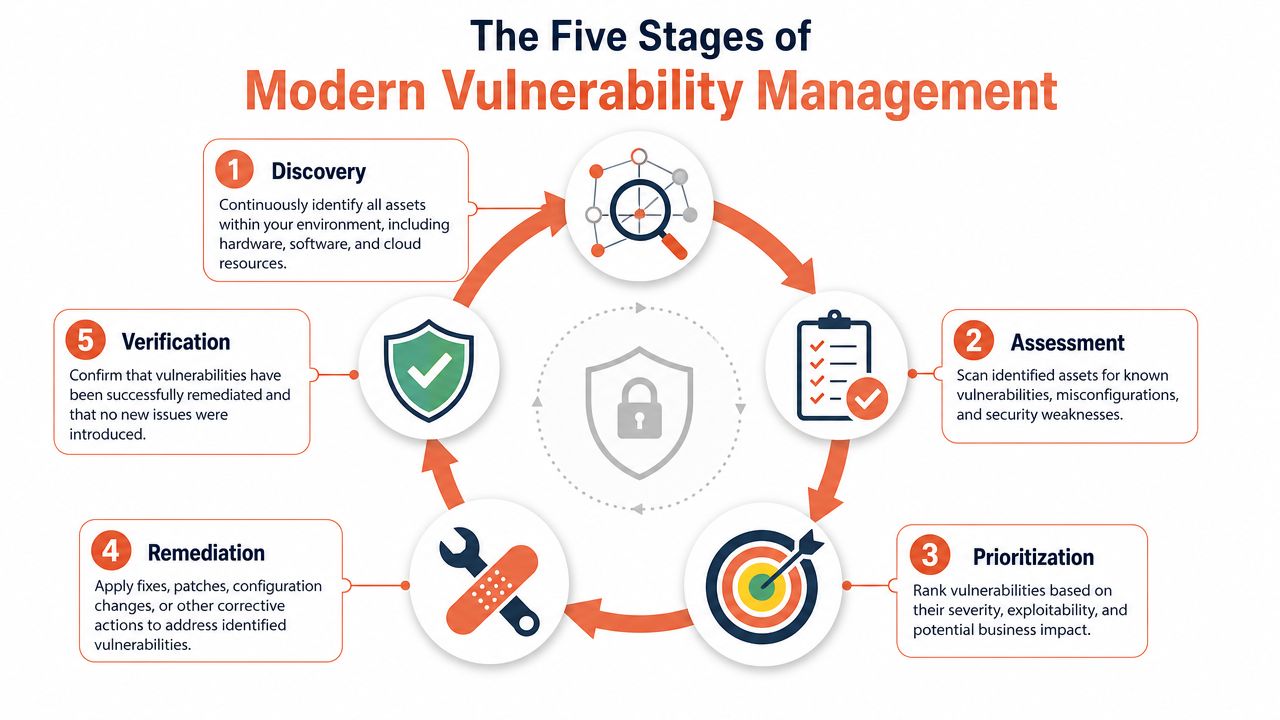
Discovery
Discovery sounds simple until you run a cloud-native estate. Assets appear and disappear constantly. Containers are rebuilt, preview environments spin up, managed databases get reconfigured, and forgotten services keep running long after their owners have changed teams.
In a healthy programme, discovery means maintaining a current inventory of workloads, dependencies, images, services, and exposed endpoints. Without that baseline, every downstream decision is compromised. You can't assess what you don't know exists.
For smaller teams, practical guidance on vulnerability management for UK SMBs is useful because it keeps the emphasis on operational basics rather than enterprise theatre.
Assessment
Assessment is where teams scan identified assets for known weaknesses and misconfigurations. This includes host issues, container image flaws, dependency vulnerabilities, and deployment mistakes in infrastructure definitions.
The trap is assuming scan volume equals control. It doesn't. Running more tools often creates duplicate findings, conflicting severity labels, and a larger triage queue. Assessment only helps when findings are normalised and tied back to assets people own.
Prioritisation
Many programmes fail because teams sort by severity score alone and call it prioritisation. That isn't enough.
The CVSS system standardises severity on a 0 to 10 scale, but it isn't a risk score on its own. Effective teams add business criticality and exploitability before deciding what to fix first (PurpleSec on vulnerability management metrics).
A critical library issue in an internal tool may matter less than a high-severity flaw in an internet-facing auth service. Severity starts the conversation. Context decides the work.
The right question isn't "How bad is this vulnerability in general?" It's "How dangerous is it in this service, in this environment, with this exposure?"
Remediation
Remediation includes patching, version upgrades, configuration changes, temporary mitigations, and sometimes isolation rather than immediate replacement. During this phase, the engineering cost becomes visible.
A fix that looks trivial in a scanner can trigger real work:
- Dependency conflicts: Updating one package can break builds or test assumptions.
- Base image drift: A container fix may require rebuilding and validating several downstream services.
- Release coordination: Shared services often need staged rollouts and change windows.
- Ownership gaps: If nobody clearly owns the workload, the ticket just ages.
Verification
Verification closes the loop. After a change, you need evidence that the issue is gone and that the fix didn't create a new problem.
The clean version of this is easy to say and hard to run manually:
- Re-scan the asset.
- Confirm the vulnerable component is gone or mitigated.
- Check that the service still behaves correctly.
- Update status automatically so reporting reflects reality.
Teams that skip verification often report progress they haven't achieved. They closed the ticket, but the exposure remains.
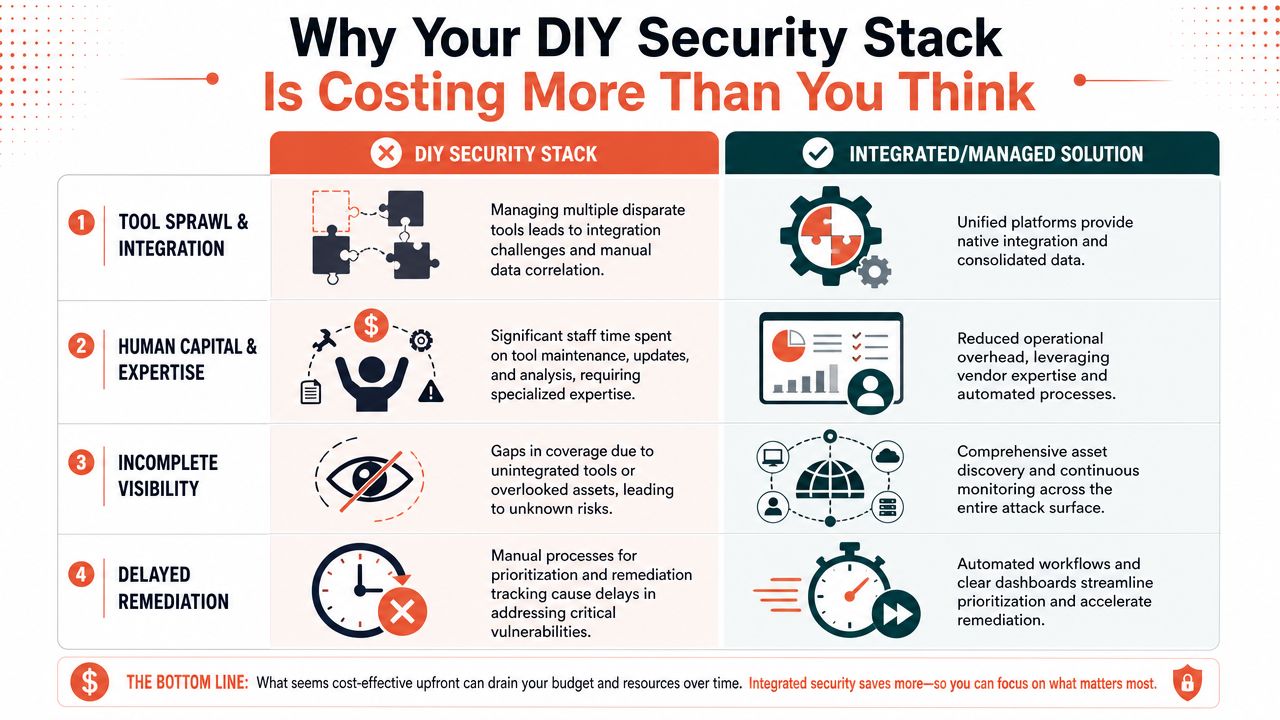
Why Your DIY Security Stack Is Costing More Than You Think
Most DIY vulnerability management stacks don't fail because the tools are bad. They fail because the operating model around them is expensive.
You buy a scanner, add container checks in CI, pull cloud findings into a dashboard, route alerts to Slack, sync tickets into Jira, and write some custom logic to deduplicate results. Nothing looks unreasonable in isolation. The cost shows up in the seams.
Integration debt is real engineering work
Every extra tool creates mapping problems. Asset names differ between cloud accounts, registries, clusters, and ticketing systems. Severity labels don't align. Ownership data lives somewhere else. Exceptions are tracked in a document that only one person trusts.
That means senior engineers end up building glue code and maintenance scripts instead of improving the product. The stack becomes another internal platform with all the usual baggage: upgrades, broken webhooks, token rotation, schema drift, false-positive handling, and reporting disputes.
A lot of teams recognise this pattern in broader platform work. That's why material on developer platform automation resonates. The same lesson applies here. If the control plane is fragmented, the humans become the integration layer.
The bottleneck is coordination
Discovery usually isn't the hardest part. Action is.
Swimlane reports that 68% of organisations struggle to remediate critical vulnerabilities within 24 hours, which points directly at speed and coordination problems rather than simple detection gaps (Wiz academy guide to vulnerability management best practices).
That lines up with what engineering leaders see every week. The ticket exists. The alert fired. Nobody disputes the issue. But remediation still slows down because:
- Developers lack context: They see a scanner finding, not the operational impact or safe upgrade path.
- Security lacks delivery control: They can flag urgency but can't move changes through build, test, and deploy.
- Platform teams become brokers: They spend time translating between tooling and teams.
- Leadership gets poor visibility: Dashboards show open counts, not whether the riskiest items are shrinking.
If you need meetings to move a routine patch from finding to production, the process is too manual for a scale-up.
DIY is expensive even before licences
The hidden cost isn't just software spend.
| Cost area | What happens in a DIY setup | What a managed approach removes |
|---|---|---|
| Staff time | Engineers maintain integrations, tune scanners, and chase remediation updates | More automation and less manual correlation |
| Hiring pressure | You look for more DevOps or security-platform talent to keep the stack running | Existing teams spend more time on product delivery |
| Delayed releases | Teams postpone fixes because release workflows are brittle | Security changes fit into normal delivery paths |
| Inconsistent control | Standards vary by repo, team, and environment | Guardrails are applied more consistently |
The result is familiar. You don't just own a security process. You own the infrastructure around that process, and it keeps expanding.
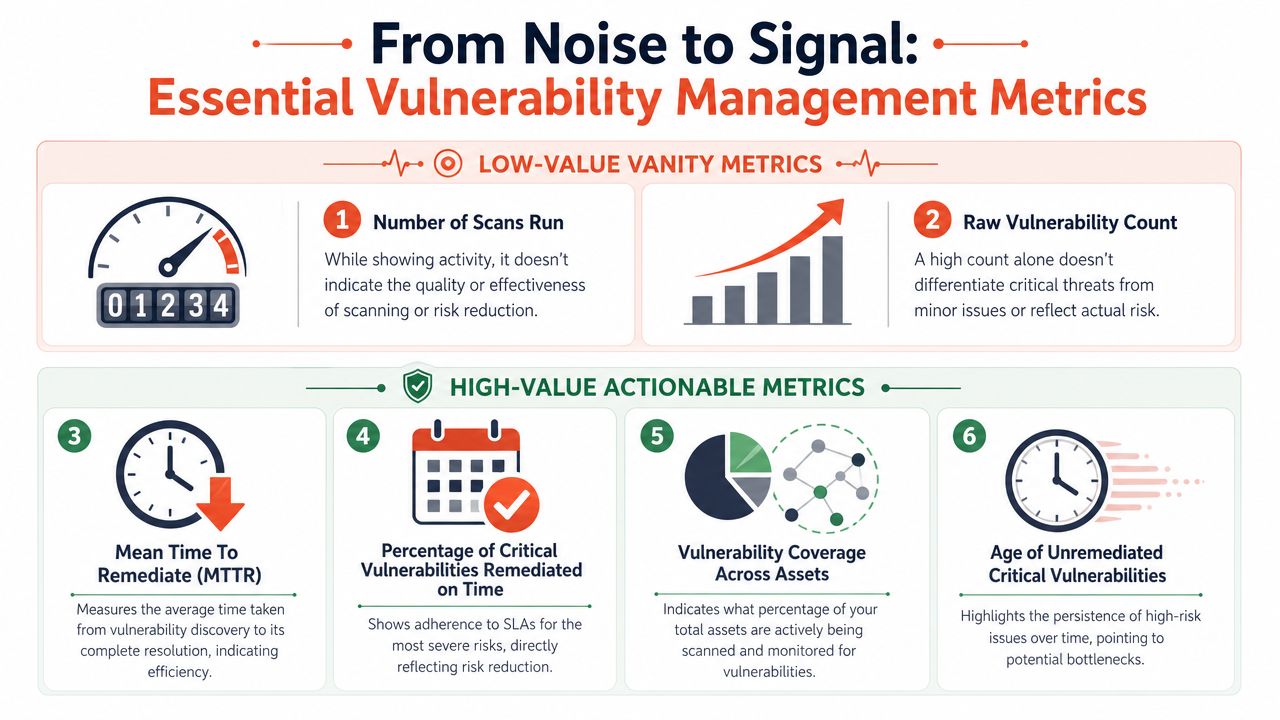
From Noise to Signal Essential Vulnerability Management Metrics
The worst vulnerability dashboards are busy and comforting. They show scans run, findings created, and long lists of open issues. None of that tells you whether risk is falling.
The most useful programmes track a smaller set of operational metrics tied to exposure reduction.
What to stop obsessing over
Some metrics create activity without insight:
- Number of scans run: This proves the machinery is active, not that the environment is safer.
- Raw vulnerability count: A large count mixes trivial, duplicated, and low-impact issues with critical ones.
- Tickets opened: That measures throughput into the queue, not outcomes.
These are useful as secondary signals for operators. They aren't leadership metrics.
What to measure instead
The most actionable KPI is Mean Time to Remediate (MTTR) because delay directly defines the exposure window. Strong programmes also prioritise by risk score rather than raw count, using exploitability and asset value to decide what gets fixed first (Cymulate on vulnerability management metrics).
The metrics that usually matter most are:
- MTTR: How long it takes from detection to verified fix.
- Critical remediation on time: Whether the most serious issues meet internal deadlines.
- Coverage across assets: Whether your scanners and checks reach the environments you operate.
- Age of open critical issues: Whether risk is accumulating in the backlog.
A falling total count can hide a dangerous truth. Old critical findings may still be sitting on your most exposed systems.
Why fragmented tooling corrupts the numbers
These metrics sound straightforward until you try to calculate them across repos, registries, clusters, cloud accounts, and ticket systems.
MTTR becomes unreliable when discovery time, ticket creation time, patch merge time, and production deployment time all live in different places. Coverage becomes misleading when ephemeral environments aren't counted consistently. Vulnerability age becomes a guessing game when duplicate findings reopen under new identifiers.
This is why teams need one operational view, not five partial ones. Good metrics don't come from better slide design. They come from a delivery stack that can observe the full lifecycle.
Embedding Security into Your Development Workflow
If vulnerability management lives outside the development workflow, it becomes a queue of interruptions. Developers get alerts after the fact, platform engineers become traffic controllers, and every fix feels like unplanned work.
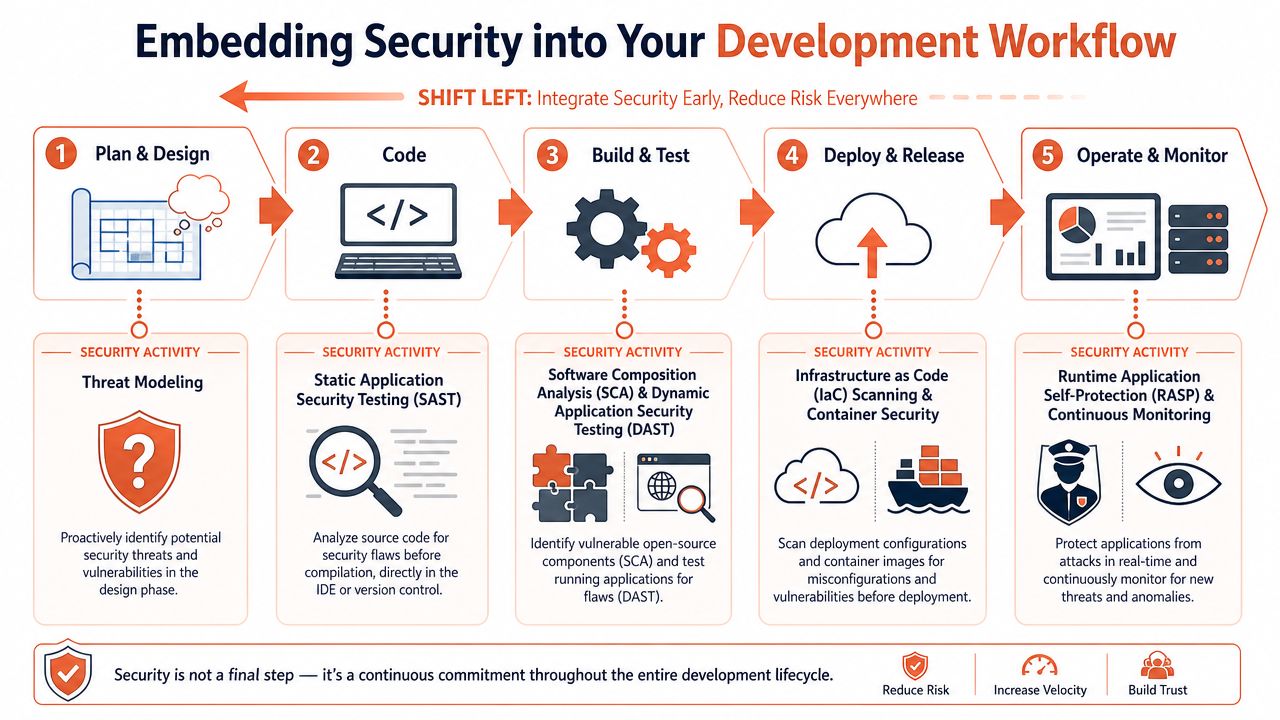
The better model is a secure paved road. Security checks happen in the same path developers already use to build, test, deploy, and operate services.
Build controls into the path of least resistance
Teams usually get the best result when they place different checks at different stages:
- Plan and design: Threat modelling catches obvious trust-boundary and data-flow issues before code exists.
- Code and review: SAST can highlight risky patterns early, especially for common framework mistakes.
- Build and test: SCA identifies vulnerable dependencies before they reach a release artefact.
- Deploy: IaC scanning and container checks stop bad configurations and known vulnerable images from moving further.
- Operate: Continuous monitoring catches drift, reopened issues, and newly disclosed flaws in running systems.
This isn't about throwing every security product into CI. It means placing controls where the feedback is timely and actionable.
Policy works best when it behaves like engineering
The moment teams hear "security policy", they expect bureaucracy. That's because many policies still arrive as documents, exception forms, and one-off approvals.
Policy as code changes that. Instead of telling developers to remember standards, the platform enforces them automatically. A deployment can be blocked if a defined class of issue remains unresolved. A base image can be rejected if it doesn't meet your rules. A repository can inherit defaults rather than reinventing them.
That approach only works when the pipeline itself is stable. Otherwise security controls become another source of flaky builds and special cases. Teams looking to avoid bespoke CI maintenance usually benefit from a more standardised delivery foundation, which is exactly the point behind zero-maintenance CI/CD pipelines.
The trade-off most teams underestimate
Embedding security early does increase initial setup work. You need build integrations, suppression workflows, ownership mapping, and sensible failure conditions. Multi-cloud environments add more complexity because the same policy has to behave consistently across different deployment targets.
But the alternative is worse. Late-stage remediation is slower, riskier, and more political. Every issue arrives as an interruption to work already in progress.
The best security workflow doesn't ask developers to think about security more often. It removes the number of moments where they have to stop and figure out what to do next.
When security is integrated properly, developers get faster feedback, platform teams get fewer ad hoc requests, and release management becomes more predictable.
The PushOps Playbook for Automated Remediation
A good vulnerability process should feel boring. Not because the risk is small, but because the path from finding to fix is routine.
Take a common scenario. A new issue is disclosed in a base image package used by several services. In a DIY setup, someone notices the alert, checks which repos inherit that image, works out which environments are exposed, opens tickets, pings owners, and waits for the next deployment window.
A better operating model runs that flow with much less manual effort.
What the workflow should do automatically
Start with continuous discovery. The platform knows which services, environments, images, and cloud resources are active. When a new finding appears, it can map the issue to real workloads instead of producing an abstract alert with no business context.
Then prioritisation kicks in. The finding is enriched with ownership, service criticality, and exposure. That matters because the same package issue has a different operational priority on an internal batch worker than on a public API.
A practical automated sequence looks like this:
- Detect the issue in the affected image, dependency, or configuration.
- Map it to live services and identify who owns those services.
- Create a work item in the team's existing workflow, such as Jira.
- Notify the right channel with enough context to act, not just a raw scanner payload.
- Trigger a safe update path where possible, such as rebuilding from a patched base image.
- Redeploy through normal release controls rather than bypassing the delivery system.
- Verify the result by rescanning and confirming the vulnerable version is gone.
Safe release matters as much as fast release
The biggest reason teams hesitate on remediation isn't laziness. It's fear of breaking production with a rushed fix.
That's why automated remediation needs to work with modern release techniques such as staged rollout, environment isolation, and feature control. Teams using patterns like feature flags and safe releases have a much easier time shipping security changes without turning each patch into an all-or-nothing event.
What this changes for engineering leaders
When the loop is automated, three things improve immediately.
- Developers spend less time triaging noise and more time applying clear fixes.
- Security and platform teams stop acting as coordinators for routine work.
- Leadership sees actual progress because verification closes the loop.
That's the point of an operationally mature vulnerability management programme. Not more alerts. Fewer manual handoffs.
Stop Managing Infrastructure Start Shipping Product
Vulnerability management is necessary. Building a sprawling in-house system to run it often isn't.
For startups and scale-ups, the failure mode is predictable. You start with scanners and sensible intentions. Then you inherit integration debt, inconsistent policies, manual verification, patch coordination overhead, and another stream of work that keeps senior engineers away from the roadmap.
The textbook version assumes unlimited time, perfect asset visibility, and a dedicated platform function. Such ideal conditions are rarely met. Teams need secure defaults, clear ownership, reliable deployment paths, and reporting that reflects real remediation rather than ticket motion.
If you're leading engineering, your job isn't to assemble a museum of security and DevOps tools. It's to give the team a production-ready foundation so they can ship features safely, across AWS, GCP, and Azure, without becoming part-time infrastructure operators.
PushOps gives software teams that foundation. It replaces fragile DIY DevOps and security plumbing with a production-ready platform for provisioning, CI/CD, observability, policy enforcement, and multi-cloud operations, so your engineers can spend less time maintaining infrastructure and more time shipping product. If that's the trade-off you want, take a look at PushOps.

