

Automating deployments for microservices isn’t just a technical upgrade; it's a strategic imperative for any engineering leader who wants to ship features faster and with more confidence. It's about escaping fragile, manual release processes.
Instead, you move to a system where every code commit can be automatically built, tested, and deployed into production with minimal human intervention. In the complex world of microservices, this is the only sustainable way to maintain velocity and stay ahead of the competition.
Stop Building a DevOps Platform and Start Shipping Product
Let's be honest. If you're a CTO or a VP of Engineering at a startup or scale-up, your biggest headache isn't a random technical bug. It's watching your smartest, most expensive engineers get bogged down wrestling with Kubernetes YAML files, fixing broken CI/CD pipelines, and navigating the maze of cloud provider IAM roles across AWS, GCP, or Azure.
You didn't hire them to build and maintain an internal DevOps stack. You hired them to build your product.
This slow drift from product innovation to internal platform maintenance is the silent killer of velocity. We all bought into the promise of microservices—speed and scalability—but that dream is often shattered by the operational nightmare of actually managing them.
Every new service you add ratchets up the complexity, demanding ever more sophisticated in-house tooling for:
- CI/CD Automation: Building and, more importantly, maintaining pipelines that are fast, secure, and reliable across dozens of services.
- Infrastructure Management: Provisioning, configuring, and securing resources across one or multiple clouds like AWS, GCP, or Azure.
- Observability: Trying to stitch together logs, metrics, and traces just to figure out what's happening in a distributed system.
- Security and Compliance: Enforcing policies, managing secrets, and maintaining a consistent security posture everywhere.
The real problem isn't the tools themselves. It's about focus. Every engineering hour spent patching a Jenkins plugin, debugging a Terraform script, or building a custom monitoring dashboard is an hour you didn't spend shipping features and beating your competition.
The Hidden Costs of DIY DevOps
The cost of building your own DevOps platform isn't just the salaries for a dedicated DevOps team. The real damage is the opportunity cost of pulling your senior product engineers away from what they do best. This DIY approach forces you to over-invest in a complex internal product that you're now stuck supporting forever.
You can learn more about the strategic advantages of moving to a managed DevOps and cloud infrastructure platform in our detailed explainer.
A modern, multi-cloud DevOps platform gives you a massive strategic lever. It abstracts away all the undifferentiated, heavy lifting of infrastructure. This lets you reclaim your team's focus and point it back at the one thing that truly matters—building and shipping features that your customers will love.
Deconstructing the Microservice CI/CD Pipeline
An automated deployment is only as good as the CI/CD pipeline that drives it. For microservices, this pipeline is a surprisingly tricky beast, often becoming a huge bottleneck for teams that try to build and manage it themselves.
On the surface, a pipeline seems straightforward: Build, Test, and Deploy. But once you apply this to a distributed architecture, you uncover layers of complexity and hidden costs that most engineering leaders don't see coming until their teams are deep in the weeds.
The Build Stage Complexity
Building a single application is one thing. Building dozens of microservices is another game entirely. Each service needs to be containerised—usually with Docker—to ensure consistency across all environments. This step alone is loaded with gotchas.
You suddenly need a private container registry, Dockerfiles optimised for small image sizes and fast build times, and a clear strategy for managing dependencies across all your services. A seemingly tiny update to a shared library can trigger a massive chain reaction of rebuilds, bringing developer productivity to a grinding halt if not handled correctly.
From Theory to Confident Releases
The testing phase is where most in-house pipelines really start to show their cracks. Simply running unit tests isn't nearly enough to guarantee a safe release in a microservices world. A robust testing strategy requires several automated layers.
- Unit Tests: Your first line of defence, verifying individual functions within a single service. They're fast and essential, but their scope is limited.
- Integration Tests: Here, you check how a service communicates with its direct dependencies, like a database or a message queue. These are slower and far more complex to set up and maintain.
- Contract Tests: These are critical for ensuring two separate microservices can communicate properly without having to spin up the entire system. They verify the API "contract" between services remains intact.
Honestly, building and maintaining the infrastructure just to run these tests reliably is a full-time job. Flaky tests and slow feedback loops kill developer momentum and destroy confidence in the very automation you’ve worked so hard to build.
The goal of a CI/CD pipeline isn’t just to automate tasks. It’s to build genuine confidence that a green build can be safely pushed to production. When your team spends more time debugging the pipeline than writing code, you’ve missed the point entirely.
This flow chart shows the ideal state, where developers can focus on the product instead of fighting broken DevOps processes.
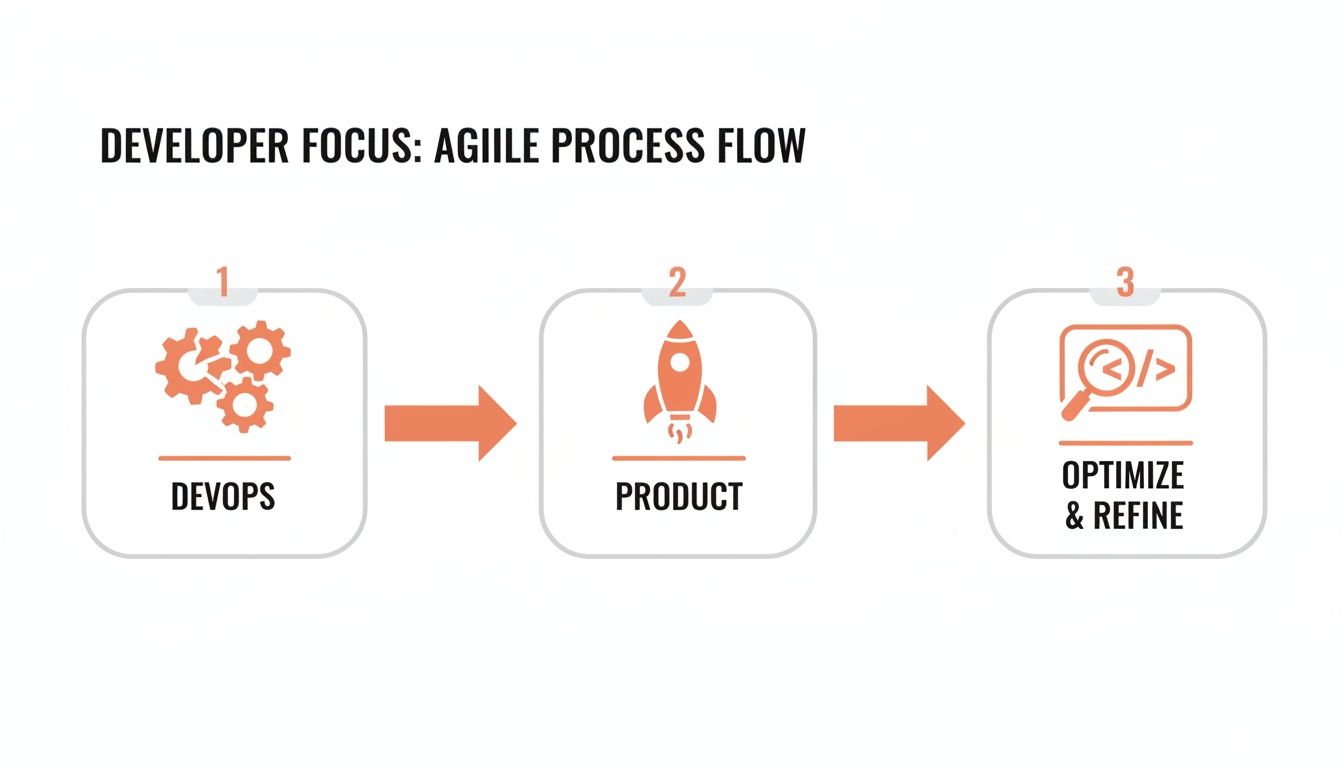
It highlights a critical truth for any growing company: every minute your team spends wrestling with infrastructure is a minute they're not spending building features that move your business forward.
The True Cost of a DIY Pipeline
The engineering effort needed to build a pipeline that's fast, secure, and reliable across dozens of services is immense. And it's not a one-time project—it demands constant maintenance, security patching, and upgrades. This is the hidden cost that quietly drains your budget and pulls your best engineers away from their real jobs.
This is where a managed DevOps platform gives you a massive advantage by taking all that complexity off your plate. For a deeper dive, you can explore the real-world benefits of zero-maintenance CI/CD pipelines and see how they free up your engineering team to focus on what matters.
The difference becomes crystal clear when you compare the two approaches.
DIY CI/CD Pipeline vs Managed Platform
Building your own pipeline seems empowering at first, but the long-term operational burden is often underestimated. You become responsible for every piece of the puzzle, from the CI server to testing frameworks, security scanners, and deployment scripts. A modern multi-cloud DevOps platform, on the other hand, abstracts away this maintenance nightmare.
| Component | DIY In-House Approach | Managed Platform Approach |
|---|---|---|
| Initial Setup | Weeks to months of engineering effort to design, build, and integrate tools. | Minutes to hours to connect repositories and configure settings. |
| Maintenance | Ongoing, high effort: Constant patching, upgrades, and troubleshooting. | Zero maintenance: The platform handles all updates, security, and reliability. |
| Tool Integration | Complex and fragile: Manually integrating CI, container registry, testing tools, and security scanners. | Pre-integrated: A seamless, unified workflow out of the box. |
| Security | Team's responsibility: Requires dedicated expertise to secure the entire toolchain. | Built-in: Managed secrets, vulnerability scanning, and compliance features are included. |
| Scalability | Difficult: Scaling build agents and infrastructure requires significant planning and cost. | Effortless: Scales automatically with your workload across multiple clouds. |
| Team Onboarding | Slow: New developers must learn a complex, custom-built toolchain. | Fast: An intuitive, standardised process anyone can use immediately. |
Ultimately, a modern multi-cloud DevOps platform handles the entire stack. Your team just pushes code, and the platform takes care of containerisation, multi-layered testing, and secure deployment across any cloud you use—be it AWS, GCP, or Azure. This shift lets you redirect your most valuable resources—your engineers' time and creativity—back to your core product.
Choosing the Right Automated Deployment Strategy
So, your CI/CD pipeline has given the green light. What's next? The critical question is how to get that new version of your microservice into production without disrupting users. This is where automated deployment strategies come in, but picking the right one is hardly straightforward. Each method forces a trade-off between speed, safety, and—of course—cloud costs.
For microservices, simply deploying everything at once is a recipe for disaster. The goal is to push updates with zero downtime and have a bulletproof, rapid rollback plan if things go sideways. This isn't just a technical nicety; it's fundamental to keeping customers happy and developers productive.
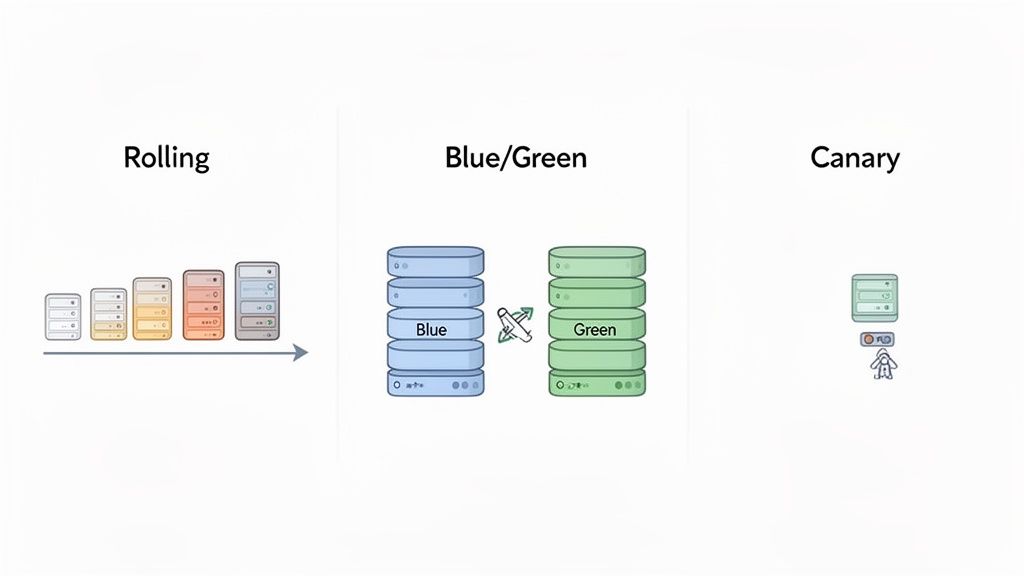
Let’s look at the most common strategies—rolling, blue/green, and canary. In theory, they sound great. In practice, building the orchestration to make them work reliably is a massive, costly headache.
Rolling Deployments: The Workhorse Method
A rolling deployment is the go-to for many teams. It works by gradually replacing old instances of a service with new ones, one-by-one or in small batches. It's resource-efficient because you aren't doubling your infrastructure.
But it has a glaring weakness: the risk of a partial outage. For a period, you have both old and new code running side-by-side. If the new version is buggy, a slice of your users will feel the pain before you can hit the brakes and roll back. This also makes debugging a nightmare, as you're left trying to figure out which version is causing the trouble.
Blue/Green Deployments: The Safer, Pricier Option
With a blue/green deployment, you spin up an entirely new, identical production environment ("green") alongside your live one ("blue"). The new version gets deployed to the green environment, where you can run final checks in complete isolation.
Once you’re satisfied, you just flip a switch at the router level, and all traffic instantly shifts from blue to green. The old blue environment stays on standby for an immediate rollback if needed. It’s incredibly safe, but the downside is obvious: it can be prohibitively expensive. You’re effectively doubling your infrastructure costs across AWS, GCP, or Azure for the entire deployment window, a deal-breaker for any cost-conscious startup or scale-up.
The real challenge with these strategies isn't understanding the theory; it's the sheer operational overhead of building them. We're talking custom scripts, complex load balancer rules, and meticulous monitoring to make the handoff seamless—a huge distraction from building your product.
Canary Releases: The Precision Approach
A canary release is the most sophisticated method. You roll out the new version to a tiny fraction of users—your "canaries"—while everyone else continues using the stable version. You then monitor this small group closely for key metrics like error rates and latency.
If everything looks healthy, you gradually dial up traffic to the new version until 100% of users are on it. This gives you surgical control and minimises the blast radius if something goes wrong. But all that precision comes with a hefty complexity tax. It requires advanced traffic management (often using a service mesh like Istio), deep monitoring, and automated health checks to work reliably. Building this yourself is a major engineering project.
The push for advanced automated deployments has been huge, especially in tech-forward regions like Europe and Singapore. For example, some fintech firms using modern DevOps platforms have cut deployment times by over 70%, moving from hours-long manual processes to fully automated pipelines that finish in minutes. Regional DevOps surveys show that teams using these techniques saw a significant drop in production incidents. You can dig into more research on regional DevOps trends and their impact.
Abstracting Away the Complexity
Each one of these strategies demands a ton of orchestration under the hood. It leaves your team with a critical choice: do you pour engineering hours into building and maintaining this complex deployment machinery, or do you stay focused on your product?
This is where a modern multi-cloud DevOps platform completely changes the game. It abstracts away all the gnarly custom scripting and manual oversight. A developer can simply pick a battle-tested strategy like "canary" or "blue/green" from a straightforward interface. The platform handles the traffic shifting, health checks, and rollback procedures automatically, no matter which cloud you’re on. If you want to learn more about these modern approaches, check out our guide on GitOps vs. Traditional CI/CD.
This frees your team to deploy with confidence, speed, and safety, without ever needing to become experts in the low-level mechanics of deployment orchestration.
Taming Complexity with Built-In Observability and Security
When your architecture explodes from a few services to hundreds, just figuring out what's going on becomes a monumental task—never mind keeping it secure. The complexity doesn't just add up; it multiplies. This is the exact point where most homegrown developer platforms start to crumble.
Two things make or break any production system: observability and security. Getting these wrong isn't just a technical hiccup—it's an existential threat to your product's reliability and your company's reputation. Building these systems from scratch is a massive, ongoing engineering project that quietly bleeds resources away from your actual business.
From Data Overload to Actionable Insights
Observability is more than just collecting logs, metrics, and traces. The real challenge—and where the value lies—is making sense of it all when an incident strikes.
In a distributed system, a single user request can trigger a chain reaction across dozens of microservices. When something breaks, the root cause could be buried anywhere. The real work is piecing together scattered data to find the problem, fast.
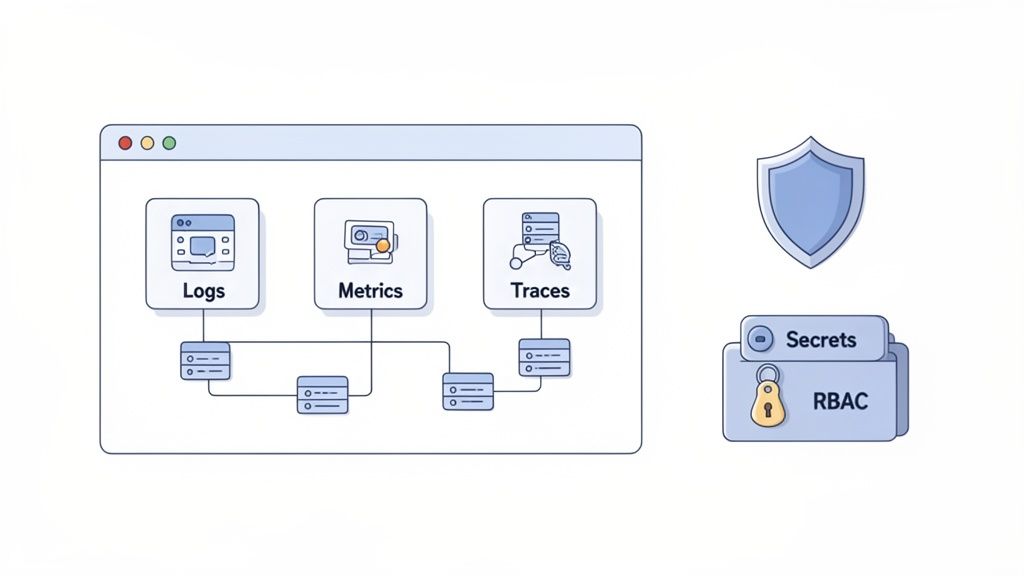
A cohesive observability stack must connect the dots:
- Logs give you the granular, event-level story of what a service was doing.
- Metrics provide the high-level, aggregated view of system health.
- Traces follow a single request from start to finish, mapping its journey through your services.
Trying to stitch these together manually with open-source tools is a full-time job. You need a unified view that connects a spike in a metric to the exact trace that caused it, and then directly to the logs that explain why it happened. Without that, your team is flying blind during an outage.
Building a world-class observability platform in-house is like deciding to build your own CRM. It’s a huge distraction from what you’re actually supposed to be doing, and you’ll spend years just trying to catch up to solutions that have already solved these problems at scale.
The impact of integrated monitoring is hard to overstate. Some scale-ups have used automated strategies to handle huge traffic spikes with horizontal autoscaling, maintaining fast response times and drastically cutting downtime costs. Studies on AI-powered monitoring also show it can boost reliability in distributed systems significantly. You can discover more about the impact of microservices architecture in recent industry reports.
Security Is Not an Afterthought
In a microservices world, your attack surface grows with every service you deploy. Relying on ad-hoc security practices and a patchwork of tools is practically an invitation for disaster.
A solid security posture can't be bolted on at the end; it has to be woven into the fabric of your deployment process from the very start.
Key Pillars of Microservice Security
If you build a secure platform yourself, you're on the hook for getting several critical components right—all demanding deep expertise.
Centralised Secrets Management: Every service needs secrets: API keys, database credentials, certificates. Scattering them in config files or environment variables is a recipe for a breach. You need a single, encrypted vault with airtight access controls.
Role-Based Access Control (RBAC): Not everyone on your team should be able to deploy to production. Implementing granular RBAC policies ensures developers have just enough access to do their jobs—and no more.
Automated Policy Enforcement: Manually reviewing every deployment for security compliance is impossible at scale. Security policies must be enforced automatically within the CI/CD pipeline, blocking any change that breaks your rules.
A managed DevOps platform bakes these capabilities in from day one. It gives you that single pane of glass for observability and enforces security automatically, delivering a production-ready system without you needing a dedicated team to build and maintain it.
Mastering Multi-Cloud Deployments and Cost Control
For any ambitious scale-up in Europe, Singapore, or the US, getting locked into a single cloud provider like AWS, GCP, or Azure is a massive strategic risk. It kills negotiation leverage, prevents you from cherry-picking the best services, and leaves you vulnerable to vendor-specific outages.
But the dream of multi-cloud freedom often crashes into the harsh reality of staggering operational complexity.
Running automated deployments for microservices consistently across different clouds is a monumental engineering headache. Your team can no longer rely on provider-specific tools. Instead, they’re forced to build a complicated abstraction layer just to make a deployment to AWS look and feel the same as one to GCP.
The Multi-Cloud Abstraction Nightmare
Committing to a multi-cloud strategy means inheriting the burden of managing completely different and incompatible systems. This isn’t a minor inconvenience; it’s a full-time infrastructure project that quietly drains your engineering resources.
Your team suddenly becomes responsible for:
- Juggling provider-specific APIs: The way you configure a load balancer in AWS is a world away from how you do it in Azure. Your platform team now has to hide that complexity from developers.
- Wrangling disparate IAM policies: Each cloud has its own unique Identity and Access Management (IAM) system. Creating a consistent set of roles and permissions that works everywhere is a frustrating and difficult task.
- Unifying networking and security: How do you manage firewall rules, VPCs, and network peering between clouds securely and consistently? This often requires specialised expertise you don't have in-house.
Without a unified platform, your engineers are forced to become experts in the arcane details of multiple clouds—a huge distraction from their real job: building your product.
Tackling Runaway Cloud Costs
On top of multi-cloud complexity comes an even bigger problem: runaway cloud costs. With microservices, it’s terrifyingly easy for your cloud bill to spiral out of control.
Every new service, environment, and developer experiment adds another line item to a bill that gets more unpredictable each month.
Most engineering leaders are flying blind. They see a massive, terrifying bill at the end of the month but have no easy way to attribute those costs back to specific features, teams, or services.
The culprits are almost always the same: over-provisioned resources and idle environments. Developers spin up powerful instances for testing and forget to turn them off. Staging and QA environments run 24/7, burning cash on nights and weekends when no one is using them.
This waste adds up silently, becoming a major drag on your company’s financial health.
Implementing Intelligent Cost Controls
Getting your cloud spend under control isn’t about a reactive panic at the end of the quarter. It requires a proactive approach—building cost optimisation right into your deployment platform.
Effective cost control is an ongoing discipline, not a one-off task. It requires purpose-built tooling to manage:
- Intelligent Autoscaling: Automatically scale services up for peak traffic and, just as importantly, scale them down to zero during idle periods. Why pay for capacity you aren't using?
- Resource Right-Sizing: Continuously analyse usage patterns to ensure you’re using the most cost-effective instance types for each workload, not the expensive defaults.
- Automated Environment Scheduling: Implement "office hours" for non-production environments. Shut them down automatically outside of working hours and spin them back up in the morning.
Building this cost management intelligence yourself is a huge undertaking. A unified multi-cloud DevOps platform solves these challenges from day one. It provides a single, consistent workflow for deploying to AWS, GCP, and Azure, completely abstracting away provider-specific complexity.
More importantly, it has cost optimisation features built into its core. A platform like PushOps delivers the visibility and automated controls you need to enforce budgets, eliminate waste, and make your cloud spend predictable—all without slowing down your developers.
The Strategic Shift From Building Platforms to Delivering Value
Let's be blunt. As a CTO or engineering leader, your core genius is your product, not cloud infrastructure. This isn't just a summary—it's a call to be realistic about where your team's most valuable asset, their time, is actually going.
Every hour an engineer sinks into debugging a CI/CD pipeline, writing deployment scripts, or wrestling with Kubernetes is an hour they didn't spend building your competitive advantage. You are, in effect, building a second, internal product. The problem? This product generates zero revenue but consumes a massive amount of resources.
This distraction quietly builds, creating a drag on your company’s momentum. The whole point of automated deployments for microservices was to go faster, yet so many teams are now bogged down by the very tools that were supposed to liberate them.
The Real Cost of Internal Platforms
Viewed through a strategic lens, the choice becomes clear. Do you keep pouring money and talent into a distracting, costly internal developer platform? Or do you adopt a managed platform that provides production-grade infrastructure out of the box?
An internal platform demands dedicated headcount, constant maintenance, and a perpetual R&D budget just to keep up with the ever-changing landscape across AWS, GCP, and Azure. The total cost of ownership goes far beyond salaries; it’s measured in missed market opportunities and slower feature delivery.
The most expensive engineer is one who is brilliant at product development but is forced to spend half their day on infrastructure troubleshooting. Your goal isn't to build the perfect DevOps stack; it's to ship a market-winning product.
A modern, multi-cloud DevOps platform realigns your team with that goal. It gives you a reliable, secure, and cost-effective foundation, letting your engineers focus entirely on innovation.
Empowering Developers to Ship Faster
Imagine a world where your developers have a true self-service workflow. They commit code, and a battle-tested pipeline automatically handles the build, security scans, testing, and deployment to any environment, on any cloud. This isn't a far-off dream; it's the day-to-day reality a unified platform provides.
This shift delivers powerful business outcomes:
- Faster Shipping Cycles: Developers release features in minutes, not days, dramatically accelerating feedback loops and time-to-market.
- Higher Engineering Morale: You free engineers from frustrating operational toil so they can focus on the creative, high-impact work they were hired for.
- Confident Scaling: Your business can grow without your infrastructure becoming a bottleneck, ensuring reliability and performance when you need it most.
Adopting a managed platform like PushOps isn’t just a tooling decision; it's a strategic partnership. It’s choosing to accelerate your business goals by giving your team a system that makes shipping simple, secure, and scalable by default.
FAQs
Got questions? Here are a few things that engineering leaders at startups and scale-ups often ask when considering automating their microservices deployments.
How Does Automating Deployments Make Things More Secure?
It’s all about consistency. Automated deployments enforce a standardised, repeatable release process, which eliminates the manual configuration errors that often create vulnerabilities.
By embedding automated security scanning (SAST, DAST) directly into your CI/CD pipeline, you catch potential issues before they ever reach production. A modern multi-cloud DevOps platform takes this further by providing role-based access control (RBAC), centralised secrets management, and detailed audit logs from day one, so every change is authorised and traceable.
What's the Biggest Hurdle to Getting Started?
Honestly, the biggest challenge is often cultural, not technical. It’s about shifting the team’s mindset from 'gatekeeping' every release to empowering developers with self-service tools that operate within clear, safe guardrails.
On the technical side, the heaviest lift is the initial time and effort to build a truly reliable CI/CD pipeline and a comprehensive suite of automated tests. This is exactly the kind of complex, time-consuming work that a managed DevOps platform handles for you, allowing you to bypass months of foundational engineering and focus on your product.
Can We Do This Without Going All-In on Kubernetes?
Absolutely. While Kubernetes is a powerful orchestrator, the core principles of automation apply just as well to other environments. You can automate deployments to AWS ECS, Google Cloud Run, or even traditional VMs managed with tools like Ansible.
The key is to use a platform that abstracts away the underlying infrastructure. That way, your deployment process stays consistent no matter where your code is running. This abstraction is a central benefit of a unified multi-cloud DevOps platform that can deploy across AWS, GCP, and Azure without requiring different scripts for each one.
Stop wrestling with infrastructure and start shipping features. PushOps gives your team a production-ready, multi-cloud platform with automated deployments, observability, and security built-in. See how PushOps works.

