


Every CTO and VP of Engineering feels the relentless pressure to innovate. But so often, progress grinds to a halt because of traditional release cycles that culminate in a stressful, all-hands-on-deck "big bang" deployment. This creates a painful loop where the fear of breaking things slows down the very teams meant to be building your future.
Stop Letting Risky Deployments Stall Innovation
If you're leading a team at a startup or a scale-up, you've probably felt this frustration. You're sinking valuable engineering hours into managing infrastructure instead of building your core product. You know the tension between shipping new features fast and keeping the lights on. The old way of doing things—long-lived feature branches, chaotic merges, and all-or-nothing deployments—is fundamentally broken. It forces your best engineers to wrestle with a complex DIY DevOps stack across AWS, GCP, or Azure instead of creating value for your customers.
This is where a fundamental shift in software delivery comes into play: separating deployment from release. Think of it like this: pushing new code to production and making a feature available to users become two completely independent events. This separation is the key to making your releases predictable, measurable, and, most importantly, safe.
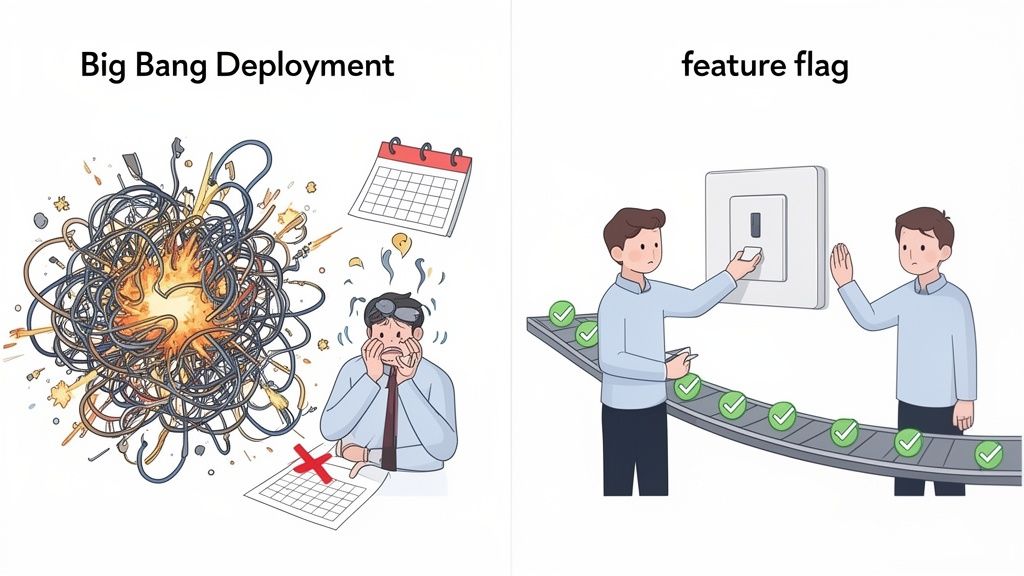
From Chaos to Control
The "deploy and pray" model is a relic of the past. Modern engineering teams need a way to de-risk the entire delivery process. Feature flags and safe releases are the tools that make this a reality. Instead of one massive, high-stakes event, you can introduce changes incrementally and with full control.
This isn't just some niche trend; it’s a seismic shift in how software gets built. The global feature flags market, already valued at $3.4 billion, is expected to rocket to $9.8 billion by 2033. This explosive growth proves that engineering leaders are actively moving away from risky deployments to cut down on failures and ship faster. You can explore more data about this market adoption to see the full picture.
The Hidden Cost of DIY DevOps
Many teams try to build this capability in-house, only to sink immense time and money into a custom internal developer platform. It’s a classic trap. You end up over-investing in a tangled web of tools for Kubernetes, CI/CD, monitoring, and release orchestration that demands constant care and feeding. This is the definition of undifferentiated heavy lifting—work that distracts you from your actual mission of building a great product.
What teams really want is a reliable, production-ready platform so they can focus on shipping features. Instead of hiring more DevOps engineers to manage a bespoke stack, a modern multi-cloud DevOps platform gives you a solution out of the box. It streamlines everything from setup and scaling to security and cloud cost control, freeing your team to focus on what they do best: building a great product.
How Feature Flags Enable Modern Safe Releases
At its simplest, a feature flag is just an on/off switch for a piece of your application’s code. These toggles give your team fine-grained control to show or hide functionality for specific groups of users, all without needing to deploy new code. It's a powerful idea that fundamentally changes how you ship software.
Under the hood, a feature flag is little more than a conditional statement—an if/else block—wrapped around your new feature. This bit of code checks whether a flag is "on" or "off" for a given user before deciding what to show them. If the flag is on, they get the new experience; if it's off, they see the old one. It’s that straightforward.
This simple mechanism is the bedrock of a much safer, more modern way to deliver software. By tucking new or unfinished features behind these flags, you separate the act of deployment from release. Your engineers can continuously merge their work into the main branch and deploy it straight to production, knowing it remains hidden and inert until you decide to flip the switch.
Escaping The Old Way of Working
This level of control provides a real escape from the tangled mess of long-running feature branches and those dreaded "big bang" rollouts. Instead of wrestling with painful merge conflicts and high-stakes deployment nights, your teams can move faster and with far less risk.
This approach transforms your entire release process from a source of stress into a controlled, strategic activity. It gives you the power to:
- Merge and deploy incomplete work safely by keeping it hidden behind a flag until it’s truly ready for users.
- Eliminate the need for separate release branches, dramatically simplifying your Git workflow and cutting down on integration headaches.
- Test new features in production with real traffic but without affecting your entire user base.
A feature flag turns a high-risk deployment into a low-risk business decision. You’re no longer asking, "Will the deployment break something?" but rather, "Are we ready to show this feature to our customers?"
Of course, building the infrastructure to manage these flags at scale is where the real complexity and hidden costs lie. You need a rock-solid system to handle targeting rules, ensure low-latency flag evaluations, and provide clear audit trails. Trying to build a DIY solution quickly becomes a full-time job, pulling your best engineers away from product development and into infrastructure maintenance.
This is exactly the problem that a modern multi-cloud DevOps platform solves. It offers a production-ready feature flagging system that’s already integrated with your CI/CD pipeline and monitoring tools across AWS, GCP, and Azure. Instead of building this complex system from scratch, you get a reliable, scalable solution out of the box, letting your team focus on what they do best: shipping great features, not managing flags.
Key Strategies for Controlled Software Releases
Realising that feature flags are basically remote controls for your code is the first step. The real magic happens when you use those controls to roll out powerful release strategies that turn deployments from high-stakes gambles into safe, predictable activities. With flags, you can finally stop rolling the dice and start making data-driven decisions about how and when your users get new features.
These strategies are what unlock the full potential of feature flags and safe releases. They let you test new ideas, check performance in the wild, and build confidence long before you commit to a full, "big bang" launch.
This diagram breaks down the core idea. You can see how new code gets wrapped inside a flag, effectively giving you an on/off switch for its release.
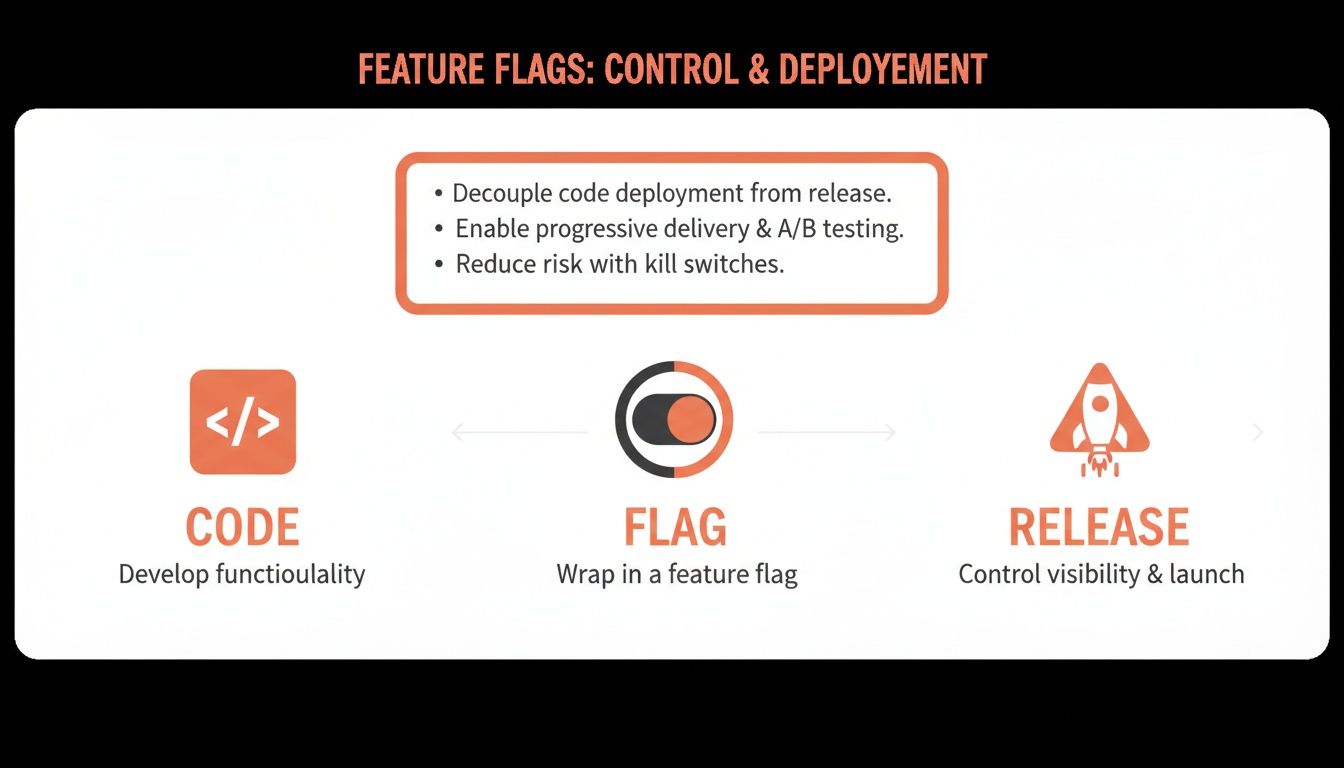
The concept is simple but profound: you can deploy code to production, but the feature it contains stays dormant until you decide to flip the switch. This separates the act of deploying code from the act of releasing a feature.
Canary Releases
A canary release is like sending a scout into new territory before the main army. You expose a new feature to a tiny, controlled slice of your user base—often just internal teams, beta testers, or a small percentage of live users—to see how it behaves in a real production environment.
For instance, a UK-based fintech startup could use a canary release to test a new AI-powered transaction categorisation engine. They might turn it on for just their own employees first. This lets them find bugs and measure performance with real data without affecting a single customer.
Dark Launching
Dark launching is a slick technique for testing backend changes under real-world load without anyone on the frontend even knowing it's happening. You can deploy new infrastructure, a refactored service, or a new third-party API integration and run it "dark." It processes production traffic in the background while users continue to see and interact with the old system.
Imagine you're swapping out a core payment gateway—a terrifying prospect. A dark launch lets you route a copy of production payment requests to the new gateway in parallel with the old one. You can compare response times, error rates, and success statuses without risking a single real transaction. It's a non-negotiable risk-mitigation strategy for any mission-critical infrastructure change.
Percentage-Based Rollouts
A percentage-based rollout is probably the most common and intuitive way to progressively deliver a feature. Once you've gained some confidence from a small canary release, you can start to gradually increase the feature's exposure to your entire user base, moving from 1% to 10%, 50%, and eventually 100%.
This incremental approach essentially gives you a volume dial for your features. If you see a spike in errors or negative feedback at 10% exposure, you can instantly turn the dial back down to 0% without a chaotic rollback or an emergency hotfix.
You might, for example, roll out a redesigned dashboard to 1% of users in Singapore. After watching key engagement metrics for 24 hours, you expand it to 10% of users in the US and UK. This controlled, multi-stage process provides a continuous feedback loop and lets you catch problems while their impact is still minimal.
The following table summarises how these release strategies compare in practice.
Comparing Safe Release Strategies
| Strategy | Primary Goal | Ideal Use Case | DIY Complexity |
|---|---|---|---|
| Canary Release | Validate stability and performance with a small, low-risk user group. | New features with unknown impact; testing on internal teams or beta users first. | Moderate |
| Dark Launch | Test backend changes (infrastructure, services) under real production load. | Swapping out critical components like databases, APIs, or payment gateways. | High |
| Incremental Rollout | Gradually release a feature to the entire user base while monitoring for issues. | Releasing a validated feature to all users while minimising risk. | Moderate to High |
While each strategy has its place, they all share a common challenge: building and maintaining the tooling to support them is a massive undertaking.
The hidden costs are huge. Your engineers will get bogged down building a complex, distributed system just to manage targeting rules, ensure low-latency flag evaluations across global regions (like Europe, the US, and Singapore), and create dashboards to monitor the impact on different user segments. This is all a distraction from what they should be doing: building your actual product.
This is where a managed multi-cloud DevOps platform comes in, providing this sophisticated release orchestration out of the box. You get all the power of canary, dark, and percentage-based releases across AWS, GCP, and Azure, without writing a single line of infrastructure code. This approach also fits perfectly with modern workflows like GitOps, which you can read more about in our guide on GitOps vs traditional CI/CD.
Integrating Flags Into Your CI/CD and Monitoring
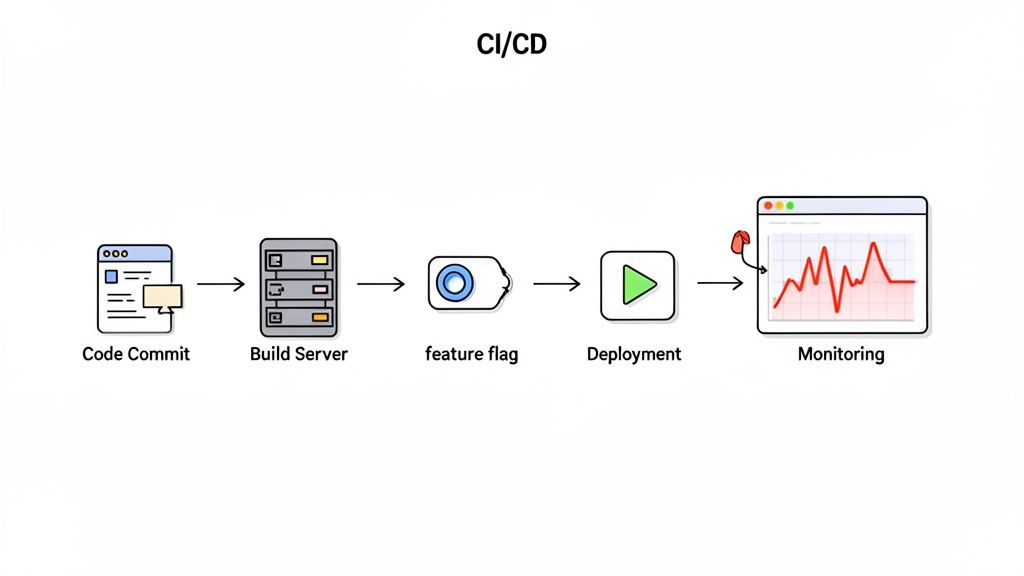
Truly effective feature flags and safe releases are more than just if/else statements sprinkled through your code. They’re operational tools. To get the most out of them, you have to weave them deeply into your development and monitoring workflows.
When flags are managed in a silo, they just create confusion. It becomes nearly impossible to connect cause and effect when you’re rolling out a change. To genuinely de-risk deployments, you must treat flag management as a core piece of your CI/CD pipeline and observability stack. This is how you build a seamless flow from code commit all the way to controlled release and performance analysis.
Connecting Deployments to Observability
The biggest headache with a DIY flagging setup is the disconnection between tools. Your feature flagging system runs in its own world, completely separate from the dashboards where you watch your application's health. This forces your engineers to constantly switch contexts, trying to piece together a story from fragmented data.
Picture this all-too-common scenario: you enable a new feature for 5% of your users in the UK. Ten minutes later, your alerts fire—there’s a latency spike in your main database. Was it the feature? Or something else entirely?
With a disconnected, home-grown system, finding the answer is a frantic scramble. Your team is now manually correlating deployment events with metric changes, cross-referencing timestamps, and digging through logs. This operational overhead is a huge hidden cost, slowing down your incident response and eroding the very confidence you were trying to build.
A truly effective release process requires a single, cohesive workflow. You need one place to deploy code, flip a switch to enable a feature, and immediately see the impact on performance metrics—all without juggling multiple dashboards.
A modern DevOps platform designed for the multi-cloud world (across AWS, GCP, and Azure) solves this. It natively integrates deployment, flagging, and observability, giving you one unified view. When you toggle a flag, the platform automatically annotates your performance graphs, making the link between a release and its impact instantly obvious.
Managing Flag Configurations as Code
For the sake of control and consistency, best practice dictates managing your flag configurations as code. Just like your application and infrastructure, your flag rules—who a feature is enabled for, what percentage of users see it—should be version-controlled, reviewed, and auditable.
This "Flags as Code" approach gives you several key benefits:
- Auditability: You get a clear Git history of every change made to your feature flags. You can see who changed what, when, and why.
- Consistency: With rules defined in code, you ensure they're applied consistently across your development, staging, and production environments.
- Automation: You can automate the creation and modification of flags as part of your deployment process.
But trying to build this workflow yourself adds another layer of complexity to your DIY DevOps stack. You have to create custom tooling to sync flag definitions from a Git repository to your flagging service, build validation checks, and make sure the whole process is secure.
This is another classic example of undifferentiated heavy lifting that distracts your team from their real job. A managed platform provides this capability out of the box, integrating directly with your Git provider. It lets your team manage feature flags and safe releases using the same familiar pull request workflow they use for everything else. You can get more insights on how this compares to traditional methods in our guide on zero-maintenance CI/CD pipelines.
This integrated approach doesn't just make operations simpler; it empowers your team. Developers can ship features faster and with more confidence, knowing they have a safety net of integrated monitoring and automated controls to stop a bad release from ever impacting most of your users.
Avoiding The DIY Trap: The Case For A Managed Platform
We've walked through the power of feature flags and safe releases all through this guide. It's clear how they can turn high-stakes deployments into controlled, data-backed rollouts. But for every CTO and VP of Engineering, this all boils down to one critical question: do we build this capability ourselves, or do we adopt a managed solution?
Many engineering leaders, especially at startups and scale-ups, start with the best of intentions. Their mission is to build a killer product, not a custom-made internal developer platform. But the road to a DIY feature flagging system is paved with hidden costs and complexities that suck up resources and shift focus away from what truly matters—your customers.
The True Cost of a Homegrown System
Building your own system sounds tempting. How hard could it be, right? The truth is, the initial build is just the tip of the iceberg. The real cost is buried in the undifferentiated heavy lifting needed to maintain, scale, and secure it over time.
You're not just building a simple toggle service. You're committing to building and running a globally distributed, low-latency, and highly available system. This involves a lot more than you'd think:
- Specialised Talent: You’ll need to hire or pull your expensive DevOps and Site Reliability Engineers (SREs) off product work to manage this complex infrastructure. Suddenly, your best people are focused on internal tooling instead of your core product.
- Massive Engineering Overhead: Your team will get bogged down maintaining SDKs for different languages, building user interfaces, implementing robust access controls, and making sure the entire system can scale across multiple cloud providers like AWS, GCP, and Azure.
- Opportunity Cost: This is the biggest hidden cost of all. Every single hour your team spends on internal infrastructure is an hour not spent shipping features that generate revenue or make your users happy.
The reality is that most teams over-invest in building and maintaining their own DevOps stack. You're solving problems that have already been solved, diverting precious capital and talent away from what makes your business unique.
The Case for a Managed Multi-Cloud DevOps Platform
A modern multi-cloud DevOps platform abstracts this entire problem away. It delivers a production-ready, secure, and scalable solution for CI/CD, feature flags, and observability straight out of the box.
Instead of your team building the infrastructure, they just use it. The platform handles all the underlying complexities of running a feature flagging system consistently across AWS, GCP, and Azure. It provides a single, unified control plane to manage releases, monitor performance, and ensure security without the DIY headache.
This is the key to unlocking your team's true potential. You can stop sinking time and money into a custom-built DevOps stack and instead adopt a platform that lets your engineers do what you hired them to do: ship great software, safely and quickly. By taking on the operational burden, a managed solution allows you to focus 100% on product innovation. To dig deeper into this, you can explore the benefits of a consolidated DevOps cloud infrastructure platform.
Frequently Asked Questions About Feature Flags
Even with a solid grasp of the strategies, engineering leaders often have practical questions about putting feature flags and safe releases into practice. Let’s tackle some of the most common concerns that CTOs, VPs of Engineering, and developers bring up when they consider this modern approach to shipping software.
How Are Feature Flags Different From Configuration Settings?
On the surface, feature flags and config settings might look alike, but they serve completely different purposes and have their own distinct lifecycles. Confusing the two is a common mistake that quickly leads to a mess.
A configuration setting is usually static and meant to stick around. Think of it as a permanent piece of your app’s DNA, like a database connection string or a third-party API key. Its value might change between environments (dev, staging, prod), but the setting itself is there for the long haul.
Feature flags, on the other hand, are dynamic and, most importantly, temporary. They’re created for one specific job: to manage the lifecycle of a new feature. Their whole purpose is to guard a new code path during development, testing, and a gradual rollout. Once the feature is fully live and stable, the flag’s work is done, and it should be removed from the code.
Treating feature flags like permanent configuration is one of the fastest ways to pile up technical debt. The idea is to use a flag for a release and then clean it up, not leave it in your codebase forever.
Will Feature Flags Make Our Codebase Complicated?
They definitely can, but only if they’re not managed properly. This is a huge risk with DIY systems. Without a structured process for a flag's entire journey—from creation all the way to removal—your codebase can get cluttered with dozens, or even hundreds, of stale if/else statements.
This leftover code, often called "flag debt," makes the application harder to read, test, and maintain. Every old flag is a dead code path that adds cognitive load for your developers. This is where the hidden costs of a home-grown solution really start to spiral.
A managed platform stops this problem by design. It gives you a central dashboard that acts as the single source of truth, showing every flag's status, usage, age, and owner. This makes it trivial to identify and schedule old flags for removal as a standard part of your team's workflow, keeping your code clean and your technical debt in check.
Who Should Be Able To Control Production Feature Flags?
The thought of giving teams the power to change production behaviour with a single click is a major concern for any engineering leader. Without the right governance, feature flags can introduce a whole new class of operational risk. Who can flip a switch that affects live traffic? Is there a clear audit trail?
These are critical questions you have to answer. Essential governance patterns include:
- Role-Based Access Control (RBAC): Defining clear permissions for who can create, modify, and toggle flags in different environments. For example, developers can toggle flags in staging, but only SREs can touch them in production.
- Approval Workflows: Requiring a second set of eyes or a formal sign-off before a flag can be changed in a production environment.
- Comprehensive Audit Logs: Keeping an unchangeable record of every single flag change—showing who changed what, from where, and when.
Building a secure, auditable, and permission-based system from scratch is a massive and error-prone undertaking. It's a full-time security and infrastructure challenge. In contrast, a modern DevOps platform like PushOps provides this robust, secure-by-default governance from day one, giving you the control you need without the DIY headache.
How Do Feature Flags Work In A Multi-Cloud Environment?
For startups and scale-ups running on AWS, GCP, and Azure, keeping things consistent is a major engineering hurdle. Managing feature flags effectively in a multi-cloud or hybrid setup is a complex systems problem that can seriously pull your team away from building your product.
A DIY solution would force you to build a globally distributed, low-latency service just to evaluate and serve flag states to all your applications, no matter where they run. You'd be on the hook for synchronisation, performance, and reliability across different cloud providers—a significant operational burden.
A multi-cloud platform solves this by giving you a unified control plane. You define your flags and targeting rules in one central place, and the platform handles the hard work of propagating them consistently and efficiently across all your environments. This makes sure a feature behaves the same way for a user in the US served from AWS as it does for a user in Singapore served from GCP.
Tired of your best engineers spending their time on infrastructure instead of your product? PushOps provides a production-ready DevOps platform that automates builds, deployments, and safe release strategies across AWS, GCP, and Azure. Stop building a DIY platform and start shipping features that matter.

