
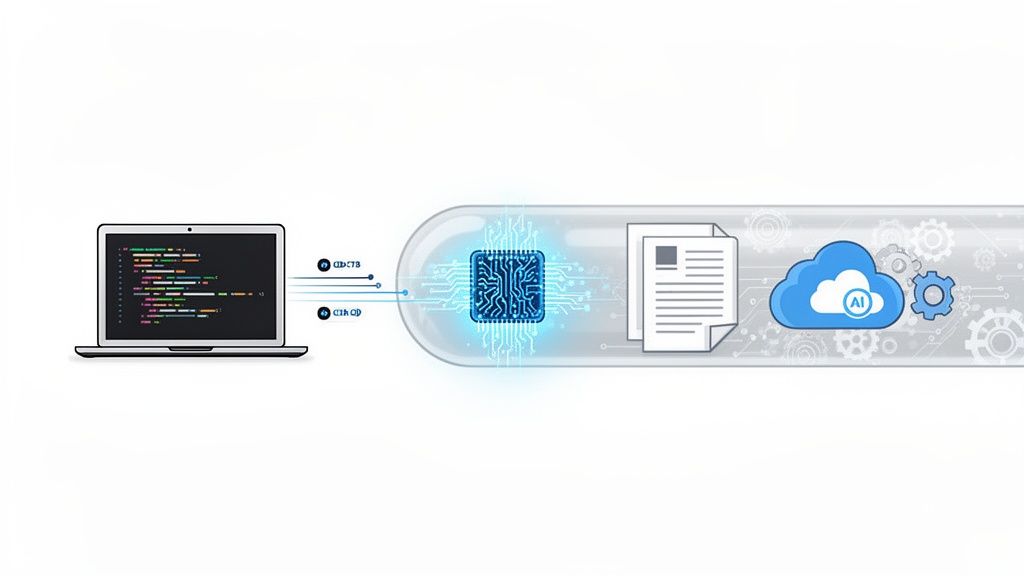

An AI content generation DevOps pipeline is a brilliant way to automate tasks like writing changelogs or documentation right inside your software delivery workflow. It’s a huge time-saver for developers, but for most teams, it acts as an unexpected stress test, revealing critical weaknesses in their underlying infrastructure. This is especially true for those trying to build and maintain their own complex, DIY DevOps stack.
Stop Building Infrastructure and Start Shipping Product
Your engineers are your most valuable asset. The problem is, they're probably spending more time on infrastructure maintenance than on creating real customer value.
As a CTO or VP of Engineering, you see this firsthand. Your best developers are stuck wrestling with Kubernetes configurations, patching brittle CI/CD scripts, and trying to make sense of unpredictable cloud bills. They should be shipping features, but instead, they're doing plumbing. This isn’t just a technical headache; it’s a strategic flaw that quietly bleeds your productivity and budget.
Most engineering teams fall into the trap of over-investing in a DIY DevOps stack. I see the same patterns again and again:
- Kubernetes Management: The sheer complexity of setting up, securing, and scaling Kubernetes clusters is immense and often underestimated.
- CI/CD Pipeline Maintenance: Teams spend countless hours updating and fixing fragile scripts for tools like Jenkins, GitLab CI, or GitHub Actions.
- Multi-Cloud Chaos: Juggling different environments across AWS, GCP, and Azure with no unified control plane is a recipe for disaster.
- Hidden Costs: The true Total Cost of Ownership for a self-managed platform isn't just server costs. It’s the salaries for a dedicated platform team and, more importantly, the lost productivity from your product engineers.
The reality is that your goal isn't a complex DevOps setup; it's a stable, production-ready platform that lets your team innovate. Your engineers want to focus on building the product, not the plumbing underneath it.
The AI Pipeline as a Stress Test
An AI content generation DevOps pipeline is a perfect example of a modern workflow that can instantly expose the fragility of a self-managed stack. While powerful, integrating AI models introduces new layers of complexity. You suddenly need to worry about API key management, model versioning, automated quality checks, and cost monitoring.
If your current infrastructure already struggles with basic deployments, it will absolutely buckle under the weight of these advanced workflows. It's crucial to have a solid foundation first, and you can get a better handle on this by exploring the principles of continuous delivery for early-stage startups.
This is where a modern, multi-cloud DevOps platform completely changes the game. Instead of trying to build everything in-house or hiring more DevOps engineers, you can adopt a managed solution. It gives you a reliable, production-ready platform out-of-the-box, taking care of the setup, scaling, monitoring, security, and cloud costs across AWS, GCP, and Azure.
Ultimately, it allows your team to finally get back to what they were hired to do: ship great products.
Architecting Your AI-Powered Content Pipeline
When you start weaving AI into your development lifecycle, you need an architecture that’s built to last. A great starting point for an AI content generation DevOps pipeline is a simple webhook-triggered workflow. This connects your Git repository straight to your AI service of choice. Just think: a developer pushes a commit, and that single action kicks off an automated process to draft release notes or update your API documentation.
But right away, you’ll hit a major fork in the road. Do you self-host an open-source model like Llama 3, or do you tap into a managed API from a provider like OpenAI or Anthropic?
For most engineering teams, especially if you're at a startup or scale-up, using a managed API is the clear winner. The setup is worlds faster, and you completely sidestep the headache of model maintenance, versioning, and scaling.
Going the self-hosting route gives you more control, sure, but it comes with a massive—and often hidden—operational tax. You’re suddenly on the hook for provisioning GPU infrastructure, managing model updates, guaranteeing uptime, and securing the whole stack. This isn't innovation; it's complex infrastructure management that pulls your best engineers away from what they should be doing: building your product.
The Hidden Costs of DIY DevOps
Trying to build this AI pipeline on a self-managed stack, whether you're on AWS, GCP, or Azure, just piles on layers of complexity that quietly eat away at your resources. You're no longer just managing the AI part; you're wrestling with the entire platform it sits on.
This cycle of hidden costs is something we see teams fall into all the time with DIY infrastructure.
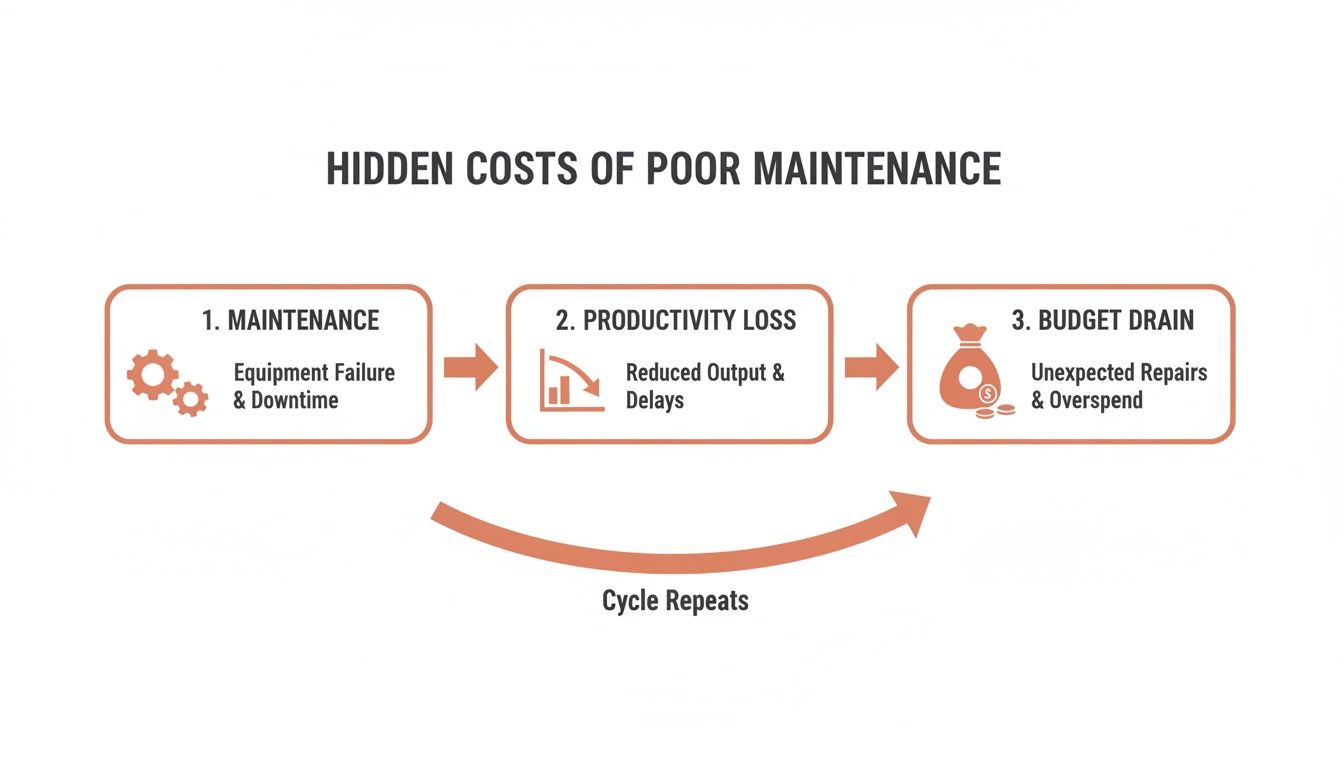
As the visual shows, that constant maintenance directly torpedoes engineering productivity, which then becomes a persistent drain on your budget.
This isn't just a local problem; it's a global trend. Take Lithuania, a digital powerhouse in the Baltics, where AI adoption has shot up to 21.0%, leaving many of its European neighbours behind. This boom is all about modernising key sectors—including software development—by using AI to drive efficiency. You can explore the full report on AI adoption in the Baltics to get the bigger picture.
Abstracting the Complexity
This is where a modern, multi-cloud DevOps platform really changes the game. It gives you a production-ready foundation that abstracts away all that gnarly infrastructure, no matter if you're on AWS, GCP, or Azure.
Instead of your team burning weeks configuring servers, networking, and security policies, they get a streamlined, self-service workflow. The platform handles the heavy lifting, empowering your developers to focus on high-value logic.
What this means in practice is that your engineers can get back to defining the workflow—what gets generated and when—instead of getting lost in the weeds of how the infrastructure works. They can build powerful automations, like generating technical documentation from code comments, without ever having to look at a Kubernetes config file. The platform provides the stability and scalability an AI content generation DevOps pipeline demands, letting you innovate much, much faster.
Automating the Pipeline with Practical CI/CD Integrations
An architecture plan is great, but it’s just theory. The real magic happens when you turn that blueprint into a living, breathing system. This is where we get practical and wire AI content generation directly into your CI/CD workflow. It’s the difference between a neat idea on a whiteboard and an automated process that reclaims hours of your team’s time every single week.
Picture this: a successful build automatically kicks off an AI job. The model instantly drafts technical documentation from the new code, summarises commits into a clean changelog, or even writes user-facing update announcements. This isn't some far-off fantasy; it’s exactly what an AI content generation DevOps pipeline delivers.
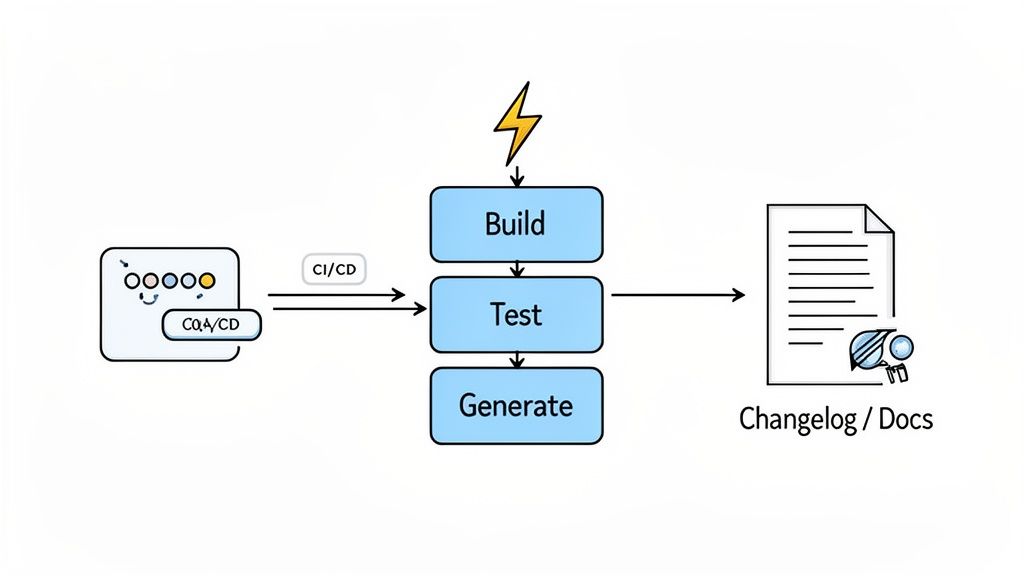
This is the exact point where many teams get stuck. They jump straight into writing custom scripts for GitLab CI or GitHub Actions, only to end up maintaining a tangled mess of brittle, hard-to-debug code. It’s a classic pipeline trap.
The DIY Path vs. Managed Simplicity
Going the DIY route always looks simple enough at first. You just add a new stage to your .gitlab-ci.yml or a new job to your GitHub Actions workflow that pings your chosen AI model's API. Easy, right?
But that first script is just the tip of the iceberg. Suddenly, you’re on the hook for managing a whole lot more:
- Secrets Management: Juggling API keys securely across dev, staging, and production environments without accidentally leaking them.
- Error Handling: What’s the plan if the AI service times out, goes down, or sends back a garbled response? The pipeline can’t just fail.
- Retries and Idempotency: You need to make sure jobs don't run multiple times and create duplicate, confusing content.
- Versioning: Your prompts and model choices will evolve. You need a way to manage and track these changes just like any other piece of code.
Each of these problems adds another layer of complexity, pulling your senior engineers away from building your actual product and into full-time pipeline maintenance. This is where the hidden costs of a self-managed stack really start to bite. You can dive deeper into avoiding this kind of complexity by understanding the principles of zero-maintenance CI/CD pipelines.
Deciding whether to build this integration yourself or use a platform comes down to a trade-off between control and operational overhead.
DIY vs Managed Platform for AI Pipeline Integration
| Aspect | DIY DevOps Stack (Kubernetes, Jenkins, etc.) | Managed Platform |
|---|---|---|
| Initial Setup | High. Requires extensive scripting, YAML configuration, and deep tool knowledge. | Low. Uses visual editors and pre-built connectors for fast integration. |
| Maintenance | High. Engineers must manually manage secrets, error handling, retries, and updates. | Minimal. The platform handles the underlying operational complexity automatically. |
| Expertise | Requires senior DevOps expertise in scripting, security, and specific CI/CD tools. | Accessible. Empowers developers without specialised DevOps skills to add AI steps. |
| Speed to Value | Slow. Weeks or months to build a robust, production-ready integration. | Fast. Deploy powerful AI workflows in hours or days, not weeks. |
| Scalability | Complex. Scaling requires manual adjustments to infrastructure and pipeline code. | Built-in. Designed to scale across multiple teams, projects, and clouds (AWS, GCP, Azure). |
The choice becomes clear when you weigh the long-term cost of maintenance against the initial investment.
A managed platform flips the script entirely. Instead of hand-writing YAML files, your developers can use a visual editor or pre-built modules to chain jobs together. The platform takes care of the tricky parts like secret injection, error handling, and logging behind the scenes.
This is a fundamental shift. It empowers your entire team to add powerful AI features to their workflows without needing to become DevOps gurus. What was once a complex engineering task demanding intimate knowledge of CI/CD internals becomes a straightforward, repeatable process.
A managed DevOps platform gives you a stable, multi-cloud foundation across AWS, GCP, and Azure. Your team gets to focus on the "what"—the valuable content you want the AI to create—instead of getting bogged down in the "how." By abstracting away all that operational grit, you free up your best engineers to do what they do best: ship features that move your business forward.
Ensuring Content Quality and Security Governance
So, you’re automating content creation with AI. That’s great, but it brings a tough new challenge to the table: how do you actually make sure the output is accurate, on-brand, and secure? An AI content generation DevOps pipeline is about more than just cranking out content faster; it’s about scaling trust.
Frankly, letting an AI generate content without proper guardrails is a disaster waiting to happen. You risk publishing glaring factual errors, sending out mixed brand messages, or even accidentally leaking sensitive company data.
This is exactly where a DIY DevOps setup starts to fall apart. You can’t manually review every single piece of AI-generated content—it’s just not possible at scale. Before you know it, you’re trying to patch things up with fragile, custom-built scripts to check for quality and security, adding yet another layer of complexity for your team to manage.
From Manual Reviews to Automated Controls
The real goal here is to move away from unreliable manual reviews and build systematic, automated controls right into your pipeline. This means every time the AI generates a piece of content, your pipeline should automatically trigger a series of validation jobs to check its work.
These checks need to cover a few critical areas:
- Factual Consistency: Does the new content contradict things you’ve already published or your internal documentation?
- Brand Voice: Is the tone and style a match for your company’s established voice? You can even use another AI model to score the output against your brand guidelines.
- Sensitive Data Scanning: Is the AI spitting out API keys, internal company jargon, or personal information that shouldn't see the light of day?
- Compliance Checks: Does the content meet legal or regulatory standards, like GDPR or other data privacy rules?
Trying to build this validation framework from the ground up is a huge job. You’re essentially tasking your team with creating, testing, and maintaining a whole suite of specialised tools, which is a full-time project on its own.
Governance as a Platform Feature
This is a problem that a modern DevOps platform is designed to solve from the start. Instead of treating security and governance as an afterthought for your team to handle, a managed platform bakes in best practices by default. Features like built-in role-based access control (RBAC) mean only authorised people can change or approve your AI-driven workflows.
You get total visibility with detailed audit logs that track every single change, pipeline run, and piece of content generated. This creates a clear, auditable trail that’s non-negotiable for compliance and security.
This is particularly important in markets with ambitious AI strategies. In Lithuania, for example, the Generative AI market is seeing a massive demand for tools that can power these kinds of pipelines. This growth is driven by a national push for strong ethical frameworks and secure data ecosystems, making multi-cloud flexibility a key requirement. You can learn more about Lithuania's AI market dynamics to see how these trends are shaping the need for secure platforms.
With a managed platform, enforcing policy isn't a script you have to write—it’s a feature you configure. This gives you the confidence to scale your AI content generation without ever sacrificing quality or security. Your pipeline becomes a trustworthy system of record, not a new source of risk.
Monitoring Pipeline Performance and Controlling Cloud Costs
Let's be honest: an automated AI pipeline is a fantastic way to burn through your cloud budget if you're not watching it closely. Without proper monitoring, you're essentially flying blind. That’s a nerve-racking spot for any CTO or engineering lead trying to keep costs from spiralling out of control.
This is where an AI content generation DevOps pipeline gets tricky. You’re juggling two massive, interconnected challenges: keeping an eye on performance and reining in the costs.
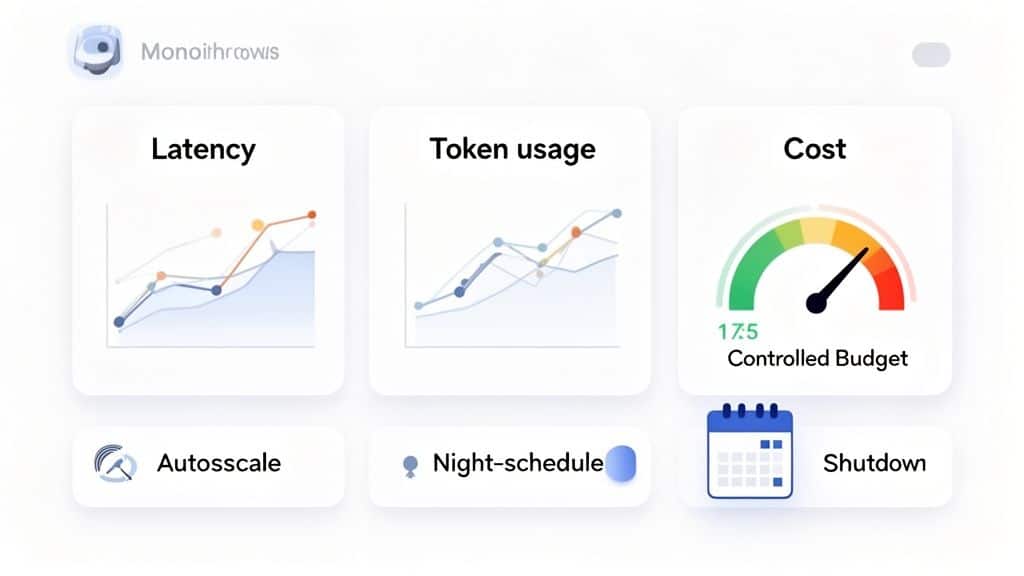
You can't manage what you can't measure. For an AI pipeline, that means looking beyond the usual CPU and memory metrics. You have to track generation latency, API error rates, and, most critically, token consumption. Every API call has a price tag, and without a dashboard showing you these numbers in real time, you're setting yourself up for a nasty surprise at the end of the month.
From Reactive Cost Cutting to Proactive Governance
The typical DIY approach to monitoring is a classic time sink. Your engineers burn weeks trying to stitch together a separate stack with tools like Prometheus and Grafana, only to then write custom exporters to pull data from various AI service APIs. It’s just one more critical piece of infrastructure your team has to build and maintain instead of shipping features.
A modern DevOps platform, on the other hand, gives you this visibility right out of the box. It pulls performance and cost metrics into a single, unified dashboard, turning those abstract cloud bills into insights you can actually act on. This immediately tackles the pain of budget overruns by replacing reactive fire-fighting with proactive financial governance.
The goal isn't just to see the costs; it's to control them intelligently. An integrated platform connects pipeline performance directly to financial impact, allowing you to make informed decisions without building a separate monitoring stack.
This proactive approach is becoming non-negotiable, especially in fast-growing tech hubs. With 21.0% AI adoption leading the Baltics, Lithuania is a perfect example of a region where AI is set to revolutionise DevOps pipelines. This aligns with a global AI content market projected to jump from USD 4.81B in 2025 to 7.09B in 2026. This explosive growth underscores the urgent need for cost-predictable pipelines to manage such rapid scaling.
Smart Features for Predictable Cloud Spend
Real cost control doesn’t come from manual interventions. It comes from automated, intelligent features that work seamlessly across all your cloud providers, whether it's AWS, GCP, or Azure. Instead of constantly reacting, a managed platform offers built-in tools for financial optimisation.
Here are a few key features that make a real difference:
- Smart Autoscaling: Automatically scales resources up or down based on real-time pipeline demand, so you’re only paying for what you actually use.
- Automated Environment Scheduling: Shuts down non-production environments like staging or QA overnight and on weekends, saving a significant chunk of your cloud bill.
- Unified Cost Dashboards: Gives you a single view of your spend across multiple clouds, ending the chaos of juggling different billing consoles.
These features transform your cloud spend from an unpredictable operational headache into a manageable, predictable cost. By exploring effective cloud cost optimisation for startups, you can see how this strategic approach lets you reinvest savings back into product innovation, not infrastructure babysitting.
Making the Strategic Shift to a Managed Platform
Let's be blunt. As a technical leader, your competitive advantage comes from shipping incredible products, not from becoming a world-class DevOps expert. Building a custom AI content generation DevOps pipeline from the ground up is a massive distraction, pulling your sharpest engineers away from real innovation.
You hired them to solve tough customer problems, not to get bogged down wrestling with Kubernetes, endlessly patching CI/CD scripts, or trying to make sense of unpredictable cloud bills from AWS, GCP, and Azure. Every single hour they pour into infrastructure is an hour stolen from the features that actually drive your business forward.
A modern, multi-cloud DevOps platform gives you the production-ready foundation you were trying to build in the first place. It’s designed to handle all the intricate setup, scaling, security, and cost controls right out of the box.
Moving to a managed platform isn't just about adding another tool to the stack. It's a strategic move to give your team back its most precious resource: focus.
This shift helps you move significantly faster, slash operational friction, and ultimately empowers your team to concentrate on building the products that will define your success in 2026 and beyond. You get the reliable, scalable platform you need, but without the hidden costs and relentless maintenance headaches of a DIY approach.
FAQs About AI Content Pipelines
We often get questions from engineering leaders about what it really takes to build an AI content generation pipeline. Here are a few of the most common ones.
How Much DevOps Expertise Do We Actually Need?
If you're building this yourself from scratch, the answer is: a lot. A DIY approach demands deep expertise in CI/CD, cloud infrastructure like Kubernetes, and complex API integrations. Your team will spend a significant amount of time scripting, managing secrets, and putting out infrastructure fires.
A managed DevOps platform, on the other hand, abstracts away most of that complexity. It’s designed to let developers self-serve without needing to become infrastructure experts, enabling even teams with limited DevOps experience to launch sophisticated pipelines quickly.
Should We Use an AI API or Host Our Own Model?
For most teams, using a managed API from a provider like OpenAI is the clear winner. You get up and running in hours instead of weeks, with absolutely zero model maintenance on your plate.
Self-hosting an open-source model gives you more control, but it also introduces serious operational overhead. You're suddenly responsible for managing GPUs, handling updates, and guaranteeing uptime. We always recommend starting with an API and only considering self-hosting if you have a highly specialised use case and a dedicated platform team to support it.
How Can We Keep AI API Costs Under Control?
Controlling costs in your AI content pipeline isn't about one single trick; it's a multi-layered strategy.
First, you need to be smart about when you trigger AI jobs. For example, only run them on a merge to your main branch to prevent racking up API calls on every single commit.
Second, your platform must have integrated cost monitoring to track API usage and set firm budgets. Finally, look for features like smart autoscaling. A managed platform can dramatically reduce your overall cloud spend on AWS, GCP, and Azure, which frees up more of your budget for the services that actually add value, like AI.
Ready to stop building infrastructure and start shipping product? PushOps provides a production-ready, multi-cloud DevOps platform that handles setup, scaling, security, and costs, so your team can focus on what matters. Learn more at PushOps.

