
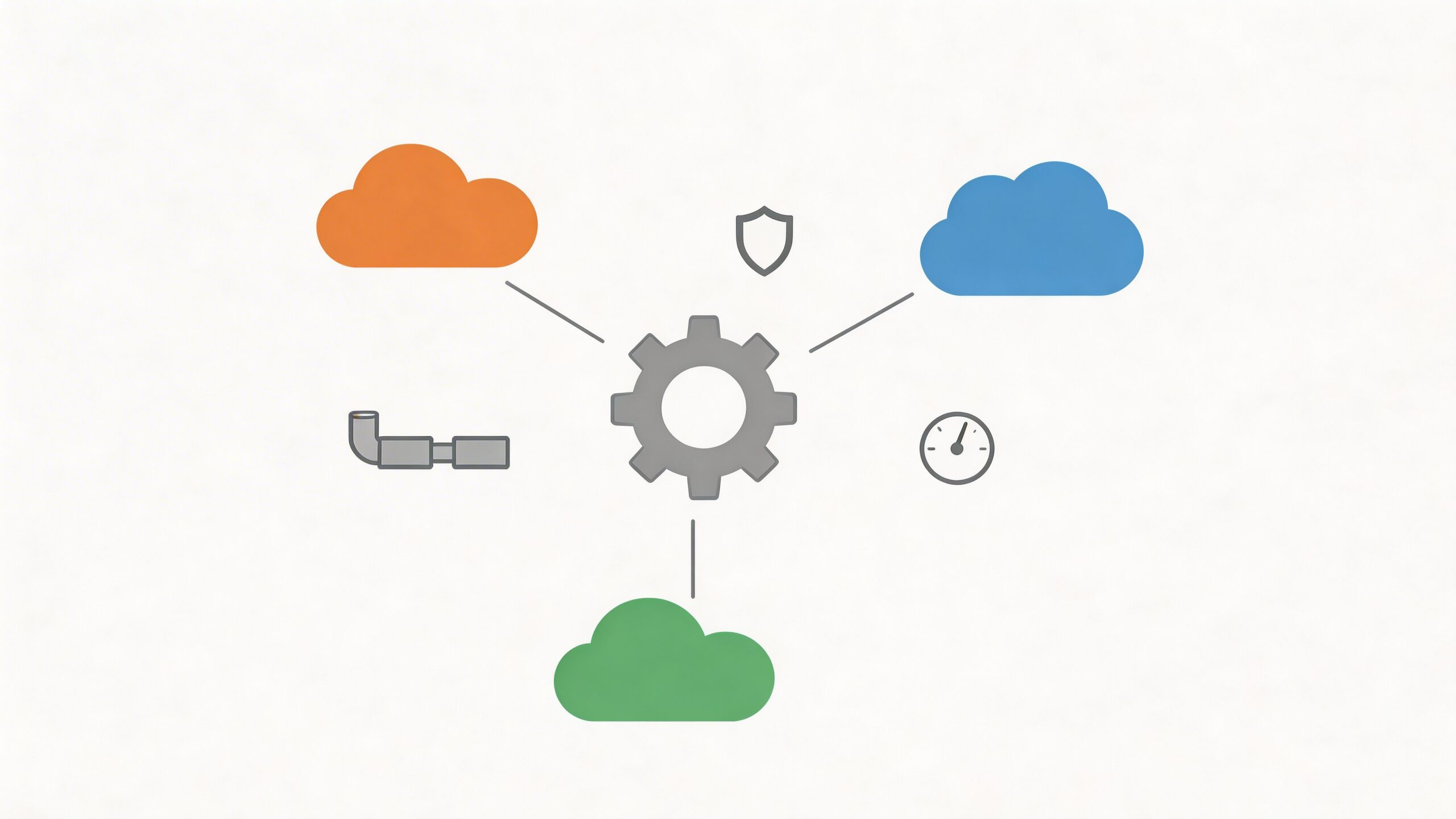

Your team didn’t choose multi-cloud because it sounded elegant. It usually happened in pieces.
A product team adopted AWS because it was the fastest path to launch. Data engineers started using GCP for analytics or AI services. A customer with procurement rules asked for Azure. Then someone glued the whole thing together with Terraform modules, shell scripts, GitHub Actions, a few Kubernetes clusters, three monitoring stacks, and tribal knowledge held by two overworked engineers.
At that point, infrastructure stops being an enabler and starts competing with product work.
That’s why multi-cloud management matters. It’s less about “using several clouds” and more about controlling the operational sprawl that follows. The category is growing fast. In 2024, North America generated 36% of global multi-cloud management revenue, and the US market is projected to grow from USD 4.33 billion in 2025 to USD 40.54 billion by 2034 at a CAGR of 28.20%, while the global market expands from USD 12.52 billion in 2024 to USD 147.12 billion by 2034 at a CAGR of 27.94% according to Electro IQ’s multi-cloud statistics roundup.
That growth makes sense. More teams are trying to keep delivery consistent across AWS, GCP, and Azure without building a platform engineering department before they’ve even reached the next revenue milestone.
Introduction to Multi-Cloud Management
Multi-cloud management is the discipline of running services across more than one cloud provider without forcing engineers to relearn everything every time they ship, debug, or secure something.
In practice, that means standardising the boring but critical parts. Provisioning. Deployments. Access control. Logging. Cost controls. Incident response. Environment lifecycle. If each cloud handles those differently, your engineers spend their week translating between platforms instead of shipping features.
What the problem looks like in real teams
A startup usually feels fine with one cloud and a few scripts. A scale-up feels the pain.
One team deploys to EKS, another uses Cloud Run, a third has an Azure setup for enterprise requirements. Nobody has a single view of environments. CI/CD works differently per repo. Security policies drift because every provider expresses them differently. Cost reviews become archaeology.
The issue isn’t that any one tool is bad. It’s that the stack becomes a patchwork.
Most DIY multi-cloud setups don’t fail in one dramatic outage. They fail by slowly taxing every release, every incident, and every audit.
What good multi-cloud management changes
A good operating model gives teams one reliable path to build, deploy, observe, and govern workloads across providers.
That doesn’t mean pretending AWS, GCP, and Azure are identical. They aren’t. It means putting a stable layer above the differences so your team can use provider-specific strengths without inheriting provider-specific chaos everywhere else.
When that layer is missing, companies often respond by hiring more DevOps engineers. Sometimes that helps. Often it just creates a larger team maintaining a brittle internal platform no customer asked for.
Understanding the Key Concepts
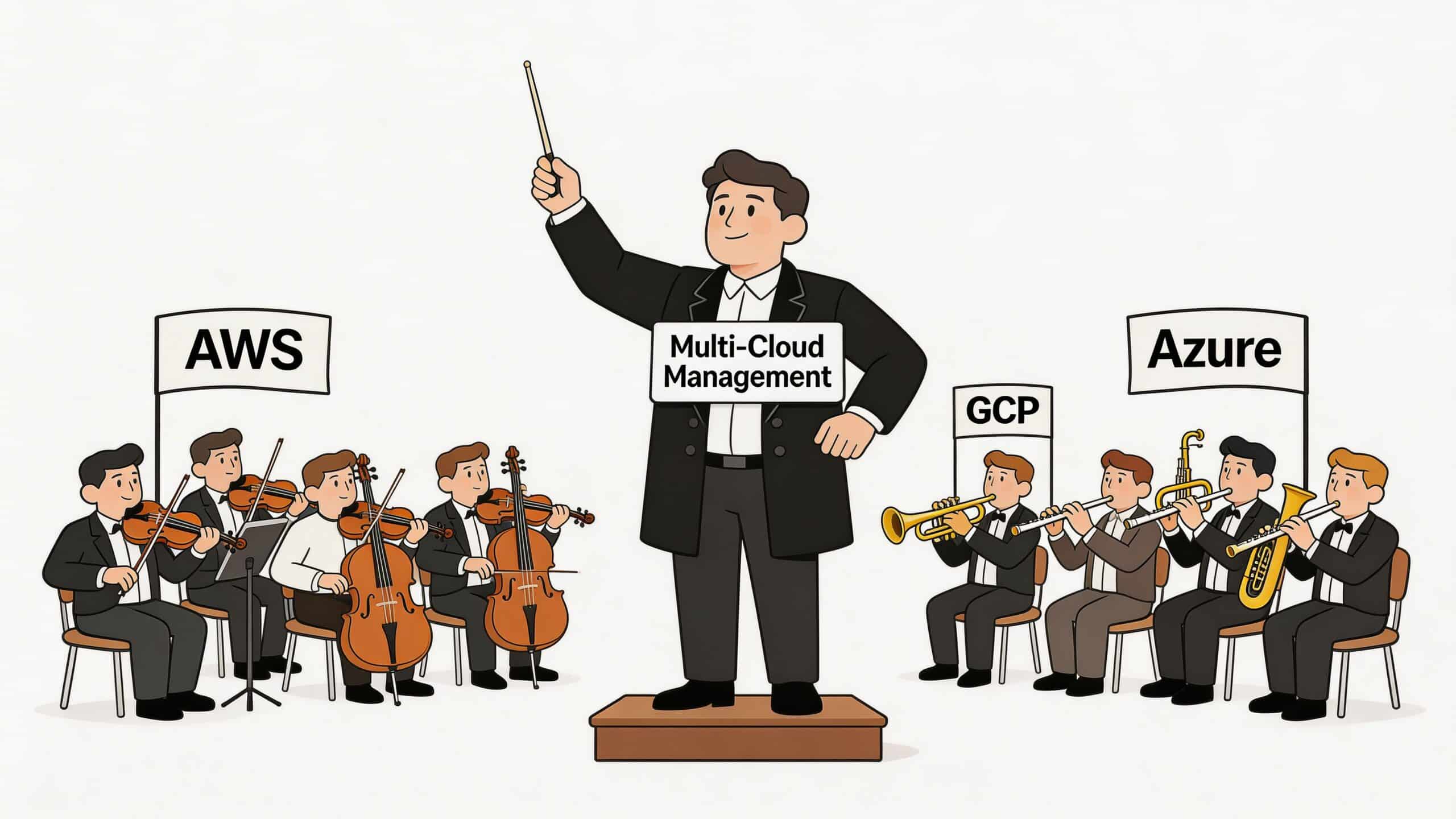
A simple way to think about multi-cloud management is an orchestra.
AWS, GCP, and Azure are the instrument sections. Each one is capable on its own. The problem starts when every section follows a different score, tuning standard, and tempo. Multi-cloud management is the conductor. It doesn’t replace the instruments. It coordinates them.
If you want a useful companion primer on the coordination layer itself, Pratt Solutions has a solid explanation of cloud orchestration, especially for teams trying to separate automation from ad hoc scripting.
The core layers that matter
Provisioning is the starting point. Teams need repeatable infrastructure creation across providers, usually through Terraform, templates, or platform abstractions. If provisioning differs too much by cloud, environments drift quickly.
Policy enforcement comes next. Access rules, auditability, encryption expectations, tagging, and network guardrails need to be applied consistently. Otherwise, one team’s “temporary exception” becomes another team’s production risk.
Environment lifecycle is where many organisations lose time. Engineers need reliable ways to create preview environments, promote releases, decommission old stacks, and keep non-production environments from lingering forever.
Observability means collecting logs, metrics, traces, and alerts in a way that lets operators understand one system, not three disconnected dashboards. During an incident, fragmented visibility is expensive.
Cost control should sit inside the operating model, not as a monthly finance exercise. Rightsizing, autoscaling, schedules, and spend visibility need to be part of how workloads run day to day.
What teams usually underestimate
The hard part isn’t setting up one of these layers. It’s keeping all of them coherent over time.
A lot of internal platforms start with good intentions and end up as wrappers around wrappers. The first version of a pipeline works. Then special cases appear. A customer needs Azure. Another workload needs GCP. Security asks for tighter approvals. The original abstractions stop fitting, and engineers drop back to custom scripts.
That’s usually when release confidence falls.
For teams rethinking the delivery layer itself, this comparison of GitOps approaches versus legacy pipeline habits is worth reviewing: https://pushops.com/explainer/gitops-vs-traditional-ci-cd/
Practical rule: if your multi-cloud strategy requires every team to understand every provider deeply, you don’t have a management model. You have distributed operational burden.
Evaluating Benefits and Challenges
Multi-cloud management earns attention because the upside is real. The catch is that each benefit arrives paired with a corresponding operational cost.
The trade-offs side by side
| Benefit | What it gives you | What it usually costs |
|---|---|---|
| Vendor flexibility | You can choose the right provider for a workload | Tooling fragments unless you standardise delivery and governance |
| Resilience | You reduce dependency on a single provider | Failover, networking, identity, and data movement get more complex |
| Commercial leverage | Procurement has options | Finance now needs clear cross-cloud cost visibility |
| Regional fit | You can place workloads to match customer or regulatory needs | Data residency and sovereignty rules become harder to enforce consistently |
| Access to specialised services | Teams can use provider-specific strengths | Portability drops if every service becomes cloud-native in a different way |
A lot of teams focus only on the left column. The right column is where budgets and engineering time disappear.
Where startups and scale-ups get caught
The first trap is assuming optionality is free. It isn’t. Running a service in multiple clouds often means more IAM models, more deployment paths, more observability plumbing, and more edge cases in incident response.
The second trap is letting each team solve the same platform problem differently. One squad uses GitHub Actions. Another writes custom runners. A third builds environment automation in Python. The company ends up with several local optimisations and no standard operating model.
The third trap is treating compliance as a later-stage clean-up job. In Europe especially, that becomes expensive fast. In 2025, Lithuania saw a 25% rise in GDPR violations related to cross-border data flows, and multi-cloud setups incurred 30% higher compliance costs versus single-cloud according to the source cited by N2WS on multi-cloud management.
That matters beyond Lithuania. It points to a broader issue for teams operating across the EU and other regulated markets. The moment data, identity, and audit trails are split across providers, policy enforcement can’t stay manual.
What works and what doesn’t
What works
- A narrow platform standard: define one approved way to provision, deploy, observe, and secure workloads.
- Policy as code: don’t rely on review comments and good intentions.
- Shared visibility for engineering and finance: cost control needs operational context.
- A clear portability rule: decide which workloads must stay portable and which can use provider-specific features.
What doesn’t
- Three clouds with three separate workflows: that multiplies toil.
- A bespoke internal platform too early: maintenance becomes a product of its own.
- Compliance by spreadsheet: it won’t keep up with change.
- Platform ownership by hero engineers: eventually they burn out or become the bottleneck.
For teams trying to tighten spend while reducing complexity, this explainer on cloud cost discipline is a useful companion read: https://pushops.com/explainer/cloud-cost-optimization-for-startups/
Comparing Architecture Patterns and Governance Models
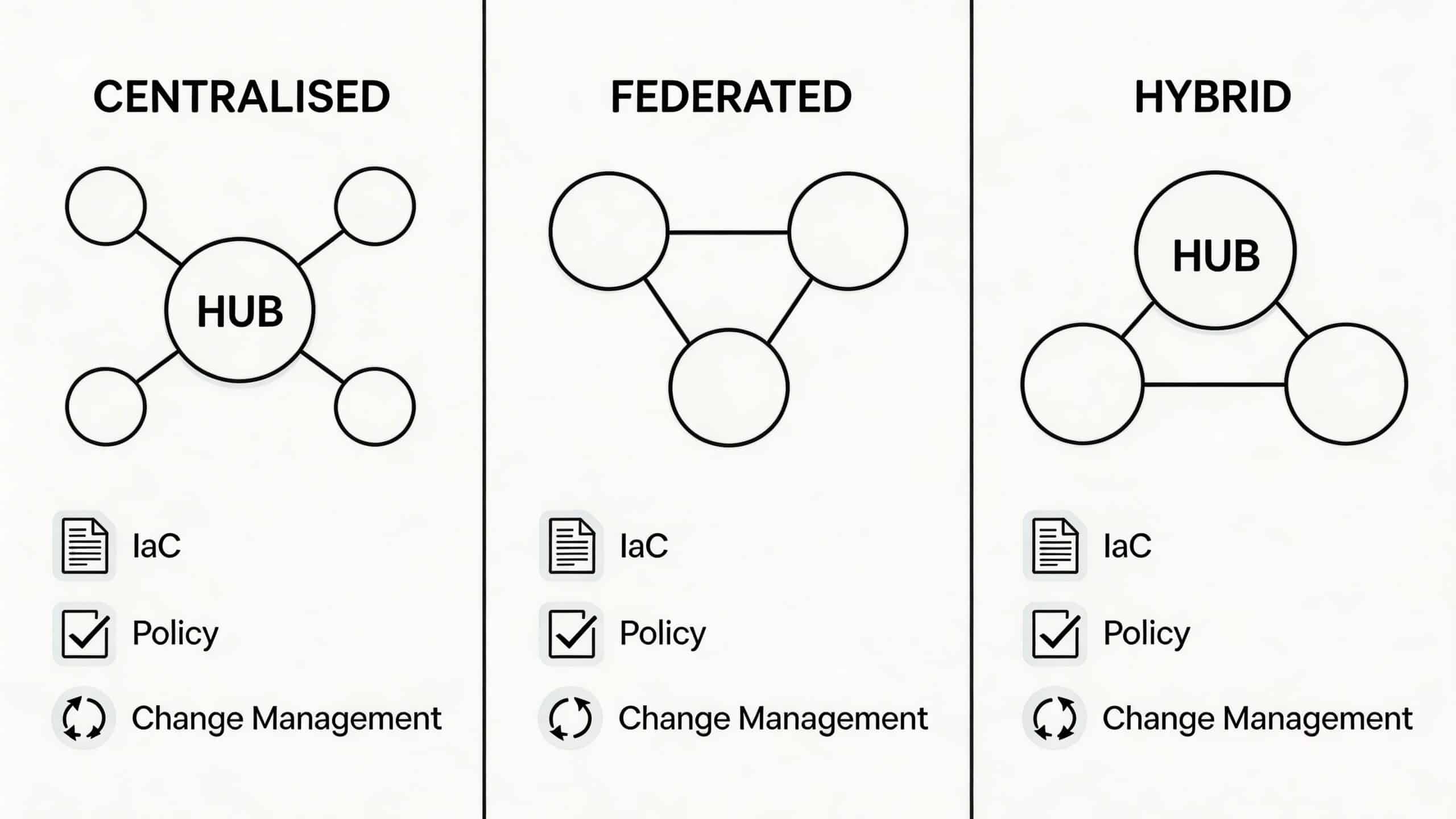
Governance shape matters more than most tooling decisions. The same cloud estate can feel manageable or chaotic depending on who owns standards, who can make exceptions, and how change moves through the system.
Centralised model
In a centralised model, one platform or infrastructure team owns the templates, guardrails, pipelines, and operating standards for everybody.
This works well when the company is still small enough that consistency matters more than local autonomy. Security teams usually prefer it because access, audit patterns, and policy enforcement are easier to control.
The downside is speed. If every change flows through one team, that team becomes the queue. Product teams start working around the platform instead of with it.
Federated model
In a federated model, each product or business unit owns more of its own cloud implementation while following broad company standards.
This can work for larger organisations with different workload needs. A data platform team may need different patterns from a customer-facing SaaS team. The model respects that.
It also creates drift fast if standards are weak. In the LT region, platforms such as Azure Arc and VMware Aria reduced configuration drift by up to 40% in hybrid setups, prevented a 25 to 30% annual rise in compliance violations, and achieved 99.99% policy adherence in production workloads according to TierPoint’s overview of multi-cloud management. That’s a strong argument for enforced policy layers when operating in a federated way.
Hybrid model
A hybrid governance model is where many scale-ups land. The platform function defines paved roads, approved modules, identity patterns, and observability standards. Product teams still own their services and day-to-day delivery inside those boundaries.
That balance is usually the most practical. Teams move quickly, but they don’t invent infrastructure from scratch every sprint.
The best governance model is the one that removes repeated decisions from product teams without trapping them in a central backlog.
A practical comparison
| Model | Best fit | Strength | Weakness |
|---|---|---|---|
| Centralised | Early-stage startup, high-regulation environment | Strong consistency | Slow change if platform team is overloaded |
| Federated | Large or highly diverse engineering organisation | Local optimisation | High risk of drift and duplicated tooling |
| Hybrid | Scale-ups standardising delivery across teams | Balance of speed and control | Requires discipline in platform boundaries |
For leaders deciding whether to keep building internally or standardise on a shared layer, this overview of a DevOps cloud infrastructure platform helps frame the trade-offs.
Defining Best Practices and Implementation Roadmap
Most failed multi-cloud programmes don’t fail because the cloud providers were wrong. They fail because implementation starts too wide. Too many exceptions. Too many tools. Too little standardisation.
A better approach is to roll out a narrow, opinionated operating model first.
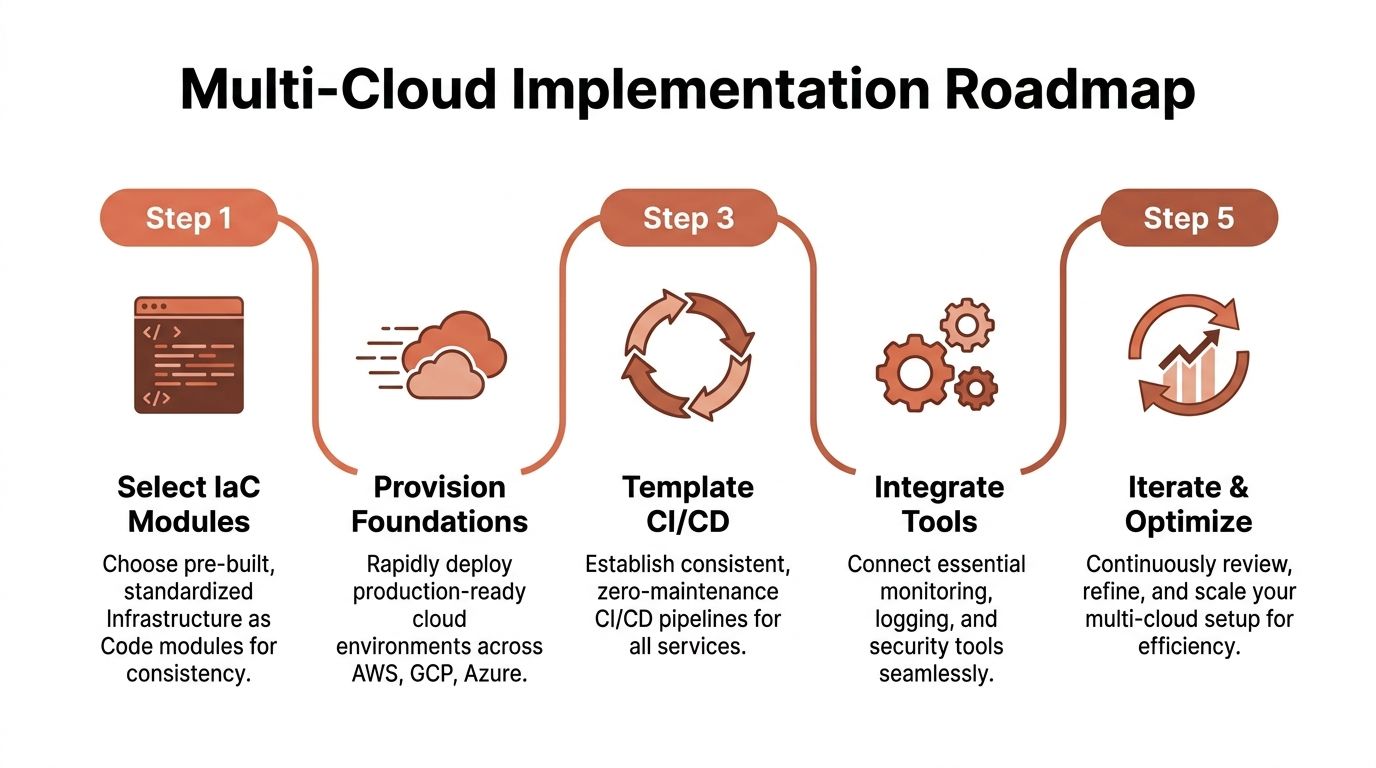
Step 1 and Step 2
Select standard IaC modules
Start with a small catalogue. Network patterns, Kubernetes foundations if you need them, managed databases, secrets handling, identity hooks, logging, and baseline policies.
Don’t let every team edit foundational modules freely. Shared modules only work when ownership is clear and changes are deliberate.
Provision production-ready foundations
Once modules are stable, make environment creation self-service. Teams should request or trigger approved foundations without opening a long ops ticket.
Here, many companies overbuild. They create an internal portal before they have stable templates. The portal isn’t the platform. The repeatable foundation is.
Step 3 and Step 4
Template CI/CD around one delivery model
Choose the release path you want teams to follow. Build, test, deploy, rollback, environment promotion, approvals, and secrets handling should all feel consistent.
You don’t need infinite flexibility here. You need a default serving the majority of services well.
Integrate observability and security from day one
Logging, metrics, traces, audit logs, and access reviews should be built into the platform baseline. If teams bolt them on later, coverage becomes uneven.
In Baltic multi-cloud setups, Dynatrace’s AI-driven observability cut troubleshooting time by 60%, and integrated observability reduced incident resolution from 2 hours to 36 minutes while boosting autoscaling efficiency by 30% according to Ternary’s guide to multi-cloud management. The exact tool matters less than the principle: observability must be unified enough to support fast diagnosis across providers.
Don’t launch a new environment type unless logs, metrics, traces, and auditability are part of the default template.
Step 5
Iterate on cost and lifecycle hygiene
Once teams are shipping on the platform, tighten cost controls. That includes environment schedules, rightsizing review, autoscaling policies, storage lifecycle rules, and ownership tagging that maps to teams.
For additional practical reading, Server Scheduler’s write-up on cloud cost optimization recommendations is useful because it stays close to operational reality rather than generic FinOps theory.
What to standardise first
- Identity and access: keep role design and audit trails uniform.
- Deployment mechanics: one approved promotion and rollback path.
- Observability baseline: every service emits the same core signals.
- Environment management: preview, staging, and production should follow predictable lifecycle rules.
- Exception handling: define how teams request deviations, and expire those deviations.
What to avoid in the first phase
- Too many platform personas: keep workflows simple for developers.
- Abstracting every provider feature: some differences should stay visible.
- Building around one expert’s preferences: platform decisions must survive staff changes.
- Treating roadmap steps as one-off projects: multi-cloud management is an operating model, not a migration milestone.
Illustrating PushOps Solutions with Concrete Examples
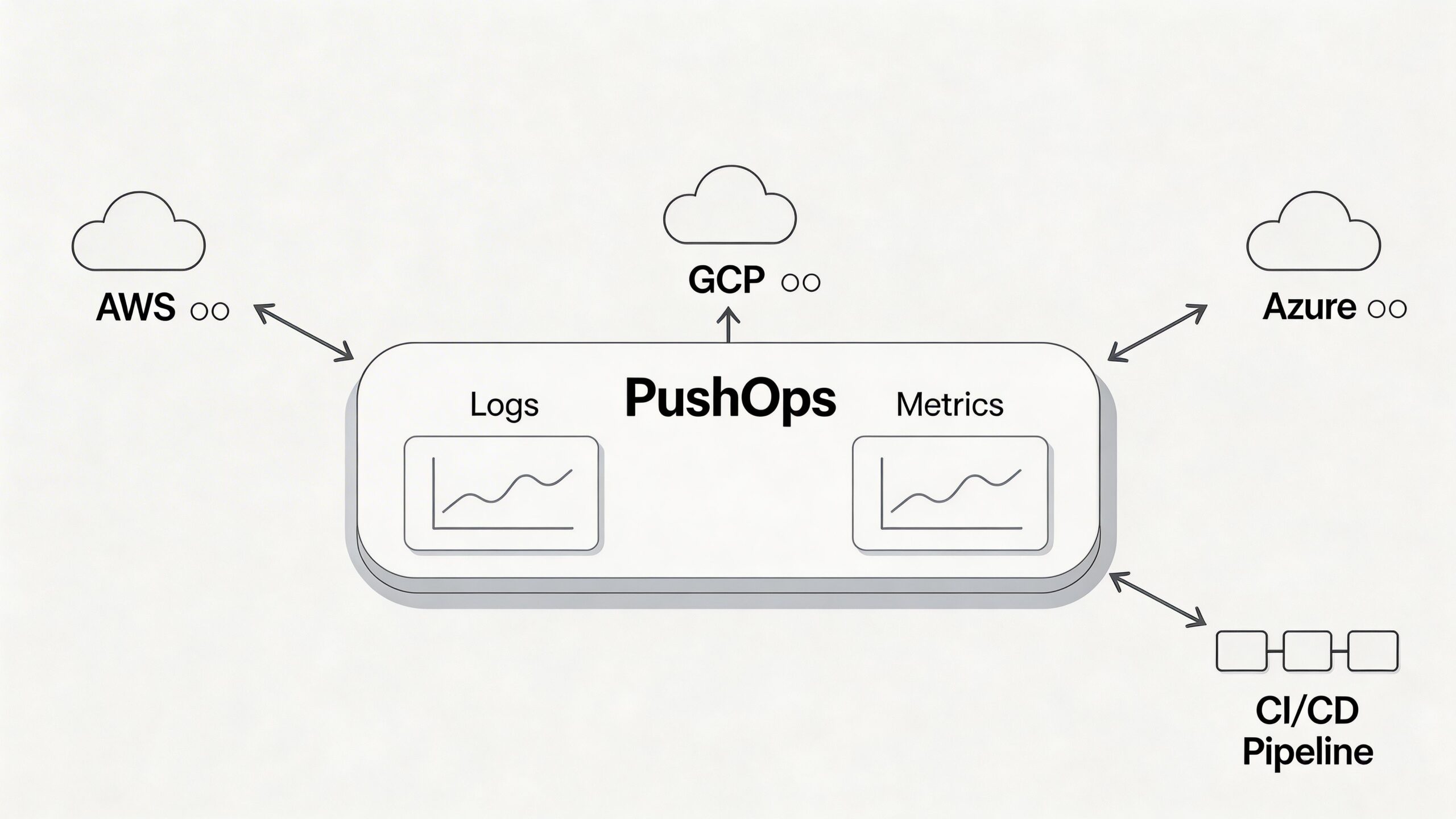
A managed platform becomes attractive when a company no longer wants to maintain the invisible glue.
That usually shows up in familiar ways. Releases depend on pipeline maintainers. Environments are inconsistent across providers. Security controls exist, but only if the right person remembered to add them. During incidents, teams jump between dashboards and chat threads trying to reconstruct what changed.
Example one
A startup with product workloads split between AWS and GCP often doesn’t need more raw infrastructure flexibility. It needs fewer moving parts.
A managed platform can give that team standard foundations, built-in deployment workflows, integrated observability, and default security controls without asking them to assemble an internal developer platform first. Developers work through a self-service path. Leadership gets a more predictable operating model. The DevOps burden drops because the company stops maintaining the scaffolding itself.
Example two
A scale-up serving enterprise customers usually hits a different ceiling. The challenge isn’t whether they can deploy to several clouds. It’s whether they can do it with repeatable governance.
In that situation, the value comes from standardised access control, audit logs, policy enforcement, environment consistency, and central visibility for logs and alerts. The platform isn’t replacing engineering judgement. It’s removing repeated infrastructure chores so senior engineers can spend more time on architecture and customer-facing features.
When a managed platform works well, product teams barely think about the mechanics behind builds, deployments, and environment creation. That’s the point.
Example three
For organisations dealing with cloud cost volatility, the practical wins usually come from platform defaults rather than finance reports. Smart autoscaling, rightsizing guidance, and scheduled non-production environments can reduce waste without requiring every team to become a FinOps specialist.
What matters is that these controls are operational, not advisory. If cost hygiene depends on someone remembering a monthly clean-up exercise, it won’t last.
The broader pattern is straightforward. DIY stacks can get you to market. Managed platforms are often what help you keep shipping once the estate spans multiple providers, more teams, tighter security expectations, and less patience for operational drag.
Conclusion and Next Steps
Multi-cloud management isn’t a badge of maturity. It’s a response to most growing software companies ending up operating across more than one cloud, more than one team, and more than one set of delivery constraints.
The mistake is thinking the answer is “hire more DevOps people” or “build a better internal platform later”. Sometimes that’s justified. Often it turns into a side business where your best engineers maintain pipelines, templates, observability wiring, and policy exceptions instead of improving the product.
The practical route is narrower. Standardise infrastructure foundations. Put policy and observability into the default path. Keep governance explicit. Be honest about which workloads need portability and which can be provider-specific. Then decide whether your company really wants to own that platform layer for the next several years.
If the answer is no, that’s not a failure of ambition. It’s a sensible operating choice.
The teams that handle multi-cloud well usually aren’t the ones with the most bespoke tooling. They’re the ones that reduce decisions, reduce drift, and reduce the amount of infrastructure work required to ship safely.
PushOps helps software teams replace fragile in-house DevOps stacks with a production-ready cloud platform across AWS, GCP, and Azure. If you want to spend less time maintaining pipelines, Kubernetes glue, monitoring sprawl, and security plumbing, and more time shipping product, take a look at PushOps.

