

Most CTOs don't decide to build an internal DevOps platform. They drift into it.
It starts with a Jenkins job nobody wants to touch, a Terraform repo maintained by two senior engineers, a Kubernetes cluster that works until it doesn't, and a monitoring stack stitched together from Prometheus, Grafana, alerts, custom scripts, and tribal knowledge. Then cloud costs climb, deployment failures burn release days, and the team that should be shipping product spends its week maintaining the machinery around it.
That's where process automation matters. Not as a buzzword, and not as a narrow workflow exercise. In a modern engineering organisation, process automation means reducing the operational burden around software delivery so developers can spend more time on product and less time on infrastructure. The strategic shift isn't just task automation. It's deciding which operational work your company should own and which it should consume as a service.
Stop Managing Infrastructure and Start Shipping Product
The warning signs are familiar. Senior engineers are debugging runners instead of customer issues. Release confidence depends on one staff engineer being online. Every new environment becomes a mini project. Security and cost control arrive later than they should because the team is still trying to keep deployments stable.
That isn't a tooling problem alone. It's a focus problem.
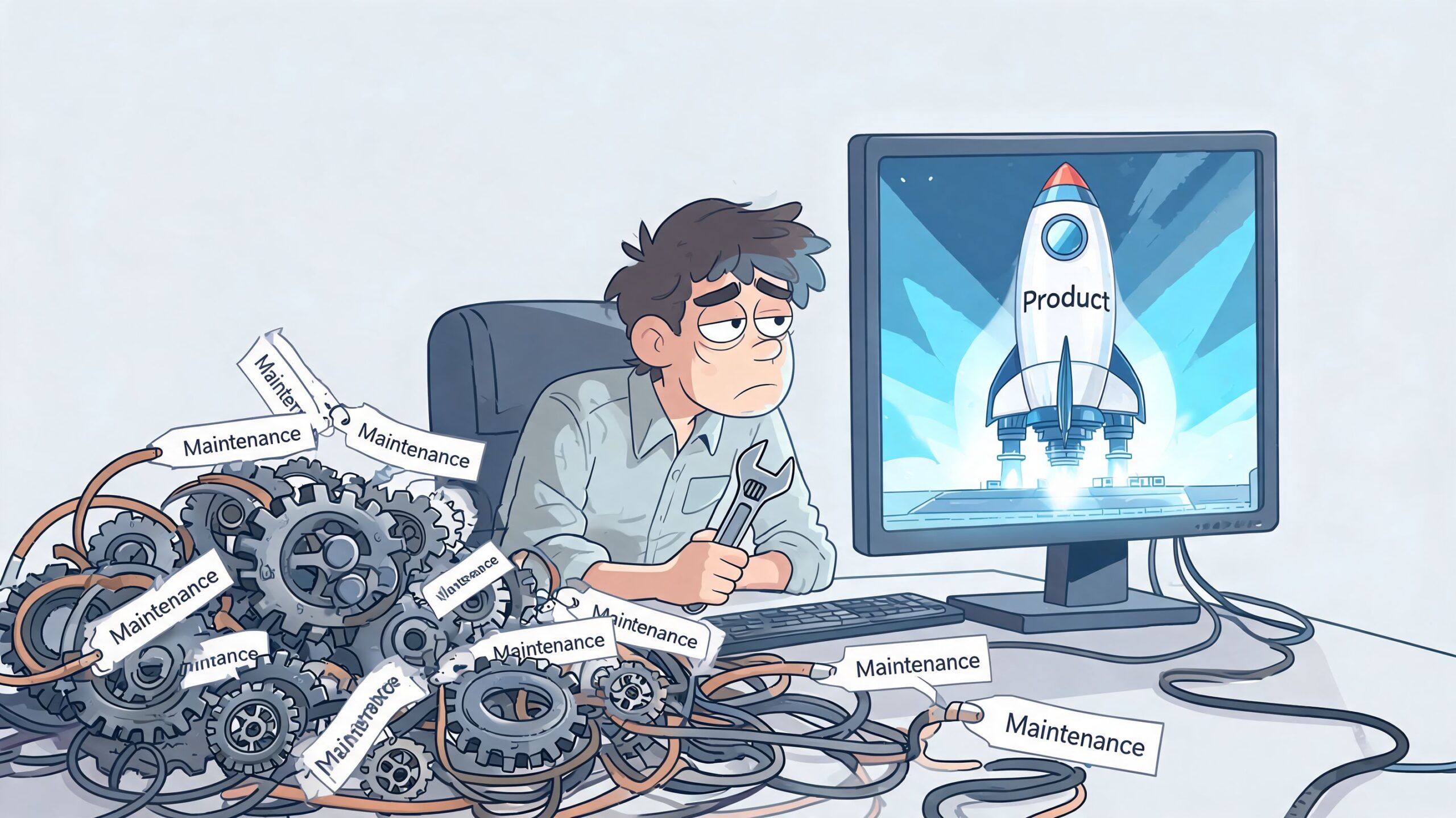
The market has already moved. The global business process automation market reached $15.81 billion in 2024 and is projected to reach approximately $31.62 billion by 2030, driven by AI integration, according to Doit Software's business process automation statistics. That doesn't mean every company needs more automation tooling. It means companies need a better way to operationalise automation without creating another internal system to maintain.
Automation should remove burden, not create another platform team
A lot of teams automate the first layer and miss the bigger cost. They automate builds, but still manage runners. They automate infrastructure, but still own Terraform state, policy enforcement, cloud permissions, incident visibility, and release safety. They reduce manual work in one place and expand platform maintenance somewhere else.
Practical rule: If automation requires permanent babysitting, you've shifted labour rather than removed it.
This is why a managed approach keeps gaining traction. If you're evaluating what practical automation looks like for lean teams, Goptimise has a useful piece on AI-driven backend deployment for startups that reflects the same broader shift. Teams want fewer moving parts between a commit and a reliable production release.
The business outcome CTOs actually want
You don't need infrastructure for its own sake. You need predictable delivery, secure defaults, reliable environments, and costs that don't surprise finance. That's the reason to invest in process automation.
A useful way to frame it is simple:
- Product work should stay with product teams
- Undifferentiated operational work should be standardised
- Fragile deployment logic shouldn't live in one engineer's head
- Platform decisions should reduce cognitive load, not increase it
For early-stage teams especially, the right question isn't whether continuous delivery matters. It does. The better question is whether you should build and maintain the machinery yourself, or adopt an approach that gets you there faster. This explainer on continuous delivery for early-stage startups is useful if you're weighing that trade-off from a delivery perspective rather than a pure tooling perspective.
Key Automation Categories for Cloud and DevOps Teams
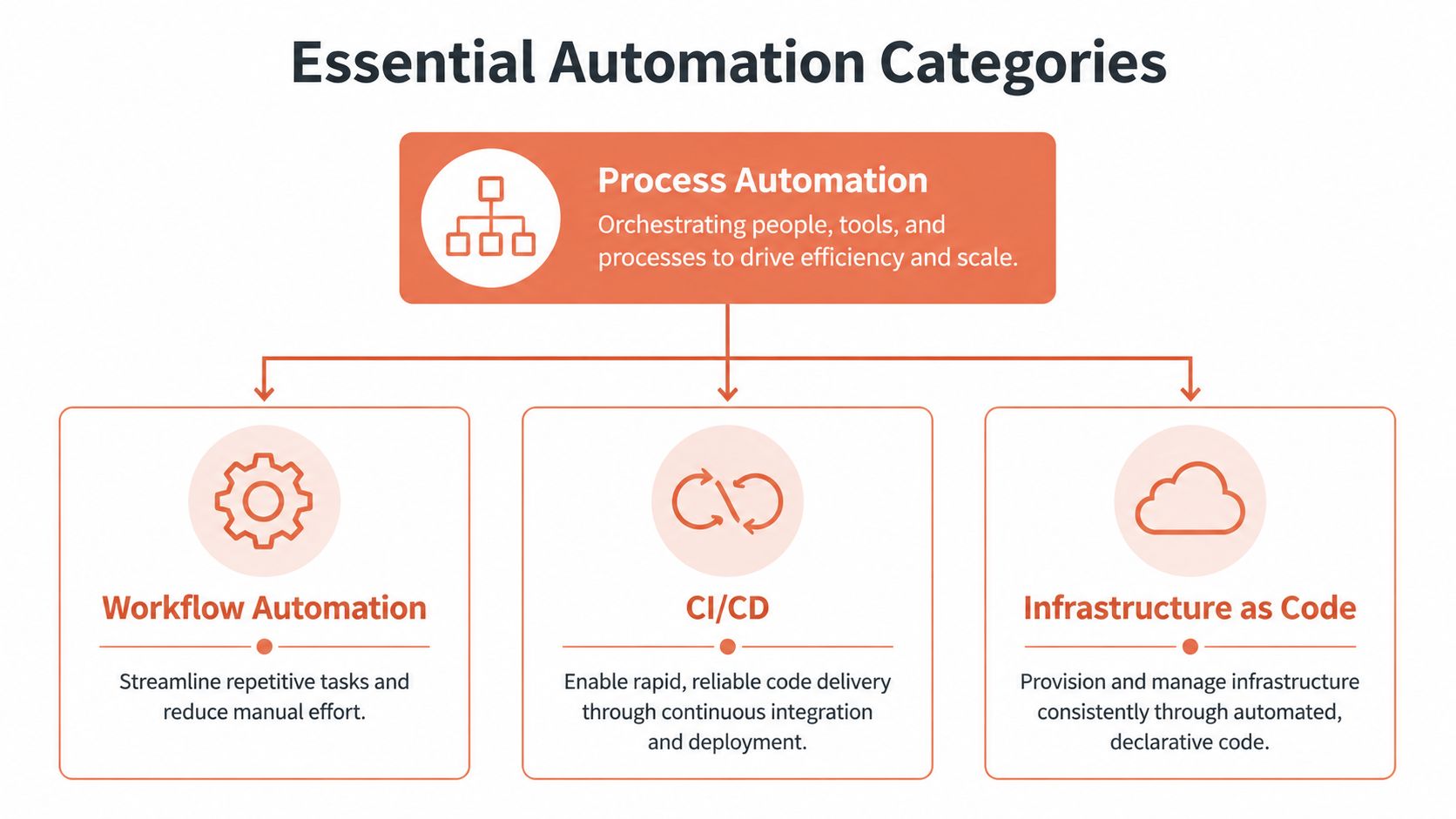
When engineering leaders talk about process automation, they often bundle very different concerns together. That creates confusion. Workflow automation, CI/CD, and infrastructure automation solve different problems, and each one becomes expensive when it's assembled as a DIY stack.
Workflow automation
Workflow automation coordinates repeatable work across people, systems, and approvals. In a software organisation, that can mean environment requests, deployment approvals, on-call handoffs, release checklists, or incident follow-ups.
The technical side sounds simple. Trigger an event, call an API, update a ticket, notify Slack. The problem is that home-grown workflow chains age badly. They depend on webhooks, bespoke scripts, permission boundaries, and naming conventions that stop being obvious after the original builder leaves.
If you want a grounded overview of how cloud teams think about these layers, Stepper's guide to cloud automation is a useful external reference because it frames automation as an operating model, not just a collection of scripts.
The first version of workflow automation usually works. The third exception path is where maintenance begins.
CI/CD
CI/CD automates the path from commit to tested, deployable, production-ready code. For developers, this is the most visible category because it's where build failures, flaky pipelines, secret handling, artifact storage, and deployment permissions all collide.
A CTO evaluating CI/CD should separate pipeline capability from pipeline ownership.
| Category | What it gives you | What DIY ownership adds |
|---|---|---|
| Build automation | Consistent test and build execution | Runner maintenance, caching issues, queue management |
| Release automation | Repeatable deployments | Rollback logic, secret rotation, branch policy drift |
| Supply chain controls | Better traceability | Ongoing updates, plugin risk, policy enforcement |
| Team self-service | Faster delivery | Access design, guardrails, support overhead |
Jenkins serves as the classic example. It's flexible, widely known, and dangerous in the wrong way for growing teams. The platform can do almost anything, which means your engineers often end up responsible for plugin compatibility, node upkeep, credential sprawl, agent scaling, and undocumented pipeline logic. GitHub Actions, GitLab CI, and CircleCI reduce some of that burden, but organizations still end up stitching together external deployment tooling, secrets management, observability, and release controls.
If your team is trying to eliminate that maintenance layer, this overview of zero-maintenance CI/CD pipelines gets to the underlying issue. The pain usually isn't writing the first pipeline. It's owning the platform underneath it.
Infrastructure automation
Infrastructure automation covers provisioning, configuration, orchestration, scaling, and policy enforcement across environments. Terraform, Pulumi, Helm, Kubernetes manifests, cloud-native autoscaling, and policy tools all sit in this category.
Many internal platforms become accidental products at this stage.
Teams start with good intentions. They standardise cluster creation, codify networking, template services, and add monitoring. Then reality arrives. One product needs a custom ingress rule. Another needs background workers. A third needs region-specific failover. Soon the abstraction leaks, exceptions multiply, and the platform team becomes a bottleneck.
A managed platform can be one way to avoid that trap. For example, PushOps provides automated deployments and production-ready cloud foundations across AWS, GCP, and Azure while handling builds, environments, observability, security defaults, and scaling in one system. That's materially different from giving teams a box of parts and asking them to maintain the assembly forever.
The pattern worth noticing
Each automation category delivers value on its own. The trouble starts when one company tries to become its own CI vendor, platform vendor, security integrator, and FinOps tooling team at the same time.
That isn't focus. It's infrastructure sprawl with better branding.
The True Benefits of End-to-End Automation
The strongest case for process automation isn't that it's modern. It's that it changes the economics of software delivery when it's implemented end to end.
Globally, 65%+ of businesses are implementing workflow automation in 2026, a 20% jump from two years prior, with an average 30% time saving on routine processes and error reductions of up to 75%, according to Vena Solutions' automation statistics. The useful takeaway for a CTO isn't the market trend by itself. It's what those outcomes look like inside an engineering organisation.
Faster delivery without heroics
When environments, builds, deployments, rollback paths, and monitoring hooks are standardised, teams stop relying on memory and improvisation. Releases become less dramatic. Developers don't need to remember the exact order of steps required to move a service safely into production.
That creates a compounding advantage:
- Lead time drops because setup and release work are repeatable
- Interruptions shrink because fewer manual steps fail in odd ways
- Developer attention returns to product work because less time is spent navigating deployment machinery
Better reliability through consistency
The operational benefit of automation isn't speed alone. It's consistency under pressure.
A manually assembled release process can work for weeks and still fail during the moment that matters most: a hotfix, a late Friday deploy, an urgent rollback, or a high-traffic launch. End-to-end automation reduces that variability by enforcing the same path every time. Build steps, approval logic, deployment rules, health checks, and environment configuration all behave the same way.
Reliable delivery comes from reducing variation in how work reaches production.
That matters to engineering leadership because inconsistency is expensive in ways dashboards often hide. It shows up as delayed releases, avoidable incidents, after-hours fixes, and the gradual slowdown that arrives when teams stop trusting their pipeline.
Clearer cost and security control
The business gains are just as important. End-to-end automation makes cloud spend easier to predict because environments, scaling rules, and deployment behaviour are governed in a consistent way. It also strengthens security because permissions, audit trails, and policy enforcement aren't added later as side projects.
A fragmented DIY stack can still deliver pieces of this. Many do. The problem is operational drag. Every extra tool adds another ownership boundary, another integration point, and another place where standards drift.
A managed approach doesn't eliminate trade-offs. It changes them. You give up some bespoke flexibility in exchange for lower maintenance, faster onboarding, and stronger operational consistency. For most startups and scale-ups, that's the right trade.
The Hidden Costs and Risks of DIY DevOps Automation
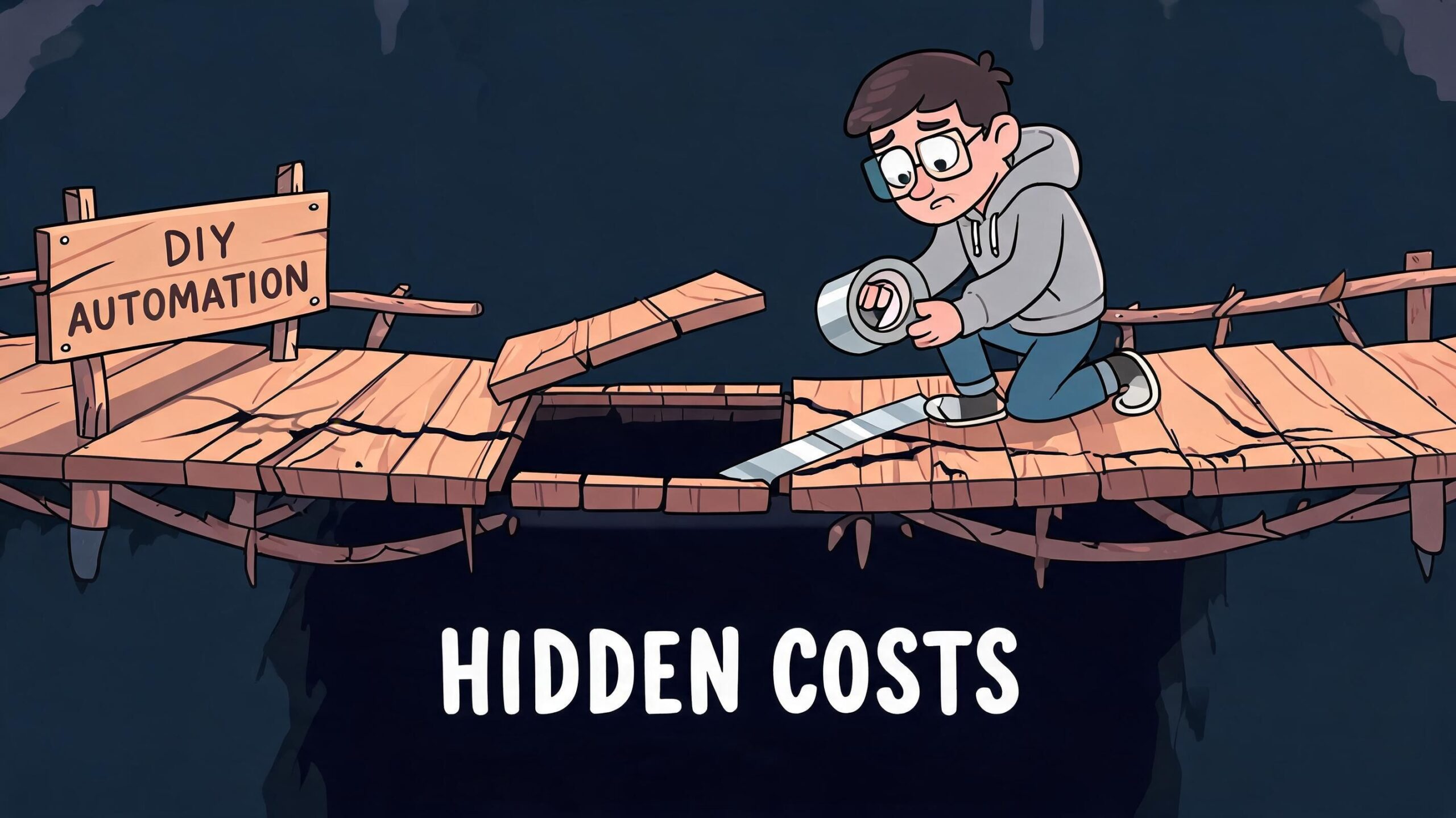
Most in-house automation projects are approved on the visible benefits. Faster deploys. Fewer manual steps. More control. The costs that hurt later are usually absent from the original plan.
Research on modern automation platforms notes that many have "left many companies grappling with inefficiency, high maintenance costs, and limited flexibility", as discussed in this analysis of the shortcomings of modern automation. That line lands because it describes what happens when teams confuse control with an actual advantage.
Maintenance becomes a permanent tax
A bespoke stack rarely stays small. One team adds Jenkins. Another adds Argo CD. Someone introduces Terraform modules, then wraps them with scripts to enforce standards. Security wants approval gates. Finance wants cost tags. SRE wants better alerts. Over time, your "automation" becomes a network of dependencies that needs continuous care.
That maintenance isn't abstract. Engineers patch plugins, upgrade runners, resolve integration breakage, tune alerts, rotate credentials, and explain the system to every new hire. The company ends up funding a platform function whether it intended to or not.
Tribal knowledge breaks automation at the worst time
DIY systems often look organised in documentation and behave differently in production. That's because frontline engineers adapt. They create workarounds for edge cases, incident scenarios, or service-specific quirks. The official process remains clean. The actual process lives in Slack threads, shell history, and the memory of the people who have already been burned once.
When that undocumented behaviour isn't reflected in the automation design, failures are predictable.
- Incident paths are missing because the design assumed normal conditions
- Rollback steps are inconsistent because they were learned informally
- Approvals and exceptions drift because people route around blockers
- Onboarding slows down because new engineers inherit fragments, not a system
A brittle platform usually isn't failing because engineers are careless. It's failing because the automation was built around the documented workflow, not the real one.
Security and cost drift appear quietly
DIY automation also creates fragmented accountability. One team owns IAM roles, another owns Terraform, another maintains dashboards, and nobody owns the end-to-end path from commit to production with equal depth. That's how least-privilege intentions become broad permissions, audit trails become partial, and cloud spend balloons through idle environments and inconsistent resource settings.
A senior engineering leader should ask a blunt question before funding another internal platform initiative.
| Decision area | DIY reality | Managed-platform reality |
|---|---|---|
| Ownership | Internal team carries ongoing maintenance | Vendor carries more of the platform maintenance burden |
| Speed to value | Slower, because assembly comes first | Faster, because standard capabilities already exist |
| Flexibility | High at the start, often messy later | More opinionated, usually easier to operate |
| Failure modes | Often unique to your implementation | More standardised and easier to reason about |
The issue isn't whether your team can build an internal platform. Many can. It's whether that's the highest-value use of scarce engineering time.
A Practical Roadmap for Implementing Automation
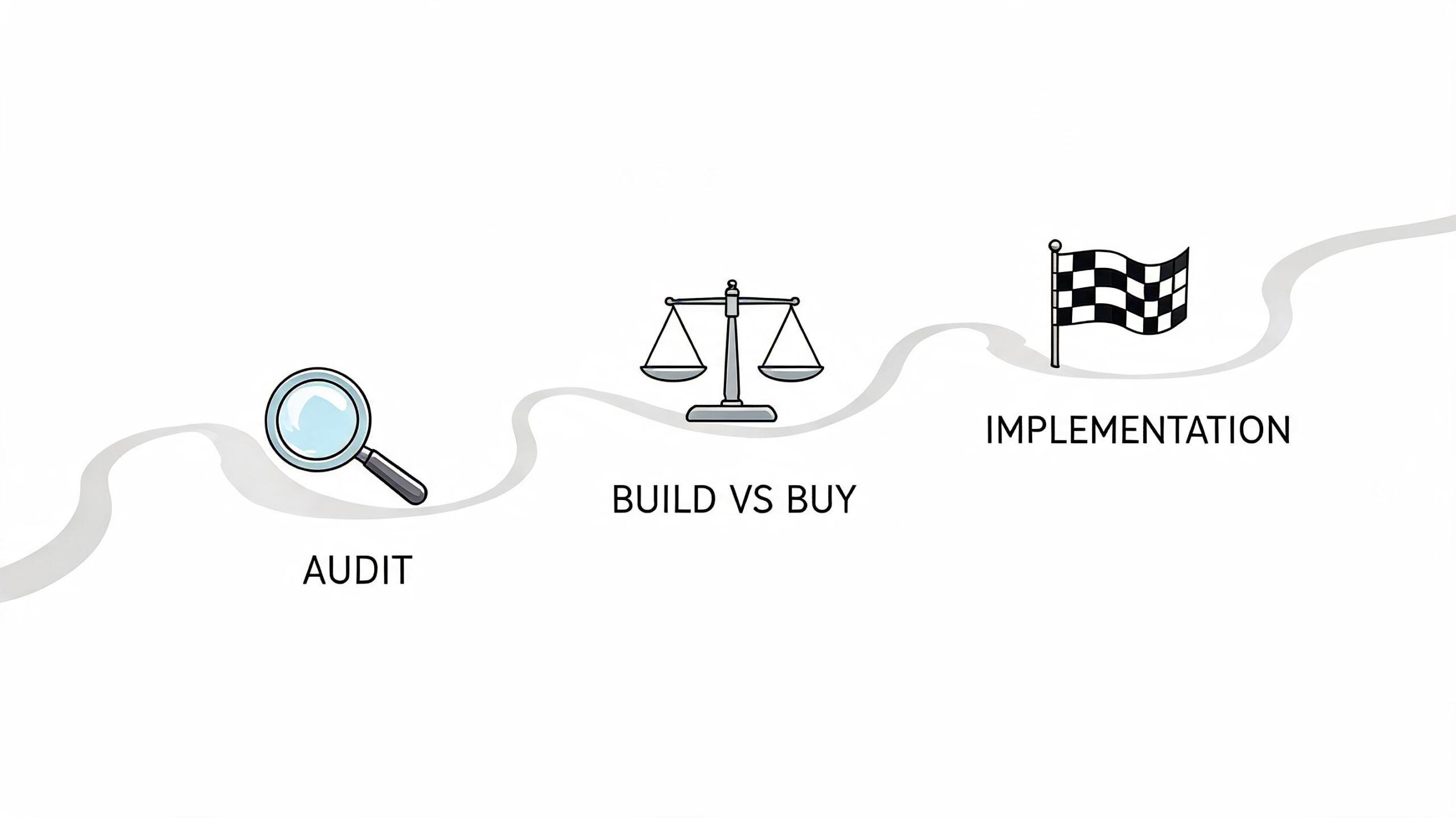
Effective automation rollout begins with operational honesty rather than tool shopping. Many organizations already recognize where friction exists. Failed handoffs, inconsistent deploys, noisy alerts, slow environment setup, unpredictable cloud bills. The mistake is trying to solve all of it at once.
Start with the workflow that hurts the business most
Don't begin with a platform diagram. Begin with the process that repeatedly costs engineering time or creates release risk.
For one company, that's deployment orchestration. For another, it's environment sprawl or weak visibility between build and production. The point is to identify one operational thread where process automation can remove repeated friction.
A practical audit usually looks like this:
- Map the actual workflow. Talk to the engineers who run releases and handle incidents, not just the people who wrote the original docs.
- List the manual decisions. Separate judgement calls from repetitive actions.
- Find the maintenance hotspots. Look for scripts, jobs, and integrations that only a few people understand.
- Trace the business impact. Tie the pain to delayed releases, engineering distraction, reliability risk, or cloud waste.
Evaluate total cost, not just licence cost
Many build-versus-buy decisions go wrong at this stage. Teams compare vendor cost with internal tool cost and ignore ownership cost.
If you build internally, include engineering time, support overhead, upgrades, incident response, compliance work, and the opportunity cost of having senior developers maintain delivery plumbing instead of revenue-generating features. If you buy, look at fit, operating model, integration effort, and how much platform work it removes.
There is a meaningful upside when the platform handles cloud efficiency as part of delivery. Cloud cost optimisation research from CTO2B notes that PushOps-style platforms have delivered 55% cost savings on infrastructure spend, with some firms reclaiming 60% of idle resources by tearing down non-production environments automatically. That matters because many cloud bills aren't caused by traffic. They're caused by unmanaged defaults and forgotten resources.
Decision lens: Choose the option that removes recurring operational work, not the one that looks cheapest in procurement.
Roll out in one high-impact slice
A good first implementation has clear boundaries. One service group. One deployment path. One environment model. One release process.
That gives you room to test:
- How easily developers can self-serve
- How well security controls fit real workflows
- Whether observability is integrated, not bolted on
- Whether cloud cost behaviour becomes more predictable
The common anti-pattern is ambitious standardisation before proof. Teams try to redesign the entire developer platform, and the initiative stalls under its own weight.
Measure operational relief
The best success metrics aren't vanity metrics. They are signs that the organisation is spending less effort on infrastructure administration.
Look for evidence such as fewer manual release steps, less pipeline maintenance, cleaner onboarding, reduced firefighting, stronger deployment confidence, and improved cost predictability. If the new automation still requires constant specialist attention, it hasn't removed enough burden.
Escape the Infrastructure Trap and Reclaim Your Focus
The strongest process automation strategy isn't the one with the most tooling. It's the one that gives your engineers the fewest reasons to think about infrastructure during ordinary product work.
That distinction matters because DIY systems often fail in subtle ways. A critical blind spot is the undocumented workflow. Frontline engineers regularly deviate from the official process because real systems have exceptions, production incidents, and service-specific edge cases. When automation is built on incomplete assumptions, failure isn't surprising. It's built in. Ysquare Technology makes that point clearly in its piece on undocumented workflows in AI automation.
What good looks like
A healthy operating model is boring in the right places. Developers can ship without opening four dashboards and messaging three people. Security controls are present by default. Cost controls aren't an afterthought. Release behaviour is consistent across services. Operational knowledge is captured in the platform, not trapped in a handful of engineers.
That doesn't mean every company should adopt the same stack. It means the winning move for most startups and scale-ups is to stop treating infrastructure assembly as a core product competency when it isn't.
The strategic choice
You can keep expanding a brittle internal stack and hire more people to carry it. Many teams do. Or you can move towards a model where infrastructure automation is consumed through a standardised developer platform that reduces manual work, narrows operational variance, and keeps engineering focused on product delivery.
If you're weighing that shift, this explainer on developer platform automation is a useful next read because it frames the problem at the level that matters to CTOs: operating model, team focus, and platform ownership.
The core decision is simple. Build an internal platform and accept the permanent maintenance burden, or adopt an approach that turns process automation into a capability your team uses rather than a product your team has to run.
If your engineers are spending too much time on pipelines, cloud setup, monitoring, security glue, and cost clean-up, it may be time to stop building your own DevOps stack. PushOps provides production-ready cloud foundations, automated deployments, integrated observability, default security controls, and cloud cost optimisation across AWS, GCP, and Azure so teams can spend more time shipping product and less time managing infrastructure.

