
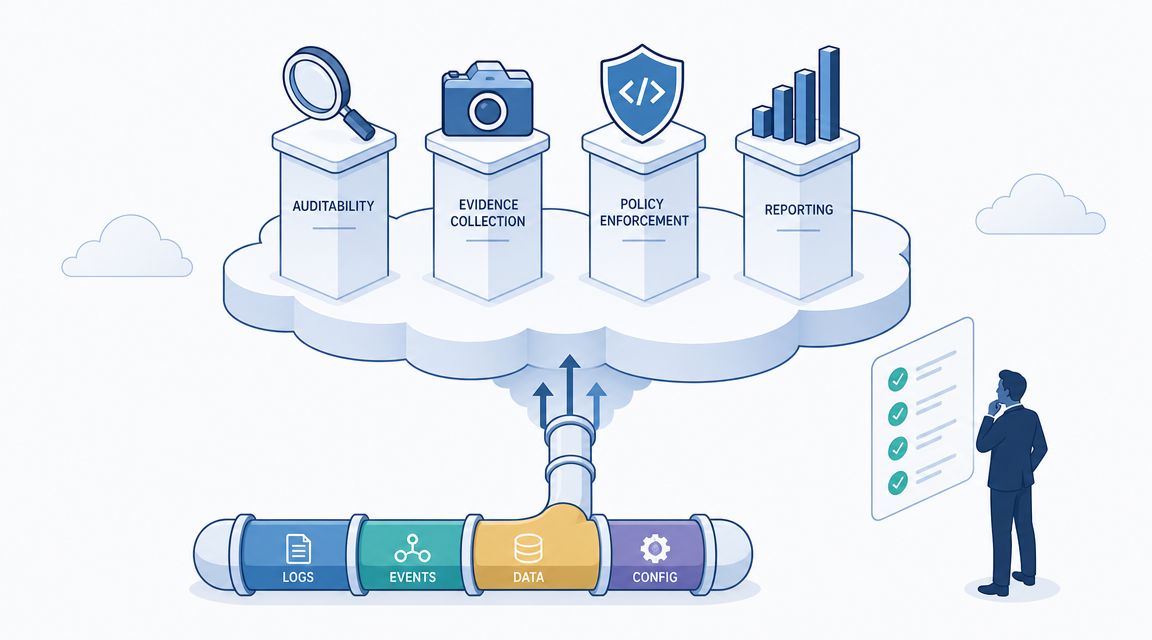

A lot of CTOs first feel compliance pressure as a roadmap disruption, not as a governance topic. A customer asks for evidence. A prospect's security review lands mid-sprint. An auditor wants proof that access controls, deployment approvals, and data handling rules were followed across environments. Suddenly senior engineers are digging through CI logs, IAM settings, ticket history, and cloud consoles instead of shipping product.
That's the problem with compliance tracking in cloud-native teams. It rarely fails because people don't care. It fails because the underlying evidence is scattered across AWS, GCP, Azure, CI/CD tools, identity providers, ticketing systems, and whatever scripts your team built six months ago and now avoids touching.
For engineering leaders, compliance tracking is an operational design problem. If controls aren't embedded in the platform, the team ends up reconstructing evidence manually. If auditability depends on tribal knowledge, every release increases risk. If policy checks live outside delivery workflows, engineers work around them.
What Is Compliance Tracking and Why Is It Your Problem
Compliance tracking is the ongoing process of proving that your systems, people, and workflows follow the policies and controls your business depends on. In practice, that means showing who accessed what, which changes were deployed, whether approvals happened, how data was handled, and whether exceptions were recorded.
That sounds like a GRC issue until an audit request lands in the engineering backlog.
For a cloud team, compliance tracking isn't a quarterly documentation exercise. It's a day-to-day requirement to keep infrastructure, deployment, access, and data handling aligned with policy while the system keeps changing. Static screenshots and point-in-time checklists don't survive modern release velocity.
In Lithuania, the pressure is getting sharper. The national Cyber Security Centre reported 4,307 cyber incidents in 2024, up 63% year over year according to RadarFirst's summary of current compliance questions. That's a useful signal for any engineering leader in the region. Periodic evidence collection isn't enough when the environment changes daily and risk does too.
Where teams usually get this wrong
Many organizations treat compliance tracking as something to prepare for later. They build product first, then add controls, then try to stitch together evidence when customers or auditors ask for it.
That usually creates three predictable problems:
- Evidence is manual: Engineers export logs, capture screenshots, and explain system behaviour from memory.
- Controls are indirect: Policies exist in docs, but not in deployment gates, IAM rules, or runtime enforcement.
- Ownership is fuzzy: Security, platform, and application teams each assume someone else has the complete picture.
Practical rule: If an auditor asks for evidence and your answer starts with “we can pull that together”, your compliance tracking model is still manual.
Why it belongs with platform engineering
The fastest way to improve compliance isn't hiring a separate team to chase artefacts. It's making the platform produce evidence by default. Immutable logs, enforced permissions, standard deployment workflows, and retained change history are engineering outputs.
That's also why data lifecycle details matter. Teams often focus on collection and retention, then neglect deletion workflows and proof. If you're reviewing how your systems should handle removal requests and downstream clean-up, Understanding Donely's data deletion is a useful example of how deletion commitments can be described clearly enough to operationalise.
The Hidden Costs of In-House Compliance Tooling
The visible cost of compliance is audits. The hidden cost is everything engineering builds around them.
When teams say they're “handling compliance internally”, what they usually mean is a mix of Terraform checks, cloud-native logs, a SIEM or log pipeline, some shell scripts, ticket exports, scanner output, policy exceptions in spreadsheets, and a handful of senior engineers who know how it all fits together. It works until one of those engineers leaves, a cloud account gets restructured, or a framework requirement changes.
A lot of leaders underestimate the burden because no single line item looks dramatic. The spend is spread across platform work, security work, delivery delays, and recurring maintenance.
The compliance tax shows up in engineering time
In 2025, 92% of organisations reported conducting at least two audits or assessments, while 58% completed four or more, according to Secureframe's compliance statistics. That matters because it means audit-readiness isn't occasional admin work anymore. It's recurring operational work.
If your setup depends on custom evidence collection, every audit cycle pulls engineers back into the same repetitive tasks:
- Rebuilding context: Someone has to explain how controls map across cloud accounts, repos, and environments.
- Fixing brittle integrations: A changed API, renamed role, or new pipeline step breaks evidence collection.
- Chasing inconsistencies: Logs, approvals, and deployment records rarely line up cleanly across separate tools.
The result isn't just effort. It's interrupted delivery.
Multi-cloud makes the DIY path worse
Single-cloud teams already deal with IAM complexity, logging differences, and environment drift. Add AWS, GCP, and Azure, and the maintenance burden climbs fast. Every provider has different primitives, naming models, policy controls, and audit surfaces. You can standardise some of it. You won't eliminate the translation layer.
That's where many internal platforms become expensive side projects. A team starts by solving one audit pain point. Then it needs centralised logs, policy checks, artefact retention, exception workflows, access reviews, and cost visibility because compliance changes often trigger more environments and more tooling.
Cloud cost then becomes part of the same problem. More logs, more scanning, more retained data, more duplicated services across accounts and regions. If your platform work is already expanding faster than product work, this explainer on cloud cost optimization is worth reading alongside your compliance design.
The most expensive compliance tooling is often the tooling you didn't intend to build. It grows out of small scripts, one-off controls, and “temporary” integrations that become permanent infrastructure.
What doesn't age well
A few patterns almost always become liabilities:
| Approach | Why it breaks down |
|---|---|
| Shared spreadsheets for evidence tracking | They drift from the real system quickly |
| Manual screenshot collection | It doesn't scale and it isn't reliable evidence |
| Tool-by-tool policy configuration | It creates inconsistent enforcement |
| Engineer-owned audit preparation | It pulls expensive talent off product delivery |
None of that creates product differentiation. It just creates operational debt.
The Four Pillars of Automated Compliance
If compliance tracking is going to work in a modern platform, it needs four things to exist together. Miss one and the whole model gets fragile.
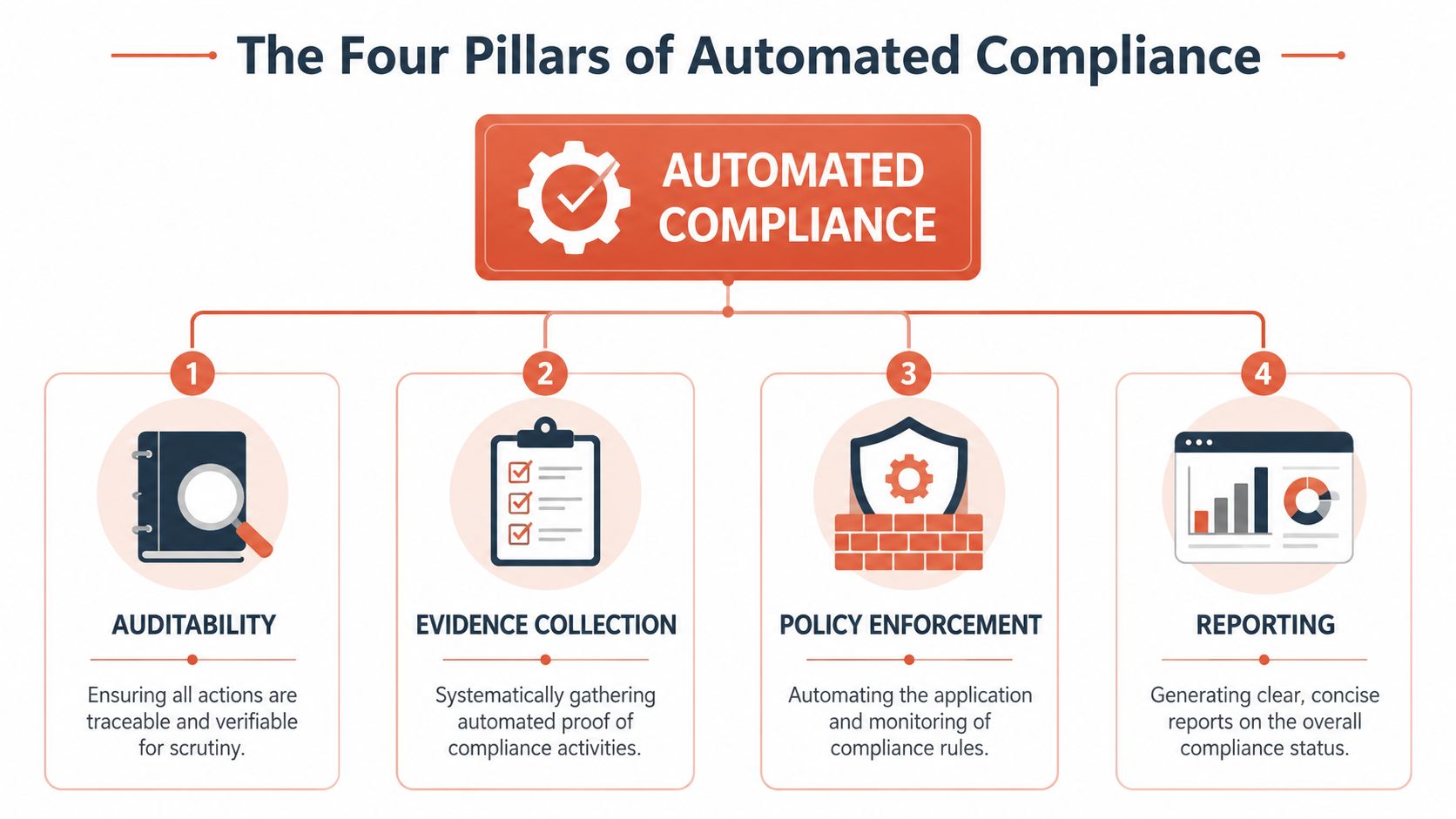
Independent compliance guidance points to four linked mechanisms: automated data discovery, real-time policy enforcement, immutable audit trails, and integration with surrounding systems. It also notes that when policies are enforced before data leaves the source, organisations reduce the gap between policy and execution where most drift occurs, as outlined in Atlan's overview of data compliance management tools.
Auditability
Auditability means the system can answer basic questions without guesswork. Who changed this setting? Who approved this deployment? Which role accessed this dataset? What happened after the exception was granted?
That requires immutable logs and stable identity context. A raw stream of events isn't enough. The records need timestamps, actors, actions, targets, and enough surrounding metadata to reconstruct intent.
A common failure mode is collecting logs without preserving meaningful relationships between them. You can see an action happened, but not how it connects to a pull request, an approval, a role assignment, or a production release.
Evidence collection
Evidence collection should happen at the source, not after the fact. If your team must manually assemble proof that a policy was followed, you're already behind.
Good evidence collection usually includes:
- Resource state snapshots: Useful for proving configuration at a point in time.
- Control execution records: Proof that a scan, check, or approval ran and passed or failed.
- Exception history: Evidence that deviations were reviewed instead of ignored.
Teams often make this harder than necessary by storing evidence in separate systems from the workflow that generated it.
Policy enforcement
With policy enforcement, compliance tracking stops being passive. The platform doesn't just observe violations. It prevents or blocks them where it can.
That can include least-privilege access controls, deployment gates, data masking rules, region restrictions, secret handling requirements, or retention and deletion policies. The key is location. Enforcement needs to happen close to the system performing the action.
Good compliance tracking starts before the risky action completes, not after someone files a finding.
Reporting
Reporting is where many teams regress back into old habits. They build decent controls, then reduce everything to static reports for auditors.
Engineering needs something different. Reporting should expose current status, open exceptions, control failures, missing evidence, and drift trends in a way operators can act on. Dashboards beat PDFs because engineers need live operational context, not end-of-quarter summaries.
A practical stack only works when these four pillars are integrated. Once they're fragmented, teams end up reconciling outputs manually again.
Integrating Compliance into Your CI/CD Pipeline
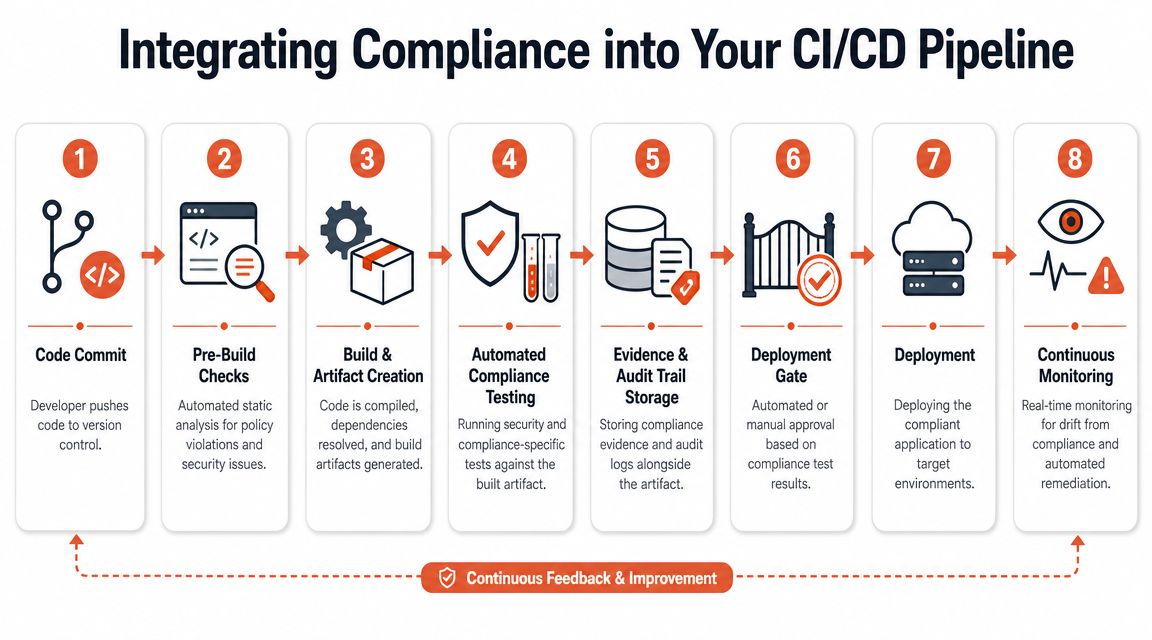
The easiest place to make compliance tracking real is inside delivery. If it doesn't live in the pipeline, it usually becomes side work.
That doesn't mean every pipeline needs a giant security stage full of slow jobs and noisy reports. It means the checks that matter should run at the points where they can prevent bad changes, capture evidence automatically, and avoid human reconstruction later.
Where the controls belong
A useful CI/CD compliance model usually spans these touchpoints:
Commit and pull request
- Check infrastructure-as-code changes.
- Validate required reviewers.
- Flag risky patterns before merge.
Build stage
- Scan dependencies and container images.
- Record build provenance and artefact metadata.
- Store results as part of the release record.
Pre-deploy gate
- Evaluate policy decisions.
- Confirm environment-specific constraints.
- Stop releases that violate mandatory controls.
Post-deploy monitoring
- Watch for drift in runtime configuration.
- Log access and change activity.
- create tickets or alerts when controls diverge.
That's the model many teams try to stitch together with GitHub Actions or GitLab CI, Terraform policy checks, Open Policy Agent, vulnerability scanners, cloud-native logs, and custom notification scripts. It can work. It also creates pipeline maintenance as a permanent responsibility.
The trade-off teams usually miss
Open-source building blocks are useful, but they rarely come pre-assembled around your workflows. Someone has to maintain policy bundles, tune scanners, manage false positives, version integrations, align evidence retention, and make sure the output is usable in audits.
That maintenance burden lands on platform engineers. Then platform engineers become pipeline custodians instead of platform multipliers.
A lot of teams would rather have secure defaults than endless pipeline plumbing. If that's the direction you're considering, these notes on zero-maintenance CI/CD pipelines are relevant because they address the operational overhead that usually gets ignored in DIY setups.
What a practical implementation looks like
The teams that make this work tend to keep the model simple:
- Policy checks are versioned: Rules change through code review, not ad hoc console edits.
- Evidence is attached to delivery events: Build, test, approval, and deploy records stay connected.
- Failures are actionable: A blocked deployment says what failed and who needs to respond.
- Runtime drift is visible: Compliance isn't assumed after deploy. It's monitored.
If your pipeline can tell you a deployment failed but can't tell you whether policy was enforced, it's still a delivery system, not a compliance-aware platform.
The goal isn't to turn every developer into an auditor. It's to make compliant delivery the default path.
Measuring Success with Frameworks and KPIs
Frameworks matter, but engineering teams often spend too much time talking about framework names and not enough time measuring whether controls work. SOC 2, ISO 27001, PCI DSS, and similar standards all drive technical expectations around access control, change management, logging, data handling, and incident response. The engineering question isn't which badge you want first. It's whether your platform can produce reliable control evidence continuously.
That's where KPI design matters. A binary view of compliant versus non-compliant is too coarse for a delivery organisation. It hides whether the system is improving, drifting, or generating avoidable toil.
Independent compliance guidance recommends tracking policy adherence, incident counts, and time to resolve issues, and points to a telemetry pipeline that consolidates logs into dashboards so compliance becomes a measurable SLO-like discipline, as described in LeapXpert's review of top compliance metrics.
The KPIs worth tracking
A useful compliance tracking dashboard should answer operational questions, not just satisfy audit requests.
Consider metrics such as:
- Policy adherence: Are teams following required workflows and control rules?
- Incident volume: Are control failures recurring in the same area?
- Time to resolve issues: How long do policy violations or exceptions stay open?
- Audit findings trend: Are the same weaknesses appearing repeatedly?
- Evidence completeness: Can the team produce records without manual backfill?
These metrics are useful because they expose process quality. Missing approvals, delayed remediation, unlogged access, and incomplete artefact chains usually show up in telemetry before they show up in an audit finding.
Framework mapping still matters
Even if your engineers don't live in audit language, someone still has to map controls to requirements. If you're tightening how technical controls line up with broader obligations, this guide to business compliance mapping strategies is a practical reference because it connects business requirements to implementation choices.
A good measurement model keeps both layers visible. Auditors need mapped controls. Engineering leaders need leading indicators that show whether those controls are healthy in production.
What success looks like operationally
You're on the right track when compliance tracking starts to look like reliability engineering:
| Signal | Healthy pattern |
|---|---|
| Violations | Detected quickly and triaged consistently |
| Evidence | Collected automatically during normal workflows |
| Exceptions | Visible, time-bound, and documented |
| Reporting | Useful to engineers, not only auditors |
That's a stronger posture than “we passed the audit last time”.
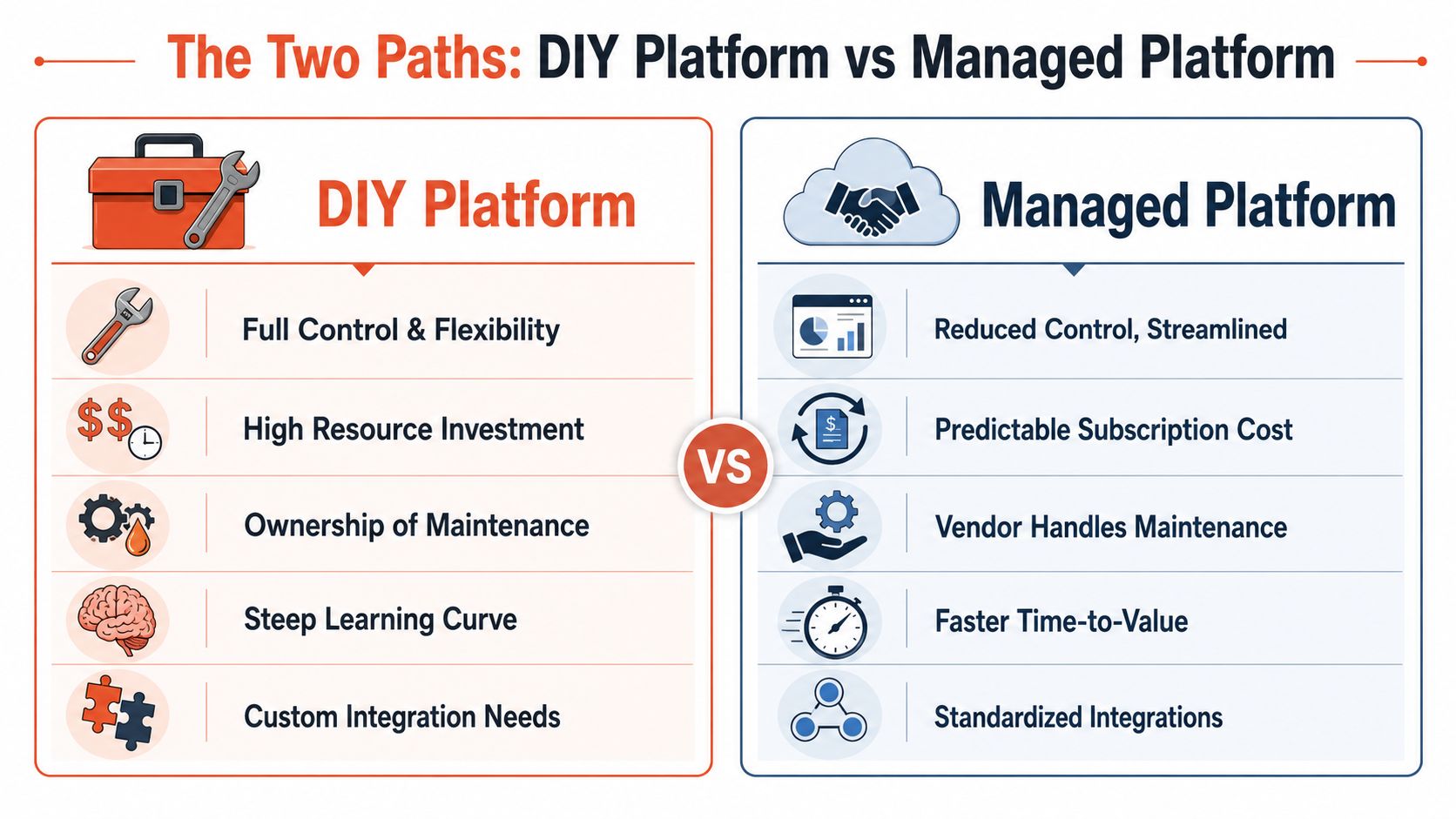
The Two Paths DIY Platform vs Managed Platform
At some point every team has to choose. Build a compliance-aware platform internally, or use a managed platform that already handles the foundation.
Those aren't moral choices. They're operating model choices.
What the DIY path actually includes
Leaders sometimes say they want “full control”, when what they really sign up for is permanent integration work. A DIY route usually means selecting and maintaining some combination of:
- Logging and retention systems
- Policy engines such as OPA
- Container and dependency scanners
- Monitoring and dashboard tooling
- Identity and access integrations
- Evidence storage and audit workflows
- Cloud-specific guardrails across AWS, GCP, and Azure
None of these components is unreasonable on its own. The trouble starts in the glue code, policy lifecycle, role design, exception handling, and upgrade path.
Privacy makes that harder. A key challenge in compliance tracking is minimising personal data collection while preserving auditability, especially given high GDPR enforcement. The EDPB's 2024 report recorded 1,746 fines totalling about EUR 1.1 billion, as noted in this discussion of compliance tracking and privacy risk. So the platform can't just collect everything forever. It has to be selective, defensible, and well-documented.
What managed changes
A managed platform shifts the work from assembling parts to operating within an opinionated system. You trade some flexibility for consistency, lower maintenance, and faster rollout.
That's often the right trade if your company's advantage comes from product delivery, not from inventing an internal control plane. A platform like PushOps' DevOps cloud infrastructure platform fits that model by standardising production foundations, deployments, observability, policy guardrails, audit logging, and multi-cloud operations in one system rather than asking a platform team to wire them together manually.
A simple comparison
| Decision area | DIY platform | Managed platform |
|---|---|---|
| Control design | Highly flexible | Opinionated but faster |
| Maintenance | Owned by internal team | Largely handled by vendor |
| Audit evidence flow | Custom-built | Built into platform workflows |
| Multi-cloud consistency | Hard to sustain | Easier if platform abstracts differences |
| Engineering focus | Split between product and platform | More product-focused |
The wrong question is “Can we build this?” Most senior teams can. The better question is “Should product engineers spend their time maintaining it?”
If your environment is highly unusual, DIY may still make sense. For most startups and scale-ups, it's expensive distraction.
An Actionable Roadmap to Continuous Compliance
Many teams don't need a giant transformation programme. They need a better sequence.
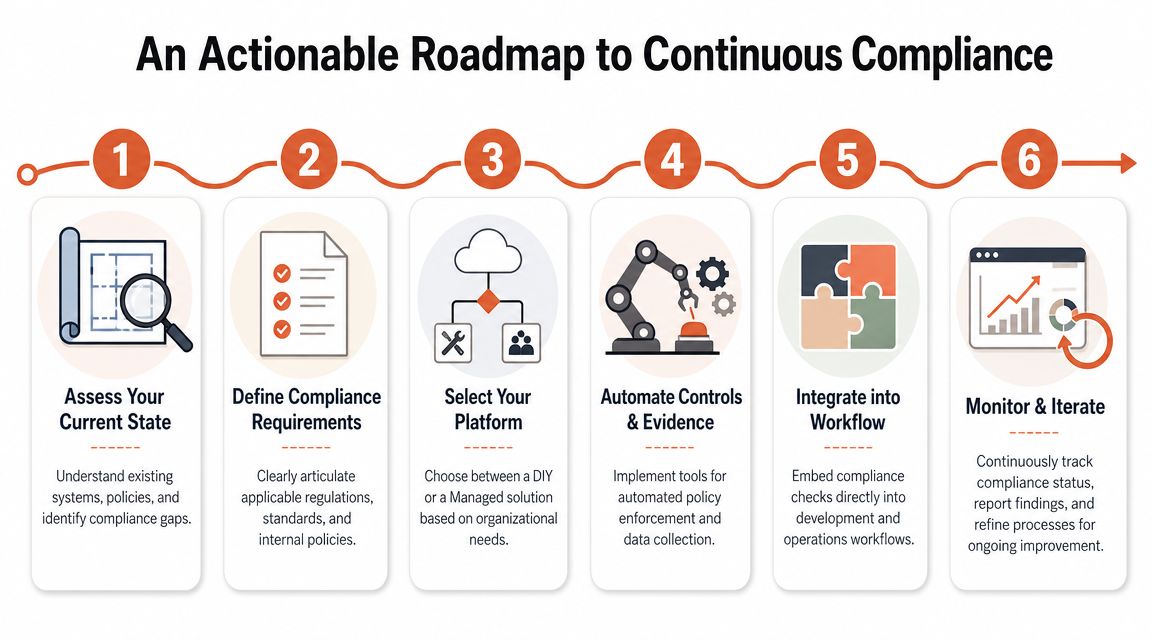
Start with the gaps that create audit pain
Map where evidence currently comes from and where it breaks. Look at access reviews, deployment approvals, policy exceptions, data handling records, and runtime logging. If a control depends on screenshots, memory, or manual exports, mark it as fragile.
Codify the non-negotiables
Turn your core rules into enforceable logic. Focus first on controls that matter across environments, such as least-privilege access, protected branches, deployment approvals, logging requirements, and sensitive data handling.
Automate evidence at the source
Attach evidence to the systems already doing the work. Builds should produce build evidence. Deployments should produce deployment evidence. Access systems should generate access records. Don't create a second evidence workflow if the first one can be made reliable.
If you're operating in regulated sectors or handling cloud migrations with sector-specific controls, this overview of PCI and FINRA cloud compliance is useful because it highlights how control expectations change with context.
Standardise the platform before you scale the process
Many teams save the most time through standardization. If every service, environment, and cloud account behaves differently, compliance tracking becomes custom work forever. Standard platforms reduce variation, and variation is what makes audits expensive.
A managed multi-cloud platform can compress this roadmap because the logging, policy enforcement, deployment workflow, and observability patterns already exist. That turns compliance tracking from a bespoke engineering project into an operating discipline the team can sustain.
If your team is spending more time stitching together infrastructure, CI/CD, logs, policy checks, and audit evidence than shipping product, it may be time to simplify the platform itself. PushOps gives software teams a production-ready cloud foundation across AWS, GCP, and Azure, with deployments, observability, access controls, audit logging, and policy guardrails built into the workflow so engineers can focus on delivery instead of maintaining internal DevOps plumbing.

