
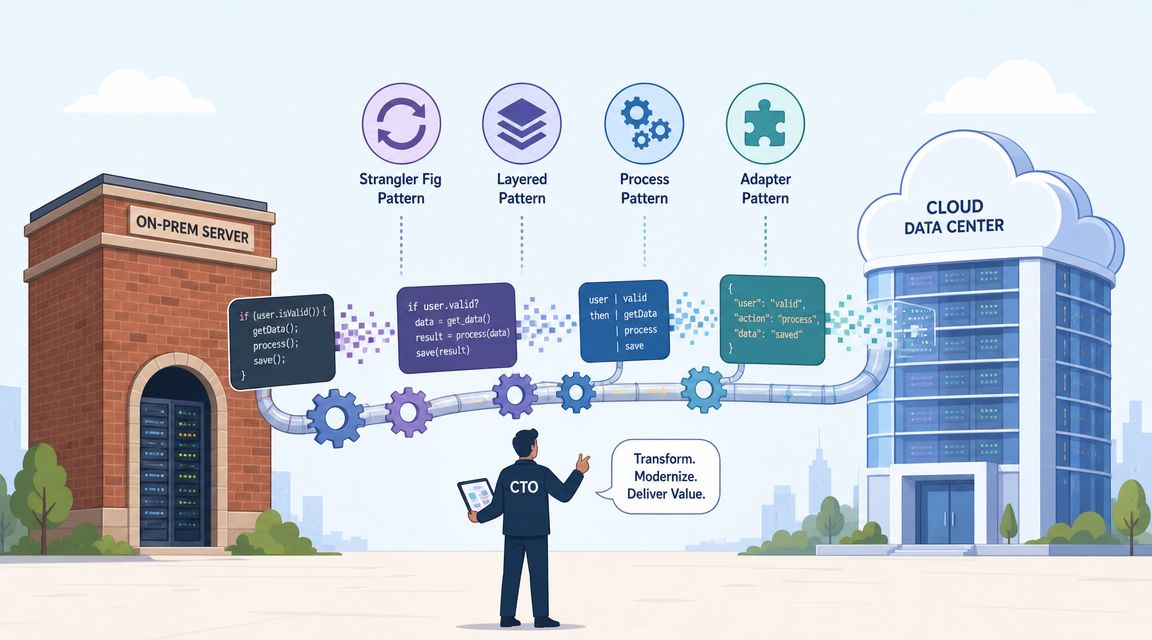

Teams don't typically decide to tackle legacy application modernization because they love architecture work. They do it because product delivery starts to feel hostage to old systems, brittle release processes, and infrastructure that only a few people understand. A routine feature slips because one shared service can't be touched safely. A compliance review exposes gaps nobody designed for. Engineers who should be improving the product spend their week tracing deployment scripts, tuning Kubernetes, or patching build pipelines.
That's the point where modernization stops being an IT clean-up exercise and becomes an operating model problem. The code matters, but the bigger question is how the application will be built, deployed, secured, observed, and owned after the migration. Teams that miss that usually replace one form of legacy with another.
The Real Cost of Keeping Your Legacy Systems Alive
The usual story starts with a product roadmap and ends with an incident call. A CTO plans a release that should have been routine. Instead, the team spends days dealing with an ageing application server, a database dependency nobody wants to touch, and a deployment path held together by tribal knowledge. The release goes out late, everyone is exhausted, and the business learns the wrong lesson. It looks like delivery is slow. In reality, the system is expensive to operate.
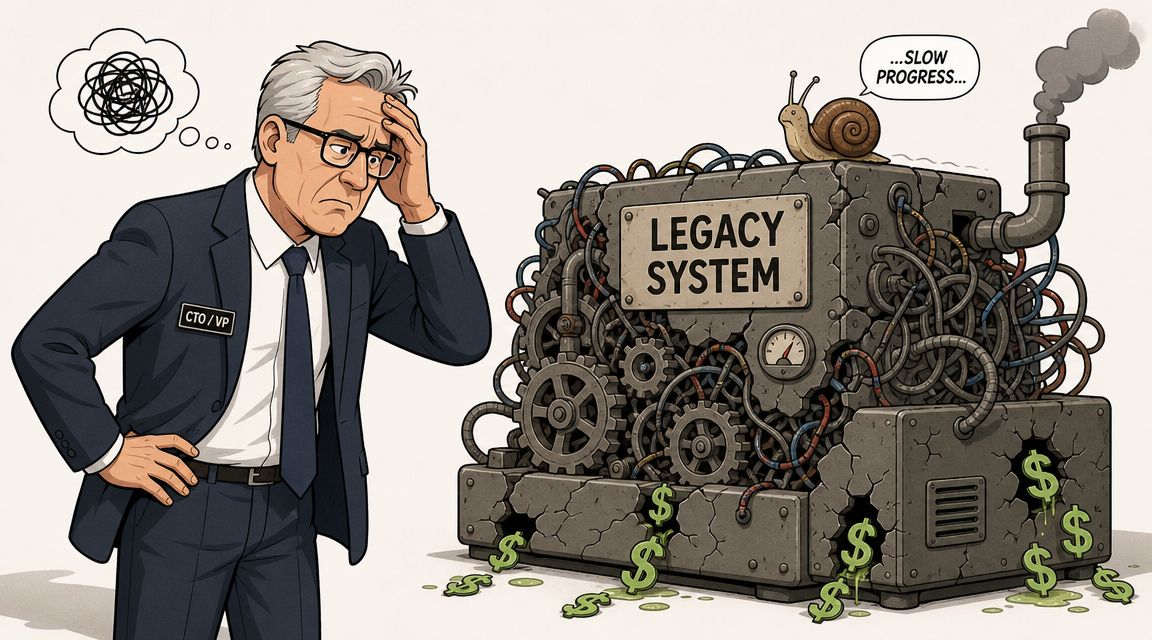
That's what makes legacy systems dangerous. They don't only cost money on paper. They absorb engineering attention. They make hiring harder because strong engineers want to work on systems they can improve. They force senior people into constant translation work between old constraints and new product demands. If you're trying to understand the broader drivers behind rising software development costs, this operational drag is one of the least visible and most persistent ones.
The budget line everyone feels but few isolate
The economics are hard to ignore. Organisations that modernise legacy applications can achieve 15–35% yearly infrastructure savings, a 30–50% reduction in application maintenance costs, and up to a 74% reduction in costs tied to hardware, software, and staff, according to LANSA's summary of IBM-cited figures.
Those figures matter because they explain why leadership teams stop treating modernization as optional. The old stack isn't just old. It is charging interest.
A few patterns show up repeatedly:
- Delayed releases: Teams batch changes because deployments are risky, which makes each release bigger and harder to recover.
- Constant firefighting: The same engineers who should be designing the future are stuck protecting the past.
- Expensive infrastructure habits: Old workloads often run in ways that are hard to tune, scale, or shut down cleanly. Work on cloud cost optimisation usually exposes how much waste is really tied to outdated architecture and poor operational visibility.
- Hidden staffing cost: You're not only paying for systems. You're paying for the people-hours required to keep them understandable.
Practical rule: If your senior engineers spend more time preserving delivery than improving it, the system is already too expensive.
Why this becomes a growth problem
Legacy application modernization is often framed as a technical project. In practice, it's a capacity recovery project. The main benefit isn't that the code looks cleaner. It's that teams get time back. They can ship smaller changes, respond faster, and spend less energy protecting fragile paths through the stack.
That's why the full cost of keeping legacy systems alive isn't maintenance alone. It's the product work that never gets done.
What Is Legacy Application Modernization Really About
Legacy application modernization isn't a synonym for rewriting a monolith in a newer language. Sometimes a rewrite is justified. Often it isn't. The goal is to remove the operational constraints that make delivery slow, risky, and expensive.
In other words, modernization is about changing how software gets built and run. That includes architecture, but it also includes release automation, environment management, observability, security controls, and team ownership. If those pieces stay stuck in the old model, the application may look newer while the delivery system remains fragile.
It's now a mainstream business priority
This shift is no longer niche. According to Red Hat's application modernization research, 95% of respondents said modernization is essential for organisational success, and companies plan to modernise 51% of their custom applications within the next year. That tells you something important. Leaders aren't budgeting for one heroic migration. They're planning portfolio-wide change.
The implication for engineering is straightforward. A modernization programme has to be repeatable. You need patterns, not one-off rescues.
Four changes that matter more than the language choice
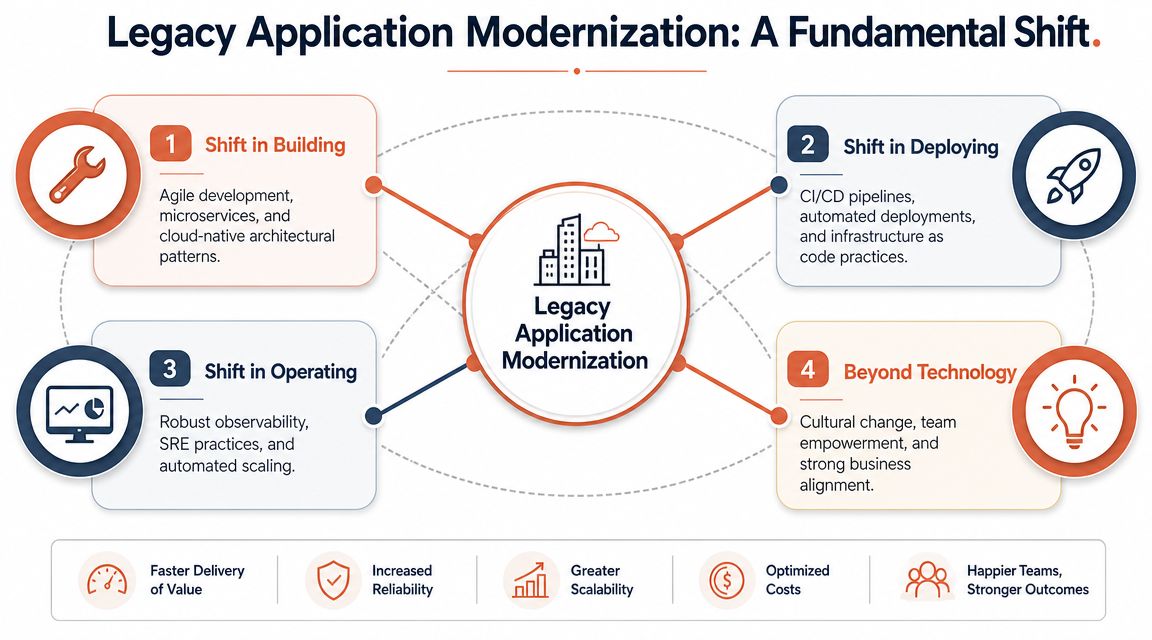
A useful way to think about legacy application modernization is as four linked shifts.
Shift in building
Old systems usually accumulate inside long-lived branches, tightly coupled services, and codebases where a simple change has a wide blast radius. Modernization improves the building side by making the software easier to change. That might mean extracting capabilities, defining clear service boundaries, or introducing API contracts around legacy components.
Many teams, when reading about scalable, secure product development, realise the same principle keeps coming up. You can't scale delivery if every change depends on undocumented internal behaviour.
Shift in deploying
Manual deployment steps are legacy behaviour even when the application runs in the cloud. If releases still depend on shell scripts, handoffs, weekend change windows, or one engineer who remembers the order of operations, the system hasn't really been modernised.
A modern deployment model usually includes:
- Automated pipelines: Build, test, and release paths should be repeatable.
- Environment consistency: Infrastructure as code matters because drift breaks confidence.
- Safer release techniques: Teams need rollback paths, staged rollouts, and reproducible artefacts.
Shift in operating
Observability often determines whether many projects succeed or fail. A modern application needs to be observable and governable. Logs alone aren't enough. Teams need metrics, traces, alerting, and a clear way to understand health across services and environments.
Modernization that improves code but worsens operations is just a more expensive kind of legacy.
Beyond technology
The final change is organisational. Someone must own the system after cutover. Teams need clear boundaries, service expectations, and enough platform support that developers can ship without becoming part-time infrastructure operators.
That's why the phrase “legacy application modernization” can be misleading. The application is only half the story. The other half is whether your delivery and operating model lets the business move faster without increasing fragility.
Comparing the Four Main Modernization Patterns
Most modernization programmes rely on some mix of four patterns. Rehost, replatform, refactor, and replace all have valid uses. The mistake is treating them as purely technical choices. They're operating model choices too. The right option depends not only on code condition, but on timeline, risk tolerance, team capability, and the burden you're willing to carry after go-live.
In practice, I'd choose the pattern by asking one blunt question first: after this move, will the team have an easier system to run, or just a different one?
The quick comparison
| Pattern | Description | Speed & Cost | Risk | Operational Outcome |
|---|---|---|---|---|
| Rehost | Move the application largely as-is to a new environment | Usually fastest initial path and often lower upfront effort | Lower code-change risk, but high chance of carrying old problems forward | Infrastructure location changes, but operational fragility often remains |
| Replatform | Move the application and make limited changes to use managed services or modern runtime components | Moderate effort with targeted gains | Balanced risk if dependencies are understood well | Can reduce some toil, especially around databases and runtime management |
| Refactor | Change parts of the application architecture or code to improve maintainability, scalability, or delivery speed | Higher effort and longer timeline | Higher execution risk, but stronger long-term upside | Usually the best path to reducing operational drag if done in phases |
| Replace | Retire the old application and adopt a new product or rebuild capability elsewhere | Cost and speed vary widely depending on business fit and migration complexity | High business-process and data-migration risk | Can remove technical burden, but often creates major change-management work |
Rehost works when time matters more than improvement
Rehosting is the classic lift-and-shift. You move the workload to cloud infrastructure and avoid deep application changes. It's attractive when a data centre exit is mandatory or the application needs to leave unsupported hardware quickly.
The problem is simple. Rehosting often preserves the same deployment pain, brittle dependencies, scaling problems, and support burden you had before. You've changed location, not behaviour.
This is especially risky when teams try to do it all at once. In markets like Lithuania, where cloud adoption is uneven, with 45% of enterprises using cloud services and 16% using advanced cloud services, a big-bang move is particularly risky. A phased approach such as the strangler pattern is usually safer for business continuity, as noted in this legacy system modernization guidance.
Replatform is often the most sensible middle ground
Replatforming keeps the core application but improves the surrounding environment. Common examples include moving from self-managed databases to managed services, replacing brittle deployment hosts, or shifting runtime concerns into container platforms and managed infrastructure.
This path works well when the application still has business value and the team needs relief without funding a full rewrite. You get some operational gains, but you don't automatically solve deep coupling, poor testability, or unclear service boundaries.
Good replatforming is disciplined. Bad replatforming becomes “just enough change to be dangerous”.
Refactor creates the most durable improvement
Refactoring is where serious modernization starts. You change the shape of the system, not only its hosting. That may involve extracting high-change domains from a monolith, wrapping legacy components behind APIs, introducing event flows, or breaking release dependencies between teams.
This is the pattern that can improve delivery speed and maintainability. It also requires patience. Teams need to preserve behaviour while changing internals, and they need enough observability to know whether they're making the system safer or merely more distributed.
A few signs refactoring is the right call:
- The application still contains valuable business logic that would be expensive to rediscover elsewhere.
- The bottleneck is changeability, not only infrastructure age.
- You can modernise slice by slice instead of forcing a full cutover.
The best refactoring programmes don't start with “how do we rebuild this?” They start with “which part hurts the business most, and how do we isolate it safely?”
Replace is clean on paper and messy in practice
Replacing a legacy application sounds decisive. Sometimes it is the right answer, especially when the old system no longer creates strategic value. But replacement programmes are usually constrained less by technology than by process, data, reporting logic, audit requirements, and behavioural quirks nobody documented.
That's why replacement often succeeds only when leaders are honest about what must be preserved exactly. Not every old feature matters. Some absolutely do.
What works better than a single-pattern strategy
Large estates rarely fit one pattern. Strong programmes mix them. They retire some systems, rehost a few, replatform where infrastructure toil is the issue, and refactor where delivery constraints are structural. The key is sequencing. Don't spend the most talented engineers polishing systems you should retire. Don't rehost a brittle monolith and pretend you've solved modernization. Don't replace business-critical workflows before you've proved data and process equivalence.
The pattern matters. The post-migration burden matters more.
How to Build Your Modernization Roadmap
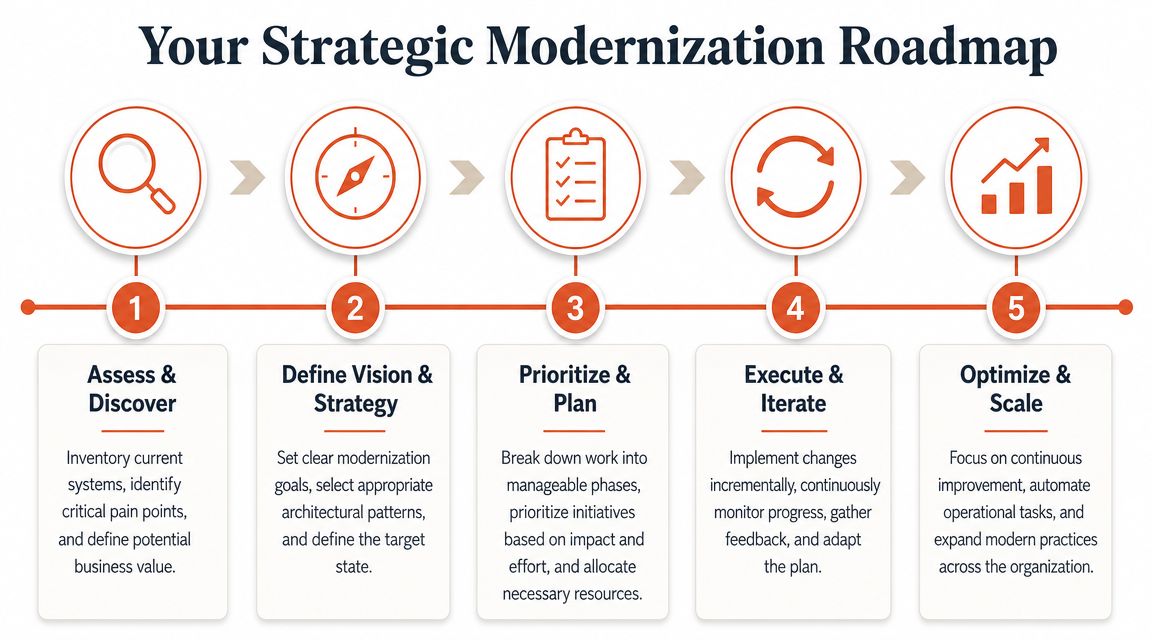
A workable modernization roadmap starts with business pressure, not architecture diagrams. If the main driver is cost reduction, your roadmap will look different from one focused on release velocity, resilience, or compliance. Teams get into trouble when they define the target stack before they define the reason for change.
The roadmap should answer three things clearly. What are we modernising first. Why that first. Who will run it after the cutover.
Start with portfolio truth, not application mythology
Every estate has at least one system that gets described as “business critical” because nobody wants to touch it. That's not enough. You need a factual inventory of dependencies, integrations, data flows, release pain, security exposure, and ownership.
A practical portfolio review usually sorts applications into groups such as:
- Keep and contain: Stable systems that should remain in place for now, but need clearer boundaries.
- Improve to reduce drag: Applications that slow delivery and deserve investment.
- Replace or retire: Systems whose business value no longer justifies their complexity.
- Delay deliberately: Workloads that can wait because another dependency must move first.
If your product leaders need a cleaner way to align technology sequencing with business priorities, a guide to defining product roadmaps is useful context. The same discipline applies here. You're choosing what earns scarce engineering attention.
Treat security and compliance as design inputs
In regulated environments, modernization fails when security is bolted on late. With regulations such as NIS2, risk assessment, access controls, and audit logging have to be part of the architecture from the start, not added after migration, as explained in this application modernization challenges overview.
That means the roadmap should define control-plane decisions early:
- Identity and access model for users, services, and operators.
- Auditability requirements for critical actions and data changes.
- Policy enforcement across environments before production cutover.
- Migration validation that proves compliance controls still work in the new state.
Leadership check: A migration that passes performance testing but fails access review is not a successful migration.
Sequence for proof, not theatre
Many roadmaps look good because they appear extensive. That isn't the same as being executable. The better approach is phased delivery with explicit proof points. Modernise a bounded slice, validate operations, learn where the hidden dependencies are, and then widen the blast radius.
Good sequencing usually follows a pattern:
- Stabilise first: Add observability, deployment discipline, and access control before deep code changes.
- Move the volatile edges: Start with domains that change often or create frequent incidents.
- Preserve compatibility: Use APIs, adapters, and parallel run periods where needed.
- Review day-two ownership: Confirm which team supports the modernised service and with what tooling.
A roadmap that ignores day-two operations is only a migration plan. Legacy application modernization needs more than that.
The Hidden Cost The DIY DevOps Platform Trap
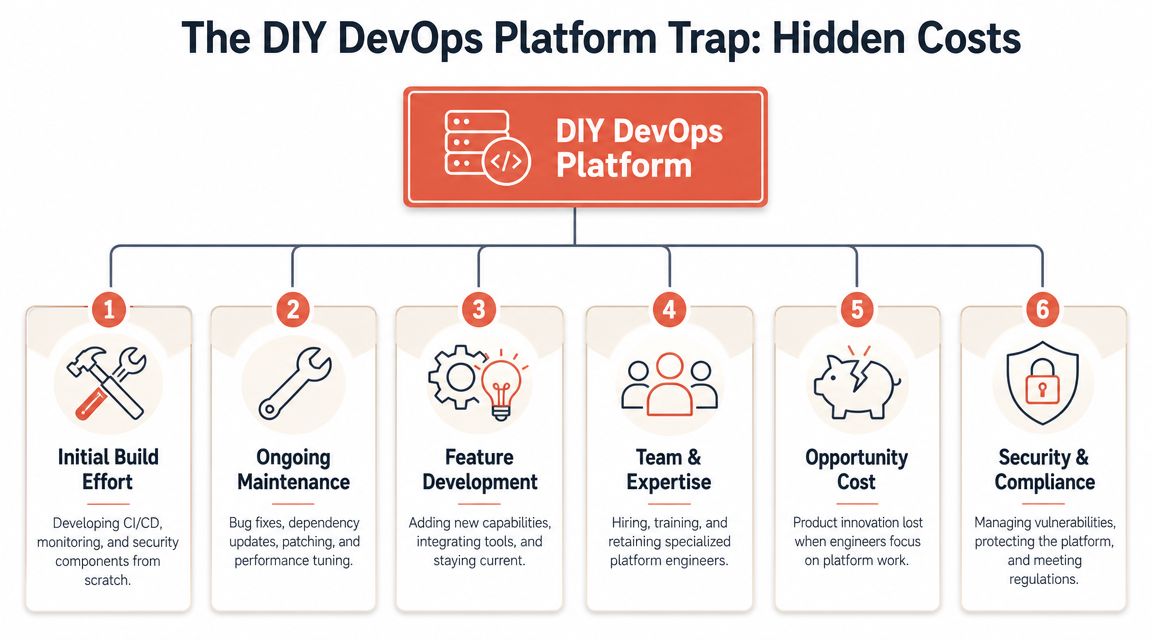
Many modernization efforts often lose the plot. The application gets attention. The platform underneath it becomes an improvised side project. Suddenly the team is standardising Kubernetes clusters, wiring CI pipelines, choosing secrets tooling, integrating Prometheus and Grafana, setting up policy checks, patching container images, and writing cloud cost scripts. None of that is fake work. All of it is real. That's exactly the problem.
For most startups and scale-ups, the biggest risk in modernization isn't the first migration. It's the decision to build and maintain a bespoke platform while also trying to ship product.
The platform iceberg
Leaders often underestimate how much work sits below the visible layer of “we'll run this on Kubernetes”. The cluster is not the platform. The platform is everything required to make that cluster safe, repeatable, observable, and usable by product teams.
That usually includes:
- Build and release automation: CI/CD pipelines, artefact handling, rollback logic, environment promotion rules.
- Operations tooling: Metrics, logs, traces, alert routing, dashboards, incident workflows.
- Security controls: Role-based access, audit trails, policy checks, patching, vulnerability management.
- Cost governance: Autoscaling rules, right-sizing, idle environment control, cloud usage visibility.
- Developer workflow design: Templates, service onboarding, secrets handling, preview environments, documentation.
Teams that want a better picture of what this automation layer should cover can look at developer platform automation. The key issue isn't whether these capabilities matter. They do. It's whether your company should be the one stitching and maintaining all of them.
The common failure mode
Many modernization guides focus on migration and ignore the question, “Who owns the modernised system?” That's a serious gap. The objective is to reduce long-term complexity, not rename it. Modernization should be judged by whether it lowers operating burden and incidents, not merely by how quickly the application moved, as argued in this modernising legacy applications perspective.
That's why DIY platform work so often creates a new legacy:
- Tool sprawl grows: One team prefers GitHub Actions, another Jenkins, another custom scripts.
- Knowledge centralises dangerously: A small platform group becomes the bottleneck for every service team.
- Maintenance never ends: Every dependency, integration, and policy engine needs updates.
- Security responsibility expands: The moment you build the platform, you own its controls and its failures.
- Product focus erodes: Your best engineers spend their best hours on plumbing.
A custom platform can be the right decision for a large organisation with unusual constraints. For many scale-ups, it's an expensive detour.
What experienced teams learn the hard way
Running a modern stack in-house is not impossible. It's just heavier than it first appears. The burden compounds because each component interacts with the others. Change the deployment model and you touch observability. Tighten security policy and you touch developer workflow. Add a new cloud and you touch identity, networking, cost visibility, and support models.
That's why platform choices are central to legacy application modernization. If you modernise the code but recreate operational fragility through bespoke tooling, you haven't escaped the original problem. You've translated it.
Modernise Your Platform Not Just Your Code
Successful legacy application modernization changes the economics of delivery. It reduces drag, lowers operating burden, improves control, and gives engineers back to the product. That rarely happens through code migration alone.
The pattern choice matters. The roadmap matters. Security design matters. But for most startups and scale-ups, the biggest strategic decision is whether to keep building the operating layer themselves. A modern system still needs CI/CD, observability, secure access, auditability, cost controls, and a developer experience people will use. If you assemble all of that internally, you need to accept that you're building a platform business inside your product business.
That's why the more durable framing is simple. Modernize the platform, not just the application. If teams want the benefits of cloud-native delivery across AWS, GCP, and Azure without sinking engineering time into bespoke infrastructure, they should think seriously about using a managed foundation instead of expanding the internal DevOps surface area. The alternative is often a familiar outcome: fewer legacy servers, but the same old bottleneck in a newer stack.
A modern internal developer platform should make shipping easier, operations safer, and ownership clearer. If it doesn't, it's adding complexity, not removing it.
If your team is spending more time maintaining infrastructure than shipping product, PushOps is worth a look. It gives you a production-ready, multi-cloud platform for deployments, environments, observability, security, and cloud cost control without forcing you to build and run all of that yourself. That means your engineers can focus on modernising application logic and delivering features, not babysitting the platform underneath it.

