
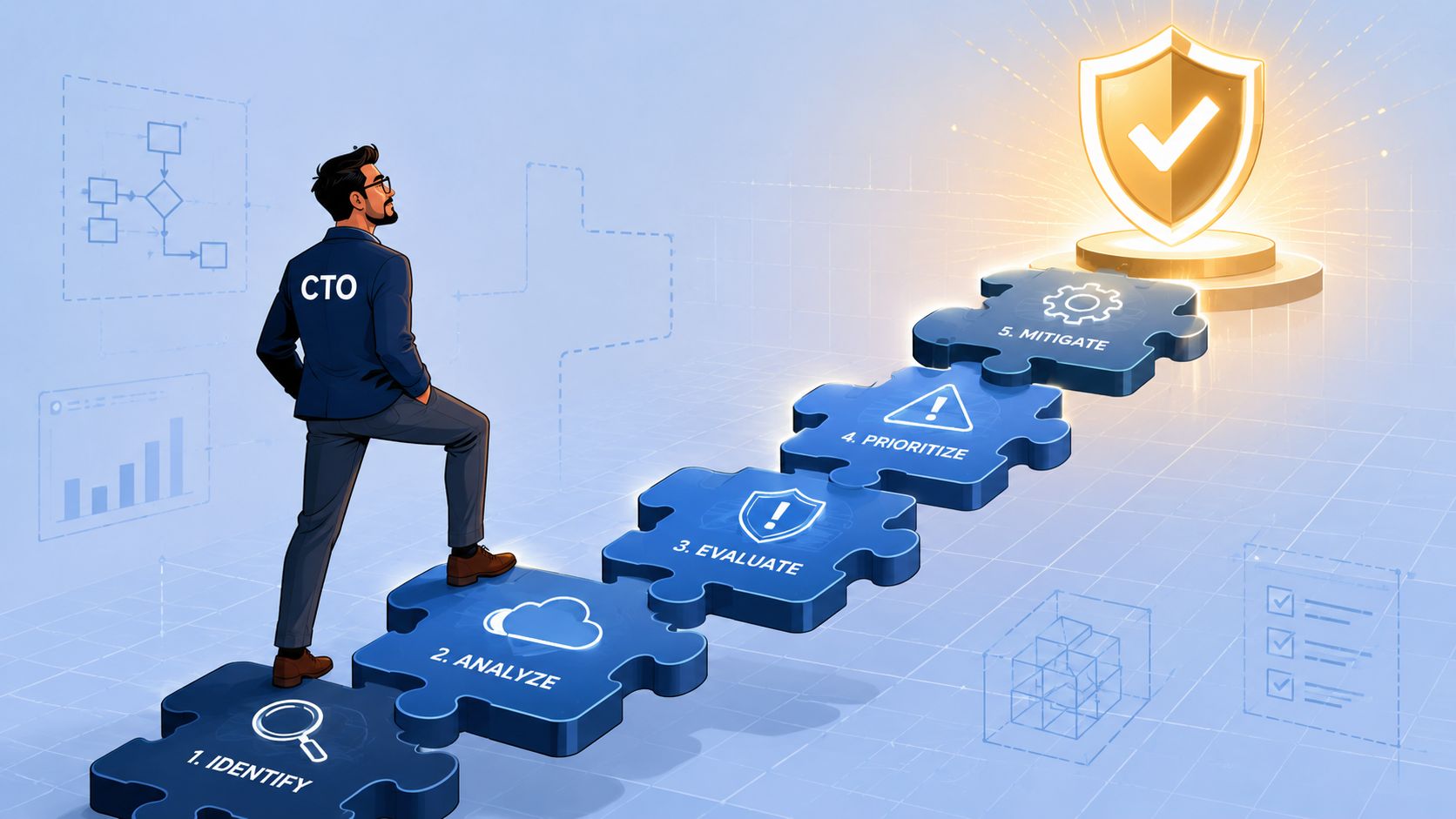

Your team probably doesn't think it has a risk assessment problem. It thinks it has a noisy alerting problem, a deployment reliability problem, a cloud cost problem, and a compliance paperwork problem.
That's how it usually shows up.
A security alert lands after hours. A routine release creates a production incident because one service depended on an undocumented queue setting. Finance asks why last month's multi-cloud bill drifted so far from forecast. An enterprise customer asks for evidence of access controls, audit trails, and incident response readiness, and suddenly your senior engineers are stitching screenshots together instead of shipping product.
Those aren't separate failures. They're signs that the business is operating without a practical risk assessment framework for its cloud estate.
Stop Firefighting and Start Strategising
Most startups and scale-ups begin with speed as the only real operating principle. That's rational. Early on, shipping beats process. A few Terraform modules, a GitHub Actions workflow, some Kubernetes manifests, a handful of dashboards in Datadog or Grafana, and the team keeps moving.
Then the stack grows teeth.
The platform now spans AWS, GCP, or Azure. Secrets live in several places. CI/CD contains inherited logic nobody wants to touch. Cost controls are partly manual. Security scanning exists, but the outputs aren't connected to release decisions. Teams have monitoring, yet still learn about user-facing issues from Slack or support tickets.
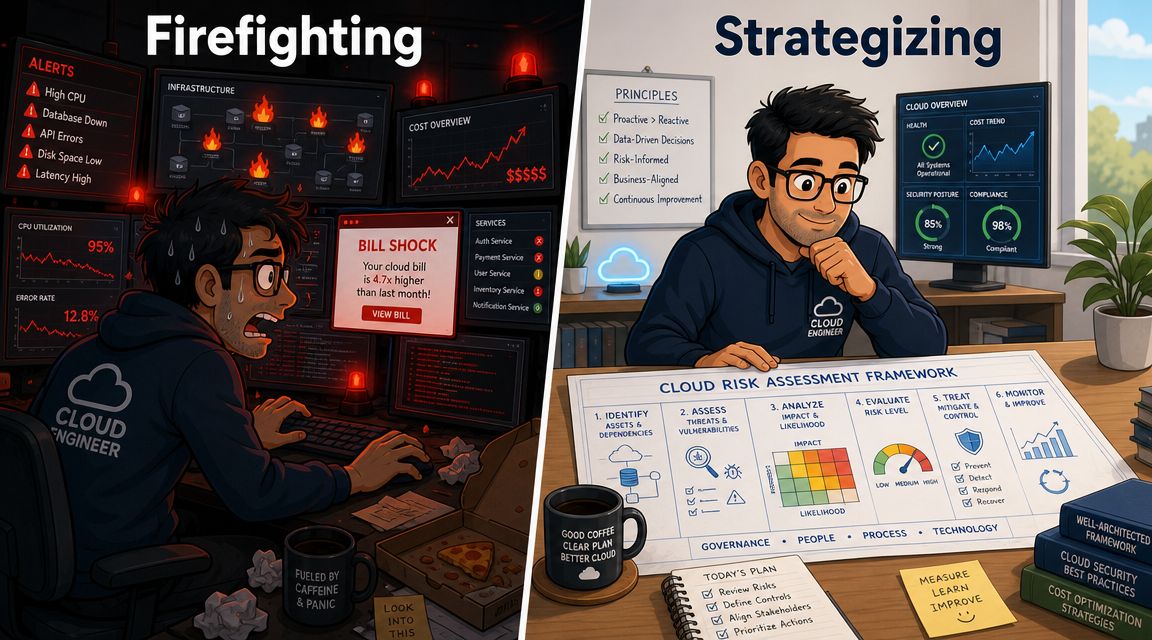
The real problem sits above the incident
The incident isn't the core issue. The missing system for deciding what matters is.
A proper risk assessment framework forces engineering leaders to answer questions that reactive teams tend to postpone:
- Which systems matter most: What can fail without serious consequence, and what directly affects revenue, customer trust, or contractual obligations?
- Which failure modes recur: Are outages coming from deployment drift, weak access boundaries, fragile dependencies, or poor rollback discipline?
- Which risks are tolerated: Some risks are acceptable for a fast-moving team. Others aren't, especially when they threaten data, uptime, or delivery confidence.
- Which controls are effective: A scanner that produces tickets nobody reviews isn't a control. It's theatre.
For cloud-native teams, infrastructure risk is business risk. If your release pipeline is fragile, product velocity is fragile. If your permissions model is messy, governance is messy. If your observability is incomplete, incident response is guesswork.
Why DIY feels cheaper until it doesn't
At this point, many leadership teams make the expensive mistake. They assume building the framework in-house is just a matter of adding a few policies, a risk register, and some scripts.
It rarely stays that small.
A DIY setup means someone has to define scoring logic, map assets, classify environments, maintain policy checks, wire security tools into CI/CD, tune alerts, document exceptions, and keep the whole thing current as architecture changes. The hidden cost isn't just tooling. It's the permanent diversion of senior engineering attention.
Practical rule: If your most experienced engineers spend more time maintaining delivery machinery than improving product delivery, your platform risk is already affecting strategy.
That same pattern shows up outside infrastructure. Teams wrestling with operational drag often see similar waste in testing and release gates, which is why this guide for CTOs on QA efficiency is useful reading alongside platform risk work.
A lot of this friction comes from fragmented tooling and unclear ownership. That's exactly why many teams start evaluating developer platform automation before they hire yet another DevOps engineer. The issue usually isn't effort alone. It's where that effort gets trapped.
What Is a Cloud Risk Assessment Framework?
A cloud risk assessment framework is a repeatable way to identify, analyse, evaluate, treat, and monitor risk across your applications, infrastructure, delivery pipelines, and operational processes.
Imagine planning a long expedition through difficult terrain. You don't just ask whether the trip is possible. You ask what could go wrong, how likely each problem is, how severe the outcome would be, which precautions are worth the weight, and what you'll keep checking while you're on the move.
Cloud systems need the same discipline.
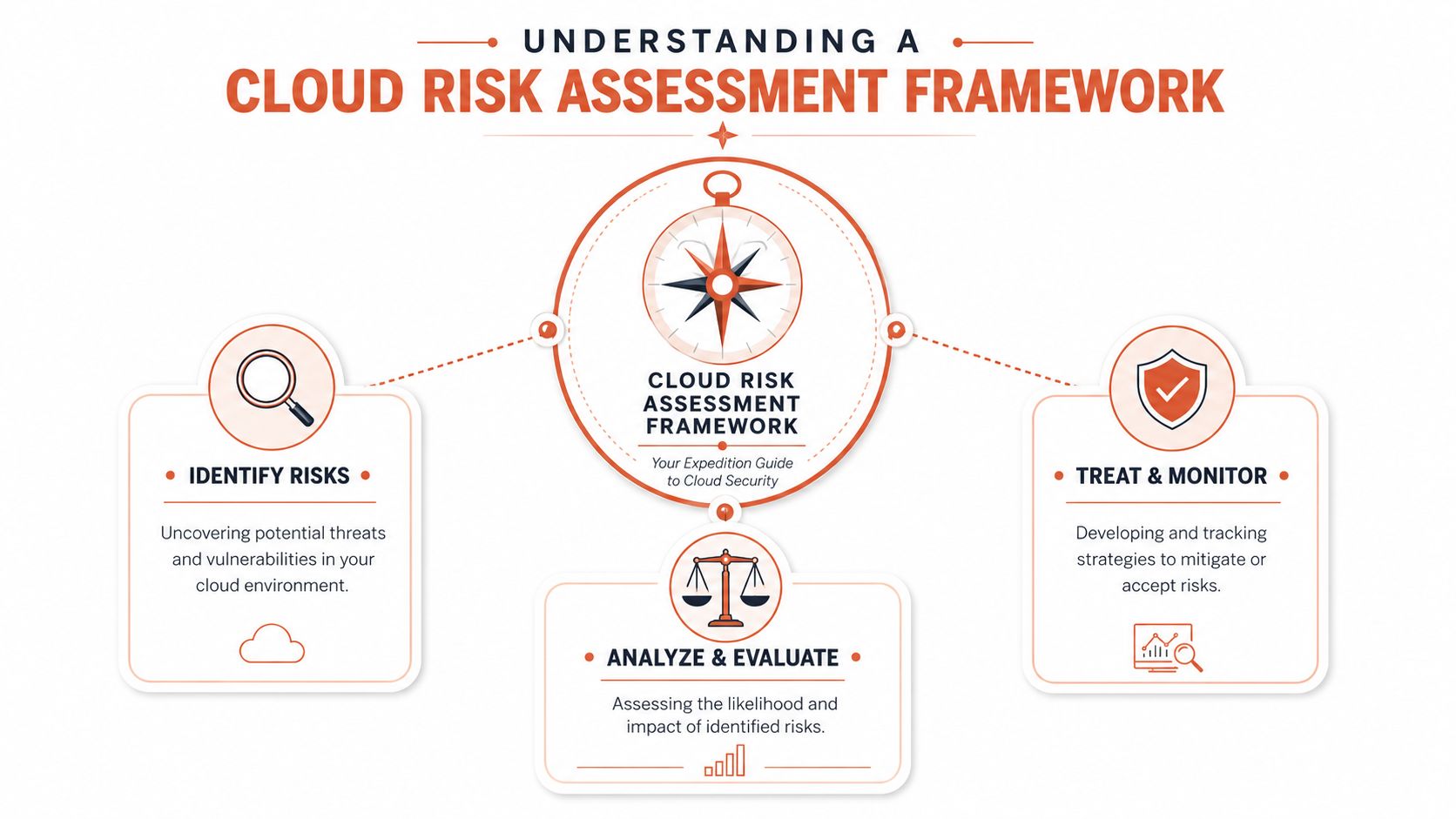
The basic loop that good teams follow
The mechanics are straightforward, even if the implementation isn't.
Identify risk
Find the assets, dependencies, trust boundaries, operational assumptions, and likely failure points. In a cloud-native stack, that includes workloads, pipelines, images, secrets, managed services, identities, third-party integrations, and cost exposure.Analyse and evaluate
Look at likelihood and impact together. A risk that's easy to trigger but easy to recover from may deserve less attention than a lower-frequency event with severe production or compliance impact.Treat and monitor
You either reduce the risk, transfer it, accept it consciously, or redesign the system so the exposure changes. Then you keep monitoring because the architecture, usage pattern, and threat surface won't stay still.
That loop sounds obvious. What's less obvious is how often teams skip parts of it. They identify threats but don't rank them properly. They buy controls but don't test whether those controls change outcomes. They review risks once a year even though the system changes every week.
Cloud risk work fails when it becomes a static document. It works when it becomes a living operational habit.
Why this matters beyond compliance
A lot of engineers hear “framework” and expect bureaucracy. The useful version does the opposite. It gives teams permission to move faster because they understand where speed is safe and where it isn't.
That's not theory. In Lithuania, risk assessment is treated as a formal governance process. The national Civil Protection and Emergency Management system requires authorities to assess hazards and prepare risk scenarios, using structured identification, likelihood-impact evaluation, and mitigation planning rather than ad hoc judgement, as outlined in this Lithuanian risk assessment framework overview. The same logic translates cleanly to cloud engineering.
For technical leaders, that means a risk assessment framework isn't just a compliance artefact. It's an operating model for deciding where to standardise, where to automate, where to add controls, and where to stop pretending a brittle setup is “good enough”.
Migration work makes this painfully clear. Teams often focus on the target architecture and underweight the operational risks introduced during transition. If that's on your roadmap, this piece on avoiding migration disaster is a useful reminder that architecture choices and migration risks can't be separated.
Core Components for Cloud Engineering Teams
Most risk frameworks look tidy on paper. Cloud environments don't. The practical version has to deal with distributed systems, shared responsibility, frequent releases, and a long list of tools that don't naturally agree with each other.
That's why a working risk assessment framework for engineering teams usually rests on a few core components. Miss one, and the rest start producing false confidence.
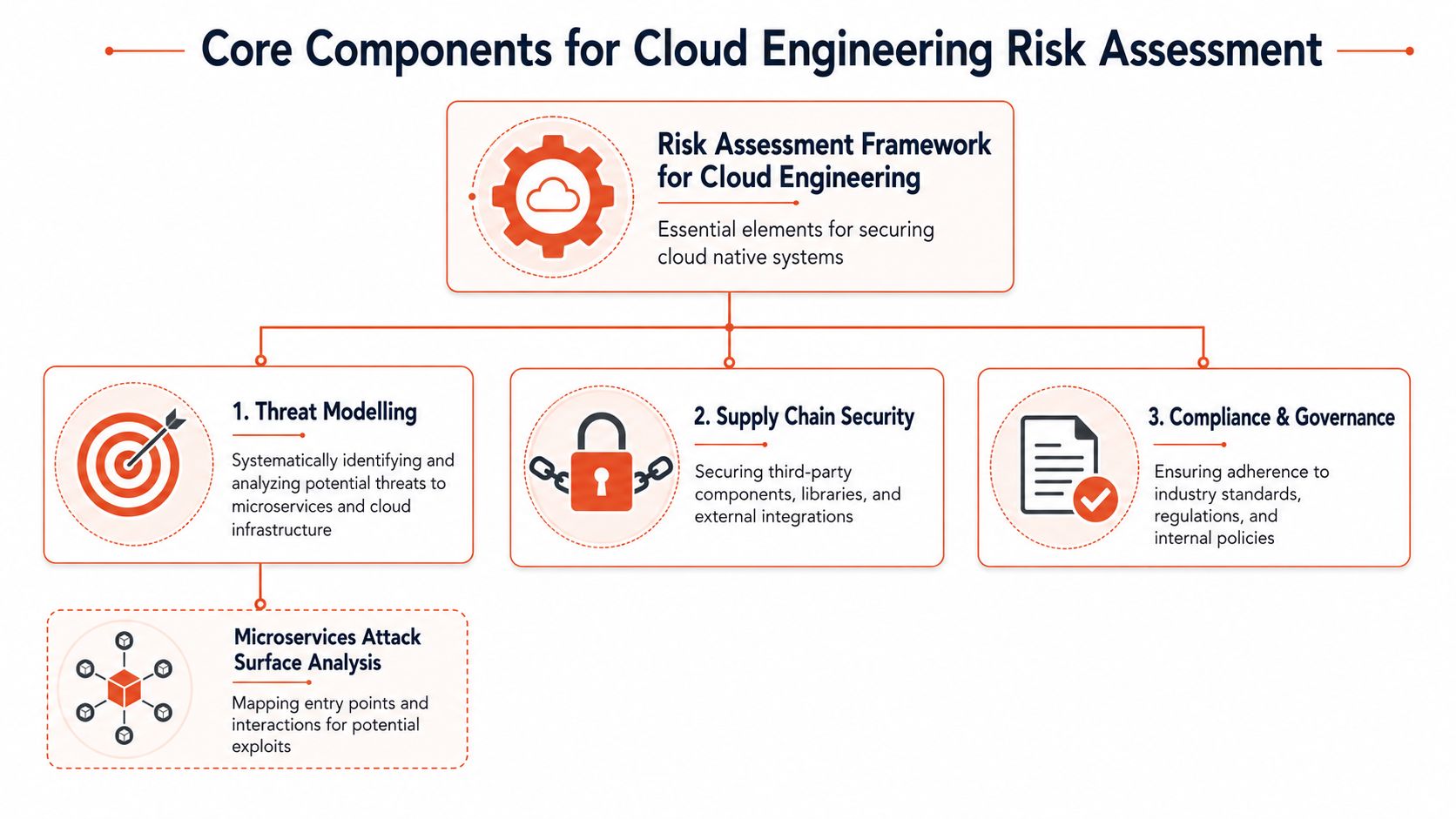
Threat modelling that reflects how the system actually behaves
Threat modelling can't stop at the perimeter because most cloud-native systems don't have a clean perimeter any more. You need to understand service-to-service calls, asynchronous workflows, API gateways, background jobs, secret access patterns, and privileged operational paths.
For microservices, the useful questions are specific:
- Where can an attacker enter: Public endpoints, admin interfaces, CI runners, developer credentials, and exposed internal tooling.
- What can move laterally: Shared secrets, over-broad IAM roles, weak tenant isolation, and trusted internal networks.
- What breaks under pressure: Rate limits, queue backlogs, retries, circuit breakers, and rollback paths.
A lot of teams do this once during a security review, then never revisit it. That's a mistake. New dependencies, rushed features, and environment drift change the attack surface constantly.
Supply chain controls that go beyond scanning
Container and package security is where DIY programmes often become a patchwork. Teams add Snyk, Trivy, Dependabot, or native cloud scanners. They get results, but not a coherent process.
Scanning alone doesn't answer the fundamental governance questions:
- Which base images are approved?
- Who can override a failing check?
- How are exceptions documented?
- What's the release rule for a vulnerable dependency in a non-critical service versus a customer-facing one?
- How do you track risk that comes from third-party actions, marketplace components, or build-time secrets?
If those decisions live in tribal knowledge, the framework is weak even if the scanner coverage looks good.
Governance that maps to delivery reality
The compliance burden has grown sharper for European teams. The EU's NIS2 directive, implemented in Lithuania, has raised expectations by requiring organisations to quantify likelihood, impact, and residual exposure, moving teams away from simple checklists and towards measurable, audit-ready risk methods, as described in this NIS2-focused risk assessment methodology overview.
That sounds reasonable until you try to operationalise it inside a fast-moving stack.
You now need evidence that controls exist, evidence that they're applied, evidence that they're reviewed, and evidence that residual exposure is understood. In practice, that pulls engineering into recurring work around policy validation, access review, deployment governance, and control monitoring.
What doesn't work: bolting compliance evidence onto the end of the release process.
What does work: building release, security, and operational controls so they generate evidence as a side effect of normal engineering activity.
The hidden factory behind the controls
A DIY implementation usually creates an internal factory of maintenance tasks. Someone has to keep the integrations healthy between CI/CD, secret scanning, image scanning, IaC policy checks, runtime telemetry, ticketing, and audit logs. When one piece changes, the whole chain needs retesting.
That's why many teams eventually look at an internal developer platform instead of adding more standalone tools. Consolidation isn't about convenience alone. It's about reducing the number of places where risk controls can fail undetected.
Comparing Common Risk Management Standards
Framework selection tends to get discussed as if it were a philosophy exercise. For a CTO, it's mostly an operating model decision. You're choosing how formal the process needs to be, how much quantification you want, and how much implementation load your team can realistically absorb.
The standards below all have value. The catch is that adopting any of them in a DIY environment creates work that doesn't show up in the neat diagrams.
What structured really means in practice
NIST's Risk Management Framework is explicit about structure. It is a 7-step, repeatable process for managing security and privacy risk, and it requires organisations to categorise systems, select and implement controls, assess effectiveness, authorise operation, and continuously monitor, according to the NIST Risk Management Framework project page.
That level of rigour is useful. It's also heavy.
For a startup or scale-up, the challenge isn't whether NIST is sound. It is. The challenge is whether you have the people, time, and operational discipline to run that cycle properly without starving product work.
Risk framework comparison
| Framework | Primary Focus | Best For | Typical DIY Overhead |
|---|---|---|---|
| NIST RMF | Structured control selection, assessment, authorisation, and continuous monitoring | Teams that need a formal, repeatable operating model for security and privacy risk | High. Requires classification discipline, control mapping, review cycles, evidence collection, and sustained monitoring effort |
| ISO 27005 | Information security risk management within a broader ISMS context | Organisations aligning security risk work with ISO-led governance and audit processes | Moderate to high. Strong process work, documentation expectations, and ongoing review overhead |
| FAIR | Quantifying information risk in business terms | Teams that want more consistent, defensible decision-making about cyber and operational exposure | Moderate. Demands clear modelling assumptions, quality inputs, and people who can translate technical conditions into business impact |
The choice most teams get wrong
The common mistake is to choose based on logo recognition. A board member knows NIST. A customer mentions ISO. A security lead prefers FAIR. So the company picks one and assumes the framework itself will create discipline.
It won't.
A framework only helps when it matches the team's operating capacity. If you choose a model that requires continuous evidence production but your tooling is fragmented, engineers will build side spreadsheets and exception processes to keep up. That's how “formal” programmes become brittle and political.
A better question is simpler: can your organisation support the cadence that the framework demands?
If your controls depend on heroic manual effort, the framework may be correct on paper and unworkable in production.
The most effective teams usually borrow the discipline of established standards, then simplify implementation around a smaller number of high-value controls, strong automation, and regular review. They don't confuse sheer breadth with usefulness.
A Practical (and Costly) DIY Implementation Roadmap
If you decide to build your own risk assessment framework, the roadmap is straightforward. The operational bill is not.
The work usually starts with good intentions. Security wants consistency. Engineering wants fewer surprises. Leadership wants clearer accountability. Everyone agrees the current setup is too reactive.
Then the implementation begins, and each step turns into a project.
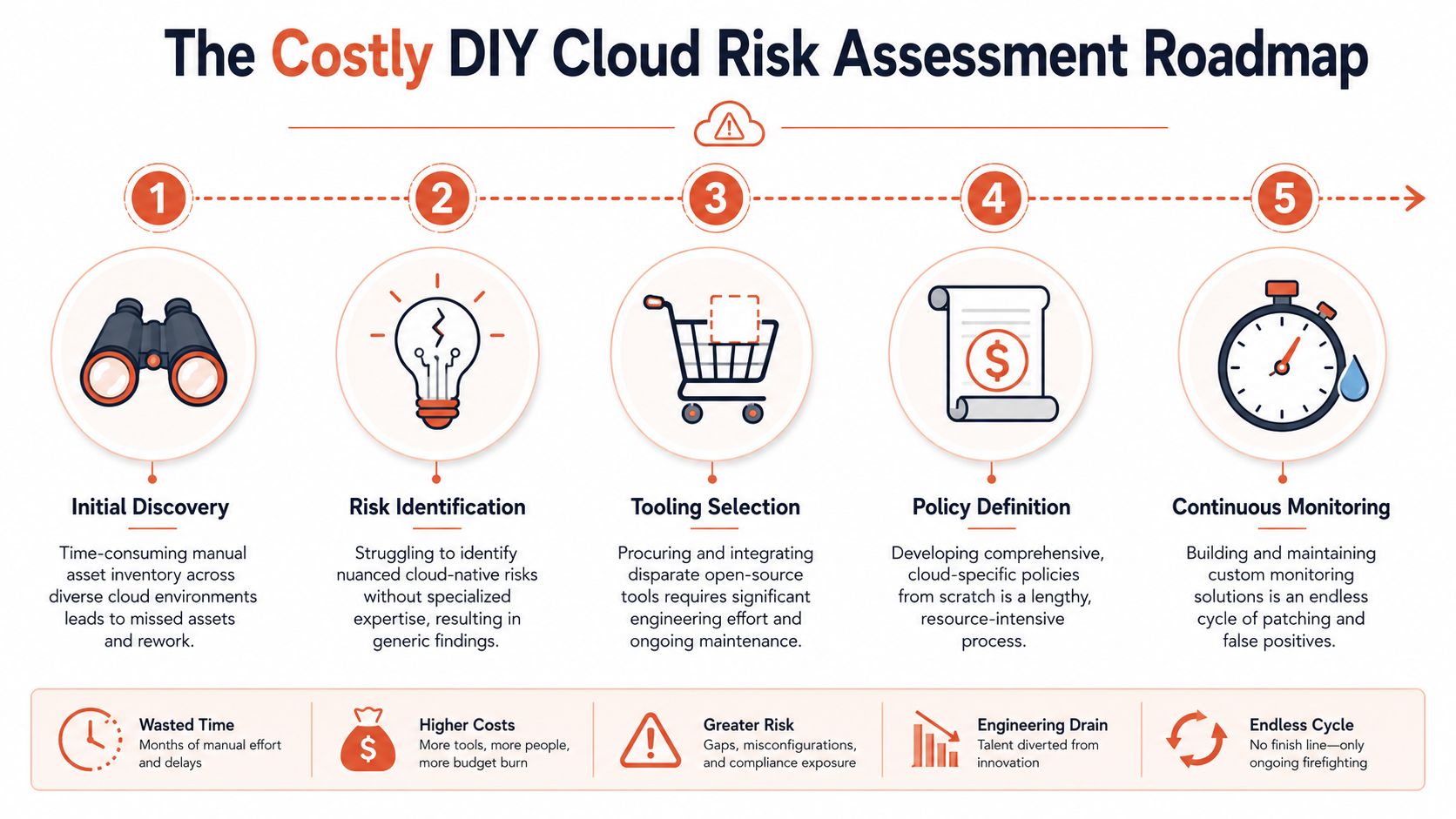
Step one through three
Define risk appetite.
This sounds strategic, and it is. But someone still has to turn broad executive intent into release rules, access policies, incident thresholds, and service classifications that engineers can use. Without that translation layer, “risk appetite” remains a slide.
Inventory assets and dependencies.
Many DIY efforts often stall at this stage. Cloud accounts, clusters, databases, queues, runners, third-party services, ephemeral environments, and deployment paths all need ownership and context. Asset lists drift fast when teams ship often.
Choose tooling and glue it together.
This is the seductive phase because open-source and SaaS options look abundant. You can assemble scanners, policy engines, dashboards, and ticketing workflows. But integration work becomes permanent work. Version changes, API changes, and pipeline changes don't stop after launch.
Step four and five
Build the scoring model
You need a method for judging likelihood, impact, and residual exposure that different teams can apply consistently. Too simple, and the output is noise. Too detailed, and nobody uses it.Attach controls to delivery workflows
Risk controls must sit inside pull requests, CI/CD gates, access workflows, runtime monitoring, and incident response. If they sit outside the delivery system, they get bypassed when time pressure rises.Create review and exception processes
Exceptions are inevitable. The dangerous part is unmanaged exceptions. You need review cycles, ownership, expiry rules, and evidence trails.
Why the DIY model degrades over time
The hardest part isn't setup. It's drift.
A major challenge in risk assessment is handling changing assumptions over time. Recent methodological work argues that assessments for complex systems should explicitly document what is included or excluded because changing assumptions can materially alter the measured risk, which is exactly why static checklists and DIY script-based systems become hard to maintain, as discussed in this research on changing assumptions in risk assessment.
That insight matters in day-to-day platform work. A framework built around last quarter's architecture often stops reflecting today's production risks. New services appear. Shared libraries change. Identity boundaries move. Data flows expand. What looked like a sensible script set becomes a museum of stale assumptions.
The hidden cost nobody budgets properly
The cost is focus loss.
Every hour spent maintaining bespoke policy code, brittle pipeline conditions, alert routing rules, asset maps, and custom compliance dashboards is an hour your senior engineers aren't spending on customer-facing work. The team starts hiring to maintain internal machinery rather than to build product.
Cloud cost governance creates a parallel version of the same problem. Even teams with decent engineering discipline often rely on fragmented reports and manual reviews when they should be reducing exposure directly in the platform layer. That's why it helps to think about cloud cost optimization as part of the same risk programme, not as a separate finance exercise.
A DIY framework can absolutely work. It just demands a level of sustained operational ownership that many growing teams underestimate.
Automate Your Framework with a DevOps Platform
The practical question isn't whether a risk assessment framework is necessary. It is. The practical question is where the complexity should live.
You can keep that complexity inside your own engineering organisation, spread across scripts, CI jobs, Terraform modules, dashboards, tickets, and human memory. Or you can move more of it into a platform that standardises the underlying controls and workflows.
That shift changes the economics of risk management.
What a platform approach improves
A managed platform doesn't remove the need for judgement. Leadership still has to decide what matters, what is acceptable, and what needs mitigation. But it does remove a large amount of repetitive implementation work.
The benefits usually show up in a few places first:
- Secure defaults: Environment setup, permissions, deployment paths, and audit behaviour are more consistent when they're baked into the platform rather than recreated team by team.
- Integrated observability: Continuous monitoring becomes more realistic when telemetry, service health, and incident context already live in the same operating surface.
- Delivery guardrails: Release workflows can enforce policy without every squad maintaining its own CI/CD logic.
- Cost risk reduction: Autoscaling, environment scheduling, and right-sizing controls are easier to apply systematically when they are native capabilities rather than separate clean-up projects.
Why this fits smaller and growing teams better
For smaller organisations, one-size-fits-all frameworks are often too complex. Recent research favours layered, scalable approaches that align mitigation to available capacity, which makes a managed platform attractive because it abstracts much of the underlying complexity while preserving structure, as described in this research on layered and scalable risk frameworks.
That's the operational point many teams miss. Mature risk management doesn't have to mean building a mini-governance department inside engineering. It can mean choosing infrastructure patterns and delivery systems that make the safer path the default path.
The best risk framework is the one your team can actually run every week, under delivery pressure, without turning product engineers into part-time platform maintainers.
A modern DevOps platform changes the conversation from “How do we assemble and maintain all these controls ourselves?” to “Which decisions should remain bespoke, and which should be standardised so the team can move?” For most startups and scale-ups, that's a much healthier question.
If your team is spending too much time maintaining pipelines, patching platform glue, chasing cloud cost drift, and preparing evidence for security or compliance reviews, it may be time to stop building the machinery yourself. PushOps gives software teams a production-ready foundation across AWS, GCP, and Azure, with deployments, observability, security controls, and cost management built in so engineers can focus on shipping product instead of operating a fragile internal platform.

