
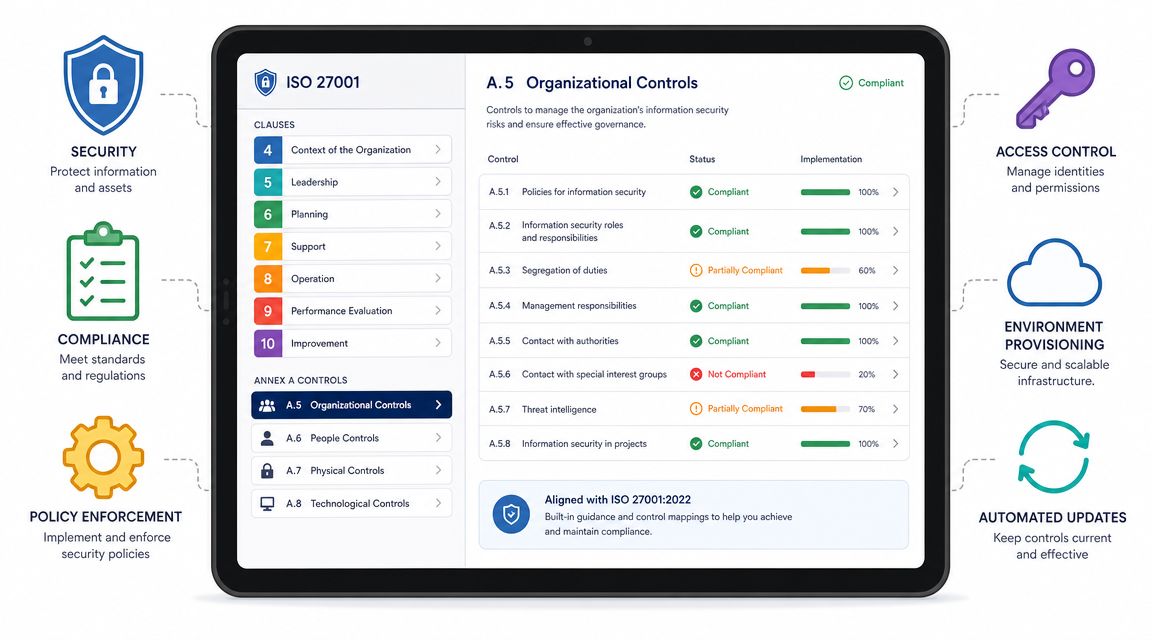

A lot of CTOs reach ISO 27001 the same way. A customer asks about certification during procurement. A security questionnaire escalates. Sales wants a date. Engineering looks at the backlog, then looks at the infrastructure stack it built piece by piece across Kubernetes, CI/CD, cloud IAM, logging, secrets, alerts, and scripts that only two people fully understand.
That's when ISO 27001 feels less like a security standard and more like a tax on product velocity.
The mistake is treating it as a paperwork project. It isn't. ISO 27001 is a management system for making security decisions in a repeatable, auditable way. For cloud-native teams, the primary challenge isn't writing a policy first. It's proving that your environments, access model, deployment process, and monitoring practices match what the policy says.
Teams that built a highly custom DevOps stack usually feel this pain more sharply. They don't just need to decide what controls they want. They need evidence, ownership, consistency, and change discipline across every moving part.
Your First Step Towards ISO 27001 Certification
The first conversation usually sounds simple. “We need ISO 27001.” Then the implications land.
A lean engineering team already running product, releases, uptime, and cloud costs suddenly has to define scope, write policies, assess risk, review vendors, collect evidence, and make sure infrastructure choices can survive auditor questions. If your stack is heavily DIY, every answer spawns another task. Who owns IAM reviews? Where are deployment approvals logged? Which services are in scope? Why is staging configured differently from production?
What the standard actually asks from you
ISO/IEC 27001:2022 is the current version of the standard, and it defines the requirements for an Information Security Management System. It has 11 clauses and Annex A includes 93 controls across 4 categories. Organisational, people, physical, and technological. The 2022 revision added 11 controls, reflecting risks tied to cloud use, monitoring, and data protection, according to the ISO 27001 standard overview from ISO.
That sounds abstract until you translate it into startup reality. It means you need more than a good security intention. You need a system that can show how you assess risk, choose controls, audit yourself, and improve over time.
Practical rule: certification gets easier when your engineering setup already produces clean evidence.
Why cloud teams should treat this as an architecture problem
For a software company, ISO 27001 requirements land directly inside delivery workflows. Access control shows up in IAM and role design. Change control shows up in pull requests and deployment approvals. Monitoring controls show up in logs, alerts, and incident handling. Asset inventory shows up in cloud accounts, services, repositories, and vendors.
That's why many teams now look for a platform approach instead of building every compliance capability in-house. A managed environment with standardised deployment, auditability, and policy enforcement can remove a lot of manual glue work. If your team is evaluating that route, PushOps has a useful overview of ISO-ready cloud infrastructure platforms.
The fastest path usually isn't “hire more engineers and build more internal tooling”. It's reducing the number of systems you need to explain, secure, and evidence in the first place.
Understanding the Core ISO 27001 Framework
When teams first read ISO 27001 requirements, they often jump straight to controls. That's backwards. The centre of the standard is the ISMS, not the checklist.
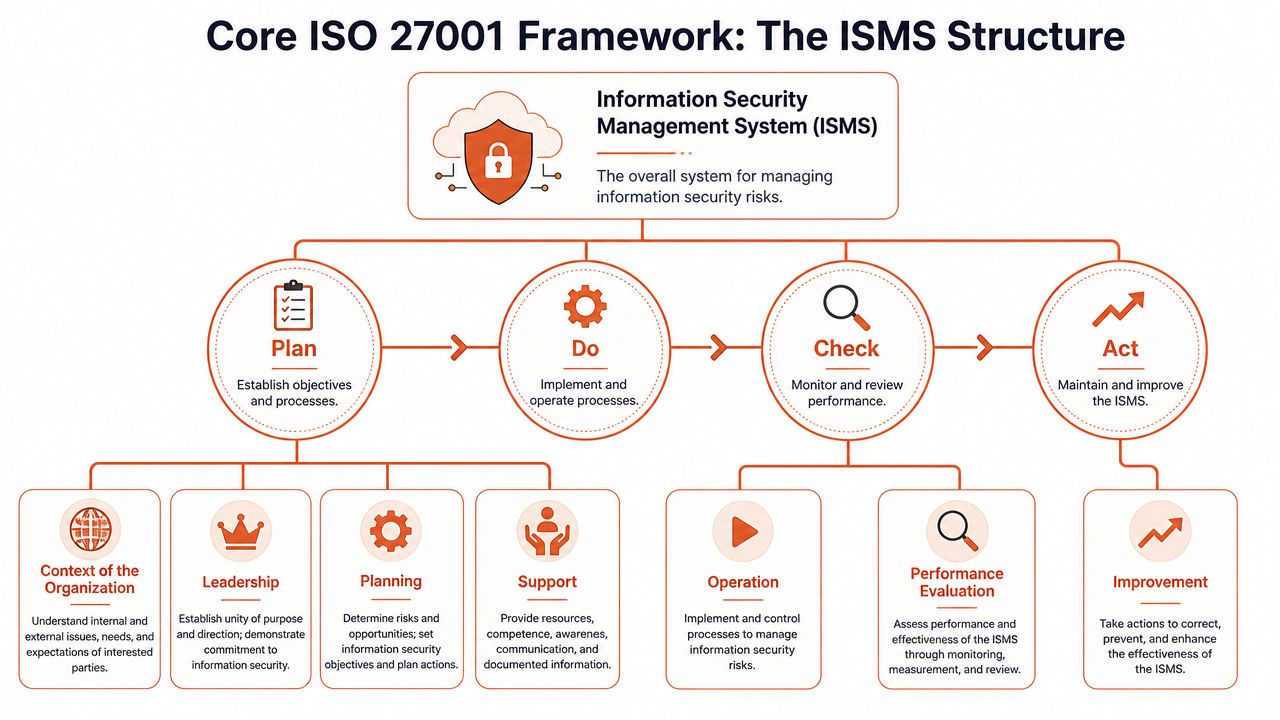
The easiest way to think about it is this. Clauses 4 to 10 define the management system you must run. Annex A gives you a structured set of controls you can select from based on risk. One defines the operating model. The other helps you implement safeguards.
The PDCA cycle in engineering terms
The standard follows a Plan, Do, Check, Act cycle. That sounds formal, but most engineering leaders already work this way when they run production responsibly.
- Plan means defining scope, risks, objectives, and responsibilities.
- Do means operating the selected controls in real environments.
- Check means reviewing logs, incidents, audit findings, and performance.
- Act means fixing weaknesses and improving the system instead of tolerating drift.
If your platform setup is fragmented, this cycle breaks down quickly. Risks live in one document, controls in another, logs in three tools, and change approvals in private Slack threads. Auditors notice that. So do customers.
Clauses tell you what, controls help with how
A useful analogy is a building. The clauses are the foundation, load-bearing walls, and inspection process. Annex A controls are the locks, alarms, doors, and operating rules inside it. You can't swap one for the other.
That distinction matters for CTOs because many teams over-focus on technical hardening and under-invest in management discipline. You can have excellent Terraform, sensible cloud IAM, and mature CI checks, but still fail because scope is vague, risk treatment is inconsistent, or management review never happens.
For teams benchmarking their vendor stack, the write-up on DocsBot platform security is a good example of the kind of practical security information buyers increasingly expect to see. The standard doesn't require a specific platform design, but it does require that your controls are justified, operating, and reviewable.
ISO 27001 rewards consistency more than cleverness.
That's why the strongest implementations are usually boring in the right places. Standard environments. Repeatable deployments. Clear owners. Limited exceptions.
The Mandatory Clauses You Cannot Ignore (4-10)
Annex A gets the attention because it feels tangible. The clauses are where certification is won or lost.
ISO/IEC 27001:2022 requires an ISMS built around Clauses 4–10, covering context and scope, leadership, risk assessment and treatment, resources and competence, operational control, performance evaluation, and continual improvement. Implementers typically need documented scope, risk assessment results, a Statement of Applicability, audit records, and corrective-action evidence to demonstrate conformity, as outlined in this breakdown of ISO 27001 requirements.
Clause 4 and Clause 5
Clause 4 is about context and scope. For a startup, that means deciding exactly what sits inside the ISMS. Your product environment, supporting systems, engineering workflows, vendors, and internal functions all need a clear boundary. If you say “the whole company” too early, you may create unnecessary audit overhead. If you exclude critical infrastructure without a sound rationale, auditors will push back.
Clause 5 is leadership. In this context, founders and senior management stop treating security as a side project for one security lead or DevOps engineer. Leadership has to set direction, assign responsibilities, and support the ISMS with actual decisions.
A common failure pattern looks like this:
- Security is delegated downward and leadership only appears during the audit.
- Priorities conflict because release pressure overrides documented controls.
- Ownership stays vague across engineering, compliance, and operations.
Clause 6 and Clause 7
Clause 6 covers planning, especially risk assessment and risk treatment. At this stage, many technical teams either overcomplicate things or stay too shallow. The goal isn't to produce a dramatic threat model for every repo. The goal is to identify real risks, decide what treatment makes sense, and justify the controls you selected or excluded.
Clause 7 focuses on support. Resources, competence, awareness, communication, and documented information all live here. In practice, this means people need the time, tools, and knowledge to operate the controls you claim to have.
If one engineer understands your Kubernetes security model and nobody else can explain it, you don't have an effective control. You have key-person risk.
Clause 8, Clause 9, and Clause 10
Clause 8 is operational control. This is daily execution. User provisioning, secure changes, environment management, backups, incident handling, and vendor oversight need to happen the same way every time, not only when a customer asks.
Clause 9 requires performance evaluation. Internal audits, management reviews, and measurement sit here. Teams often resist this because it feels non-technical, but this is how you prove the ISMS is alive.
Clause 10 covers improvement. Corrective actions matter because the standard assumes issues will occur. The question is whether you identify root causes, fix them, and keep records.
Audit reality: auditors rarely expect perfection. They do expect evidence that your system catches problems and drives follow-through.
A practical way to think about Clauses 4 to 10 is as a management operating system for security. If the operating system is weak, no amount of technical tooling will compensate for it.
A Practical Guide to the 93 Annex A Controls
Annex A is where many CTOs feel both relief and confusion. Relief, because the controls are concrete. Confusion, because there are many of them and not all will apply in the same way to every company.
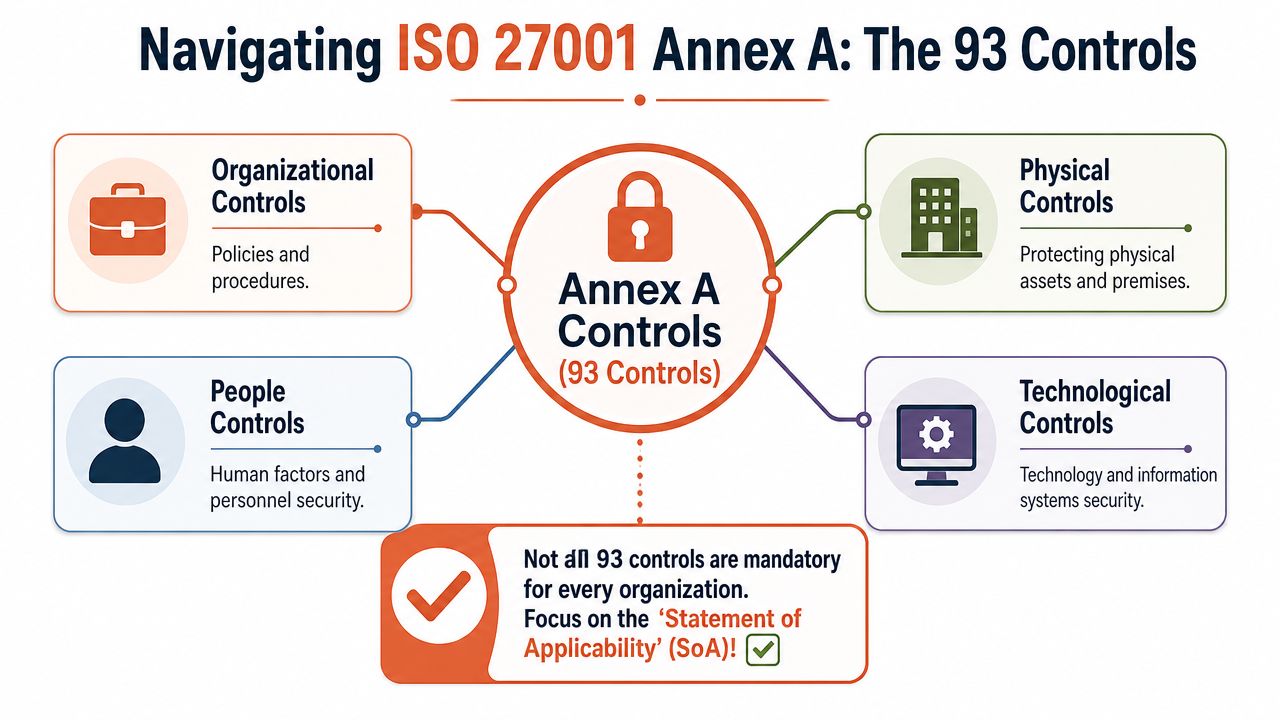
The key point is simple. Annex A is not a flat checklist where every team implements every item identically. The 2022 edition contains 93 controls grouped into 37 organisational, 8 people, 14 physical, and 34 technological controls, with 11 new controls including cloud-service security, threat intelligence, ICT readiness for business continuity, and secure coding, according to URM Consulting's summary of Annex A.
The four control groups in real operations
Organisational controls cover policy, asset management, access governance, supplier relationships, incident handling, and change management. For software teams, these controls shape who can approve production access, how third-party services are reviewed, and how infrastructure changes are governed.
If your release process depends on tribal knowledge, these controls will expose it. A useful companion resource is this guide for effective process change, especially when you need to turn ad hoc engineering habits into reviewable operating practice.
People controls focus on the human side. Screening, responsibilities, awareness, and disciplinary processes sound HR-heavy, but they affect engineering directly. Privileged access, onboarding, offboarding, and secure development behaviour all depend on people controls being clear.
Physical controls matter even for cloud-first companies. Remote working, device handling, office access, and protection of equipment still need thought. If laptops, shared workspaces, and home office practices are ignored, cloud security won't save you.
The controls cloud-native teams feel most strongly
Technological controls are where startup CTOs usually spend the most time. These include logging, access control, malware protection, secure configuration, network security, backup, monitoring, and secure coding.
For cloud-native teams, the controls that usually require the most practical judgement are:
- Cloud-service security because responsibility is shared across your team and the provider.
- Secure coding because policy means nothing if it never reaches the pull request and build pipeline.
- Threat intelligence because teams need a repeatable way to notice relevant issues and respond.
- Monitoring activities because alert noise without ownership doesn't count as control effectiveness.
The strongest Annex A implementations aren't the longest. They are the ones where every selected control has an owner, an operating method, and evidence.
That's where DIY platforms often become expensive. Every extra custom workflow creates another control implementation you have to maintain and explain.
Essential Documentation Your Auditor Will Expect
Auditors don't certify intentions. They review documented decisions and operating evidence.
One of the most underserved parts of ISO 27001 is how cloud-native teams define scope. Scope must explicitly define what is included and excluded and must reflect organisational context and interested parties, as noted in this ISO 27001 implementation guide. That matters when your product spans cloud accounts, managed services, CI systems, third-party observability tools, contractors, and multiple environments.
The core documents to get right
You don't need literary policies. You need documents that match reality.
- ISMS scope statement. Define systems, teams, services, and boundaries clearly. Name what's in scope and what's excluded. If a third-party platform handles part of your deployment or observability chain, address it explicitly.
- Risk assessment and risk treatment records. Show how you identified risks, evaluated them, and decided what to do. Avoid generic entries like “cyber attack” without context.
- Statement of Applicability. This is one of the most important documents in the whole system. It records which Annex A controls apply, which do not, and why.
- Policies and procedures. Keep them operational. Access control, incident handling, secure development, change management, backup, vendor management, and acceptable use are common examples.
- Internal audit, management review, and corrective-action records. These prove the ISMS is running, reviewed, and improving.
The common documentation mistakes
The most common problem is scope drift. Teams include “all production systems” in a policy, then discover that logging, secrets, support tooling, and contractors were never mapped properly. Another problem is writing documents that describe an ideal future state rather than current practice.
That's why work-instruction quality matters. If you need a practical model for writing procedures people can follow, this article from Trupeer Inc. on documentation standards is helpful.
A short checklist helps keep documentation grounded:
- Name real systems rather than broad abstractions.
- Assign owners for every document and control area.
- Match tooling to text so an auditor can trace policy to implementation.
- Document exclusions carefully with business and risk rationale.
- Version everything and retire stale procedures quickly.
If your documentation says one thing and your cloud environment shows another, the cloud environment wins.
Mapping ISO 27001 Controls to Your DevOps Tooling
The most useful way to read modern ISO 27001 requirements is to map each control area to an engineering problem. Once you do that, gaps become visible fast.
Recent guidance aimed at developers and CTOs highlights new or expanded Annex A items such as secure coding, configuration management, threat intelligence, monitoring activities, data deletion, and data leakage prevention. The hard part is justifying why your chosen DevOps and cloud controls are sufficient, as described in DataGuard's overview of Annex A changes.
Control versus engineering reality
Here's what that translation usually looks like.
| Control area | Engineering problem | Practical implementation |
|---|---|---|
| Secure coding | Security guidance lives in docs but not in delivery | Pull request checks, branch protections, code review rules, and pipeline enforcement |
| Configuration management | Environments drift over time | Infrastructure as code, standard templates, reviewable changes, and rollback paths |
| Monitoring activities | Alerts exist but nobody can prove review and response | Central logs, health checks, alert ownership, and retained incident records |
| Data deletion | Data lifecycle is unclear across services and backups | Defined retention rules, deletion workflows, and system-level evidence |
| Data leakage prevention | Sensitive data appears in logs, exports, or unmanaged tools | Secret handling, output controls, role limits, and monitoring of risky paths |
| Threat intelligence | Teams hear about issues informally and react inconsistently | Scheduled review process, tracked actions, and defined escalation paths |
Why platform design matters
A fragmented toolchain can satisfy these controls, but it creates a documentation burden. Every extra integration needs ownership. Every script needs maintenance. Every exception needs explanation.
A unified deployment and infrastructure layer can make evidence much easier to collect because the same system handles provisioning, permissions, changes, and runtime signals in a standard way. If you're comparing that approach with a hand-built stack, this overview of a DevOps cloud infrastructure platform is a useful reference point for what capabilities to look for.
The best control implementations share three traits:
- They're close to the workflow. Developers don't have to leave their normal tools to follow them.
- They're hard to bypass casually. Good controls reduce dependence on memory.
- They leave evidence behind. Reviews, changes, alerts, and approvals should be traceable.
That last point matters most. In practice, the control you can evidence consistently is usually more valuable than the one that looks stronger on paper.
Automating Compliance with a Unified DevOps Platform
DIY compliance usually starts with good intentions. Terraform for provisioning. GitHub Actions or GitLab CI for pipelines. Cloud-native logging. A secrets manager. A policy tool. Cost controls somewhere else. Then someone wires them together with scripts and conventions.
It can work. It also creates a large maintenance surface.
What DIY really costs
The issue isn't only technical complexity. It's operational variance. One repository follows the standard pipeline. Another has legacy exceptions. One environment has strong role separation. Another still uses shared credentials. Logs are available, but retention and review patterns differ by team.
That's exactly where ISO 27001 friction shows up. You're not only implementing controls. You're proving that they operate consistently.
A unified platform approach reduces that burden by standardising the mechanics of infrastructure, deployment, access, and evidence. Instead of teaching every squad how to assemble compliant patterns, you provide a paved road.
A practical mapping for platform capabilities
| ISO 27001 control area | Relevant Annex A controls | PushOps platform capability |
|---|---|---|
| Access governance | Access control and related operational restrictions | Centralised role-based access, permissions, and audit logs |
| Configuration management | Secure configuration and managed change | Standardised infrastructure provisioning and policy enforcement |
| Monitoring and review | Monitoring activities and operational visibility | Integrated observability, health metrics, alerts, and incident context |
| Change control | Controlled deployment and traceability | Automated build and deployment workflows with change records |
| Secure operations | Ongoing maintenance and system hygiene | Continuous updates and operational guardrails |
| Cost and environment discipline | Controlled use of cloud resources within governed environments | Environment scheduling, right-sizing, and standard lifecycle handling |
Only mention the product when it clarifies the model. In this case, PushOps fits because it combines infrastructure provisioning, deployments, observability, permissions, and auditability into one managed layer rather than leaving teams to stitch those capabilities together manually.
If you're assessing whether that kind of operating model is worth adopting, this explainer on developer platform automation covers the trade-off well.
Custom stacks give you freedom. They also give you more exceptions to defend during audit.
For startups and scale-ups, the usual question isn't whether engineers can build the stack. They can. The question is whether that's the highest-value use of engineering time when customers are waiting on product delivery and security evidence.
Frequently Asked Questions about ISO 27001
Do we need to implement every control in Annex A
No. Control selection is risk-driven. Your job is to assess risk, choose relevant controls, and justify the decision in the Statement of Applicability. What auditors look for is logic, consistency, and evidence.
Is ISO 27001 mainly a documentation exercise
No. Documentation matters, but it only holds up if your operations match it. A tidy policy set won't help if production access is unmanaged, changes are inconsistent, or monitoring doesn't lead to action.
Should a startup hire more DevOps engineers for this
Sometimes you need specialist support, but headcount alone doesn't solve fragmentation. If every control requires another internal script, another exception path, and another person to maintain it, you're scaling complexity, not reducing risk. Many teams get further by simplifying the platform layer first.
How should we scope a cloud-native product
Start with the services, environments, teams, and vendors that materially affect customer data, production delivery, and security operations. Be explicit about inclusions and exclusions. If your CI/CD system, logging stack, identity provider, or managed database influences security, treat scoping as an engineering boundary exercise, not a legal footnote.
What usually slows teams down the most
In practice, it's inconsistency. Different repositories use different controls. Infrastructure isn't standardised. Ownership is blurry. Evidence is scattered across tools. The standard itself is manageable. The sprawl around it is what burns time.
Is ISO 27001 similar to SOC 2
They overlap in many practical areas, especially around access, change management, monitoring, vendor control, and evidence collection. They are not identical, but work done to mature your delivery platform, documentation discipline, and operating controls often helps with both.
Can a managed platform replace the ISMS
No. Leadership, risk decisions, internal audits, and management review remain your responsibility. What a platform can do is reduce the implementation and evidence burden for technical controls, which leaves your team more time for the governance work only you can do.
If your team is spending more time maintaining Kubernetes workflows, CI glue, cloud permissions, and evidence trails than shipping features, it's worth rethinking the model. PushOps gives software teams a managed way to provision cloud infrastructure, automate deployments, standardise environments, and keep security controls observable across AWS, GCP, and Azure, without expanding a fragile in-house platform footprint.

