
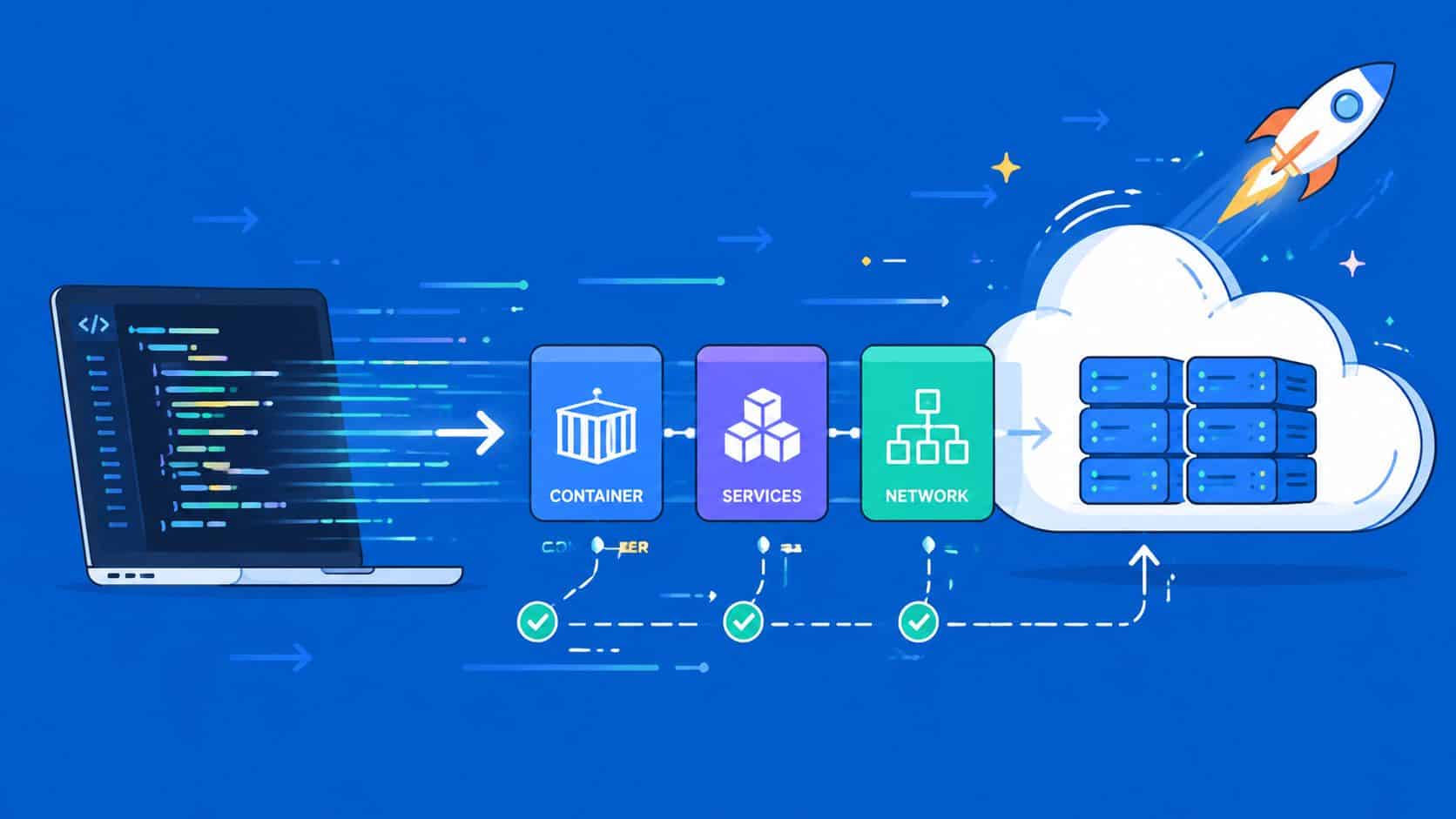

Your team adopted infrastructure as code to move faster. Instead, senior engineers are reviewing Terraform plans at midnight, debugging brittle YAML, patching Kubernetes add-ons, and chasing drift across environments. Product work slips because the platform itself has become a product, except no customer asked for it.
That's the part many leadership teams miss. Infrastructure as code is the right direction. It gives infrastructure the same discipline as software: version control, review, repeatability, and safer change management. But adopting IaC doesn't automatically mean your team should assemble and maintain a full internal DevOps stack around it.
That distinction matters more now because IaC is no longer a niche practice. The global market was estimated at USD 1.06 billion in 2024 and is projected to reach USD 9.40 billion by 2034, with a 24.39% CAGR according to Precedence Research's infrastructure as code market outlook. That kind of growth tells you something simple: IaC has become a core operating model for serious software teams.
Introduction
At its simplest, infrastructure as code is a way to define cloud infrastructure in files rather than clicking through consoles by hand. Think of it as an executable blueprint for networks, databases, compute, permissions, and deployment environments. You can review it, test it, version it, and apply it repeatedly.
Two ideas sit underneath most IaC systems.
Declarative and imperative models
A declarative approach says what you want. You define the desired end state, such as a managed database, a private network, and a container cluster, and the tool works out how to create or update them.
An imperative approach says how to do it. You specify the sequence of steps, often with more procedural control, but also with more room for complexity to spread.
For CTOs, the distinction isn't academic. Declarative tooling usually scales better for standardised environments and reviewable change control. Imperative approaches can be useful when workflows are unusual, but they often increase maintenance load because the team owns more execution logic.
The strategic question
Most engineering leaders don't struggle with the idea of IaC. They struggle with the next decision. If infrastructure should be code, does that mean you also need to build the surrounding platform yourself?
Practical rule: Treat IaC as a delivery discipline, not as a mandate to become a platform vendor inside your own company.
That's where cost, speed, and focus start to diverge. The core issue isn't whether to use infrastructure as code. It's whether your business should spend scarce engineering time building all the systems required to run it well.
What Is Infrastructure as Code Really
Infrastructure as code gets described too narrowly as “managing infrastructure with code”. That's accurate, but incomplete. In practice, IaC is a way to turn cloud operations into a controlled engineering system.
It's a blueprint that executes
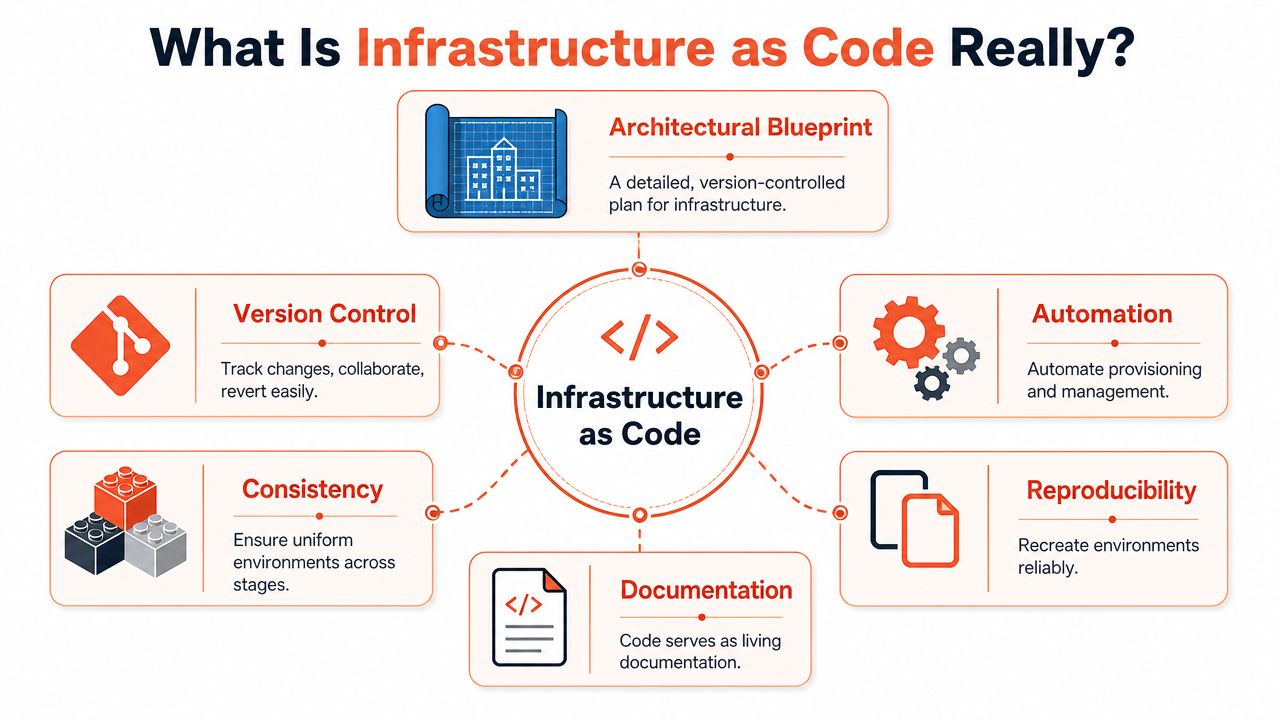
A good mental model is an architectural blueprint. A blueprint isn't the building itself. It is the precise, reviewable plan that tells everyone what should exist and how the parts fit together. IaC does the same for cloud environments.
That changes three things immediately:
- Change becomes visible. A pull request shows that a subnet changed, a role widened, or a database parameter was updated.
- Environments become reproducible. Dev, staging, and production can be created from the same patterns rather than rebuilt from memory.
- Infrastructure becomes auditable. Teams can trace what changed, who approved it, and what code introduced it.
Why idempotence and immutability matter
Two terms matter more than is generally appreciated.
Idempotence means you can apply the same definition repeatedly and get the same result. If the environment already matches the code, nothing unexpected should happen. That's what prevents routine deployments from turning into fire drills.
Immutability means you prefer replacing infrastructure over patching it in place when practical. Instead of nursing a server through years of small manual fixes, you create a clean replacement from code. That sharply reduces drift.
Without those principles, infrastructure as code degrades into “scripts that happen to create cloud resources”. That isn't the same thing.
The hidden assumption that causes trouble
The common assumption is that once infrastructure is written as code, operating it will become cheaper by default. Sometimes it does. Often it doesn't.
DIY IaC tends to push costs sideways into engineering time:
| What teams expect | What often happens |
|---|---|
| Faster provisioning | Faster provisioning plus a permanent maintenance burden |
| More consistency | More consistency only if modules, reviews, and policies are enforced |
| Less manual work | Less clicking, but more pipeline, state, and tooling work |
| Better control | Better control for experts, more friction for everyone else |
The code itself is rarely the expensive part. The expensive part is everything required to make that code safe, reusable, compliant, and operable by teams that didn't write the original setup.
The Promise and Perils of DIY Infrastructure Automation
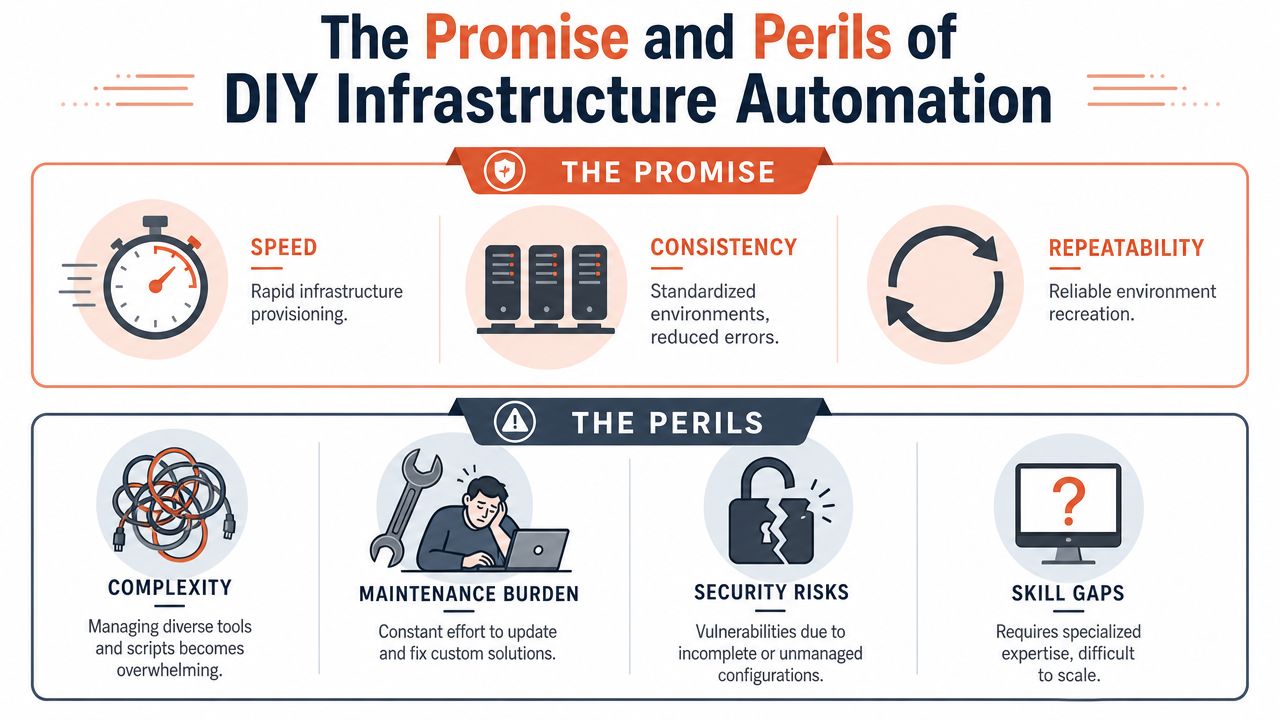
The promise of IaC is real. Provisioning gets faster. Environments become more consistent. Rebuilds stop depending on whoever remembers the old console settings. Those are major gains.
The problem is that many teams stop the analysis too early. They choose Terraform, Pulumi, or CDK and think they've made an infrastructure decision. In reality, they've started a platform programme.
IaC is one layer, not the whole platform
Provisioning tools create resources. They don't give you a complete operating model. Once a team standardises on IaC, it usually also needs to design or integrate:
- CI and CD workflows for planning, approvals, apply steps, rollback strategy, and environment promotion
- State management so multiple engineers and services don't corrupt the same infrastructure state
- Secrets handling for credentials, tokens, and runtime configuration
- Observability across logs, metrics, traces, and alert routing
- Policy enforcement for security, tagging, access control, and approved patterns
- Cost controls to stop idle and duplicated environments from multiplying
- Kubernetes operations if containers are part of the stack, including upgrades, ingress, autoscaling, and cluster add-ons
Each piece is reasonable in isolation. Together, they become an internal developer platform.
The accidental IDP problem
A lot of startups and scale-ups don't decide to build an internal platform. They drift into it. One team writes Terraform modules. Another team adds GitHub Actions. Someone else bolts on OPA checks. Then Prometheus, Grafana, Vault, Argo CD, SSO integration, cloud policy scanning, and budget scripts appear over time.
Now leadership owns a second product:
The first product serves customers. The second product serves engineers. Only one of them creates revenue directly.
That second product needs backlog prioritisation, maintenance, documentation, onboarding, upgrades, and incident response. If a few senior DevOps or platform engineers hold the whole thing together, you also have a knowledge concentration problem.
Where the DevOps tax shows up
The hidden cost of DIY infrastructure automation usually appears in three places.
- Engineering focus moves away from product. Your best engineers spend time maintaining workflows instead of shipping features.
- Operational complexity rises with every integration. A simple change might involve Terraform modules, CI policy checks, state locking, and deployment coordination.
- Reliability becomes team-dependent. The platform works well while the original builders stay close to it. It gets fragile when they leave, rotate, or move up the stack.
That's why the argument for DIY IaC based on “control” often needs scrutiny. Control is valuable. But if the operating burden keeps expanding, you're not really buying control. You're buying ongoing complexity.
Common IaC Tools and the Platforms They Create
Most infrastructure as code discussions focus on syntax or provider support. That's useful, but it misses the leadership question. The true decision isn't only which tool to pick. It's what operational system that tool forces you to build around it.
Terraform and OpenTofu
Terraform made declarative, multi-cloud provisioning mainstream. Teams like it because the model is understandable, the provider ecosystem is broad, and modules give you a path to reuse.
But production use quickly demands more than .tf files. You need remote state, locking, module governance, review workflows, drift handling, secrets discipline, policy checks, and conventions for how teams consume shared infrastructure safely. Without those guardrails, Terraform becomes easy to start and hard to govern.
Pulumi and AWS CDK
Pulumi and AWS CDK let teams define infrastructure with general-purpose languages. That can improve adoption when developers already work in TypeScript, Python, or similar languages.
It also changes the failure modes. Application developers gain flexibility, but they can also introduce more abstraction, more custom logic, and less obvious infrastructure intent. Review quality matters more. Testing matters more. Policy controls matter more.
If your team says “developers can manage their own infrastructure now”, the next question should be “what stops every service from inventing its own platform pattern?”
Crossplane and platform-style control planes
Crossplane shifts the conversation from provisioning scripts towards Kubernetes-native control planes and self-service abstractions. It can be powerful for platform teams building standardised interfaces for many internal users.
It also assumes a fairly mature organisation. You're not just managing infrastructure. You're managing compositions, claims, platform APIs, Kubernetes operations, and organisational boundaries between platform and product teams. That can be the right move for some companies. For many, it's a large jump in operational ambition.
Provisioning is the easy part
A CTO should evaluate these tools less like products and more like foundations.
| Tool choice | What it helps with | What you still need |
|---|---|---|
| Terraform or OpenTofu | Multi-cloud declarative provisioning | State, policy, review, module governance, cost controls |
| Pulumi or CDK | Familiar languages and richer abstractions | Strong guardrails, review discipline, testing, standard patterns |
| Crossplane | Platform APIs and self-service abstractions | Kubernetes maturity, platform ownership, governance model |
The common pattern is straightforward. IaC tools solve resource definition. They don't solve platform governance on their own.
That's why effective infrastructure as code isn't really about provisioning. It's about deciding who may create what, through which workflow, under which security controls, with what budget visibility, and how quickly that system can evolve without becoming a bottleneck.
Designing a Production-Ready IaC Workflow
A production-ready IaC workflow has less to do with writing resource definitions and more to do with reducing blast radius. Teams usually learn this after the first few painful incidents: an overly broad IAM change, a broken module update, a state collision, or a surprise cloud bill caused by environments that nobody cleaned up.
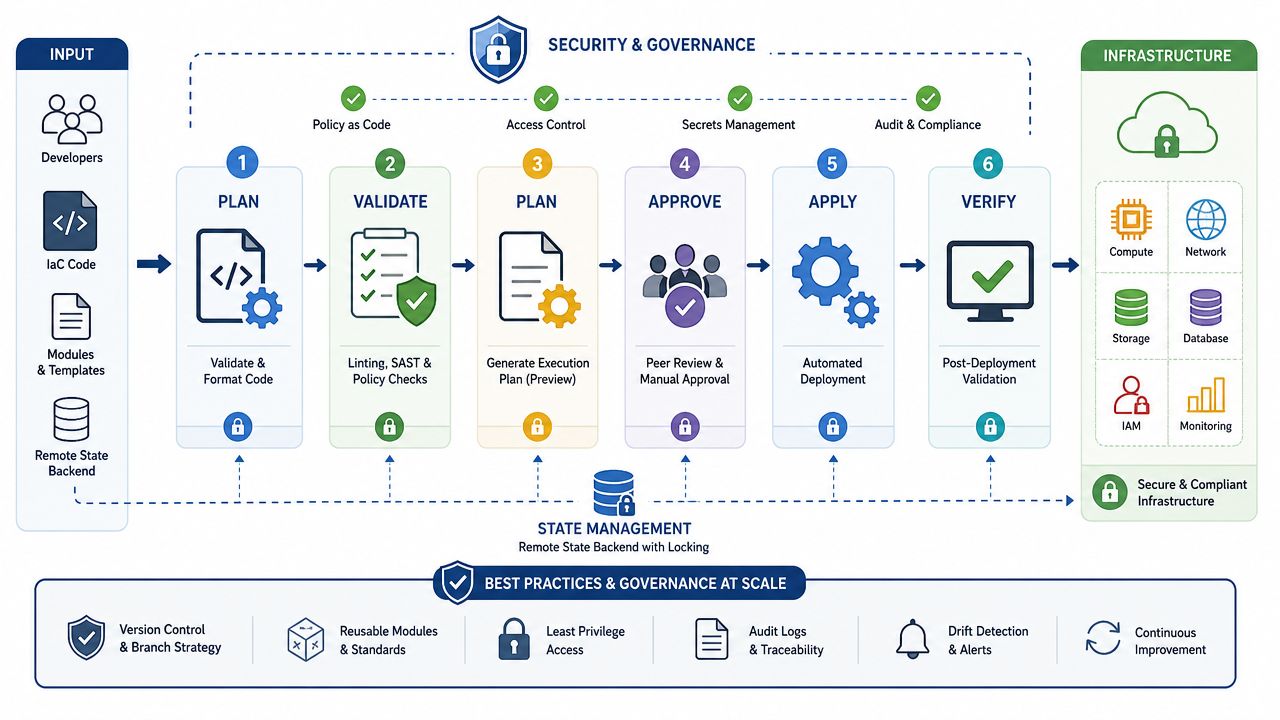
This is the workflow maturity teams need:
Structure the code for scale
Reusable modules are useful, but large monorepos with shared state and weak boundaries become hard to operate. For scaling teams, guidance from Platform Engineering on infrastructure as code setups is clear on the important point: IaC can increase cloud spend if not governed properly, and larger organisations emphasise splitting code, using service catalogues, and adding static analysis because governance becomes a first-class problem.
That advice matters even for smaller companies. If a team can create environments freely but nobody owns lifecycle rules, teardown discipline, or approved templates, cloud waste follows naturally.
A practical baseline looks like this:
- Split by boundary, not by convenience. Separate shared networking, data services, and application environments so one change doesn't touch everything.
- Publish approved building blocks. Service catalogues and vetted modules reduce random variation across teams.
- Keep state isolated. One state file per sensible unit beats one giant state file that every change depends on.
Build reviews that go beyond syntax
A pull request for infrastructure should answer more than “does it compile?”. It should answer what changes, who is affected, and whether the blast radius is acceptable.
Useful controls include:
- Automated plans in pull requests so reviewers can see intended infrastructure deltas.
- Static analysis and policy checks for tagging, network exposure, naming rules, and approved instance classes.
- Manual approvals for sensitive changes such as networking, access, or production data services.
If your team needs a practical reference for the operating discipline behind this, it's worth taking time to learn IaC with DocuWriter.ai, especially around review and maintainability habits that often get skipped when teams are moving quickly.
Treat cost as part of the control plane
Many homegrown setups encounter issues here. Cost is often monitored after deployment instead of constrained before deployment. That's backwards.
Operational advice: Infrastructure as code only improves financial discipline when cost rules sit in the same workflow as provisioning rules.
That means defining who can create long-lived environments, what defaults are allowed, when non-production systems should sleep, and how teams request exceptions. It also means deciding whether your delivery model should stay close to traditional pipelines or move towards a pull-based operating model. This comparison of GitOps vs traditional CI/CD workflows is useful because the governance implications are often more important than the deployment philosophy itself.
The inflection point leaders should watch
A homegrown IaC workflow starts becoming a liability when the platform team spends more time maintaining the workflow than improving developer throughput.
Typical signs include a growing review queue, repeated exceptions to policy, state handling that only a few people understand, and infrastructure patterns that differ from team to team because nobody had time to standardise them properly. At that point, the issue isn't tooling quality. It's ownership capacity.
When a DIY IaC Platform Stops Making Sense
The tipping point rarely arrives as one dramatic failure. More often, product delivery slows while infrastructure ownership keeps expanding. Engineers spend more time troubleshooting the path to production than building the software that should be in production.
Business signals that matter
A DIY IaC platform usually stops making sense when several of these conditions show up at once:
- Roadmaps slip because infrastructure work keeps winning. Critical product engineers are pulled into platform maintenance, access issues, cluster upgrades, and broken pipelines.
- Hiring doesn't close the gap. You need experienced DevOps or platform people faster than the market can supply them.
- Cloud costs feel hard to predict. Environments multiply, exceptions pile up, and nobody fully trusts the spend profile.
- A few people hold tribal knowledge. If one or two platform specialists are unavailable, delivery confidence drops immediately.
That's also the stage where teams start exploring automation beyond classic Terraform-style workflows. The field itself is shifting.
New abstractions increase the decision load
The IaC space now includes Infrastructure from Code, where resources are defined within application code. The trade-off described in this analysis of IaC and IfC trends is the one CTOs should care about: these approaches can increase developer autonomy, but they also make governance harder if infrastructure intent becomes less explicit.
For a team already stretched by DIY operations, that adds another layer of architecture choices, review patterns, and policy design. It doesn't simplify the platform problem. It extends it.
A useful way to think about the decision is this: if your company's competitive advantage is not building internal cloud tooling, then every extra hour spent assembling provisioning, policy, deployment, observability, and access systems is an opportunity cost.
For leaders evaluating alternatives, this overview of developer platform automation is a practical lens. It frames the problem the right way: not as “which IaC tool should we adopt next?” but as “how much platform complexity should our product team really own?”
Streamline IaC with a Modern DevOps Platform
A modern DevOps platform changes the shape of the problem. Instead of asking your team to stitch together provisioning, deployment, observability, security, and cloud cost controls from separate tools, it gives you an operating layer that already connects those concerns.
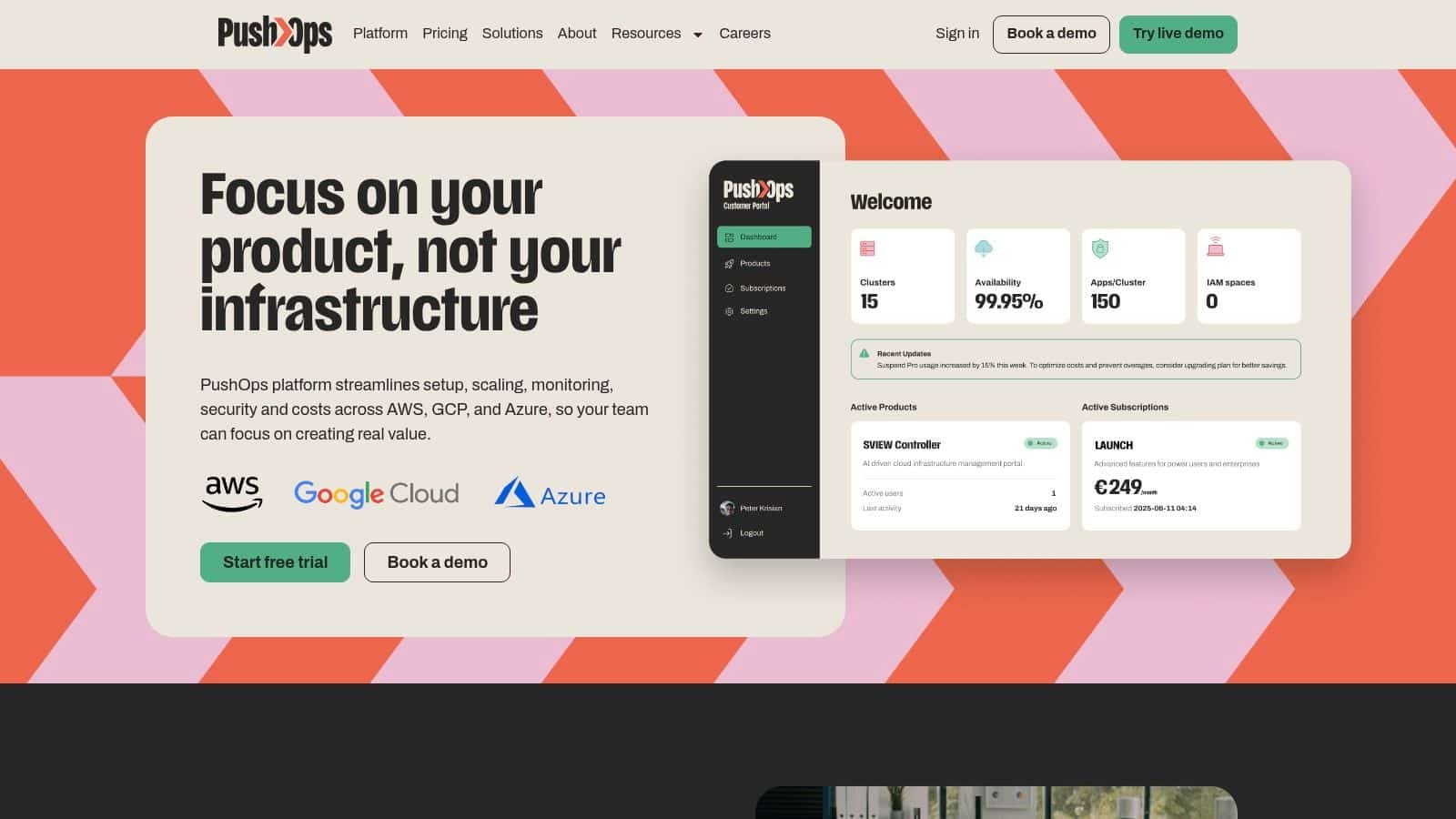
That doesn't make infrastructure as code irrelevant. It makes it usable at the pace most product teams need. The value is less about hiding infrastructure and more about removing repetitive platform assembly work that doesn't differentiate your business.
What leaders should expect from a managed platform
A credible platform should provide a few things out of the box:
- Production-ready cloud foundations across AWS, GCP, and Azure without requiring your team to assemble every baseline by hand
- Integrated deployment workflows so developers aren't maintaining bespoke pipelines for each service
- Unified observability and operational visibility without a long integration project
- Built-in security and access controls that don't depend on scattered scripts and conventions
- Cost governance features such as environment scheduling, right-sizing support, and clearer ownership boundaries
That last point is often underestimated. Teams don't only need automation. They need automation that reduces operational noise and prevents avoidable waste.
Why this is a strategic choice, not just a tooling choice
Leaders often compare a platform subscription against the cost of a few engineers. That's too narrow. The true comparison is against the total cost of maintaining a custom operating model over time.
That includes upgrade work, incident handling, fragmented monitoring, policy drift, onboarding friction, cloud inefficiency, and the simple fact that senior engineers aren't spending that time on product. If you want a broad operational benchmark, this guide for DevOps professionals is a useful companion read because it highlights how many disciplines mature teams are expected to operationalise simultaneously.
For teams trying to reduce that burden, a cloud infrastructure and DevOps platform overview is a better framing than another narrow IaC tool comparison. The question isn't whether infrastructure should be defined in code. It should. The question is whether your company should also own the full stack required to run that model well.
If your engineers are spending too much time maintaining infrastructure instead of shipping product, it may be time to stop building the platform yourself. PushOps gives teams a production-ready, multi-cloud DevOps foundation with deployment workflows, observability, security controls, and cloud cost optimisation built in, so your team can keep the benefits of infrastructure as code without inheriting the full operational burden of a DIY platform.

