
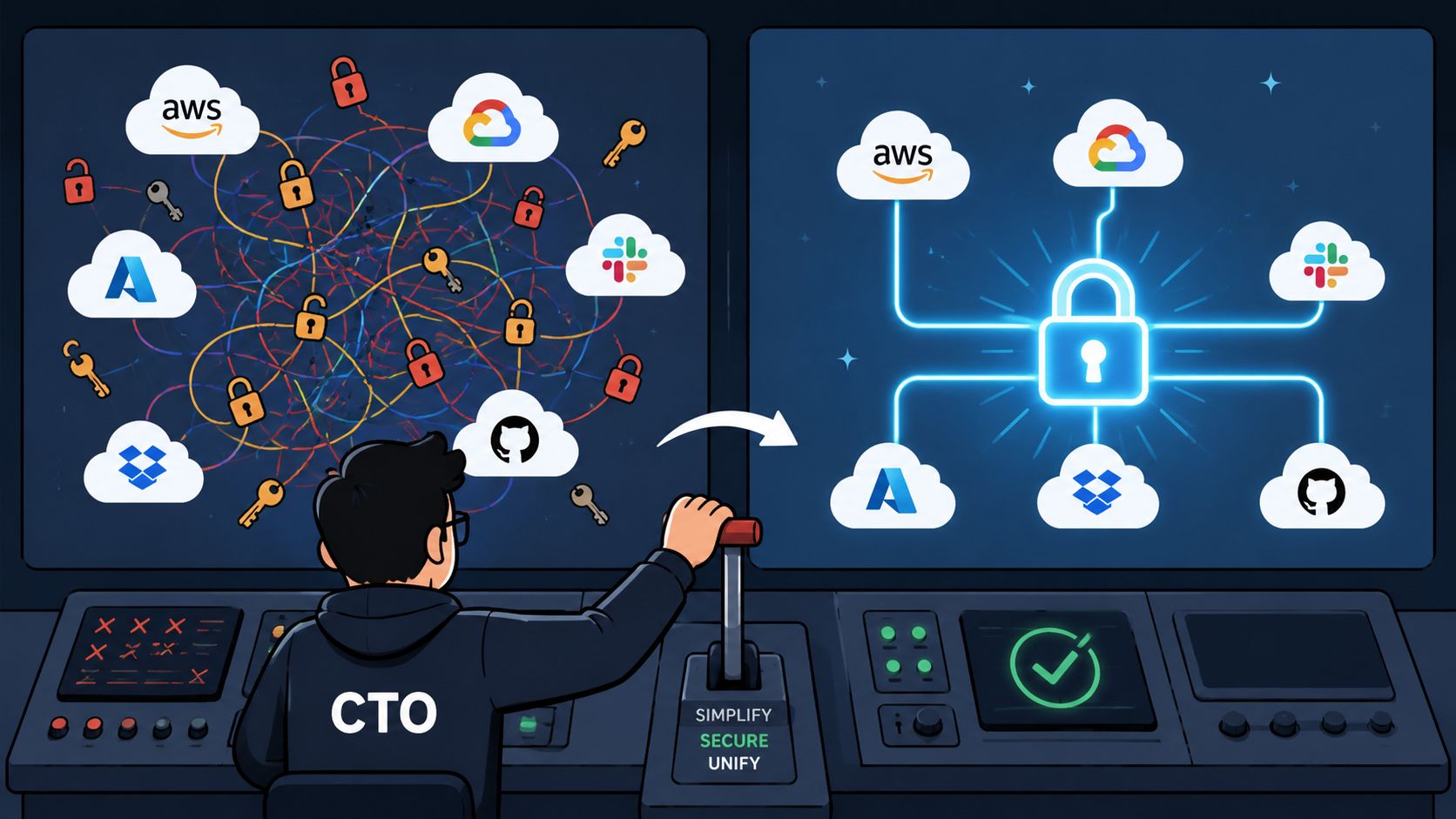

You're usually not thinking about data encryption when the roadmap is healthy. You're thinking about release cadence, cloud spend, hiring, and whether the team can ship the next feature before the next board update. Then a large prospect sends a security questionnaire, an auditor asks how keys are managed, or an engineer realises production data is encrypted in one place but handled too loosely in another.
That's when encryption stops looking like a simple checkbox and starts behaving like an operations programme. The algorithm choice is rarely the hard part. The hard part is making encryption consistent across services, clouds, environments, backups, logs, and access paths without slowing delivery to a crawl.
The Data Encryption Trap Most Startups Fall Into
A familiar pattern shows up in growing teams. Early on, one service uses database encryption defaults, another adds TLS correctly, a third stores a secret in a way that “works for now”, and everyone assumes they'll tidy it up later. Nothing looks obviously broken. The stack passes basic reviews, customers are happy, and product work keeps moving.
Then the company grows up.
A new enterprise customer asks whether sensitive fields are encrypted separately from the rest of the record. Legal wants a clearer answer on personal-data protection. Someone notices key rotation is manual in one cloud and undocumented in another. At that point, the issue isn't whether the team understands encryption in principle. It's whether the organisation can operate it reliably.
Why this turns into an engineering drain
Encryption spreads across your whole estate:
- Application code decides what gets encrypted before it reaches storage.
- Cloud services apply their own defaults, policies, and key workflows.
- Platform teams have to standardise access, rotation, auditability, and incident response.
- Developers inherit the friction when local development, staging, and production all behave differently.
What starts as “enable encryption” turns into a steady stream of infrastructure work. Engineers write wrappers around cloud key services, patch deployment workflows, debug permissions, and document exceptions. None of that ships customer value directly.
Practical rule: If encryption depends on tribal knowledge, it isn't under control.
The trap is treating data encryption as a feature implementation. In practice, it's an operational system. It needs repeatable defaults, audit trails, environment parity, and clear ownership. Teams that miss that distinction often end up building a fragile internal platform around security controls they never wanted to own in the first place.
Fundamental Data Encryption Concepts Explained
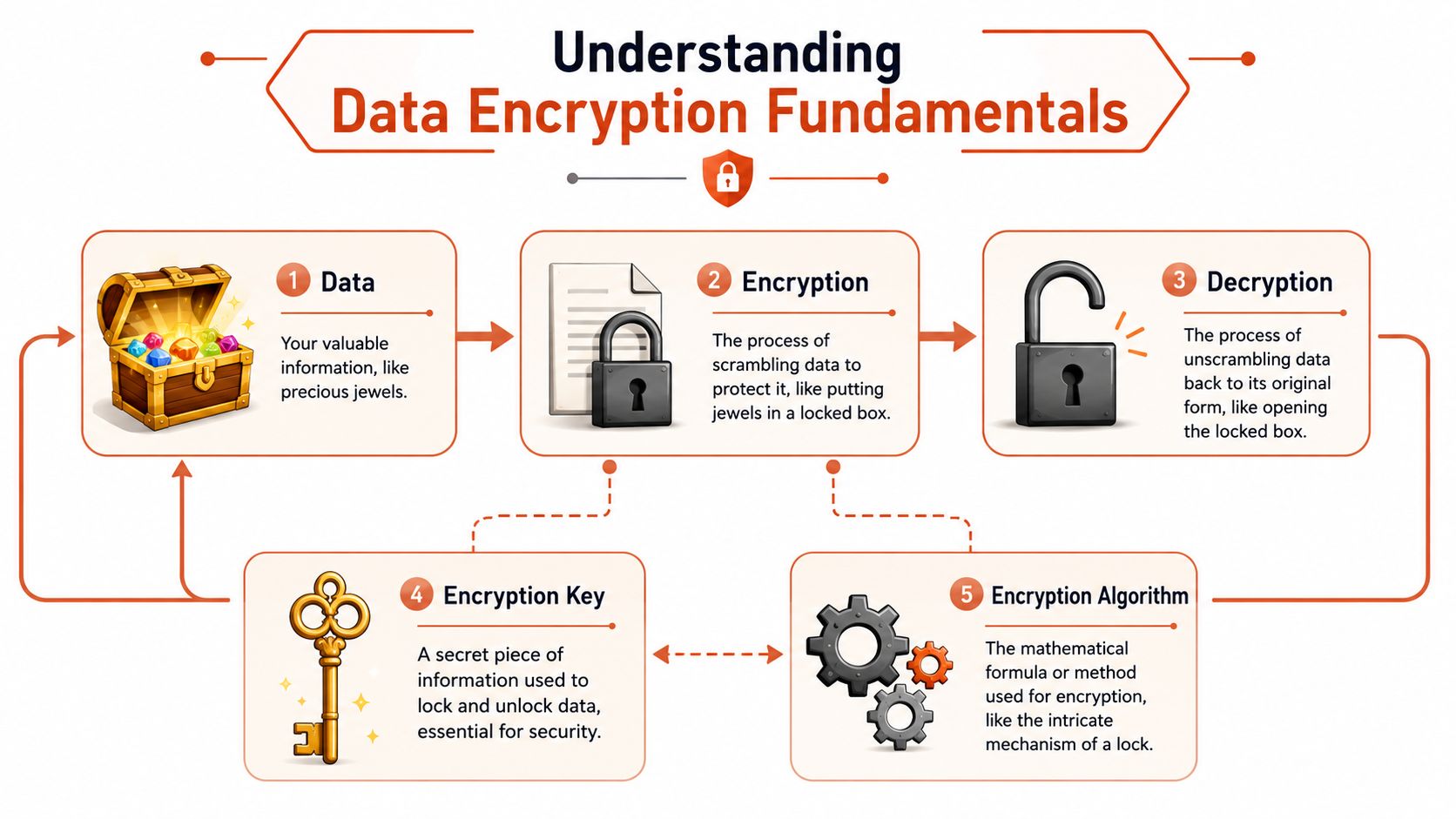
The cleanest way to explain data encryption is to start with a locked box. Your data is the item in the box. Encryption is the act of locking it so that unauthorised people can't read it. Decryption is making it accessible again for approved use. The key is the secret that makes both steps possible.
For a quick reference on the core term itself, Vulnsy's glossary entry on encryption is a useful plain-English definition to share with non-specialists.
Symmetric and asymmetric encryption
Symmetric encryption uses the same key to lock and later access the box. It's fast, which is why teams use it for bulk data such as files, database content, and backups.
Asymmetric encryption uses a pair of keys. One key is public and can be shared. The other stays private. That model is useful for secure communication and identity, because one side can receive protected data without first sharing the secret key itself.
In practice, systems often combine both. Asymmetric methods help establish trust or exchange secrets. Symmetric methods do the heavy lifting for actual data.
Data at rest and data in transit
CTOs should separate two common states of data:
- Data at rest is stored data. Think databases, object storage, snapshots, queues, archives, and backups.
- Data in transit is moving data. Think browser sessions, service-to-service traffic, API calls, and replication streams.
Both matter. Encrypting storage but ignoring service traffic leaves gaps. Encrypting network traffic but storing sensitive records too broadly also leaves gaps. You need both to be consistent.
Why AES keeps showing up everywhere
For symmetric encryption, AES is the dominant standard. It replaced the older DES standard, which used a 56-bit key and was later cracked. AES supports 128-bit, 192-bit, and 256-bit keys, and AES-256 is widely used for sensitive data at rest and in transit. For AES-256, the algorithm performs 14 rounds of transformation, and NIST's framing is straightforward: security depends on keeping the cryptographic key secret, as summarised in the AES reference.
That last point matters more than many architecture diagrams admit. Teams often spend too much time debating algorithms and too little time thinking about where keys live, who can use them, and how they're rotated safely.
Good encryption design is less about fancy cryptography and more about making the secure path the default path for every engineer.
Why Key Management Is Your Real Encryption Headache
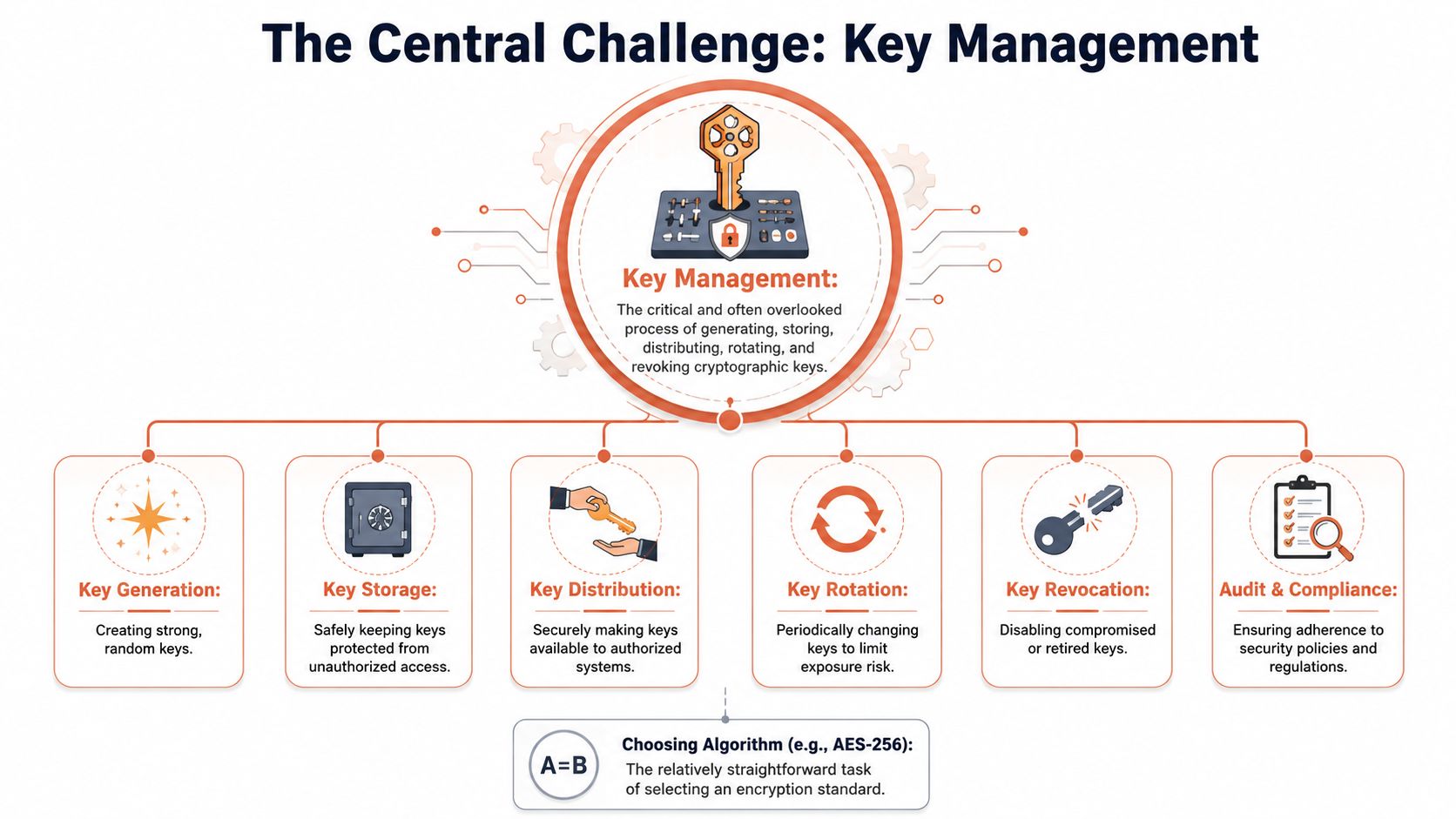
Adopting AES-256 usually presents few challenges. That decision is well understood. The operational burden starts the moment you ask more useful questions: who generates keys, where they're stored, which services can use them, how rotation works, what happens during incidents, and how auditors verify any of it.
That's why key management becomes the centre of gravity.
The algorithm is the easy part
Saying “we use strong encryption” isn't enough. If an attacker gets the key, the algorithm choice doesn't rescue you. If an engineer hard-codes secrets, if rotation causes outages so it never happens, or if a broad IAM role can unwrap keys in production, the control exists mostly on paper.
The underlying principle is blunt: encryption is only as strong as key management. Security guidance highlighted by TierPoint notes that roots of trust should be hardware-protected in a TPM 2.0 or TEE, which is exactly the kind of operational detail basic explainers tend to skip in favour of high-level diagrams, as discussed in this key management overview.
What teams actually have to manage
A functioning key management model usually includes several moving parts:
- Generation and storage. Keys need to be created with strong randomness and stored somewhere designed for secrets, not in app config files or ad hoc vault patterns.
- Access control. Services need the minimum permission required to use a key, and humans should have sharply limited paths to administrative actions.
- Rotation and revocation. Keys age, roles change, incidents happen. Rotation has to be safe enough that teams don't postpone it indefinitely.
- Auditability. Someone should be able to answer who used which key, for what purpose, and when.
- Recovery planning. Teams need a controlled answer for loss, compromise, or mistaken revocation.
KMS, CMKs, and hardware boundaries
Managed tooling emerges as a key factor. Most cloud estates rely on some form of KMS for centralised key control. Some teams choose customer-managed keys because they want tighter lifecycle control or customer-facing assurances. More sensitive workloads may involve HSM-backed workflows or hardware-backed trust anchors.
All of that can be reasonable. The problem is operational sprawl.
A single-cloud setup is already enough to create policy drift. A multi-cloud setup makes it worse. Different permissions models, different logging semantics, different service integrations, different naming conventions, and different edge cases during rotation all create work your product team didn't sign up for.
If your key management design can only be explained by the one staff engineer who built it, you don't have a platform. You have a dependency risk.
What doesn't work
Three patterns fail repeatedly:
| Pattern | Why it fails |
|---|---|
| App-managed secrets everywhere | Teams duplicate logic across services and lose central visibility. |
| Manual rotation runbooks | They look fine until the first urgent rotation under production pressure. |
| Cloud-by-cloud one-offs | Every provider's implementation drifts, and audits become slow and argumentative. |
The hidden cost isn't just security exposure. It's engineering attention. Senior people spend time on key custody, permission edge cases, and compliance evidence instead of product architecture, reliability, or customer delivery.
Practical Encryption Patterns Across AWS GCP and Azure
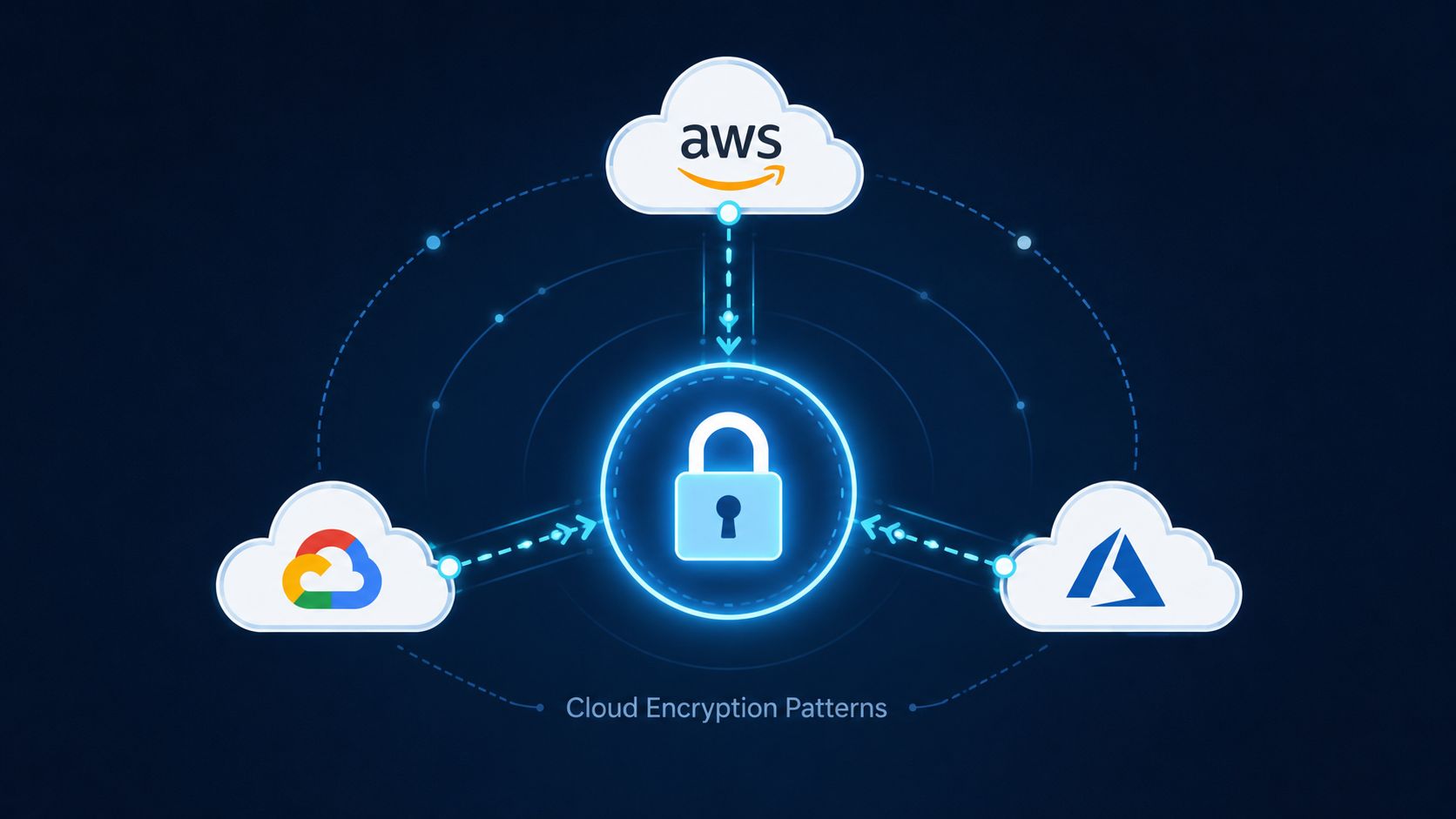
Multi-cloud encryption usually sounds simple in strategy documents. Use managed key services, encrypt storage, secure network traffic, and apply least privilege. The friction appears in implementation, because AWS, GCP, and Azure all give you the pieces, but not a single operating model.
What the clouds give you
At a high level, each provider offers familiar building blocks:
| Cloud | Common pattern | Operational reality |
|---|---|---|
| AWS | Service-managed encryption plus KMS integration | Strong coverage, but permissions and service combinations can get intricate fast |
| GCP | Default encryption with Cloud KMS options | Clear primitives, but policy consistency across projects needs discipline |
| Azure | Broad platform encryption with Key Vault and related controls | Good integration, but governance often sprawls across subscriptions and teams |
That similarity is deceptive. Teams still need to align naming, policy inheritance, environment separation, incident handling, and access reviews across all three. The cloud products differ just enough to create extra work in every deployment standard and every audit conversation.
A useful backgrounder on this broader operational problem is PushOps' explainer on the DevOps cloud infrastructure platform, especially if your team is trying to standardise cloud operations without creating a platform team bottleneck.
Envelope encryption in plain English
One pattern worth understanding is envelope encryption. Instead of encrypting all your data directly with a master key, the system encrypts the data with a short-lived data key. Then it encrypts that data key with a higher-level key held in your key management system.
That approach reduces blast radius and makes large-scale systems practical. You don't expose the top-level key in every data operation. You manage fewer sensitive assets directly, and services can work with wrapped data keys rather than full access to the root of trust.
Granularity matters more than teams expect
The other big design choice is where to encrypt. The most useful split is between broad encryption and selective encryption.
According to Privacera's overview of encryption granularity trade-offs, field-level encryption is especially useful when only specific users should access PII or financial fields, while volume or file-level encryption protects everything more broadly but can reduce analytics flexibility.
That choice affects more than security. It affects developer productivity.
- Field-level encryption gives stronger isolation for selected attributes. It's often the right call for customer identifiers, payment-related data, and sensitive profile fields.
- File or volume-level encryption is easier to apply broadly. It suits storage baselines and reduces the chance that a service is accidentally left unprotected.
- Mixed models are common. Teams use broad infrastructure encryption by default, then add field-level controls only where the business risk justifies the extra complexity.
What works in practice
The most reliable pattern is boring by design:
- Default to cloud-native encryption for storage and managed services.
- Apply stricter field-level controls only to the data classes that need them.
- Centralise key policy instead of letting each service invent its own rules.
- Keep developer workflows consistent across environments.
What doesn't work is making every application team become part-time cryptography operators. That leads to custom wrappers, partial rollouts, and a backlog full of security exceptions.
Balancing Performance Cost and Compliance
Encryption has a cost. It uses compute, introduces service dependencies, and can complicate application behaviour when teams choose a more granular model. If you're using managed key services, you also inherit usage patterns and architecture decisions that affect spend and latency. None of that is imaginary.
Still, the cost conversation often gets framed too narrowly.
The key question for a CTO isn't whether encryption adds overhead. It's whether the overhead is lower than the cost of weak controls, inconsistent implementation, and slow compliance response. In nearly every serious software business, the answer is yes.
The business case has already shifted
The market has moved past debating whether encryption is optional. In the tech sector, enterprise-wide encryption strategy adoption rose from 31% in 2012 to 72% in 2022, a 41-point increase, and the same source says the average cost associated with encryption-related cybersecurity challenges reached USD 4.24 million by 2021, according to Kiteworks' analysis of encryption trends and AES-256 adoption.
That matters for two reasons. First, customers increasingly treat encryption as part of the baseline, not a premium feature. Second, poor implementation becomes expensive in ways that don't show up in a simple infrastructure line item.
GDPR changed the operating baseline
In Europe, GDPR made encryption a practical default control after its adoption in 2018, and that shifted the expectations for organisations handling personal data in markets such as Lithuania and across the broader EU. The wider commercial direction points the same way. The global encryption software market was valued at USD 14.5 billion in 2023 and is projected to reach USD 60.7 billion by 2033, with a 15.4% CAGR, according to Market.us' summary of encryption software statistics.
That doesn't mean every company should over-engineer every workload. It does mean the baseline has hardened. Prospects, partners, and regulators expect a coherent answer.
The expensive part of encryption usually isn't the CPU cycle. It's the operational inconsistency that appears when every team implements it differently.
Where CTOs should focus
A practical decision framework looks like this:
- Performance-sensitive paths should use the simplest secure pattern that satisfies the data classification.
- Regulated or high-trust workloads deserve tighter controls even if they introduce more engineering friction.
- Shared platform standards matter more than local optimisation, because inconsistency creates long-term cost.
Compliance, speed, and cost aren't separate tracks here. A standardised encryption posture makes audits faster, incidents easier to contain, and product teams less likely to reinvent controls service by service.
Stop Building a Platform and Start Shipping Product
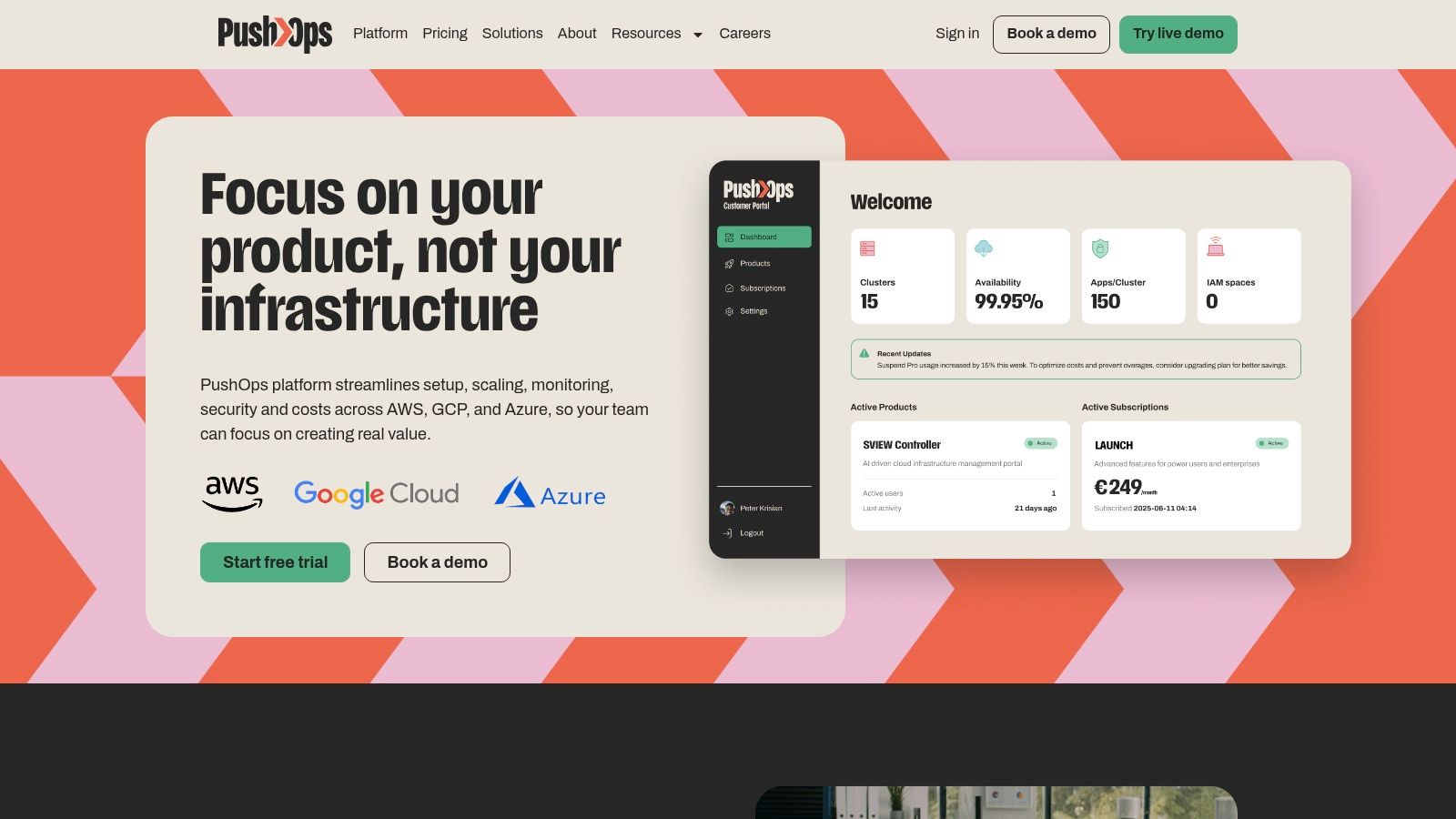
By the time a team has handled key lifecycle, cloud-by-cloud policy differences, service defaults, access controls, audit trails, and field-level exceptions, it has inadvertently started building an internal platform. Most companies don't set out to do that. They arrive there one urgent security requirement at a time.
That's the strategic mistake.
A lot of startups and scale-ups assume they need more DevOps engineers to solve encryption properly. Often they don't. They need fewer bespoke decisions, fewer one-off scripts, and fewer provider-specific workflows that only a small internal group understands.
The hidden cost of the DIY path
DIY encryption operations tend to create the same downstream problems:
- Security becomes uneven because each team implements controls differently.
- Delivery slows down because senior engineers get pulled into infrastructure reviews and exception handling.
- Cloud flexibility weakens because patterns that worked in one provider don't translate neatly to another.
- Costs become harder to predict because the stack grows through tooling accretion rather than platform design.
A managed approach is attractive for the same reason managed databases are attractive. You're not outsourcing responsibility. You're reducing the amount of specialist operational machinery your product team has to own directly.
For engineering leaders trying to cut this drag, PushOps has a useful explainer on how to reduce DevOps overhead without turning every security and deployment concern into an internal platform project.
What a better operating model looks like
The strongest teams make encryption part of the platform baseline:
- storage and service defaults are pre-configured
- access patterns are standardised
- policies are consistent across environments
- observability and auditability are built in
- developers don't need to become cloud security specialists to ship safely
That's how you keep data encryption from becoming a permanent tax on feature delivery. Security controls work best when they're reliable, repeatable, and mostly invisible to the teams building the product.
Your Data Encryption Readiness Checklist
Use this as a quick leadership audit. If several answers are unclear, your encryption posture is probably more manual than it should be.
Questions worth asking this week
- Do you have a current inventory of sensitive data stores? Include databases, object storage, caches, backups, queues, logs, and analytics exports.
- Can you prove data is encrypted at rest and in transit across production services? “We think so” isn't enough for customers or auditors.
- Is key ownership clear? Someone should own creation, access policy, rotation, revocation, and evidence collection.
- Are key operations centralised and auditable? If every team manages keys differently, review quality will drift.
- Do production and non-production environments follow the same encryption model where appropriate? Gaps often appear in staging, support tooling, and temporary environments.
- Have you decided where field-level encryption is worth the extra complexity? Not every field needs it, but some almost certainly do.
- Can you rotate keys without service disruption? If rotation feels dangerous, it will be delayed.
- Are hardware-backed trust controls used where risk justifies them? This is often where mature and immature programmes diverge.
- How much senior engineering time goes into maintaining encryption-related infrastructure? That time has an opportunity cost.
- Could a new team ship a compliant service without asking three different people how security works? If not, the platform is still too bespoke.
A helpful next read is PushOps' guide to developer platform automation, especially if you're trying to turn security and delivery standards into repeatable defaults rather than ticket-driven manual work.
If your team is spending too much time stitching together cloud security, deployment workflows, and operational guardrails, PushOps is worth a look. It gives software teams a production-ready foundation across AWS, GCP, and Azure so they can spend less time maintaining infrastructure and more time shipping product.

