
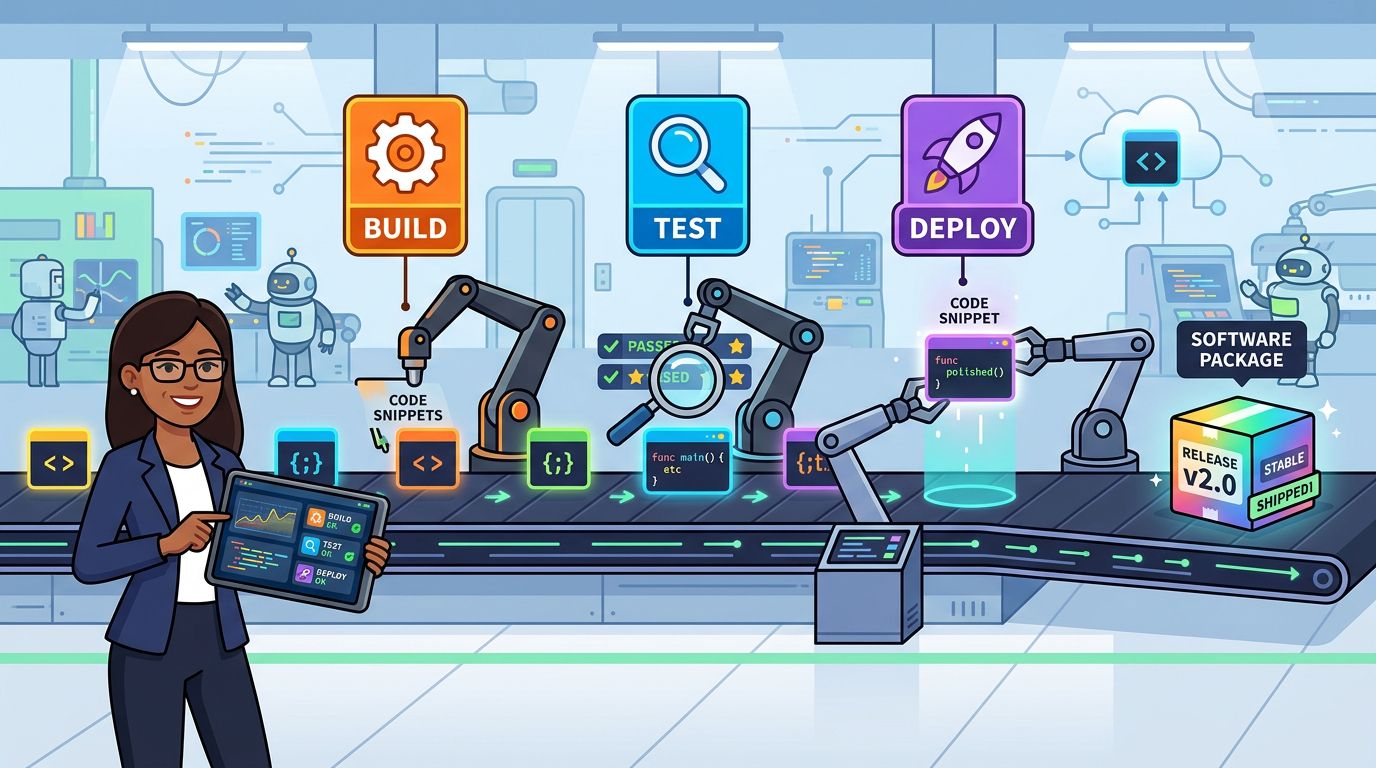

Your team probably says it's doing DevOps. What it's often doing is babysitting infrastructure.
The pattern is familiar across startups and scale-ups in Europe, Singapore, the UK, and the US. Senior engineers spend Monday fixing a broken CI runner, Tuesday untangling Kubernetes permissions, Wednesday chasing noisy alerts, and Thursday patching a build image nobody wants to own. Friday arrives, and the roadmap moved less than expected.
That isn't a tooling problem. It's a leadership problem. You've allowed delivery infrastructure to become a side business.
Continuous integration should increase delivery speed and reduce risk. Instead, many teams turn it into a DIY platform project with custom scripts, brittle YAML, and too many moving parts across AWS, GCP, and Azure. The result is operational drag, hidden cost, and slower product delivery. If you're serious about shipping, you need to treat continuous integration as a build versus buy decision, not as an engineering hobby.
Why Your Engineers Are Wasting Time on Infrastructure
A CTO sees it first in planning meetings. The roadmap says product work. The sprint board says “fix pipeline”, “rebuild staging”, “update base image”, “investigate flaky integration tests”, and “patch monitoring agent”. Your best backend engineer is suddenly the unofficial platform lead. Your frontend lead is waiting on a failed preview environment. Nobody planned for this, but everyone is paying for it.
This is how infrastructure steals capacity. Not in one dramatic incident, but in constant small interruptions that break flow and consume senior attention.
The work nobody wanted becomes mission critical
Teams frequently don't choose to build an internal platform because it creates advantage. They choose it because each individual decision looks reasonable.
You add GitHub Actions or GitLab CI. Then custom runners. Then container builds. Then secrets management. Then artifact storage. Then branch environments. Then security scanning. Then policy checks. Then monitoring and rollback logic. Suddenly you own a platform.
Practical rule: If product engineers spend more time maintaining delivery systems than improving user-facing software, your platform strategy is already off course.
The hidden cost isn't only salary. It's the features you didn't ship, the migrations you postponed, and the product feedback you didn't collect because engineering time disappeared into infrastructure.
When these systems fail, the cost gets very real. More than half of significant IT outages now cost over $100,000, and one in five top $1 million, according to industry data on the hidden cost of DIY DevOps. That's why platform sprawl isn't just inefficient. It's expensive.
CI is a business lever, not a side project
Continuous integration should help you reduce integration risk and keep developers in a fast feedback loop. It should not require a shadow team to keep the machinery alive.
If you're building your own internal stack, read this practical explainer on developer platform automation. It captures the problem many growing teams hit: they wanted faster shipping, but ended up maintaining the factory instead of producing the goods.
The core decision is simple. Do you want engineers building product, or engineers building the system that lets other engineers build product?
Understanding the Core Principles of Continuous Integration
Continuous integration is straightforward when you strip away the jargon. Developers merge small changes into a shared codebase frequently. Each change triggers an automated process that builds the application, runs tests, and returns feedback quickly. If something breaks, the team sees it immediately and fixes it while the context is still fresh.
That's the entire point. Reduce integration risk early and often.
The assembly line analogy still works
Think of continuous integration like a modern assembly line. A developer commit enters the line. The system assembles the product, inspects it, checks whether it fits with everything already built, and signals pass or fail before work continues. You don't wait until the end of a quarter to discover that all the parts don't fit together.
Here's the basic flow:
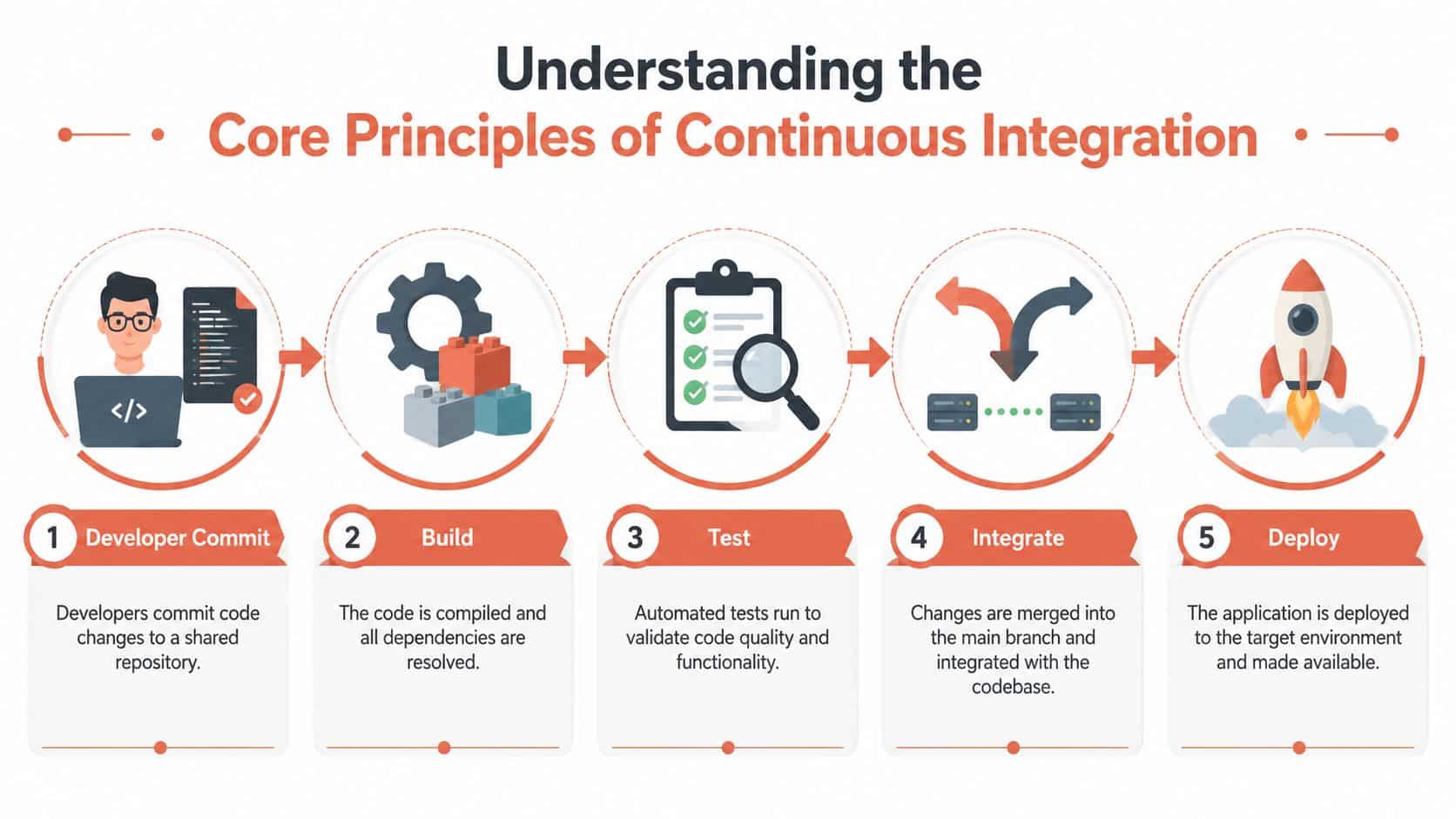
A good CI system gives your team a predictable loop:
- Commit code to a shared repository
- Build the application or package
- Test the change automatically
- Integrate it with the main line safely
- Prepare it for release or handoff
That loop sounds basic because it is. The challenge isn't understanding the principle. The challenge is maintaining the machinery around it without wasting engineering time.
CI is older than many teams realise
This isn't a new fad dressed up as DevOps wisdom. Continuous Integration was first formally proposed by Grady Booch in 1991 and was adopted as one of the twelve core practices of Extreme Programming in 1996, as noted in the history of continuous integration. Its roots predate many modern Agile methods.
That matters because it reframes CI correctly. This is not optional process theatre. It's a long-standing engineering discipline for teams that want to move quickly without accumulating integration debt.
If your leadership team needs a shared vocabulary before making platform decisions, this glossary of essential CI terms for engineering leaders is a useful reference.
Continuous integration doesn't exist to impress auditors or fill dashboards. It exists to shorten the time between writing code and knowing whether that code is safe to build on.
The Anatomy of a Modern CI Pipeline
A modern CI pipeline looks tidy on a whiteboard. In practice, it's a stack of decisions that somebody has to own, maintain, secure, and debug.
At a high level, the pipeline starts when a developer pushes code. From there, the system checks out source, installs dependencies, builds artefacts, runs tests, stores outputs, reports status, and often prepares handoff into deployment. That sequence isn't complicated conceptually. The operational burden sits inside each stage.
Where complexity actually lives
Here's a simple view of the pipeline and the work hiding underneath it:
| Stage | What happens | What your team ends up owning |
|---|---|---|
| Source | A commit or pull request triggers automation | Repository hooks, branch rules, credentials, event logic |
| Build | Code is compiled or packaged | Build images, caching, dependency management, runner capacity |
| Test | Automated checks run | Test frameworks, flaky environment fixes, parallelisation, test data |
| Artefacts | Outputs are stored for later use | Registry access, retention, versioning, integrity checks |
| Feedback | Results go back to developers | Notifications, dashboards, logs, debugging workflows |
This is why “we already have CI” often means “we have a collection of scripts held together by tribal knowledge”.
The build stage is where DIY starts to hurt
Builds look easy until they aren't. Language versions drift. Containers pull different dependencies. Caches become inconsistent. Runners fill up. A shared build image works for one service and breaks another. Multiply that across several teams and the cost lands on senior engineers who should be solving customer problems instead.
Testing adds another layer. Unit tests are usually manageable. Integration tests are where many pipelines slow down or become flaky because they depend on real services, seeded data, or temporary environments that nobody standardised properly.
If you want a useful overview of why teams adopt CI in the first place, this guide on how to boost speed with continuous integration is worth scanning. The benefits are real. The mistake is assuming those benefits arrive automatically once you turn on a CI product.
Tool choice is only the beginning
Jenkins, GitHub Actions, GitLab CI, CircleCI, Buildkite, and similar tools are just orchestration surfaces. They don't remove the need to manage runners, secrets, images, network access, artefact policies, notification paths, and environment consistency.
That's the trap. Leaders think they're choosing a tool. In reality, they're choosing an operating model.
A CI pipeline isn't the YAML file. It's the total system behind the YAML, including all the maintenance work required to keep it reliable.
The DIY DevOps Trap and Its Hidden Costs
Many groups justify DIY DevOps with the same argument. We need control. We have special requirements. We can tailor it better ourselves.
Sometimes that's true. Usually it's expensive self-deception.
The spreadsheet lies first
A homegrown setup often looks cheaper because the first line item is small. One engineer wires together GitHub Actions, Terraform, Kubernetes, a registry, a monitoring stack, and some shell scripts. It feels efficient because no large invoice shows up.
Then costs appear. Someone has to maintain plugins, patch runners, handle credentials, tune clusters, fix broken pipelines, review security settings, and support every product team that touches the stack.
In Amsterdam, senior DevOps engineers cost €100,000 to €140,000 annually, plus recruitment, onboarding, and software costs, according to data on DevOps hiring costs in Amsterdam. That should stop any startup leader from casually saying, “Let's just hire one or two platform people.”
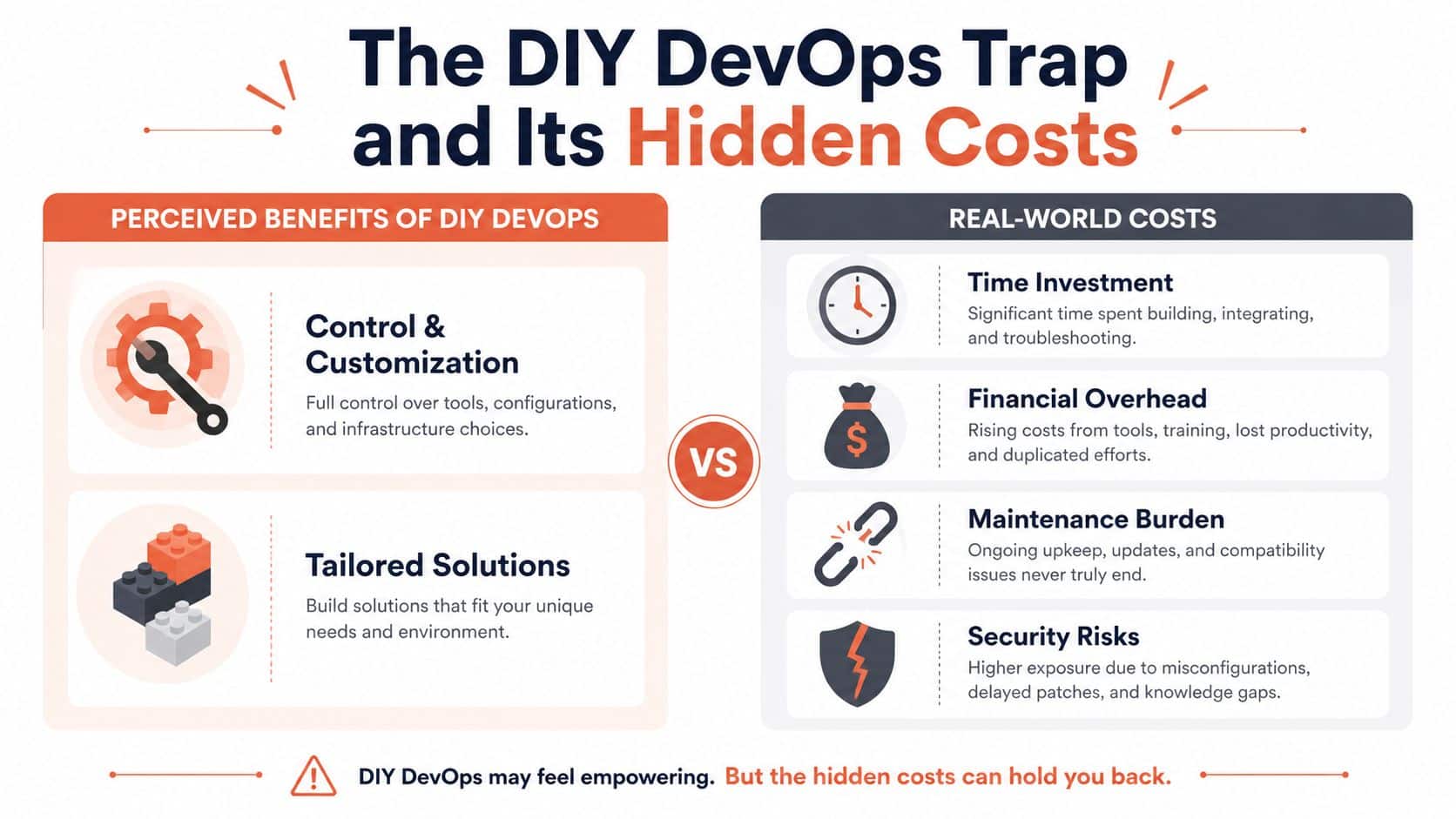
What you think you're buying versus what you actually get
The perceived benefits of DIY are real enough. The problem is that leaders rarely price the full package.
- Control and customisation: You can shape the stack around your workflows. You also inherit every maintenance obligation that comes with that freedom.
- Custom integrations: You can connect the exact tools you like. You also create coupling that makes upgrades and replacements painful.
- In-house ownership: You keep knowledge close. You also make delivery depend on a handful of specialists.
Now compare that with the actual outcomes many startups see:
| Perception | Reality |
|---|---|
| We'll save money | You shift cost into senior engineering time |
| We'll move faster | You add queueing, support work, and platform debt |
| We'll stay flexible | You create a brittle stack only your team understands |
If this sounds familiar, this explainer on zero-maintenance CI/CD pipelines is worth reading. The strategic point is simple. Pipeline maintenance is undifferentiated work for most startups.
Build versus buy is a product decision
The actual TCO question isn't “Can we assemble this ourselves?” Of course you can. The question is whether building and maintaining a bespoke CI foundation is the best use of your engineering organisation.
For most startups, it isn't.
You don't win because your team wrote clever Jenkinsfiles, hand-managed Kubernetes control planes, or spent six months on an internal developer platform. You win because you shipped product sooner, kept quality high, and stayed focused.
CI Best Practices That Drive Velocity
The fundamentals still matter. If you get them right, continuous integration becomes a force multiplier. If you get them wrong, the pipeline turns into a slow, noisy gate that developers work around instead of trusting.
Optimise for feedback speed, not pipeline theatre
A strong CI setup is designed around one question: how quickly can a developer learn whether a change is safe?
Start with these habits:
- Keep changes small: Small merges reduce conflict, shorten investigation time, and make failures easier to isolate.
- Automate the build completely: If a developer has to remember manual steps, your pipeline is unreliable by definition.
- Make failures visible immediately: Status checks in pull requests, logs that people can read, and alerts that point to the actual issue matter more than glossy dashboards.
- Treat the main branch as a protected asset: Don't allow unstable code to linger there.
These are simple rules. They're also where DIY setups often drift. One team adds a custom exception. Another introduces a manual workaround. A third disables a failing check “temporarily”. After that, trust in the pipeline decays.
The testing pyramid is non-negotiable
Many teams wreck CI by leaning too heavily on slow end-to-end testing. The better approach is the testing pyramid. Put most of your coverage in fast unit tests, fewer checks in integration tests, and only a small set in end-to-end tests.
That structure isn't just elegant. It improves delivery outcomes. Teams that adhere to the testing pyramid achieve a 40% reduction in change failure rate and a 35% improvement in lead time for changes, according to research cited in Semaphore's CI pipeline guidance.
Leadership takeaway: If your pipeline is slow, don't start by buying more runner capacity. Start by asking whether your test mix is wrong.
A practical review looks like this:
- Audit test distribution: Count where time is spent
- Pull fast checks forward: Linting, unit tests, and static checks should fail early
- Isolate expensive tests: Run coarse-grained suites with intent, not by habit
- Kill flaky tests aggressively: A flaky test is a broken control, not a minor nuisance
Standardise the good behaviour
Best practices fail when they depend on discipline alone. They stick when the platform makes the good path the easy path.
That's why mature teams standardise:
- Build templates for common service types
- Approved base images so dependencies don't drift
- Shared secret handling rather than per-repo improvisation
- Consistent quality gates across repositories and business units
For teams designing pipelines around container workloads and distributed services, these strategies for cloud-native CI/CD provide useful implementation ideas.
The broader point is blunt. Velocity comes from standardisation, fast feedback, and sane defaults. It doesn't come from letting every team invent its own CI religion.
How to Enable CI Securely and at Scale
Security and scale are usually treated as separate concerns. In real systems, they're the same operational problem seen from different angles.
The moment your CI pipeline touches multiple repositories, cloud accounts, environments, registries, and deployment targets, it becomes part of your production attack surface. If you're operating across AWS, GCP, and Azure, that surface gets wider and harder to reason about.
Shift security left into the pipeline
Security checks can't live at the end of delivery. They need to live inside it.
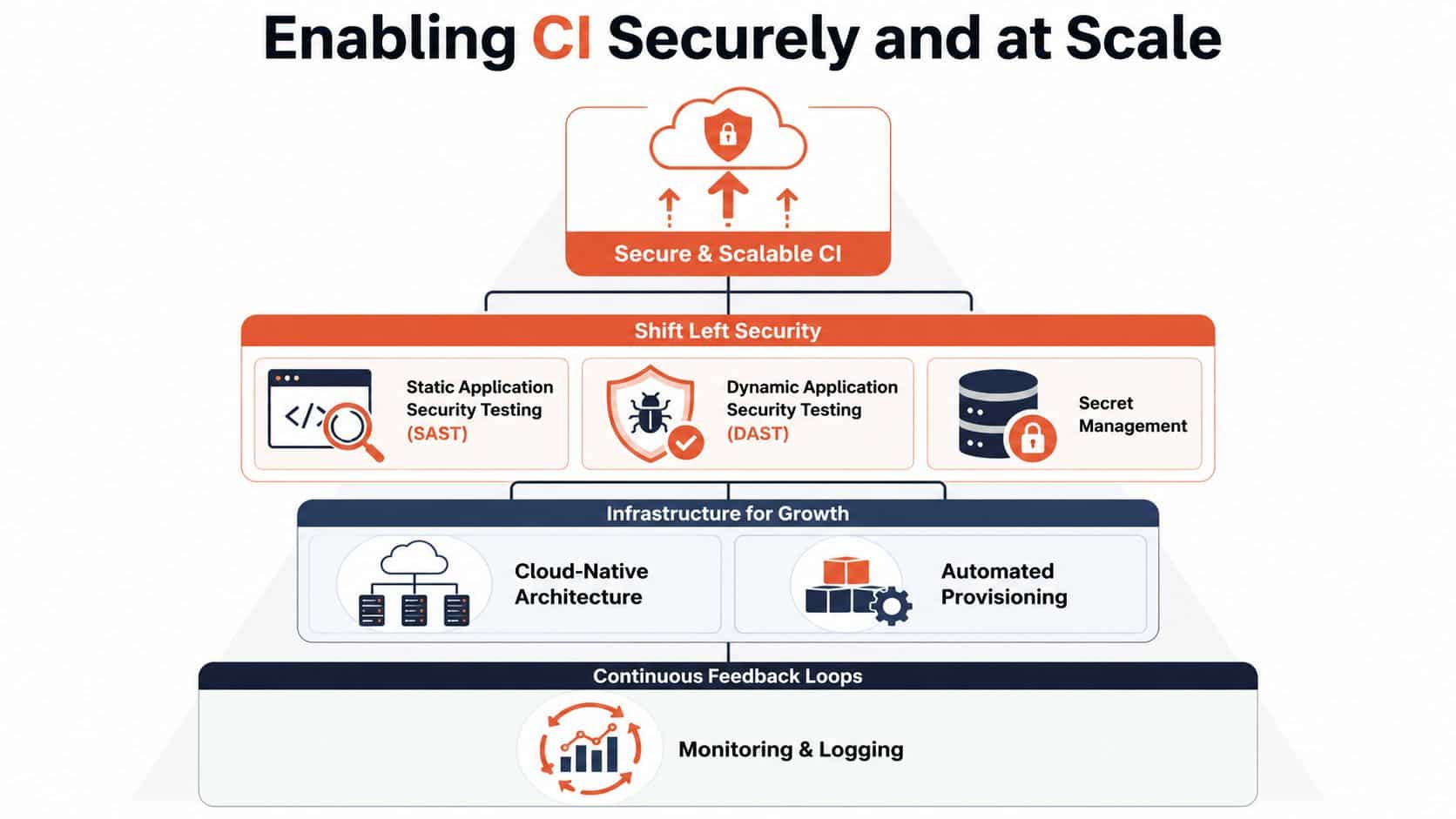
That means adding controls directly into CI:
- SAST during build validation: Catch risky code patterns before merge
- Secret scanning on commits and pull requests: Stop credentials from moving downstream
- Image and registry scanning: Validate what you're packaging
- Signature verification and SBOM checks: Ensure artefacts are traceable and trustworthy
- DAST in later-stage validation: Test running applications, not just source code
Recent data reveals that 65% of organisations experienced CI/CD pipeline breaches due to missing security integrations like signature verification and Software Bill of Materials implementation, according to Cycode's CI/CD pipeline security guidance. That number should end the debate about whether security can wait until after the pipeline is “working”.
Multi-cloud amplifies inconsistency
A startup may begin on AWS and later add GCP for data workloads or Azure for enterprise requirements. That's normal. What breaks teams is trying to preserve consistent CI behaviour across all three using ad hoc scripts and tool-specific exceptions.
You end up with different runner models, different secret stores, different identity patterns, different network rules, and different deployment assumptions. Every exception becomes another place where security and reliability can drift.
A unified approach matters more here than in a single-cloud setup. The right operating model should give teams one way to build, test, secure, observe, and promote software, regardless of cloud provider.
If your team is debating workflow models for infrastructure and application delivery, this comparison of GitOps vs traditional CI/CD is a useful framing device.
Secure CI at scale isn't about adding more gates. It's about making every environment follow the same trusted path.
Observability belongs inside delivery
A scalable CI system doesn't stop at pass or fail. It feeds into monitoring, logging, and rollback decisions. If a release path lacks visibility, your team won't know whether “successful” builds are resulting in healthy software.
That's why modern CI design should connect build outputs, deployment signals, runtime health, and incident response into one loop rather than treating them as separate tools owned by separate teams.
Your Path to Effortless Continuous Integration
Continuous integration is not the optional part of modern software delivery. The optional part is whether you insist on building and maintaining the entire machinery yourself.
If you're leading a startup or scale-up, the build versus buy decision should be ruthless. Ask whether owning CI infrastructure improves your product, your margin, or your speed to market. For most companies, the honest answer is no.
Use this checklist before adding more headcount
A quick leadership review is enough to expose the problem:
- Pipeline ownership: Do product engineers regularly stop roadmap work to fix CI?
- Tool sprawl: Are you stitching together separate systems for builds, secrets, monitoring, security, and cloud cost control?
- Cloud inconsistency: Do AWS, GCP, and Azure workloads follow different delivery rules?
- Maintenance drag: Does somebody on your team act as the unofficial expert for runners, YAML, and broken environments?
- Scaling pain: Does every new service or team require bespoke setup?
If you answered yes to several of those, you don't need more improvisation. You need a production-ready platform approach.
Stop acting like an infrastructure company
Founders and engineering leaders often say they want focus. Then they fund internal platform work that pulls senior developers away from the core product. That contradiction is expensive.
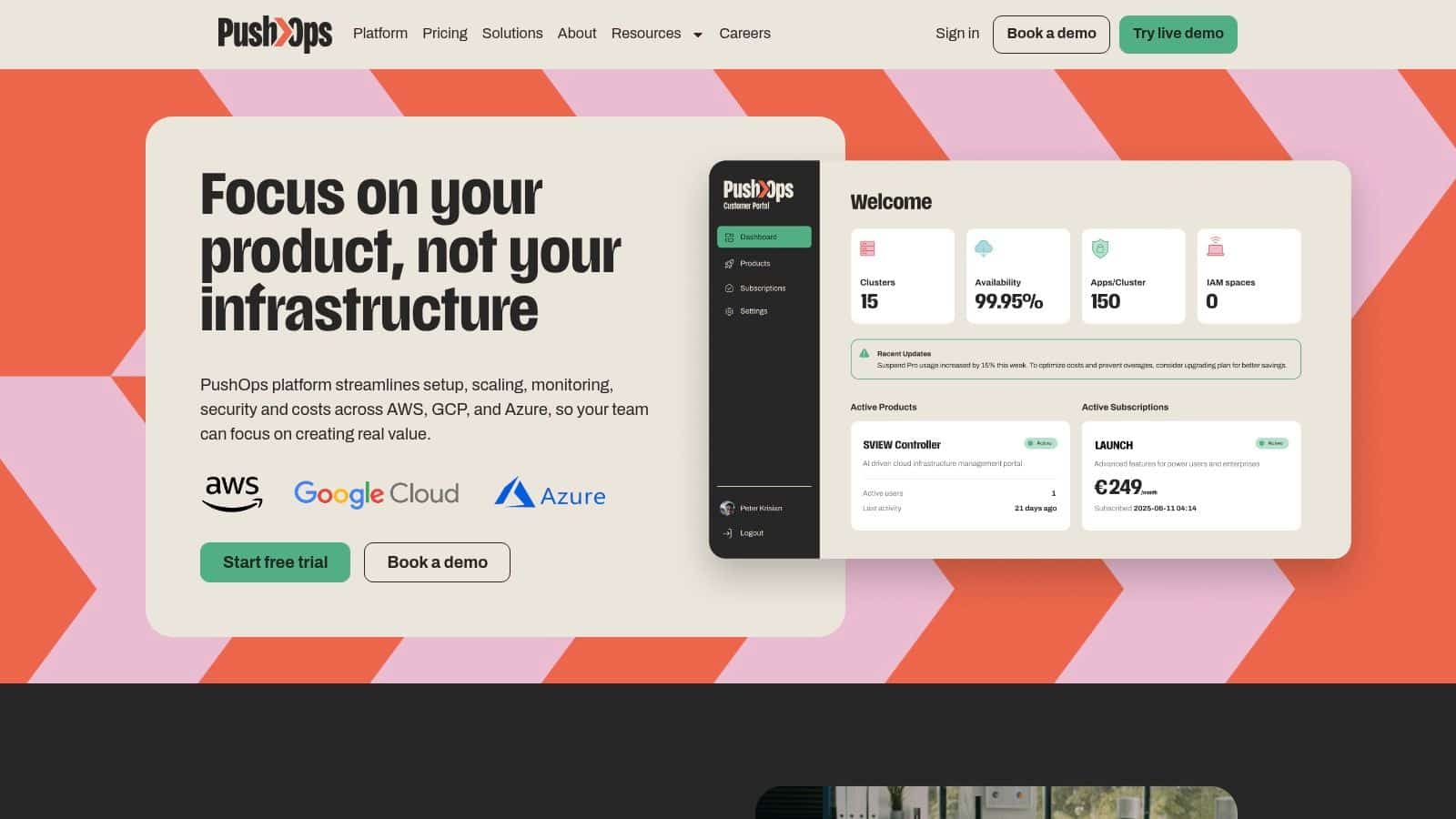
A modern managed DevOps platform changes the operating model. It streamlines setup, scaling, monitoring, security, and cloud cost control across AWS, GCP, and Azure. It gives teams a production-ready foundation without requiring them to become part-time specialists in Kubernetes, CI orchestration, and platform maintenance.
That doesn't mean giving up engineering standards. It means enforcing them with less operational drag.
The best startups don't confuse control with ownership. They keep control over delivery quality, release policy, visibility, and security posture. They stop owning the undifferentiated plumbing that slows everybody down.
If you want a cleaner path to continuous integration without turning your engineering team into an internal platform department, take a look at PushOps. It gives startups and scale-ups a production-ready, multi-cloud DevOps platform so teams can ship faster, standardise delivery, reduce infrastructure overhead, and stay focused on product.

