


As a CTO or engineering leader, your primary goal is to ship features that deliver value, not to spend your team's precious time wrestling with infrastructure. Yet, many startups and scale-ups find themselves bogged down in a costly cycle of building and maintaining a complex internal DevOps platform. You end up over-investing in Kubernetes, stitching together CI/CD pipelines, and struggling with monitoring, security, and unpredictable cloud bills. The time spent on this operational treadmill is time stolen directly from your product roadmap.
This guide provides a detailed analysis to help you find the best CI/CD pipeline for Kubernetes, but it also challenges the assumption that you should be building this yourself. We will explore the hidden complexities and spiraling costs of a DIY approach, from initial setup and hiring specialized engineers to the long-term maintenance that drains your budget.
We'll compare leading tools like Argo CD, Tekton, GitLab, and GitHub Actions, evaluating them on practical criteria. However, throughout this analysis, we will repeatedly return to a critical idea: a modern multi-cloud DevOps platform can streamline setup, scaling, monitoring, security, and cloud costs across AWS, GCP, and Azure, freeing your team to focus on shipping features. The goal is to provide a clear path towards a reliable, production-ready foundation, so your team can get back to what they do best: building and shipping great software.
1. PushOps
PushOps stands out because it directly addresses the core frustration of engineering leaders: spending too much time on infrastructure instead of product. It is a modern multi-cloud DevOps platform designed for teams that want to bypass the significant time and cost of building a bespoke internal developer platform. It provides a turnkey solution that provisions production-ready foundations across AWS, GCP, and Azure in minutes, making it a compelling choice for establishing the best CI/CD pipeline for Kubernetes without the typical operational drag.
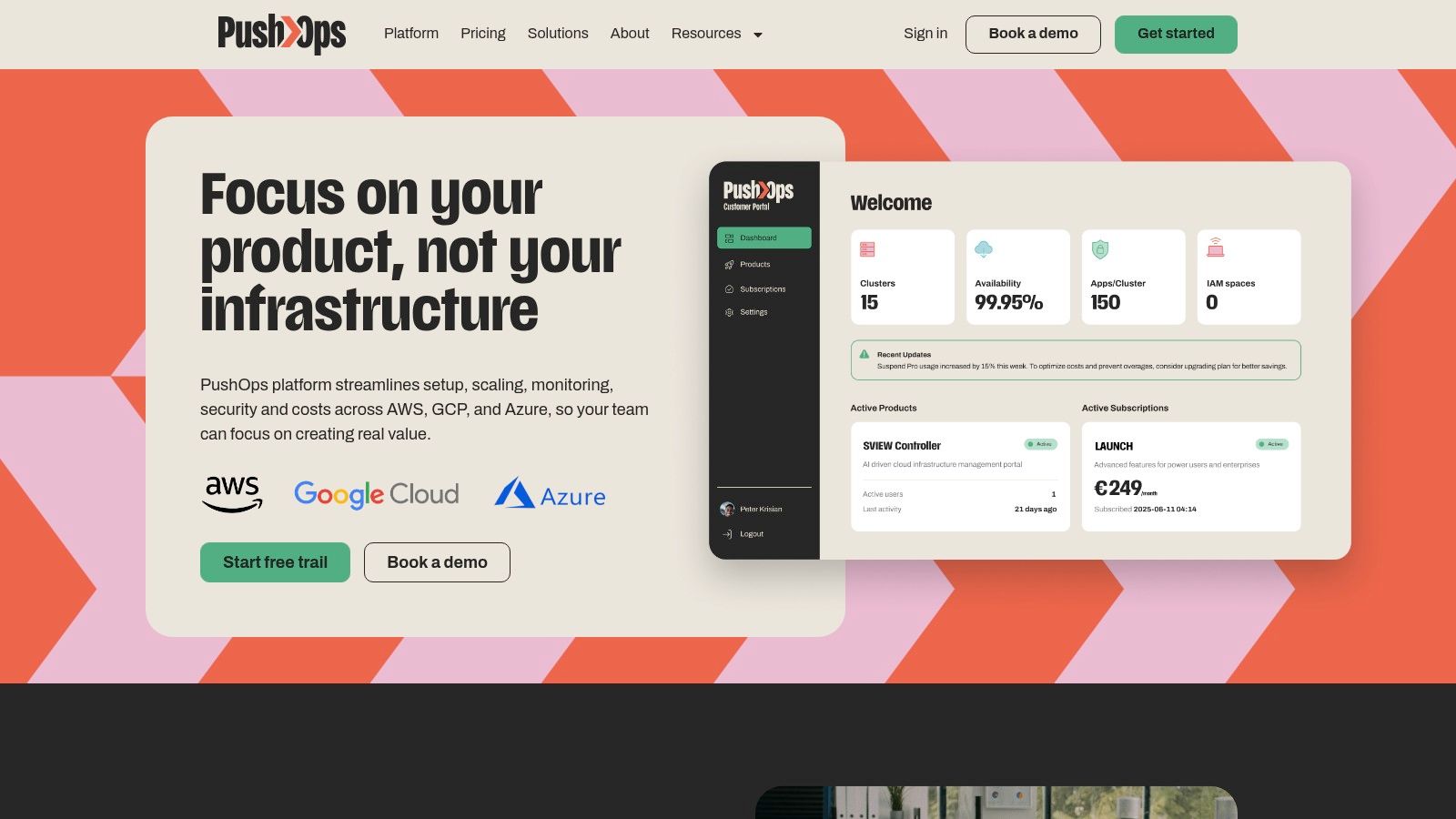
The platform automates the entire software delivery lifecycle, from builds and deployments to environment provisioning and release strategies. By integrating observability, security, and cost optimisation by default, PushOps replaces the fragile scripts and complex toolchains that so many teams struggle to manage. This consolidation allows developers to gain self-service workflows with zero pipeline maintenance, accelerating feature delivery while keeping cloud costs predictable. It is an excellent fit for scale-ups looking to standardize deployment practices or migrate to the cloud without hiring more DevOps engineers. For a deeper look into its architecture, you can learn more about this type of DevOps cloud infrastructure platform.
Key Features & Use Cases
- Multi-Cloud Provisioning: Get production-grade infrastructure on AWS, GCP, or Azure, ready in minutes.
- End-to-End Automation: A complete CI/CD workflow handles builds, testing, deployments, and advanced release strategies (e.g., blue-green, canaries).
- Integrated Observability & Security: Real-time health metrics, incident management, RBAC, audit logs, and policy enforcement are built-in, not bolted on.
- Cost Management: Smart autoscaling, resource right-sizing, and automated environment scheduling prevent cloud waste.
| Pros | Cons |
|---|---|
| Rapid time-to-value with pre-configured, production-ready infrastructure. | No public pricing requires contacting sales for a total cost of ownership (TCO) analysis. |
| Reduces operational overhead by consolidating multiple DevOps tools. | May have less low-level customisation compared to a fully bespoke, DIY Kubernetes setup. |
| Developer self-service workflows empower teams to ship features faster. | Potential for platform lock-in if your organisation has highly specialised infrastructure requirements. |
| Built-in cost optimisation helps control and predict cloud spend effectively. | Limited public social proof like customer testimonials or case studies available. |
Ideal for: Startups and scale-ups aiming to accelerate delivery without the expense of building an in-house platform team. It's particularly effective for teams managing multi-cloud environments or looking to standardize their CI/CD and Kubernetes operations.
2. Argo CD (with Argo Rollouts)
As a CNCF-graduated project, Argo CD has become the standard for implementing declarative, GitOps-driven continuous delivery for Kubernetes. Instead of using imperative kubectl commands, your team manages deployments by declaring the desired state in a Git repository. Argo CD’s control plane then continuously reconciles this state with your live clusters, automatically detecting and correcting any drift. This declarative approach provides an auditable, version-controlled history of every change, which is a significant win for compliance and stability.
Combined with Argo Rollouts, it offers sophisticated progressive delivery strategies like canary and blue-green deployments out of the box. This makes it one of the best CI/CD pipeline tools for Kubernetes if your priority is robust, auditable, and safe release management. However, it's crucial to remember that Argo CD is just one piece of the puzzle.
Analysis
- Ideal Use-Case: Engineering teams that have fully committed to Kubernetes and want a native, declarative CD system. It’s perfect for organisations that require strict audit trails and want to empower developers with a clear, Git-based promotion process. To understand the fundamental shift this represents, you can explore the differences between GitOps versus traditional CI/CD methodologies.
- Strengths: Its tight integration with the Kubernetes API and ecosystem tools like Helm and Kustomize is a major advantage. The web UI provides excellent visibility into application synchronisation status, health, and deployment history.
- Limitations: Argo is a CD tool only. You must integrate and manage a separate CI engine (like Jenkins, GitLab CI, or GitHub Actions) to build and test your container images. This adds another layer of complexity that your team must support, increasing the hidden costs of your DIY platform. A managed solution, by contrast, handles this integration out of the box.
3. Flux
As a fellow CNCF-graduated project, Flux provides a robust GitOps toolkit for keeping Kubernetes clusters in sync with sources of configuration like Git repositories. It operates on a pull-based model, where its controllers, running inside the cluster, continuously reconcile the live state with the desired state defined in Git. This secure, pull-based approach is a key reason why major platforms like GitLab recommend Flux for production-grade GitOps deployments. Its modular architecture allows teams to compose a delivery system that precisely fits their needs.
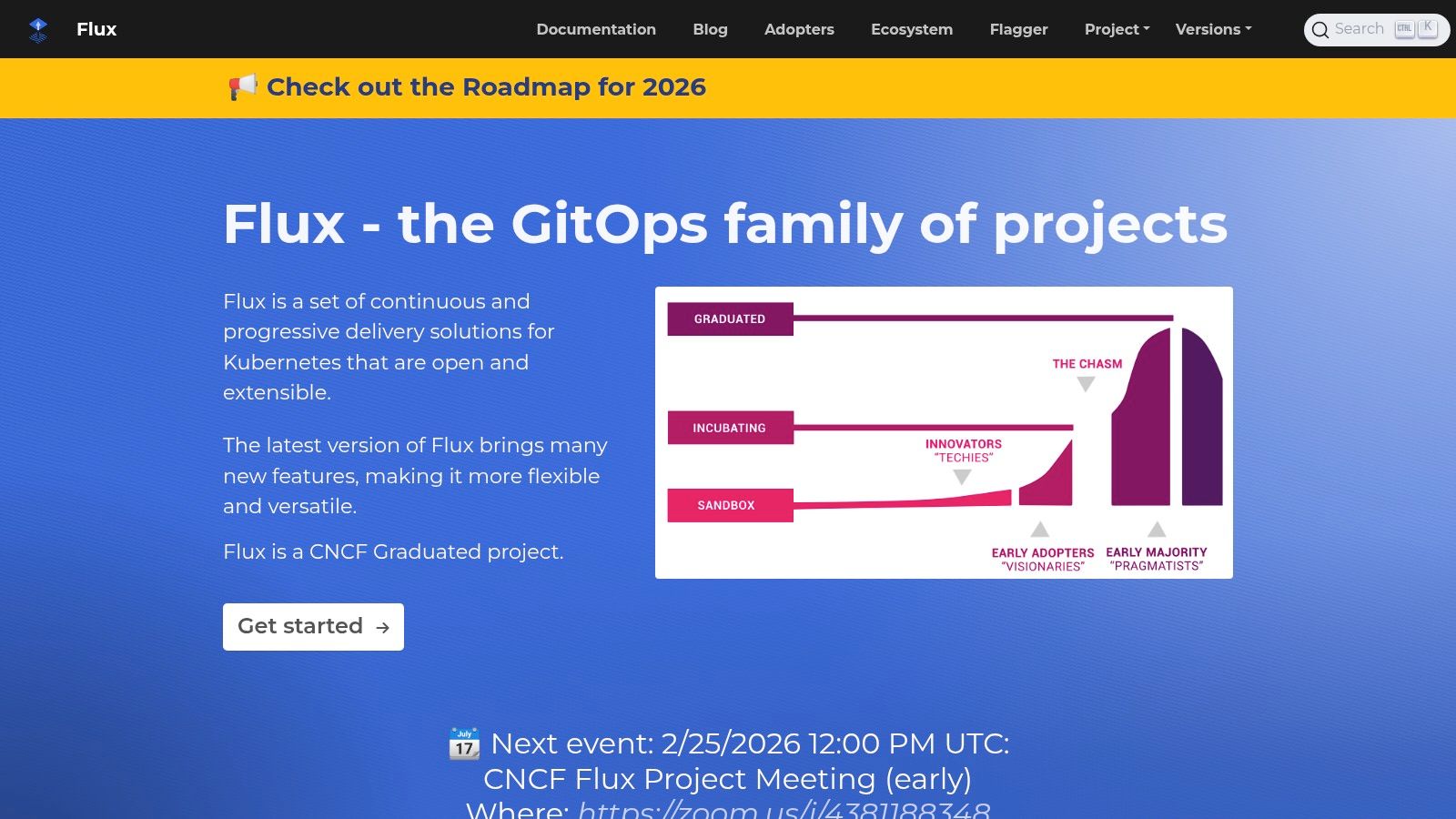
For engineering leaders, Flux offers a powerful way to enforce consistency and security across multiple environments. By treating Git as the single source of truth, every change is auditable and version-controlled. This makes Flux one of the best CI/CD pipeline for Kubernetes options when security and scalability are primary concerns, but this power comes with the responsibility of building and maintaining the surrounding platform.
Analysis
- Ideal Use-Case: Platform engineering teams responsible for managing multiple clusters and tenants. Its strong multi-tenancy support and composable nature make it ideal for organisations looking to build a secure, scalable internal developer platform without being locked into a single vendor's opinion.
- Strengths: The highly modular design with separate controllers (for sources, Kustomizations, Helm releases) provides great flexibility. Its pull-based reconciliation model enhances security by eliminating the need for external systems to have direct cluster credentials.
- Limitations: Flux is philosophically "headless" and lacks an official, built-in user interface, which can steepen the learning curve for teams accustomed to GUI-driven workflows. While community UIs exist, they represent another component your team must integrate and maintain, adding to the operational overhead of a DIY solution—a problem that a managed DevOps platform solves.
4. Tekton
As a Kubernetes-native framework from the Continuous Delivery Foundation, Tekton provides a powerful, vendor-neutral set of building blocks for creating CI/CD systems. It defines pipelines, tasks, and steps directly as Kubernetes Custom Resource Definitions (CRDs). This approach allows platform teams to build standardized, portable, and declarative pipelines that run natively within any conformant Kubernetes cluster, providing deep control over the entire build, test, and deploy lifecycle.
Because it offers fundamental primitives rather than a pre-packaged solution, Tekton is one of the best CI/CD pipeline for Kubernetes frameworks for organisations building a bespoke internal developer platform. It gives you the flexibility to design a CI/CD system precisely tailored to your team's workflows, but this flexibility comes with a high price in engineering effort.
Analysis
- Ideal Use-Case: Platform engineering teams that need a flexible, Kubernetes-native foundation to construct a custom CI/CD solution for their developers. It’s well-suited for companies that want to standardize pipeline execution across multiple teams and clouds without being locked into a specific vendor's ecosystem.
- Strengths: Its core strength is its standardized, CRD-based pipeline model, ensuring portability and reusability. The framework is highly extensible and integrates well with other ecosystem tools like Skaffold and Knative, allowing for fine-grained control over execution.
- Limitations: Tekton is a framework, not a complete, out-of-the-box product. It requires significant investment from a platform team to build the necessary user experience, guardrails, and integrations. This effort represents a substantial hidden cost, as teams must essentially build and maintain their own CI/CD platform, a challenge that can be sidestepped with zero-maintenance CI/CD pipelines.
5. Spinnaker
Originally developed by Netflix and Google, Spinnaker is a battle-tested, multi-cloud continuous delivery platform built for large-scale, high-velocity software delivery. It provides powerful and flexible pipeline management capabilities, allowing teams to construct complex workflows that span multiple cloud providers or environments. For teams that need one of the best CI/CD pipeline tools for Kubernetes with enterprise-grade safety and multi-cloud support, Spinnaker remains a top contender—provided they can stomach its operational complexity.
Spinnaker’s strength lies in its deep orchestration capabilities, which go far beyond basic GitOps synchronization. While GitOps tools focus on state reconciliation, Spinnaker excels at managing the entire release lifecycle. However, this power comes at a significant cost, pulling valuable engineering resources away from your core product.
Analysis
- Ideal Use-Case: Large organizations with complex deployment needs, such as rolling out services across Kubernetes, AWS EC2, and Google Compute Engine simultaneously. It is well-suited for regulated industries requiring strict separation of duties and auditable manual approvals.
- Strengths: Its ability to create immutable infrastructure and manage advanced deployment strategies (like red/black, canary) with automated analysis is a significant advantage. Spinnaker's application-centric view provides a clear dashboard of what is running where.
- Limitations: Spinnaker is notoriously complex to set up and maintain, comprising multiple microservices that require significant operational expertise. This represents a huge hidden cost in engineering time, distracting your team from building product features and pushing you to hire more DevOps engineers just to keep the lights on.
6. Codefresh (Argo-powered GitOps CD with CI)
Codefresh builds on the power of Argo by providing a commercial, enterprise-ready GitOps platform. It takes the core open-source projects (Argo CD, Rollouts, etc.) and adds a unified control plane with advanced features like environment promotion and analytics. This addresses a common challenge for scaling teams: while Argo is excellent, managing its components across multiple applications and clusters introduces significant operational overhead. Codefresh aims to abstract away this complexity.
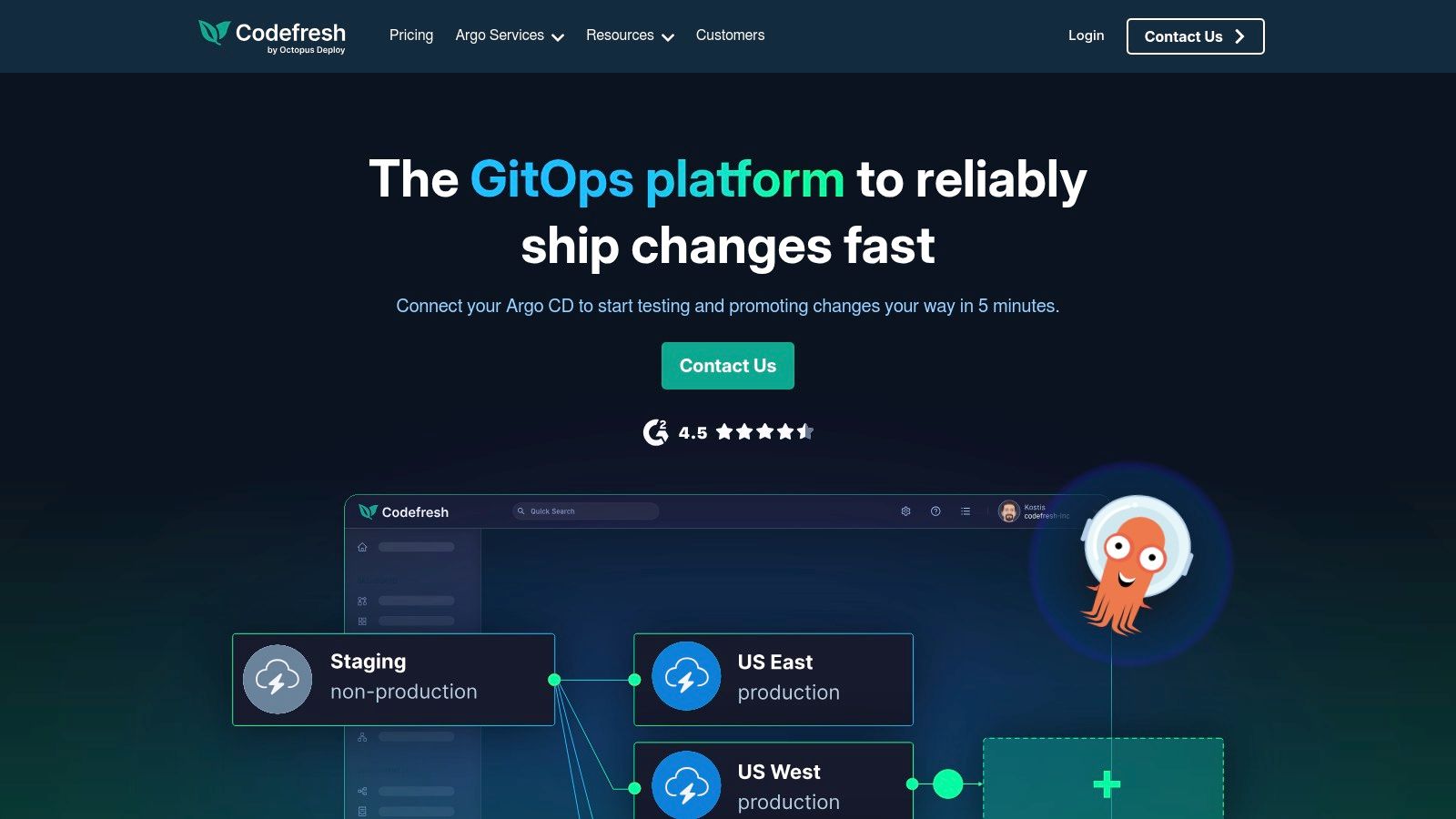
The platform also includes an optional, container-native CI module. By integrating CI and CD under one roof, Codefresh offers a complete solution that can be one of the best CI/CD pipelines for Kubernetes for organizations wanting the benefits of GitOps without the deep investment in building and maintaining a custom toolchain. It’s a step toward a managed solution, but still requires significant in-house expertise.
Analysis
- Ideal Use-Case: Scale-ups and enterprises that are committed to GitOps with Argo but need a supported, integrated platform to manage multi-cluster deployments. It is a strong fit for teams that want to avoid the hidden costs of stitching together and managing open-source tools themselves.
- Strengths: Simplifies complex promotion flows across environments and offers enterprise-grade support directly from Argo maintainers. The unified dashboard provides much-needed visibility into deployment health, history, and compliance.
- Limitations: This is a commercial product with pricing available upon request. Adopting Codefresh also means aligning with its specific GitOps abstractions and workflows, which still leaves your team responsible for managing clusters, monitoring, security, and cost control across potentially multiple clouds.
7. Harness (CI/CD and GitOps platform)
Harness is a full software delivery platform designed for enterprises that require strong governance and automation. It goes beyond simple CI/CD, offering modules for GitOps, continuous verification, and even cloud cost management. For teams frustrated with the high cost of stitching together and maintaining disparate DevOps tools, Harness provides an opinionated, end-to-end solution that reduces the need for extensive glue code.
Its strength lies in SRE-grade deployment strategies like canary analysis with automated verification and rollback. This makes it a compelling choice for organizations that need one of the best CI/CD pipelines for Kubernetes but also want a governed, auditable platform that simplifies complexity instead of adding to it. It is another step towards consolidation, but still a complex system to manage.
Analysis
- Ideal Use-Case: Enterprise engineering organizations or scale-ups that need a unified platform to manage CI, CD, security, and costs. It is perfect for teams looking to standardize delivery practices with built-in governance and reduce the overhead of maintaining a complex toolchain.
- Strengths: The continuous verification feature, which uses machine learning to analyze logs and metrics to detect anomalies post-deployment, is a major differentiator. Its modular approach allows you to adopt only the pieces you need.
- Limitations: The platform can feel heavyweight and overly complex for small teams with simple needs. Pricing for enterprise-grade features is opaque and requires engaging with their sales team, and you are still responsible for managing the underlying Kubernetes clusters and cloud infrastructure.
8. GitLab CI/CD (with GitLab Kubernetes Agent)
For teams aiming to consolidate their toolchain, GitLab presents an all-in-one DevSecOps platform with an integrated CI/CD solution. It manages everything from source code management to security scanning and Kubernetes deployments within a single interface, which can drastically reduce tool sprawl and the associated context-switching for developers. This makes it one of the best CI/CD pipeline tools for Kubernetes for organizations that want to standardize on a single platform.
The GitLab Kubernetes Agent establishes a secure connection between your GitLab instance and your Kubernetes clusters, enabling both push-based and GitOps-style deployments. While this consolidation is appealing, the dream of a single platform often meets the reality of managing a complex, self-hosted system.
Analysis
- Ideal Use-Case: Companies that are already using GitLab for source code management and want a unified solution for their entire software development lifecycle. It’s a strong choice for enterprises that need built-in security and compliance controls.
- Strengths: The primary benefit is having a single application for source code, CI/CD, package registries, and security scanning. This simplifies user management and the developer experience.
- Limitations: While powerful, the all-in-one nature can feel restrictive if you prefer best-of-breed tools. GitLab Runners require careful configuration and management to optimize performance and cost, adding another layer of infrastructure your team must support. This DIY aspect means you're still in the business of managing infrastructure, just with a different tool.
9. GitHub Actions (for CI with Kubernetes deploy)
For teams whose code already lives on GitHub, GitHub Actions offers a CI pipeline with minimal friction. Because it is integrated directly into the repository, you can go from code commit to container build and test in minutes. This tight integration provides an exceptionally fast time-to-value for development teams and is a great starting point for CI.
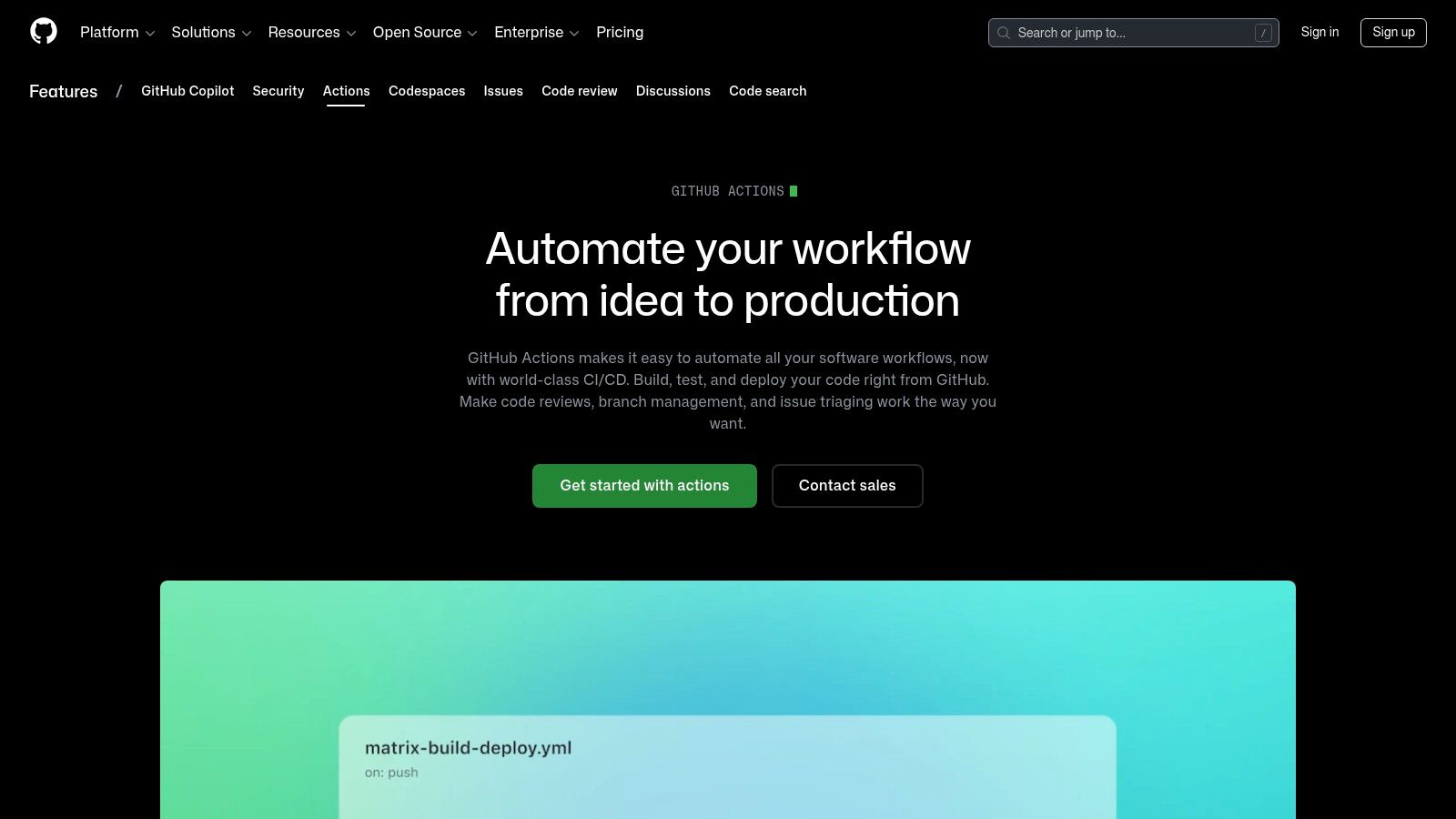
Its real strength for Kubernetes comes from its extensive marketplace, which contains pre-built actions for logging into cloud provider registries and deploying with Helm. This makes it one of the best CI/CD pipeline for Kubernetes options if you prioritize speed and simplicity for the CI part of the equation, while handling CD through direct scripting. But this simplicity can be deceptive as you scale.
Analysis
- Ideal Use-Case: Development teams who host their code on GitHub and need a fast, integrated CI system. It is particularly effective for straightforward deployment patterns where you build an image, push it to a registry, and then run a script.
- Strengths: The rich ecosystem and marketplace are major benefits, offering actions for nearly every task imaginable. The ability to use either GitHub-hosted or self-hosted runners provides flexibility for different security and performance needs.
- Limitations: GitHub Actions is primarily a CI tool. Its deployment capabilities are based on running scripts, which lacks the declarative, self-reconciling nature of a true GitOps tool and offers poor visibility into cluster state. The cost model for runners can also become complex and expensive at scale, adding to the hidden costs of your DIY platform.
Visit the GitHub Actions website
10. Google Cloud Deploy (with Cloud Build)
For teams deeply invested in the Google Cloud ecosystem, Google Cloud Deploy offers a managed continuous delivery service that simplifies deploying to Google Kubernetes Engine (GKE). Paired with Google Cloud Build for CI tasks, it presents a fully managed, low-ops solution native to Google Cloud. This allows your team to focus on application logic rather than wrestling with the configuration of a separate CD tool.
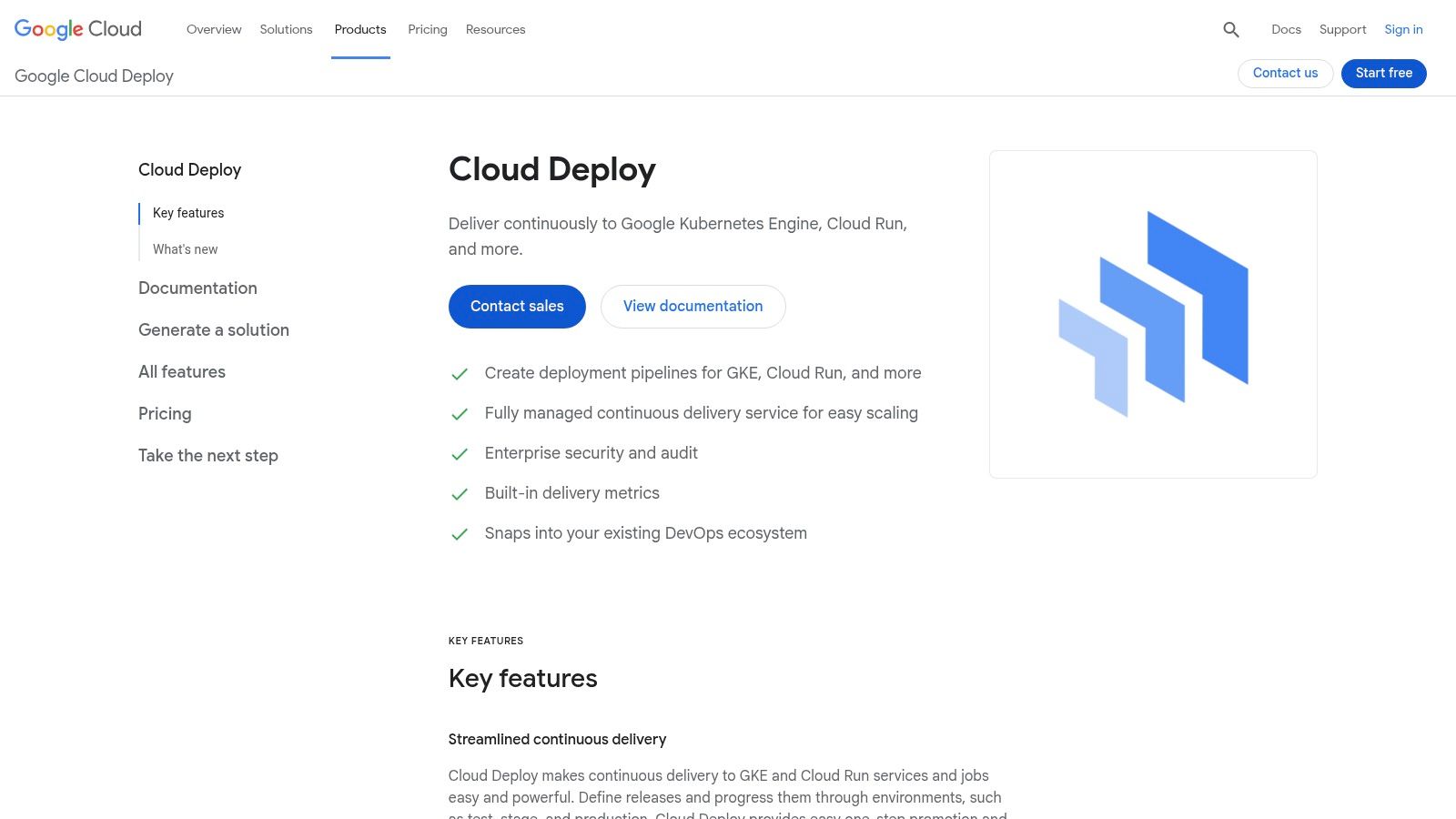
This tight integration makes it a strong contender for the best CI/CD pipeline for Kubernetes if your infrastructure is standardized on GCP and you want to minimize operational overhead. However, this simplicity comes at the cost of being locked into a single cloud provider.
Analysis
- Ideal Use-Case: Startups and scale-ups running workloads exclusively on Google Cloud, particularly GKE. It is an excellent choice for teams that want a fully managed CD experience without the complexity of configuring and maintaining third-party tools.
- Strengths: The primary benefit is its seamless integration with other Google Cloud services, including IAM for security and Cloud Logging for audits. Its managed nature removes significant operational burdens.
- Limitations: Its greatest strength is also its main weakness. The service creates tight coupling to the Google Cloud Platform, making multi-cloud deployments across AWS or Azure nearly impossible. A modern multi-cloud DevOps platform offers a more strategic, portable choice for future growth.
Visit the Google Cloud Deploy website
11. Azure DevOps Pipelines
For organizations standardized on Microsoft tooling or heavily invested in the Azure cloud, Azure DevOps Pipelines offers a mature and well-integrated CI/CD solution. It provides strong native support for Kubernetes and Helm deployments, especially to Azure Kubernetes Service (AKS). The platform combines source control, package management, and planning into a single ecosystem.
This all-in-one approach can simplify the toolchain for teams already within the Microsoft environment, making it one of the best CI/CD pipeline tools for Kubernetes if you seek deep integration with Azure. However, like its GCP counterpart, this path can lead to significant vendor lock-in.
Analysis
- Ideal Use-Case: Development teams running on Azure or using other Microsoft products. It’s a strong choice for enterprises that need robust governance and security controls integrated directly into their deployment workflows.
- Strengths: The tight integration with Azure Active Directory and AKS simplifies security and deployment management. The ability to run unlimited minutes on a self-hosted parallel job offers significant cost savings.
- Limitations: The YAML pipeline syntax can feel verbose and complex. Most critically, it anchors your operations to the Azure ecosystem, limiting your ability to adopt a multi-cloud strategy for cost, performance, or redundancy without significant rework.
Visit the Azure DevOps website
12. AWS CodePipeline (with CodeBuild)
For teams deeply integrated into the Amazon Web Services ecosystem, AWS CodePipeline offers a managed CI/CD service that removes much of the infrastructure overhead. When paired with AWS CodeBuild, it creates a serverless CI/CD flow with native deployment actions for Amazon EKS. This setup is particularly effective for organizations that standardize on AWS services.
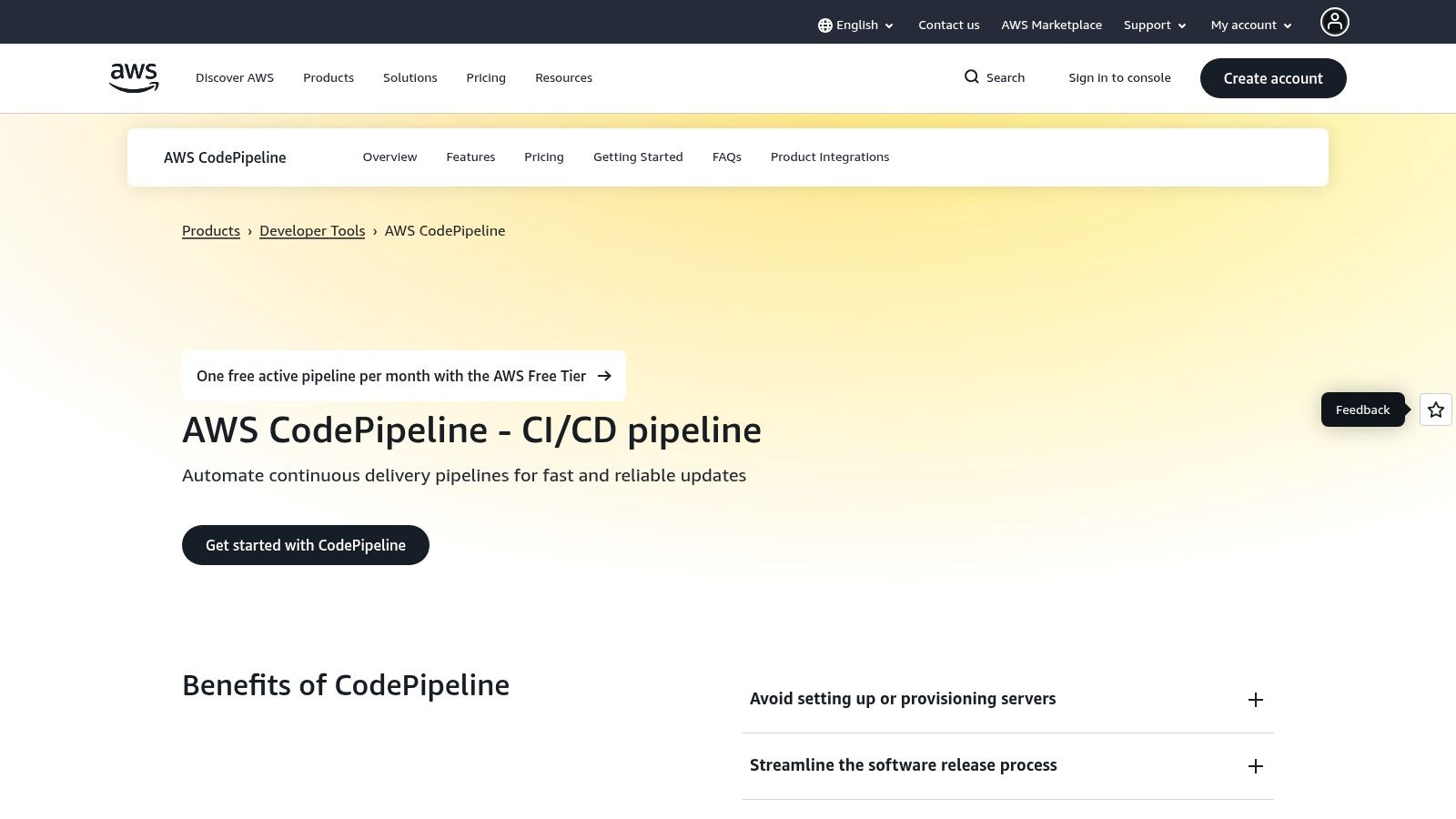
It represents one of the best CI/CD pipeline for Kubernetes choices if your primary goal is to minimize operational burden and you operate exclusively on AWS. But this convenience comes with the steep price of vendor lock-in, a strategic risk for any growing company.
Analysis
- Ideal Use-Case: Development teams already using AWS for their infrastructure who want a straightforward, managed CI/CD solution without the complexity of setting up separate tools.
- Strengths: As a fully managed service, it requires almost zero infrastructure maintenance. The native integration with EKS, IAM, and other AWS services creates a predictable and secure workflow.
- Limitations: The pipeline structure is quite opinionated and can feel restrictive. This AWS-centric design introduces significant vendor lock-in, making it difficult to adopt a multi-cloud strategy for AWS, GCP, and Azure without a complete re-architecture of your delivery process. This is a risk a managed DevOps platform helps you avoid.
Visit the AWS CodePipeline website
Top 12 Kubernetes CI/CD Pipeline Comparison
| Product | Core focus | Unique selling points | Target audience | Pricing & ops overhead |
|---|---|---|---|---|
| PushOps (recommended) | Turnkey multi‑cloud infra + end‑to‑end automation (commit→prod), observability, security | Plug‑and‑play production foundations, cost optimization (autoscaling/right‑sizing), self‑service dev workflows, zero pipeline maintenance | Engineering teams wanting to avoid in‑house platform work, migrations, scale | Commercial — contact sales; low operational overhead (managed patterns, replaces bespoke scripts) |
| Argo CD (with Argo Rollouts) | GitOps CD for Kubernetes with reconciliation & drift detection; progressive delivery via Rollouts | Kubernetes‑native declarative CD, strong community, canary/blue‑green traffic shaping | K8s teams seeking auditable GitOps CD | Open‑source; CD only (needs separate CI); hosting/ops required |
| Flux | GitOps toolkit (controllers for sources, Kustomize, Helm, OCI delivery) | Modular controllers, secure pull model, strong multi‑tenant scaling | Organizations adopting GitOps at scale, multi‑cluster environments | Open‑source; minimal official UI; operational setup required |
| Tekton | Kubernetes‑native CI framework (Pipelines/Tasks as CRDs) | Vendor‑neutral pipeline primitives, portable, fine‑grained control | Platform teams building standardized pipelines and internal developer platforms | Open‑source; framework — needs platform UX and guardrails |
| Spinnaker | Mature multi‑cloud CD and deployment orchestration | Battle‑tested for complex rollouts, rich safety and audit features | Large orgs with complex multi‑target release processes | Open‑source; higher operability overhead (multiple components) |
| Codefresh (Argo‑powered) | Commercial GitOps CD + optional CI, env promotion and analytics | Simplifies multi‑app multi‑cluster promotions; SaaS or self‑hosted; enterprise support | Enterprises using Argo needing governance and promotion flows | Commercial — contact sales; reduces custom GitOps plumbing |
| Harness | Full delivery platform (CI, CD, GitOps, verification, rollback) | Opinionated governed workflows, continuous verification, finops features | Enterprises requiring SRE‑grade verification and governance | Commercial enterprise pricing; can be heavyweight to adopt |
| GitLab CI/CD (with Agent) | All‑in‑one DevSecOps: CI/CD, security, Kubernetes agent | Centralized platform, built‑in security/compliance, merge trains & review apps | Teams standardized on GitLab seeking integrated DevSecOps | SaaS/self‑hosted tiers; Dedicated for data residency; moderate ops |
| GitHub Actions | CI with marketplace actions and Kubernetes deploy steps | Fast repo→pipeline flow, huge action ecosystem, reusable workflows | Teams hosted on GitHub wanting quick CI and deploys | SaaS pricing (runners at scale); runner/billing tuning may be needed |
| Google Cloud Deploy (with Cloud Build) | Managed CD for GKE and Google Cloud targets | Low‑ops GKE integration, approvals/rollouts, predictable pricing | Teams primarily on GCP/GKE preferring managed services | Managed commercial service; limited cross‑cloud portability |
| Azure DevOps Pipelines | Mature CI/CD (YAML/classic) with AKS and Helm support | Tight Microsoft tooling integration, generous free minutes/self‑hosted options | Organizations standardized on Azure / Microsoft stack | SaaS pricing; free minutes & self‑hosted job benefits; YAML can be verbose |
| AWS CodePipeline (with CodeBuild) | AWS‑native managed CI/CD with native EKS deployment action | Native EKS/VPC support, IAM‑native security and artifact flows | Teams operating primarily on AWS | Managed service with AWS pricing; limited cross‑cloud portability |
From DIY Complexity to Production-Ready Simplicity
Navigating the landscape of CI/CD tools for Kubernetes reveals a clear spectrum, from highly flexible, open-source frameworks to fully managed, integrated platforms. On one end, you have powerful tools like Argo CD, Flux, and Tekton. These give your team immense control but are merely components, not complete solutions.
The path of building your own CI/CD platform from these building blocks often involves a long and costly journey of integration, security hardening, and ongoing maintenance. As your organization grows and demands support for multiple clusters across different cloud providers like AWS, GCP, and Azure, this self-built platform becomes a major operational burden. The complexity quickly multiplies, pulling your most valuable engineers away from product development and into the business of infrastructure management.
The Core Dilemma: Building the Platform vs. Building the Product
The central question for any CTO or engineering leader isn't just about selecting the best CI/CD pipeline for Kubernetes from a list of tools. The real decision is strategic: should your team’s focus be on constructing and maintaining a bespoke DevOps stack, or should it be on shipping features that drive business value? The hidden costs of the DIY approach—from salaries for specialized DevOps engineers to the lost opportunity of delayed product releases—are substantial.
This is the fundamental trade-off we've explored. While native cloud tools like AWS CodePipeline or Azure DevOps offer a more integrated starting point, they create vendor lock-in and often lack the multi-cloud portability that modern applications require. This is where a managed DevOps platform shifts the equation entirely.
Reclaiming Your Team's Focus
Instead of dedicating months to stitching together CI/CD, monitoring, security, and cost controls, a platform like PushOps provides a cohesive, production-ready environment from day one. It abstracts the underlying infrastructural complexity across AWS, GCP, and Azure, offering a standardized, secure, and scalable workflow that empowers your entire development team, not just a handful of DevOps specialists. By providing a self-service experience, your developers can deploy and manage their applications confidently, freeing them to innovate and deliver value faster.
Ultimately, the right choice depends on where your organization can gain the most leverage. For most startups and scale-ups, that leverage comes from product velocity, not from becoming experts in the intricacies of Kubernetes infrastructure. Choosing a path that prioritizes simplicity and reliability allows you to focus your resources where they matter most: creating an exceptional product for your customers.
Tired of managing the complexity of Kubernetes CI/CD? PushOps provides a fully managed, multi-cloud DevOps platform that lets your team deploy applications on AWS, GCP, and Azure without the operational overhead. Stop building infrastructure and start shipping features today by exploring what PushOps can do for you.

