
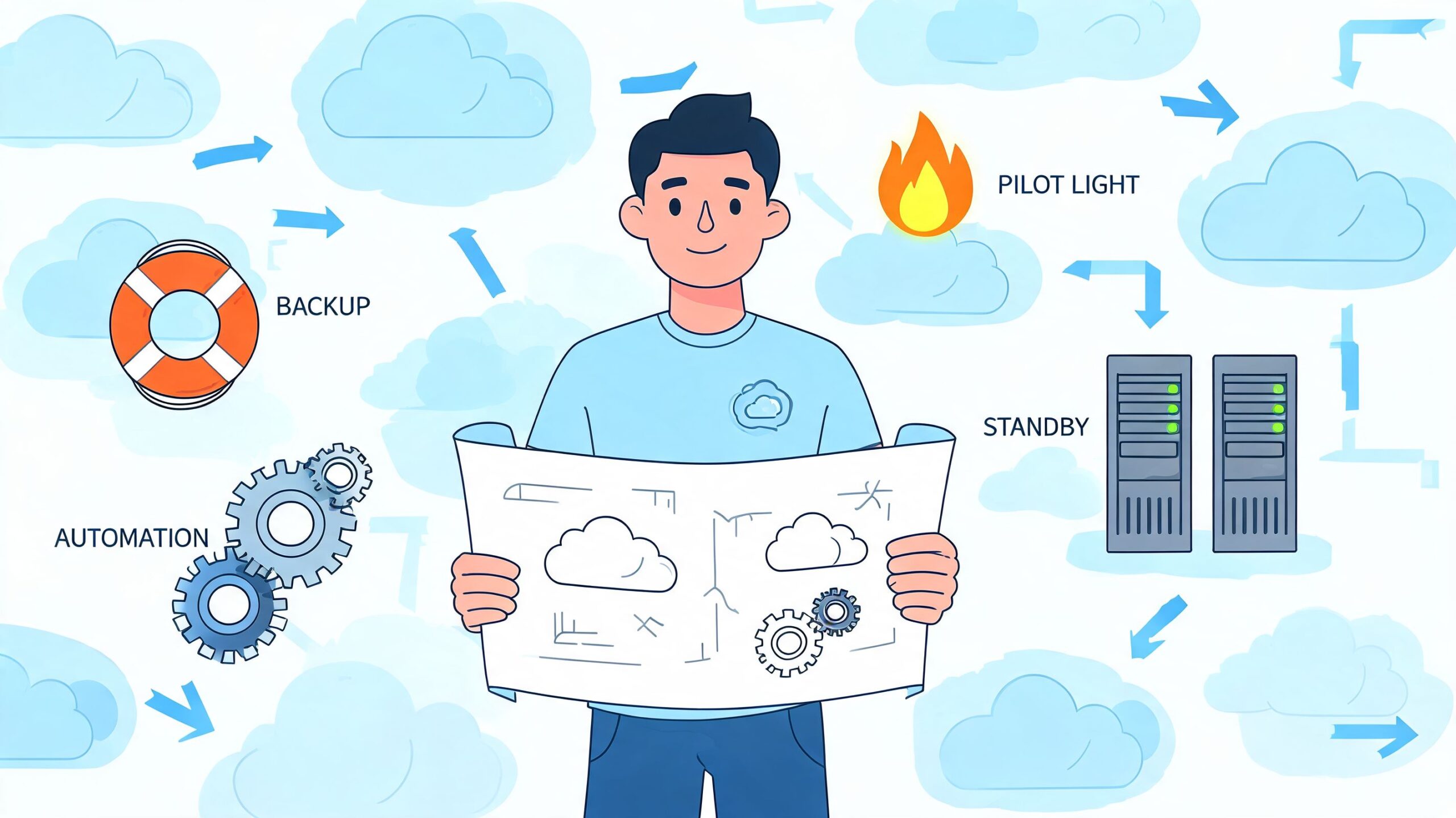

At some point, most engineering leaders realise their disaster recovery plan isn't really a plan. It's a pile of Terraform, cloud snapshots, IAM exceptions, stale runbooks, Slack lore, and one platform engineer who knows how failover is supposed to work.
That's manageable when you're small. It becomes expensive when you scale. It becomes dangerous when customers, auditors, and revenue depend on it.
I've seen teams treat disaster recovery planning as a side project. They write a document, schedule a backup, replicate a database, and tell themselves they're covered. Then an outage hits and the essential question isn't “Do we have backups?” It's “Who's awake, who knows the order of operations, which dependencies changed last month, and why are senior developers spending their week reconstructing infrastructure instead of shipping product?”
For cloud-native teams, disaster recovery planning is no longer just an ops concern. It's a strategic decision about where your engineering time goes.
Your DR Plan is a Product You Shouldn't Be Building
The familiar version starts at 3 a.m. A critical service fails. Monitoring fires. Someone opens a runbook last edited two quarters ago. Another person checks whether the standby environment still matches production. A third discovers the database restore procedure still assumes an older schema or a different secret path.
That's not bad luck. That's what happens when a company turns disaster recovery planning into an internal product nobody owns.

The real cost isn't the outage alone
IT professionals often consider disaster recovery in terms of backups, regions, and failover. The larger cost sits elsewhere.
Your best engineers end up maintaining:
- Cloud glue code: Scripts that bridge AWS, GCP, and Azure differences.
- Environment parity work: Keeping staging, standby, and production close enough that recovery doesn't break in surprising ways.
- Tooling drift: CI/CD, Kubernetes manifests, secrets, monitoring rules, and access policies that all change faster than DR documents do.
- On-call fatigue: The same people who should be building product spend nights validating infrastructure assumptions.
A useful primer like ARPHost's guide for resilient IT is good for grounding the fundamentals. The problem is that many teams stop at the checklist level and never account for the long-term ownership burden.
DIY DR often looks cheap in a roadmap meeting and very expensive in the sixth month of maintenance.
Why cloud-native teams get trapped
A modern stack adds moving parts that older DR advice barely touches. Your sign-up flow may depend on an API gateway, identity service, managed database, queue, object storage, observability agent, webhook workers, and a third-party billing integration. Recovering “the app” now means recovering an ecosystem in the right order.
That's why I'm sceptical when teams say they'll “just automate it”. They usually mean they'll build another fragile layer on top of existing fragility.
If you want a sense of how platform automation changes the equation, look at how developer platform automation reduces the number of bespoke recovery steps a team has to maintain in the first place. The best DR plan is often the one that removes avoidable operational variation before a disaster ever happens.
What works and what doesn't
A few patterns are reliable.
| Approach | What usually happens |
|---|---|
| DIY DR with mixed scripts and tribal knowledge | Works until key people are unavailable or the environment changes |
| Document-heavy DR with little automation | Looks thorough, fails under pressure |
| Platform-level standardisation | Reduces manual decisions during incidents |
| Recovery built into delivery workflows | Keeps plans closer to production reality |
The blunt truth is this. Your company probably shouldn't be building a custom DR product unless infrastructure resilience is itself your business.
Conducting a Business Impact Analysis Without Boiling the Ocean
A Business Impact Analysis, or BIA, sounds bureaucratic. It isn't. It's just the discipline of deciding what matters before an outage forces the decision for you.
Most BIAs fail because teams start with infrastructure inventory. They list clusters, nodes, buckets, and databases. That creates paperwork, not clarity. Start with business functions instead.
Map customer journeys before systems
For a SaaS company, the useful opening questions are practical:
- Which user journeys generate revenue or protect retention?
- Which workflows must continue during an incident?
- Which delays are painful but tolerable?
- Which systems support those journeys behind the scenes?
The sign-up flow, login, payment processing, core application actions, and customer support tooling usually matter more than a perfect inventory of every internal service. Once you know the business-critical journeys, map the dependencies beneath them. That includes microservices, queues, managed databases, object storage, identity providers, DNS, observability, and third-party APIs.
Keep the analysis sharp
A BIA gets bloated when every stakeholder marks their system “critical”. Don't let that happen.
Use a simple working model:
- Revenue-critical: If this stops, customers can't buy or use the core service.
- Operationally critical: The business can't support customers or operate safely without it.
- Important but deferrable: Painful to lose, but survivable for a period.
- Recover later: Internal tools and low-impact workloads.
This is also where role clarity matters. Atlassian's disaster recovery guidance notes that 40 to 50% of organisations lack documented escalation matrices, which can create 2 to 4 hour delays in disaster declaration and plan activation. I've seen exactly that failure mode. The issue isn't technology first. It's indecision.
Practical rule: If your team can't state who declares a disaster, who approves failover, and who communicates to customers, you don't have a usable plan.
A lean BIA template for engineering leaders
You don't need a months-long consultancy exercise. You need a document your team will maintain.
| Business function | Supporting systems | Owner | Manual workaround | Recovery priority |
|---|---|---|---|---|
| Customer sign-up | Front end, auth, user DB, email provider | Growth engineering | Limited | High |
| Payments | Billing service, payment gateway, ledger DB | Platform or payments team | None | Highest |
| Internal analytics | ETL jobs, warehouse, dashboards | Data team | Yes | Low |
The useful output is not a perfect spreadsheet. It's a recovery order everyone accepts.
Where DIY stacks make this harder
Multi-cloud environments complicate BIA work because dependencies spread across providers. One service in AWS may authenticate against a system in Azure and push events into GCP. The moment you do that with custom Kubernetes operators, hand-rolled CI/CD, and fragmented monitoring, dependency mapping turns into archaeology.
That's the hidden tax. Teams spend weeks discovering how their own systems fit together. By the time they finish, the architecture has already changed.
Defining RTO and RPO That Match Your Budget and Business
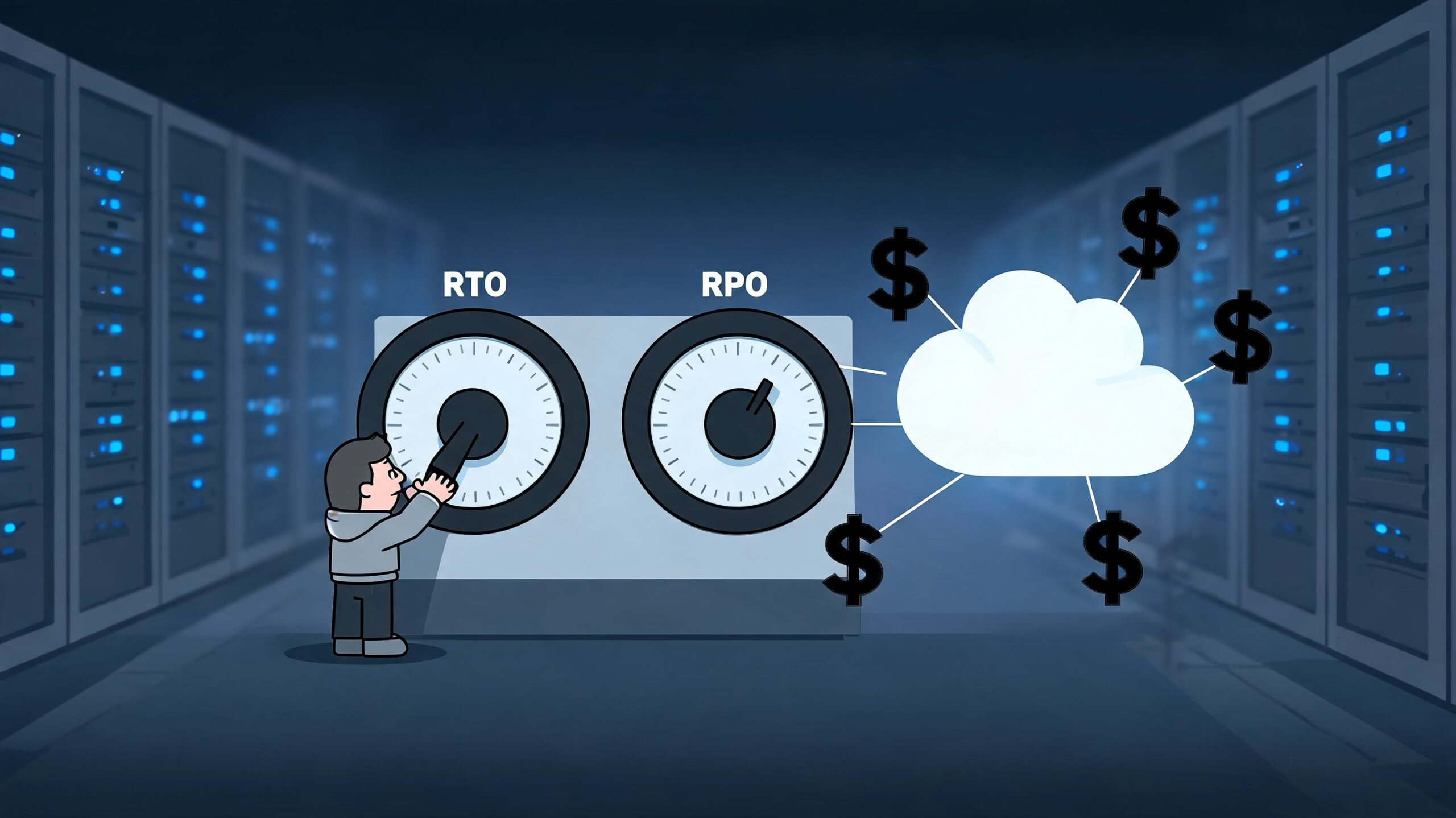
Recovery Time Objective (RTO) is how long a service can be down. Recovery Point Objective (RPO) is how much data you can afford to lose.
Those two settings drive almost every cost in disaster recovery planning. Get them wrong and you either overspend badly or accept risk you didn't mean to accept.
Every service doesn't deserve the same target
A common mistake is pretending every workload needs near-zero recovery. That sounds responsible. It usually means you're funding premium resilience for systems that don't justify it.
Kaluari's DR planning guidance recommends tiered targets, where mission-critical systems aim for near-zero RPO, tier-2 systems can operate with a 4-hour RPO, and tier-3 systems can use an 8 to 24 hour RPO. The same source notes that 60 to 70% of companies fail to establish these criteria before deployment.
That failure shows up later as chaos. Someone discovers the customer billing path was protected with weak recovery assumptions, while a low-value internal tool got overengineered.
Use a tiering model that finance can understand
Engineering teams often define RTO and RPO in technical language. Finance and leadership hear cost. Translate it.
| Tier | Example workload | Sensible posture |
|---|---|---|
| Tier 1 | Payments, authentication, production database | Tight RTO, minimal data loss |
| Tier 2 | Customer admin, support systems, internal APIs used in production flows | Moderate recovery targets |
| Tier 3 | Analytics, internal dashboards, batch jobs | Slower recovery, cheaper backup model |
This forces trade-offs into the open. If someone wants tier-1 recovery for a low-value service, ask what business outcome justifies it.
What teams get wrong in practice
The worst pattern is inconsistency.
- Overprotection: Active replication for systems that nobody needs during an incident.
- Underprotection: Nightly backups for data that customers expect to be current.
- No agreement on loss tolerance: Product, engineering, and leadership each assume different things.
- Targets with no implementation path: A slide says “near-zero” but the tooling can't deliver it.
RTO and RPO aren't aspirations. They're commitments your architecture and operating model must actually support.
A mature plan accepts asymmetry. Your payment service may need fast recovery and minimal data loss. Your internal reporting stack probably doesn't. The mistake is trying to buy psychological comfort by setting everything to maximum protection.
Budget and resilience have to be negotiated together
Every improvement in recovery speed has a price. More replication, more standby capacity, more automation, more testing, more policy management, more operational discipline. That doesn't mean aggressive targets are wrong. It means they need to be earned by business criticality, not anxiety.
The most effective teams decide service by service, not by slogan. They don't ask for the “best” disaster recovery planning. They ask for the level that protects the business without turning infrastructure into the business.
Choosing Your Recovery Strategy Without Building a Second Datacentre
Recovery patterns are easy to define and hard to operate. That distinction matters.
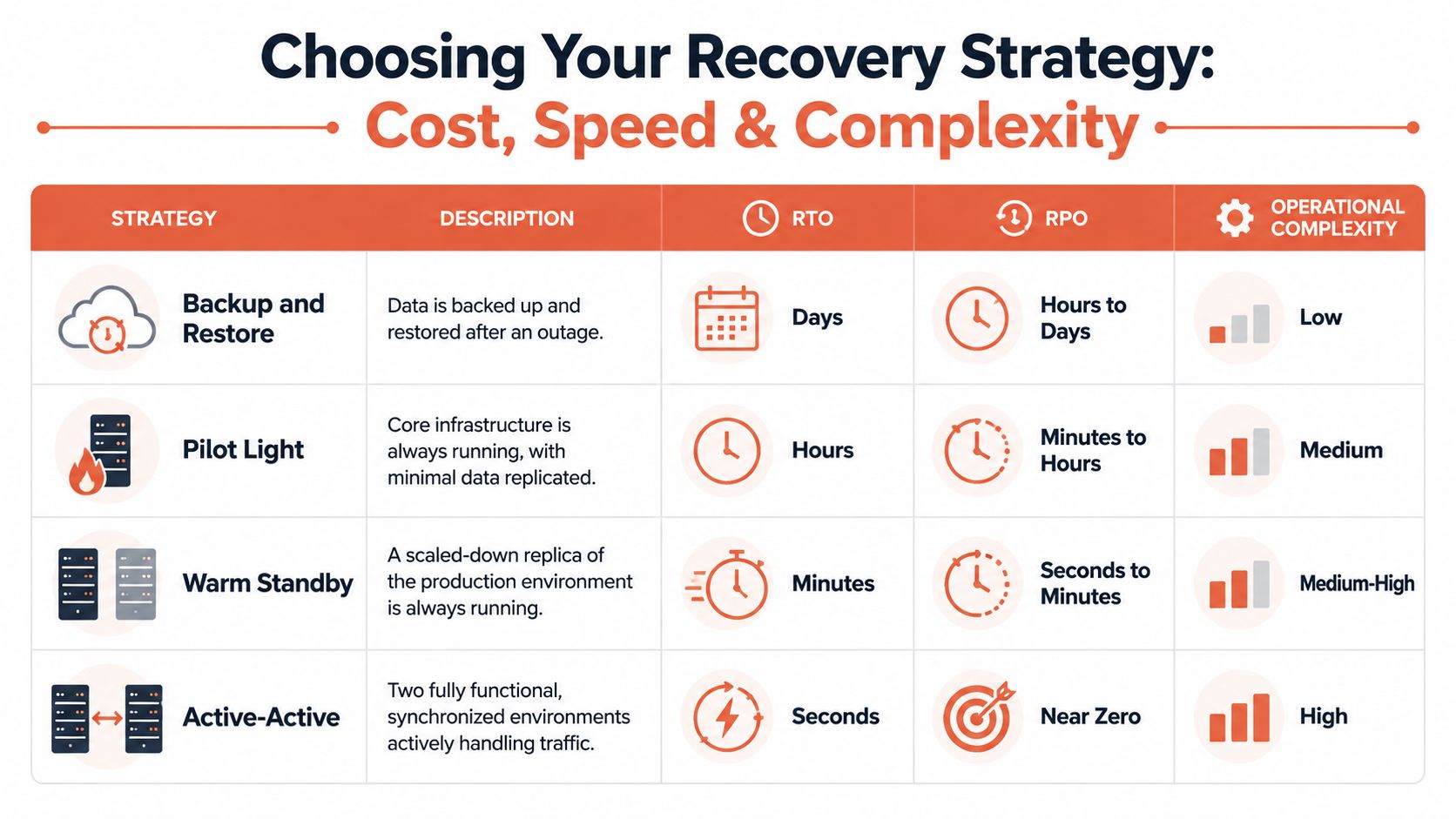
On a whiteboard, backup and restore, pilot light, warm standby, and active-active all sound like sensible options. In a real environment with Kubernetes, managed services, cloud IAM, CI/CD, observability, and multiple providers, each one carries operational baggage that many teams underestimate.
Backup and restore
This is the cheapest-looking strategy. You back up data and rebuild after failure.
It's fine for lower-priority systems. It becomes ugly for modern applications because “restore” rarely means restoring one thing. You need infrastructure definitions, secrets, network configuration, storage, service dependencies, and the right application versions in the right order.
DIY reality: teams discover that restoring a database is the easy part. Recreating the working application environment is where they lose time.
Pilot light
Pilot light keeps the core infrastructure ready while the rest is scaled up during a disaster. It can be a sensible middle ground.
The catch is drift. If production changes every week, your pilot environment needs to keep pace. Teams often maintain the databases and a minimal control plane, then forget IAM changes, webhook endpoints, sidecar configuration, or queue consumers.
DIY reality: one “small” mismatch between the standby path and production turns a theoretical recovery pattern into a debugging exercise during an incident.
Warm standby
A warm standby runs a scaled-down version of production continuously. Many scale-ups want to land here because it offers quicker recovery without the full cost of active-active.
Operationally, this isn't lightweight. You still need image consistency, configuration parity, traffic management, data replication discipline, and regular drills. If your organisation spans AWS, GCP, and Azure, you also need to keep provider-specific behaviours aligned.
DIY reality: you aren't just paying for standby capacity. You're paying for the humans who constantly keep it trustworthy.
Active-active
Active-active means two live environments handling traffic at the same time. It delivers the strongest recovery posture and the highest operating complexity.
For many product companies, DR transforms into platform engineering at enterprise scale. You now manage data synchronisation, routing logic, consistency behaviour, deployment coordination, and incident response across two active production footprints.
DIY reality: this is not a backup strategy. It is a second platform with all the staffing and process overhead that implies.
A side-by-side view
| Strategy | Strength | Hidden cost in a DIY setup |
|---|---|---|
| Backup and restore | Lower steady-state cost | Recovery is manual and dependency-heavy |
| Pilot light | Better recovery speed for critical pieces | Drift between dormant and live systems |
| Warm standby | Good balance for many production workloads | Ongoing parity work and more testing burden |
| Active-active | Fastest recovery posture | High coordination overhead across people, tooling, and clouds |
Why automation changes the economics
Systnet's disaster recovery statistics report that organisations using automated disaster recovery programs can reduce costs by more than 30%. The same source says 36% of businesses use cloud-based DRaaS solutions, with 23% planning adoption within the next year.
That aligns with what many engineering leaders eventually conclude. The issue isn't whether a recovery pattern is theoretically valid. It's whether your team can maintain it without sacrificing product throughput.
If you're dealing with cross-provider failover, multi-cloud management is where strategy stops being abstract. The more clouds you involve, the less forgiving manual coordination becomes.
If your DR approach requires heroic engineers to remember special cases under stress, the strategy is weaker than it looks on paper.
The Unseen Engine Automation and Continuous Testing
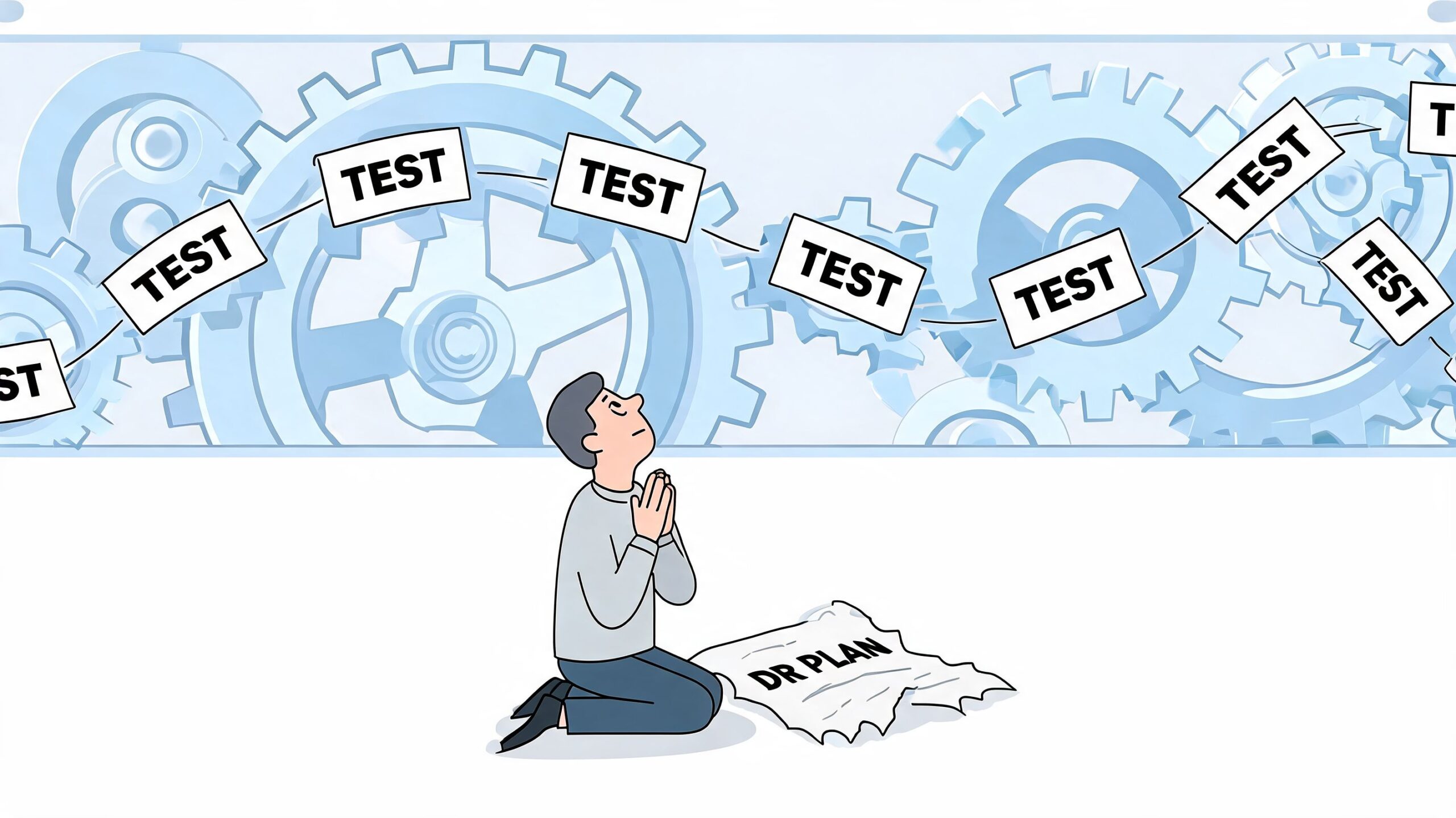
A disaster recovery plan that hasn't been exercised recently is wishful thinking with formatting.
Most organisations know this. Few behave accordingly. Secureframe's roundup of disaster recovery statistics says only 20% of organisations feel fully prepared for outages, 22% have no formal disaster recovery plan, and nearly 1 in 5 organisations take more than a month to recover when disasters strike.
That gap exists because testing is where DR stops being a document and becomes work.
Testing exposes the truth
A written plan can hide all kinds of assumptions:
- Broken sequencing: The app comes up before identity or data dependencies are ready.
- Stale access paths: The people running recovery no longer have the right permissions.
- Data integrity gaps: Replication worked, but restore validation didn't.
- Toolchain drift: CI/CD, Helm charts, Terraform modules, and secrets no longer match the documented path.
You only find these issues by running drills. Not tabletop theatre. Real failover exercises, restore tests, and validation steps prove the recovered environment can serve traffic.
Why teams avoid proper drills
Because drills are expensive in the ways engineering budgets rarely model.
Someone has to script the environment bring-up. Someone has to validate data. Someone has to check observability, networking, certificates, and external integrations. Someone has to coordinate the exercise so it doesn't disrupt production. Then the team has to update documentation, close gaps, and repeat the process after the next architectural change.
That's not a side task. It's a recurring operational programme.
The moment you commit to serious DR testing, you've committed to maintaining another internal system with its own backlog, defects, and ownership burden.
Automation is the only durable path
Manual disaster recovery planning breaks down in cloud-native environments because the number of moving parts grows faster than a team's capacity to remember them.
What works better:
- Automated infrastructure recreation through versioned definitions.
- Automated runbooks for common failure scenarios.
- Regular restore verification instead of assuming backups are usable.
- Traffic cutover procedures that are rehearsed, not improvised.
- Post-test updates folded into normal delivery work.
Without that, the plan decays every sprint.
The burnout nobody budgets for
I've watched teams build impressive DR machinery and then resent it. Senior engineers become custodians of pipelines, replicas, failover scripts, and cloud policy edge cases. Product work slows. Infrastructure chores expand. Incidents become personal because too much of the plan lives in people's heads.
If your delivery model still depends on brittle bespoke automation, reducing operational drag in the deployment layer matters as much as the DR plan itself. Zero-maintenance CI/CD pipelines are relevant here because every manual release and environment inconsistency becomes one more variable during recovery.
The quiet lesson is simple. Resilience depends on boring repeatability. Teams burn out when recovery relies on memory, heroics, and undocumented exceptions.
Focus on Your Product Not Your Pipelines
By the time most companies take disaster recovery planning seriously, they've already paid for doing it casually. They've lost engineering time, accepted hidden risk, and normalised a lot of operational work that has nothing to do with customer value.
The harder truth is that many teams then overcorrect. They decide to build a more complete internal platform for DR, multi-cloud controls, failover automation, observability, and cost governance. That feels mature. In practice, it often means they've chosen to maintain a second product.
The strategic question is where your team should spend attention
For startups and scale-ups, the choice usually isn't build versus buy. It's whether your best technical people should spend the next year refining infrastructure mechanics or improving the product customers pay for.
That trade-off gets sharper in riskier environments. Athreon's disaster recovery strategy article says that in high-risk regions, 52% of mid-sized tech outages stem from ransomware tied to poor multi-cloud policy enforcement, and 75% of CTOs report 2 to 3 times higher AWS bills post-incident due to unoptimised recovery. Those numbers point to a pattern. Weak governance and rushed recovery don't just create downtime. They create expensive downtime.
What to challenge in your current model
Ask these questions plainly:
- Are senior developers maintaining infrastructure that doesn't differentiate the business?
- Does your DR capability depend on a few people rather than repeatable systems?
- Can you recover across clouds without manual reconciliation and late-night guesswork?
- Are you absorbing security and cost complexity that a platform could standardise?
If the honest answer is uncomfortable, that's useful.
Good disaster recovery planning protects the business. Great disaster recovery planning does that without turning your engineering team into full-time operators.
The end state worth aiming for is not an impressive runbook library. It's a platform and operating model where recovery is routine, testing is built in, policy enforcement is consistent, and engineers can go back to shipping.
If your team is tired of stitching together Kubernetes, CI/CD, monitoring, security controls, cloud cost tooling, and disaster recovery logic across multiple providers, PushOps is worth a look. It gives software teams a production-ready platform across AWS, GCP, and Azure, with built-in automation, observability, security defaults, and cost controls, so your engineers can spend less time maintaining infrastructure and more time building product.

