
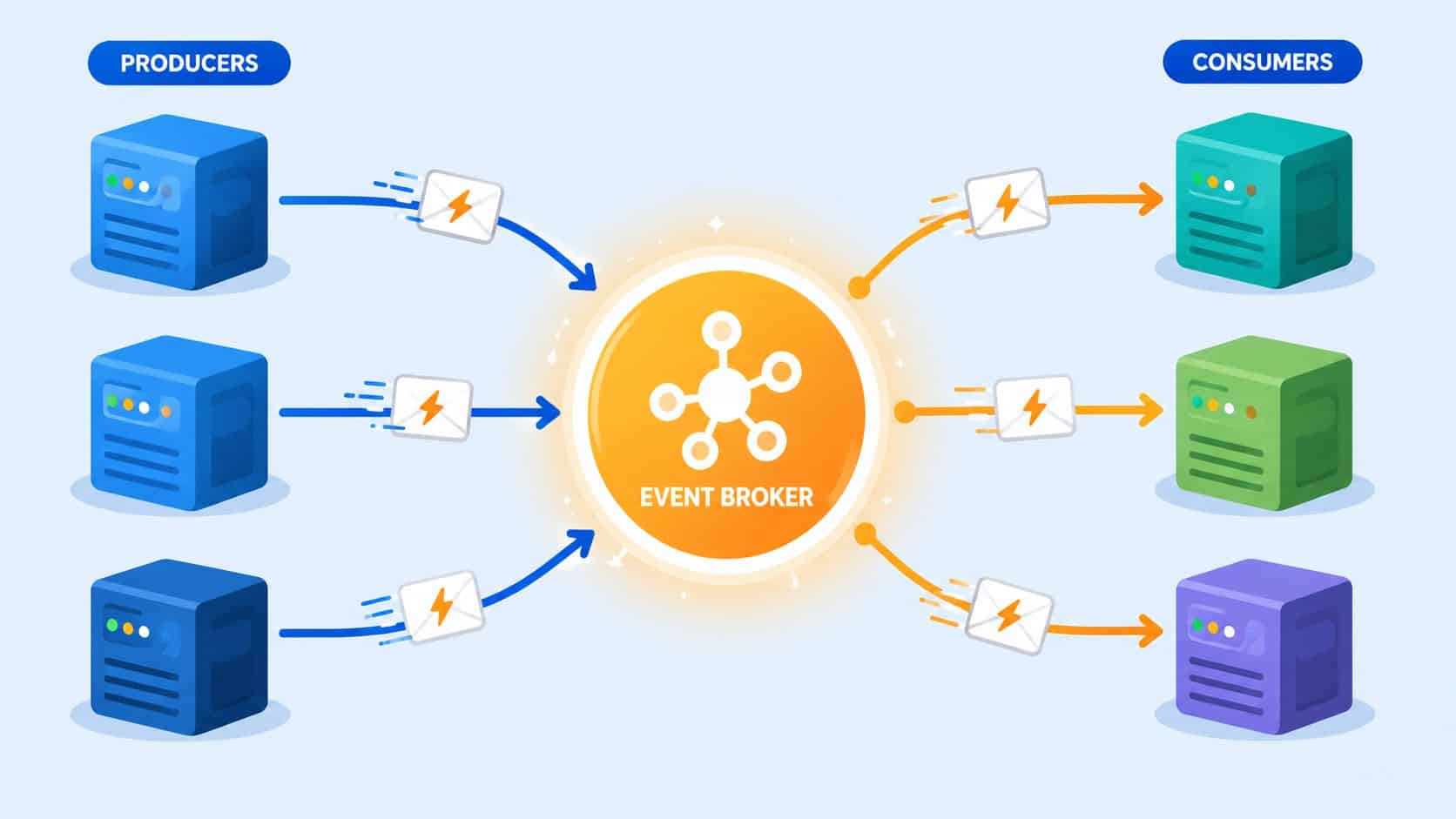

Your product team probably isn't arguing about architecture because architecture is fun. They're arguing because the current system has started to slow the company down.
A once-manageable monolith now turns simple releases into tense coordination exercises. One change in checkout touches payments, inventory, notifications, and reporting. Deployment windows get longer. Rollbacks get riskier. Engineers spend more time discussing blast radius than shipping features. For startups and scale-ups in Europe, Singapore, the UK, and the US, that's usually the point where event driven architecture enters the conversation.
It should. Used well, event driven architecture gives teams a way to decouple services, scale independently, and react to business activity in real time. But the architecture diagram is the easy part. The hard part is everything underneath it: brokers, schemas, tracing, retries, deployments, security, cloud permissions, cost control, and the daily operational work needed to keep the whole thing reliable.
That's where many teams make the expensive mistake. They decide they need not only event driven systems, but also their own platform stack to support them. Then they find themselves maintaining Kubernetes clusters, CI/CD pipelines, monitoring stacks, policy rules, and bespoke deployment scripts when what they wanted was a production-ready foundation that lets engineers focus on product.
Why Your Monolith Is Grinding to a Halt
A monolith rarely fails all at once. It becomes a drag in layers.
First, release coordination gets messy. Then one team's change starts blocking another team's roadmap. Then scaling becomes uneven. The search function needs more headroom, but the entire application gets scaled because that's the only lever available. Eventually, a single codebase starts carrying too many responsibilities, and every deployment feels larger than it should.
That's the moment when event driven architecture becomes attractive. Instead of forcing every business process through direct, synchronous calls, services publish events such as order placed, payment captured, or shipment created. Other services subscribe and react without being tightly coupled to the original transaction. The system becomes more modular. Teams can move with more autonomy. Failures are easier to isolate.
EDA solves one bottleneck and exposes another
The architectural shift is often right. The implementation path is where teams get trapped.
If you move from a monolith to event-driven services without a solid platform foundation, you trade visible monolith pain for distributed systems pain. The user-facing app may feel cleaner, but now your engineers own brokers, delivery semantics, retries, dead-letter handling, cross-service authentication, release automation, event versioning, and cloud-specific operational glue.
Practical rule: If your move to EDA creates more platform work than product progress, the architecture is being implemented on the wrong foundation.
This is why many teams over-invest in DIY DevOps. They assume architectural freedom requires building the entire supporting platform in-house. In reality, that choice often creates a long tail of maintenance.
PushOps notes in its cloud cost optimisation explainer that building a home-grown internal developer platform creates a permanent operational tax: custom scheduling scripts break, CI/CD pipelines demand constant attention, and cost-monitoring tools drift out of sync, while every hour spent debugging Terraform modules or fixing flaky deployments is an hour not spent improving the actual product or gaining competitive advantage.
The monolith isn't the only thing slowing you down
When teams discuss migration, they often focus on service boundaries and messaging patterns. They spend less time on the mechanics of running the system after launch.
That's backwards. In practice, the long-term cost of event driven architecture is dominated by operations, not diagrams.
A useful starting point is to pair the move toward EDA with disciplined service design. If you're refining boundaries and responsibilities, these microservices best practices from Wonderment Apps are worth reading because they force the right questions early: what should be split, what should stay together, and where coupling is still acceptable.
Before you break the monolith apart, be honest about the target state. You don't just need loosely coupled services. You need a reliable way to provision, deploy, monitor, secure, and operate them across AWS, GCP, or Azure without turning your best engineers into part-time platform maintainers.
The Core Components of Event Driven Architecture
At a high level, event driven architecture is simple. Something happens. A system records that fact as an event. Other systems react.
The complexity appears when that simple flow has to work reliably across services, clouds, environments, and teams.
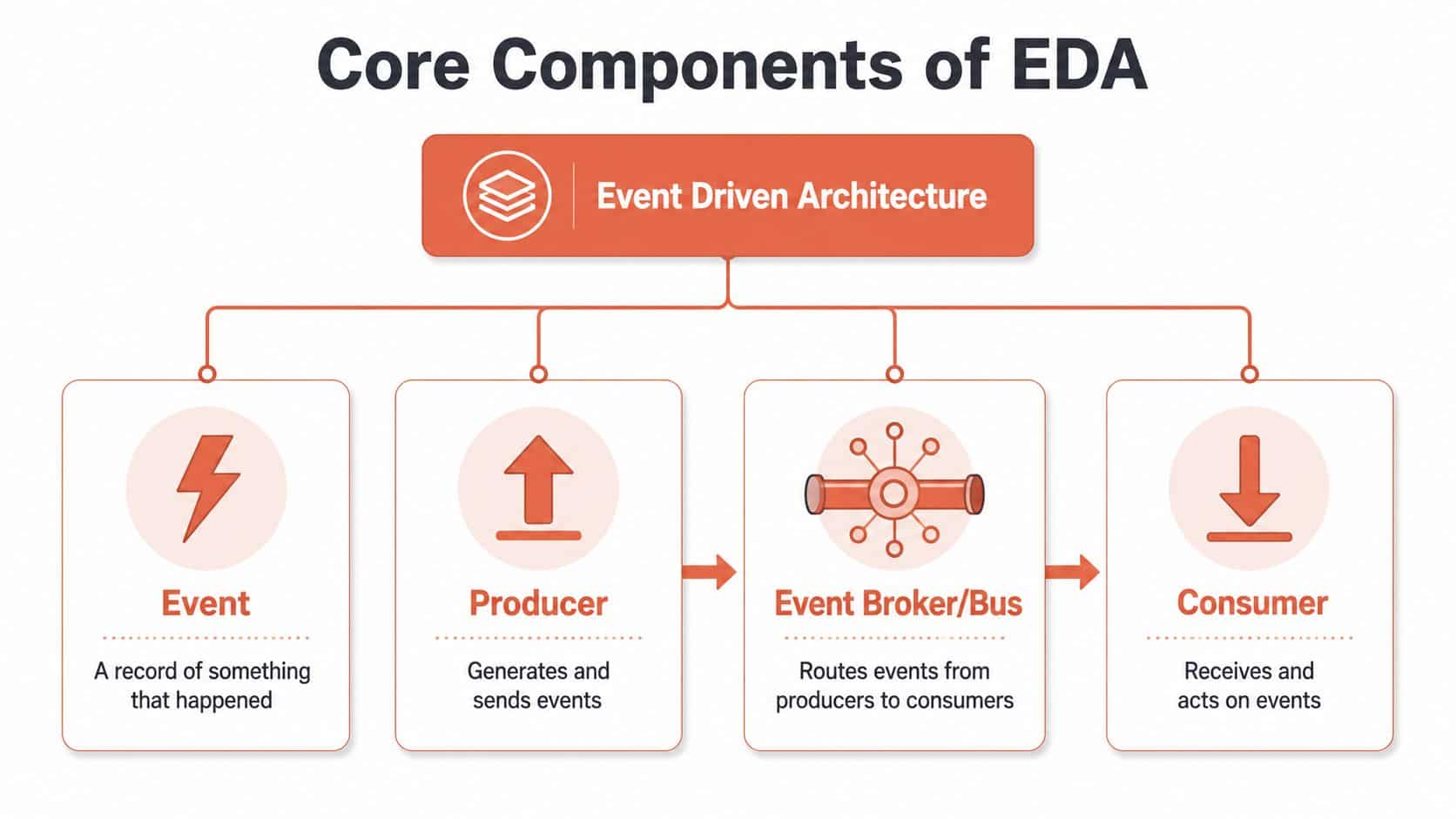
Event, producer, broker, consumer
Think of EDA as a digital postal system.
An event is the letter. It records that something happened. An order was placed. A refund was issued. A file was uploaded. Good events describe facts that already occurred, not commands disguised as messages.
A producer is the sender. It creates the event and publishes it. In a commerce platform, the checkout service might publish an order-created event after it commits the order.
The event broker or message bus is the sorting centre. It receives events and routes them to the right destinations. Tools such as Kafka, Amazon EventBridge, Google Cloud Pub/Sub, Azure Service Bus, or RabbitMQ fulfill this role.
A consumer is the recipient. It subscribes to relevant events and performs work. A billing service may create an invoice. A notification service may send an email. An analytics pipeline may update a dashboard.
The schema is the contract
The most underestimated component is the event schema.
Without a clear schema, producers and consumers drift apart. One team renames a field. Another starts assuming a value is always present. A third adds semantics nobody documented. The result isn't innovation. It's fragile integration.
A broker moves messages. A schema keeps teams from breaking each other.
This is one reason many EDA rollouts stall after initial enthusiasm. According to a Solace-commissioned global survey of 840 professionals, 72% of global businesses use event-driven architecture, but only 13% have reached the “gold standard” of implementation. Adoption is broad. Mastery is not.
The broker is not just another service
On whiteboards, the broker is usually drawn as a neat box in the middle. In production, it's one of the most critical pieces of infrastructure you own.
It has to be provisioned correctly, secured properly, monitored continuously, scaled without drama, and integrated with your deployment workflow. If you're running across multiple environments or multiple clouds, that burden compounds. IAM roles, service accounts, networking rules, encryption settings, throughput limits, retention policies, and cost behaviour all become part of the architecture.
A DIY setup usually means your DevOps team, platform engineers, or senior developers carry that load.
That's why the core components of event driven architecture should never be discussed as abstract building blocks alone. They are also operational responsibilities. The more freedom you want at the application layer, the more discipline you need at the platform layer.
Key EDA Patterns and Messaging Models
Not all event-driven systems work the same way. Teams often say they're “using EDA” when they're making very different choices about message flow, storage, replay, and coordination.
Those choices matter because they affect reliability, developer workflow, and cost from day one.
Pub/Sub and event streaming are not interchangeable
Publish/subscribe is usually the simpler model to adopt. A producer publishes an event, the broker distributes it, and interested consumers receive it. This works well for notifications, workflow triggers, and fan-out scenarios where multiple systems need to react independently.
Event streaming treats events more like a durable log. Consumers can read in order, track offsets, and replay history. That's useful when you need auditability, state reconstruction, analytics pipelines, or long-running data processing.
Here's the practical difference.
| Attribute | Publish/Subscribe (e.g., AWS SNS, GCP Pub/Sub) | Event Streaming (e.g., Apache Kafka, AWS Kinesis) |
|---|---|---|
| Primary model | Broadcast events to interested subscribers | Maintain ordered streams of events over time |
| Retention | Often shorter-lived and delivery-focused | Designed for retained, replayable event logs |
| Ordering | Usually less central to design | Often a core design concern |
| Replay | Limited or implementation-specific | Common and expected |
| Best fit | Notifications, workflow triggers, loose fan-out | Analytics, audit trails, stateful processing |
| Operational profile | Simpler initial adoption | Higher operational and governance demands |
A lot of teams pick the wrong model for the wrong reason. They choose streaming because it sounds future-proof, then use it for straightforward notifications that didn't require replay or ordering. Or they choose basic pub/sub, then later realise they need retention, reprocessing, and event history.
Choreography and orchestration
Messaging model is only one part of the design. You also need to decide how business processes coordinate.
In choreography, services react to events independently. Order service emits an event, inventory reacts, billing reacts, fulfilment reacts. This can be elegant and loosely coupled, but it gets hard to reason about when the process spans many services.
In orchestration, one service or workflow engine coordinates the steps. That gives clearer control flow, but it also creates a central dependency.
Use choreography when the domain really is reactive and decentralised. Use orchestration when the business process needs explicit control, visibility, or compensating logic.
Event sourcing and CQRS
Some teams go further and adopt event sourcing and CQRS.
With event sourcing, the event history becomes the source of truth. Instead of only storing current state, the system records every state-changing event. That improves auditability and replay, but it raises the bar for schema discipline, data modelling, and operational maturity.
With CQRS, write models and read models are separated. That can help scale and tailor data access patterns, but it also means more moving parts and more eventual consistency to manage.
These patterns are powerful when they solve a real domain problem. They're a bad idea when adopted because they look impressive in an architecture review.
If your deployment process is already fragile, adding event sourcing or CQRS will magnify the pain, not fix it.
Automated release pipelines matter more than teams expect. A fragmented deployment setup turns every schema change and consumer rollout into a coordination problem. If you're standardising service delivery, automated deployments for microservices are part of the operational answer, not a separate concern.
The Real Benefits and Hidden Trade-Offs of EDA
The appeal of event driven architecture is real. So are the costs.
If you only hear the upside, you'll underestimate the operational work. If you only hear the downside, you'll miss why so many engineering organisations keep moving in this direction.
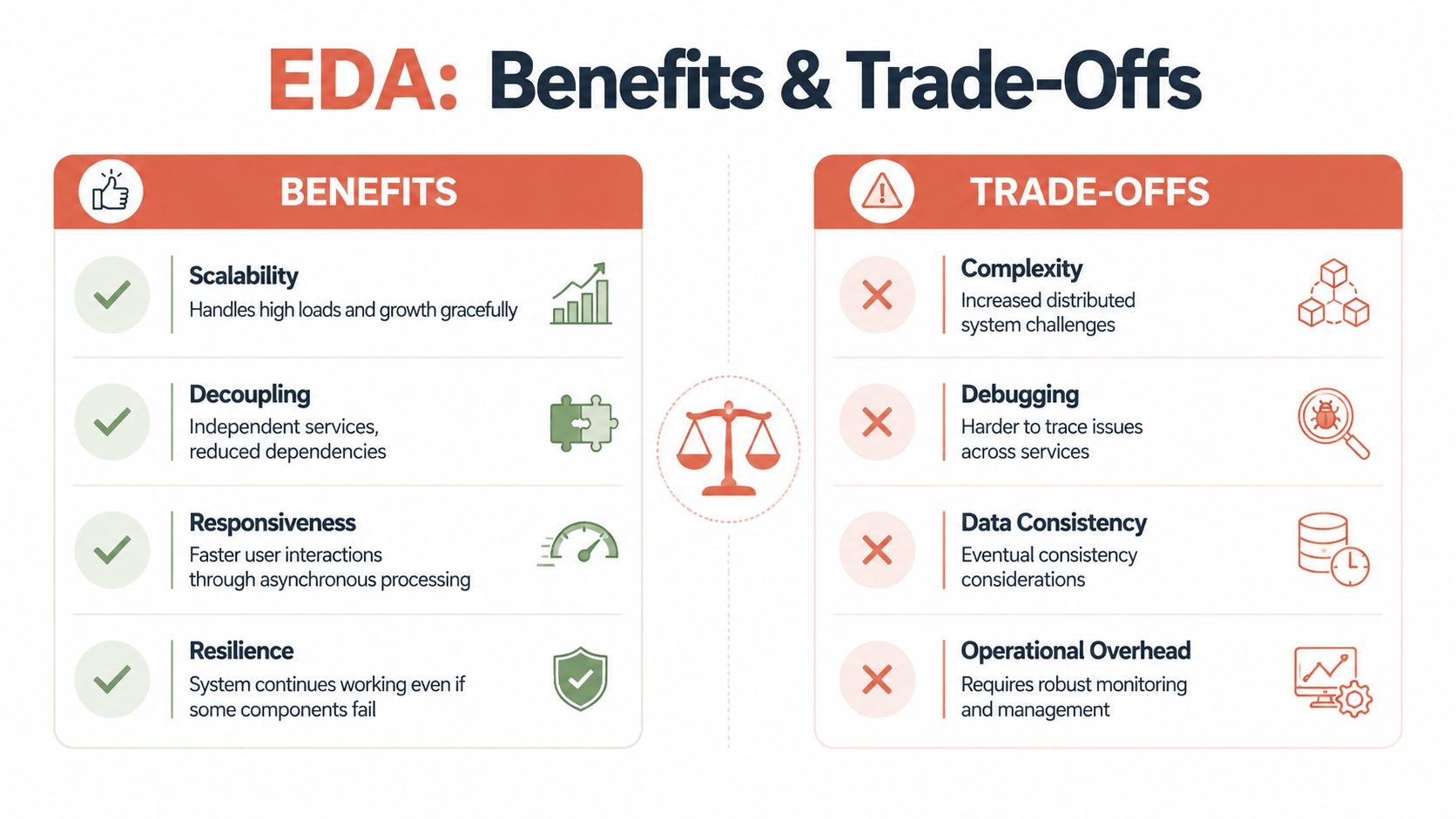
What works well
EDA gives engineering teams three benefits that are hard to ignore.
- Decoupling improves team autonomy. Producers and consumers can evolve more independently when they communicate through events instead of tightly coupled synchronous calls.
- Scalability becomes more targeted. Services can scale according to their own workload rather than dragging the entire application up with them.
- Resilience improves. A temporary issue in one consumer doesn't always need to block the whole business process.
For businesses dealing with high-volume, high-velocity workloads, this model is especially compelling. A 2025 perspective on EDA adoption and scaling describes event driven architecture as powering applications across industries including e-commerce, finance, logistics, media, and generative AI, while highlighting decoupling, scalability, and resilience as core advantages.
What hurts in practice
The trouble starts when teams treat those benefits as free.
Eventual consistency is the first shock. In a synchronous system, you often know the result immediately. In an event-driven system, one service may have accepted the event while downstream consumers are still processing. That's fine architecturally, but product teams need to understand the user experience implications.
Debugging is the second shock. If an order confirmation email doesn't go out, was the issue in checkout, the broker, the consumer, the retry logic, or the schema? In distributed asynchronous flows, that answer often isn't obvious.
Schema evolution is the third. Once multiple consumers depend on an event, changing it is no longer a local decision. It becomes a contract change with blast radius.
Good EDA design reduces coupling between services. Bad EDA operations increase coupling between teams.
There's also the cost side. Brokers, observability stacks, CI/CD pipelines, cloud networking, and security controls all have to be maintained. The infrastructure itself costs money, but the hidden cost is usually engineering time.
According to DeployFlow's analysis of outages and managed services economics, more than half of significant IT outages now cost over $100,000, and one in five top $1 million. The same analysis argues that when engineers spend more time fighting infrastructure than building product, the total cost of DIY DevOps exceeds the cost of managed services because of hidden expenses such as slower releases and repeat outages.
The honest conclusion
EDA isn't a silver bullet. It's a trade.
You gain architectural flexibility, asynchronous scale, and cleaner service boundaries. In exchange, you accept more distributed systems complexity and a stronger need for operational discipline. Teams that acknowledge that trade early usually do well. Teams that don't often end up with a complex architecture running on an improvised platform.
Implementing EDA on the Cloud The DIY Minefield
Cloud providers make event-driven building blocks easy to find. They don't make the whole system easy to operate.
On AWS, teams often combine EventBridge, SQS, SNS, Lambda, Kinesis, ECS, EKS, CloudWatch, and IAM. On GCP, the stack may involve Pub/Sub, Eventarc, Cloud Run, GKE, Cloud Monitoring, and service accounts. On Azure, it's commonly Event Grid, Service Bus, Functions, AKS, Monitor, and Azure RBAC.
Each service is useful. The problem is the seams between them.
Multi-cloud turns small differences into daily friction
A startup may begin on one cloud and stay there. Many scale-ups don't. Acquisitions, customer requirements, geography, data residency, or existing team experience can push workloads across AWS, GCP, and Azure.
That's where the DIY approach starts to fray.
One team writes deployment logic around IAM roles. Another has to relearn the same concepts through GCP service accounts. Monitoring dashboards live in different tools. Security policies are enforced differently. Billing categories don't line up cleanly. The result is a platform that exists in pieces, not a coherent delivery system.
If your engineers are already frustrated by infrastructure work, this fragmentation makes it worse, not better.
Cloud-native doesn't mean low-maintenance
Managed cloud services reduce some burden, but they don't remove operational responsibility.
You still need to answer questions such as:
- How are events promoted across environments? Development, staging, and production need consistent configuration and safe rollout paths.
- Who owns access control? Publishing and consuming rights need to be explicit and reviewable.
- What happens when a deployment changes a schema or consumer expectation? Without strong release discipline, changes break downstream systems unnoticed.
- How are costs controlled? Event volume, retention, egress, and over-provisioned compute can creep up fast in a fragmented setup.
A practical perspective for European startups makes this point clearly. In this discussion on startup infrastructure choices, manual CI/CD releases are described as slowing time-to-market, while automated infrastructure enables instant scaling and recovery. The same piece argues that real-time monitoring is critical and warns startups against provisioning 10 EKS clusters without the manpower to manage them, recommending managed services to reduce operational overhead.
Integration work is still platform work
A lot of teams tell themselves they'll “just wire the services together”. That wiring becomes the platform.
Identity. Secret management. Deployment templates. Environment promotion. Logging standards. Retry policies. Alert routing. Cost visibility. None of this is glamorous, but every part of it affects whether EDA feels like an advantage or like drag.
For leaders trying to reduce that friction, work on integrating systems for efficiency is useful because it frames integration as an operational discipline, not a one-off project.
The key lesson is straightforward. Using native cloud services is sensible. Building your own inconsistent abstraction layer on top of all of them usually isn't. If the company's goal is to ship product faster, the platform model should reduce cognitive load across clouds, not multiply it.
Observability The Achilles Heel of Distributed Systems
Most event-driven failures don't start with the broker being obviously down. They start with uncertainty.
An event was published, but one consumer didn't react. A retry loop fired, but only in one region. A database write succeeded, yet the downstream process never saw the event. Engineers then spend hours reconstructing the path from logs, dashboards, and assumptions. That is the operational tax of EDA.
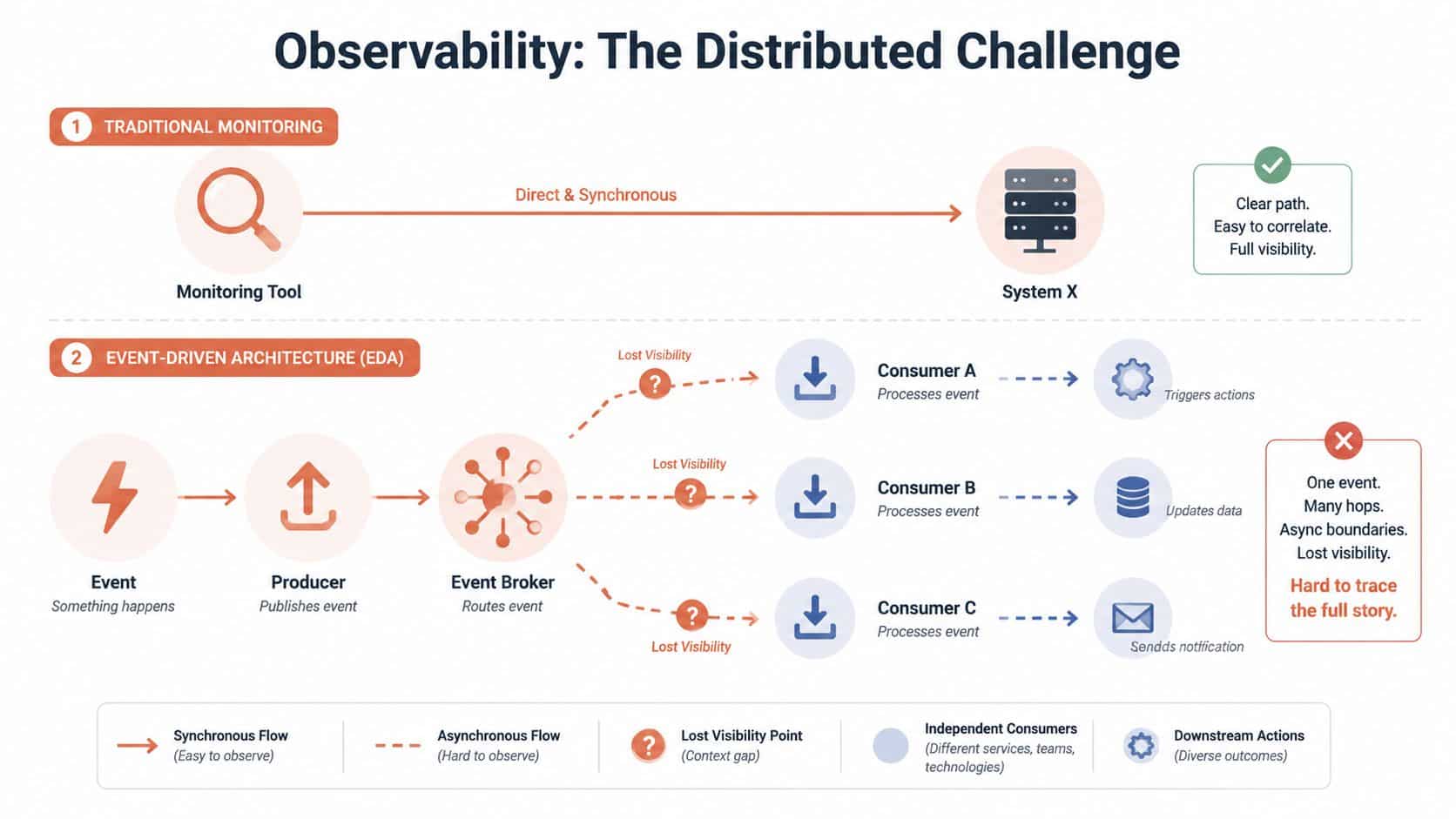
Traditional monitoring stops being enough
In a monolith or a mostly synchronous application, it's often possible to trace a request through a narrow path. In an asynchronous system, one business action can produce a cascade of events across many services, queues, and data stores.
That's why observability has to be designed into the system. According to Three Dots Labs on EDA reliability and the outbox pattern, observability is the critical technical prerequisite for maintaining reliability in event-driven systems, because debugging asynchronous distributed systems without tracing, correlation IDs, and structured logs is statistically nearly impossible. The same source states that the outbox pattern is the only safe mechanism to publish events without data loss.
What has to be in place from the start
A workable observability baseline for EDA includes a few essential elements:
- Distributed tracing so engineers can follow an event path across services.
- Correlation IDs so a single business transaction can be connected end to end.
- Structured logs so machines and humans can query the same records reliably.
- Outbox-based publishing so state changes and event publication stay consistent.
Without those, you aren't operating an event-driven system. You're operating a black box.
Retrofitting observability into a decoupled system is substantially more difficult than building it in.
That wording comes from Microsoft's guidance on event-driven architecture, and it matches what most senior teams learn the hard way. Once services are already in production, adding correlation IDs consistently across producers, brokers, and consumers becomes painful.
Tooling matters, but workflow matters more
Teams often jump straight to dashboard tooling. Kibana, Grafana, OpenSearch, cloud-native monitors, and tracing back ends all have a place. If you're weighing interface trade-offs, this comparison of deciding on an observability front end is a useful practical read.
Still, better charts won't rescue missing instrumentation.
What works is a disciplined workflow:
- Generate a correlation ID at the system edge.
- Carry it through every event and consumer hop.
- Log in structured form with event type, source, and processing outcome.
- Trace publish and consume latency.
- Fail safely when publish and persistence could diverge.
If release quality is already uneven, this becomes even more important. Reducing breakage upstream saves pain downstream, which is why reducing deployment failures belongs in the same conversation as observability.
The harsh truth is simple. Failure in event driven architecture isn't typically due to a lack of understanding of producers and consumers. It's because the system's behavior under stress remains opaque.
From Monolith to Modern A Practical Migration Path
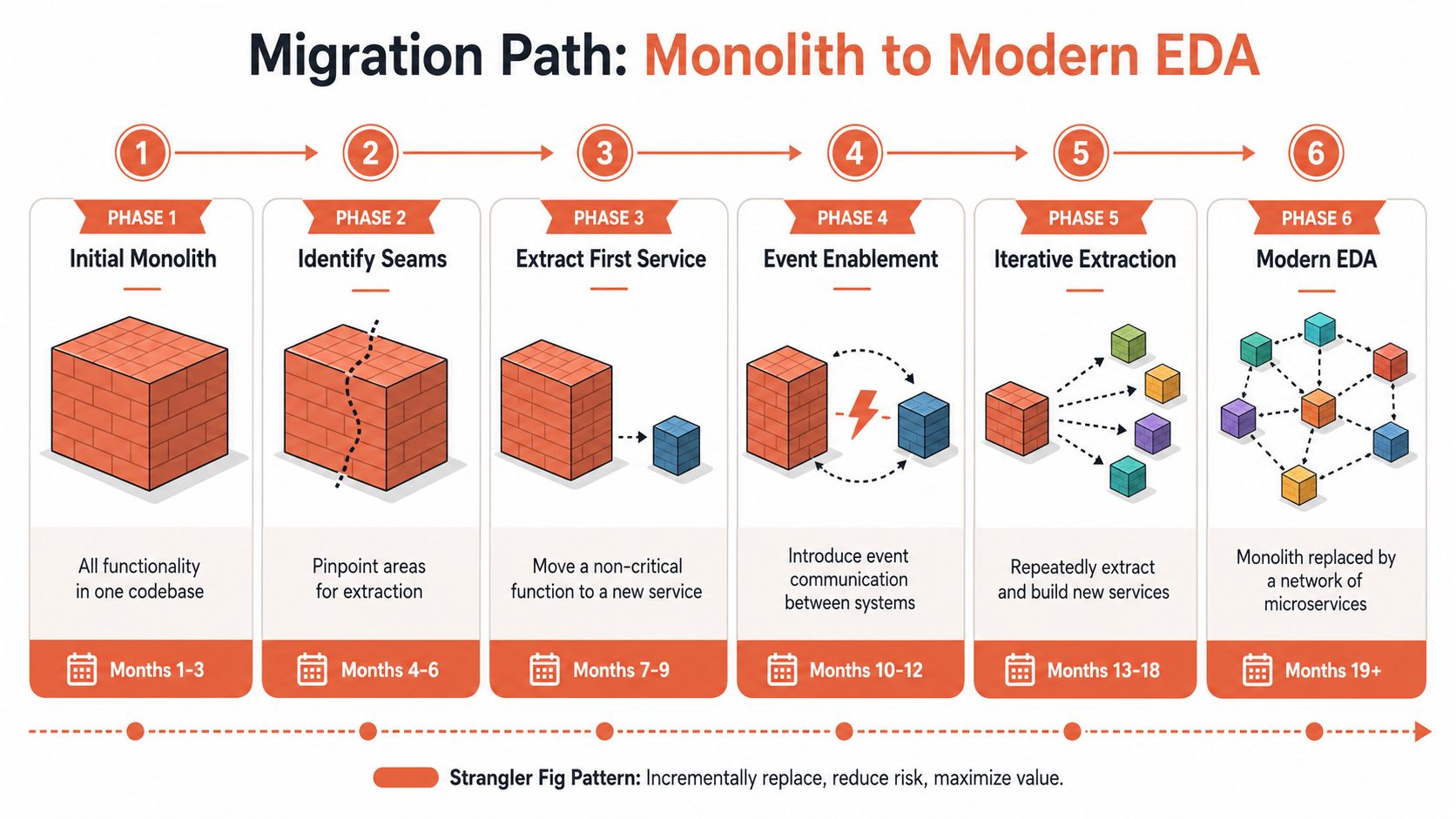
A full rewrite is usually the worst way to move toward event driven architecture. It concentrates risk, delays learning, and creates a long period where engineers are rebuilding instead of shipping.
A better path is incremental extraction.
Start with seams, not slogans
The Strangler Fig approach works because it respects the reality of running a live product. Identify a clear seam in the monolith. Choose a bounded capability with manageable dependencies. Extract that first, keep the blast radius controlled, and introduce event-based integration where it gives a real advantage.
Good early candidates are usually functions that already have natural boundaries, such as notifications, audit trails, search indexing, or asynchronous reporting. Poor early candidates are often the most business-critical transactional flows, where the organisation hasn't yet built confidence in its observability and release discipline.
Governance needs to arrive early
Migration isn't only about extracting code. It's also about putting contracts and standards in place before event volume and service count grow.
That includes:
- Schema governance so event formats stay stable and changes are deliberate.
- Versioning rules so producers and consumers can evolve safely.
- Access control so teams know who can publish or consume each event.
- API and event contracts that developers can test before runtime.
Open standards prove helpful. The open-source standards overview from Boyney says the CloudEvents specification provides a standardized format for event data that achieves 99.9% interoperability, and that AsyncAPI serves as the industry standard for defining asynchronous APIs, preventing 85% of runtime integration errors in event-driven microservices. Even if you don't adopt every part of those standards immediately, using them as governance anchors reduces chaos.
Domain boundaries matter just as much as transport choices. If you're carving a monolith apart, this guide to domain-driven design is useful because it keeps the migration focused on business boundaries instead of technical fashion.
The pragmatic target state
The goal isn't to eliminate the monolith overnight. The goal is to reduce coupling, improve deployment independence, and introduce event-driven behaviour where it creates business and engineering value.
That requires restraint. Extract too slowly and the monolith keeps dominating every release. Extract too aggressively and you create distributed complexity the team can't yet operate.
The right migration path is usually the one that improves delivery while tightening operational discipline at the same time.
If your team is spending more time stitching together Kubernetes, CI/CD, monitoring, security policies, and cost controls than shipping product, that's a platform problem, not a hiring problem. PushOps gives software teams a production-ready multi-cloud DevOps platform across AWS, GCP, and Azure, with deployments, environments, observability, security, and cost optimisation built in. Instead of building your own internal platform to support event-driven systems, you can adopt one that lets engineers focus on features, reliability, and release speed.

