
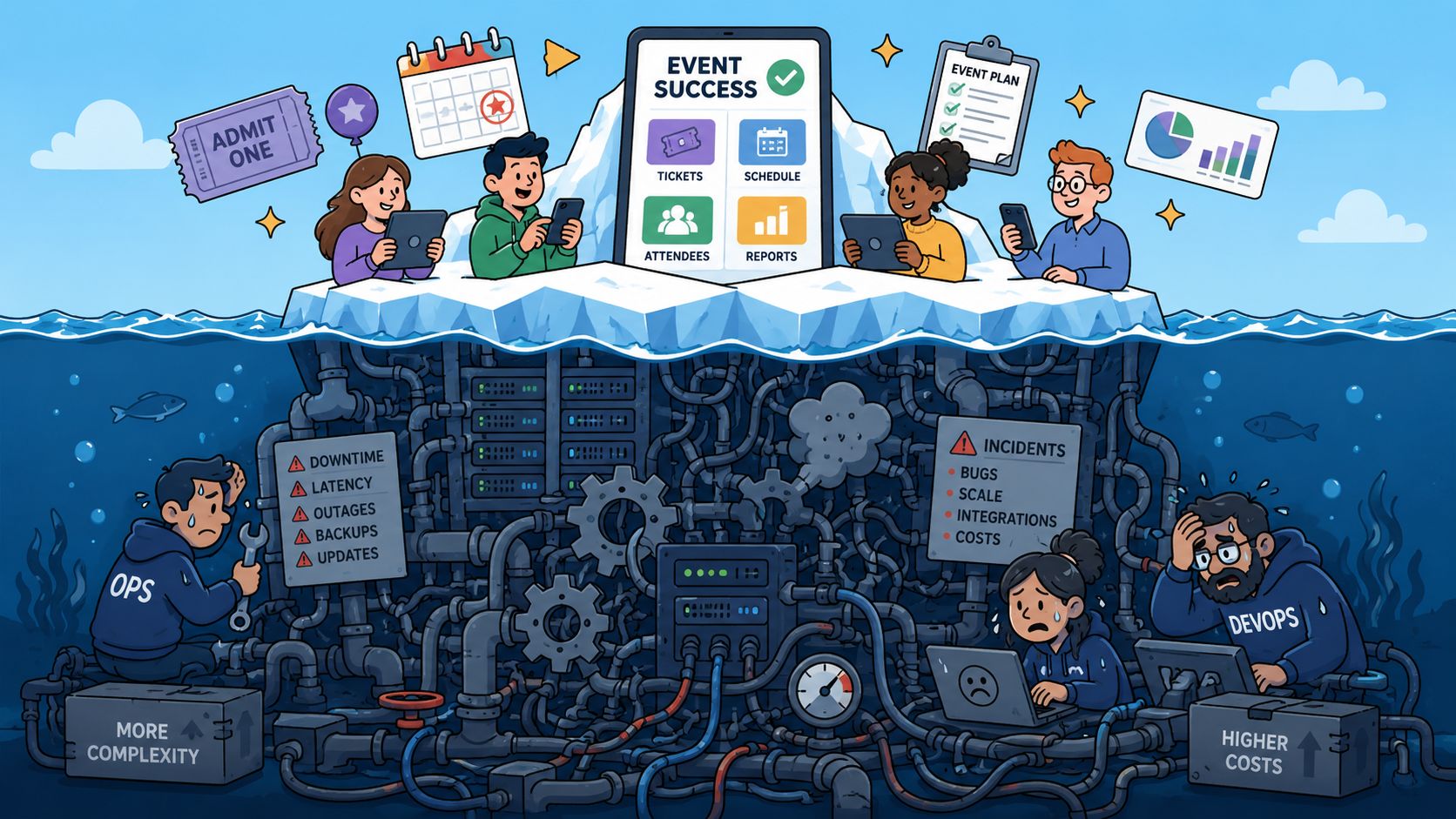

Your product team thinks it's building event management software. In practice, it often ends up building an event application plus a private cloud platform, a release system, a monitoring estate, a security programme, and a cost-control layer. That second part is where schedules slip.
This happens a lot in startups and scale-ups across Europe, Singapore, the UK, and the US. A conference platform, partner summit portal, hybrid event app, or internal event operations system looks like a straightforward product brief. Then the engineering reality shows up. Registration spikes hit all at once. Streaming has to work under pressure. Payment flows need tighter controls. Compliance questions arrive late and urgently. Someone asks for AWS today, Azure next quarter, and maybe GCP for a new region.
If you're a CTO or VP Engineering, the strategic mistake isn't choosing build over buy. It's assuming the only thing you're building is the product.
The Event Software Mandate Build vs Buy Is the Wrong Question
A common boardroom instruction sounds simple enough. Off-the-shelf event management software doesn't fit your workflow, your product data, or your brand, so build your own. That can be the right product decision. It's often the wrong infrastructure decision.
The category is large enough that more companies are tempted to create custom solutions for their own needs. The market is projected to reach USD 38.96 billion by 2032, growing at a CAGR of 14.28% according to Research and Markets' event management software market outlook. That kind of growth encourages teams to think there's room for one more custom-built platform. Sometimes there is.
Build the application, not the operating burden
The mistake is framing the decision as a pure build-versus-buy debate. For engineering leadership, the actual split is different:
| Decision path | What you actually sign up for |
|---|---|
| Build the product | Registration flows, attendee data models, agenda logic, sponsor tools, integrations, analytics, mobile experiences |
| Build the universe it runs on | Kubernetes operations, CI/CD, observability, secrets, compliance controls, cost governance, scaling logic, incident response |
That second column is where strong teams lose focus. Kubernetes rarely gives you competitive advantage for an event product. Neither does hand-rolled release orchestration. Neither does spending senior engineering time stitching together monitoring, alerting, logging, role-based access, and cloud cost policies.
Practical rule: If the work won't make the attendee, organiser, or sponsor experience better, it probably belongs in platform infrastructure, not your product roadmap.
Streaming-heavy event platforms make this especially obvious. Video workflows add transcoding, media pipelines, storage, delivery, and operational complexity on top of normal application concerns. The trade-offs are similar to the ones described in RenderIO's FFmpeg hosting analysis, where self-managing the media layer can inadvertently become an engineering commitment of its own.
What CTOs should optimise for
Most startups don't need maximum customisation of infrastructure. They need reliable, production-ready delivery so developers can ship event features without babysitting plumbing.
That means the better question is this: can your team build differentiated event functionality while relying on a managed, multi-cloud DevOps foundation for setup, scaling, monitoring, security, and spend control across AWS, GCP, and Azure?
When teams answer that truthfully, the product roadmap usually gets cleaner. You still build what matters. You stop rebuilding the commodity layers around it.
Deconstructing the Modern Event Platform Stack
Before you estimate headcount or promise a launch date, define the actual stack. Modern event management software is not one web app. It's a system of tightly coupled services with different operational profiles, security requirements, and failure modes.
This visual helps frame the architecture at a glance.
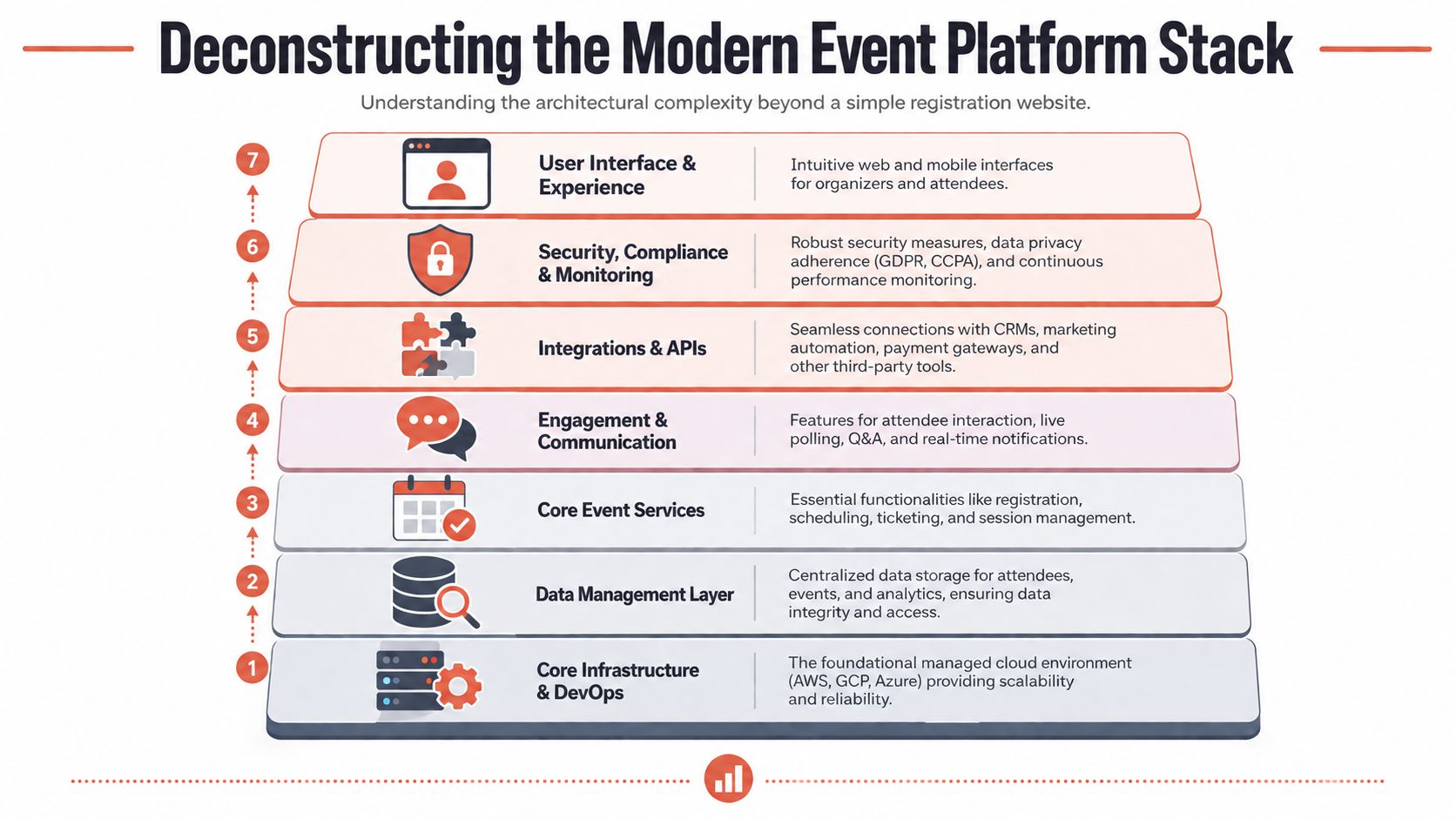
According to InEvent's breakdown of enterprise event management software features, enterprise platforms in 2026 must natively support eight core categories: registration and ticketing, event website and marketing, onsite check-in, attendee engagement and mobile app, hybrid and virtual streaming, networking, sponsor management, and analytics with CRM integration, while also meeting requirements such as SOC 2 Type II and GDPR.
The application scope is already broad
If you translate those categories into engineering work, you're looking at something like this:
- Registration and ticketing: Form builders, pricing rules, payment handling, confirmation flows, edge-case validation, and traffic surges when launches open.
- Event website and marketing: CMS-like page management, campaign attribution, branded assets, lead capture, and localisation concerns.
- Onsite check-in: Fast read and write paths, badge workflows, offline tolerance, device compatibility, and operational support at the venue.
- Engagement and mobile: Agenda sync, session updates, notifications, Q&A, and real-time interaction patterns.
- Hybrid and virtual streaming: Session orchestration, stream resilience, recording, fallback behaviour, and support workflows when live content fails.
- Networking and sponsor tools: Profiles, permissions, matchmaking logic, sponsor assets, lead workflows, and exhibitor administration.
- Analytics and CRM integration: Event telemetry, reporting models, sync reliability, field mapping, and auditability.
That list still understates the operational detail. Every module has its own traffic pattern. Ticket launch peaks are different from streaming concurrency. Sponsor dashboards create a different support burden than attendee mobile experiences.
The non-functional scope is where most estimates break
The harder work sits underneath. Event platforms handling payments and personal data need secure registration and authentication, event creation and agenda management, embedded streaming, engagement tooling, plus rigorous load testing, security audits, vulnerability assessments, browser and device validation, and post-launch monitoring, as described in Digital Samba's guide to event software development.
A useful way to think about the stack is by responsibility, not features:
| Layer | What your team has to own if it's DIY |
|---|---|
| User experience | Web app, mobile app, organiser console, attendee journeys |
| Domain services | Registration, schedules, sponsors, networking, analytics |
| Integrations | CRM, payment systems, identity, marketing tools |
| Data layer | Transactional data, reporting stores, retention policies |
| Security and compliance | Access control, encryption, auditability, policy enforcement |
| Operations | Builds, deployments, monitoring, rollbacks, incident handling |
| Cloud foundation | Runtime setup, scaling, networking, backups, cost controls |
Enterprise event software fails less often because of a missing feature than because one of these layers was under-built or owned by the wrong team.
For CTOs, this is the uncomfortable truth. The feature brief may be reasonable. The full stack obligation often isn't, especially if your engineers also need to keep shipping core product work.
The Hidden DevOps Tax of DIY Infrastructure
The moment your team decides to run the platform itself, you create a second factory. The first one produces event software. The second one produces deployment scripts, cluster policies, dashboards, alerts, secrets handling, cost reports, patch cycles, and recovery procedures.
That hidden factory consumes senior talent fast.
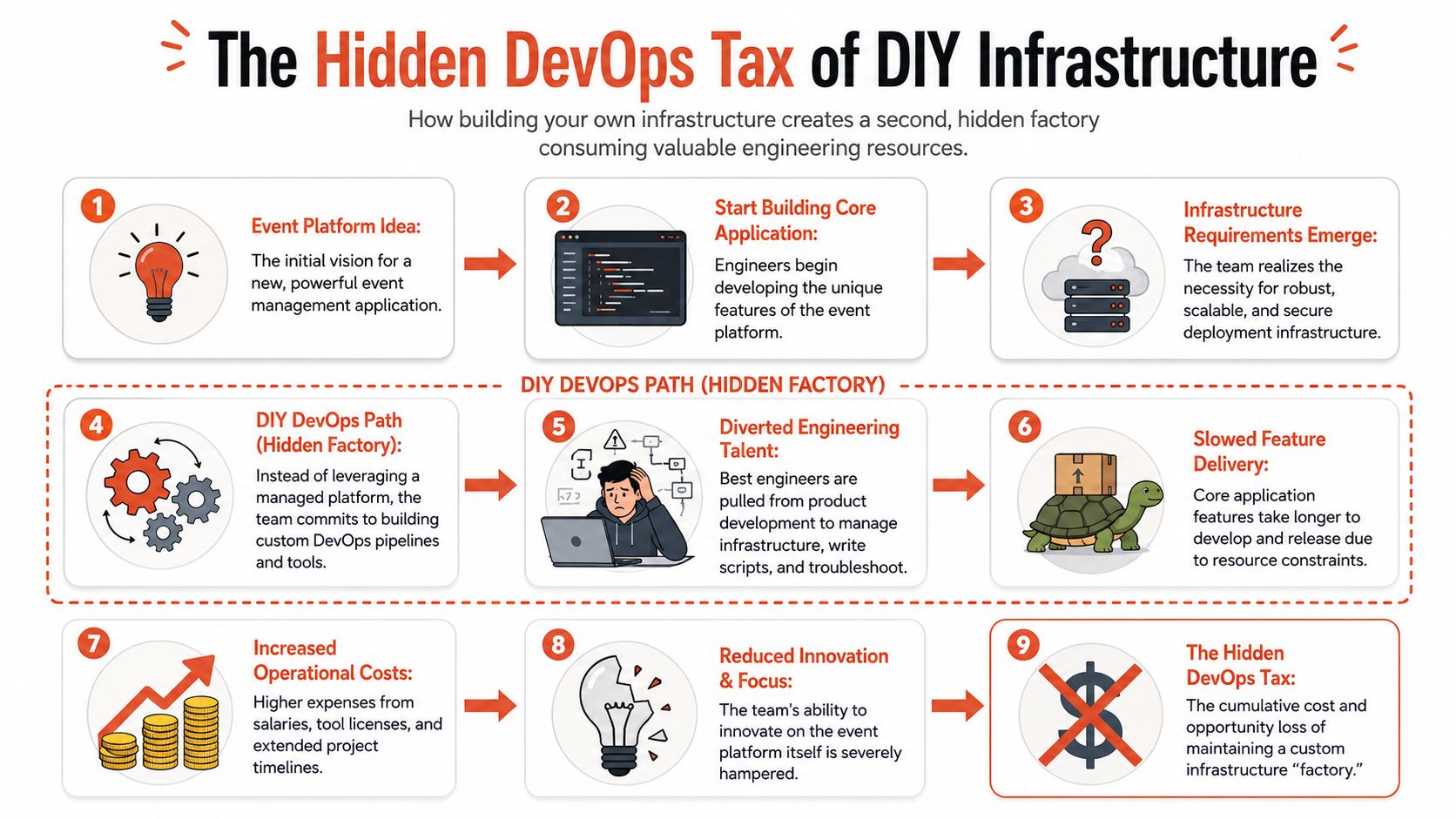
The broad productivity drag is not hypothetical. Developers waste 40% of their time on manual deployment tasks and infrastructure maintenance, costing companies $1 trillion annually in lost productivity globally, according to Ellty's analysis of DevOps inefficiency.
Where the tax shows up first
You usually see it in five places.
- Release management gets fragile: CI/CD starts as a few scripts, then turns into a critical system that only two engineers understand.
- Kubernetes becomes a side business: The cluster needs upgrades, policy decisions, ingress tuning, secret rotation, and debugging under load.
- Monitoring sprawls: Logs live in one tool, metrics in another, alerts in a third, and nobody trusts the signal quality.
- Security becomes reactive: Compliance controls arrive as tickets after architecture choices were already made.
- Cloud costs drift: Test environments stay on too long, oversized services become normal, and no one wants to touch the deployment logic that controls scaling.
A lot of teams respond by hiring more operations talent. Sometimes that's justified. Often it just formalises the overhead rather than removing it.
Why event workloads magnify operational pain
Event management software creates awkward demand curves. Registration deadlines can compress load. Launch windows can spike traffic sharply. Hybrid and virtual sessions add sustained pressure in a different pattern. Organiser tools must remain stable while public traffic changes quickly.
That means your DevOps burden isn't just “run a web app”. It's more like this:
- Build a resilient release path.
- Provision environments consistently across cloud accounts.
- Enforce access and permission boundaries.
- Instrument application and infrastructure health.
- Create rollback and recovery paths.
- Keep costs understandable while usage shifts.
Each of those steps looks manageable in isolation. Together, they become a permanent tax on delivery velocity.
The most expensive infrastructure isn't the line item on your cloud bill. It's the salary cost of your best engineers solving solved problems.
There's also a compounding effect on team design. New hires need to learn your bespoke deployment model. Platform knowledge concentrates in a few people. Internal tooling gets just good enough to be depended on, but not robust enough to disappear into the background.
The false economy of internal platforms
Engineering leaders often justify DIY infrastructure because it appears to preserve control. In practice, many teams end up with a brittle internal developer platform that lacks the reliability, documentation, guardrails, and polish of a mature managed service.
A better framing is to ask whether your company should own the undifferentiated parts at all. If your developers are spending too much time on that hidden factory, guidance like PushOps' explainer on how to reduce DevOps overhead is useful because it forces the core question. Which parts of your stack are strategic, and which parts are just expensive to maintain?
Here's the practical trade-off:
| DIY approach | Managed platform approach |
|---|---|
| High control over every layer | High control over application delivery and policy, less toil on foundation work |
| Slow setup and ongoing maintenance | Faster setup with standardised workflows |
| Knowledge trapped in scripts and tribal memory | Knowledge captured in productised workflows |
| Security and cost controls assembled manually | Security and cost controls built into the operating model |
The hidden DevOps tax isn't a one-time mistake. It renews every sprint.
Reclaiming Focus with a Managed DevOps Platform
The cleanest way out is to stop treating infrastructure assembly as core product work. A managed DevOps platform gives your team a production-ready foundation and lets developers work through a standard path from commit to deployment without handcrafting the machinery underneath.
That matters most when your stack has to span AWS, GCP, and Azure, because the complexity is not just technical. It's organisational. Teams need consistent deployment behaviour, observability, security controls, and cost discipline across environments that were not designed to feel uniform by default.
This is what the operating layer should feel like in practice.
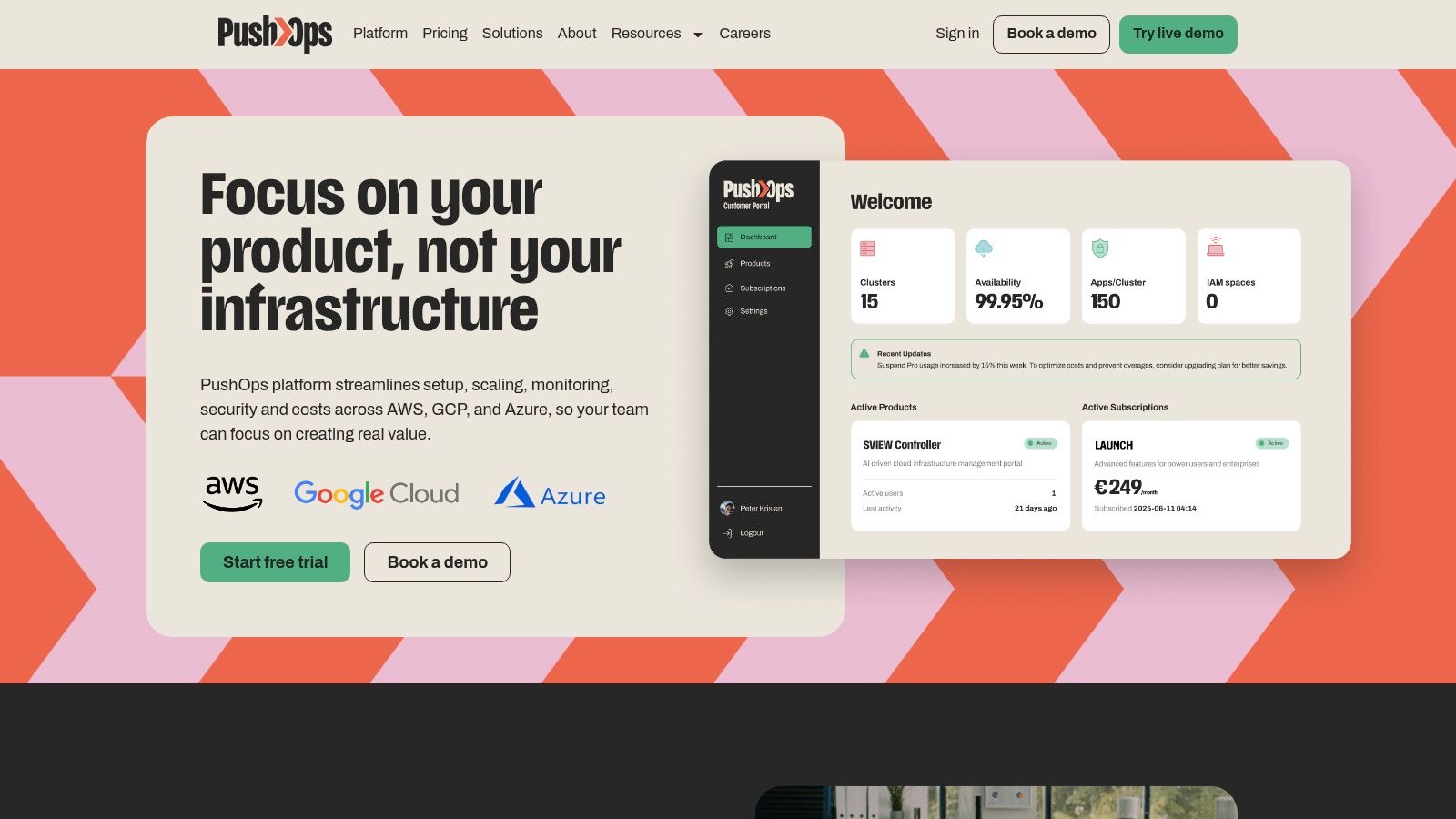
What gets abstracted away
A strong platform does not remove engineering choice. It removes repetitive engineering labour.
Instead of assembling a home-grown estate, your team gets:
- Provisioned environments: Production-ready foundations on the cloud provider you need.
- Automated delivery: Builds, deployments, and release workflows without constant pipeline maintenance.
- Integrated observability: Health metrics, incidents, and performance signals visible in one operational flow.
- Security by default: Role-based access, permissions, auditability, and standardised controls.
- Cloud cost discipline: Autoscaling, right-sizing, and environment scheduling without every squad inventing its own method.
That's a much better match for event management software teams. Your developers should be making registration logic simpler, organiser workflows clearer, and attendee experiences more reliable. They shouldn't be debugging a bespoke deployment layer before lunch.
Why this changes team behaviour
Managed platforms also improve the day-to-day ergonomics of engineering. When developers trust the path to production, they ship smaller changes more often. When preview and environment workflows are standardised, product and design teams can review faster. When observability comes integrated, incidents become easier to triage because teams aren't jumping between disconnected tools.
Operational advice: Standardise the path to production before you scale the engineering team. Otherwise each new squad creates its own local version of DevOps.
The result isn't less serious engineering. It's better allocation of serious engineering. If you want a useful primer on what this model looks like at the infrastructure layer, this overview of a DevOps cloud infrastructure platform captures the core shift well: stop building plumbing from scratch when you can build product on top of a prepared foundation.
For CTOs, that's the strategic move. Keep product ownership. Drop the infrastructure hobby.
How a Platform Accelerates Event Software Delivery
The benefits become obvious when you look at delivery scenarios rather than architecture diagrams. Event management software has moments where failure is very public. That's why teams need a platform approach that reduces launch risk while keeping development speed high.
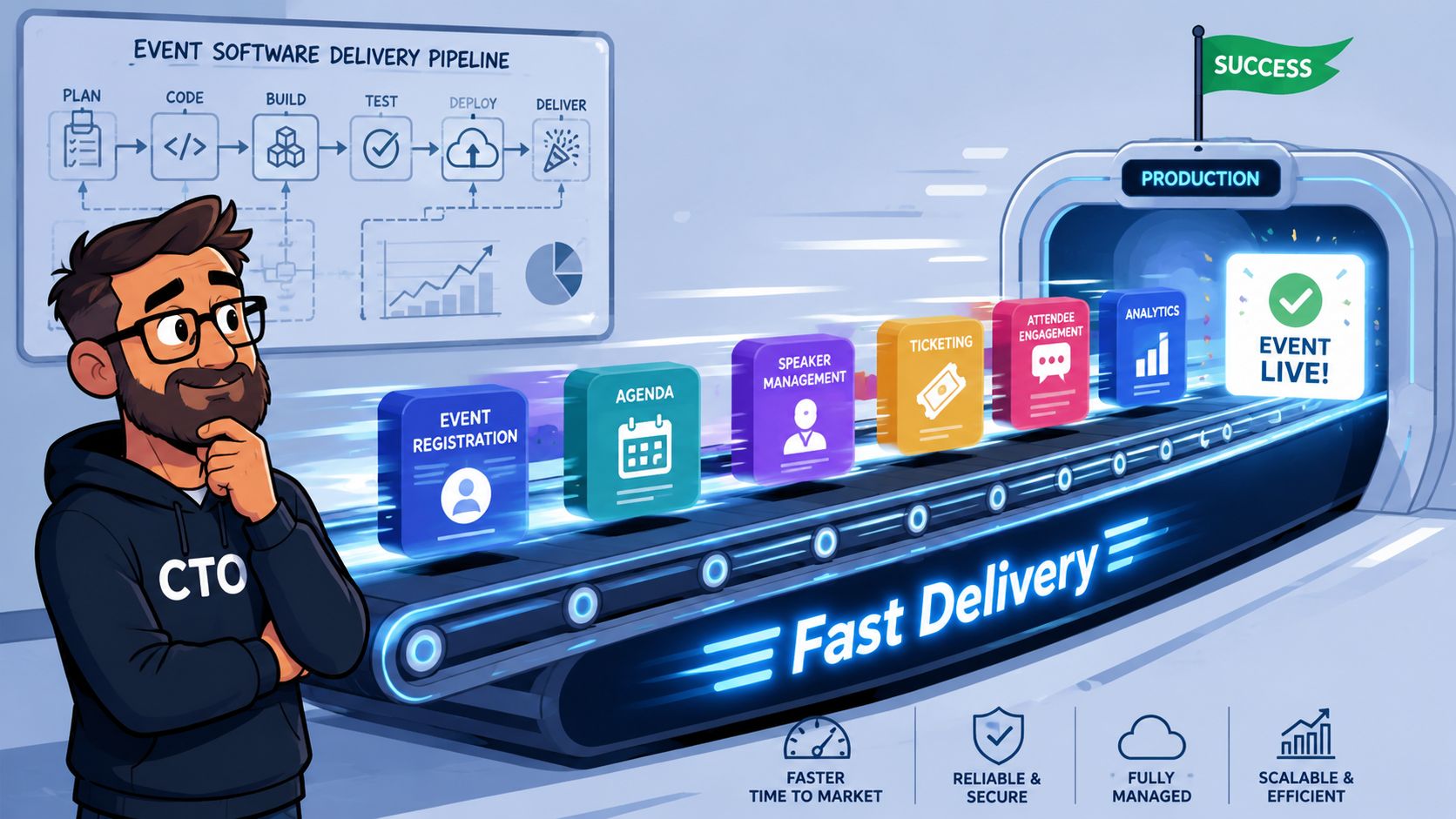
In Europe, engineering organisations are already moving this way. The European DevOps market is projected to grow at a 20.5% CAGR to USD 6.8 billion by 2032, with cloud-based DevOps platforms holding over 60% of the market, according to the Europe DevOps market report. That direction fits what many CTOs have already realised operationally. Managed, multi-cloud tooling is easier to justify than endless DIY maintenance.
Scenario one: the ticket release
Your marketing team launches registration for a flagship event. Traffic jumps immediately. In a DIY setup, engineers watch dashboards, tweak scaling thresholds, and hope the release path doesn't become the outage path.
With a mature platform model, the goal is simpler. Autoscaling, deployment consistency, and baseline monitoring are already in place. Engineers stay focused on whether the registration experience is working, not whether the cluster policy is.
Scenario two: the payments service
You add paid workshops, sponsor packages, or premium access tiers. Now a portion of your system sits closer to payment and personal data concerns. Security controls can't be retrofitted politely after launch.
A platform-first setup gives the team a stronger default posture. Access controls, audit logs, controlled deployment workflows, and standardised environments reduce the chance that every service becomes its own little compliance puzzle.
Scenario three: stakeholder review on every pull request
Fast-moving product teams need previews that don't involve a Slack thread and a manually updated staging server. Product managers want to inspect registration changes. Designers want to check edge cases. Sales engineers want to demo sponsor workflows before release.
That's where standardised automation matters most. If you want a practical example of the model, zero-maintenance CI/CD pipelines are the right direction because they remove ongoing pipeline babysitting from the engineering calendar. Reviews happen sooner. Releases get smaller. Rollbacks get less dramatic.
Shipping event software quickly isn't about writing code faster. It's about removing the operational drag between a good commit and a safe release.
Scenario four: cloud choice stops being a migration crisis
Many scale-ups don't stay on one provider forever. Regional needs, existing enterprise contracts, or compliance preferences can push teams across AWS, GCP, and Azure over time.
If your deployment model is tightly coupled to a home-grown setup, every cloud decision becomes a mini replatforming exercise. With a modern managed approach, the cloud layer is still important, but it stops dictating how every team works day to day. That is the acceleration. Less rework. Less bespoke tooling. More product shipped.
Your Strategic Choice Build Features Not Plumbing
Technology leaders don't win by owning the most infrastructure. They win by directing scarce engineering time towards the parts of the product customers notice.
That matters in event management software because the product surface is already demanding. Registration, check-in, attendee engagement, streaming, networking, sponsor tooling, and analytics create enough engineering work on their own. Adding a self-managed DevOps estate on top usually weakens the roadmap rather than strengthening it.
The better use of engineering time
The strategic choice is straightforward:
- Use engineers for differentiation: attendee experience, organiser workflows, data integrations, reliability where users feel it.
- Reduce undifferentiated toil: cloud setup, deployment maintenance, monitoring assembly, security plumbing, cost-control scripts.
That pattern shows up beyond events too. Operational software in adjacent categories often becomes more valuable when teams stop custom-building every back-office layer. A useful parallel is in SendPhoto insights on studio tools, where the strongest systems are the ones that help operators run the business without adding unnecessary technical burden.
Your platform strategy should make product development easier every quarter. If it becomes a permanent internal project, it's failed its job.
If you're leading a startup or scale-up, don't ask whether your team can build event management software. Ask whether the same team should also maintain the full DevOps machine around it. In most cases, the answer is no.
Use the team you have to build the product your market will remember.
If your team is spending too much time on infrastructure instead of shipping product, PushOps is worth a look. It gives engineering teams a production-ready path on AWS, GCP, and Azure with automated deployments, integrated observability, built-in security controls, and cloud cost optimisation, so developers can focus on event software features rather than maintaining the platform underneath them.

