
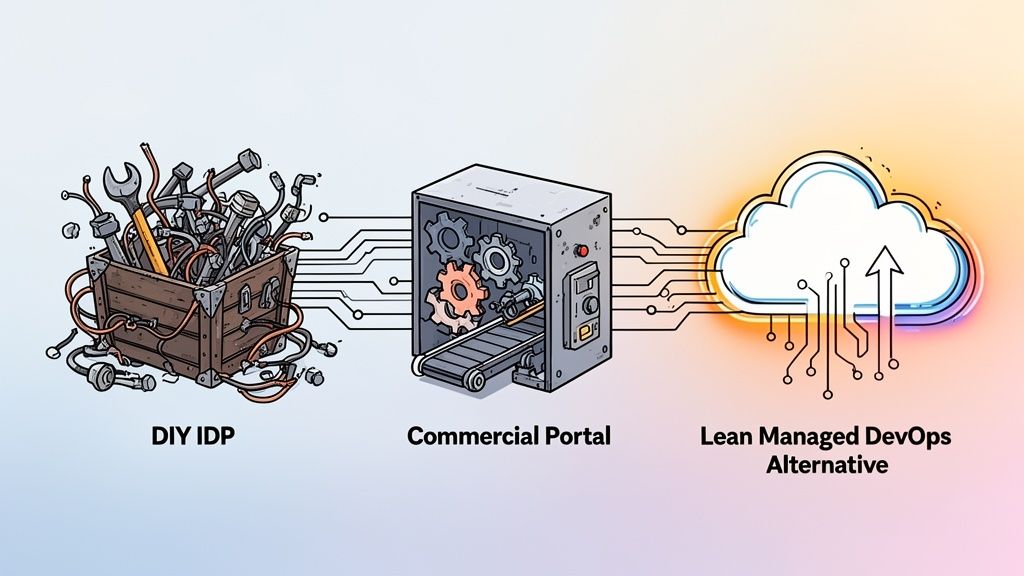

Looking for an internal developer portal alternative? For most engineering teams, this means ditching a resource-draining, self-built system for a managed DevOps platform. As a CTO or VP of Engineering, you know the goal: empower your developers with the self-service they need without the crippling overhead. This is about freeing your best people to ship features that drive revenue, not manage infrastructure.
The True Cost of Your Internal Developer Portal
For engineering leaders at startups and scale-ups, the idea of an Internal Developer Portal (IDP) is incredibly appealing. It promises a world of self-service bliss where developers can spin up resources, check on services, and manage their apps all on their own. But for too many teams across Europe, Singapore, the UK, and the US, that promise often crumbles into a resource-intensive nightmare.
The initial draw, particularly with open-source frameworks like Backstage, is the idea of a "free" or cheap entry point. Don't be fooled. The real cost of an IDP has little to do with software licenses. It’s a story told in hidden expenses that quietly drain your budget and kill your team's momentum. Most teams over-invest in building and maintaining their own DevOps stack—Kubernetes, CI/CD, monitoring, security, and cost control—when what they really want is a reliable, production-ready platform to build on.
The Hidden Financial Drain of DIY Platforms
The biggest line item isn't software—it's salaries. A DIY portal isn't a tool you just set up and forget. It's a complex internal product that demands its own dedicated platform team. For an organization with around 300 developers, you're likely looking at a team of seven to fifteen engineers just to build and maintain a functional portal.
That creates a massive financial burden and a significant opportunity cost.
- Platform Team Salaries: You'll find yourself hiring expensive DevOps and full-stack engineers not to build your core product, but to build an internal tool. This can easily run you over $1,000,000 per year in salaries alone.
- Developer Time Lost: A clunky or poorly designed IDP quickly becomes a bottleneck. Every hour your developers spend wrestling with a confusing interface or waiting for the platform team to fix a broken plugin is an hour of lost productivity.
- Opportunity Cost: Your best engineers—the ones you hired to build a competitive edge—end up bogged down integrating CI/CD tools and building UI components for an internal portal. Every minute they spend on infrastructure is a minute they aren't spending on features that actually make you money.
The hard truth is that most engineering teams are over-investing in their DevOps stack. We talk more about how to break free from this cycle in our guide to developer platform automation.
The vendor-agnostic community at www.internaldeveloperplatform.org puts the IDP's true cost of ownership at roughly $150,000 per 20 developers. It’s a stark reminder that what looks free on the surface often carries the heaviest price tag.
The Problem with Commercial IDPs and Homegrown Solutions
While jumping on a commercial IDP might cut down the initial build time, it doesn’t eliminate the core problems. You still need a team to handle integration, configuration, and ongoing maintenance. On the other hand, homegrown solutions—often a fragile patchwork of scripts and open-source tools—are a nightmare to scale and maintain.
This is exactly why a modern internal developer portal alternative has become so important. Instead of building or buying a portal, a managed DevOps platform gives you a production-ready foundation as a service. It abstracts away the headaches of Kubernetes, multi-cloud deployments across AWS, GCP, and Azure, and security, letting you achieve operational excellence without the crushing overhead.
Comparing IDP Options: Build vs. Buy vs. Managed Platform
When engineering leaders realize their internal developer portal is becoming more of a resource drain than a productivity booster, the path forward splits into three distinct choices. This isn't just about features; it's a strategic decision between building a custom solution, buying a commercial portal, or adopting a managed DevOps platform.
Each path carries significant implications for your budget, team structure, and overall speed.
For many startups and scale-ups, the first instinct is to build. Using an open-source framework like Backstage seems like a cost-effective way to get a tailored experience. But this road is often paved with hidden complexities and runaway costs. The "free" software quickly demands a dedicated platform team, turning your best engineers into internal tool builders instead of product innovators.
This flowchart maps out the two very different realities of running an IDP.
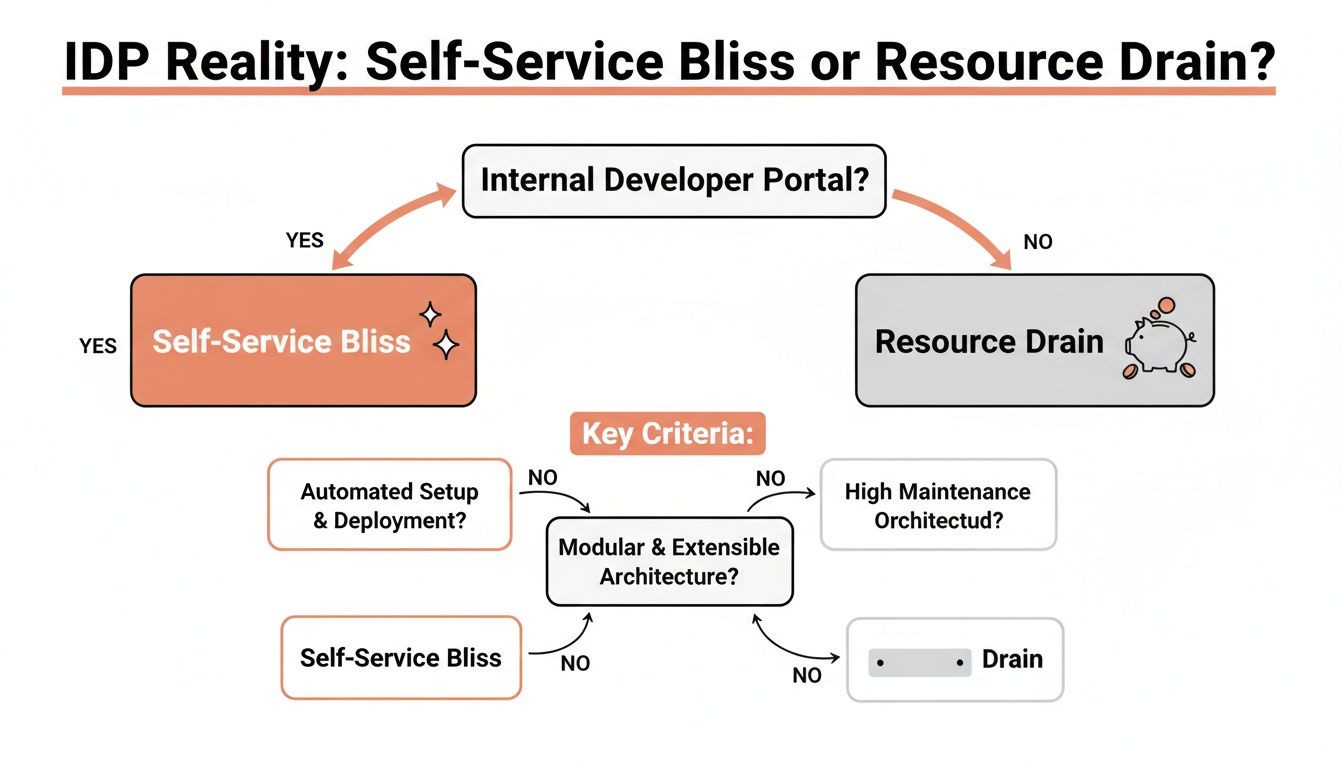
It starkly contrasts the promise of "Self-Service Bliss" with the all-too-common outcome of a "Resource Drain"—a fork in the road determined almost entirely by the platform's architecture and operational overhead.
Let's break down the three approaches to developer enablement, focusing on what really matters: total cost, time to value, and operational burden.
Strategic Comparison of IDP Alternatives
| Decision Criteria | DIY Platform (e.g., Backstage) | Commercial IDP | Managed DevOps Platform |
|---|---|---|---|
| Time to Value | Very Slow (6-12+ months) | Moderate (weeks to months) | Fast (days to weeks) |
| Total Cost | Extremely High ($1M+ annually) | High (licence fees + team cost) | Predictable (subscription-based) |
| Team Overhead | High (7-15 engineers for 300 devs) | Moderate (requires configuration) | Low (fully managed) |
| Flexibility | Maximum control, maximum work | High, within vendor constraints | High, focused on workflows |
| Core Function | Visibility and cataloguing | Visibility and scorecards | Full-stack execution & visibility |
This table highlights a critical trade-off: the initial appeal of a "free" or "buy" solution often hides a mountain of ongoing operational work and cost. A managed platform, in contrast, aims to eliminate that work entirely.
Build Your Own DIY Platform
Going the DIY route with a framework like Backstage gives you total control, but it also saddles you with total responsibility. You aren't just snapping together some plugins; you're effectively becoming a software vendor for an internal product that requires constant attention.
This approach demands serious in-house expertise in frontend (React), backend, and DevOps. Your team is on the hook for everything: plugin development, integration maintenance, handling breaking changes, and ensuring the whole thing scales. The initial build can take up to 12 months before delivering any real value, and that’s just to get started.
A common pitfall is thinking one or two engineers can manage a Backstage instance. In reality, an organization with 300 developers may need a team of 7 to 15 engineers just to build and maintain a functional portal, often costing well over a million dollars a year.
Buy a Commercial IDP
Opting for a commercial internal developer portal from vendors like Port or Cortex can definitely shorten your time-to-value. These products come with pre-built components, no-code customization, and managed integrations that cut down the initial development effort. You get a polished UI and features like service catalogues and scorecards right out of the box.
However, a commercial IDP isn't a silver bullet. While the vendor manages the core platform, your team is still responsible for configuring it, weaving it into your workflows, and managing all the underlying infrastructure it connects to.
Crucially, most commercial IDPs are just that—portals. They provide a window into your systems but don't actually perform the underlying DevOps tasks. You still need a separate, robust stack for CI/CD, Kubernetes, and monitoring for them to report on.
Adopt a Managed DevOps Platform
The third option flips the script entirely. You can choose an internal developer portal alternative that is more than just a portal—it's a complete, managed DevOps platform. This approach abstracts away not just the portal's UI, but the entire complicated infrastructure stack humming away beneath it.
A managed platform like PushOps handles everything from provisioning production-ready infrastructure on AWS, GCP, and Azure to automating builds, deployments, and monitoring. Instead of your team wrestling with Kubernetes or writing CI/CD pipelines, they get a streamlined, self-service workflow that just works. For a closer look at this model, you can learn more about what a modern DevOps cloud infrastructure platform entails.
This model delivers the "golden path" developers crave without the rigidity or maintenance nightmare of a traditional IDP. It bakes deployment, operations, and visibility into a single, cohesive system, freeing your team from the undifferentiated heavy lifting of infrastructure management. The result is a faster path to production, better reliability, and a dramatic drop in operational costs, letting your engineers get back to what they do best: shipping features.
Why a Managed Platform Is the Superior Alternative
Let's be honest, the conversation around internal developer portals often misses the entire point. The goal was never to build a pretty portal; it was to unblock your developers and get features shipped faster. A managed DevOps platform—the most effective internal developer portal alternative—actually understands this. It delivers on that original promise by shifting the focus from building tools to delivering real outcomes.
Instead of your team getting bogged down building and maintaining another complex internal system, you subscribe to a platform that handles all the operational grunt work as a finished product. This isn't just about putting a UI on top of your scripts. It's about abstracting away the entire undifferentiated workload: Kubernetes cluster management, nightmarish CI/CD pipeline configurations, multi-cloud security policies, and round-the-clock monitoring.

From Rigid Portals to Flexible Golden Paths
Traditional IDPs, even the expensive commercial ones, often just become rigid service catalogues. They show developers what services exist but do little to actually help them build, deploy, or manage those services. A managed platform provides a true "golden path" that isn't just a view—it's a fully paved road straight to production.
This means developers get a self-service workflow that just works, right out of the box, for 80-90% of what they need to do, from spinning up a new microservice to pushing a hotfix. This paved path includes:
- Automated infrastructure provisioning on AWS, GCP, or Azure.
- Pre-configured CI/CD pipelines that build, test, and deploy code automatically.
- Integrated observability with logs, metrics, and traces available from the word go.
- Built-in security guardrails and role-based access control (RBAC).
This approach frees developers from cognitive overload. At the same time, it liberates your platform engineers from the soul-crushing cycle of tool maintenance and integration firefighting.
The frustration with self-built tooling isn't just a local problem; it's a global one, felt acutely in fast-growing tech hubs. Take Lithuania, for instance. A recent survey found that while 43% of smaller software firms use IDPs, a staggering 94% are unhappy with their current self-service tools. Engineering teams in Vilnius and Kaunas report waiting an average of 1-7 days for DevOps help, with 78% experiencing delays of more than a day. In stark contrast, modern platforms that replace IDPs slash this wait time to under a day for 30% of users through genuine self-service provisioning. These numbers echo global stats where some teams see deployment times drop by 65%. You can read the full research on the state of internal developer portals to see just how widespread these challenges are.
Achieving Production-Readiness in Minutes, Not Months
The single biggest differentiator of a managed platform is speed to value. Building a decent internal platform can take months, or even years, of dedicated engineering effort before it delivers any real return. With a managed alternative, you're production-ready almost immediately.
Your team subscribes to operational excellence instead of trying to build it from scratch. This means you inherit a platform built on industry best practices for security, scalability, and cost management from day one.
Instead of trying to assemble a puzzle of disparate tools, you get a cohesive system where every component is designed to work together. This tight integration provides powerful, out-of-the-box capabilities that are incredibly difficult and expensive to replicate yourself.
- Automated Cost Optimization: The platform intelligently manages cloud resources, using autoscaling and environment scheduling to keep costs in check without manual intervention.
- Unified Observability: Developers get instant insight into application health and performance without having to configure and manage a separate monitoring stack.
- Effortless Multi-Cloud: Deploying across AWS, GCP, and Azure becomes a simple configuration choice, not a major engineering project. Our guide on automated deployments for microservices digs deeper into this streamlined process.
Ultimately, a managed DevOps platform is the superior internal developer portal alternative because it correctly identifies the problem. Your business doesn't need another internal software project to maintain. It needs a reliable, scalable, and secure way to ship code to production. By focusing on that outcome, it frees your most valuable resource—your engineers—to build the products that actually drive your business forward.
Solving Real-World Development Bottlenecks
The theory behind an internal developer portal alternative sounds great, but its true worth is measured by how it solves the daily, gritty frustrations that bring development to a standstill. As an engineering leader at a growing company, you're all too familiar with the promise of "self-service" that still leaves teams waiting days for infrastructure. You need practical fixes for real problems, not just another tool.
This is where a managed DevOps platform moves past abstract ideas to deliver concrete capabilities that directly attack these pain points. These aren't just bullet points on a feature list; they are direct answers to the question, "How does my team ship faster and more reliably without hiring an army of DevOps engineers?"
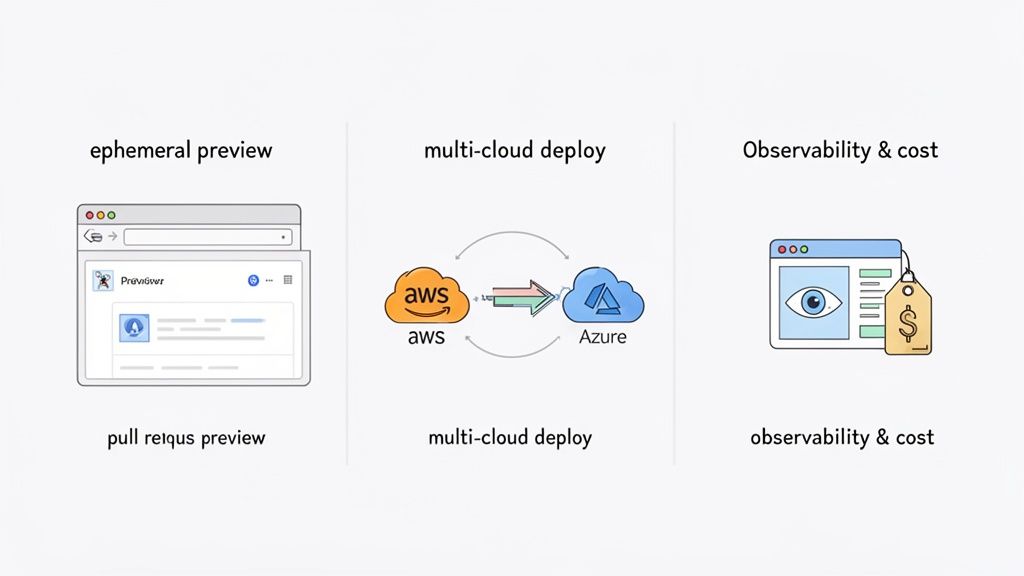
Let’s dig into three critical scenarios where this approach truly shines, turning development friction into a smooth, operational flow.
Instant Preview Environments for Every Pull Request
One of the most common complaints I hear is about the painfully long feedback loop between writing code and actually seeing it run. Developers push a change and then join a queue for a shared staging environment. It’s slow, often breaks due to conflicts, and kills any hope of rapid iteration. This is a massive productivity killer.
A managed platform completely flips this on its head. By integrating directly with your source control, like GitHub or GitLab, it automatically spins up a complete, isolated, and temporary preview environment for every single pull request.
This means anyone—a developer, a product manager, or a QA engineer—can click a link in the PR and see the proposed changes live in a fully functional environment. Once the PR is merged, the environment is automatically destroyed, which keeps resource costs down. This single feature knocks out several problems at once:
- Eliminates Staging Bottlenecks: No more waiting for a slot on the shared
stagingserver. - Accelerates Code Reviews: Reviewers can test functionality directly instead of just reading code.
- Improves Quality: Bugs get caught much earlier in the development cycle, long before they can touch production.
This capability alone is a game-changer for developer experience, wiping out a major source of daily frustration and mental overhead.
Automated Multi-Cloud Deployments Without the Custom Scripts
For scale-ups operating across Europe, Singapore, the UK, and the US, a multi-cloud strategy isn't a luxury—it's often a requirement for compliance, performance, or redundancy. But deploying consistently across AWS, GCP, and Azure is notoriously complex. It usually devolves into maintaining a tangled mess of fragile, provider-specific deployment scripts.
A managed DevOps platform abstracts this entire nightmare away. It treats different cloud providers as simple deployment targets, letting your team deploy to any region on any supported cloud with a quick configuration change, not a massive re-engineering project.
The platform deals with the provider-specific APIs, networking, and IAM roles under the hood. Your developers just define what their application needs, and the platform makes sure it runs correctly, whether it's on an EKS cluster in London or a GKE cluster in Singapore. This is what makes it a powerful internal developer portal alternative—it actually executes the deployment, it doesn't just link to a wiki article telling you how to do it yourself.
Instant Visibility Into Health and Cloud Spend
One of the biggest hidden drains of a DIY DevOps setup is the complete lack of integrated visibility. Getting a clear picture of an application's health or its real cloud spend means manually stitching together data from a dozen disconnected tools for logging, metrics, and billing. This reactive, fragmented process makes troubleshooting slow and cost control feel like a guessing game.
This problem is especially sharp in rapidly growing tech hubs. Take Lithuania's software engineering scene, where a 21% AI adoption rate has created a massive need for efficient infrastructure. Yet, reports show that 78% of Lithuanian developers wait over a day just for infrastructure help. Teams that adopt modern platforms as IDP alternatives see huge improvements: some cut time spent gathering service context by 65%, while firms migrating to multi-cloud setups report 44% less redundant work. These platforms also give developers plug-and-play security features like RBAC and automated audits, provisioning secure environments in minutes. You can explore more data on how modern portals are reshaping developer workflows.
A managed platform gives you this visibility right out of the box. Since it controls the entire stack from infrastructure provisioning to application deployment, it can offer a single, unified dashboard showing:
- Real-time application health: Logs, metrics, and traces are automatically collected and linked together.
- Granular cost breakdowns: See exactly how much each service, environment, or even each pull request preview is costing you.
- Performance insights: Easily identify bottlenecks and optimise your resource allocation.
This instant, unified view gives teams the confidence to operate independently, making smart, informed decisions about performance and cost without all the usual operational drag.
Your Playbook for Migrating to a Managed Platform
Switching to a new platform, especially a full-fledged internal developer portal alternative, can feel like a massive undertaking. As a CTO or VP of Engineering, your concerns about disruption, data migration, and getting your team on board are completely valid. But moving away from a disjointed DevOps stack or a homegrown IDP that’s not cutting it doesn't have to be a painful, all-or-nothing affair.
The most successful migrations follow a phased, low-risk playbook. It’s all about delivering value right away and building momentum. Instead of a risky "big bang" switch, you start small, prove the concept works for your teams, and then expand. It’s a step-by-step process of replacing complexity with clarity.
Phase 1: Start with a Pilot Project
Your journey shouldn’t start with a company-wide mandate. Instead, pick a single, self-contained pilot project. The goal here is simple: show value quickly and smooth out any bumps in a low-stakes setting. It’s your chance to see the platform's real power without touching critical production workflows.
Find a service that's non-critical but still representative of your stack. Maybe it's a new microservice, an internal tool, or a project that's been a headache to deploy. This gives a small, agile team a chance to get their hands dirty with the platform's self-service features.
Key activities in this phase usually look like this:
- Connect Your Source Control: First, you’ll integrate your existing GitHub or GitLab repository. This is typically a quick, five-minute job.
- Deploy a Single Service: Let the pilot team push their service through the platform's automated CI/CD pipeline. They'll feel the immediate relief of not having to write or maintain another brittle deployment script.
- Gather Early Feedback: Get direct feedback from the team. Their initial wins and positive experiences will become your strongest internal case study.
Phase 2: Standardise and Expand
Once the pilot project has shown clear wins—like faster deployments, easier environment setup, and better visibility—it's time to standardise this new workflow. You can start with one specific team or a group of related services. This phase is all about codifying the "golden path" you’ve just proven.
You’ll work with the managed platform’s support team to establish best practices that fit your organisation. This could mean setting up base templates for different service types, configuring role-based access control (RBAC), or defining deployment strategies for staging and production.
This is where you see the undeniable value of a managed platform. Instead of your team spending weeks figuring out how to secure Kubernetes or optimise cloud costs across AWS, GCP, and Azure, you’re inheriting a solution where experts have already built in those best practices.
The conversation shifts from "How do we build this?" to "How do we best apply this?" This phase creates your first group of internal champions who can help bring other teams into the fold.
Phase 3: Migrate Workloads Incrementally
With a standard workflow and a growing number of internal advocates, you can start the broader migration. This should still be a gradual process, not a forced march. Encourage teams to move their services over when it makes sense for their own roadmaps, like during a major feature update or a refactoring effort.
A modern managed platform makes this easy because it’s designed for coexistence. It can integrate seamlessly with the infrastructure you already have, letting you migrate services one by one without having to tear everything down. Concerns like vendor lock-in are less of an issue, as these platforms are built on open standards and major cloud providers, ensuring your applications stay portable.
The process usually follows these steps:
- Identify the Next Batch of Services: Prioritise services that will get the biggest bang for their buck from streamlined deployments and built-in observability.
- Onboard the Next Team: Use your internal champions and the platform's documentation to guide the next team through their first deployment.
- Decommission Old Tooling: As services are successfully migrated, you can start shutting down the fragile scripts and redundant tools they replaced. This simplifies your stack and cuts down your maintenance burden.
By following this practical, phased playbook, you de-risk the entire migration. You turn a daunting project into a series of small, manageable wins. This builds a groundswell of support and ultimately leads to a more productive, reliable, and cost-effective engineering organisation.
Frequently Asked Questions About IDP Alternatives
When you're looking at alternatives to a traditional internal developer portal, you need to cut through the marketing noise and ask the tough questions. For engineering leaders in competitive markets like the UK, US, and Singapore, getting this decision right is critical. Here are the straight answers to the questions we hear most often.
Is a Managed DevOps Platform Just Another Form of Vendor Lock-in?
That’s a fair question, and one every CTO should be asking. The reality is, modern managed platforms are built to reduce lock-in, not create it. They do this by standing on the shoulders of giants—open-source standards and the world's biggest cloud providers like AWS, GCP, and Azure.
Think about it: a homegrown portal, customized down to the last detail, locks you into the niche knowledge of the few engineers who built it. A managed platform ensures your applications stay portable. The only "lock-in" you get is with higher productivity and better reliability, freeing up your engineering talent to focus on your actual product.
Can a Managed Platform Be Customised for Our Unique Workflow?
Absolutely. The goal isn't to force your team into a rigid, one-size-fits-all box. A good IDP alternative provides a "golden path" that automates the 95% of grunt work in your DevOps cycle, so your team can focus on the unique 5% that makes your workflow special.
These platforms are built with robust APIs and plenty of integration points. You can plug in your existing toolchain and script custom actions exactly where you need them. You get the huge upside of standardisation for security, monitoring, and deployment, but you don't lose the flexibility to adapt the platform to how your team already works. It strikes the right balance between governance and developer freedom.
A well-designed managed platform offers "paved roads, not gated communities." Developers get a clear path to production, but they aren't trapped. They can always go "off-road" when a project demands it.
How Does This Internal Developer Portal Alternative Handle Security?
Security isn't just a feature; it’s a core design principle and one of the biggest advantages over a DIY setup. Instead of expecting your team to be cloud security experts on top of everything else, a managed platform builds security in from day one.
This isn’t just a vague promise. It means concrete features like:
- Role-Based Access Control (RBAC): Permissions are granular, ensuring developers only get access to what they need, when they need it.
- Automated Policy Enforcement: Security and compliance rules are applied automatically to every single deployment, cutting down the risk of human error.
- Comprehensive Audit Logs: You get a clear, unchangeable record of every action, which is essential for compliance and tracking down issues.
- Continuous Security Updates: The platform is constantly patched and updated by security professionals to defend against the latest threats.
By making security the default, a managed platform drastically reduces your exposure to common cloud misconfigurations. It takes that constant, low-level anxiety about securing a complex stack off your team's plate so they can ship features confidently.
Ready to see how an internal developer portal alternative can transform your engineering team? PushOps replaces the endless complexity of DIY DevOps with a streamlined, secure, and cost-effective platform. Book a demo today and discover how you can get production-ready on AWS, GCP, or Azure in minutes, not months.

