
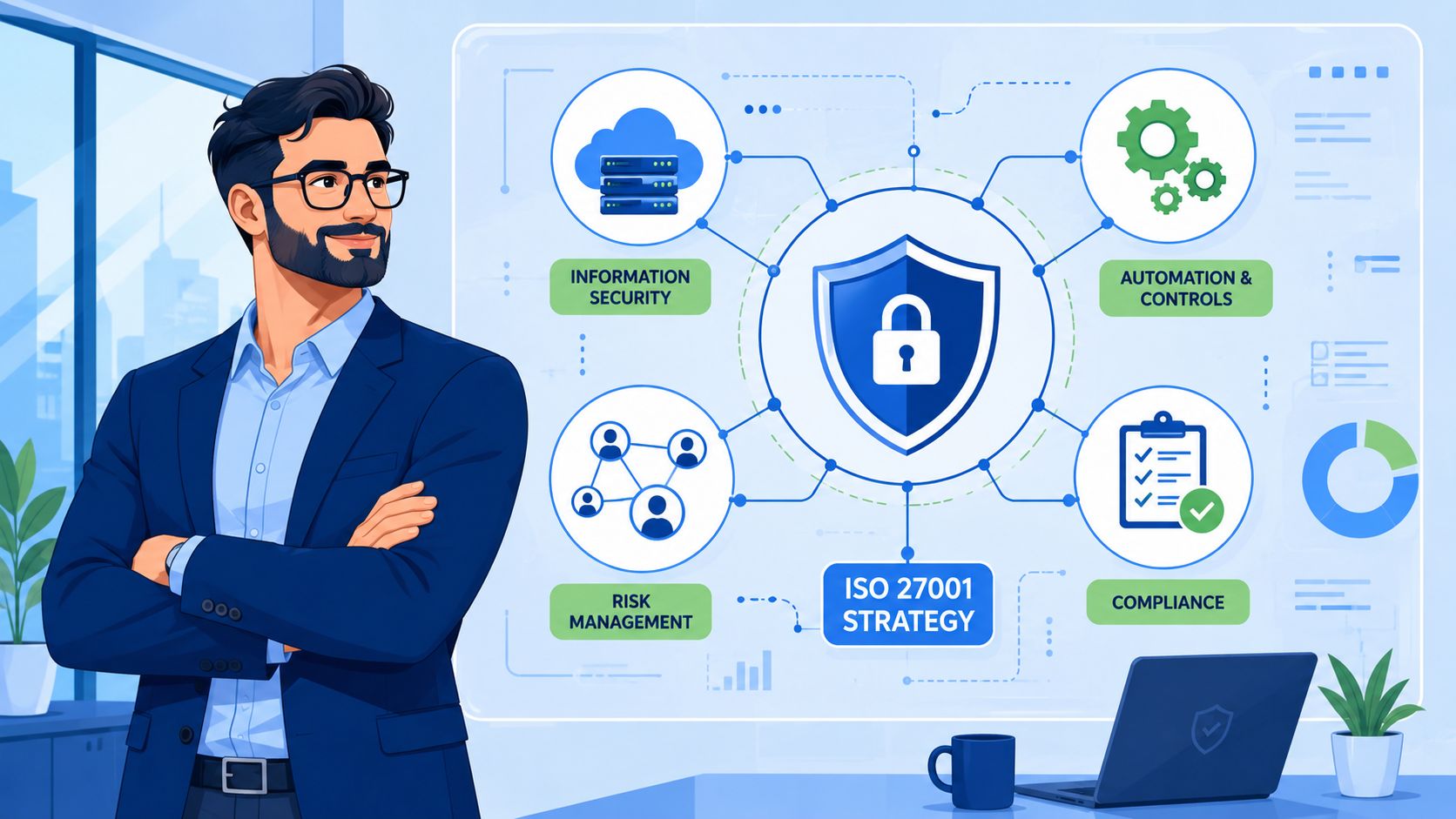

ISO 27001 lands on the CTO's desk at the worst possible moment. The team is already juggling releases, cloud costs, on-call pain, and the usual pile of security questionnaires from prospects. Now someone wants an Information Security Management System, a risk register, internal audits, policies, and evidence for controls that most engineers have never read.
That dread is understandable. Most startups don't fail at ISO 27001 because the standard is impossible. They fail because they treat it like a side project run through spreadsheets, screenshots, and heroic manual effort. Engineering ends up doing governance by night and platform work by accident.
The better approach is to treat ISO 27001 implementation as a consequence of running a disciplined engineering organisation. If your infrastructure, access model, deployment flow, logging, and change management already work in a controlled way, compliance becomes a validation exercise rather than a scramble.
Your ISO 27001 Starting Point From Dread to Strategy
Monday starts with a customer security review in the morning, a production incident after lunch, and a founder asking whether ISO 27001 can be “sorted this quarter”. That is usually the moment the work gets framed badly. Teams start hunting for policy templates and Annex A checklists before they have decided what they are trying to control.
A better starting point is operational, not administrative. ISO 27001 implementation works when the ISMS reflects how engineering already builds, ships, grants access, responds to incidents, and records changes. In startups that run a messy stack of scripts, screenshots, and tribal knowledge, certification becomes a painful manual exercise. In teams with a disciplined platform underneath, compliance is mostly proving what already happens.
Start with a boundary you can defend under pressure
The first decision is not which policy to write. It is where the system starts and stops.
For a software company, the right first scope is usually close to production. Include the environments that run customer workloads, the build and deployment path that can change them, the identity systems that grant access, and the operational processes that govern change and incident response. That gives you a scope tied to real risk and daily engineering work.
Small teams get into trouble when they define scope by aspiration. “Everything we do” sounds ambitious, but it creates a control surface nobody can explain consistently, let alone maintain. Auditors will test whether the boundary is clear. Your engineers will feel the cost long before the audit does.
Practical rule: scope the parts of the business you can govern, observe, and evidence without heroics.
Implementation timing varies a lot by team maturity. In practice, startups usually spend months getting to a certifiable state, especially if access control, change management, supplier review, and evidence collection still live in separate tools and spreadsheets. The calendar matters less than the operating model. Manual compliance drags because every control needs chasing. Platform-led compliance moves faster because the underlying controls are already enforced.
Build the operating model first
Annex A matters, but it is a poor place to begin. Control catalogues tempt teams into treating ISO 27001 as a documentation exercise. The standard is about managing information security risk in a repeatable way. That means the early work should focus on who can access what, how changes reach production, what gets logged, how incidents are handled, and where evidence will come from.
I have seen startups lose weeks writing polished policies while production access is still shared, approvals happen in Slack, and nobody can show who changed what. That effort does not reduce risk. It just creates paperwork that the platform cannot support.
This is why a modern platform changes the shape of the project. If your infrastructure patterns, identity model, CI/CD flow, audit trails, and environment baselines are already standardised, ISO 27001 stops being a separate stream of work bolted onto engineering. It becomes the visible result of good engineering discipline. A cloud infrastructure platform designed for ISO-aligned controls gives teams a cleaner starting point than another round of bespoke scripts and internal process docs.
Avoid building a compliance side job for engineers
The actual cost of ISO 27001 is rarely the audit. It is the manual work in the months before it. Someone has to collect screenshots, chase approval records, reconcile user access, update risk entries, and prove that the written process matches production reality.
If the platform does not enforce the basics, engineering becomes the enforcement layer. That is expensive, fragile, and hard to sustain after certification. The better strategy is plain. Standardise the way systems are provisioned, deployed, accessed, and monitored first. Then write the ISMS around those working controls. Compliance holds up far better when it is built on routines the team already follows.
Scoping Your ISMS Without Boiling the Ocean
On a bad ISO 27001 implementation, scoping turns into a political exercise. One founder wants the whole company in scope for credibility. Engineering wants to keep it limited because they know half the estate is undocumented. Security gets stuck in the middle trying to define a boundary nobody can operate.
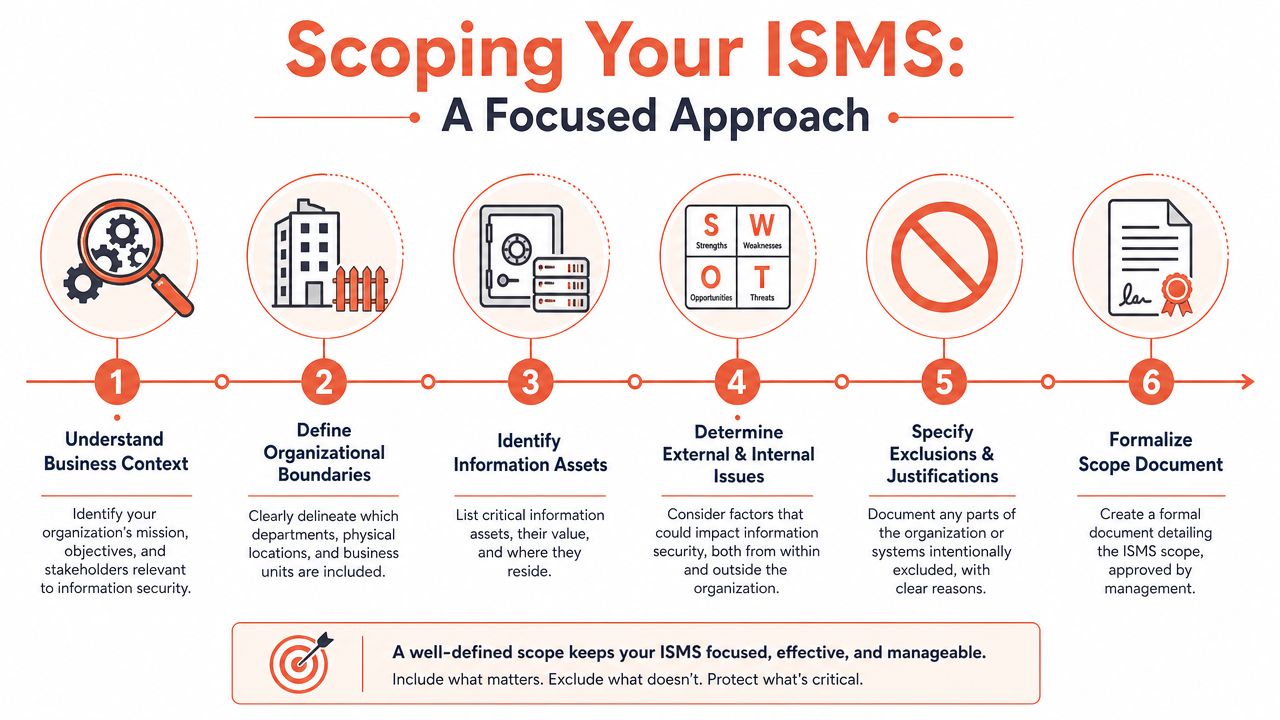
Good scoping is much less dramatic. It draws a line around the systems, people, and processes the team can govern today, then states clearly why that line makes sense for the business.
A lot of startups still scope by org chart. That is usually the wrong frame. Auditors care about legal entities, locations, and responsibilities, but the actual security exposure usually sits in environments, repositories, identities, deployment paths, data stores, and third-party services.
The scope should match how the business actually runs
A defensible first scope usually centres on the systems that process customer data or can affect production. For a startup, that often means:
- Production infrastructure across AWS, GCP, or Azure, where customer-facing workloads and sensitive operational data live
- Build and deployment systems that can change production behaviour
- Identity and access management because access mistakes create outsized risk
- Incident handling and change management processes because auditors will want to see how the team reacts under pressure
Some things can stay out of the first certification round. Internal tooling used by a small commercial team, for example, may not belong in scope if it has no route into customer data, admin access, or production changes. The key is to document the exclusion and defend it with a real rationale, not convenience.
This is one place where outside help can be useful if the boundary is messy. Teams that already rely on Accelerate IT Services Inc. security offerings often have an easier time separating business-critical systems from everything else because the service map and control ownership are already clearer.
Scope around control points, not departments
Scoping gets easier once you ask a blunt question. What can change production, expose customer data, or bypass normal approvals?
That question usually points to a short list. Cloud accounts. Repositories. CI/CD pipelines. Secrets stores. Admin consoles. Logging and monitoring systems. Backup paths. Key vendors with privileged access.
This is why platform maturity matters so much. If the company runs on a defined cloud foundation, standard delivery workflows, managed identities, and central logging, the scope is easier to describe and easier to defend. The ISMS starts to follow the shape of the platform. If the estate grew through one-off clusters, hand-built runners, shared admin accounts, and undocumented exceptions, scoping becomes forensic work.
I have seen teams lose weeks here. Not because the standard is unclear, but because nobody can answer basic questions about what exists, who owns it, and how it reaches production.
A scope document people can defend
The scope statement should be short, specific, and operational. Leadership should understand it. Engineering should recognise it. An auditor should be able to test it against reality without decoding vague language.
A useful test is this:
| Question | Good sign | Bad sign |
|---|---|---|
| Can engineering list the in-scope systems? | Clear inventory | Endless debate |
| Can security explain exclusions? | Written rationale | “We just left that out” |
| Can leadership support the scope? | Business reason is obvious | Scope exists only for audit optics |
A narrow scope with real control beats a company-wide scope nobody can run.
The trade-off is straightforward. A tighter scope reduces early overhead, but it also forces discipline. The systems inside that boundary need to be standardised, documented, and governed properly. That is exactly why a modern DevOps platform helps. If your access model, deployment flow, environment baselines, and audit trails are already consistent, the scope is easier to define because the platform has already removed a lot of ambiguity. Compliance becomes the byproduct of running engineering in a controlled way, not a separate paperwork exercise bolted on afterwards.
The Risk Assessment You Will Actually Finish
Monday morning, an investor asks whether production access is controlled and reviewed. Security says yes. Engineering says mostly. Nobody can show the same answer in one place. That is what a bad ISO 27001 risk assessment feels like in practice. Not a theory exercise. A pile of half-kept spreadsheets, stale tickets, and control decisions nobody can trace.
A useful risk assessment is operational. It shows how a system can fail, what the consequence is, who owns the fix, and what the organisation decided to do about it. If an auditor picks one risk at random, they should be able to follow the chain from asset to treatment to control to evidence without guesswork.

Keep the workflow boring and consistent
The teams that get through this cleanly use a simple, documented workflow. Iterasec's implementation guide calls out the basics clearly: record likelihood, impact, ownership, treatment, and the Statement of Applicability so each control decision is traceable.
That sounds formal. It is still manageable if the model stays small and repeatable.
- List the assets that matter. Repositories, CI pipelines, container registries, clusters, databases, admin consoles, backups.
- Write down realistic failure paths. Unauthorised access, bad configuration, weak change control, missing logs, poor secrets handling.
- Score impact and likelihood with one method and stick to it.
- Assign an owner who can reduce the risk, not just observe it.
- Choose treatment. Reduce, accept, transfer, or avoid.
- Record the control decision in the SoA.
The painful part is never the scoring matrix. It is the manual stitching together of facts across tools. One team exports IAM roles. Another checks deployment settings by hand. Someone screenshots backup policies the night before the review. That work does not fail because people are careless. It fails because the operating model is fragmented.
Teams running on a DevOps cloud infrastructure platform start from a better position. Standard deployment paths, consistent access patterns, environment baselines, and central audit trails cut down the number of bespoke risks you need to debate. Compliance starts to fall out of good engineering habits instead of becoming a separate project.
Use Annex A as a filter for treatment decisions
Annex A is useful here, but not as a checklist to complete line by line. Use it to pressure-test whether the treatments in your register map to real controls and whether those controls operate in daily work.
For engineering-led companies, the same themes come up again and again:
- Access and identity for who can reach what, approve changes, and assume privileged roles
- Secure change management for how code and infrastructure move into production
- Logging and monitoring for what your team can detect, review, and investigate
- Resilience and recovery for how services fail, restore, and prove they can recover
That grouping saves time because it reflects how systems are run. It also exposes where DIY setups create hidden audit pain. If IAM lives in several consoles, pipelines differ by team, and logging depends on local preference, the risk register turns into a documentation tax. Every review becomes a manual reconciliation exercise.
Make the register useful after certification
A dead risk register is easy to spot. It has tidy rows, old dates, and no connection to current platform changes.
The useful version gets touched when something changes materially. A new service, a new cloud account, a new third-party integration, a new privileged role. That review does not need a committee meeting. It needs a short pass by the people who understand the system and have authority to change it.
I have seen startup teams save days of prep by treating the register as part of delivery governance rather than annual audit admin. That is the broader point of this article. If the platform already enforces sane defaults and leaves evidence behind, ISO 27001 risk work becomes lighter, faster, and more defensible.
If you need a practical external reference for specialist support around cloud, endpoint, and broader cyber operations, Accelerate IT Services Inc. security offerings are worth reviewing for the service categories they cover.
Implementing Annex A Controls the Platform Way
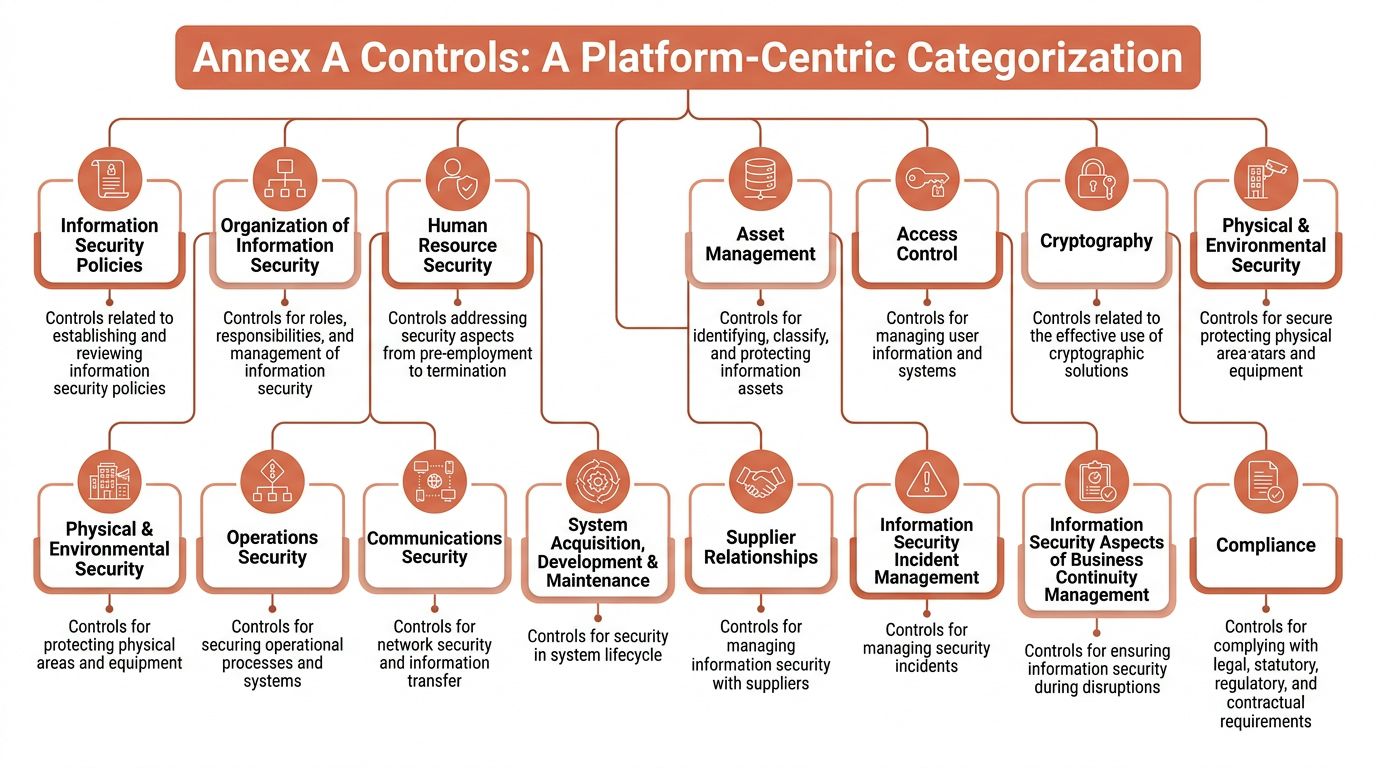
Annex A becomes painful when teams treat controls as paperwork first and system behaviour second. The usual result is a patchwork of policies, tickets, scripts, and screenshots that looks acceptable in a shared folder and falls apart under audit sampling.
A better approach is to map controls to how the platform runs. Start with the places where engineering can enforce consistent behaviour. Identity, change management, logging, backup, recovery, vulnerability handling, and incident response. If those are built into the delivery platform, compliance stops being a separate project and starts showing up as a byproduct of sane operations.
Where manual implementations usually go wrong
I see the same pattern in early-stage teams. A policy says privileged access must be controlled. In practice, admins are granted directly in cloud consoles because it is faster. A policy says production changes need approval. In practice, someone drops a message in Slack and deploys anyway. A policy says incidents must be handled consistently. In practice, the team improvises at 02:00 and writes the post-incident notes later.
None of that is unusual. It is what happens when the platform does not carry the control.
The weak spots tend to cluster in a few areas:
- Access control. Roles drift, exceptions pile up, and nobody can explain who approved what.
- Operations security. Backups, patching, and alerts exist, but each service owner does them differently.
- Secure development and change. Release rules live in team habit, not in the pipeline.
- Incident management. The process is documented, but the response path is still manual and inconsistent. A practical guide for DevOps incident response is useful if that part of the operating model is still ad hoc.
If a control relies on memory, it will fail during a busy week.
What the platform should enforce
The platform should remove discretion from the controls that matter most. Engineers should not need to remember every approval step, retention setting, or logging pattern for every service. The system should make the secure path the default path.
That changes the trade-off. You spend more time upfront standardising templates, pipelines, and access patterns. You spend far less time later explaining exceptions, chasing evidence, and fixing drift before the auditor finds it.
| Control area | Manual approach | Platform-aligned approach |
|---|---|---|
| Access management | Permissions set ad hoc in cloud consoles | Central role-based access with reviewable assignments |
| Change control | Human approvals buried in chat or tickets | Pipeline-enforced deployment stages and approvals |
| Logging | Teams configure logs differently | Standardised audit trails and retention patterns |
| Monitoring | Dashboards vary by service owner | Shared observability with baseline health and alerting |
DIY DevOps often gets expensive in ways founders do not see at first. Every custom runner, one-off environment, or team-specific deployment pattern creates another place for a control to behave differently. Then someone has to prove that difference is acceptable.
The cleaner route is to standardise how infrastructure is provisioned, how services move between environments, and how privileged access is granted and reviewed. Policy still matters. Human review still matters. The difference is that the platform carries more of the burden. For teams weighing that shift, a DevOps cloud infrastructure platform explainer gives useful context.
Build controls into delivery, not around it
Good Annex A implementation looks boring in the best way. New services inherit logging and retention settings. Deployment pipelines enforce approvals for higher-risk changes. Access requests follow a defined path. Recovery procedures are tested against the same platform patterns each time.
That boring consistency is what auditors trust, and what engineering teams need if they want compliance without constant interruption.
Evidence should fall out of the system
Screenshots and one-off exports are still common, but they are a poor record of control operation. They show a moment. They do not show that the control has been working over time.
Platform-generated records are better because they come from the systems doing the work. Access histories, deployment logs, policy checks, retention settings, backup results, alert timelines. Those artefacts are harder to fake, easier to review, and far less painful to maintain.
That is the core platform advantage in ISO 27001 implementation. You are not trying to bolt compliance onto engineering after the fact. You are building an operating model where Annex A controls are expressed in code, configuration, and repeatable workflows. Certification then becomes confirmation of how the platform already works.
Automating Evidence for Continuous Compliance
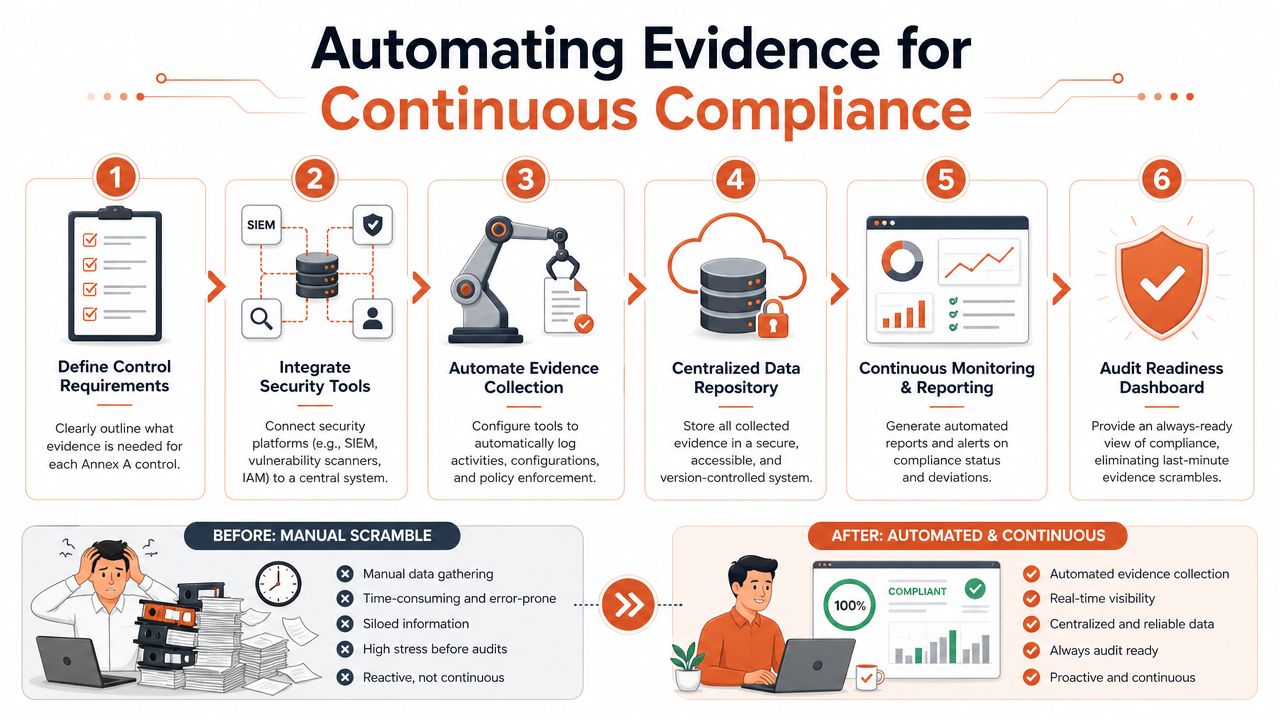
Most audit stress comes from one problem. The team doesn't have evidence organised until someone asks for it. Then the scramble begins. Screenshots get taken. Documents get renamed. Logs are exported into folders nobody will open again.
That isn't just inefficient. It also exposes weak control ownership. If you can't show evidence until the week before the audit, your ISMS probably isn't operating continuously.
What auditors actually expect to see
Mature implementations maintain the core artefacts all the time. Auditors expect items such as the ISMS policy, risk register, Statement of Applicability, and internal audit reports, and APNIC's guide stresses treating ISO 27001 as an ongoing control cycle with continuous monitoring rather than a one-off project (APNIC certification guide).
That expectation changes how evidence should be produced. The strongest setups use operational systems as the primary record.
Build an evidence pipeline, not an evidence chase
A workable evidence model usually has these parts:
- Control source. Where the control lives, such as IAM, CI/CD, infrastructure policy, logging, or ticketing.
- System record. The log, config history, approval trail, or policy state that proves operation.
- Review cadence. Who checks it and how often.
- Retention and access. Where evidence is stored and who can retrieve it.
That's why platform automation matters so much. If your deployment system logs every production change, your identity layer records role assignment and revocation, and your observability stack keeps an auditable history, you're not assembling evidence manually. You're querying your operating model.
Continuous compliance is mostly operational discipline
A lot of teams hear “continuous compliance” and think they need another large compliance tool. Often they don't. They need fewer disconnected systems and better defaults.
The same is true for incident handling. Good evidence isn't just a ticket that says an incident happened. It's the timeline of detection, escalation, response, review, and corrective action. If your team is tightening this side of the process, this guide for DevOps incident response is a practical read because it frames incident work as an automated operational system rather than a manual escalation tree.
Strong compliance evidence usually comes from normal engineering workflows that were designed properly in the first place.
This is also where internal developer platforms earn their keep. Not because “platform” is fashionable, but because standardising environments, deployments, access, observability, and policy enforcement gives you one place to see whether controls are holding. Teams that keep stitching together separate cloud-native tools can achieve the same result, but they pay for it in integration work and maintenance forever.
If you want a reference for what that automation layer looks like in practice, developer platform automation is the right model to study.
Nailing the Audit and Staying Compliant
By the time you reach the audit, the hard work should already be done. The internal audit should have exposed weak documentation, missing ownership, or controls that exist on paper but not in practice. Management review should have forced leadership to look at risk, nonconformities, and improvement actions as operating issues rather than audit theatre.
The best way to handle the external audit is to be concrete. Show the system boundary. Show the risk workflow. Show how control decisions link to evidence. Show who owns the exceptions. Auditors don't need perfect theatre. They need a coherent, operated ISMS.
A few habits make a real difference:
What helps in the audit room
- Use live systems carefully instead of over-relying on slide decks. If a control is enforced in the platform, demonstrate it there.
- Keep answers close to scope. Don't volunteer stories about out-of-scope edge cases unless asked.
- Bring the owners. The engineer who runs deployments, the person who owns identity, and the manager who signs off reviews should all be able to explain their part.
What keeps the certificate healthy afterwards
- Run internal audits as operational checks rather than ceremonial exercises.
- Review changes to the platform and supplier stack before they become uncontrolled risk.
- Treat corrective actions seriously. Small recurring misses usually point to weak system design, not careless individuals.
ISO 27001 implementation works best when it stops being a side quest. If your team is still building and maintaining too much of its own DevOps stack, compliance will keep feeling expensive because the underlying platform is inconsistent. When the engineering foundation is secure, automated, observable, and standardised, certification becomes proof of maturity rather than a drain on delivery.
PushOps helps software teams get that foundation in place without building a full internal platform function from scratch. If you want a simpler route to secure cloud infrastructure, standardised deployments, audit-friendly access controls, and always-on operational visibility across AWS, GCP, and Azure, take a look at PushOps.

