
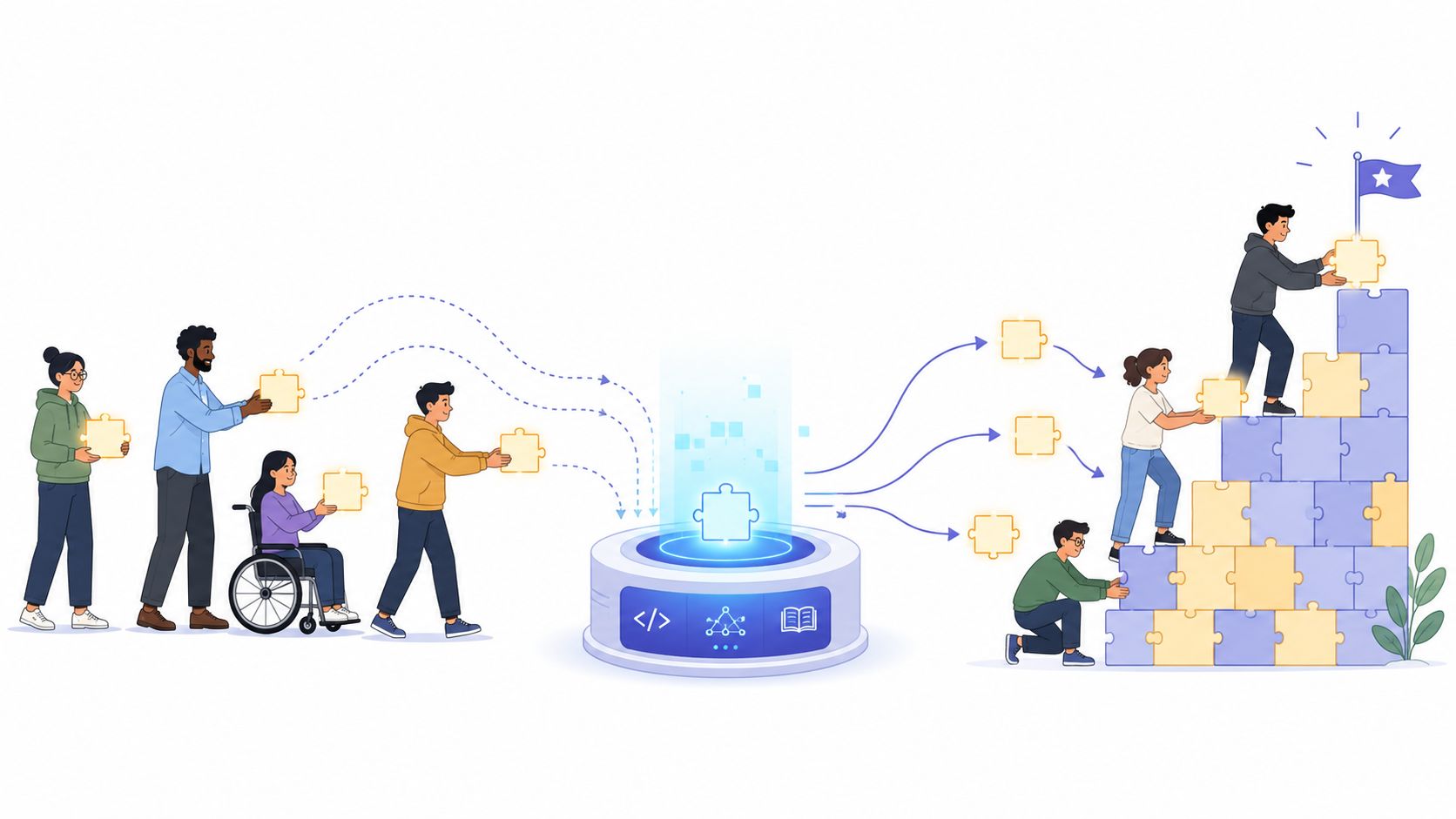

A release is queued. The pipeline fails on a step nobody has touched in months. One engineer knows why the runner needs that odd environment variable, another remembers which dashboard shows the production error rate, and the person who originally wired the alerting rules is on leave. Nobody is blocked by a lack of effort. They're blocked by a lack of accessible operational knowledge.
That's what broken knowledge sharing looks like in software teams. It isn't abstract. It shows up as delayed releases, slow incident response, fragile handovers, and senior engineers getting pulled into every awkward deployment because the system only makes sense if you already know how it works.
For startups and scale-ups in Europe, Singapore, the UK, and the US, this gets worse when the team keeps building its own platform layer. Kubernetes, CI/CD, monitoring, security controls, cloud cost management, internal tooling. Each choice can be rational on its own. Together, they often create a maze that only a few people can make sense of.
The Real Cost of I Do Not Know
A production incident rarely starts as a knowledge-sharing initiative. It starts with a small operational gap.
A deploy rolls back unexpectedly. The logs are split across multiple tools. The runbook exists, but it's stale. The engineer on call knows the application, not the infrastructure glue around it. So the team starts paging people based on memory, not process. That's when “I don't know” turns into real cost.
This is one reason DIY DevOps becomes expensive long before finance notices it. Developers waste 40% of their time on manual deployment tasks and infrastructure maintenance, which costs companies globally $1 trillion annually in lost productivity, according to analysis of DevOps investor trends. If your team says it wants to focus on product but spends large parts of the week nursing pipelines, wrangling Kubernetes, and maintaining internal deployment logic, you're already paying the tax.
Where the delay actually comes from
The hidden problem usually isn't that engineers won't document things. It's that the operating model keeps producing knowledge that's difficult to capture.
A custom stack creates dozens of tiny dependencies:
- Pipeline knowledge: Someone knows why one branch deploys differently from another.
- Cloud knowledge: Someone else knows which AWS, GCP, or Azure setting was changed to stop an outage.
- Monitoring knowledge: Alerts exist, but only one person knows which ones matter.
- Security knowledge: Access, permissions, and audit decisions live in ticket history and memory.
Practical rule: If a release depends on remembering undocumented exceptions, your problem isn't discipline. It's system design.
That's why clean handovers matter, but handovers alone won't rescue a messy platform. Teams still need practical habits, including clear ownership and repeatable transfer points. A useful reference is this guide to steps for seamless documentation handovers, especially for release ownership, incident follow-up, and role transitions.
The deeper fix is to remove avoidable operational complexity, not just describe it better. Teams that want less interruption need fewer moving parts, fewer one-off scripts, and fewer platform behaviours that only make sense to the people who built them. That's also why many engineering leaders are looking for ways to reduce DevOps overhead instead of hiring yet another person to babysit infrastructure.
Why Your Wiki Is Failing Your Engineers
Most engineering teams respond to knowledge gaps the same way. They create more documentation.
That sounds sensible. It often fails.
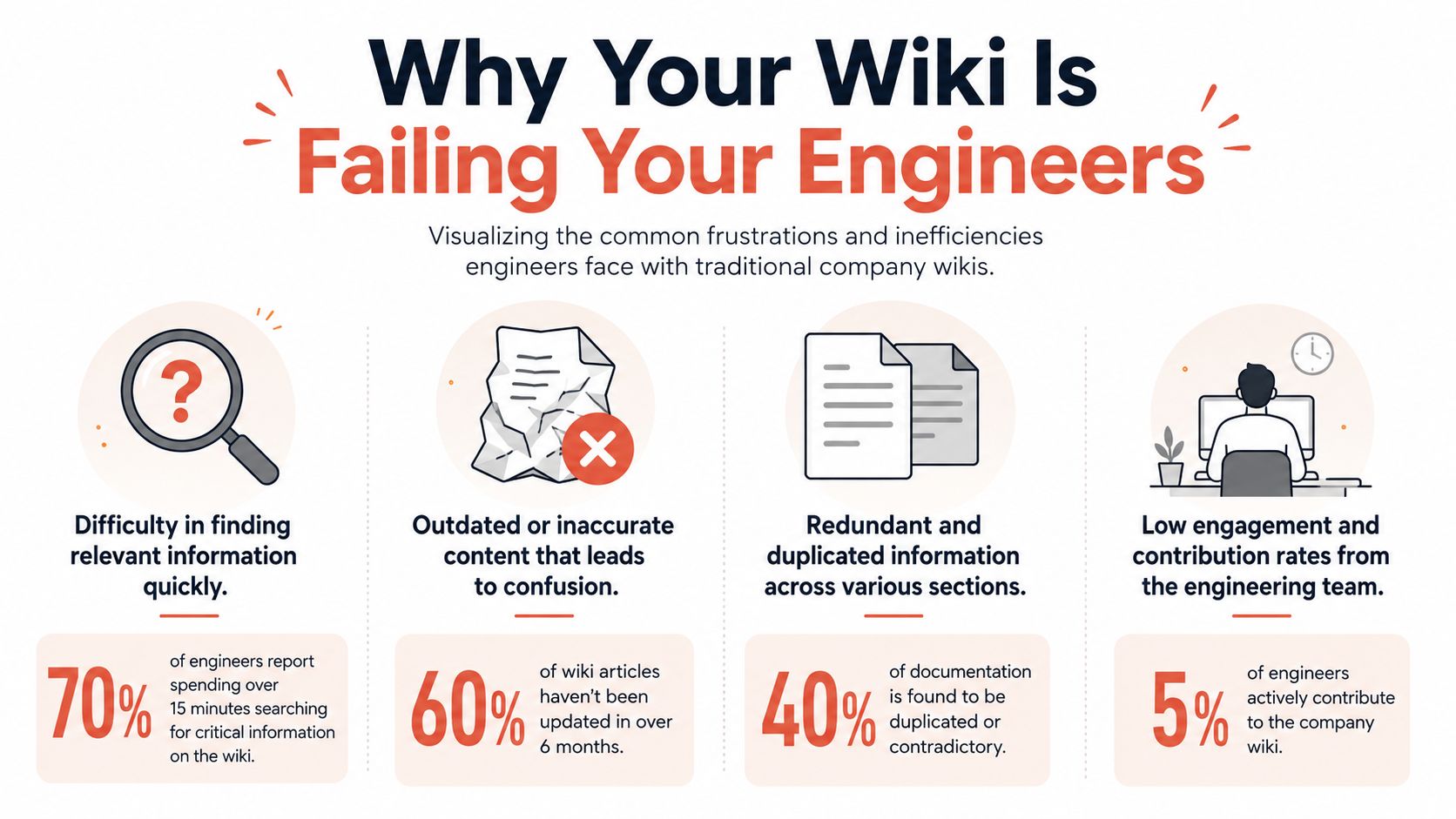
A wiki can store information, but it usually can't keep pace with a modern delivery system where infrastructure, deployment logic, security controls, cloud usage, and service dependencies change constantly. The faster the team moves, the faster a static knowledge base drifts away from reality.
Static docs lose to live systems
The main weakness of the wiki model is separation. The knowledge lives in one place. The work happens somewhere else.
An engineer troubleshoots in Slack, reviews deploy logs in a CI tool, checks cloud events in a provider console, and searches dashboards in a monitoring product. Then, maybe, they're expected to summarise all of that into a clean article later. That last step is where knowledge sharing breaks. Work is urgent. Documentation is deferred. Deferred documentation becomes missing documentation.
Research from Starmind found that organizations embedding knowledge capture directly into workflow tools such as Slack and Teams achieve 50% higher retention of critical technical insights than separate documentation platforms, and show a 3.2x increase in knowledge reuse during incident response scenarios according to their write-up on improving knowledge sharing across organizations.
Engineers don't need more pages to search. They need answers tied to the tools and workflows they already use.
What a failing wiki looks like in practice
You can usually spot the pattern quickly:
| Symptom | What engineers experience |
|---|---|
| Search friction | They know the answer exists somewhere, but can't find the current version |
| Stale guidance | The documented process no longer matches the deployment or environment |
| Duplicate content | Multiple pages say slightly different things, so nobody trusts any of them |
| Low contribution | The same few people write docs while everyone else treats the wiki as optional |
This gets even harder in scale-ups that are building internal developer portals, custom release tooling, or layered cloud abstractions. Documentation multiplies because every exception needs an explanation.
If your team is still committed to text-first knowledge capture, it helps to explore collaborative markdown tools that make shared editing less painful. But better editing won't solve the central issue. The issue is structural. When the platform itself is fragmented, the knowledge around it fragments too.
That's why many teams start questioning whether they need a home-grown portal at all. In practice, an internal developer portal alternative often matters less because of UI preference and more because it reduces the number of disconnected places where operational truth can drift.
The wiki is often carrying the wrong burden
A wiki works best for durable context. Architecture principles. Service ownership. Decision records. Security standards.
It works badly as the main defence against day-to-day operational entropy. If engineers must read three pages before they can deploy safely, your process is too fragile. If they need to ask the same senior person to interpret those pages, the documentation hasn't solved the problem.
The DevOps Complexity Trap and Its Knowledge Debt
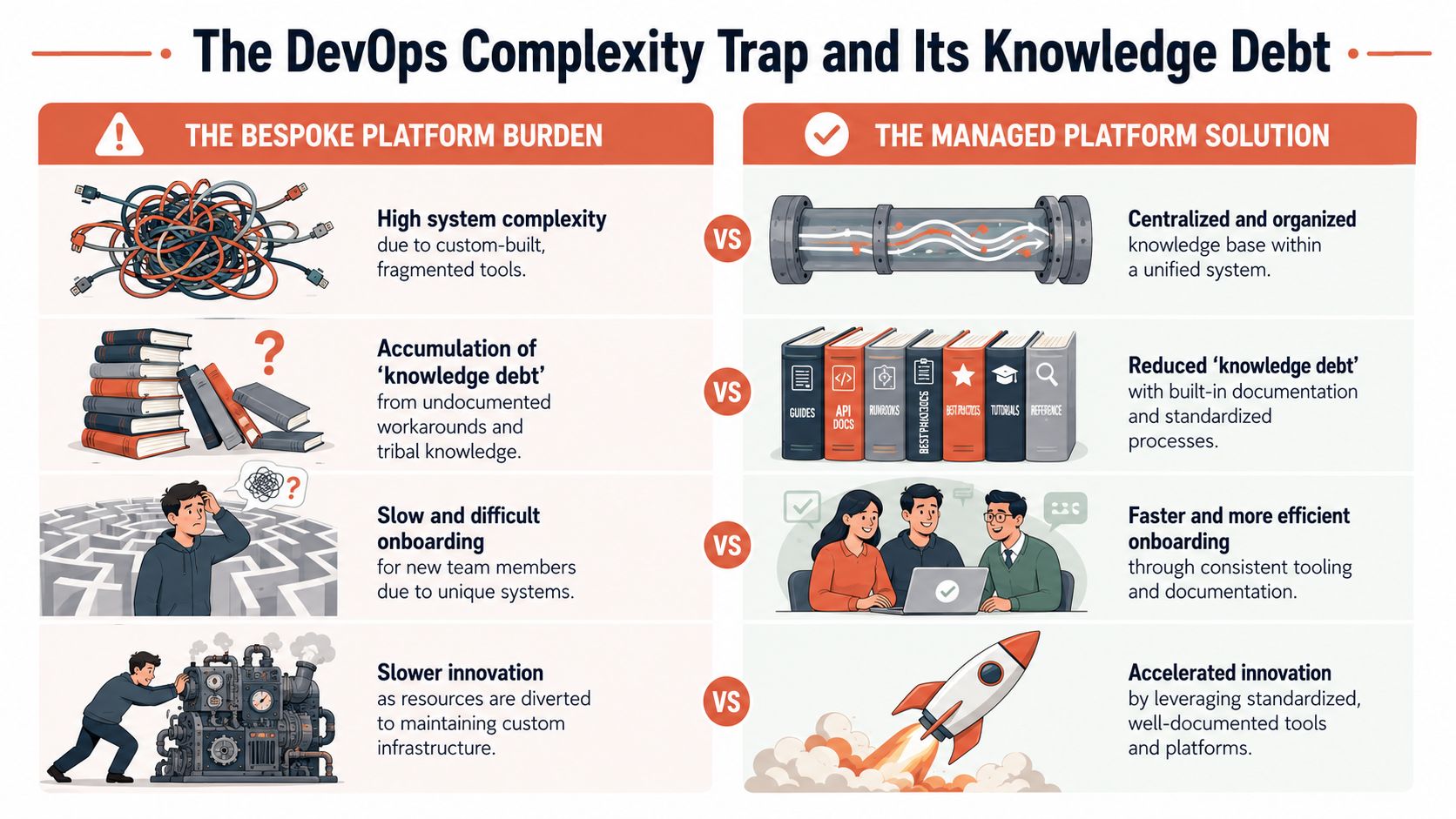
Custom infrastructure stacks create a special kind of debt. Not just technical debt. Knowledge debt.
It builds up when a team assembles Kubernetes clusters, CI/CD pipelines, secrets handling, observability tooling, security rules, release logic, and cloud cost controls from separate components. Every layer adds power. Every integration adds another place where somebody has to remember how it works.
The stack becomes a specialist language
The problem isn't Kubernetes itself. Or CI/CD. Or observability vendors. Strong tools can be the right choice.
The problem appears when the combination becomes so bespoke that only a small group understands the whole system. Then knowledge sharing turns into translation work. Application engineers need platform engineers to explain the deployment path. New hires need tribal history to understand why one service uses one release strategy and another uses a different one. Security reviews depend on knowing which exception was approved six months ago.
A short list of common DIY patterns that create knowledge debt:
- Custom pipelines with historical baggage: The YAML works, but only because of buried assumptions.
- One-off cloud policies: A workaround fixed an old issue and nobody wants to touch it.
- Fragmented monitoring: Metrics, logs, traces, and alerts sit in different products with different owners.
- Internal scripts: They save time until the original author leaves or changes teams.
The staffing math gets uncomfortable
Leadership teams often justify this as flexibility. Sometimes it is. But the flexibility can be expensive.
In Europe, the average salary for a remote DevOps engineer is €78,022 per year, while senior engineers in Eastern Europe cost $70–$90/hour, according to European DevOps compensation data. That's before counting the opportunity cost of having highly capable engineers maintain bespoke plumbing instead of shipping product improvements.
And labour cost is only one side of it. A DIY stack also creates hidden cost through cloud sprawl and migration friction. For European startups in particular, hidden data egress charges in cloud hosting can turn a seemingly simple export or move into an unplanned bill. Those costs rarely show up in the original “we'll build it ourselves” decision.
When a platform needs constant explanation, the platform is part of the problem.
Why internal platforms often increase dependency
Internal developer platforms are meant to simplify delivery. Sometimes they do. Sometimes they become another product your company has to run.
That means roadmap decisions, maintenance work, support requests, access models, documentation, upgrades, and integration ownership. It also means your platform team becomes the keeper of institutional memory for how software gets built and shipped.
This is the trap. The platform centralises complexity, but doesn't necessarily remove it. So the team gets more standardisation on paper while still depending on a few experts in practice.
A more durable path is to automate the repetitive operational choices and standardise the workflow itself. That's where developer platform automation becomes more than convenience. It reduces the amount of knowledge each engineer must personally hold in order to deploy, scale, observe, and secure services safely.
Knowledge debt slows product teams first
The first visible symptom usually isn't a platform failure. It's product slowdown.
Engineers wait for reviews from the one person who understands release strategy. Features are delayed because environment setup is inconsistent. Incident response gets noisy because observability isn't standardised. Security becomes a sequence of exceptions instead of defaults.
By then, knowledge sharing isn't a documentation challenge anymore. It's the direct result of choosing an operating model that keeps generating hard-to-transfer expertise.
From Tacit Knowledge to a Platform-Based System
The most valuable operational knowledge in a software team is usually tacit. It lives in judgement, pattern recognition, and habits.
A senior engineer knows which deploy is safe to retry. An SRE can tell from a dashboard shape whether the problem is application behaviour or infrastructure. A staff engineer knows which cloud setting matters because they've been burned by it before. That kind of knowledge is hard to write down fully and even harder to keep current.
The goal isn't perfect documentation
Trying to document every operational nuance usually fails. Teams don't have time, systems change too quickly, and the resulting material becomes too heavy to use.
A better model is to encode knowledge into the workflow. Instead of telling engineers which sequence to remember, give them a repeatable path that already includes the right defaults, guardrails, and visibility. Instead of documenting every security rule separately, apply secure access, permissions, auditability, and policy enforcement as part of the platform. Instead of maintaining a page on release patterns, make the release path self-service and standardised.
Bloomfire notes that 68% of organizations lose critical tacit knowledge when senior SMEs leave unexpectedly, yet only 22% have structured capture protocols for these roles, in its guide on knowledge sharing. That gap matters most in environments where infrastructure behaviour depends on a handful of experts.
What a platform-based system changes
A managed platform can turn specialist knowledge into ordinary workflow. Not by replacing engineering judgement, but by reducing how often every engineer must reconstruct operational know-how from scratch.
That usually shows up in four places:
- Provisioning becomes predictable: Teams don't need a private set of cluster or environment conventions in someone's notebook.
- Deployments become consistent: The system handles builds, release flow, and environment handling in one path.
- Observability becomes shared: Real-time health metrics, incident context, and performance views aren't scattered across disconnected tools.
- Security becomes default behaviour: Access control and auditability don't depend on remembering to configure them manually.
Operating principle: The best knowledge-sharing system is often the one that removes the need to ask for permission or interpretation.
AI helps when the foundation is clean
AI can support this model, especially for search, summarisation, and question answering across operational material. But AI doesn't fix fragmented systems. It amplifies them.
If your release knowledge is split between Slack threads, CI logs, old docs, and a few senior engineers' memories, an assistant can only do so much. It works better when the workflows themselves are standardised and the source material is current. For teams exploring that route, it's worth seeing how to get AI answers from documents, particularly when pairing document search with platform events, runbooks, and service metadata.
The practical shift is simple. Stop treating knowledge sharing as an extra layer on top of operations. Make operations the place where knowledge is captured, enforced, and reused.
Implementation Patterns for Effective Knowledge Transfer
A platform reduces chaos, but teams still need habits that keep knowledge moving. The good news is that these habits don't need to be heavy. They need to be close to delivery work.
The most effective patterns are the ones engineers can follow during normal development, incident response, and release work without opening another separate process document.
Use rotation to expose hidden knowledge
Large-scale DevOps environments that implement Technical Thursdays and Cross-Functional Dynamic Role Rotation show a 35% increase in knowledge transfer velocity compared with static role structures, according to research on knowledge transfer in DevOps settings. The reason is intuitive. People learn faster when they touch systems outside their usual lane.
That doesn't mean random job swapping. It means deliberate exposure.
A workable rotation pattern might include:
Release shadowing
A product engineer joins a platform or operations-led release and narrates the steps back afterwards.Incident pair response
The on-call engineer handles the event with a second engineer from another team, then both update the runbook tied to that service.Environment ownership rotation
Different developers take responsibility for staging quality, deployment checks, or rollback readiness on a rotating basis.
Make handoffs event-driven
Most handoffs happen too late. The project is nearly done, the migration is already live, or the incident is over. By then, context has leaked away.
Create trigger-based handoffs instead. For example:
| Event | Required transfer |
|---|---|
| New service created | Record owner, deployment path, dashboard location, and rollback notes |
| Incident resolved | Add an After-Action Review linked to the service and the affected environment |
| Engineer changes role | Transfer recurring operational tasks, not just credentials and docs |
| Tooling change shipped | Update the live workflow or runbook before marking the work complete |
This changes the tone of knowledge sharing. It stops being “please remember to document this later” and becomes “this operational event isn't complete until the transfer is done”.
After-Action Reviews work best when they answer one question clearly. What should the next engineer be able to do in minutes that took us hours today?
Put runbooks next to the work
A runbook buried in a wiki is reference material. A runbook attached to the environment, service, or deployment path is an operational tool.
Good runbooks are short and specific. They don't try to teach cloud computing. They help an engineer act safely under pressure. In practice, that means:
- Link dashboards, not just describe them
- State rollback conditions in plain language
- Document known failure modes
- Record human escalation paths only when system cues aren't enough
Reward reuse, not heroics
Many teams still praise the person who remembers everything. That creates the wrong incentive.
Reward the engineer who turned a recurring manual check into a standard platform action. Reward the team that reduced exception handling. Reward the developer who replaced an oral tradition with a safe, visible workflow. That's what scalable knowledge sharing looks like in engineering.
Focus on Product Not Your Platform
Engineering leaders rarely set out to build a knowledge-sharing problem. They set out to move fast, gain control, and avoid bottlenecks. Then the stack grows. Kubernetes gets customised. CI/CD branches into special cases. Monitoring, security, and cloud cost tooling multiply. Soon the organisation is spending too much time understanding its delivery system and not enough time improving the product.
That's the core issue. Knowledge sharing breaks down when the operating environment is too bespoke to be easily understood, reused, or taught.
For CTOs, VP Engineering, and senior developers, the strategic question isn't whether your team can build an internal platform. Many can. The question is whether that's the highest-value use of your engineers' time. If you want a reliable, production-ready foundation across AWS, GCP, and Azure, the smarter move is often to adopt a managed platform that already handles setup, scaling, monitoring, security, and cloud cost controls in a coherent way.
A simple decision lens
If your team is dealing with any of the following, it's worth rethinking the DIY path:
- Senior engineers are infrastructure interpreters: They spend too much time translating the stack for everyone else.
- New hires learn by osmosis: Success depends on who sits near the right expert.
- Delivery workflows are fragile: Releases require memory, caution, and backchannel confirmation.
- Cloud operations keep expanding: More tools are added, but clarity doesn't improve.
The strongest teams make product work easier to ship. They don't ask every developer to become a part-time platform archaeologist.
A unified DevOps platform won't eliminate the need for judgement. It will eliminate a lot of avoidable platform labour. That yields operational benefits. Developers get self-service workflows instead of pipeline maintenance. Leaders get predictable security and observability defaults instead of scattered exceptions. Finance gets better cloud cost control instead of surprises. Above all, the business gets more feature velocity because engineering energy goes back into the roadmap.
If your developers keep getting pulled into infrastructure work when they should be shipping, that's your signal. Knowledge sharing doesn't scale through meetings and more wiki pages alone. It scales when the platform itself becomes simpler, standardised, and easier for the whole team to use.
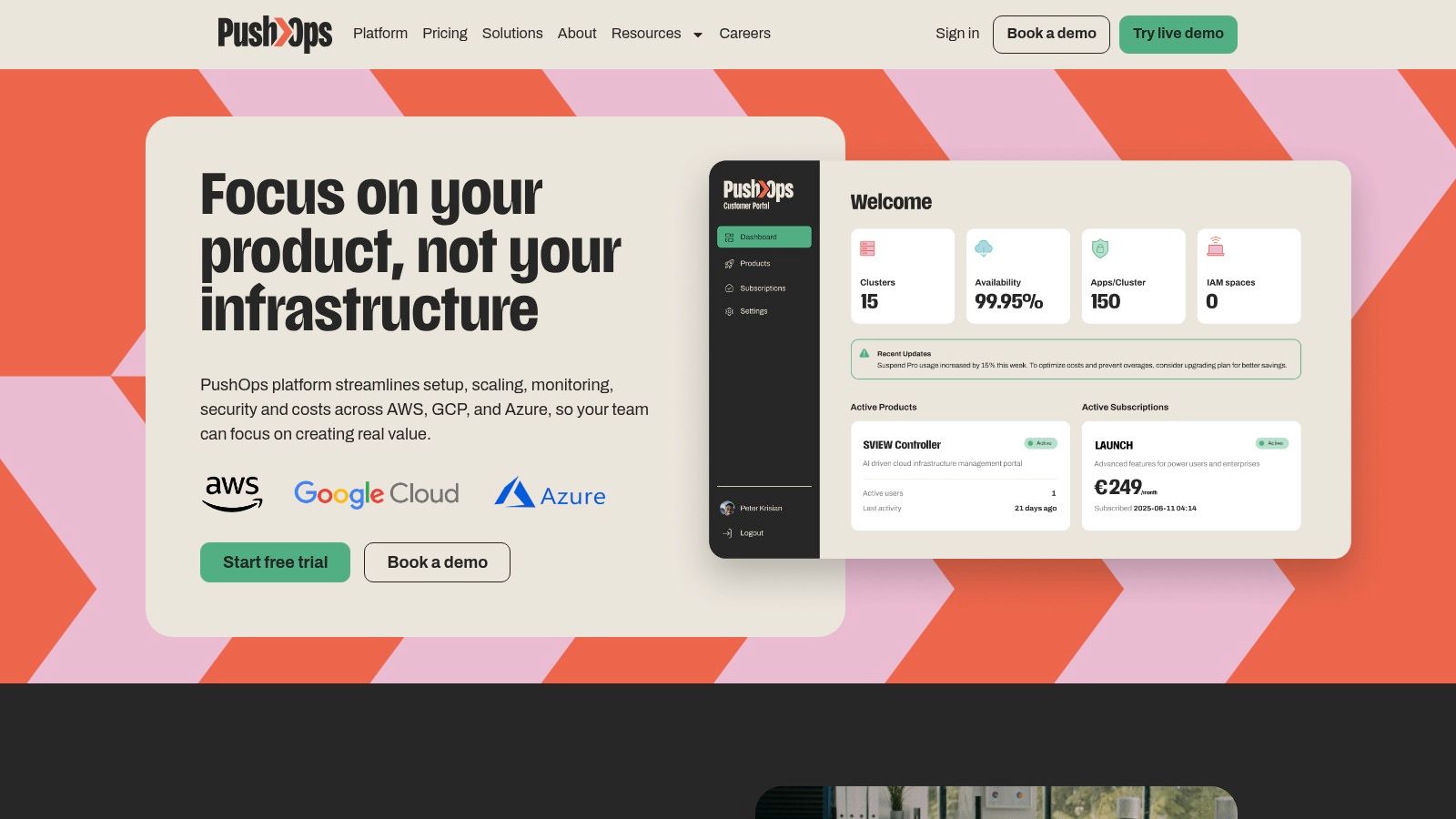
If your team wants to spend less time maintaining pipelines, stitching together cloud tooling, and explaining bespoke infrastructure, it's worth taking a closer look at PushOps. It gives engineering teams a production-ready path across AWS, GCP, and Azure with integrated deployment workflows, observability, security defaults, and cloud cost controls, so your developers can focus on product instead of platform work.

