
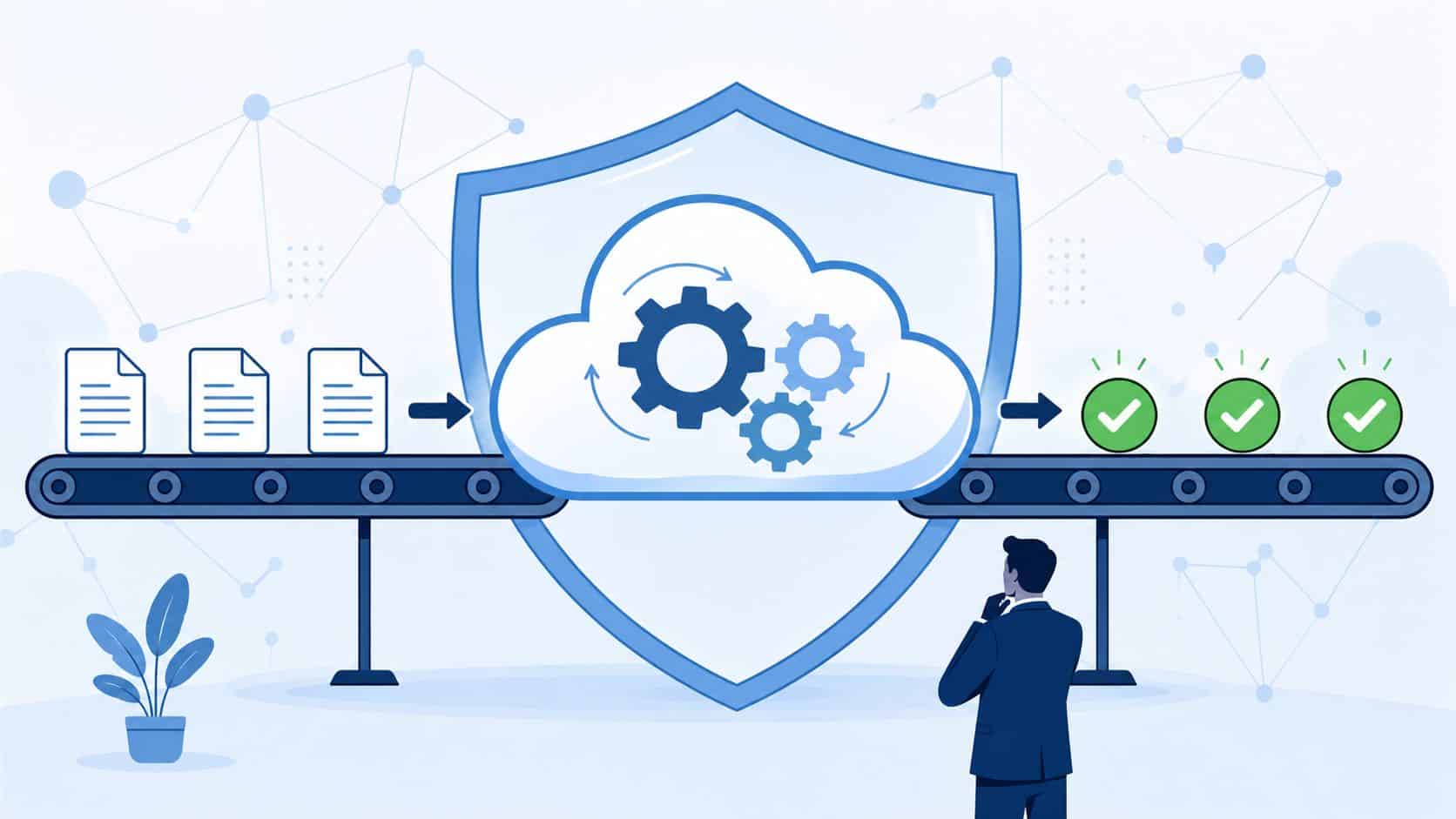

The week usually starts with product plans and ends with audit evidence. A CTO wants to review roadmap risk, unblock a launch, and decide where the next engineering hire goes. Instead, senior engineers are tracing IAM changes, checking whether deployment logs are complete, and patching another gap in a home-grown Kubernetes and CI/CD setup.
That pattern is common in startups and scale-ups across Europe, Singapore, the UK, and the US. Teams build their own stack because it seems cheaper and more flexible at first. Then compliance turns that stack into a second product. Someone has to maintain access controls, logging, evidence collection, policy checks, alerting, cost controls, and cloud-specific differences across AWS, GCP, and Azure.
The waste is measurable. Developers waste 40% of their time on manual deployment tasks and infrastructure maintenance, which costs companies $1 trillion annually in lost productivity globally, with the burden hitting startups in Europe and the US especially hard when they don't have a dedicated platform team, according to Ellty's DevOps productivity analysis.
Stop Managing Compliance and Start Shipping Product
A familiar scenario looks like this. Your team has a product that customers want. Release pressure is rising. Then a customer security questionnaire lands, an enterprise prospect asks about auditability, or a board member asks whether your cloud setup is ready for a formal compliance review.
Nobody planned for the operational sprawl that follows.
When compliance lands on the engineering team
The work doesn't arrive as one neat project. It arrives as fragments.
- Access questions show up as requests to prove least-privilege permissions.
- Deployment concerns turn into demands for approval trails and rollback clarity.
- Security reviews expose drift between what Terraform says and what production runs.
- Cloud cost reviews reveal idle environments, overprovisioned services, and tooling overlap.
None of that is unusual. What's expensive is who ends up doing it. Your high-impact engineers stop building customer-facing features and start acting as part-time auditors, part-time SREs, and part-time policy interpreters.
Compliance doesn't just consume legal and security time. It quietly pulls senior product engineers into infrastructure work they never meant to own.
Why DIY turns into a resource drain
Many development teams don't decide to build an internal developer platform because they love platform engineering. They do it because they want control. They assemble Kubernetes, GitHub Actions or GitLab CI, cloud-native IAM, log pipelines, alerting, secrets management, and a patchwork of scripts to connect everything.
That stack can work. It just doesn't stay finished.
Every new environment, customer requirement, and cloud security review adds another layer. The result is an internal platform that needs roadmap time, on-call coverage, and specialist knowledge. At that point, regulatory compliance isn't a checkbox. It's an engineering tax that compounds every month you keep the system running by hand.
For CTOs, the key question isn't whether your team can build this. It usually can. The fundamental question is whether that's the highest-value use of your engineering capacity.
What Cloud Regulatory Compliance Really Means
Cloud regulatory compliance isn't a document set. It's the operational ability to show, at any moment, that your systems are configured, monitored, and governed in a way that matches the rules you have to follow.
That shift matters because the market has moved away from manual, point-in-time compliance work. The regulatory compliance market is projected to grow from USD 25.38 billion in 2026 to USD 56.22 billion by 2035, at a CAGR of 9.3%, reflecting a move from manual compliance to integrated, policy-driven frameworks, according to Business Research Insights.
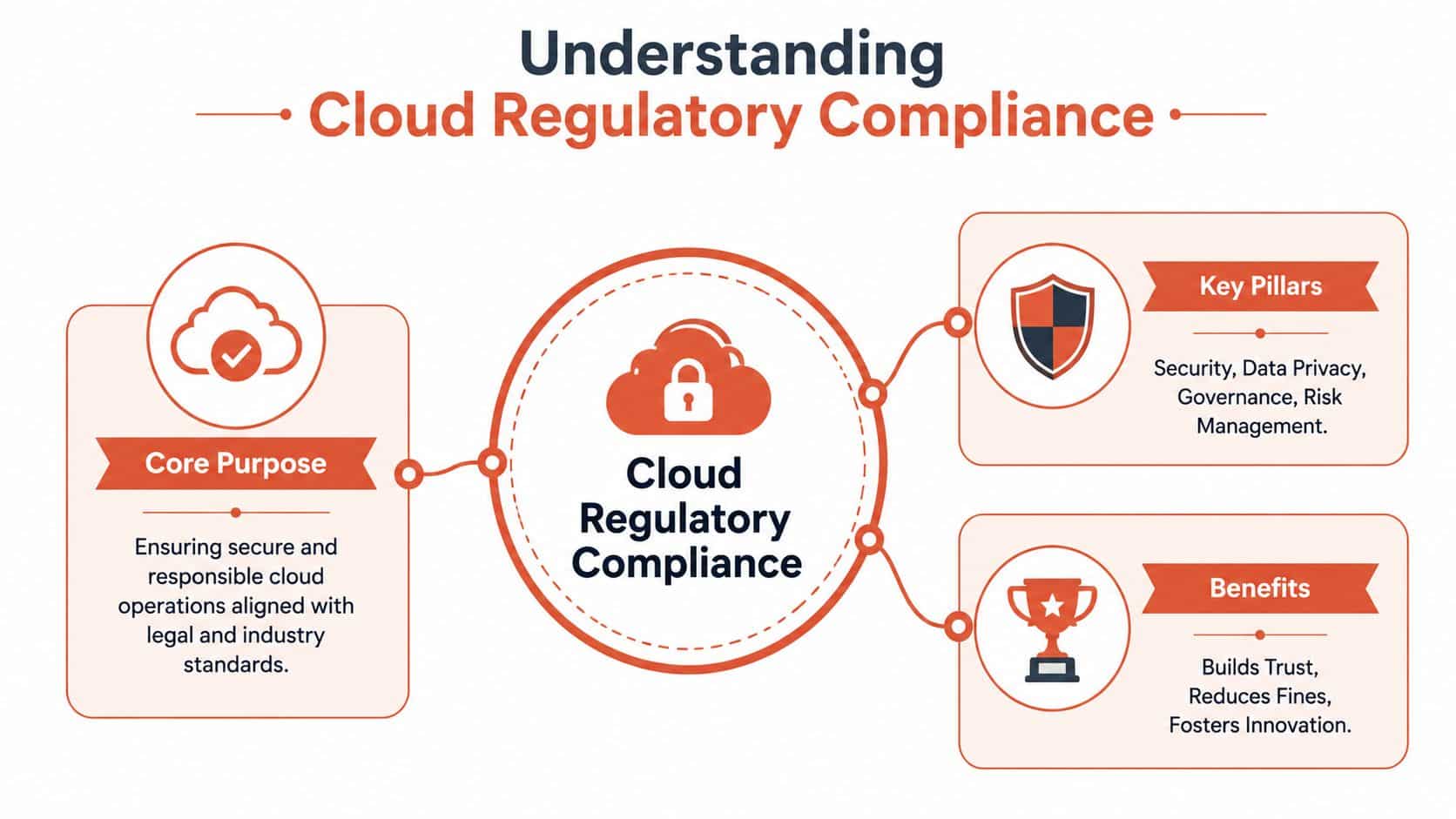
Compliance is evidence in motion
In practical terms, cloud compliance means your team can answer questions like these without a scramble:
- Who changed access to a production resource, and when?
- Which deployments ran in a given period, and were controls enforced?
- How are secrets managed, rotated, and restricted?
- What happens when a control fails, and who gets alerted?
- Can you prove the same baseline is applied across AWS, GCP, and Azure?
If those answers live in Slack threads, tribal knowledge, or separate dashboards that only one engineer understands, you don't have a compliance process. You have a dependency risk.
Annual audit thinking is obsolete
Many teams still treat compliance as an annual event. They gather screenshots, export logs, update a few policies, and survive the audit window. That approach breaks in cloud environments where infrastructure changes daily.
A healthier model is continuous verification. Controls are defined once, enforced automatically, and recorded as part of normal delivery. That includes deployment logs, access history, policy checks, and security updates.
Some adjacent workflows also need the same treatment. If you're trying to remove manual friction from approvals and records, tools that streamline compliance with eSignatures can help outside the infrastructure layer, especially where sign-off trails still depend on email and PDFs.
Operational test: if preparing for an audit means pausing feature work, your compliance model is still manual.
What this means for a modern platform team
For engineering leaders, compliance should be treated like reliability. You don't want heroic effort. You want repeatable controls, default guardrails, and fast evidence retrieval.
That is why teams increasingly look for a production-ready, multi-cloud platform instead of extending a DIY stack forever. The goal isn't to avoid accountability. It's to make compliant operations the default state rather than a recurring engineering project.
Translating Major Standards into Cloud Controls
Standards sound abstract until they hit implementation. A CTO hears SOC 2, ISO 27001, GDPR, HIPAA, or NIS2. An engineer hears identity, logging, encryption, backups, network boundaries, ticket history, and incident workflows.
That's the useful translation. Regulatory compliance becomes manageable when every requirement maps to a concrete cloud control.
From policy language to technical reality
A common mistake is to keep standards at the policy level. That produces elegant documents and messy infrastructure. The stronger approach is to ask what a control looks like in production.
For example:
- Access control becomes role-based access, strong authentication, and reviewable permissions.
- Change management becomes auditable CI/CD pipelines, approvals, and deployment records.
- Data protection becomes encryption, retention rules, and controlled backup access.
- Availability and resilience become tested recovery paths, health monitoring, and capacity policies.
Europe adds an especially important operational expectation. For cloud infrastructure platforms operating in Europe, the EU NIS2 Directive legally requires continuous monitoring of security controls and real-time detection of control failures, mandating incident detection within 24 hours, which makes automated observability a direct compliance capability, as summarised by MetricStream's NIS2 compliance guide.
Compliance standards to cloud controls map
| Standard | Core Principle | Practical Cloud Control Example |
|---|---|---|
| SOC 2 | Security and change control | RBAC, audited deployment pipelines, immutable logs, environment separation |
| ISO 27001 | Risk-based control management | Policy baselines, asset inventory, access reviews, backup verification |
| GDPR | Data protection and accountability | Encryption at rest and in transit, access restrictions, retention workflows, audit trails |
| HIPAA | Safeguarding sensitive health data | Least-privilege access, logging, secure backups, incident response workflows |
| NIS2 | Continuous monitoring and incident handling | Real-time observability, alerting on control failure, incident reporting workflows |
What teams actually need to build
The table looks simple. The implementation never is, especially across multiple clouds.
AWS, GCP, and Azure all provide native controls, but they don't present them in one operational model. Your engineers still need to standardise identity patterns, define policy boundaries, make logs searchable, and ensure environments are provisioned consistently. That's where infrastructure as code matters. A disciplined approach to infrastructure as code practices gives teams a way to express controls repeatedly instead of rebuilding them by hand.
The hard part isn't knowing that a standard requires access control. The hard part is enforcing the same access model across every environment without slowing delivery.
Where DIY mappings fail
DIY compliance usually fails in one of three places:
- Interpretation drift. Security, DevOps, and app teams each implement the same control differently.
- Evidence gaps. The control exists, but nobody can prove it quickly.
- Cloud divergence. One cloud account or region follows the pattern. Another doesn't.
This is why standards work best when translated into platform-level defaults. Developers shouldn't have to remember every control for every deployment. The platform should carry most of that load.
The Hidden Costs of the DIY Compliance Trap
The visible cost of DIY compliance is salaries. The hidden cost is lost momentum.
When a startup decides to build its own compliance-capable platform, it rarely budgets for the long tail. Someone has to maintain the cluster architecture, fix brittle CI/CD jobs, tune monitoring, review permissions, chase policy drift, and answer every "can we prove this?" request from sales, security, or auditors.
Innovation slows long before an audit fails
The broad economic drag is real. Regulatory compliance burdens impose an estimated aggregate innovation loss of approximately 5.4% on economic growth, and enterprises in some regions spend 20–30% of their IT operational budgets on compliance tasks instead of product development, according to George Washington University regulatory studies research.
That macro view matches what engineering leaders see at team level. Product work gets squeezed by operational chores that don't disappear after the first implementation. Every manual approval flow, one-off alert rule, and bespoke policy script adds maintenance load.
The costs that don't show up in the spreadsheet
A DIY stack often looks efficient on paper because much of the work is absorbed by existing engineers. That's exactly the problem.
- Senior engineers become platform custodians instead of building product.
- Release confidence drops because compliance-sensitive changes are harder to verify.
- Knowledge silos form around the one or two people who understand the whole setup.
- Procurement and sales cycles drag because evidence collection takes too long.
This is one reason many teams start evaluating developer platform automation models before they plan another DevOps hire. The issue isn't just labour cost. It's the compounding effect of turning infrastructure into an internal product with no clear owner and constant support demands.
Management rule: if every compliance request depends on your most senior infrastructure engineer, you don't have a scalable operating model.
Why more headcount doesn't fully solve it
Hiring more DevOps engineers can reduce immediate pressure. It doesn't remove the structural problem. More people still inherit fragmented tooling, uneven control implementation, and manual evidence work.
Most small teams and startups also face direct external spend if they try to patch capability gaps with consultants. Managed DevOps retainers commonly sit in the low thousands of dollars per month, and more complex engagements can run higher, based on DeployFlow's overview of DevOps services for startups. That spend often comes on top of slower releases, repeat outages, and product engineers being pulled back into tooling work.
DIY compliance isn't just expensive because of what you buy. It's expensive because of what your best people stop doing.
How a Modern DevOps Platform Automates Compliance
A platform approach changes the compliance conversation from "who's going to wire this together?" to "which controls should be standard for every environment?"
That's the key shift. Regulatory compliance becomes a delivery property of the platform, not a parallel project running beside the product roadmap.
Compliance by default beats compliance by memory
Teams often over-engineer because vague requirements get interpreted too broadly. Organisations often over-interpret compliance requirements, increasing operational overhead by up to 30%, and a platform that correctly implements best-practice controls can prevent that over-engineering, according to the AMA's playbook on reducing unnecessary workflow burden.
A modern platform reduces that risk by making core controls part of the default operating model:
- Access control is built in through role-based access and permissions, not assembled ad hoc in each tool.
- Audit trails are native through logs of activity, deployment history, and policy-relevant events.
- Observability is integrated so control failures can be detected during normal operations, not discovered weeks later.
- Security updates and policy enforcement are centralised so teams don't have to maintain custom glue code around every service.
That is materially different from a stack of tools. Tools give you components. A platform gives you behaviour.
What this looks like in day-to-day engineering
In practice, a managed multi-cloud platform should handle several things without custom project work:
| Operational need | DIY reality | Platform approach |
|---|---|---|
| Provisioning environments | Repeated setup, cloud-specific variance | Standardised production-ready templates |
| CI/CD control | Pipeline maintenance and brittle scripts | Managed delivery workflows with consistent guardrails |
| Audit evidence | Manual exports and screenshot hunts | Built-in logs and traceable activity history |
| Monitoring and incident response | Separate tools with hand-built integrations | Unified observability and alerts |
| Cost control | Reactive clean-up and overprovisioning | Right-sizing, autoscaling, and scheduling defaults |
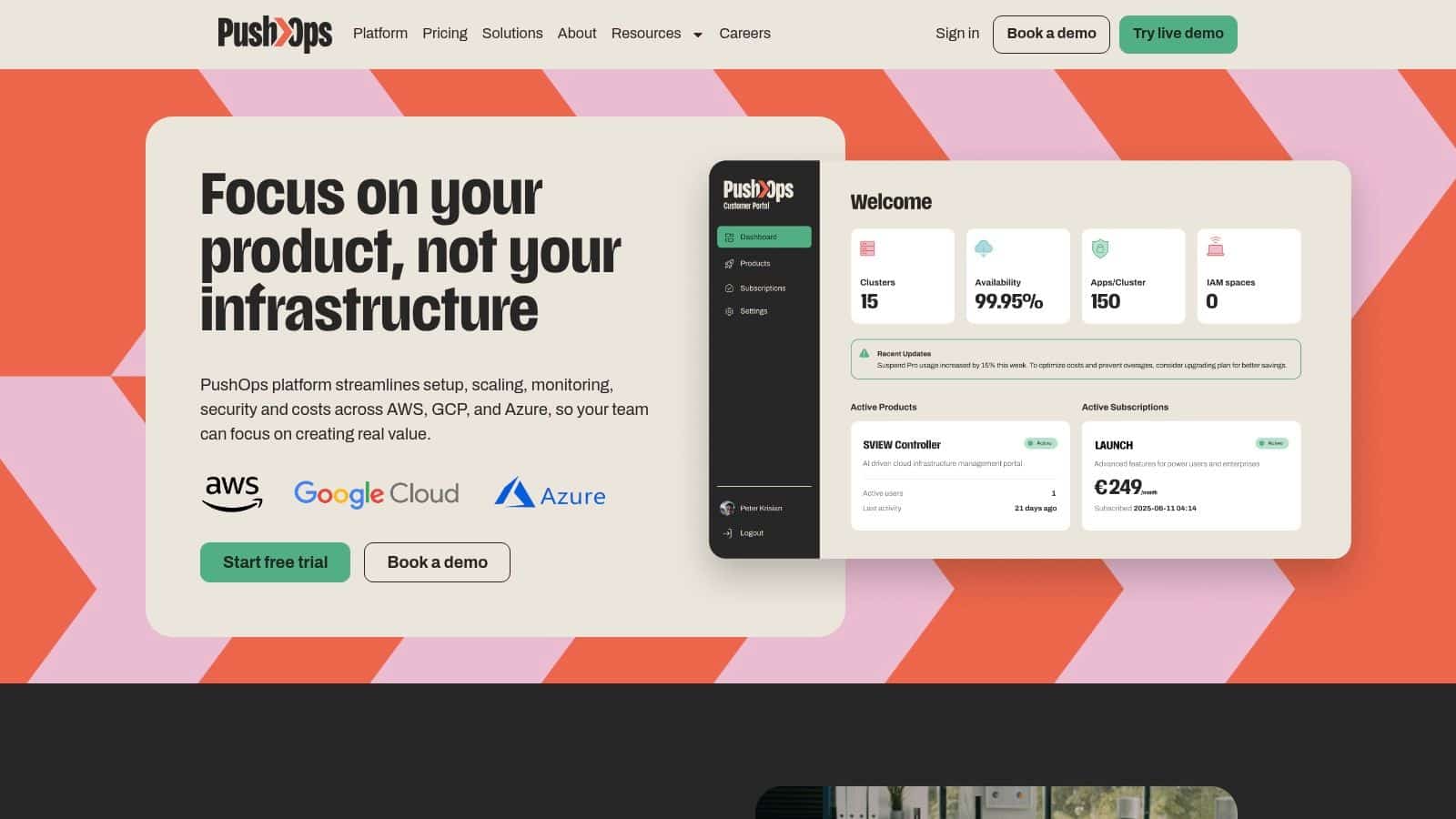
That is where a product like PushOps' DevOps cloud infrastructure platform fits. It provisions production-ready foundations on AWS, GCP, and Azure, automates deployments and environments, includes observability, enforces security controls such as role-based access and audit logs, and adds cloud cost controls like autoscaling and scheduling. For a CTO, the point isn't tool consolidation for its own sake. It's reducing the amount of compliance and operations logic your team has to invent and maintain internally.
Audit readiness becomes an operational outcome
This is also why audit transformation work increasingly overlaps with platform design. If you're thinking about how evidence, controls, and monitoring should evolve, Lighthouse Consultants' audit transformation insights are a useful companion read from the assurance side.
Good compliance automation doesn't create more process. It removes manual interpretation and makes the right controls hard to bypass.
For startups and scale-ups, that's usually the practical end state. Developers keep a self-service workflow. CTOs get visibility. Security expectations are enforced in the background. The company spends more time shipping product and less time nursing the machinery around it.
Your Actionable Cloud Compliance Checklist
A useful compliance review starts with operations, not policy binders. If you're trying to judge whether your current setup is sustainable, ask your team questions that expose manual work, fragile controls, and hidden ownership.
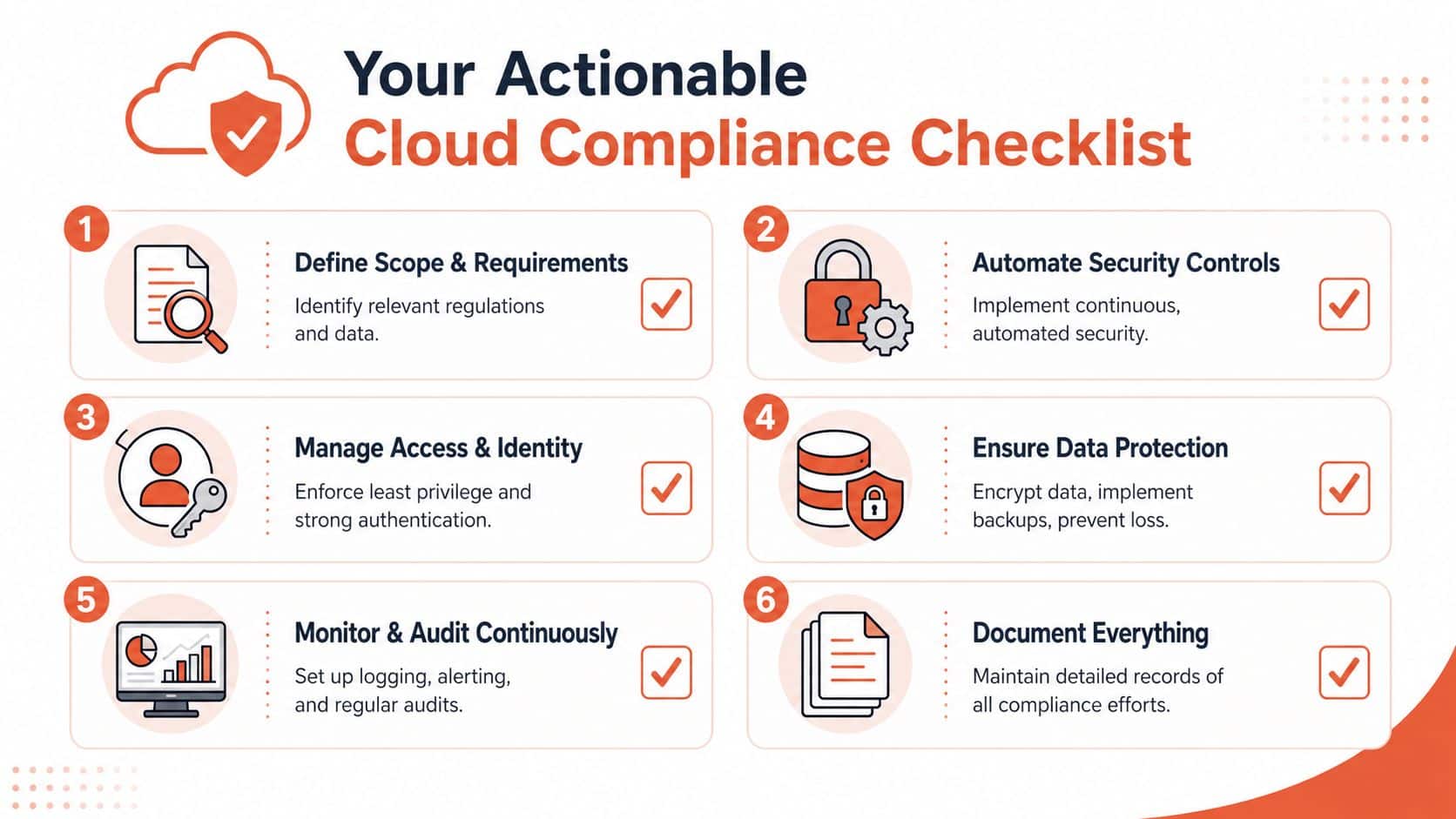
Questions worth asking this quarter
Where did engineering time go last month
Look at how much senior developer time went into deployments, access reviews, audit evidence, monitoring upkeep, and cloud cost correction rather than customer-facing work.Can you prove control effectiveness quickly
If a customer, auditor, or partner asks for evidence of access control, logging, or deployment history, can your team retrieve it without a fire drill?Are controls consistent across AWS, GCP, and Azure
Multi-cloud flexibility only helps if the same security and operational baseline follows every environment.Who owns the platform logic
If one engineer or a small cluster of specialists is carrying most of the operational knowledge, resilience is weaker than it looks.
Signs your current model is too manual
Some warning signs don't require a formal audit to identify:
- Approvals happen in chat tools and aren't tied cleanly to change records.
- Evidence collection depends on screenshots or one-off exports.
- Developers maintain pipelines that should have become standard infrastructure long ago.
- Cloud spend surprises keep appearing, including idle environments and overlooked egress charges. European startups are particularly exposed to underestimated data egress and overprovisioning waste, as described in Redu's write-up on cloud cost pitfalls for European startups.
A practical way to tighten the system
Use this order if you need a grounded plan:
- Define the scope first. List which regulations, customer requirements, and internal controls apply.
- Standardise the baseline. Pick one operating model for identity, deployments, logs, monitoring, and backups.
- Automate evidence. If a control matters, it should create retrievable records by default.
- Reduce interpretation drift. Security, platform, and app teams should work from the same control definitions.
- Review adjacent domains. If you work in health or handle sensitive medical workflows, Technovation's guide for healthcare compliance is a practical checklist for risk assessment thinking beyond infrastructure.
The right goal isn't a larger pile of controls. It's a calmer system that lets engineering move without reopening the same compliance problems every sprint.
If your team is spending too much time maintaining infrastructure, chasing audit evidence, and rebuilding controls that should already be standard, it's worth looking at PushOps. It gives software teams a production-ready path across AWS, GCP, and Azure with built-in deployment workflows, observability, role-based access, audit logs, policy enforcement, and cloud cost controls, so regulatory compliance becomes part of day-to-day operations instead of a recurring engineering drain.

