
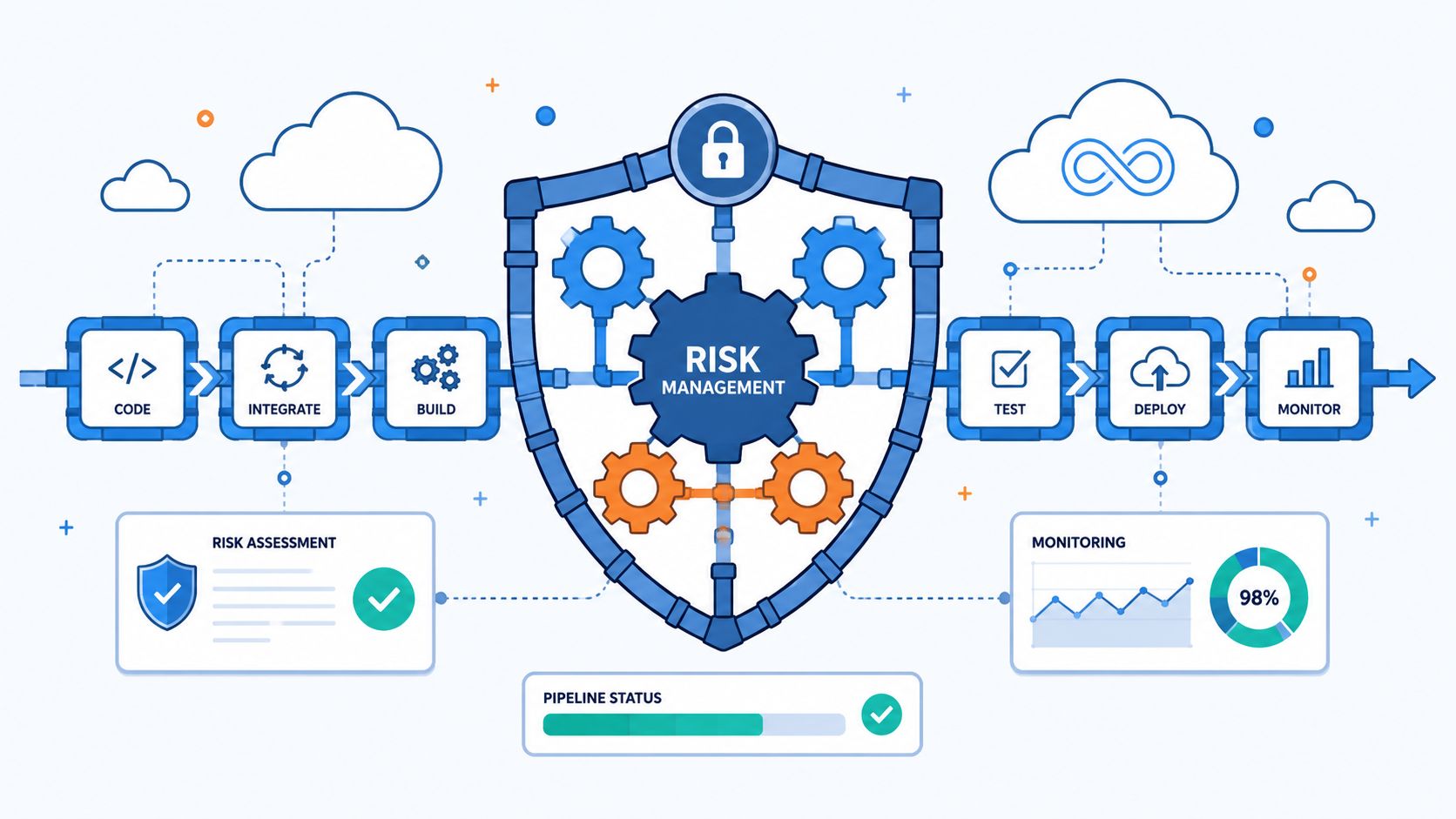

The alert lands at 2 a.m. Production is erroring, the deployment looked clean, and the root cause turns out to be a small manual infrastructure change that nobody thought was risky enough to document properly. By morning, your team has burned half a day on rollback, log scraping, and a Slack archaeology exercise to work out what changed.
That's the version of risk most startup engineering leaders live with.
It isn't a boardroom heat map. It's failed releases, fragile CI jobs, permissive IAM roles, stale Terraform, noisy monitoring, and cloud spend that drifts up because no one owns the whole system end to end. Teams in Europe, Singapore, the UK, and the US keep running into the same trap. They hire good engineers to build product, then gradually turn them into part-time platform maintainers.
Your Team Is Shipping Code Not Managing Infrastructure
A lot of teams say they need risk management software when what they really mean is something more practical. They need fewer avoidable incidents, fewer blind spots in delivery, and less time spent nursing an internal stack that grew faster than the company's operating discipline.
The pattern is familiar. A startup begins with sensible choices: GitHub Actions, Terraform, Kubernetes, a monitoring stack, some scripts around secrets and deploys, maybe a cost tool or two. None of that is unreasonable on its own. The trouble starts when each piece evolves separately, under pressure, with different assumptions and no real platform boundary.
Three things usually happen next:
- Release risk creeps up: pipelines become brittle, approvals vary by repo, and “temporary” exceptions become permanent.
- Security control gets uneven: one team has solid scanning and policy checks, another bypasses them because the workflow is too slow.
- Ops toil expands: senior engineers spend more time maintaining the delivery system than improving the product.
That is unmanaged operational risk. It's day-to-day exposure created by complexity.
The broader market reflects how common this has become. The global risk management software market reached USD 13.05 billion in 2025, and North America held 35.60% market share that year, reflecting strong demand for integrated platforms that deal with operational and cyber risk in highly digital environments, according to Mordor Intelligence's risk management software market analysis.
The problem usually isn't a missing dashboard
Most engineering leaders already have dashboards. They have alerts, cost views, security scanners, and audit logs spread across multiple tools. What they often don't have is a system that reduces the number of risky hand-offs in the first place.
Practical rule: If your risk controls depend on engineers remembering the right manual step at the right moment, you don't have a reliable control. You have a hope-based process.
That distinction matters. A standalone risk tool can record issues. An integrated operational platform can prevent a meaningful share of them from reaching production.
What strong teams optimise for
The best startup teams don't try to become infrastructure hobbyists at scale. They standardise the boring parts so developers can move quickly without rebuilding the same guardrails in every service.
A CTO should ask a blunt question: are your engineers generating advantage, or are they keeping a bespoke machine alive?
For fast-growing companies, the primary goal isn't to “manage infrastructure better”. It's to remove enough operational complexity that shipping product becomes the default again.
What Is Operational Risk Management in the Cloud
For a technical team, risk management software should be understood as an operating layer inside delivery, not a separate governance ritual. In cloud environments, operational risk management means identifying the conditions that cause incidents, assessing their impact, applying controls before they spread, and keeping those controls visible after deployment.
That workflow is easier to see when you map it to real engineering work.
The five motions that matter
Identify
In practice, this is finding an exposed storage bucket, a CI secret with weak handling, or a deployment path that skips policy checks. You're not hunting abstract threats. You're looking for misconfigurations and fragile workflows in AWS, GCP, or Azure.Assess
Not every issue deserves the same response. A permissive IAM role attached to a production workload has a different blast radius from an overbroad setting in a development environment. Good systems separate noise from material risk.Mitigate
This is where software earns its keep. Controls become codified. You block unsafe changes, enforce least privilege, standardise deployment paths, and reduce the number of one-off fixes hiding in scripts.Monitor
Controls decay. Teams change. New services arrive. Monitoring keeps checking whether yesterday's safe configuration is still safe today.Report
Reporting matters, but not as theatre. The useful report tells you which services are exposed, which controls are failing repeatedly, and who owns the fix.
Why spreadsheets fail here
Spreadsheets can track issues, but they don't keep pace with live infrastructure. They're static snapshots of a dynamic system. That's why cloud-native approaches are replacing them. In regions adopting cloud-native risk management, modular software architectures have reduced risk assessment cycle times by 40–55% compared with spreadsheet-based processes by removing manual data entry and enforcing consistent scoring, as described by Wolters Kluwer's overview of risk management software.
A practical example helps. If your team discovers repeated deployment instability, you don't just record “deployment risk” in a register. You trace it through the system:
- Change path: where can an unsafe config enter the pipeline?
- Control point: which automated checks should stop it?
- Runtime signal: what telemetry confirms the control worked?
- Ownership: who fixes the workflow, not just the latest incident?
That's also why it helps to think about deployment reliability and risk together. Teams that want a more operational view of this problem should look at reducing deployment failures in CI/CD, because release reliability is one of the clearest expressions of cloud operational risk.
What good implementation looks like
A workable cloud risk model usually has these traits:
| Area | What works | What fails |
|---|---|---|
| Change control | Policy checks inside delivery flow | Manual approvals in chat |
| Security | Defaults enforced in tooling | Repo-by-repo exceptions |
| Visibility | Runtime and deployment signals connected | Separate dashboards with no context |
| Ownership | Clear service and platform accountability | “Someone from DevOps owns it” |
Risk management becomes useful to engineers when it removes repeated judgement calls from routine delivery.
That's the shift. In the cloud, operational risk management isn't paperwork. It's disciplined automation around the places your team tends to get hurt.
Integrating Risk Control into Your CI/CD and Cloud Stack
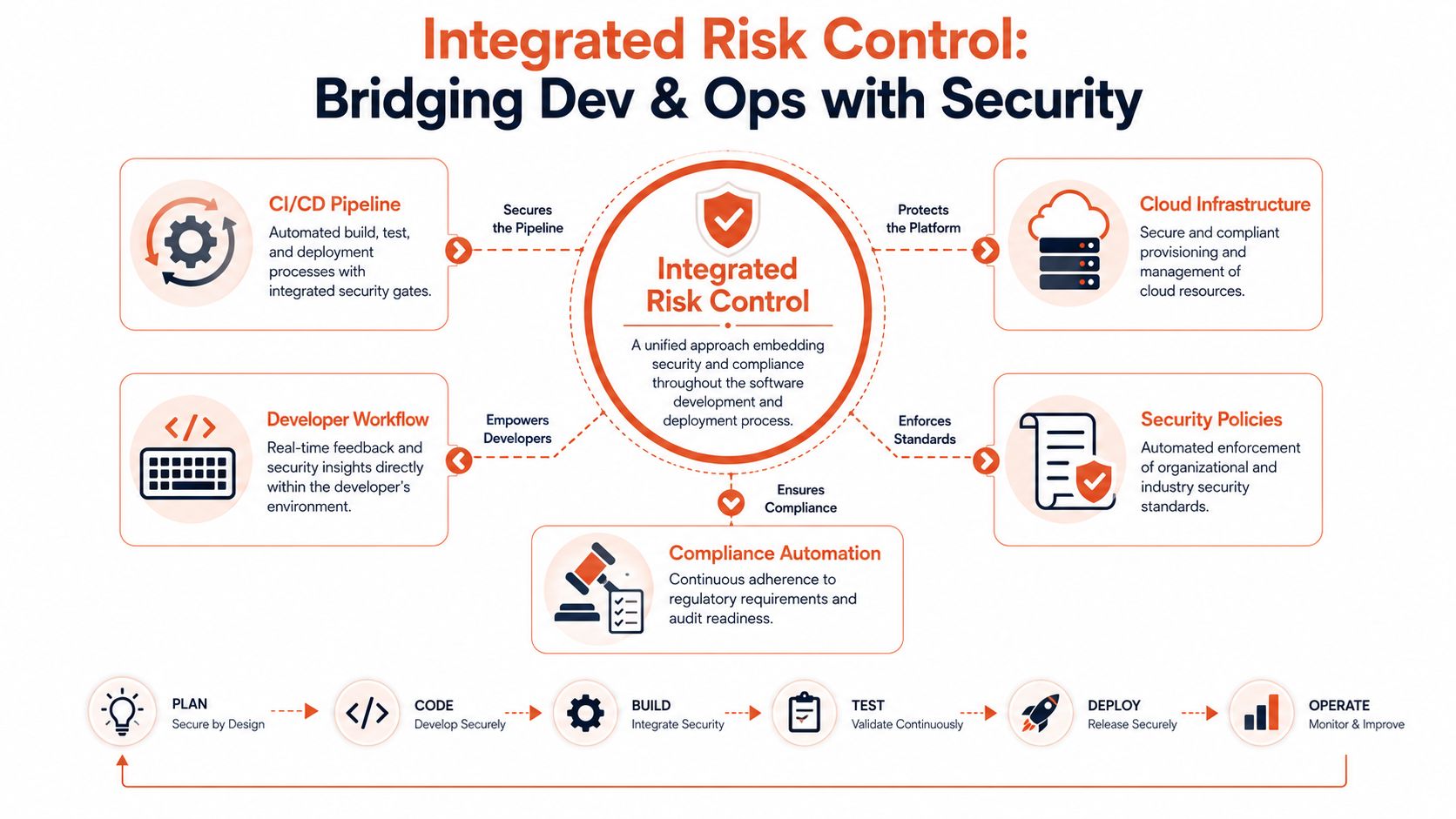
The strongest risk controls don't live in a separate portal that people check after the fact. They sit inside the path from commit to production.
If you're running modern delivery, that means the control surface is already there. It's in CI policy checks, IaC validation, secret handling, deployment approvals, runtime observability, and cost controls attached to environments. The question is whether those controls are integrated enough to be dependable.
Risk control belongs in the developer workflow
A practical setup often includes SAST in CI, policy-as-code checks before infrastructure changes are applied, and runtime alerts tied back to deployment events. Tools such as Open Policy Agent, GitHub Actions, Terraform, and cloud-native observability can all play a role. But stitching them together internally is where many teams get stuck.
The tooling count grows. The interfaces differ. Ownership gets fuzzy. One team maintains the pipeline templates, another owns Kubernetes, another handles cloud security, and nobody has a clean answer for how risk is measured across the whole flow.
That fragmentation creates a false sense of coverage. You can have many controls and still have weak operational risk management because the controls don't work together.
The human risk gap is real
Often, buying decisions prove flawed. Buyers often choose for visual reporting rather than behavioural control. 81% of risk software buyers prioritise dashboards, but they often miss the human risk gap. Modern platforms can detect patterns of decision failure, such as developers bypassing security controls, and those behaviours contribute to 60-80% of cloud incidents, according to Gartner Digital Markets buyer insights on risk management.
That matters more than it sounds. A skipped check in CI, a one-off production hotfix, or an undocumented policy exception usually doesn't look dramatic in isolation. Over time, those choices become the actual operational risk model of the company.
If a platform can't show where teams routinely bypass the intended path, it's only measuring technical state. It isn't measuring delivery behaviour.
Build the control plane once
If you need a reference point for what mature cloud and pipeline practice looks like, Technioz DevOps expertise is a useful external resource because it frames delivery as an integrated discipline rather than a set of disconnected tools.
The same principle applies internally. Strong teams define one paved road for builds, deployments, environments, and security enforcement. They don't ask every squad to become experts in platform design.
A simple way to sanity-check your current setup is to review whether you have:
- One deployment path: not a different release ritual per repo or business unit.
- One policy model: checks enforced consistently across infrastructure and application delivery.
- One observability story: deployment, runtime, and incident signals tied together.
- One ownership boundary: developers self-serve within safe defaults instead of waiting on a platform bottleneck.
Teams trying to simplify this often start with zero-maintenance CI/CD pipelines, because pipelines are where delivery risk, security friction, and platform toil tend to intersect first.
A standalone risk tool can tell you something went wrong. An integrated platform can make the wrong thing harder to ship at all.
The Hidden Costs of DIY DevOps and Fragmented Tooling
DIY DevOps looks cheap right up until you count the engineering time, incident load, and maintenance drag it creates.
Most startups don't choose a fragmented stack because they love complexity. They get there incrementally. One tool solves CI, another handles observability, another covers secrets, another gives cost reporting, and a growing pile of scripts glues the gaps together. On paper, the software licences may look modest. In practice, the team is paying with scarce engineering capacity.
That cost compounds in a particularly startup-specific way. The people maintaining infrastructure aren't generic operators. They're usually senior engineers who should be building product capability, improving architecture, or shortening time to release.
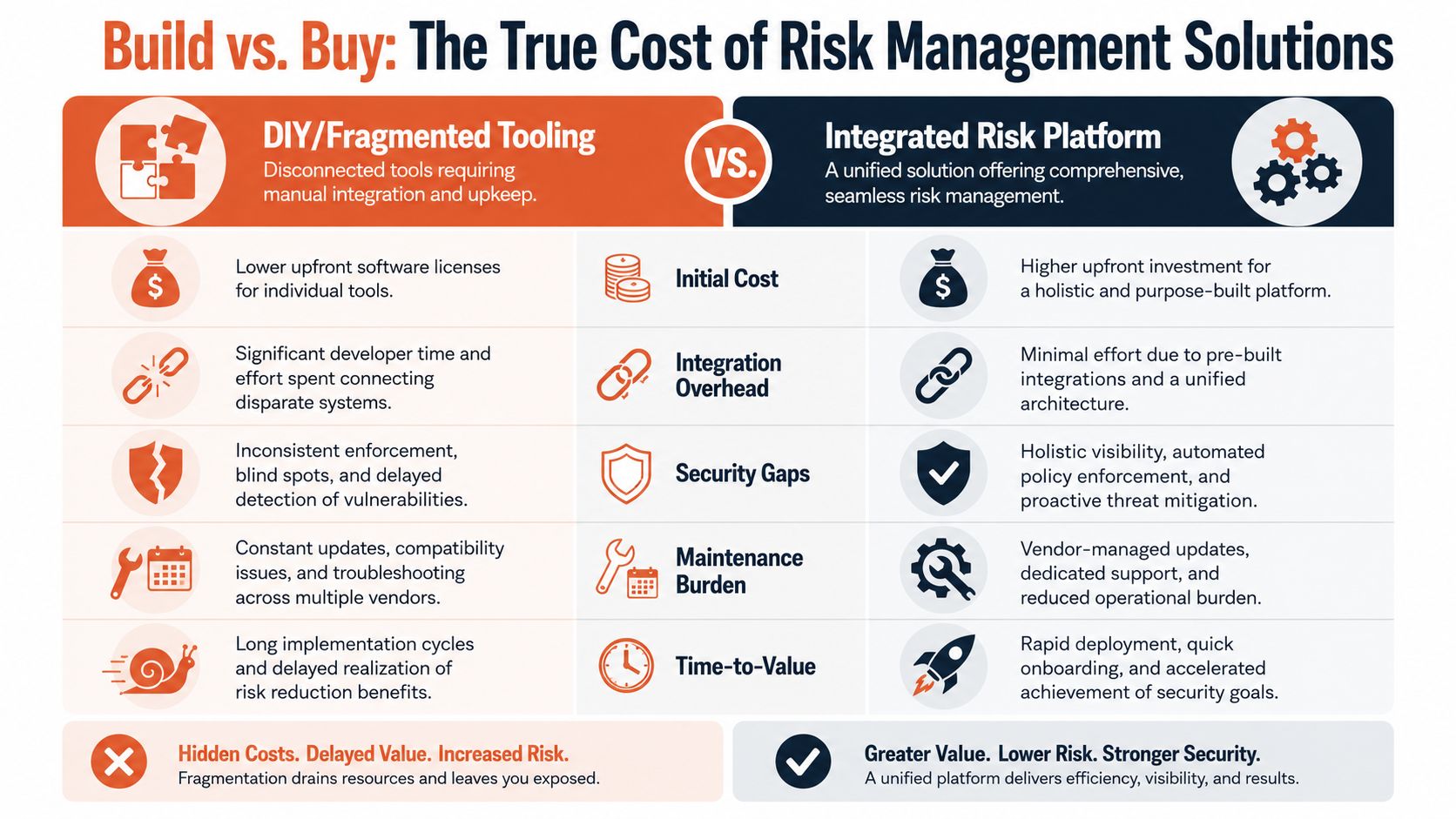
Your “free” stack isn't free
DIY DevOps approaches incur hidden annual costs averaging $300,000, with the drag showing up through slower release cycles, repeat outages, and senior engineers absorbed in tooling maintenance, as outlined in this analysis of the hidden cost of DIY DevOps.
That figure resonates because it matches what many CTOs already suspect. The budget line says infrastructure is under control. The calendar says otherwise.
Where the money actually goes
A fragmented stack creates cost in places finance rarely labels as infrastructure spend:
- Engineering diversion: senior developers debug pipeline issues instead of shipping roadmap work.
- Recovery effort: outages trigger all-hands interruptions, rollback work, and post-incident cleanup.
- Tooling upkeep: version drift, integration breakage, and one-off scripts need constant attention.
- Decision latency: releases slow down because nobody fully trusts the delivery path.
European startups feel this especially sharply because capital efficiency matters. There's a strong business argument for automating DevOps infrastructure rather than sinking talent into maintaining fragile internal systems, as discussed in this perspective on automated DevOps infrastructure for European startups.
Buy versus build is really a focus decision
A lot of teams compare licence cost against headcount too narrowly. The better comparison is between a production-ready platform and the accumulated burden of replacing platform capability with engineers, consultants, and perpetual maintenance.
In the UK startup market, managed DevOps retainers typically range from £4,000 to £12,000 per month for growth-stage companies, while a full in-house DevOps transformation can cost between £25,000 and £500,000+ over 3–18 months, according to this UK startup DevOps cost breakdown. The exact route depends on maturity and complexity, but the strategic question is simple: do you want your company to fund product development, or recreate a platform business inside your engineering org?
Operator's view: Every custom platform decision creates an ongoing maintenance obligation. Teams usually budget for implementation and forget to budget for ownership.
If you're weighing options, it helps to examine developer platform automation through that lens. The value isn't just convenience. It's reducing the amount of expensive engineering attention consumed by keeping delivery infrastructure alive.
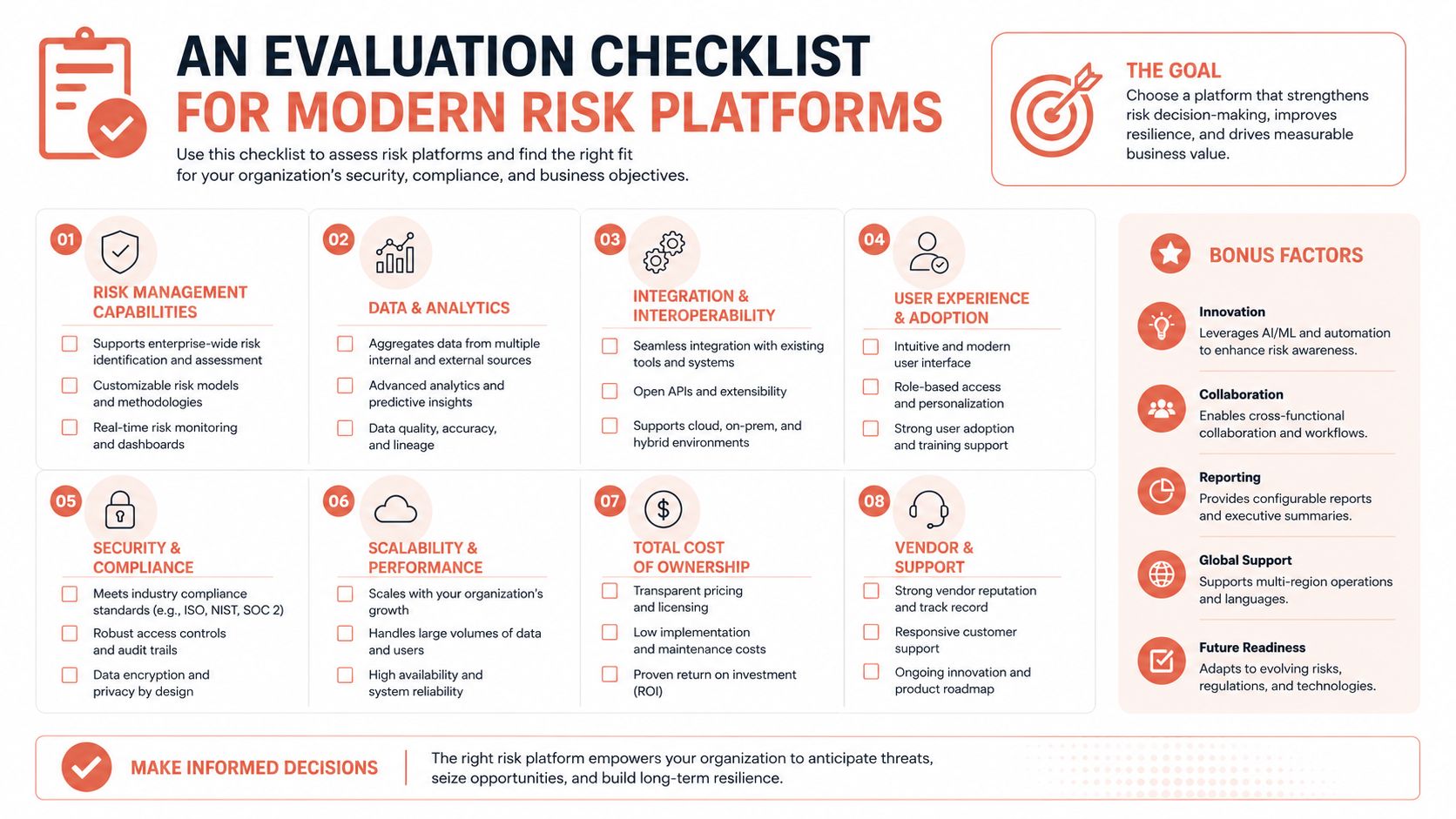
An Evaluation Checklist for Modern Risk Platforms
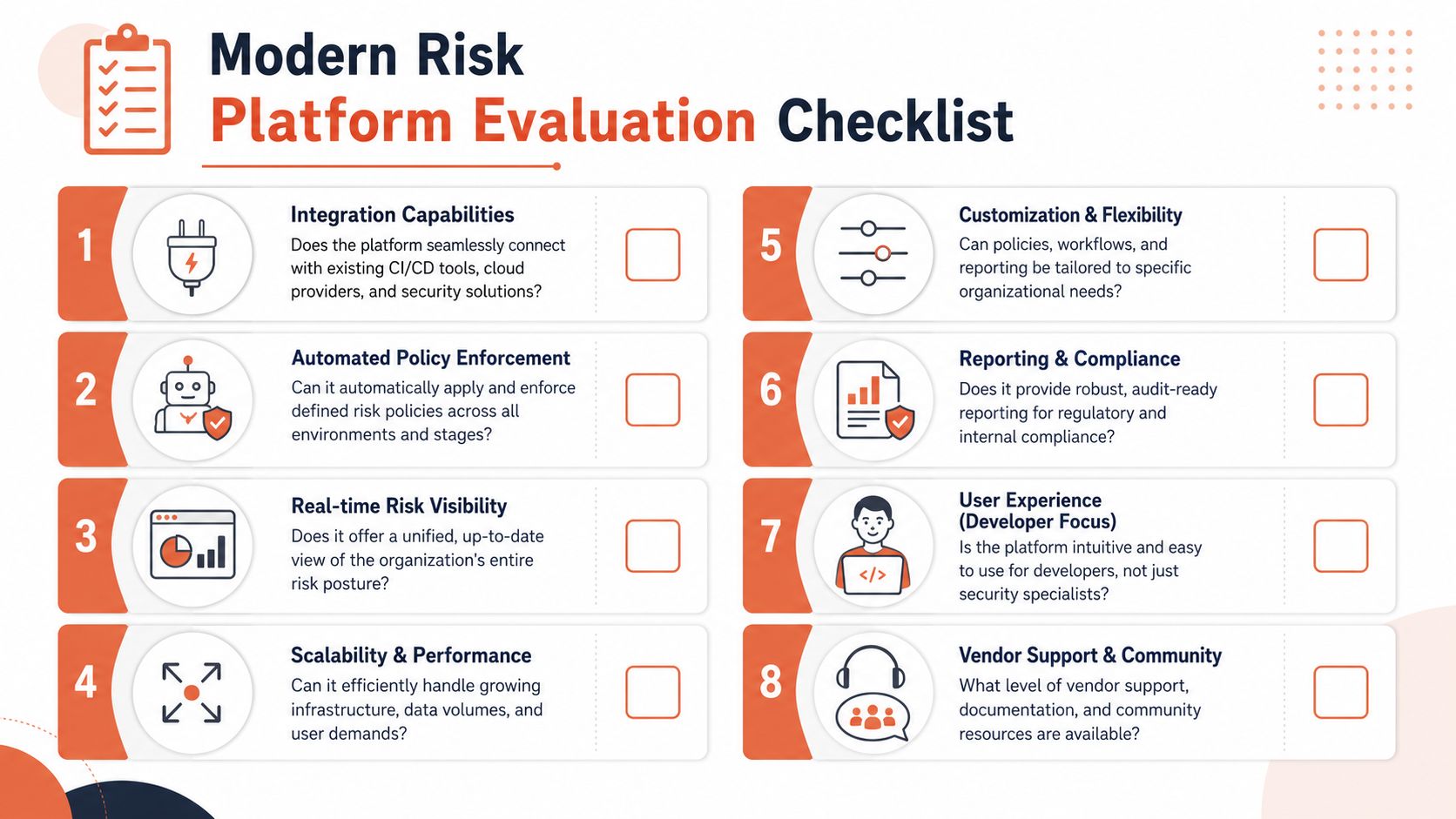
When a CTO or VP Engineering evaluates risk management software, the useful question isn't “which product has the most features?” It's “which option reduces operational exposure without creating another specialist system my team has to maintain?”
That changes the shortlist quickly. A platform that looks strong in procurement-led demos may still be a poor fit for software teams if it doesn't connect clearly to CI/CD, runtime operations, and multi-cloud infrastructure.
Evaluate for operational reality
Industry estimates suggest 15–25% of a DevOps engineer's capacity is permanently consumed by maintaining CI/CD pipelines, IaC templates, and monitoring configurations rather than improving them. That's why multi-cloud platforms are worth serious attention, as noted in this review of DevOps implementation cost expectations.
A good evaluation process should treat that lost capacity as part of the buying decision.
Questions worth asking vendors
Use these criteria to separate real operational advantage from polished demos:
Coverage across AWS, GCP, and Azure
If your company is already multi-cloud, or expects to become so, ask whether the platform provides a coherent operating model across providers. You want consistent deployment workflows, security controls, visibility, and spend governance. You do not want three different patterns hidden behind one UI.
Setup effort and long-term ownership
Ask what your team must build, configure, and maintain after implementation. Some products are powerful because they're highly configurable. That can also mean they arrive half-finished and require internal specialists to keep them useful.
Security by default
A strong platform should enforce role-based access, auditability, policy controls, and safe deployment defaults without requiring constant expert intervention. If secure operation depends on bespoke setup in every environment, the product is pushing risk back onto your team.
Cost visibility tied to action
Cloud cost data matters when it changes behaviour. A useful platform helps teams see where spend is drifting and gives them controls they can apply, such as environment scheduling, rightsizing, or safer autoscaling policies.
Developer experience
This point gets underestimated. If using the platform makes developers slower or more dependent on a central team, they'll route around it. For a different but relevant lens on operational discipline, Digna's data reliability checklist is worth reading because it shows how reliability work becomes sustainable only when teams can follow a repeatable operating model.
A shortlist should expose trade-offs
| Evaluation area | Strong answer | Warning sign |
|---|---|---|
| Platform fit | Supports delivery workflow directly | Mostly a reporting layer |
| Maintenance burden | Vendor-managed upgrades and controls | Internal team owns integrations forever |
| Developer adoption | Self-service with guardrails | Ticket-driven access to everything |
| Risk visibility | Unified operational view | Separate security, cost, and release silos |
The best platform decision usually looks boring in the right way. Fewer moving parts. Fewer exceptions. Less custom glue. More consistency from commit to production.
That's what operational risk management should buy you.
Focus on Product Not Your Platform
Most startups don't fail because they lacked another dashboard. They lose speed because too many good engineers become caretakers of infrastructure they never intended to run as a product.
That's the mistake hidden inside a lot of risk management software discussions. The conversation drifts toward compliance categories, reporting structures, and control libraries, while operational damage keeps happening in delivery. A brittle pipeline blocks releases. A manual cloud change causes an outage. A fragmented stack hides cost drift until the invoice arrives. A security exception becomes normal because the paved road is too hard to use.
Those aren't separate issues. They're symptoms of the same architectural decision. The company kept building its own operating substrate long after that stopped being a source of advantage.
A better mindset for technical leadership
CTOs and VP Engineering leaders should challenge one assumption hard: that more internal platform work automatically creates more control. Often it does the opposite. It spreads ownership, increases cognitive load, and makes reliability depend on a handful of engineers who understand the glue code.
A production-ready multi-cloud DevOps platform changes the trade-off. It can streamline setup, scaling, monitoring, security, and cloud cost control across AWS, GCP, and Azure. More importantly, it lets developers work inside a system designed to enforce good defaults rather than relying on tribal knowledge and constant intervention.
You don't need your startup to become unusually good at managing infrastructure. You need it to become unusually good at shipping product without operational chaos.
That's the core frame for risk management software in a software company. Not generic GRC. Not another silo. Operational risk reduction through standardised delivery, stronger defaults, and less engineering toil.
If your team is still spending too much time on Kubernetes upkeep, CI/CD maintenance, patchwork monitoring, and cloud cost firefighting, the answer usually isn't to hire more people into the same pattern. It's to stop treating infrastructure assembly as a core competency when what the business needs is reliable product delivery.
If you want that shift without building an internal platform team around every problem, PushOps gives software teams a production-ready cloud infrastructure and deployment platform across AWS, GCP, and Azure. It replaces fragile scripts and fragmented tooling with integrated deployments, observability, security defaults, and cloud cost controls so your engineers can spend more time shipping features and less time managing infrastructure.

