


A familiar pattern plays out in growing software teams. A developer needs a new environment, another waits on a pipeline fix, and a senior engineer jumps into Slack to explain why staging no longer matches production. The roadmap says “ship features”. The calendar says “repair delivery plumbing”.
That tension usually starts long before anyone says “we need an internal developer platform”. It starts when Kubernetes, CI/CD, monitoring, secrets, cloud permissions, and cost controls are all introduced one by one, often with good intent, but without a single operating model behind them. What looked flexible at the start becomes fragile at scale.
Introduction to Internal Developer Platform Challenges
A CTO at a startup rarely wakes up wanting to review Terraform modules or debug failed deployment jobs. Yet that’s where many weeks go. Product teams ask for speed, but engineering leaders inherit tool sprawl, inconsistent environments, and queues for DevOps help.
The cost is bigger than inconvenience. The 2025 State of Internal Developer Portals report says 94% of developers are dissatisfied with current self-service tools, only 11% use internal developer portals for tasks such as creating cloud resources or Kubernetes clusters, and tool sprawl costs developers an average of 6.7 hours each week. The same report says 78% of teams wait a day or more for assistance.
That creates a hidden tax on delivery.
A team might have GitHub Actions for builds, Terraform for infrastructure, ArgoCD for deployments, Grafana for dashboards, and a collection of scripts that only two people fully understand. Nothing is “wrong” in isolation. The problem is that developers still need to know too much about the machinery behind every release.
Most infrastructure pain in startups doesn’t come from one bad tool. It comes from too many good tools stitched together without a clear developer experience.
An internal developer platform is meant to solve that. Not by removing engineering discipline, but by packaging it into a workflow developers can use without opening a support ticket every time they want to ship.
Understanding Key Concepts of an Internal Developer Platform
An internal developer platform works best when you think of it as an app store for developers. Instead of asking developers to assemble infrastructure from raw parts, the platform gives them approved, ready-to-use options.
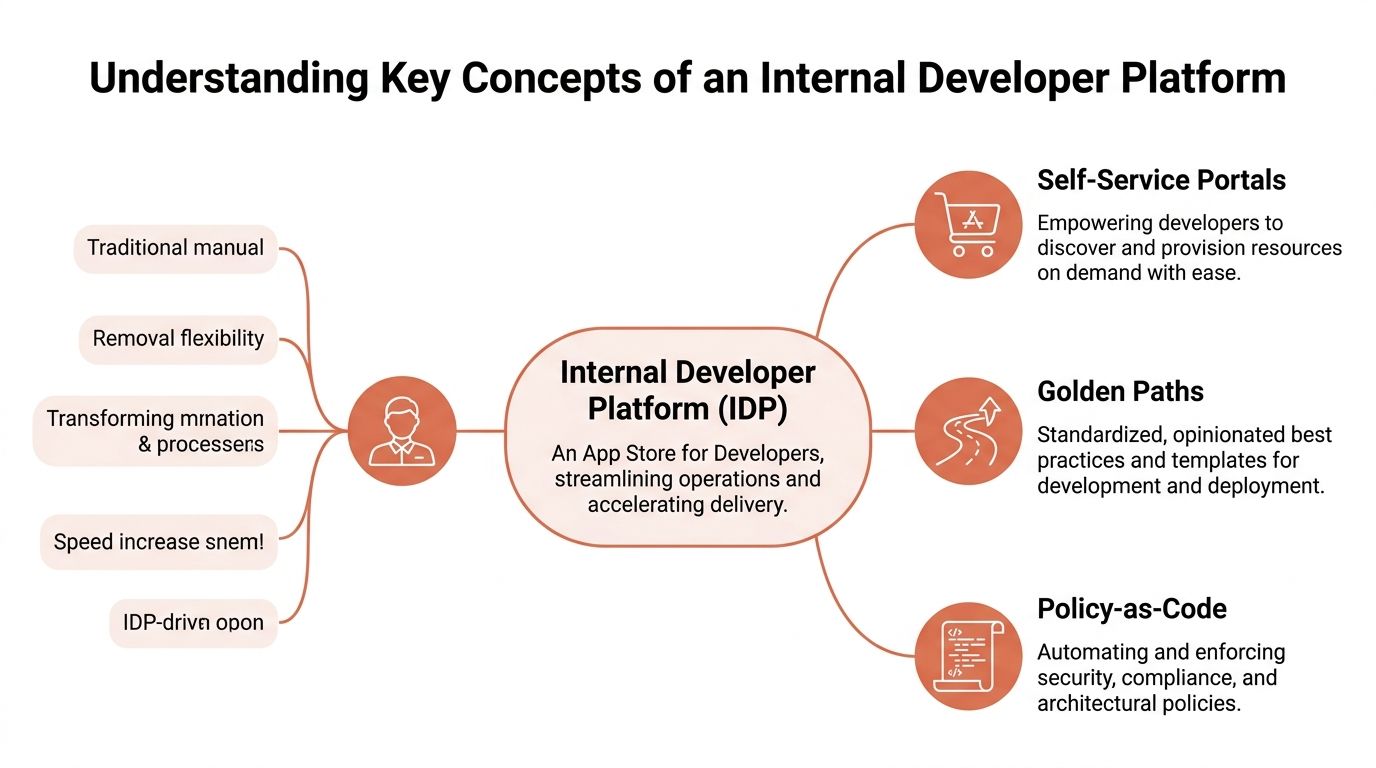
A developer shouldn’t need to remember every Kubernetes setting, networking rule, or CI step just to launch a service. They should be able to choose a standard service template, supply a few inputs, and let the platform handle the rest.
According to the State of Platform Engineering 2024 summary, over 65% of enterprises have built or adopted an internal developer platform. The same source says companies using IDPs deliver updates 40% faster, cut operational overhead nearly in half, and reduce context switching by 35%.
Self service without chaos
Self-service is often misunderstood. It doesn’t mean “everyone can do anything”. It means developers can perform common actions on their own within safe limits.
Typical self-service actions include:
- Create a new service
- Provision a test environment
- Trigger a deployment
- View logs and health checks
- Roll back to a stable version
That’s the difference between autonomy and anarchy. The platform gives freedom inside guardrails.
Golden paths and policy as code
A golden path is a recommended way to build and ship software. It’s opinionated on purpose. If your team uses Node.js services on Kubernetes with GitOps and standard monitoring, the golden path should encode that setup so each team doesn’t reinvent it.
Policy as code moves rules out of tribal knowledge and into automation. Instead of telling teams to remember security settings, the platform enforces them by default.
Practical rule: if a platform depends on developers reading a wiki page to stay compliant, it isn’t really a platform yet.
The clearest technical explanation of these ideas is in this technical guide to the Internal Developer Platform, which is useful if you want to compare abstract definitions with the operational reality of platform work.
Drift detection in plain English
Environment drift happens when production, staging, or a cluster configuration changes in a way nobody planned. One manual tweak can create a bug that only appears later.
Drift detection is the platform checking, “Does the environment still match the approved version?” If not, it flags the mismatch or restores the intended state. It serves as version control for your runtime setup, not just your application code.
Core Components That Power an Internal Developer Platform
A solid internal developer platform isn’t one product screen. It’s a set of connected capabilities that remove repeated engineering work.
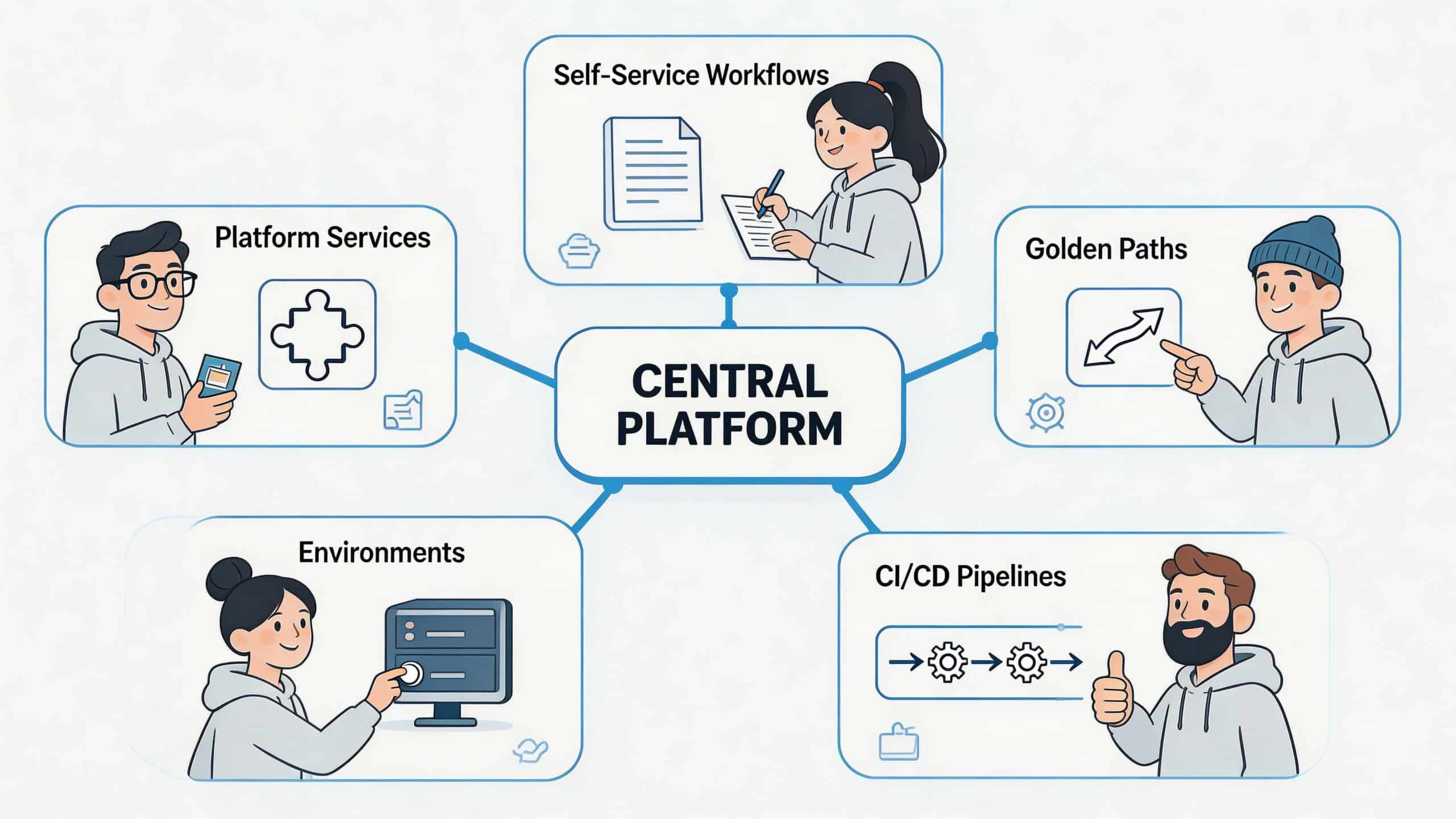
When CTOs assess platforms, they should look less at marketing labels and more at how these parts work together in daily delivery.
Self service workflows and golden paths
The front door matters. If developers can’t discover the right way to create a service, they’ll fall back to old scripts and direct cloud access.
A good platform offers standard workflows for common tasks:
- New service creation with approved templates
- Environment requests for dev, test, and staging
- Deployment actions tied to branch or release workflows
- Operational tasks such as restart, rollback, or log access
Golden paths sit underneath those actions. They encode the preferred buildpacks, runtime settings, networking defaults, and deployment strategy. This reduces variation where variation adds risk, not value.
One useful reference point is this overview of a DevOps cloud infrastructure platform, which shows how infrastructure, deployment, and operations can be presented as one coherent workflow instead of separate tools.
CI CD that developers don’t need to babysit
Teams don’t want “a CI/CD system”. They want code changes to move reliably from commit to production.
The internal developer platform should wire together build, test, deploy, and rollback. Tools like Jenkins, ArgoCD, and GitHub Actions can all play a role, but the platform experience should hide unnecessary complexity.
A practical example is a canary rollout. Instead of a manual release meeting, the platform can send a small slice of traffic to the new version, watch service health, and roll back if errors rise. Developers get safer releases without becoming release engineers.
Environment management and drift control
Environment setup is where many delivery delays begin. Teams often think they have standard environments, but each one collects small differences over time.
A platform should manage environments as reusable templates, not one-off projects. That includes:
- Consistent configuration across dev, test, staging, and prod
- Versioned infrastructure definitions
- Automated checks for drift or unauthorised changes
- Predictable teardown for temporary environments
The bug that “only happens in staging” is often an environment problem, not an application problem.
If your team keeps saying “works on my machine” or “staging is weird again”, your platform layer is doing too little.
Observability by default
Observability shouldn’t be bolted on after the first incident. The platform should attach logs, metrics, traces, and health checks from the start.
That means a new service should arrive with dashboards, alerts, and enough context to diagnose issues quickly. Prometheus, Grafana, and tracing tools are powerful, but many teams get limited value because each service team wires them differently.
A platform standardises that work. The outcome isn’t just better dashboards. It’s faster diagnosis under pressure.
Security and access without ticket ping pong
Security becomes friction when it’s separate from the delivery path. The better approach is to make secure defaults part of the platform itself.
Look for:
- Role based access controls tied to teams and environments
- Audit logs for deployment and access history
- Policy enforcement for secrets, runtime settings, and approvals
- Standard permissions that remove ad hoc admin requests
This helps CTOs reduce both risk and interruption. Developers spend less time waiting for privileges, and security teams get consistency.
Cost controls inside the platform
Cloud cost control usually arrives late, after the surprise invoice. A stronger model is to build cost awareness into the platform.
That can include autoscaling, right-sizing, scheduled shutdowns for non-production environments, and visibility into which services consume what. Developers then make cost-aware decisions without becoming FinOps specialists.
Business Benefits and Technical Tradeoffs of an IDP
The business case for an internal developer platform is straightforward when delivery friction is already visible. Fewer handoffs, safer releases, and less custom infrastructure work usually translate into more time spent on product.
The technical tradeoff is that standardisation always changes how teams operate. Some engineers will worry that a platform reduces flexibility. Sometimes they’re right. A platform that forces every edge case into one template becomes a bottleneck.
Where the gains show up
The strongest gains often come from consistency, not magic. Teams stop rebuilding the same deployment patterns, service scaffolding, and access controls for every project.
In the LT region, Baltic FinOps Consortium data summarised here says engineering teams adopting IDPs achieve 34% higher DORA metrics, moving from one deploy per week with 45-minute recovery times to 10 deploys per day and 7-minute recovery through automated pipelines and integrated observability.
For CTOs, that means the platform discussion isn’t only about infrastructure elegance. It’s about business throughput. If you care about release confidence, incident recovery, and whether teams can ship without opening three internal tickets, this is part of the same problem.
A related lens is developer productivity. This article on developer productivity is useful because it frames productivity as reduced friction, not just more output.
Where teams get it wrong
Platform efforts fail when leaders treat them as a side project or a tooling bundle. An internal developer platform needs ownership, operating rules, and clear service boundaries.
Common tradeoffs include:
- Upfront design effort. You need to define what “the standard path” is.
- Change management. Teams must trust the platform enough to stop bypassing it.
- Tooling constraints. Some workloads won’t fit the first version of the platform.
- Buy versus build tension. Full control sounds attractive until maintenance takes over.
A useful decision frame is this explanation of developer platform automation, which helps separate automation that removes toil from automation that moves complexity around.
The best internal developer platform doesn’t eliminate choice. It removes low-value choices so engineers can spend judgment on product and architecture.
Bespoke solutions still make sense when a company has unusual compliance, infrastructure, or workload requirements. Most startups and scale-ups, though, don’t need a custom platform as much as they need a reliable one.
Choosing and Implementing an Internal Developer Platform with Checklist and KPIs
The hardest question isn’t “What is an internal developer platform?” It’s “Should we build one ourselves?”
Many teams start by assembling tools they already know. Kubernetes on one side, CI/CD on another, observability elsewhere, and a backlog full of glue work in between. That can work. It can also turn into a second product that your company never meant to own.
Build or buy decision points
Build in-house if your environment is unusually specialised and that difference is central to your business. For example, you may have strict deployment controls, uncommon networking models, or internal systems that an off-the-shelf product can’t represent well.
Buy or adopt a managed platform if your bottlenecks are familiar ones:
- Your team spends too much time on platform maintenance
- Developers wait on environment setup or pipeline fixes
- Only a few engineers understand the current delivery stack
- You need standardisation across AWS, GCP, or Azure
- You want governance without hiring a larger platform team
In the LT region, this summary on internal developer platforms says cloud-native adoption is growing with AWS and GCP usage up 45% YoY. It also notes that IDPs reduce deployment failure rates by 62%, and time-to-service creation falls from 4.2 days to 18 minutes through automated provisioning and drift detection.
That matters because many CTOs underestimate how much platform value comes from reducing wait states, not just from making deployments faster.
A migration path that teams can actually follow
Don’t migrate everything at once. Start with the workflow that creates the most repeated pain.
A practical rollout often looks like this:
Map the current path
Write down how a service moves from idea to production. Include every handoff, approval, script, and manual check.Find the repeated work
Focus on the steps teams perform again and again, such as environment setup, service scaffolding, deployment approval, and log access.Define one golden path
Pick a common service type and create a standard workflow around it. Keep the first version narrow.Pilot with one willing team
Choose a team that ships regularly and can give honest feedback. Avoid the most complex workload first.Bake in security and observability early
Don’t add them later. If the first platform experience lacks dashboards, logs, and sensible access rules, adoption will stall.Train through usage, not theory
Good onboarding means developers complete real tasks quickly. They shouldn’t need a platform engineer beside them for basic actions.Expand only after the first path works
Add more service types, cloud options, and policies once the first workflow is stable and trusted.
Start with one painful workflow and make it boring. Boring is what scale looks like in platform engineering.
Migration Checklist and KPIs
| Step | Action | KPI | Target |
|---|---|---|---|
| Audit toolchain | List current CI/CD, infrastructure, monitoring, security, and cost tools | Tool sprawl baseline | Clear inventory agreed by engineering leadership |
| Identify first use case | Pick one common service or deployment path to standardise | Adoption of pilot workflow | Pilot team uses the new path for routine delivery |
| Define golden path | Create approved templates, defaults, and guardrails | Time to service creation | Move toward the 18-minute benchmark noted in the LT region source |
| Automate environments | Standardise dev, test, staging, and production setup | Deployment failure rate | Improve toward the 62% reduction reported in the LT region source |
| Add observability and policy controls | Make logs, metrics, access, and auditability part of the default setup | Recovery quality | Faster diagnosis and fewer manual escalations |
| Train teams | Use short, task-based onboarding | Self-service completion | Most common actions completed without platform team help |
| Review economics | Compare maintenance effort and cloud usage before and after | Platform operating cost | Lower platform toil and more predictable cloud use |
For teams evaluating alternatives to a heavily customised portal, this guide to an internal developer portal alternative is a useful reference during vendor review.
KPIs that matter to CTOs
Choose KPIs that reflect delivery quality, not vanity.
Good platform KPIs include:
- Deployment frequency because it shows whether shipping has become easier
- Lead time to production because waiting is often a primary cost
- Recovery time because a fast path to rollback matters as much as release speed
- Environment provisioning time because that’s where many teams bleed momentum
- Developer satisfaction with platform workflows because unused platforms fail
- Operational overhead because platform work should shrink routine support load
Avoid measuring success only by “number of platform features shipped”. A platform succeeds when product teams depend on it without feeling trapped by it.
PushOps in Action with Internal Developer Platform Use Cases
Abstract platform discussions become clearer when you tie them to everyday delivery work. Three patterns show up often in teams that adopt a managed internal developer platform.
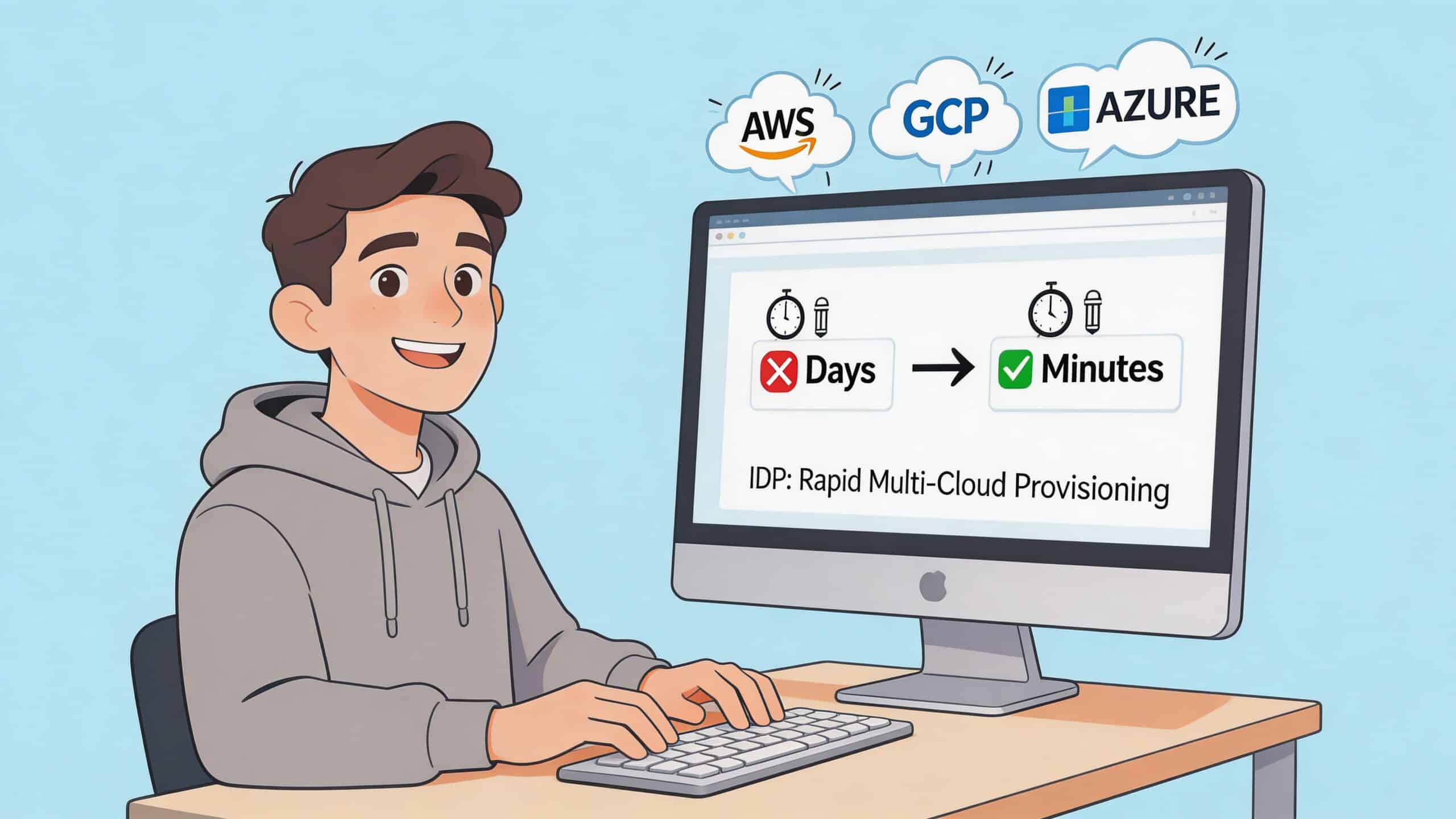
Multi cloud setup without bespoke glue
A startup running workloads across AWS, GCP, and Azure usually starts with good reasons. One product needs a managed service on one cloud, another team inherits a different provider, and suddenly platform consistency becomes hard.
A managed platform gives teams one operating surface for provisioning foundations, deployments, and observability across clouds. Developers don’t need separate cloud-specific playbooks for every common task. The CTO gains a standard process instead of three parallel ones.
CI CD without becoming a pipeline company
Scale-ups often discover they’ve built a side business in pipeline maintenance. Release engineers spend time repairing YAML, adjusting runners, and explaining deployment paths that should have been automatic.
A managed platform can remove most of that maintenance burden by giving teams zero-touch workflows from commit to production, with release strategies and rollback built in. The value isn’t only speed. It’s that senior engineers stop acting as interpreters between developers and the delivery stack.
Onboarding teams that aren’t platform experts
Many internal platform efforts break down when onboarding teams that lack platform expertise. LT region pilot data shows 85% of developers lack advanced platform engineering skills and 55% of IDP pilots fail due to usability friction. The same source says SaaS IDPs with zero-maintenance onboarding and low-code templates see 3x higher adoption among junior-mid teams.
That aligns with what many CTOs already feel. If only your most senior infra-minded developers can use the platform well, you haven’t simplified delivery. You’ve hidden complexity behind a new interface.
A platform should lower the skill threshold for safe delivery. It shouldn’t require every developer to think like an SRE.
Next Steps for Adopting an Internal Developer Platform
Teams don’t have an infrastructure problem. They have a focus problem. Too much engineering time goes into maintaining delivery machinery that doesn’t differentiate the product.
An internal developer platform helps when it turns repeated operational work into a standard, self-service experience. The best outcome is simple. Developers ship more safely, leaders get clearer governance, and fewer people lose time to environment drift, pipeline repair, and cloud sprawl.
If you’re evaluating the next move, start with one workflow your team finds frustrating today. Decide whether that pain is worth owning as a permanent internal system. If it isn’t, a managed approach is often the faster and lower-risk path.
If your team wants a practical way to reduce DevOps overhead without building an entire platform in-house, take a look at PushOps. It gives software teams a production-ready path across AWS, GCP, and Azure, with self-service workflows, deployment automation, observability, security controls, and cost optimisation built in, so your engineers can get back to shipping product.

