
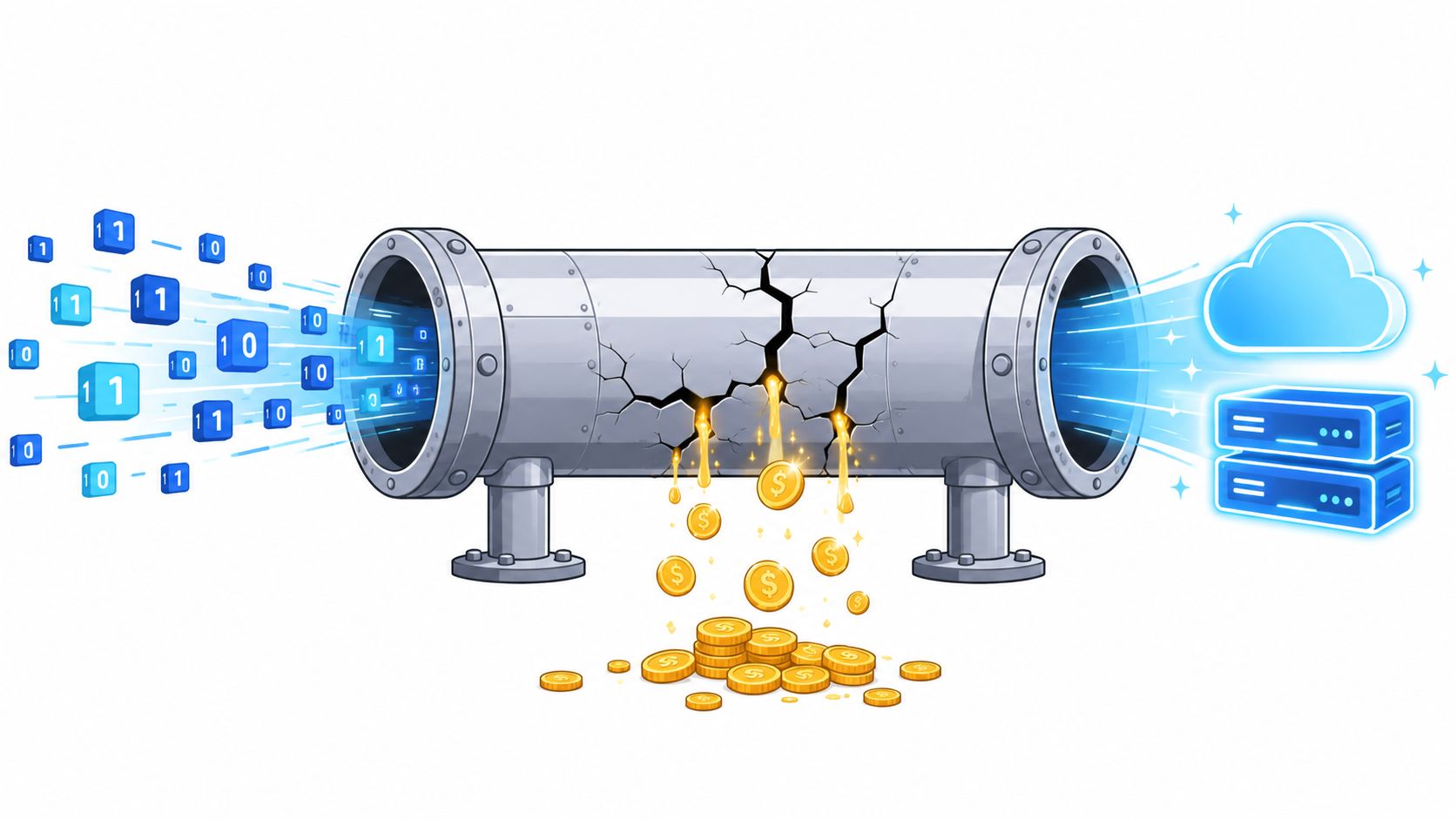

It's late, the release window is slipping, and your senior engineers are debugging a deployment script instead of closing the week with a shipped feature. Nobody planned for that to become normal. Yet in a lot of startups and scale-ups, the CI/CD pipeline has gradually turned from a speed tool into a maintenance burden.
That's the trap. Teams invest in a CI/CD pipeline to move faster, reduce release risk, and standardise delivery. Then the pipeline itself becomes another product to build, secure, support, and evolve. Every flaky build, every brittle plugin, every one-off cloud workaround takes time away from roadmap work.
For CTOs and VP Engineering leaders, that's not just a technical annoyance. It's a capital allocation problem. If your best people are spending their week nursing infrastructure, you're funding operational drag instead of product progress.
Your Pipeline Is Costing More Than You Think
A lot of engineering leaders still think about pipeline cost as a tooling line item. Jenkins hosting. GitHub Actions minutes. Artifact storage. Maybe a few paid plugins. That's the visible part.
The actual cost sits in the interruptions.
A developer merges code. The build fails, not because the change is broken, but because an agent image drifted. Another engineer reruns a flaky test suite. Someone with production access gets pulled into Slack because the deployment job can't authenticate against the target environment. By the time the issue is fixed, three people have context-switched away from feature work.
The expensive part of a DIY CI/CD stack usually isn't the infrastructure. It's the engineering attention it consumes every week.
This gets worse as the company grows. The first version of the pipeline was probably written by one capable engineer who knew the whole system. Later, the stack gained special cases. Mobile builds need one path. Hotfixes need another. Staging works one way on AWS, production another way on Azure. Security checks were added later. Cost controls later still.
Where the drag shows up
- Release friction means developers wait on the system rather than on code review.
- Operational dependency means a small number of people become gatekeepers for delivery.
- Uneven standards mean each team solves the same deployment problem slightly differently.
- Pipeline fragility means a small infrastructure change can block product work for hours.
The result is predictable. Engineering leaders ask for velocity, but the organisation has built a second platform team by accident. It just isn't called that yet.
Why leaders miss it
Cloud invoices are easy to spot. Opportunity cost isn't.
When senior developers spend their time maintaining release automation, you're paying expert salaries for work that doesn't differentiate your product. You're also slowing architecture work, onboarding, and customer-facing delivery. Over time, that compounds into a very expensive habit.
What Is a CI/CD Pipeline Really
A CI/CD pipeline is the automated path from a code commit to running software. The easiest way to think about it is as an assembly line for software delivery. Developers provide the raw materials through code changes. The pipeline builds, tests, packages, and releases those changes in a repeatable way.
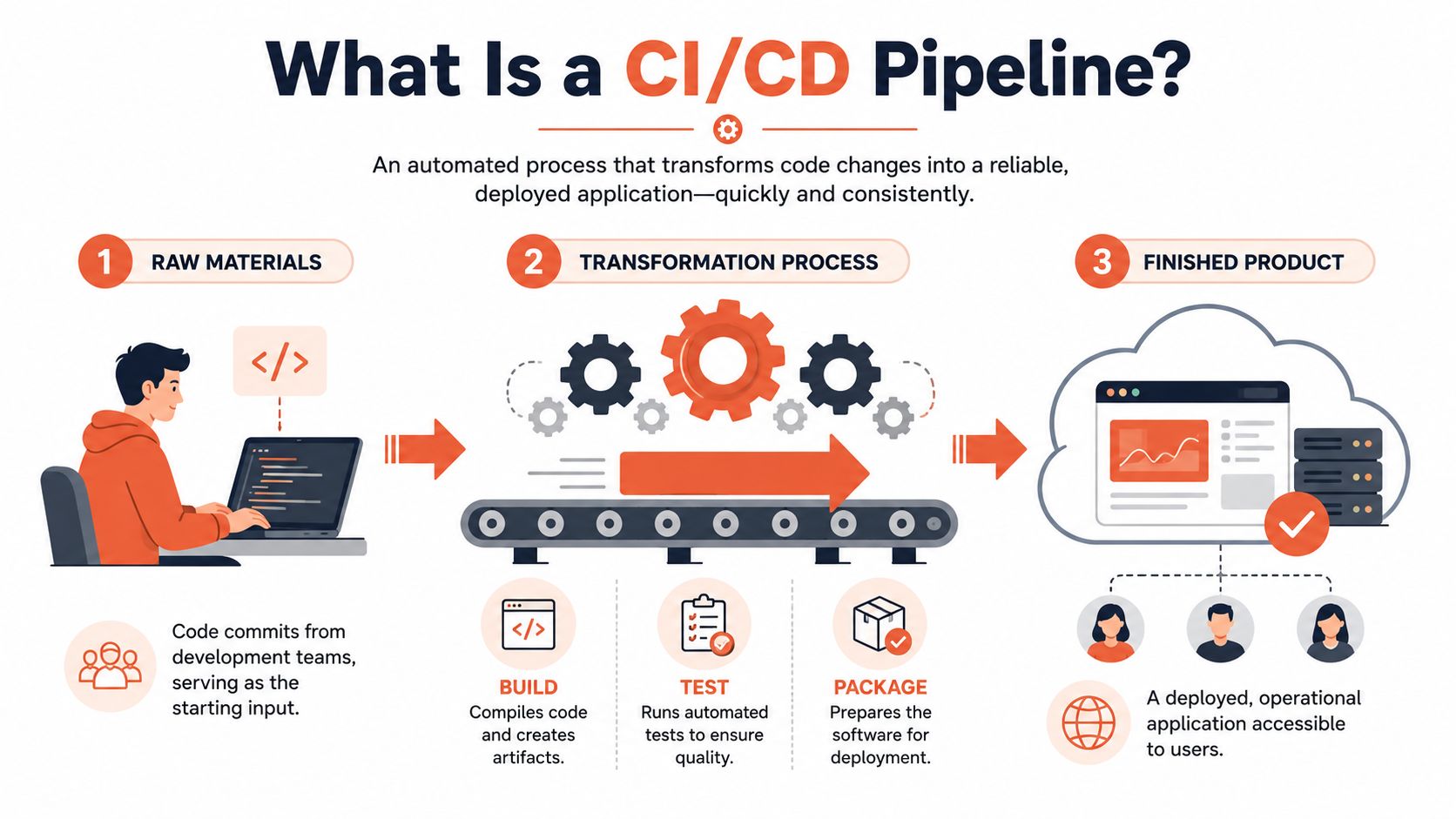
Continuous Integration
Continuous Integration is the discipline of merging code into a shared branch frequently and validating it automatically. In practice, that means every commit should trigger predictable checks such as compiling the code, running tests, and catching integration issues early.
That matters because integration problems are cheapest to fix when they're still small. If teams leave validation until the end of a sprint or before a release, defects cluster together and debugging gets slower.
Continuous Delivery and continuous deployment
Continuous Delivery takes the output of CI and moves it towards release readiness. The application is packaged, tested further, and prepared for promotion into a production-like or production environment. A team may still require a manual approval before going live.
Continuous deployment goes one step further. If the build passes all required checks, it deploys automatically to production.
The distinction matters less than is commonly assumed. The point isn't ideological purity. The point is having a delivery system that is fast, reliable, and boring enough that engineers trust it.
For teams thinking about optimizing software delivery, it helps to view CI and CD less as tools and more as operating discipline. The workflow should reduce manual effort, not just relocate it.
What a pipeline should do for the business
A good CI/CD pipeline does three things well:
- Reduce release risk by catching issues before they reach production.
- Shorten delivery cycles so product changes move from commit to customer without unnecessary waiting.
- Create repeatability so releases don't depend on tribal knowledge or one engineer's memory.
Practical rule: If your release process still depends on a handful of people remembering a sequence of steps, you don't have a mature pipeline. You have scripted heroics.
That's why the pipeline matters beyond engineering. It affects revenue velocity, customer trust, and how much management overhead the organisation needs to ship safely.
The Anatomy of a Modern Pipeline
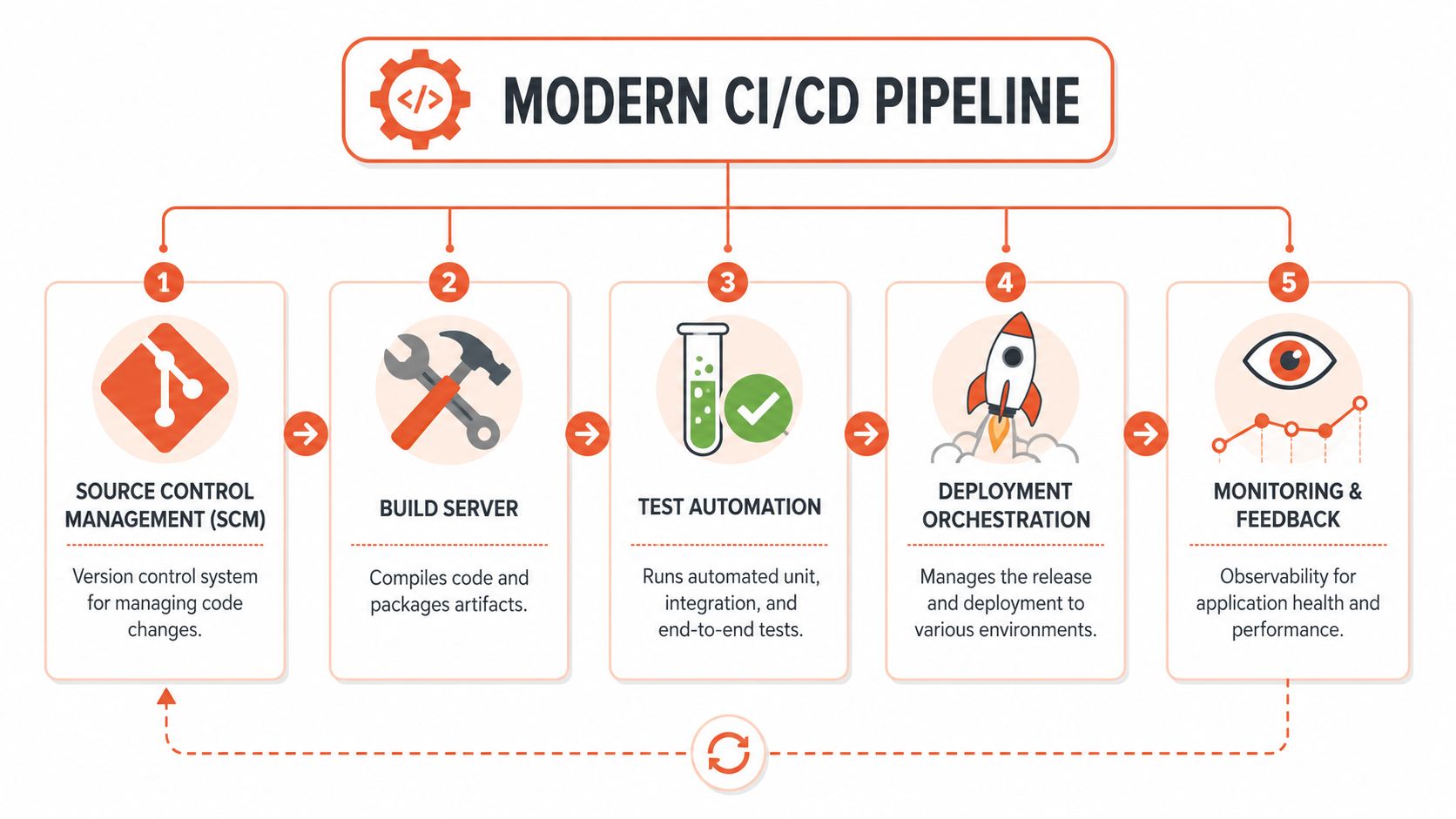
A modern pipeline looks straightforward on a whiteboard. In practice, each stage introduces its own maintenance and governance load.
Source to deploy is not one step
A typical pipeline often begins with source control, usually Git-based workflows. A commit triggers the build system. The build compiles code, resolves dependencies, packages the result, and hands it to automated tests. If those pass, the artifact is stored and promoted towards deployment.
That sequence sounds obvious, but ordering matters more than many teams realise. TechTarget's guidance on CI/CD pipeline design and controls is directionally right for real-world operations: source, build, test, and deploy should be separated so checks fail fast before expensive environment promotion. It also recommends publishing test and code-coverage results, gating promotion on predefined thresholds, and running security scans such as SCA, SAST, and DAST as part of the pipeline.
That's the technical ideal. The operational burden starts immediately after.
The components teams underestimate
Source control workflows
Branch protection, merge policies, secret handling, repository permissions, and multi-repo coordination all become pipeline concerns. If your teams run different conventions across services, your delivery logic fragments with them.
Build infrastructure
Jenkins, GitHub Actions, GitLab CI, CircleCI, or Azure DevOps can all work. The choice isn't the hard part. The hard part is maintaining runners, caching dependencies, pinning versions, handling concurrency, and keeping builds reproducible across languages and environments.
Test automation
Unit, integration, contract, and end-to-end tests all belong in the delivery story, but not all in the same way. Teams often overload the main path with every possible test, then wonder why feedback is slow. Others under-test and push risk downstream into staging or production.
Artifact management
An artifact repository sounds administrative until retention, immutability, naming conventions, provenance, and rollback confidence become release blockers. If the organisation can't say exactly what was built and what was deployed, incident response becomes guesswork.
Deployment orchestration
Cloud complexity frequently permeates the developer workflow. Kubernetes manifests, Helm charts, environment variables, secrets, approvals, canary strategies, and rollback logic all have to work across environments. Multi-cloud makes that harder because each provider has slightly different primitives, policies, and integration points.
What works and what doesn't
| Pipeline decision | What works | What fails later |
|---|---|---|
| Stage design | Clear separation between source, build, test, and deploy | Monolithic jobs that hide where failures happen |
| Security | Scans integrated into the pipeline path | Security checks bolted on after release prep |
| Artifact handling | Immutable, versioned outputs | Rebuilding from source during release |
| Deployments | Standardised workflows across services | Service-specific scripts maintained by each team |
Mature pipelines don't rely on a single tool. They rely on disciplined interfaces between stages.
That distinction matters because leaders often debate tooling when the bigger problem is operating model. If every team heavily customises the pipeline, maintenance scales with headcount.
The Hidden Factory Costs You Are Not Tracking
The headline cost of a DIY pipeline is comforting because it looks finite. You can point to the cloud bill and procurement invoices. That's only the visible layer.
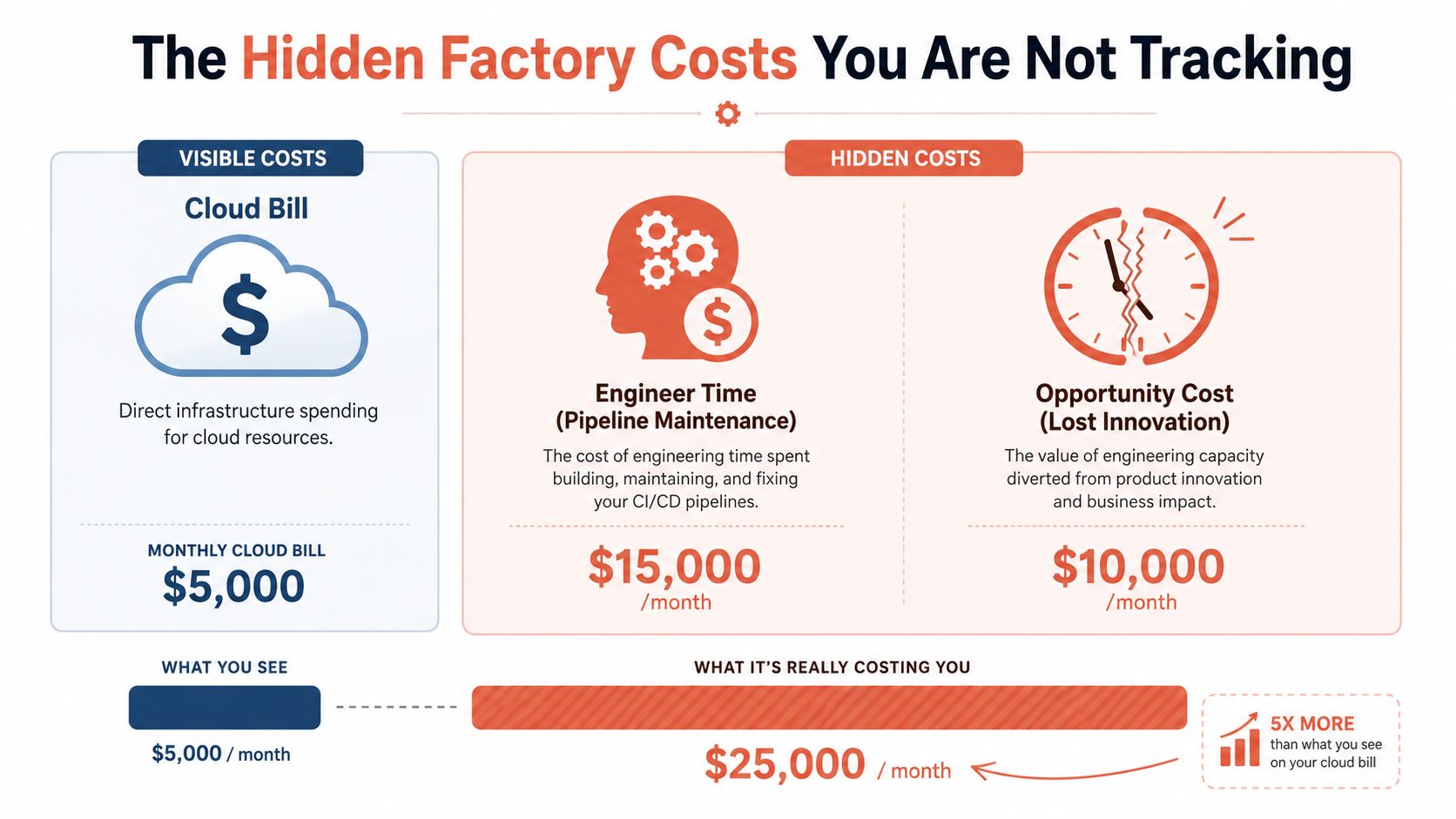
What doesn't show up cleanly in finance reporting is the cost of engineers spending time on pipeline upkeep instead of product work. A slow release process doesn't just delay shipping. It pulls senior attention into less impactful work, fragments ownership, and trains teams to avoid change because delivery feels risky.
The costs most teams bury inside payroll
A homegrown stack creates hidden labour in several forms:
- Platform maintenance through plugin upgrades, build image updates, failed integrations, and access issues.
- Context switching when product engineers get dragged into infra incidents and lose half a day to recover focus.
- Local workarounds when one team writes custom scripts because the shared path is too brittle or too slow.
- Onboarding drag when new developers need tribal knowledge to understand how software reaches production.
That's the DevOps tax. Even if you never hire a dedicated platform team, you're still paying for one informally.
DIY DevOps vs Managed Platform
| Factor | DIY CI/CD Stack | Managed Platform (PushOps) |
|---|---|---|
| Ownership | Internal teams own tooling, upgrades, and failure recovery | Vendor handles platform operation and standard delivery workflows |
| Developer experience | Varies by team, repo, and cloud environment | More consistent self-service patterns across teams |
| Security controls | Often assembled from multiple tools and policies | More likely to be built in by default |
| Multi-cloud setup | Requires custom integration work across AWS, GCP, and Azure | Abstracted into a common operating model |
| Cost visibility | Cloud spend is clear, labour cost is diffuse | Subscription is explicit, labour overhead usually drops |
There's a financial version of this conversation too. Leaders focused on infrastructure spend should look at cloud cost optimisation trade-offs together with engineering labour, not separately. Cheap tooling can become expensive delivery if every savings decision pushes more maintenance back onto developers.
The business trade-off is simple
If your company's edge is product execution, then every hour spent maintaining CI jobs, Kubernetes manifests, build runners, and ad hoc deployment logic should be challenged. Some companies do need deep internal platform capability. Most early and mid-stage software businesses need dependable release infrastructure without turning it into a strategic side quest.
A pipeline should be an internal utility. Once it starts competing with your product roadmap for engineering time, the operating model is wrong.
Managed platforms aren't magic. They don't remove the need for release discipline, testing strategy, or sensible architecture. They do remove a large class of repetitive work that many teams mistakenly accept as normal.
Securing and Observing Your Delivery Pipeline
A common assumption is that pipeline security means adding a few scanners and enforcing approvals. That's not enough anymore.
The harder problem is that many organisations don't have one pipeline. They have a main platform, some team-specific automation, one-off scripts, cloud-native deployment jobs, and a layer of “temporary” tooling that never went away. Security and observability break down quickly in that environment because governance is centralised on paper and distributed in reality.
Why distributed pipelines change the problem
Upwind's guidance on CI/CD pipeline security in distributed environments highlights a gap many teams feel but rarely articulate well: modern defences have to account for distributed pipelines and shadow automation. It points to controls such as artifact signing, hash validation, scoped credentials, and environment isolation, rather than assuming central governance alone will keep delivery safe.
That lines up with what engineering leaders see in practice. The biggest risk often isn't the official pipeline everyone reviews. It's the side path someone created to get around friction in the official one.
What strong pipeline control looks like
- Identity tied to builds so you can trace who triggered what, with which permissions.
- Scoped credentials so one compromised job can't move laterally across environments.
- Artifact integrity checks so teams deploy what they intended, not a substituted or rebuilt package.
- Environment isolation so failures and permissions don't spill between stages.
Observability has the same distributed problem. If build logs live in one tool, deploy events in another, and runtime signals somewhere else, your engineers spend incidents stitching together a timeline manually.
Basic dashboards aren't enough
A usable operating model needs one consistent view of build status, deployment history, failure modes, and environment health. Without that, every release issue becomes an investigation. The team wastes time answering basic questions such as which artifact was promoted, which checks passed, and whether the problem started in build, deploy, or runtime configuration.
Security in delivery pipelines is mostly about control over movement, identity, and integrity. Scanners help, but they don't replace those foundations.
That's why pipeline governance can't be an afterthought. It has to be part of the delivery system design.
How a DevOps Platform Unifies Your Stack
The primary appeal of a modern DevOps platform isn't convenience. It's standardisation without endless internal build-out.
When a team has to assemble Kubernetes operations, CI runners, deployment logic, observability, policy enforcement, and cloud cost controls on its own, the stack drifts. Every local optimisation adds another exception to maintain. A platform approach unifies those concerns into one operating model so developers work through a common path instead of bespoke scripts.
What unification changes day to day
Developers get self-service workflows instead of ticket queues. Engineering managers get fewer surprise dependencies on the people who originally built the pipeline. Security teams get more consistent enforcement because policy sits closer to the platform, not scattered across repositories and shell scripts.
A managed option can be a sensible choice. For example, PushOps provides a multi-cloud DevOps platform for AWS, GCP, and Azure that handles production-ready infrastructure foundations, automated builds and deployments, integrated observability, security controls, and spend management through a single system. If you're evaluating that model, its overview of a DevOps cloud infrastructure platform is a practical starting point.
Why this is a leadership decision
This isn't really a tooling conversation. It's an operating model decision about where your team should spend scarce senior engineering time.
Good infrastructure leaders know that not every problem deserves an internal platform project. Some of the best lessons in DevOps for IT managers come down to that exact judgment: standardise what should be boring, and save custom engineering for work that creates business value.
The trade-off to evaluate honestly
| If you build internally | If you standardise on a platform |
|---|---|
| You keep maximum flexibility | You accept opinionated defaults |
| You can tailor edge cases deeply | You reduce bespoke operational work |
| You own every dependency and upgrade path | You shift more of that burden to the provider |
Neither path is universally correct. But many product companies overestimate the value of custom delivery infrastructure and underestimate the long-term cost of owning it.
Your Next Steps Toward Effortless Delivery
A release slips on Thursday afternoon. Engineering loses half a day tracing a failed deployment, someone patches the runner, and the team still ships late. That cost rarely shows up in a tool invoice, but it shows up in roadmap slippage, missed customer commitments, and senior engineers spending their week on delivery plumbing instead of product work.
The right next step is to treat CI/CD as an ownership problem, not just a tooling choice.
Three practical moves
Audit engineering time
Map the recurring work tied to your pipeline: broken builds, flaky runners, deployment rollback support, secrets rotation, access reviews, and environment drift. Include work absorbed by product teams, platform engineers, and tech leads. If five people each spend a small slice of time keeping delivery running, you still have a real platform cost.Calculate total cost of ownership
Add up cloud spend, CI vendors, security tools, observability tooling, and the internal labor required to keep them working together. In many teams, the expensive part is not compute. It is the opportunity cost of experienced engineers maintaining systems that do not differentiate the product.Assess standardisation readiness
Look for signs that the business can accept opinionated delivery patterns: shared environments, repeatable service templates, consistent security controls, and a willingness to retire one-off pipeline logic. Teams with those habits usually get value from a managed model faster. Teams that still rely on custom release steps for every service often need to simplify first.
A practical next step is to compare your current setup against a managed approach built around zero-maintenance CI/CD pipelines. The point is not to give up engineering judgment. The point is to stop assigning expensive product engineers to work that should already be standardized.
If your team is spending too much time maintaining delivery infrastructure and not enough time shipping product, PushOps is worth evaluating. It gives software teams a production-ready, multi-cloud path for builds, deployments, environments, observability, security, and cost control, so engineering can focus on product work instead of running a bespoke DevOps stack.

