

Your engineers wanted to ship features. Instead, they're debating node pools, rewriting CI jobs, tuning alerts, and trying to explain a cloud bill that nobody trusts. That's a familiar pattern in startups and scale-ups. A team chooses cloud infrastructure as a service because it promises flexibility, speed, and room to grow. Then it turns into a second business inside the business.
The problem isn't that IaaS is flawed. The problem is that raw infrastructure gives you power without removing responsibility. You can build almost anything on top of it. You also inherit the daily work of keeping that thing secure, observable, cost-controlled, and deployable.
Your Team Is Building an Infrastructure Company by Accident
IaaS sits at the bottom of modern cloud computing, and it's enormous in market importance. Infrastructure as a Service generated $180 billion in global revenue in 2025, according to these cloud computing market figures. That number tells you two things. First, this model is not niche. Second, a huge share of software delivery still depends on teams operating infrastructure, not just consuming finished platforms.
That's where the trap starts.
A company says it needs “just enough cloud” to run applications on AWS, Azure, or Google Cloud. In practice, “just enough” expands fast. Someone needs to define network boundaries. Someone needs to harden base images. Someone needs to wire CI/CD to environments. Someone needs to decide how secrets move, how logs are retained, how alerts are routed, and who approves production access. None of that is your product. All of it becomes your problem.
The hidden platform team appears early
The first version often looks harmless:
- A Kubernetes cluster for flexibility: sensible at first, then followed by ingress rules, certificate rotation, add-ons, upgrades, and policy management.
- A CI/CD setup for speed: useful until pipeline maintenance starts breaking builds more often than the application code does.
- Monitoring for reliability: necessary, but quickly fragmented across metrics, logs, traces, dashboards, and on-call rules.
- Cloud cost controls: always postponed until the bill gets attention from finance.
Soon you haven't just adopted cloud infrastructure as a service. You've started building an internal platform. This often happens without an explicit decision.
Practical rule: If your developers spend more time discussing deployment mechanics than customer-facing functionality, you're already paying the DIY platform tax.
The uncomfortable part is that smart teams often make this mistake precisely because they're capable. They can build the stack, so they do. What they underestimate is the carrying cost. Every custom workflow, Terraform module, Helm chart, runner image, and security exception becomes another thing to maintain.
That's why it helps to think about IaaS as an operating model decision, not a hosting choice. The question isn't whether your team can assemble the pieces. It's whether assembling them is the best use of senior engineering time. If you're rethinking that balance, developer platform automation is the category worth understanding, because it changes the conversation from “how do we build all of this?” to “what should we stop owning?”
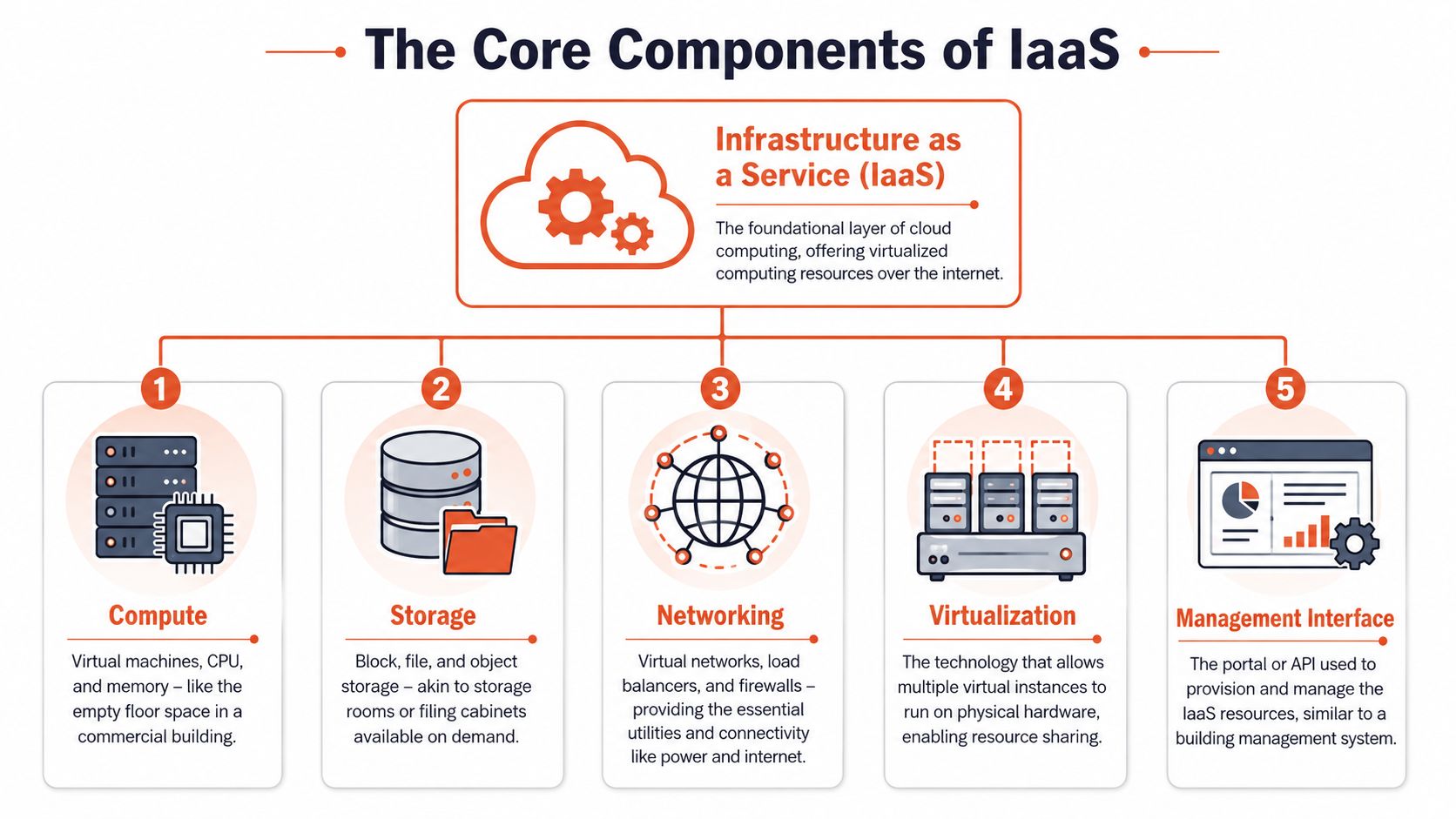
The Core Components of IaaS
IaaS is most easily grasped when likened to leasing raw commercial space. The landlord provides the structure, power, water, and access. You still decide what gets built inside, how it's secured, and how it operates day to day.
In cloud infrastructure as a service, the provider gives you virtualised building blocks. You rent them separately, scale them on demand, and pay for what you use, as described in the GSA explanation of IaaS provisioning. That sounds simple. The operational burden sits in what happens after provisioning.
Compute
Compute is the part organizations often see first. Virtual machines, autoscaling groups, and container hosts are the rented floor space where your applications run.
What the provider gives you is capacity. What your team still owns is everything above that baseline:
- Operating system care: image hardening, updates, package maintenance, and vulnerability handling
- Runtime setup: language runtimes, container configuration, process supervision, and service dependencies
- Workload behaviour: scaling rules, startup times, graceful shutdowns, and failure recovery
If a service crashes because of memory pressure, poor readiness checks, or a bad deployment, the cloud provider hasn't failed you. Your application stack has failed inside rented infrastructure.
Storage
Storage looks straightforward until retention, recovery, and performance requirements get involved. Block volumes, object stores, and file systems are all available. Choosing one is easy. Operating it properly isn't.
Teams still need to make decisions on:
- Durability strategy: backups, snapshots, restore testing, and replication patterns
- Data layout: which workloads need low latency, which need archival retention, and which need lifecycle rules
- Access control: encryption choices, key ownership, and permissions for services and people
Storage mistakes tend to stay hidden until an incident exposes them.
Backups are not the same as recovery. A backup that nobody has restored under pressure is a theory.
Networking
Networking is where many DIY cloud environments become brittle. Virtual private clouds, subnets, routing, load balancers, firewall rules, and private connectivity give you fine-grained control. They also create a lot of ways to misconfigure production.
The provider handles the underlying network substrate. Your team still designs and governs the virtual network controls layered on top. That means ingress decisions, internal segmentation, service exposure, and the path traffic takes between systems all remain your responsibility.
The control plane matters more than teams expect
The management interface is the multiplier. APIs, consoles, Infrastructure as Code, and policy tools determine whether your environment is repeatable or chaotic. This is why strong teams standardise quickly. They need fewer one-off fixes and fewer human steps.
If you want a cleaner view of that operating layer, a DevOps cloud infrastructure platform sits above raw resources and turns those primitives into a repeatable developer workflow. That's often the difference between “we have cloud” and “we can deliver reliably on cloud”.
IaaS vs PaaS vs SaaS What to Actually Choose
Leaders often frame this as a technical taxonomy question. It's usually an operating burden question.
A simple analogy works. IaaS is renting a kitchen with appliances and utilities. PaaS is getting a prepared meal kit with the cooking environment already arranged. SaaS is ordering dinner and eating it. The more control you keep, the more work you keep.
The practical difference
With IaaS, your team manages the software stack that runs on top of rented infrastructure. With PaaS, the provider removes much of the server and runtime work. With SaaS, you mostly configure the application and use it.
That sounds obvious, but many teams choose IaaS for reasons that are emotionally true and operationally expensive. They want flexibility. They don't want to be boxed in. They think future needs justify present complexity. Sometimes they're right. Often they're pre-paying complexity for optionality they never use.
IaaS vs. PaaS vs. SaaS A Practical Comparison
| Model | You Manage | Provider Manages | Best For | Hidden Cost |
|---|---|---|---|---|
| IaaS | OS, runtime, apps, deployment workflows, security controls above infrastructure, cost governance | Physical infrastructure and core cloud resources | Custom systems, migration of specialised workloads, teams that need deep control | Platform engineering overhead, fragmented tooling, ongoing operational maintenance |
| PaaS | Application code, some config, service-level behaviour | Infrastructure, much of the runtime and platform layer | Product teams that want to move quickly without owning servers | Platform constraints, opinionated workflows, migration friction if you outgrow it |
| SaaS | Business configuration, user workflows, admin settings | The full application, platform, and infrastructure stack | Standard business functions such as CRM, support, collaboration, analytics | Process compromise, integration work, and dependency on the vendor's roadmap |
What CTOs should actually optimise for
The common mistake is treating control as always good. Control only matters if it creates business advantage. If your product wins because of domain knowledge, speed of delivery, and customer experience, then owning every layer of the deployment stack may be a distraction.
A better filter is this:
- Choose IaaS when you need low-level control for architecture, compliance design, or workload portability, and you're prepared to run the operating model that comes with it.
- Choose PaaS when developer velocity matters more than custom infrastructure patterns.
- Choose SaaS when the capability is not strategically differentiating.
There's also a middle path. Many companies want IaaS-level cloud choice with a PaaS-like experience for developers. That's where platform layers become useful. Instead of asking each team to solve pipelines, observability, deployment policy, and guardrails from scratch, you standardise them once. Cost discipline belongs in that conversation too, especially if you're already wrestling with cloud cost optimization, because uncontrolled flexibility is one of IaaS's most expensive side effects.
The Real Benefits and Hidden Trade-Offs of IaaS
IaaS marketing usually gets the headline benefits right. It gives you room to design your own architecture. It lets you provision resources when you need them. It supports multi-environment delivery and modern application patterns. The mistake is assuming those benefits arrive fully formed the day you open a cloud account.
They don't. Your team has to enable them.
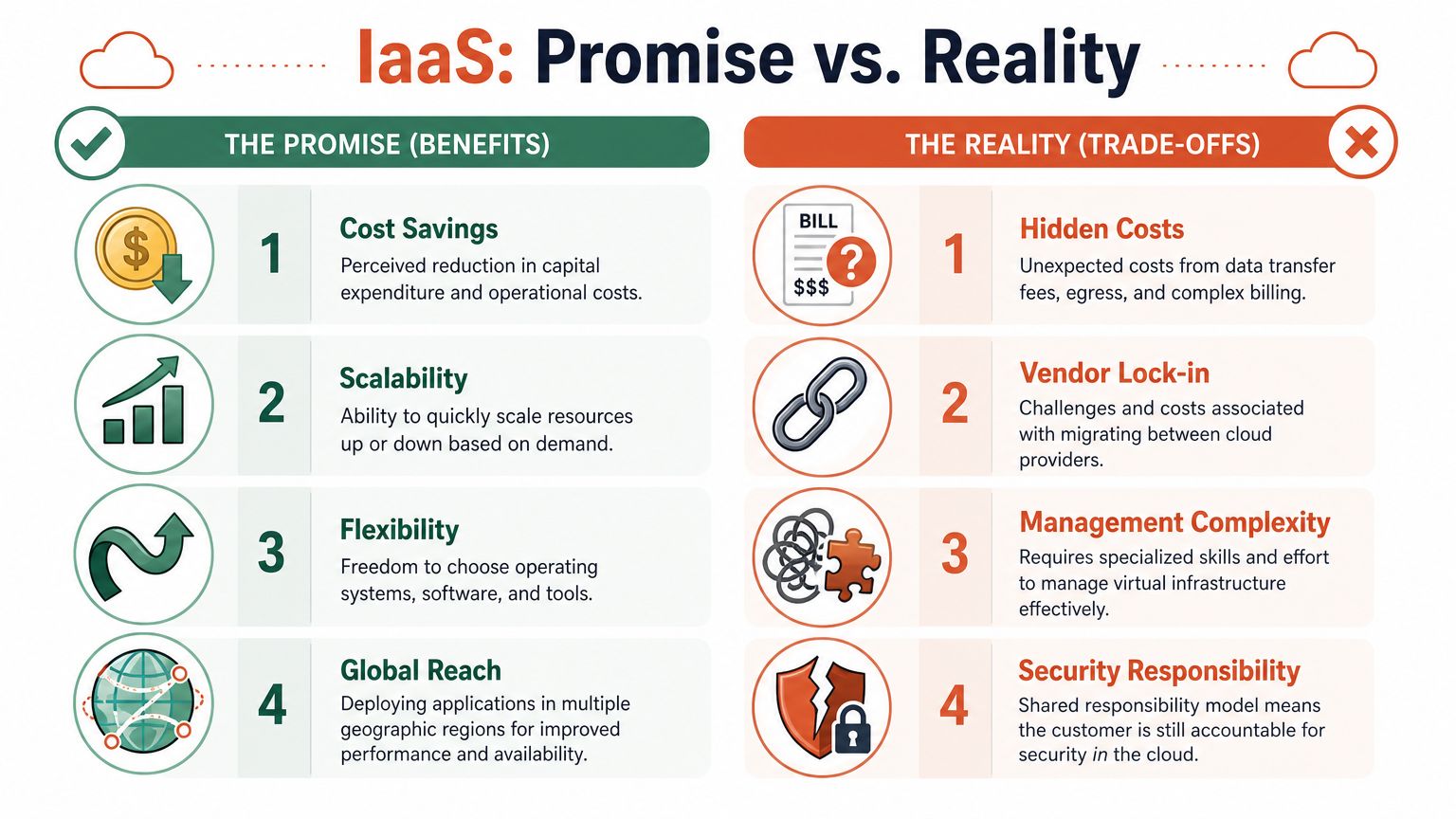
The promise
IaaS gives engineering leaders three attractive things.
First, flexibility. You can choose operating systems, runtime components, deployment patterns, and network design. That matters when you're migrating legacy systems, supporting unusual workloads, or trying to keep architectural options open.
Second, elasticity. You can add compute, storage, and networking resources as demand changes instead of buying fixed hardware upfront.
Third, reach. Large providers let teams run workloads across multiple regions and support teams distributed across markets.
Those are real advantages. They explain why cloud infrastructure as a service remains such a central model.
The reality
Each promise carries an operational invoice.
| Promise | Trade-off in practice |
|---|---|
| Flexibility | More decisions, more ways to drift, and more room for inconsistent environments |
| Elasticity | Applications still need to scale correctly. Infrastructure can expand while the service itself still fails |
| Reach | More regions and more clouds increase policy, deployment, support, and debugging complexity |
The most painful issue is that IaaS moves effort, it doesn't erase it. Google's explanation of the model is useful here: the provider manages the physical compute, storage, patching, and network substrate, while the customer remains responsible for the operating system, applications, virtual network controls, data, and user access in the IaaS responsibility overview from Google Cloud. That split is where many cloud plans become under-scoped.
If you move to IaaS without changing how you standardise operations, you haven't simplified infrastructure. You've outsourced the building and kept the hard parts.
What tends not to work
Teams struggle when they treat infrastructure assembly as a side task for already busy product engineers. They also struggle when they buy separate tools for each operational need and hope those tools become a platform by accident.
Common failure modes look like this:
- One team owns everything informally: nobody has time, but everyone has access
- Every service deploys differently: releases become tribal knowledge
- Security is bolted on late: IAM, patching, and audit trails lag behind growth
- Cost reviews happen after surprises: spend becomes reactive instead of governed
IaaS is powerful. It's just not self-managing. The benefits are real, but they only show up cleanly when teams invest in standard operating paths, strong automation, and clear ownership. Without that, you get the flexibility of raw cloud and the drag of a home-built platform.
Adopting IaaS the Right Way Key Considerations
IaaS adoption usually breaks down after the migration plan is approved. The machines are running, the network is in place, and leadership assumes the hard part is over. Then the second job begins: patching systems, reviewing access, chasing cloud spend, fixing weak deployment paths, and stitching together enough telemetry to diagnose incidents under pressure.
That is the part teams under-budget.
Security ownership needs named operators
Shared responsibility is easy to agree with and easy to under-resource. The provider handles the underlying hardware and core infrastructure. Your team still owns the guest operating system, workload configuration, data controls, and access policy, as outlined in this shared responsibility explanation for IaaS security.
The practical question is simpler than the model. Who does the work every week?
Security gaps show up fast when nobody is clearly assigned to:
- Patch operating systems and maintain hardened base images
- Define IAM roles and review privileged access
- Manage encryption settings and key usage
- Store audit logs and lead incident response
Regulated environments feel this first, but the problem is broader than compliance. If ownership is vague, important tasks become best effort work. Best effort is not an operating model.
Cost control depends on engineering habits
Cloud pricing gives teams flexibility. It also makes it easy to create waste at speed.
The usual problems are familiar: idle non-production environments, oversized instances, storage nobody cleans up, overlapping monitoring tools, and autoscaling settings that were never revisited after launch. Finance can report the bill. Engineering creates most of it.
Good cost control looks operational, not ceremonial. Teams need clear tagging, environment schedules, service ownership, regular rightsizing reviews, and budget checks tied to technical decisions. If nobody can explain why a workload costs what it costs, the team is not managing IaaS yet.
Observability should be part of the platform, not a side project
Raw infrastructure gives you many places to send logs, metrics, and traces. That does not mean you have observability.
Useful observability helps an engineer answer four questions quickly: what failed, where it failed, who was affected, and what changed right before it failed. In many DIY IaaS setups, that evidence is scattered across vendor consoles, separate dashboards, CI tools, and chat history. The result is slow diagnosis and noisy incident calls.
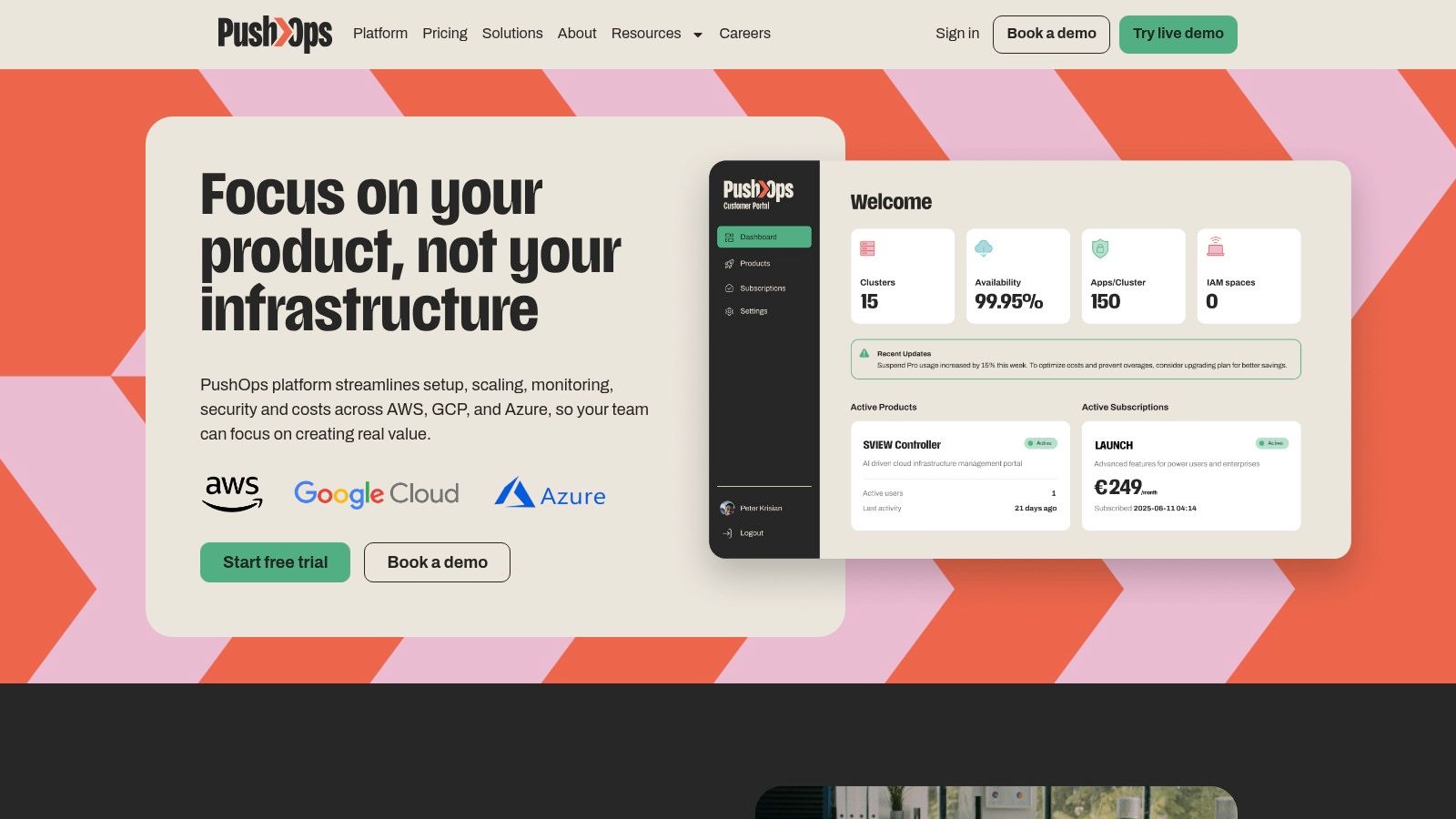
Standardisation matters more than tool count. A managed DevOps platform can give teams one operating path for deployments, telemetry, and access instead of asking every squad to assemble its own version.
Multi-cloud increases coordination costs
Multi-cloud can be the right choice. It can also become a status project with a large support bill.
Running across AWS, Azure, and Google Cloud means more than learning three consoles. It means reconciling different IAM patterns, network models, managed service behavior, policy controls, release workflows, and billing structures. Every difference creates process work for someone inside your company.
For teams comparing practical IaaS solutions for businesses, the better question is not just what infrastructure you can provision. It is how much operational load your team still owns after the contract is signed.
That is why many organizations get better results from a managed platform approach. A platform like PushOps abstracts IaaS primitives into a standardized developer workflow. The value is not that it replaces engineering judgment. The value is that it removes a large share of repetitive platform work so internal teams can spend more time on the product and less time running an infrastructure company by accident.
Conclusion Stop Building Infrastructure Start Building Product
Cloud infrastructure as a service is powerful because it gives teams raw capability. You can shape networks, provision compute, design deployment patterns, and support almost any application architecture you need. That's why IaaS remains so important.
It's also why many engineering organisations end up overcommitted.
The hard part of IaaS isn't getting a server running. The hard part is everything that follows. Standardising environments. Maintaining CI/CD. Hardening images. Designing IAM. Watching costs. Correlating logs, metrics, and releases. Keeping all of it consistent across teams as the business grows. That work is real. It competes directly with roadmap delivery.
The strategic choice is operational
Most CTOs don't need another abstract cloud debate. They need a cleaner answer to one practical question: should the company build and maintain its own operational platform, or should it adopt one that already solves the repetitive parts well?
That's the critical fork in the road.
If infrastructure design is central to your product, a heavier DIY approach may be justified. If your advantage comes from shipping useful software quickly, then building a bespoke DevOps estate often becomes an expensive detour. Hiring more DevOps engineers can keep the machine running, but it doesn't change the underlying pattern. You're still funding internal complexity instead of reducing it.
What works better for product-focused teams
The healthier model is usually this:
- Keep the control you need
- Standardise the workflows developers repeat every day
- Push security, observability, and cost guardrails into the platform layer
- Treat infrastructure as a capability, not a craft project
That's how teams get the upside of cloud infrastructure as a service without turning the engineering organisation into an accidental infrastructure company. The aim isn't to give up control. It's to stop spending senior talent on plumbing that doesn't move the market for your product.
If your team wants the flexibility of AWS, GCP, or Azure without owning every pipeline, policy, alert, and environment by hand, take a look at PushOps. It's a practical route for teams that want production-ready cloud foundations, standardised delivery workflows, integrated observability, and tighter cost control, while keeping engineers focused on shipping product instead of maintaining a home-built platform.

