


Another month ends. Finance asks why the cloud bill jumped, engineering says the spend is “mostly shared infrastructure”, and nobody can say with confidence which product, team, or customer workload caused the increase.
That situation isn't a sign your engineers are reckless. It's a sign your cost allocation model belongs to an older era. Old methods assumed fixed servers, stable workloads, and tidy monthly cost centres. Your stack probably runs across Kubernetes, managed databases, CI/CD, observability tools, and a mix of AWS, GCP, or Azure services that scale up and down constantly. The bill changed because the system changed. Your reporting didn't keep up.
For CTOs, VP Engineering, and senior developers at startups and scale-ups in Europe, Singapore, the UK, and the US, this becomes a strategic distraction fast. Teams end up over-investing in building their own DevOps stack, then layering more scripts and dashboards on top to explain the costs of the stack they already shouldn't be maintaining. That's backwards. You want a reliable, production-ready platform so your teams can ship features, not spend their best people reconciling Kubernetes namespaces with finance spreadsheets.
Introduction Why Your Cloud Bill Is a Mess and What to Do
The biggest mistake I see is assuming cloud cost allocation is a finance clean-up exercise. It isn't. It's an infrastructure design problem, an ownership problem, and a visibility problem.
That matters because multi-cloud adoption has become mainstream, with more than 87% of organisations running workloads across multiple cloud providers to optimise costs and access specialised services, while also taking on much more operational complexity in visibility and spend control, according to this multi-cloud management guide. If you're operating across AWS, GCP, and Azure, your bill is messy by default unless you built for attribution from day one.
Many teams still treat cloud spend like legacy hosting. They look at invoices, assign broad percentages to departments, and call it close enough. That worked when infrastructure was static. It fails when environments are ephemeral, services are shared, and autoscaling changes the cost profile throughout the day.
What's actually causing the mess
- DIY platform sprawl: You built Kubernetes, CI/CD, monitoring, security controls, and cost dashboards separately. Now every tool has its own tags, identities, and reporting logic.
- Shared resource ambiguity: Clusters, runners, observability pipelines, and security tooling support multiple teams at once.
- Manual reconciliation: Engineers spend time stitching together billing exports, tag reports, and internal project mappings instead of building product.
Your cloud bill isn't high because cloud is inherently uncontrollable. It's high because your operating model hides who is consuming what, and your team compensates with manual work.
If you're dealing with broader service management complexity as well, this article on streamlining IT operations in UAE is a useful reminder that operational clarity starts with systems that are designed to be manageable. The same logic applies to cloud cost governance.
A practical first move is to stop guessing and get visibility into the billing mechanics behind your environments. A good primer is this guide to cloud cost optimisation, especially if your current process still relies on monthly spreadsheet archaeology.
Why Traditional Cost Allocation Fails in the Cloud
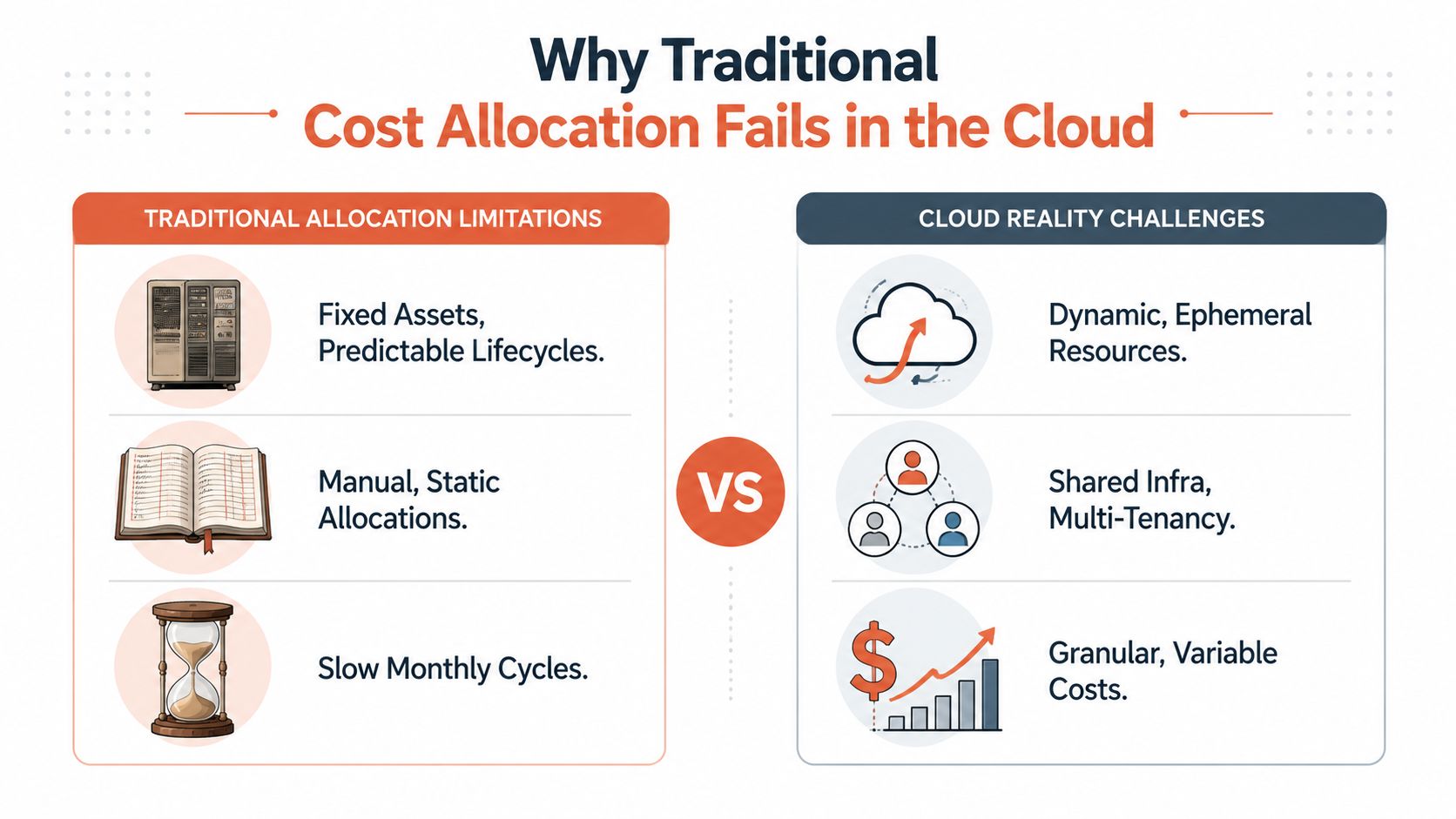
Traditional cost allocation was built for fixed assets, stable usage, and slower reporting cycles. Cloud infrastructure has none of those characteristics.
Static rates break dynamic systems
A lot of internal cost models still apply a broad indirect rate to cloud spend because it feels simple. That simplicity is fake. A critical flaw in many DIY cost plans is applying a static indirect rate such as 15% to a dynamic cloud bill, which ignores the hourly fluctuations of autoscaling infrastructure across AWS, GCP, and Azure and fails to support full cost allocation based on actual costs, as described in OpenGov's explanation of Cost Allocation Plans.
That single error creates three downstream problems:
- Mispriced products because shared platform costs land in the wrong places.
- Weak engineering decisions because teams can't see the cost of their own architecture choices.
- Audit and reporting risk because the allocation method doesn't match actual usage patterns.
The cloud cost model is structurally different
Think about the difference between a traditional server room and a modern Kubernetes setup.
In the server room model, hardware sat in one place, depreciated over time, and served a relatively stable set of workloads. You could spread costs by department or headcount and get something roughly acceptable.
In the cloud model, costs come from layers of abstraction:
- Compute changes constantly: nodes scale, pods reschedule, serverless functions burst.
- Shared tooling spans everything: logging, tracing, secrets management, image scanning, and ingress don't belong to one team.
- Consumption is granular: storage, network egress, managed services, and API calls all move independently.
Why DIY allocation keeps getting worse
Every extra script you write to “fix” visibility becomes another operational dependency. Someone has to maintain the tag taxonomy. Someone has to reconcile billing exports. Someone has to explain why one dashboard shows one number and finance has another.
Practical rule: If your allocation method can't explain yesterday's cost spike without engineering intervention, the method is too manual.
That's why so many startups and scale-ups pour senior engineering time into internal platforms that never become strategic assets. They become expensive admin systems. The hidden cost isn't just cloud waste. It's the opportunity cost of engineers maintaining billing logic instead of shipping product.
Core Principles of Modern Cloud Cost Attribution
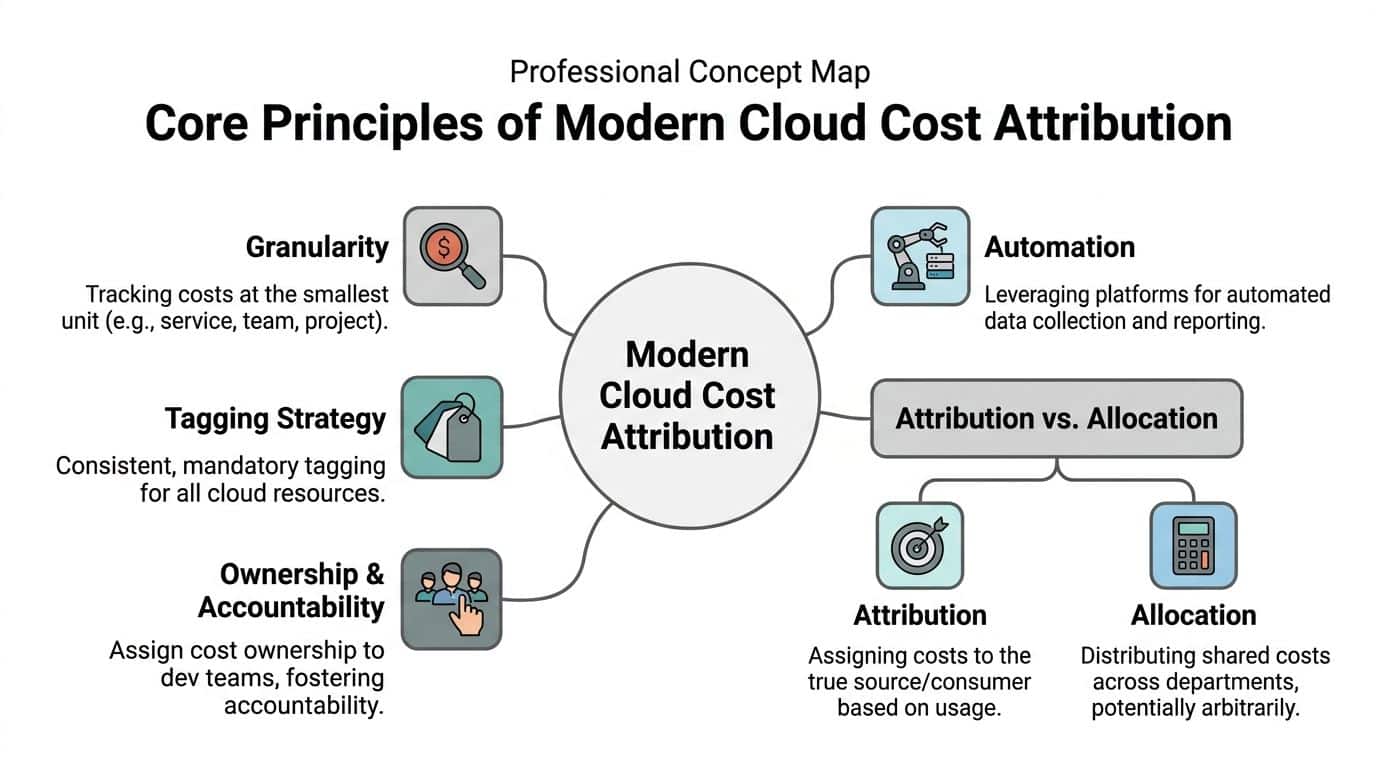
Modern cost allocation starts with a blunt distinction. Attribution is about identifying who consumed a resource. Allocation is what you do when costs are shared and exact usage can't be fully isolated. Mature teams push as much spend as possible into attribution first, then use disciplined allocation for the remainder.
Showback first, chargeback later
A lot of CTOs jump straight to chargeback because finance wants accountability. That's usually premature.
Showback gives teams visibility into what they consumed. Chargeback assigns the spend formally to their budgets. If your tags, ownership model, and shared-cost logic are still immature, chargeback creates arguments instead of accountability. Showback is the right first step for most product organisations because it helps engineering teams trust the numbers before money moves between cost centres.
Driver-based allocation is non-negotiable
The core principle is simple. Effective cost allocation aligns with cause-and-effect principles by assigning costs based on actual resource consumption, using driver-based methods such as users or software licences where those drivers reflect consumption fairly, as explained in this cost allocation accounting guide.
In cloud terms, that means your drivers should resemble actual technical usage. Good examples include:
- Compute-linked drivers: CPU time, memory reservation, node occupancy, or a normalised compute unit.
- Delivery-linked drivers: build minutes, deployment frequency, or runner usage for CI/CD.
- Traffic-linked drivers: API calls, requests served, data transfer, or storage consumption.
Bad drivers are the ones teams pick because they're easy to find rather than because they reflect benefit. Headcount often falls into that category for engineering platforms.
Three allocation problems that break naïve models
The hardest part isn't understanding the theory. It's applying it where cloud systems get messy.
First, Kubernetes. A namespace doesn't equal a fair bill. Shared nodes, control-plane overhead, ingress, logging agents, and sidecars all muddy the picture.
Second, shared services. Your observability stack, vulnerability scanners, and CI/CD runners support many teams at once. You need a method that reflects relative use or relative benefit, not a rough split by department.
Third, untaggable resources. Some managed services don't fit your tag policy cleanly, or they inherit tags inconsistently through tooling. If you don't design a fallback model, those costs pile into an “unallocated” bucket that nobody owns.
For finance leaders trying to connect infrastructure spend to growth quality, the logic is similar to how unit economics drives sustainable growth. If you can't connect cost drivers to the output they support, you can't make disciplined investment decisions.
If you need a concrete way to think about service-level cost inputs across providers, this walkthrough of the Azure pricing calculator is useful because it forces the right question: what exactly is consuming the resource, and why?
Tackling the Hardest Cloud Allocation Problems
The hard cases are where most in-house cost allocation efforts fall apart. Not because the team is careless, but because the model was never designed for shared, ephemeral infrastructure.
Shared costs with no perfect usage metric
The most common unresolved problem is shared infrastructure that benefits several projects at once. The formal challenge appears even in grant guidance: costs may support multiple projects in proportions that “cannot be determined because of the interrelationship of the work”, and archaic bases like headcount are a poor fit for modern shared cloud resources, which creates the need for data-backed methods such as normalised compute units, as noted in the NIH guidance on allocation of costs and closely related work.
For cloud teams, that usually shows up in four places:
- Shared Kubernetes clusters: platform overhead, ingress, service mesh, and logging agents.
- CI/CD pipelines: runners, artefact storage, and build infrastructure.
- Security tooling: container scanning, secrets management, policy enforcement.
- Observability platforms: metrics, traces, and log pipelines used across products.
A governance model that people can defend
If you're building this in-house, your method has to be defensible, repeatable, and boring. Boring is good. It survives audits and budget reviews.
Use this operating model:
- Define direct first. Attribute anything you can tie to a service, environment, or team directly before creating shared pools.
- Create a small number of shared pools. For example: cluster overhead, CI/CD, observability, and security.
- Pick one driver per pool. Don't mix logic inside a single pool unless you want endless arguments.
- Write down the rationale. Why this driver, why now, and what business benefit it approximates.
- Review on a schedule. Cloud architectures change. Your allocation basis should change with them.
If a team can't explain the method in plain English to finance, the method is too complicated to govern.
Showback vs chargeback models
| Aspect | Showback | Chargeback |
|---|---|---|
| Purpose | Visibility and behavioural change | Formal budget accountability |
| Best use | Early-stage governance and trust-building | Mature organisations with stable cost drivers |
| Team reaction | Usually lower friction | Often higher friction if data quality is weak |
| Data requirement | Strong enough for insight | Strong enough for financial consequence |
| Shared cost tolerance | More flexible | Must be tightly documented |
Documentation is part of the system
You don't just need a model. You need records that survive scrutiny. A defensible allocation process should document the percentage charged to each activity, the reasoning behind that percentage, and the supporting approvals and records retained with the transaction trail, including operational metrics such as headcount or FTE where relevant, as described in UCSF's cost allocation methodology best practices.
That's the part engineering teams underestimate. The work doesn't stop at tagging. Someone has to maintain the logic, evidence, and approvals over time.
How a DevOps Platform Automates Cost Attribution
Many organizations believe the answer is “better dashboards”. It usually isn't. The deeper problem is fragmented platform ownership.
When engineering builds its own DevOps stack, cost attribution becomes an integration project across provisioning, CI/CD, observability, security, identity, and cloud billing exports. Each layer introduces drift. Tags are inconsistent. Environments are created outside the paved path. Shared tooling bills arrive without context. Then a senior engineer gets stuck writing another reconciliation job to patch the gap.
Automation changes the economics of accuracy
A managed DevOps platform solves cost allocation in the same place it solves deployment, observability, and security. That matters because attribution quality depends on standardisation at the moment resources are created, not after the invoice lands.
A strong platform approach does four things well:
- It enforces consistent metadata. Environments, teams, and projects are provisioned with the same ownership structure every time.
- It keeps visibility close to operations. The people deploying services can also see the cost consequences.
- It reduces shared-cost chaos. Standardised environments make it easier to group and distribute unavoidable overhead.
- It lowers total spend as a side effect. Rightsizing, autoscaling, and environment scheduling remove waste before finance has to allocate it.
Why this beats hiring more DevOps engineers
Many startups make an expensive mistake. They hire more DevOps engineers to manage the complexity created by their own bespoke platform choices. That can keep the lights on, but it rarely produces substantial benefits.
A platform approach is better because it turns repeated infrastructure work into a productised operating model. Setup is faster. Governance is embedded. Monitoring, security, and deployment workflows follow one system instead of five stitched together.
You don't need more people hand-curating cloud spend. You need fewer moving parts and better defaults.
This is especially important in multi-cloud setups where AWS, GCP, and Azure each expose billing and tagging differently. A central platform gives engineering and finance a common frame of reference. It also avoids the common failure mode where every team invents its own naming, ownership, and environment standards.
If you want a clearer view of what that operating model looks like in practice, this explainer on developer platform automation is worth reading. It gets to the core point quickly: standardise the platform, and cost attribution becomes a by-product of good delivery engineering instead of a separate internal project.
Cost allocation gets easier when the bill gets smaller
There's another reason platform-based cost allocation works better. It doesn't only classify costs. It shrinks them.
When idle environments shut down automatically, when instances are right-sized, and when autoscaling is configured with sensible guardrails, you remove waste before it enters your allocation model. That means fewer disputes over shared overhead and fewer “mystery costs” nobody can justify.
That's the business case CTOs should care about. Better speed, cleaner governance, and lower infrastructure drag on the engineering roadmap.
From Reporting to Optimization A Culture of Accountability
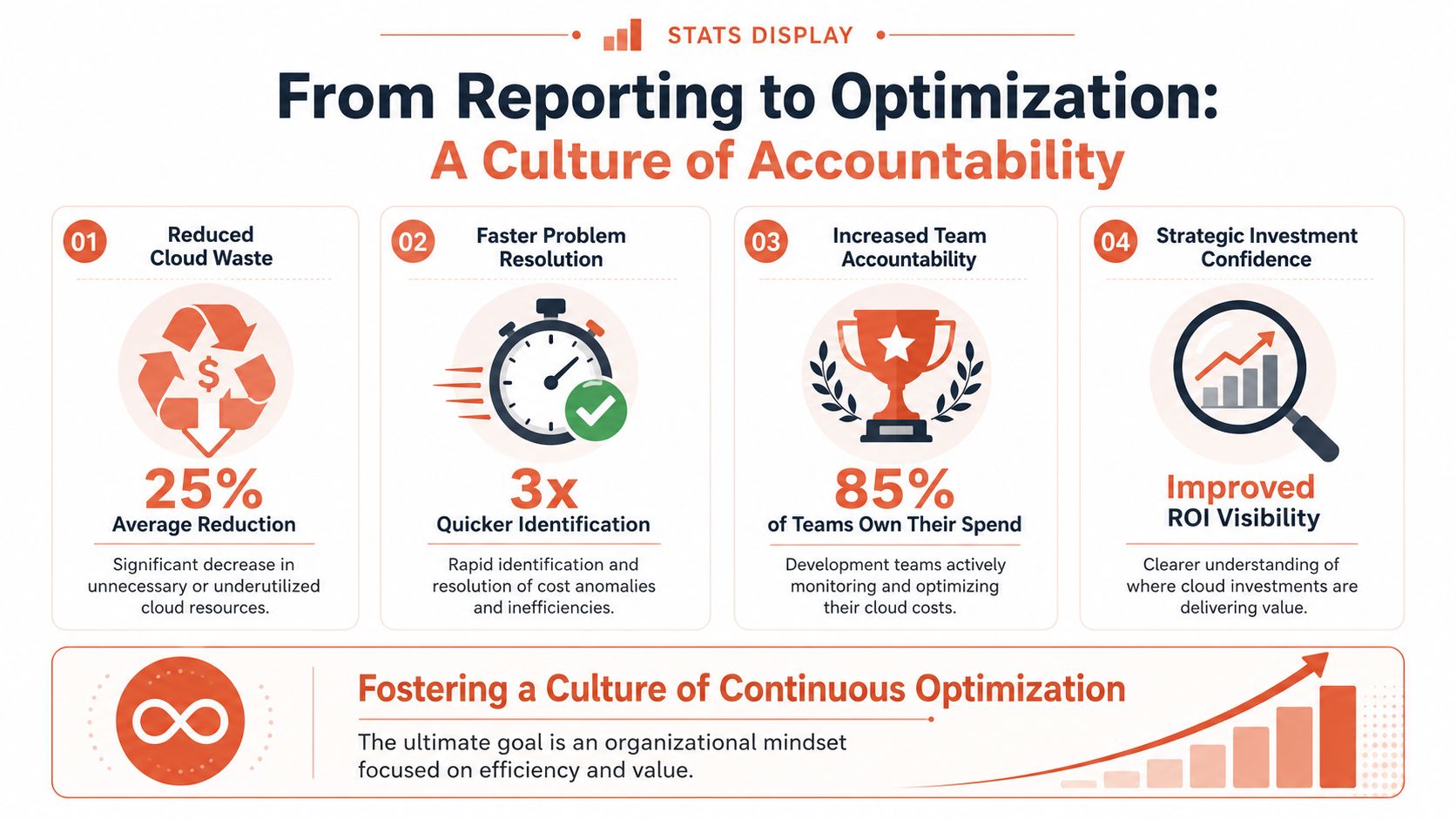
The end goal isn't a perfect spreadsheet. It's a team culture where engineers understand the cost impact of architectural decisions and product leaders can connect infrastructure spend to business value.
Visibility creates immediate leverage
In the initial assessment and visibility phase of multi-cloud cost optimisation, organisations typically uncover 15-30% in potential savings through quick wins such as removing unused resources and basic rightsizing, according to Opsio's multi-cloud cost optimisation overview. That's why visibility isn't an administrative nice-to-have. It's the first operational lever.
The mistake is stopping there. Reporting without action just gives you better charts about the same waste.
The KPIs that actually matter
Track metrics that force engineering and product to speak the same language:
- Cost per feature area: Useful when one product surface drives disproportionate infrastructure use.
- Cost per active user: Helps assess whether scaling patterns still make economic sense.
- Unallocated spend trend: If this grows, your tagging and ownership model is slipping.
- Shared platform overhead by team: Shows whether central tooling is delivering value proportionate to use.
Leadership view: Cost allocation only works when product, engineering, and finance all trust the same model enough to make decisions from it.
A good allocation model changes behaviour. Teams start cleaning up idle resources. They challenge overbuilt services. They ask whether a managed service is worth it versus running something in-house. Those are healthy conversations because they tie technical choices to speed, cost, and reliability.
The payoff is bigger than cleaner reporting. Engineering stops looking like a black-box cost centre and starts operating like a disciplined investment function.
Conclusion Stop Building Cost Tools and Start Shipping Product
If you're a startup or scale-up, your engineering team shouldn't spend its best hours building internal systems to explain the cost of the internal systems it already built.
That's the trap. Teams start with good intentions. They assemble Kubernetes, CI/CD, monitoring, security, and cloud controls in-house because each decision seems rational on its own. Then they realise they also need cost allocation, ownership models, reporting layers, governance rules, and exception handling for shared resources. Soon the platform exists to support itself.
Traditional cost allocation methods can't keep up with dynamic, multi-cloud environments. Static percentages, broad departmental splits, and spreadsheet-based chargeback models break the moment your infrastructure becomes shared, automated, and elastic. The answer isn't to hire more people to maintain the mess. It's to stop creating the mess in the first place.
CTOs should make one decision clearly. Invest engineering time in product differentiation, or invest it in bespoke operational plumbing. Those are not equivalent bets.
For founders and operators thinking carefully about cost discipline in adjacent digital sectors, even niche funding discussions like financiamiento para juegos blockchain reflect the same underlying truth: capital should go to growth and product advantage, not avoidable operational drag.
The companies that win don't just reduce cloud spend. They reduce the amount of organisational attention wasted on understanding it.
If your team is tired of maintaining Kubernetes glue, CI/CD sprawl, fragmented monitoring, and hand-built cost controls, take a serious look at PushOps. It gives you a production-ready path across AWS, GCP, and Azure so your developers can focus on shipping features, while the platform handles the operational groundwork that usually turns into a costly in-house project.

