
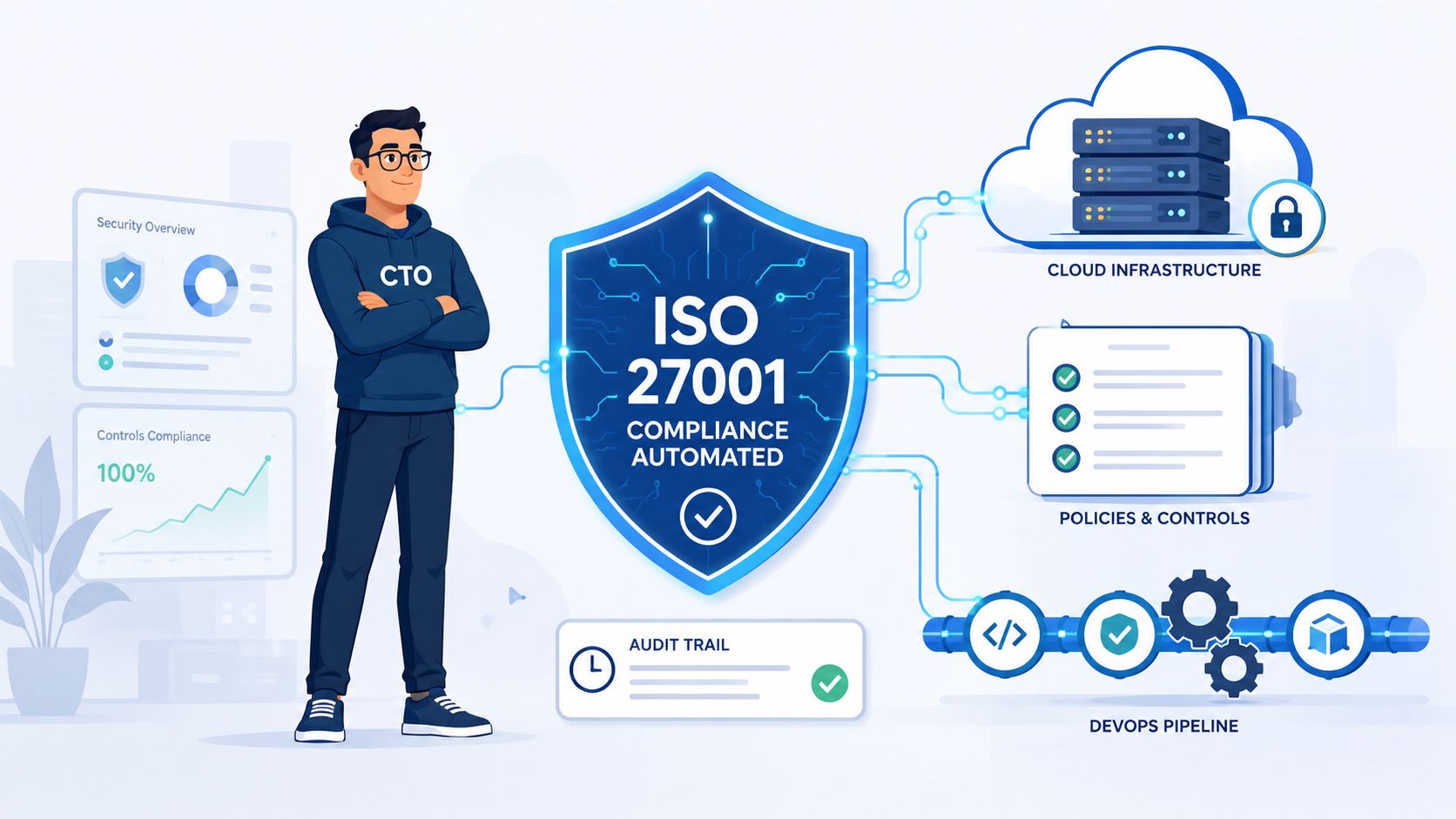

Your audit date is on the calendar. Engineering is still shipping. Nobody wants to pause product work to hunt for screenshots, export logs, or explain why production access lives in three places.
That's where organizations get stuck. They didn't set out to build a compliance machine. They built a product, added Kubernetes, layered on CI/CD, stitched together monitoring, and spread cloud workloads across AWS, GCP, or Azure. It worked well enough for delivery. Then ISO 27001 turned that stack into an evidence problem.
For CTOs and VP Engineering teams in Europe, Singapore, the UK, and the US, the frustration is rarely the standard itself. It's the operational drag. The same engineers who should be improving release flow and shipping features end up maintaining internal tooling, documenting controls by hand, and translating technical reality into audit language. That's expensive, brittle, and unnecessary if your platform does the right work by default.
The Inevitable Audit and the DIY DevOps Stack
A familiar scenario goes like this. The company has grown fast, landed bigger customers, and now needs ISO 27001 to close enterprise deals or satisfy procurement. The audit is booked. On paper, the team looks mature enough. There's infrastructure as code somewhere, pipeline automation in parts of the stack, cloud logging enabled in several accounts, and a collection of policies in Notion, Confluence, or shared drives.
Then the evidence requests arrive.
Suddenly, every gap in the home-grown DevOps setup becomes visible. One environment was provisioned manually. Another uses a slightly different deployment path. Access reviews live in Jira comments. Security evidence is scattered between Slack threads, cloud consoles, CI logs, ticket histories, and screenshots that nobody fully trusts six weeks later. If you need a practical starting point for the audit side of that work, this comprehensive compliance audit guide gives a solid checklist view of what auditors usually expect.
The pressure has intensified because ISO 27001 isn't niche any more. The number of valid ISO/IEC 27001 certificates jumped from 48,671 in 2023 to 96,709 in 2024, a 98.7% increase, driven by the mandatory transition to the updated 2022 standard, according to ISO 27001 certification statistics. That changed the market. Compliance automation is no longer optional background tooling. It's part of operating a serious software business.
Where DIY starts to break
The weak point usually isn't intent. It's fragmentation.
- Custom scripts drift: what one DevOps engineer wrote for deployment logging doesn't match what the next person expects during an audit.
- Manual exports age badly: the moment someone downloads evidence from a live system, it starts becoming stale.
- Control ownership gets fuzzy: security, platform, and application teams all assume someone else is updating the record.
Practical rule: if proving a control depends on a person remembering to collect evidence, the process is already too fragile.
A lot of leadership teams respond by hiring another DevOps engineer or asking the platform team to build internal compliance workflows. That usually expands the same problem. You add more moving parts around an already complex stack instead of reducing the system surface area. A better route is to make your delivery platform generate audit-ready evidence as a normal by-product of doing the work. That's the difference between bolting compliance on afterwards and building it into the operating model with developer platform automation.
What Is ISO 27001 Compliance Software Exactly
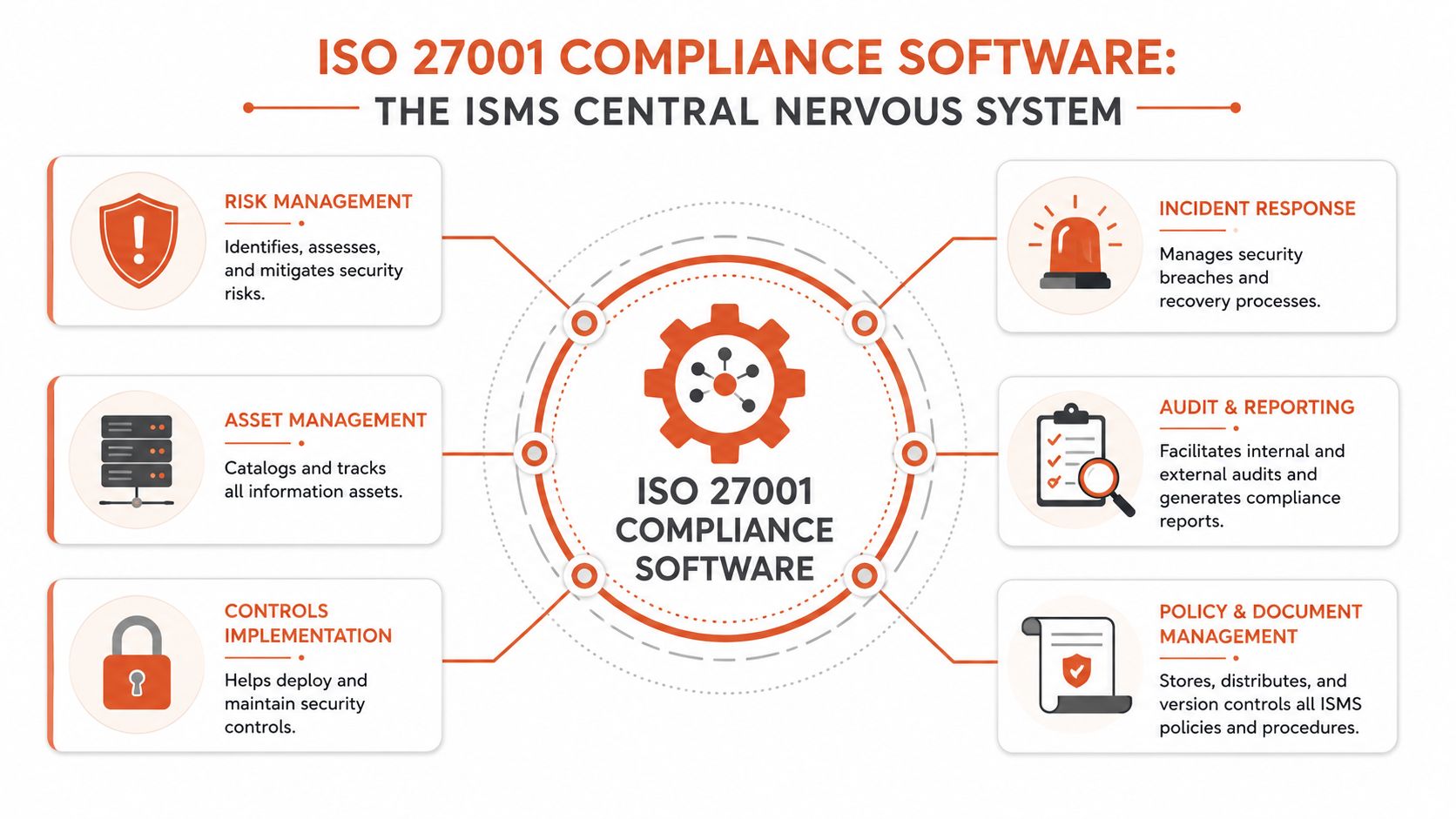
ISO 27001 compliance software is the operational layer that connects your policies, risks, controls, assets, and evidence into one system. It's not just a document store and it isn't useful if it behaves like another isolated GRC portal that engineering ignores. For a technical organisation, it should function more like the control plane for the ISMS.
Instead of asking teams to maintain separate spreadsheets for risk registers, policy versions, audit evidence, and control status, the software creates one source of truth. When that's done well, auditors can trace a control to an owner, then to supporting evidence, then to the workflow that produced it. Engineering doesn't need to stop every sprint to reconstruct the story manually.
Think of it as operational memory
A manual setup behaves like a team navigating cloud security with scattered notes. Someone knows where the IAM review lives. Someone else knows which repository contains deployment rules. A third person remembers the last incident review. That works until people change roles, the company scales, or the auditor asks for evidence spanning multiple systems.
Compliance software gives you structure:
- Policies and documents stay versioned and reviewable.
- Risks and controls can be linked instead of tracked in separate files.
- Evidence stays tied to the source activity that generated it.
- Audits become retrieval exercises rather than archaeology.
Good compliance software doesn't replace engineering judgment. It removes the repetitive work that makes engineering resent compliance.
Why this matters to fast-moving product teams
For startups and scale-ups, the value isn't abstract governance. It's fewer interruptions. When platform automation is done properly, developers aren't asked to become part-time evidence clerks. They work through normal pipelines and environments, and the system records the facts around access, deployment, logging, review, and change.
That aligns with how modern teams already want to operate. European startups implementing automated DevOps infrastructure achieve a 40-60% reduction in setup time, provisioning a new production environment in 30 minutes instead of the 3 days required for manual work, based on automated DevOps infrastructure data. The same principle applies to compliance. If platform work is automated, evidence collection can ride along with it.
What it should not become
A lot of compliance tooling fails because it adds process without removing labour. If engineers still need to export logs, copy screenshots into tickets, and update status by hand, the software is acting as a reporting burden, not a control system.
The right model is simple. Delivery workflows, access controls, environment segregation, logging, and policy enforcement should feed the compliance layer automatically. When that happens, the software stops being a side project and becomes part of how the company runs.
Core Capabilities That Replace Manual Engineering Work
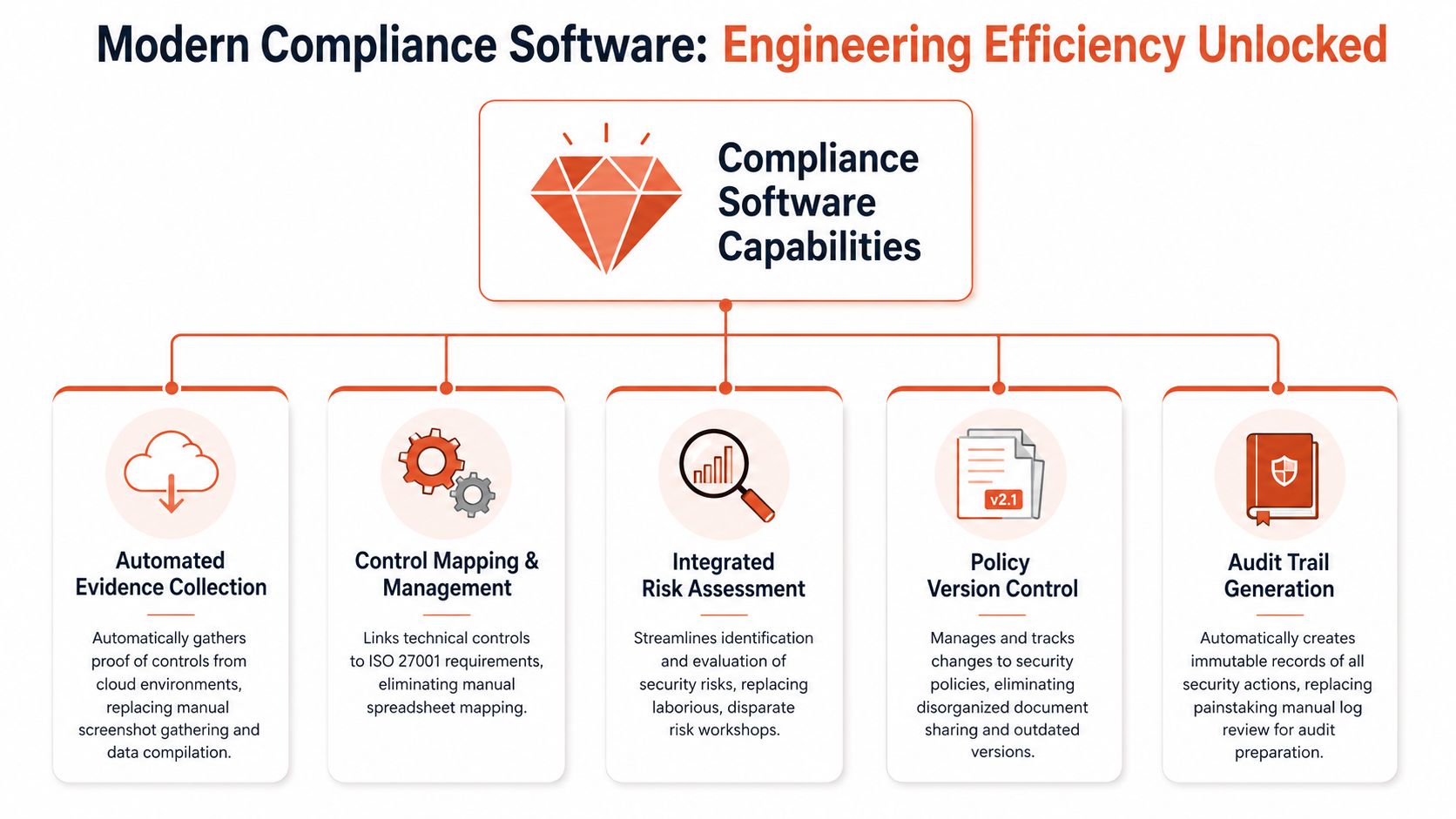
The useful way to evaluate compliance software is to ask one question repeatedly: what manual engineering task does this remove? If the answer is vague, the feature is probably decoration.
Control mapping that engineers can live with
Control mapping sounds administrative until you do it by hand. Someone has to connect technical practices to Annex A controls, keep that mapping current, and explain why one control is satisfied by several systems and one system supports several controls. In spreadsheets, this turns into stale cross-references and duplicated interpretations.
A good system maps controls to actual technical sources. Repository settings, deployment approvals, access policies, logging configurations, and change records should all point back to control statements. That gives security and engineering a shared view of what exists and what is still weak.
Evidence collection from live systems
This is a capability often underestimated. Auditors don't care that your team is busy. They care whether evidence is complete, traceable, and current.
Manual evidence collection usually looks like this:
- Screenshots from consoles
- CSV exports from cloud tools
- Ticket links pasted into spreadsheets
- Slack approvals with no durable context
That process breaks under scale, especially in multi-cloud environments where state changes constantly. Evidence should come directly from AWS, GCP, Azure, source control, CI/CD systems, and observability tooling. It should arrive time-stamped, linked to the control it supports, and stored without requiring engineers to stop delivery work.
Policy and document control
Organizations often think they have policy management because they have documents. They don't. They have files.
Real policy control means version history, ownership, review cycles, and a clean relationship between the written rule and the technical enforcement behind it. If your password policy says one thing while your identity platform enforces another, the software should make that mismatch obvious.
Risk management with technical context
Risk registers often fail because they're written once for the audit and then ignored. Engineering leaders need risk entries tied to systems, owners, and mitigation work. If a cloud configuration issue affects production access, the remediation should sit near the evidence and the control status, not in a detached spreadsheet.
That's also where adjacent practices matter. Teams thinking about behavioural detection and insider risk often benefit from reading about managing internal threats with AI, because control evidence is stronger when detection and response are tied back to real operating signals instead of policy statements alone.
The best compliance records are generated during normal work, not recreated at quarter end.
Audit trails that survive real scrutiny
Audit trails must answer basic questions fast. Who changed what? When? Under which approval path? In which environment? Was the change reviewed? Was access appropriate?
If your platform can't answer that without pulling engineers into side conversations, you don't have an audit trail. You have logs. Compliance software becomes valuable when it turns those logs into retrievable, contextualised records that support the ISMS instead of overwhelming it.
Choosing Your Compliance Path DIY vs Software vs Platform
Most leadership teams evaluating ISO 27001 land in one of three models. They either keep using general-purpose tools and scripts, buy standalone compliance software, or adopt a broader platform approach where compliance is built into delivery and infrastructure operations.
The decision looks tactical at first. It isn't. It changes how much engineering time gets redirected away from product.
Compliance Management Approach Comparison
| Attribute | DIY (Spreadsheets & Scripts) | Standalone Compliance Software | Integrated DevOps Platform (e.g., PushOps) |
|---|---|---|---|
| Engineering overhead | High. Engineers and security leads maintain scripts, exports, and manual mappings | Moderate. Some workflow improves, but integrations often need manual upkeep | Lower. Delivery workflows and controls can produce evidence as part of normal operations |
| Initial setup effort | Looks low at first, then expands as audits require structure | Moderate, with process design still needed | Moderate, but operational and compliance setup are aligned from the start |
| Audit readiness | Reactive. Teams assemble proof near the audit date | Better for documentation and workflow tracking | Stronger when platform events, access, logs, and deployments are already captured |
| Multi-cloud scaling | Fragile. Every cloud and tool adds another manual path | Depends on connector depth | Better fit when AWS, GCP, and Azure are part of the same operating model |
| Ongoing maintenance | Continuous script and process drift | Ongoing admin plus tool integration management | More centralised if the platform owns environments, pipelines, and enforcement |
| Developer experience | Interruptive. Product work pauses for evidence requests | Mixed. Better than DIY, but can still feel separate from delivery | Better when self-service workflows and compliance guardrails live together |
Why DIY is usually the most expensive choice
Teams often call the DIY route “free” because they already pay for Jira, Confluence, cloud tools, and source control. That overlooks the actual cost. The spend shows up in diverted engineering hours, delayed releases, brittle internal scripts, and repeated audit preparation work.
Companies using a “free” DIY DevOps approach face average hidden annual expenses of $300,000 due to lost developer productivity, delayed features, and security risks, according to this analysis of the hidden cost of DIY DevOps. That number is credible because the hidden work compounds in ordinary places: pipeline maintenance, environment drift, access review clean-up, and compliance evidence collection.
The trade-off most teams miss
Standalone compliance software can improve control tracking and audit workflow. It often helps security teams first. But if the software sits beside the delivery stack rather than inside it, engineering still ends up doing translation work. Someone must connect the technical event to the compliance record.
An integrated platform changes that equation. Instead of asking developers to prove after the fact what happened in CI/CD, environments, and access management, the platform records those events as they happen. That's the difference between buying a compliance tool and adopting a cloud operating model that naturally supports compliance. For teams comparing that broader approach, this overview of a DevOps cloud infrastructure platform is useful because it frames compliance as a consequence of platform design, not a separate project.
Automating Evidence from Cloud and CI CD Pipelines
The hardest part of ISO 27001 in modern engineering organisations isn't writing policies. It's proving, continuously, that the controls are operating in live systems without forcing people to export data manually.
That's why evidence automation matters. It closes the gap between what your team does and what the auditor can verify.
A practical workflow from commit to evidence
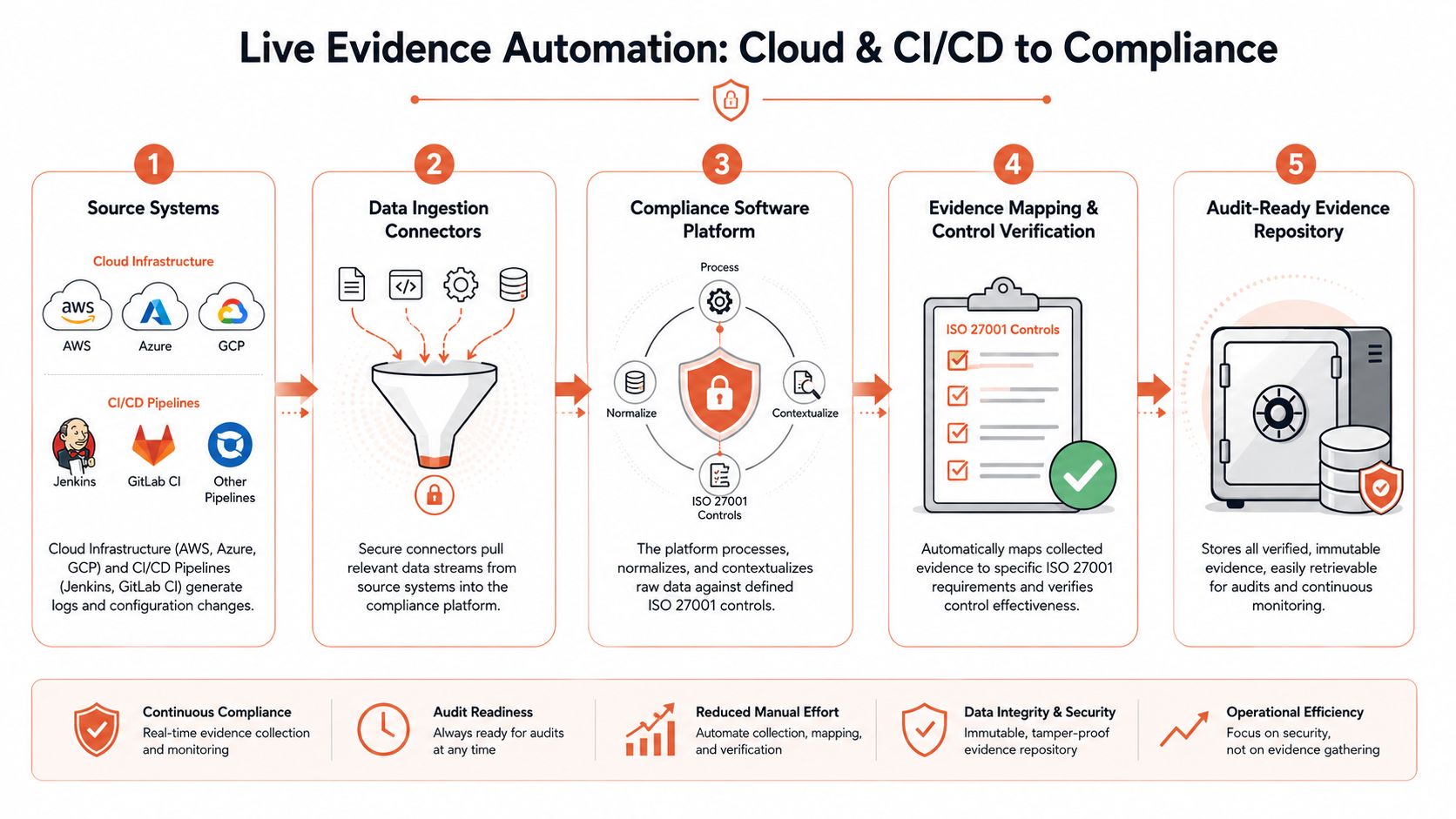
Start with a normal developer action. A developer commits code to Git and opens a merge request. The CI/CD system builds the artefact, runs the defined checks, and prepares deployment through the approved path.
Now the compliance layer should do work in parallel.
Capture the source event
The commit, author, branch protection state, review approvals, and pipeline trigger become part of the record.Evaluate the build and repository controls
Secure repository management needs to be visible in the evidence. Branch protections, permissions, and workflow rules should be linked to the relevant controls.Verify environment separation
The deployment target matters. Development, testing, and production need to stay separated in a way the system can prove, not merely describe.Store time-stamped deployment evidence
Deployment logs, approver identity, runtime destination, and policy checks should enter an immutable evidence trail.Map that evidence to the control set
The team shouldn't need to manually attach every event to a spreadsheet row. The system should know which controls the workflow supports.
Why Annex A controls matter in pipeline design
Annex A Control 8.25 (Secure Development Life Cycle) mandates secure repository management and separation of development, testing, and production environments, which are often cited by European regulators like Lithuania's NKSC as baseline requirements that must be enforced via automation, as outlined in the ISO 27001 standard reference. For cloud-native teams, that requirement is concrete. It affects repositories, pipeline rules, environment boundaries, and release procedures.
If your compliance process relies on engineers copying evidence out of secure systems, you've introduced a second risk while trying to prove the first control.
What good automation looks like
In practice, strong evidence automation does a few things well:
- It reads directly from systems of record. Cloud accounts, source control, deployment tools, and logging platforms should be connected natively.
- It preserves context. A deployment log without the related change, approval path, and environment target is only partial evidence.
- It avoids manual exports. Teams shouldn't need to copy entire datasets out of secure systems just to satisfy audit readiness.
- It stays current. Evidence should reflect live operations, not a monthly batch of screenshots.
An operational platform offers superior performance to disconnected tooling. If the same system manages build paths, deployments, environment boundaries, and release mechanics, evidence can be captured as a by-product of delivery. Teams looking at this from the pipeline angle should review how zero-maintenance CI/CD pipelines change the evidence problem. Less pipeline sprawl means fewer places where compliance records can break.
Multi-cloud makes manual proof worse
AWS, GCP, and Azure all expose the signals you need, but not in one consistent workflow. If your company runs across clouds, evidence gathering by hand becomes slower and more error-prone. A modern platform should normalise those records so the auditor sees one control narrative, not three cloud-specific interpretations.
That's the operational win. You don't slow down delivery to become compliant. You design delivery so that compliant behaviour leaves durable evidence automatically.
Common Pitfalls in Adopting Compliance Software
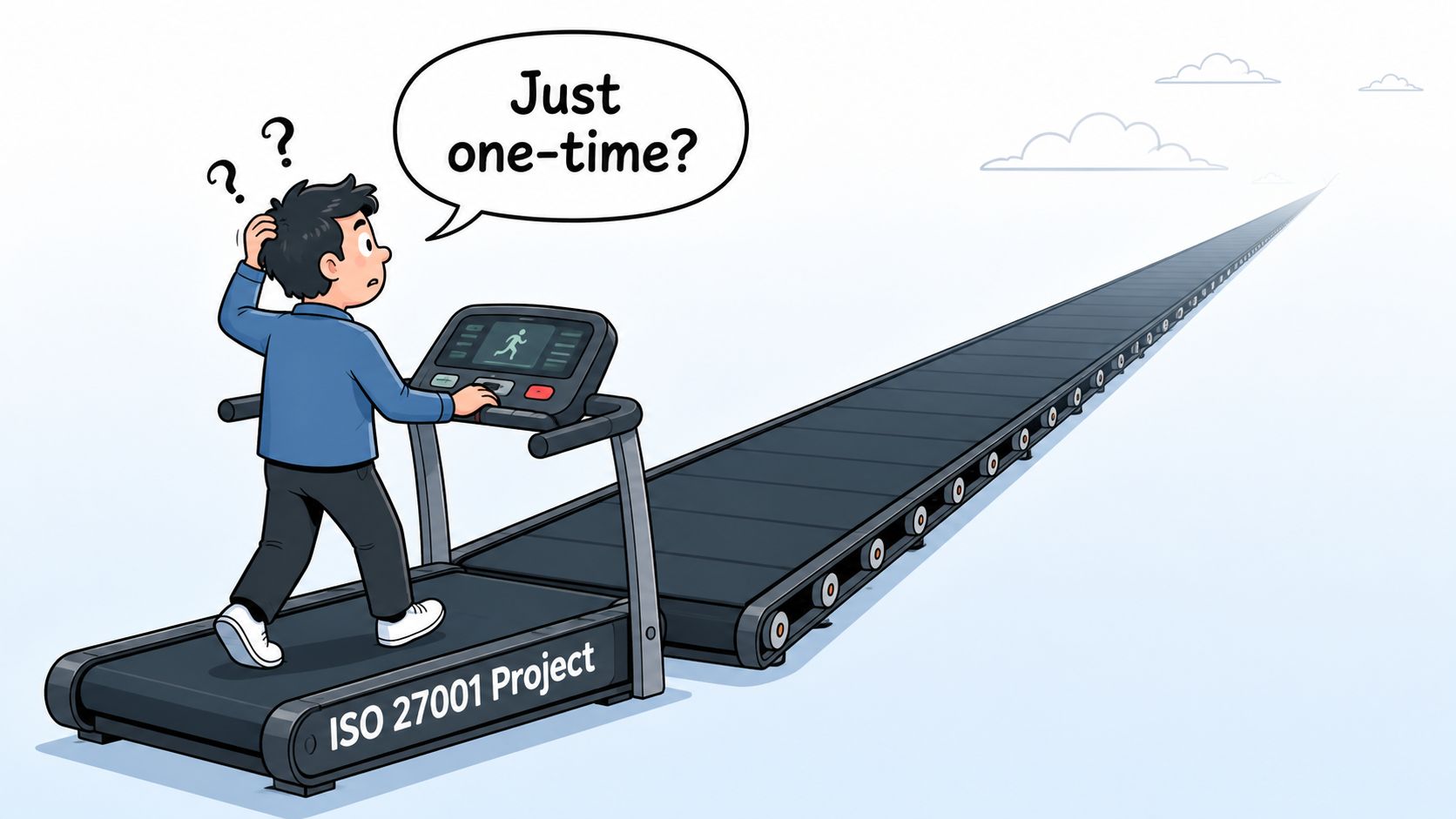
The biggest mistake is treating ISO 27001 as a project with an end date. Teams sprint towards certification, document everything once, pass the audit, and then drift back into normal delivery habits. The software becomes a repository of old decisions instead of a live operating system.
That pattern shows up later in surveillance audits. Data indicates that 68% of organisations fail year-2 surveillance audits due to incomplete documentation of control ownership and status updates, according to this ISO 27001 questionnaire guide. The problem usually isn't a missing policy. It's stale ownership, unclear status, and weak evidence continuity.
Pitfall one, disconnected tooling
A tool that doesn't connect cleanly to your engineering workflow creates more admin. If developers need to update one system for delivery and another for compliance, the compliance system loses first. People skip it until audit season.
Pitfall two, ownership without enforcement
A named control owner isn't enough. The software needs to make status visible and force routine review. Otherwise ownership becomes ceremonial. Someone is listed, but nobody updates the control after changes in architecture, staffing, or cloud usage.
Pitfall three, buying shelf-ware
Some teams buy a product because it demos well to security leadership, then never embed it into how engineering works. That leads to manual backfilling, low trust in evidence quality, and a familiar complaint that compliance software creates work instead of removing it.
Continuous compliance only works when the same workflows that run production also feed the control record.
The practical fix is straightforward. Choose software that fits your actual stack, captures evidence from live systems, and keeps ownership current without depending on memory. If the process still depends on quarterly clean-up efforts, the implementation isn't finished.
Frequently Asked Questions About ISO 27001 Software
Can't we just use Jira and Confluence
You can use them for parts of the process. They're useful for tickets, decisions, and documentation. They're weak as a compliance system because they don't guarantee evidence integrity, control mapping, or direct collection from cloud and pipeline events. You still need a durable way to connect technical facts to controls.
Does compliance software guarantee we'll pass the audit
No. Software improves structure, traceability, and evidence quality. It doesn't replace a working ISMS, clear ownership, or sensible scope. Auditors still assess whether controls are appropriate and operating in practice.
Is standalone software enough for engineering-led teams
Sometimes, but only if it integrates thoroughly with the way your teams build and deploy. If it sits outside the delivery path, engineers still end up doing manual translation work.
Can one system support multiple frameworks
Yes, if it maps one technical control to several frameworks. That matters for scale-ups moving into regulated markets or dealing with customer security questionnaires. The primary benefit is operational reuse. You validate the control once, then reuse the evidence across standards where the mapping makes sense.
If your team is spending more time maintaining infrastructure, pipelines, and compliance evidence than shipping product, it's worth looking at PushOps. It provides a production-ready cloud platform across AWS, GCP, and Azure, automates deployments and environments, and enforces security defaults such as role-based access, policy enforcement, and audit logs. For engineering leaders, the practical value is simple. Fewer bespoke scripts, less platform maintenance, and a cleaner path to continuous audit readiness.

