
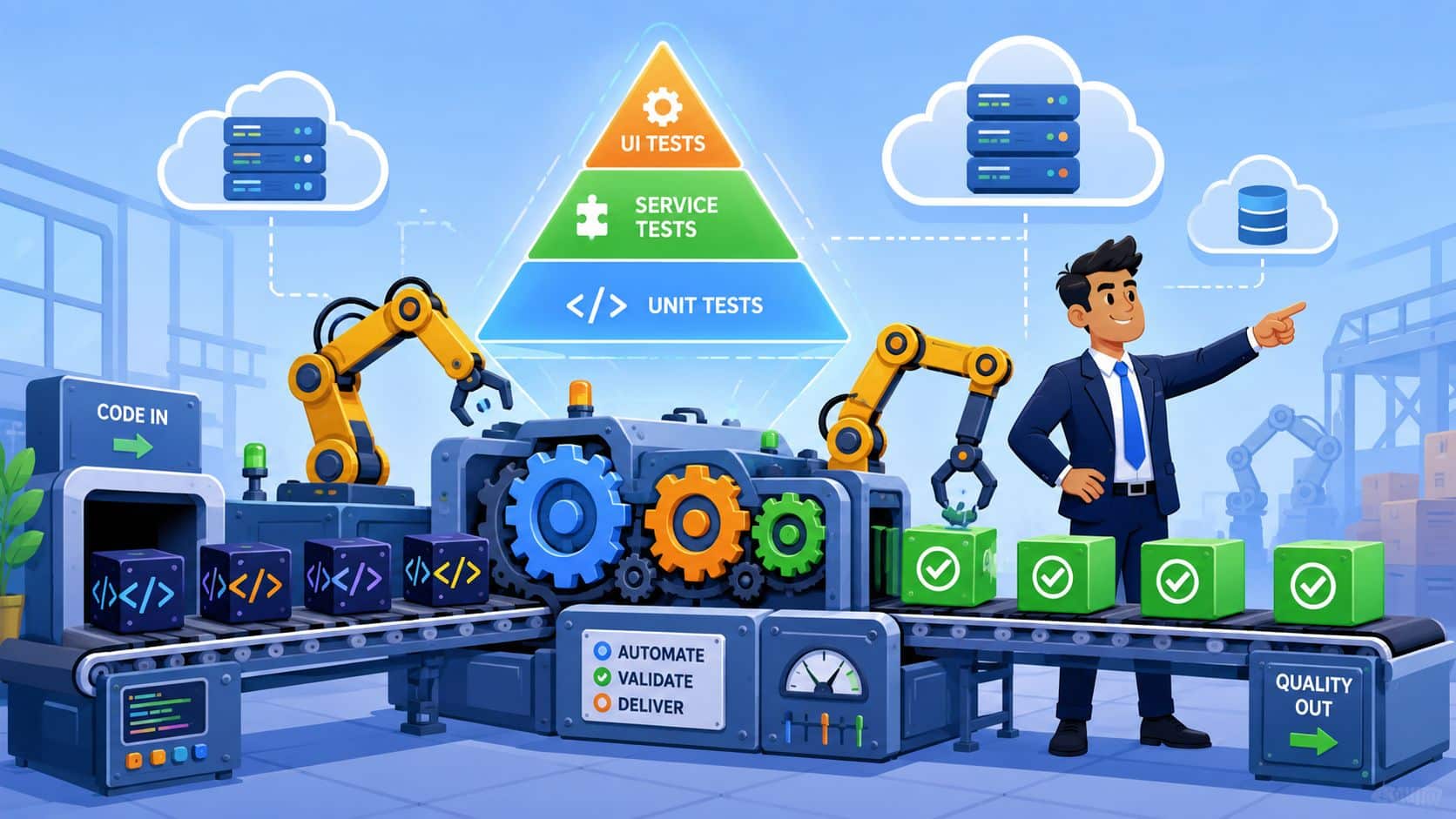

Your team is probably living this already. A pull request looks clean, CI is green on one branch, red on another, and a release that should take minutes stretches into hours because one end to end test fails for no reproducible reason. The test itself gets blamed first. Then the framework. Then QA. But in most startups and scale-ups, the underlying fault line sits underneath the tests.
Test automation only looks like a scripting problem from a distance. Up close, it's an infrastructure problem wrapped in a quality problem. If environments drift, pipelines are brittle, secrets are handled inconsistently, and ephemeral test systems are expensive to run, even well-written tests turn into operational drag.
That's why many CTOs, VP Engineering leaders, and senior developers across Europe, Singapore, the UK, and the US feel stuck. They set out to ship faster, but instead they end up maintaining Kubernetes clusters, tuning CI runners, patching observability gaps, reviewing IAM policies, and chasing cloud spend. The product roadmap slows down while internal platform work steadily expands.
Beyond Bug Hunts Test Automation as a Delivery Engine
A familiar pattern plays out late in the day before a release. A team has merged the final changes, the deployment window is open, and the pipeline stalls on a flaky regression test. Someone reruns the job. It passes. The release goes out, but nobody feels confident because the signal from the suite is weak.
That's not a testing success. It's a delivery system failure.
Test automation should sit in the centre of software delivery, not at the edges as a QA afterthought. The value isn't just catching bugs. The value is shortening feedback loops, protecting release confidence, and letting developers merge and deploy without dragging half the engineering organisation into a war room.
Where teams usually get it wrong
Teams often focus first on writing scripts. They choose Selenium, Playwright, Cypress, or a mix of tools. They debate page objects, fixtures, and assertion styles. Those choices matter, but they're not the main determinant of whether automation helps or hurts.
The hard part is running those tests reliably, at the right stage, against the right environment, with stable dependencies and clean rollback paths.
Flaky tests rarely start as flaky code. They usually start as unstable systems.
When leadership treats test automation as a test authoring exercise, the suite grows but trust declines. Developers stop believing failures. Product managers hear “pipeline issue” too often. Release cadence drops because nobody wants to bet the launch on a stack they can't explain.
Why this has become a business issue
Companies aren't investing in test automation because it sounds modern. They're doing it because delivery speed and confidence now directly shape revenue, customer retention, and engineering efficiency. The Mordor Intelligence automation testing market report projects the global test automation market will grow from $40.44 billion in 2026 to $78.94 billion by 2031, and notes that 25% of companies reported immediate ROI after adoption.
That's the upside. The catch is that ROI appears quickly only when the delivery engine around the tests is dependable.
A better way to frame the problem
The useful question isn't “How many tests do we have?” It's “Can our delivery system give developers fast, reliable feedback without creating more operational work than product progress?”
If the answer is no, the bottleneck isn't a lack of scripts. It's the platform underneath them.
The Test Automation Landscape From Units to End to End
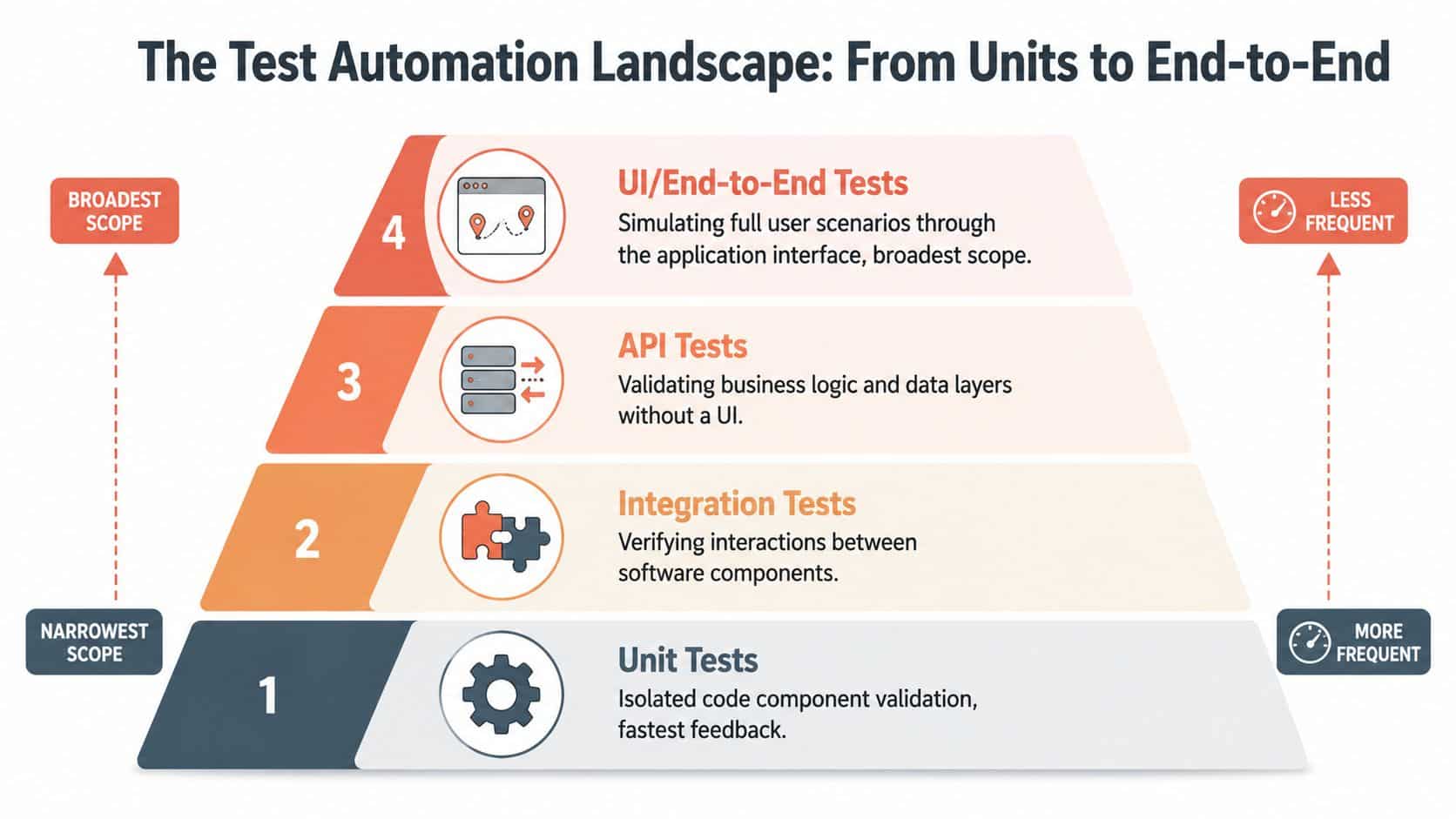
Not all tests do the same job, and treating them as interchangeable is one of the fastest ways to build a slow pipeline. Good test automation is a portfolio. Each layer protects a different kind of risk, with different cost and speed trade-offs.
Unit tests
Unit tests are the cheapest feedback you can buy. They check a small piece of code in isolation, like testing a single spark plug before putting it into an engine. If a validation method, pricing function, or permission rule breaks, unit tests should catch it before anything reaches a shared environment.
They matter because developers can run them constantly. When a team skips this layer and leans on browser tests instead, every defect becomes more expensive to find.
Integration and API tests
Integration tests check whether components work together. Think of them as testing whether the brakes, steering, and dashboard still communicate after assembly. They usually catch issues around databases, queues, external services, and contract mismatches.
API tests sit near this layer and often give better value than teams expect. They validate business logic and data flows without the cost of driving a browser. For many SaaS products, a lot of release risk lives here.
A practical way to use them:
- Integration tests for boundaries: Verify service-to-service behaviour, persistence, and event handling.
- API tests for workflows: Cover checkout, user provisioning, billing, and permissions without a UI dependency.
- Shared contracts for stability: Keep schemas and payload expectations explicit so downstream breakage is obvious.
UI and end to end tests
These tests simulate real user journeys across the application interface. They're the full road test. They answer the question executives care about most: can a user sign up, log in, pay, upgrade, or complete the task that drives value?
They're also the easiest layer to overuse. Browser automation is slow, sensitive to timing, and vulnerable to environment inconsistencies. That doesn't make it optional. It means it needs restraint.
Use end to end tests to protect the handful of journeys that would block a release. Don't use them to compensate for weak unit or API coverage.
What high-performing teams do differently
A lot of organisations have already moved meaningful work from manual testing into automation. The Testlio test automation statistics roundup states that 46% of organisations have replaced 50% or more of manual testing efforts with automation, and that 78% of high-performing teams use agile or DevOps methodologies for test automation initiatives, compared with 54% of general enterprises.
That gap matters because automation works best when it's built into delivery, not bolted on afterwards.
Some teams also use AI support to reduce triage overhead around failures, especially in fast-moving repos. Tools such as Hermes AI agent can help engineering teams organise and interpret repetitive signals around incidents and workflow bottlenecks, which is often more useful than adding yet another dashboard.
Building a Winning Test Automation Strategy
A strong test strategy isn't a diagram for a slide deck. It's a cost model. Every test you add has a price in execution time, maintenance effort, and trust. The best teams design that portfolio deliberately instead of accumulating tests one release at a time.
Read the pyramid as a budget
The test pyramid is often explained as a quality concept. Leadership should read it as a spending decision.
At the bottom, unit tests are usually fast to run and cheap to maintain. In the middle, integration and API tests cost more but protect important seams. At the top, UI and end to end tests give broad coverage but consume the most operational energy per test. They need more setup, more data coordination, more waiting, and more debugging.
If most of your coverage sits at the top, your testing estate becomes expensive even before cloud bills enter the picture.
What an inverted pyramid looks like in practice
You can usually spot it without opening a dashboard. Developers hesitate to merge late in the day. CI queues grow during busy periods. Release branches collect “temporary” test skips. Teams rerun jobs until they pass, which destroys the meaning of green.
A common pattern looks like this:
- Too few unit tests: Small regressions slip through and reach slower suites.
- API coverage is thin: Teams use the browser to verify business rules that should be checked lower down.
- End to end coverage explodes: Every feature gets another UI path, whether it deserves one or not.
- Ownership gets fuzzy: QA writes many tests, but developers still own most code changes, so failures bounce between teams.
Build for signal, not for volume
More tests don't automatically mean better safety. Better signal does.
A practical portfolio usually has a broad base of developer-owned unit tests, a focused layer of integration and API tests for service behaviour, and a narrow set of end to end tests around critical user journeys. That shape improves two things at once. Developers get faster feedback on routine changes, and release managers get stronger confidence from a smaller, more meaningful UI suite.
Practical rule: every browser test should defend a business-critical flow or a regression class you can't cheaply catch lower in the stack.
The operational consequence leaders often miss
Even the best strategy fails if the infrastructure can't support it. Different suites need different run times, data states, environment guarantees, and provisioning patterns. A unit test suite can tolerate shared runners. Integration and UI tests usually can't. Once teams try to enforce that consistently across multiple repos and clouds, the strategy becomes an operations challenge.
That's where many in-house efforts start to sag. The architecture on paper is sensible. The system running it is not.
The Real Cost of Test Automation The DIY DevOps Tax
The most expensive part of test automation usually isn't Playwright, Selenium, or the QA engineer writing assertions. It's everything required to make those tests run reliably at scale. That's the DIY DevOps tax, and many startups pay it for years before admitting it exists.
A team starts with good intentions. They wire up CI, build a Kubernetes-based runner strategy, add secrets management, create preview environments, configure observability, and bolt on security controls. Each individual decision sounds reasonable. Together, they become an internal platform programme.
Where the tax shows up
The spend is rarely concentrated in one invoice, which is why it gets underestimated.
- People costs: A typical startup can spend $9,600 on a basic 90-day DevOps consulting engagement, according to Acquaint Soft's DevOps budget breakdown. That same source notes direct cloud cost savings in that period often offset only part of the spend. Separately, Fullstack Techies' managed DevOps provider overview says most startups spend $3,000 to $7,000 per month on a managed DevOps retainer.
- Cloud waste: Idle environments, overprovisioned runners, and peak-capacity assumptions push costs up fast. Redu Cloud's startup hosting analysis warns that startups overprovisioning compute, storage, and bandwidth for peak loads can double or triple monthly cloud costs.
- Engineering focus: Senior developers end up owning platform glue instead of product delivery. That opportunity cost doesn't appear on a cloud bill, but it's very real.
Why DIY gets harder as the company grows
The first version of a home-built stack often feels efficient. Then the business adds compliance requirements, multiple environments, more services, stricter release windows, and expansion across AWS, GCP, or Azure. Suddenly the “simple” CI setup needs branch isolation, audit trails, role-based controls, deployment policies, environment scheduling, and cost guardrails.
That's not side work. It's a platform product, and platform products need owners.
For teams evaluating whether to keep building internally, developer platform automation is worth understanding as a category. The key shift is moving from bespoke scripts and internal conventions to a standardised delivery layer that developers can use without operating it themselves.
DIY DevOps vs managed platform for test automation
| Factor | DIY DevOps Stack | Managed Platform (PushOps) |
|---|---|---|
| Environment setup | Built and maintained internally with custom scripts and manual fixes | Standardised provisioning and environment workflows |
| CI/CD upkeep | Pipelines need regular patching as tools, repos, and cloud services change | Pipeline logic is abstracted into a maintained platform |
| Security controls | Teams stitch together permissions, auditability, and policy checks | Security is enforced by default through built-in controls |
| Observability | Separate tooling for logs, metrics, alerting, and incident handling | Unified operational visibility inside the delivery workflow |
| Cloud cost control | Teams manually tune scaling and shut down idle resources | Cost optimisation is built into environment and scaling behaviour |
| Developer experience | Developers wait on platform specialists or tribal knowledge | Self-service workflows reduce operational dependency |
The strategic mistake
The most common leadership error is assuming hiring one more DevOps engineer will solve this permanently. It might reduce pain for a quarter. It rarely changes the shape of the problem. Internal stacks accumulate complexity faster than teams can remove it.
If your engineers spend more time maintaining delivery plumbing than improving delivery speed, the stack is no longer serving the business.
Scaling Automation with CI/CD and Dynamic Environments
The hardest part of scaling test automation isn't writing another suite. It's making sure every suite runs in an environment that behaves predictably. When developers test against one setup, CI runs against another, and staging drifts from production, failure signals become noisy and teams lose confidence.
This is why “flaky” often means “environment-dependent”.
Environment drift breaks otherwise good automation
A browser test may pass locally because the service version, feature flags, seed data, and network behaviour are stable on a developer machine. The same test fails in CI because a dependency was upgraded in one environment but not another, or because shared runners create timing contention.
That pattern gets worse in multi-cloud setups. Different base images, storage behaviour, network defaults, and provisioning paths introduce small inconsistencies that compound over time.
The Mabl automation strategy article highlights the scale of the problem: teams using Infrastructure-as-Code can reduce setup time by 40 to 60% and cut regression failures caused by configuration drift by 25%, yet 68% of teams still report automation breaking because of environment inconsistencies across AWS, GCP, and Azure.
What Infrastructure-as-Code actually solves
Infrastructure-as-Code gives teams a way to define environments declaratively with tools such as Terraform or Ansible. That matters because test reliability depends on repeatability. If the platform can provision the same software versions, dependencies, network settings, and supporting services every time, test outcomes become more trustworthy.
It also changes the economics of testing:
- Faster setup: Fresh environments can be created on demand instead of maintained permanently.
- Cleaner isolation: Test runs don't collide as often because they don't need to share mutable state.
- Lower waste: Environments can be torn down after use instead of sitting idle all week.
Manual orchestration versus platform-driven orchestration
A manual approach usually grows by layers. One team scripts environment creation. Another team adds CI templates. A third adds branch previews. Then someone has to manage secret rotation, image updates, failed teardown jobs, and inconsistent rollback logic.
That's manageable in one cloud with a small estate. It becomes brittle across multiple clouds.
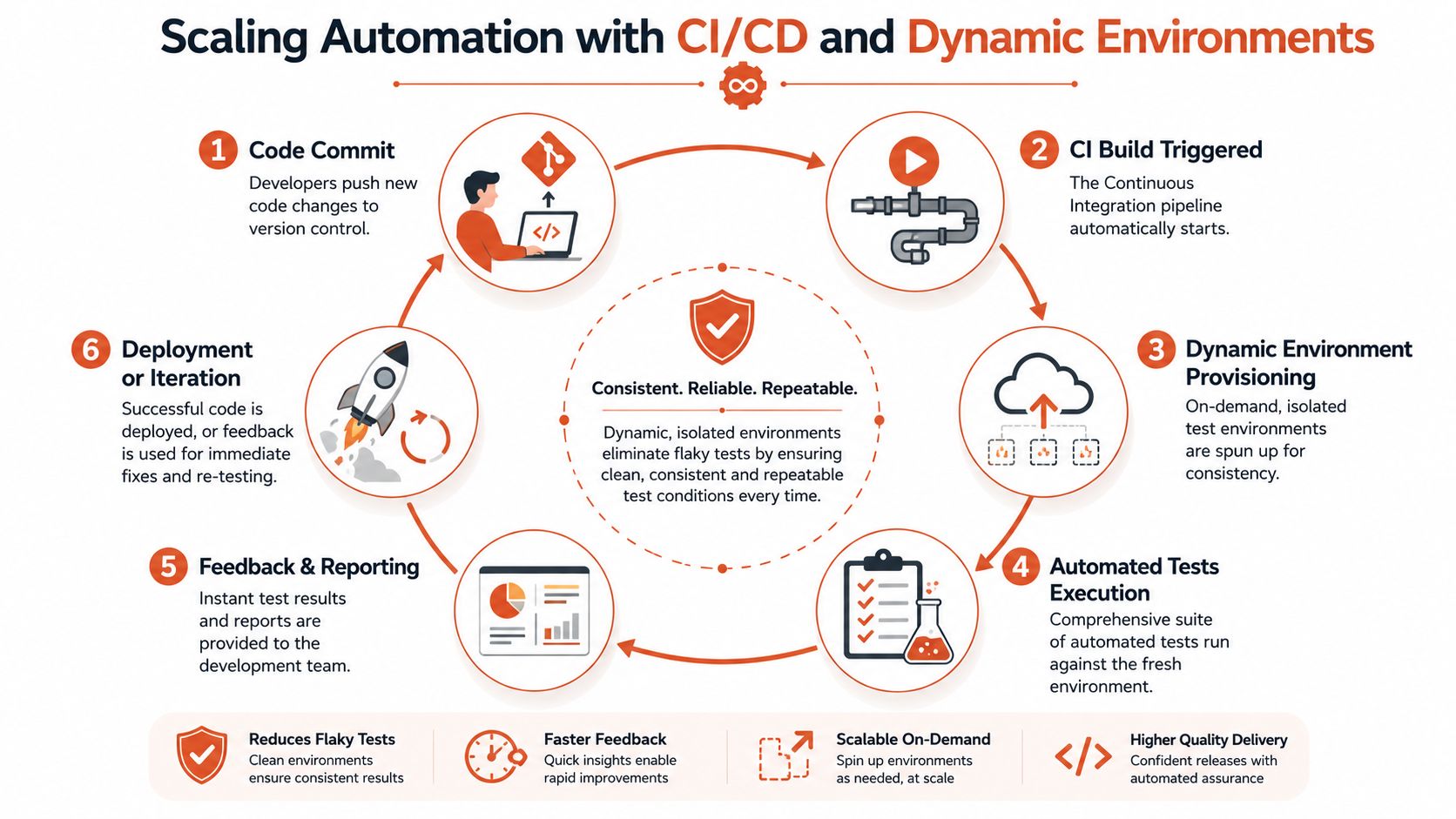
A platform-driven approach does the opposite. The workflow is standardised:
- A developer pushes code.
- CI starts automatically.
- A clean test environment is provisioned for that change.
- The relevant suites run in the right order.
- Results flow back quickly to the team.
- The environment is removed or promoted depending on the outcome.
That's the operational model many teams want, but very few want to maintain themselves over time.
For leaders trying to remove this maintenance burden, zero-maintenance CI/CD pipelines captures the principle well: the pipeline should serve developers without becoming a parallel engineering product that needs constant repair.
A visual example helps. This is the kind of workflow teams aim for when they want reliable, repeatable release automation.
What works and what usually fails
What works is boring consistency. Standard environment definitions. Explicit test stages. Predictable teardown. Built-in observability. Scheduled non-production environments. Autoscaling rules that match test demand. Security defaults that don't rely on a spreadsheet of exceptions.
What fails is custom glue. Hand-built runners with tribal ownership. Shared test environments that everybody mutates. Pipelines nobody wants to touch because every fix risks breaking releases.
Reliable test automation needs a controlled runtime, not just a good framework.
For startups and scale-ups, that distinction matters because infrastructure work expands gradually. One more cluster, one more queue, one more monitoring rule, one more secret scope. Before long, the platform intended to support product velocity becomes the thing slowing it down.
Measuring What Matters Test Automation ROI and Key Metrics
Many automation programmes struggle when leadership asks a simple question: what did we gain? Teams usually answer with counts. Number of tests. Pass rate. Defects found. Those metrics are easy to collect and weak at explaining business value.
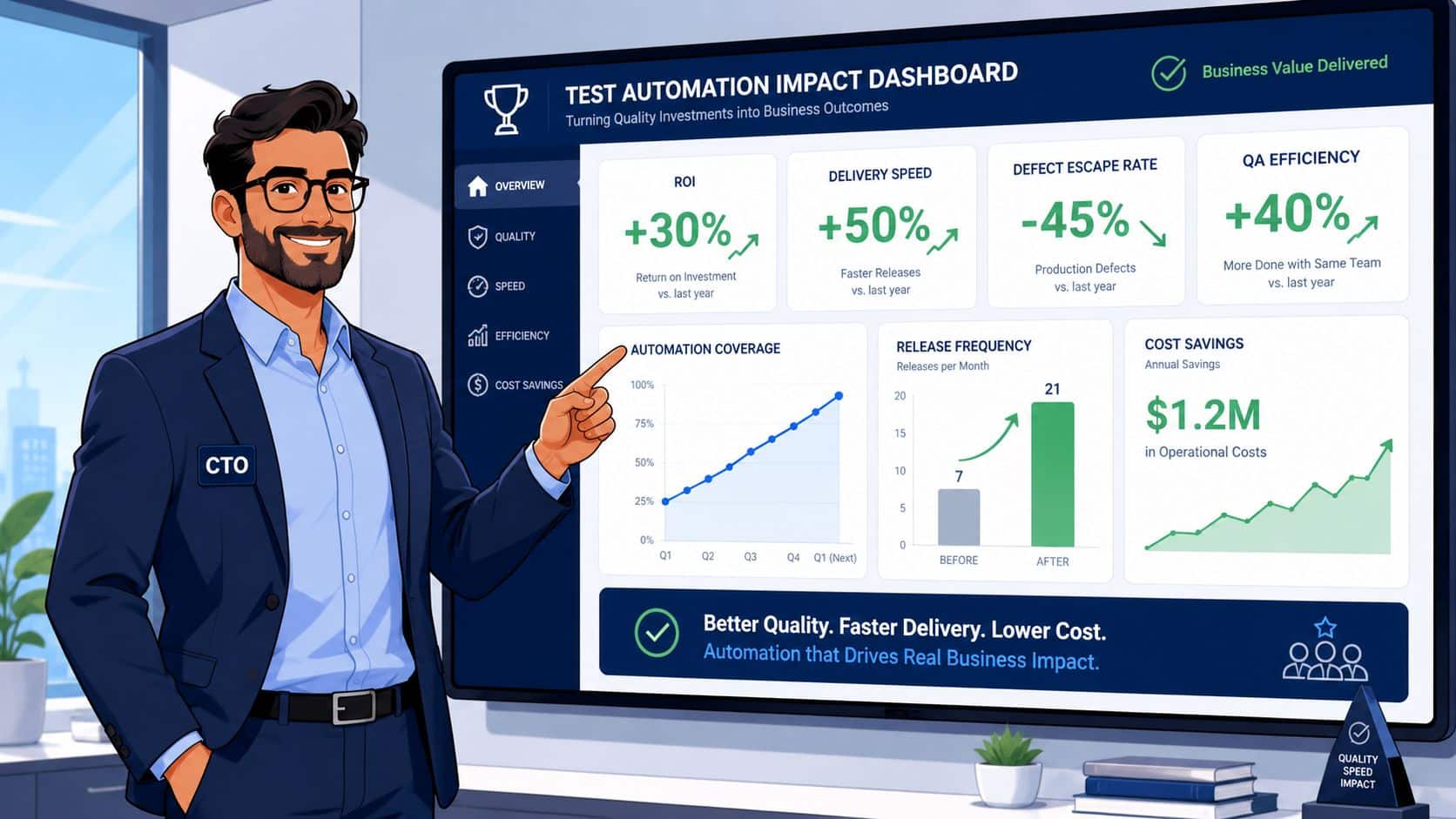
The better lens is delivery performance.
Start with delivery outcomes
If test automation is healthy, four things should improve over time:
- Deployment frequency: teams should be able to release more often with less ceremony
- Lead time for changes: code should move from commit to production with less waiting
- Change failure rate: fewer releases should create incidents or urgent rollback work
- Mean time to recovery: when something does go wrong, teams should isolate and fix it faster
Those metrics speak to executives because they connect directly to speed, risk, and operational resilience. A bloated suite with poor signal often makes these worse, even if test counts rise.
Track maintenance overhead explicitly
A second metric matters just as much and far fewer teams monitor it carefully: test maintenance overhead. If your engineers spend most of their time fixing brittle scripts instead of adding coverage for new behaviour, automation has turned into drag.
The TestDevLab analysis of high-impact automation gaps reports that 72% of teams struggle to quantify the value of automation, while 65% of organisations spend more time maintaining existing scripts than creating new tests.
That should change how leaders evaluate automation health. A suite that catches issues but absorbs excessive maintenance time may still be a bad investment.
A practical measurement model
Use a lightweight operating review rather than a giant reporting exercise.
- Compare release speed before and after key automation investments: focus on cycle time and deployment friction.
- Review failure quality, not just failure quantity: ask whether failed tests point to real product issues or platform noise.
- Separate script maintenance from new coverage work: if maintenance dominates, investigate environment stability and suite design.
- Map incidents back to test gaps: identify whether escaped defects came from missing coverage, poor sequencing, or inconsistent environments.
Good automation reduces decision time. Teams know faster whether to merge, hold, deploy, or rollback.
Why platform visibility matters
Measuring ROI gets harder when CI, infrastructure, cloud cost data, observability, and deployment history all live in separate systems. Teams then spend extra effort assembling dashboards instead of improving outcomes.
An integrated delivery platform changes that by surfacing build behaviour, environment usage, release health, and operational signals in one place. That doesn't make the metrics easier because they're flashy. It makes them easier because the underlying workflow is already connected.
From Fragile Scripts to a Resilient Delivery Platform
By the time a team feels pain from test automation, the issue usually isn't a missing framework feature. It's accumulated operational burden. The suite depends on fragile environments, the pipeline needs constant repair, and cloud costs rise because nobody has time to tame the infrastructure behind the tests.
That's why the actual goal was never just more automation. The goal is resilient delivery.
What durable teams optimise for
Durable teams want a delivery system that developers trust and leadership can scale. That means stable environments, fast feedback, sensible test distribution, visible costs, and security controls that don't require constant manual policing. It also means reducing bespoke operational work so engineering time stays close to customer value.
When teams tighten bug handling and release discipline together, the result is much stronger than test coverage alone. For teams refining the reporting side of that process, Halo AI's latest bug guide is a useful companion read because poor bug reports can waste just as much engineering time as poor tests.
The build versus operate decision
Many companies can build a functional internal stack. Fewer can keep operating it cleanly as they add products, regions, compliance requirements, and multiple cloud targets. At that point, delivery stops being a tooling question and becomes an operating model question.
A strong automated deployment pipeline matters because it turns release mechanics into a repeatable system instead of a collection of team-by-team scripts.
The teams that move fastest are rarely the ones with the most custom infrastructure. They're the ones that have removed the most operational friction between code commit and safe production release.
PushOps helps software teams replace fragile, bespoke delivery infrastructure with a production-ready multi-cloud platform across AWS, GCP, and Azure. If your engineers are spending too much time on CI/CD upkeep, environment management, monitoring, security controls, and cloud cost tuning instead of shipping features, PushOps is worth a look.

