
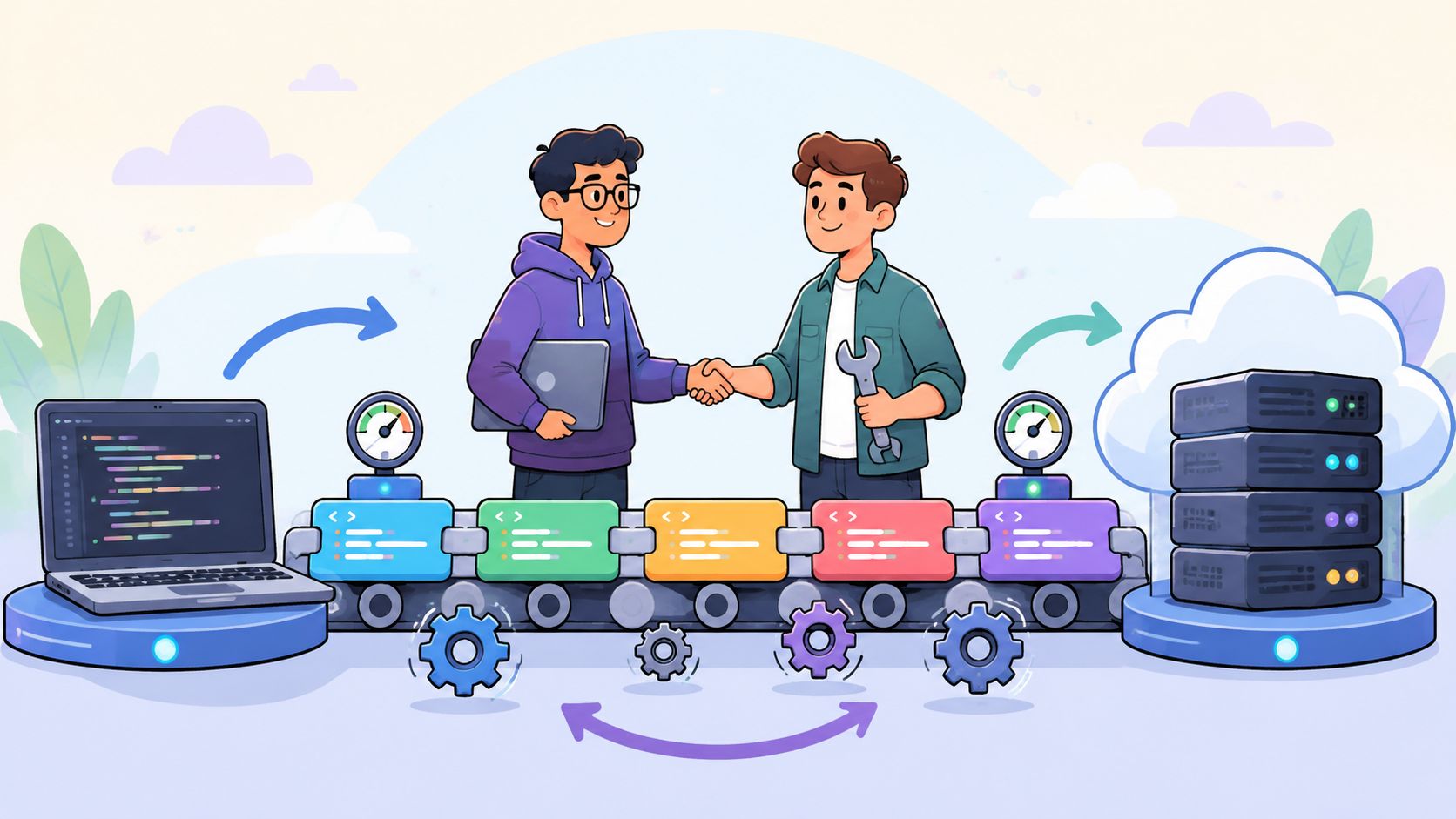
Your team didn't hire strong engineers so they could spend their week fixing broken CI jobs, tuning Kubernetes manifests, stitching together monitoring, and debating whether a failed deploy was a pipeline issue, a cloud policy issue, or a container issue. Yet that's where many startups and scale-ups end up.
That tension sits at the heart of what is DevOps. In theory, DevOps helps teams ship software faster and more reliably. In practice, many organisations translate it into “build an internal platform ourselves”, then watch product engineers drift into infrastructure work that doesn't differentiate the business. For CTOs, VP Engineering, and senior developers in Europe, Singapore, the UK, and the US, the question isn't whether delivery needs to improve. It's whether building and maintaining your own stack is the smartest way to get there.
What Is DevOps Beyond the Buzzwords
DevOps is not a job title, a Kubernetes cluster, or a CI/CD toolchain. It's a way of organising software delivery so development and operations work toward the same outcome: shipping useful changes quickly, safely, and repeatedly.
At its best, DevOps reduces the drag between writing code and running it in production. Teams automate repetitive work, standardise environments, shorten feedback loops, and make reliability part of delivery instead of a separate phase. That matters when your engineers should be building product, not babysitting infrastructure.
In many companies, though, the practical experience looks different. Developers own application code but still get pulled into Helm charts, Terraform drift, secrets handling, alert noise, cost anomalies, and deployment failures. Operations or platform teams try to help, but they often become a bottleneck because every environment request, pipeline fix, and production change flows through a small group of specialists.
What DevOps actually means in practice
A pragmatic definition is this:
DevOps is a business strategy for delivering software with less friction between build, release, operations, and recovery.
That strategy usually includes shared ownership, automation, observability, and fast rollback or recovery paths. It also means recognising that every layer you build yourself becomes something you have to maintain.
For leaders deciding whether to expand internal capability or simplify delivery, it helps to understand the trade-off between hiring to patch gaps and reducing the number of gaps in the first place. If you still need to recruit infrastructure cloud talent, that can solve an immediate staffing problem. It doesn't remove the long-term burden of owning the stack.
Why this matters now
European teams are heavily involved in this shift. Europe dominated the global DevOps market in 2025 with the largest share of 30.9%, signalling strong movement toward cloud-based, automated deployment pipelines instead of manual in-house infrastructure work, according to Straits Research's DevOps market analysis.
That doesn't mean every company should assemble its own platform from raw parts. It means the pressure to modernise is real. A more useful question is whether your team needs more tooling to manage, or a clearer operating model with fewer moving parts. A concise explanation of that platform-first approach is covered in this DevOps cloud infrastructure platform explainer.
From Siloed Teams to Continuous Delivery
DevOps didn't appear because the industry wanted a new label. It emerged because the old model produced slow releases, brittle handovers, and constant friction between the people who wrote software and the people who had to keep it running.
Under the older delivery model, development was rewarded for shipping changes and operations was rewarded for stability. That split sounds sensible until release day arrives. Then one team wants speed, the other wants caution, and neither side owns the full outcome.
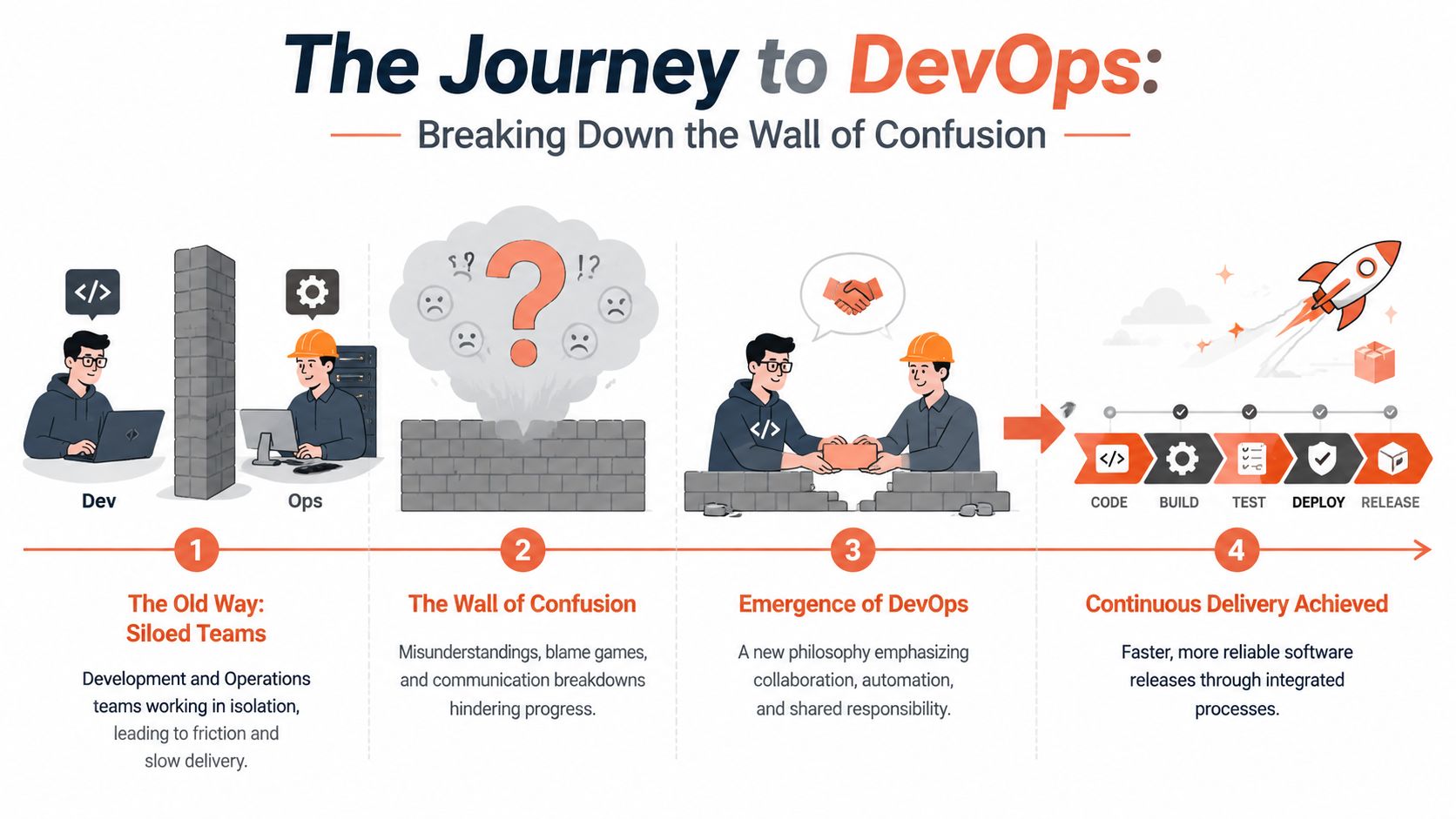
The wall that slowed everyone down
Most senior engineers have seen some version of this pattern:
- Development throws work over the wall and assumes operations will deploy it.
- Operations adds controls and approvals because unstable releases hurt uptime.
- Testing arrives late so integration issues show up at the worst moment.
- Release risk compounds because changes batch together instead of moving in small increments.
That isn't just a process problem. It's a business problem. Features take longer to reach customers, failures become harder to isolate, and teams burn expensive time coordinating instead of building.
The moment the industry changed
The term and movement took shape in response to that pain. DevOps officially emerged in 2007 when Patrick Debois highlighted the inefficiencies caused by the separation between software development and IT operations. The movement was further catalysed in 2009 at the O'Reilly Velocity Conference, where John Allspaw and Paul Hammond presented “10+ Deploys per Day: Dev and Ops Cooperation at Flickr,” showing that communication and collaboration could enable daily deployments and reduce failure rates, as outlined in this history of DevOps.
The key lesson from that history is still relevant. DevOps wasn't born as an infrastructure trend. It was a response to delivery failure.
When teams share responsibility for getting code into production and keeping it healthy, release speed stops fighting operational stability.
Why the history still matters
A lot of current confusion comes from forgetting that origin. Companies adopt cloud tools, container platforms, and deployment pipelines, then wonder why they still feel slow. Often they've copied the tooling but kept the same hand-offs, approval chains, and ownership gaps.
That's why mature teams aim for continuous delivery, not just automated deployment steps. They reduce the organisational friction that made releases painful in the first place. Tools matter. But the tools only help when the operating model changes with them.
The Core Principles That Drive DevOps Success
If you strip away vendor language and job-title inflation, DevOps rests on a few durable ideas. The most useful shorthand is CAMS: culture, automation, measurement, and sharing.
Most organisations start with the second item. They buy tools, wire up pipelines, and expect speed to appear. That's usually where the disappointment begins.
Culture comes first
The hardest part of DevOps isn't Jenkins, GitHub Actions, ArgoCD, Terraform, or Kubernetes. It's getting teams to behave like they own the same outcome.
When developers can ship code but don't feel responsible for operability, alerts, rollback safety, or runtime cost, operations inherits the mess. When operations controls production but lacks context on product priorities, delivery slows down. Good DevOps closes that gap with shared incentives and clear ownership.
Research shows that 62% of organisations that adopt DevOps tools still fail to achieve expected velocity improvements because they neglect the required cultural shift, and that having an automated pipeline is not DevOps but rather one output of the practices around it, according to Anthony Elmore's analysis.
Practical rule: if two teams can each say “that isn't our problem”, you don't have DevOps yet.
Automation should remove toil, not add ceremony
Automation matters because manual release work doesn't scale. Build steps, environment provisioning, testing, deployment checks, and rollback paths should be consistent and repeatable.
But automation can turn into overhead when teams bolt together too many components. A pipeline that requires plugin maintenance, custom scripts, exceptions, and tribal knowledge may be automated on paper while still consuming engineering time every week.
Useful automation has three traits:
- It's boring to run because the common paths are standardised.
- It's easy to debug because failure points are visible.
- It reduces specialist dependency so developers aren't blocked on one platform expert.
Measurement keeps the conversation honest
Without measurement, every delivery discussion becomes opinion. One team says releases are fast enough. Another says incidents are too frequent. Finance says cloud costs are drifting. Nobody has a shared baseline.
In DevOps, measurement isn't there to decorate a dashboard. It tells you whether the system helps teams move safely or just feels complex.
Sharing prevents local optimisation
Sharing is the least glamorous CAMS element, but it's often where strong organisations pull ahead. Knowledge about deployments, failure modes, cloud patterns, and recovery procedures can't live in one engineer's head or one team's wiki folder.
A healthy DevOps culture shares runbooks, templates, defaults, and lessons from incidents. That's how teams avoid rebuilding the same answer five times in slightly different ways.
Essential DevOps Practices and Their Hidden Costs
The core DevOps practices are familiar. CI/CD, infrastructure as code, automated testing, observability, and DevSecOps all make sense. Most leaders don't need convincing that these practices matter. They need a realistic view of what it costs to build and maintain them well.
CI/CD speeds delivery, until the pipeline becomes a product
Continuous integration and continuous deployment shorten the path from code commit to production. Done properly, they reduce waiting, catch issues earlier, and make releases less dramatic.
There's also a measurable impact. Organisations that implement CI/CD practices experience a 50% reduction in lead time for changes, according to Market Research Future's DevOps services report.
That's the upside. The hidden cost appears when the pipeline itself becomes an internal product. Teams start maintaining Jenkins controllers, GitHub Actions runners, GitLab CI templates, plugin updates, secrets rotation, branch policies, runner capacity, and flaky deployment logic. Every fix steals time from product work.
If your team is tired of maintaining that layer, this zero-maintenance CI/CD pipelines explainer outlines what it looks like when the pipeline stops being another engineering project.
Infrastructure as code is good discipline, but it creates operational ownership
Terraform, Pulumi, and cloud-native templates improve consistency. They make infrastructure reviewable and repeatable. They also create a codebase that someone must understand, test, secure, and evolve.
That's manageable for a focused platform team with clear scope. It becomes expensive when application engineers inherit module design, provider upgrades, state issues, environment drift, and cloud-specific edge cases across AWS, GCP, and Azure.
A short decision view helps:
| Practice | Benefit | DIY burden |
|---|---|---|
| CI/CD | Faster, safer releases | Pipeline maintenance, runner ops, security updates |
| IaC | Repeatable environments | State management, module upkeep, cloud expertise |
| Observability | Faster diagnosis | Tool sprawl, alert tuning, dashboard ownership |
| DevSecOps | Earlier risk detection | Policy management, exceptions, developer friction |
Observability and security are where DIY stacks sprawl
Observability sounds straightforward until you're paying for multiple logging, metrics, tracing, and alerting systems while engineers still struggle to answer basic questions during an incident. Security has a similar pattern. Teams add scanners, admission policies, role controls, audit tooling, and compliance checks, then discover that each control needs tuning and ownership.
None of that means you shouldn't invest in these practices. It means you should be honest about whether your company wants to operate a DevOps platform or use one.
The wrong test isn't “can we build this?”. It's “should our product team still be supporting this a year from now?”
For many scale-ups, a managed multi-cloud setup is the practical middle path. It gives teams production-ready environments, release automation, monitoring, default security controls, and cloud cost management across AWS, GCP, and Azure without turning platform maintenance into the main engineering workload. In that category, PushOps is one option. It provisions infrastructure and automates deployments, environments, observability, and cost controls so developers can stay closer to feature work.
How to Measure DevOps Performance and Structure Teams
If you can't measure delivery, you can't improve it. If you can't define team boundaries, you'll hire expensive specialists into overlapping roles and still have confused ownership.
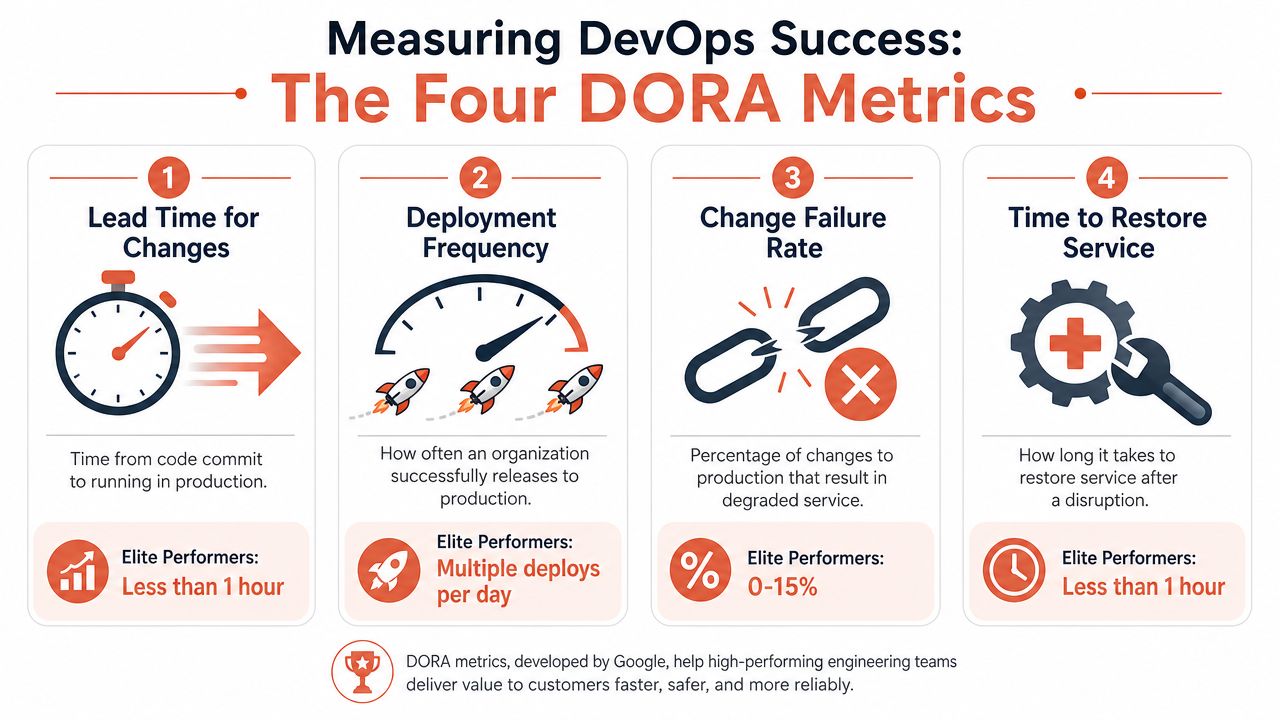
The cleanest way to evaluate DevOps performance is through the DORA metrics. They focus attention on speed and stability instead of vanity measures.
Start with lead time and recovery
Among the metrics, lead time for changes is especially useful because it reveals how much friction exists between coding and customer value. Mature teams achieve lead time in hours, typically less than 1 hour, while medium or low-performing teams take days to weeks. High-performing teams also maintain a mean time to recover of approximately 5 minutes, whereas sub-par teams experience recovery times spanning several hours, according to Splunk's overview of DevOps metrics.
The four metrics to track are:
- Lead time for changes. Time from commit to production.
- Deployment frequency. How often you release successfully.
- Change failure rate. How often a release causes degraded service.
- Time to restore service. How quickly the team recovers after disruption.
These metrics work because they expose trade-offs. If deployment frequency rises but failure rate also rises, you haven't improved the system. You've just increased the pace of mistakes.
Don't blur DevOps, SRE, and platform engineering
A second source of confusion is role design. Leaders often hire a “DevOps engineer” when they need a mix of delivery automation, reliability engineering, and internal platform design.
A more useful distinction looks like this:
| Role | Primary focus | Typical concern |
|---|---|---|
| DevOps | Delivery speed and flow | How code moves to production |
| SRE | Reliability and incident response | How services behave under failure |
| Platform Engineering | Developer self-service | How teams consume infrastructure safely |
When organisations lump all three together, one person ends up responsible for pipelines, uptime, cloud governance, on-call quality, templates, and developer experience. That's not a role. It's a backlog.
A startup rarely needs three separate specialist teams. It needs a delivery system that gives developers guardrails without forcing them to become part-time platform operators.
For many scale-ups, the practical answer is not “hire more niche roles immediately”. It's to give product teams a platform that already handles common reliability, deployment, and self-service patterns. Then you add specialist depth only where the business needs it.
Overcoming DevOps Adoption Hurdles
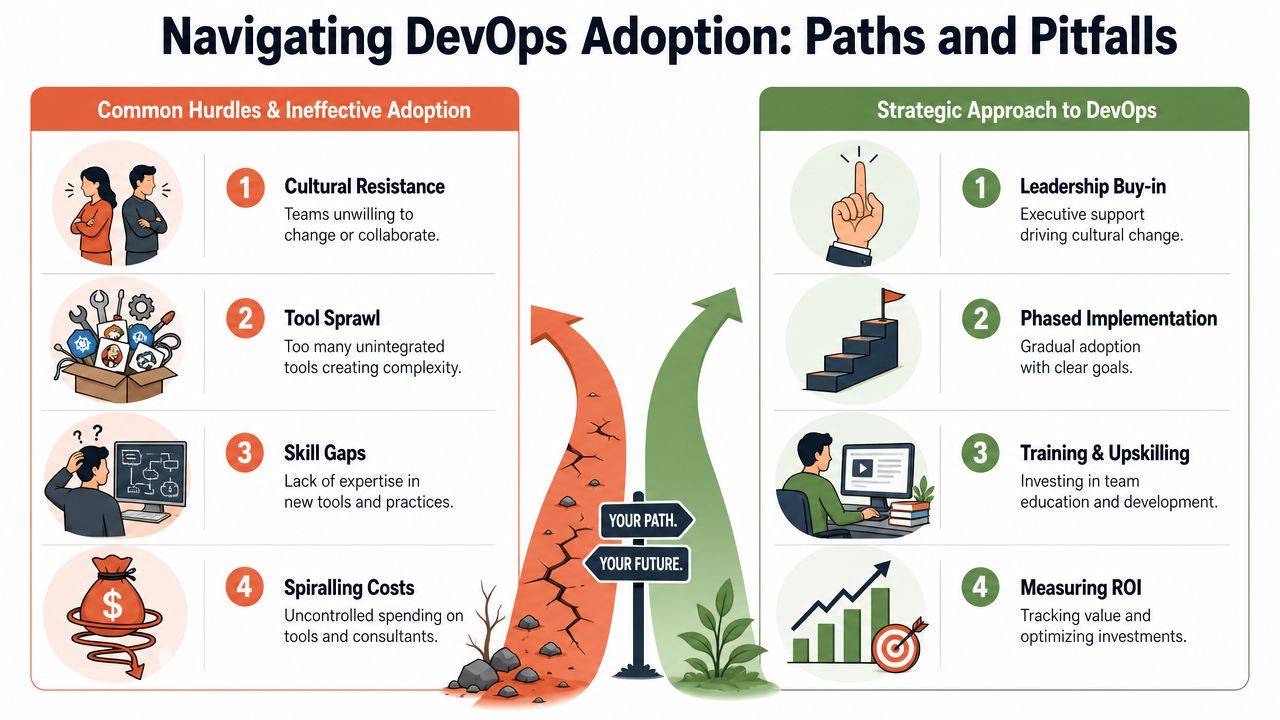
Most DevOps adoption stalls for ordinary reasons. Teams resist process change. Tooling sprawls. Skills are uneven. Costs rise before benefits are visible. None of that is unusual. What matters is whether leadership chooses a path that reduces complexity or compounds it.
The DIY path
The do-it-yourself route usually starts with good intentions. A company wants control, flexibility, and lower long-term dependency on vendors. So it assembles a stack from cloud services, open-source tools, and internal scripts.
That path often includes:
- Building a platform team to own CI/CD, infrastructure templates, secrets, observability, and security controls.
- Evaluating and integrating tools across source control, build runners, deployment orchestration, monitoring, logging, policy, and cost visibility.
- Writing custom glue code because the tools don't line up cleanly out of the box.
- Supporting it indefinitely through upgrades, breakages, cloud changes, and new compliance requirements.
The direct spend is substantial. Transitioning from a traditional development model to DevOps incurs direct costs between $100,000 and $500,000, with a significant portion allocated to culture transformation and training rather than only software tools, according to RapDev's cost analysis of DevOps transformation.
That number matters less as a budgeting line and more as a reminder that the work isn't just technical. The operating model, skills, and team habits all have to change.
The platform path
The alternative is to treat DevOps as a capability you consume through a unified platform instead of assembling each layer yourself.
That approach usually looks like this:
- Connect your cloud accounts across AWS, GCP, or Azure.
- Adopt standard deployment workflows instead of custom per-team logic.
- Use built-in observability and security defaults rather than stitching separate systems together.
- Give developers self-service access within clear guardrails.
This path doesn't remove the need for engineering discipline. It removes a large chunk of undifferentiated engineering work.
Which path makes sense
If your company's edge is infrastructure itself, building in-house may be justified. Some organisations need deep customisation, unusual compliance controls, or a platform that is central to the product.
Most scale-ups aren't in that category. They need reliable environments, safe releases, strong monitoring, and predictable cloud spend. They don't need to turn those needs into a multi-year internal platform programme.
The mistake isn't using DevOps. The mistake is assuming DevOps requires maximum ownership of every layer.
Focus on Your Product Not Your Pipelines
The useful answer to what is DevOps isn't “a set of tools” or “a team we need to hire”. It's a method for getting product changes into customers' hands with less friction and less operational drama.
That means culture matters. Clear ownership matters. Metrics matter. But so does restraint. A company can fully believe in DevOps principles and still decide that maintaining Kubernetes internals, CI runners, observability plumbing, security policy wiring, and cloud cost controls is not where its engineers create the most value.
The strategic question leaders should ask
Ask one blunt question: is your engineering team's highest-value contribution building deployment machinery, or building the product your customers pay for?
For many teams, the answer becomes obvious once the internal platform backlog grows faster than the product backlog. At that point, adding more DevOps engineers may solve the symptom while preserving the structure that caused it.
A better operating model often combines strong delivery discipline with a managed platform that handles the routine infrastructure work. That leaves your team free to focus on releases, feedback, and roadmap execution. If you're trying to align engineering effort with business priorities, this piece on building a strategic product roadmap is a useful companion read. For a more direct view of reducing platform toil, this developer platform automation explainer shows how self-service delivery can work without the usual maintenance burden.
DevOps should help your team ship. It shouldn't become the thing your team ships.
If your developers are spending too much time on pipelines, cloud setup, monitoring, security wiring, and cost control, PushOps is worth evaluating. It provides a managed multi-cloud platform for AWS, GCP, and Azure that provisions production-ready infrastructure, automates deployments and environments, and includes observability, security defaults, and cost optimisation so teams can stay focused on building product.

